Results by title
81 books match the query 'Revolutions, Uprisings & Rebellions' and 3 start with a non-letter
1777
The Year of the HangmanJohn S. Pancake
University of Alabama Press, 1977
No one who has read the history of the War of Independence can fail to be fascinated by the campaign of Gentleman Johnny Burgoyne. The story evokes pictures in the mind's eye: scarlet-coated Englishmen; the green and blue uniforms of the German mercenaries; the flash of brass and silver and steel accoutrements; the swarms of Indians in their war paint; the whole moving through the green forests or sailing the blue waters of lakes and rivers. Even the names have a lyrical tone: Richelieu, Champlain, Oriskany, Ticonderoga, and La Chine.
Part of this fascination is the fact that the fate of the expedition marked a turning point in the history of the war. It is not surprising that there has been a host of chroniclers, scholars, and novelists, and those who fall in a category somewhere between because their artistry bridges the gaps that footnoted facts cannot, and so allows some scope for imagination (and may teach more history than the rest).
This fascination was partly responsible for Pancake’s exploration of this particular part of the history of the war. There was also the fact that no scholar since Hoffman Nickerson in his Turning Point of the Revolution (1926) has attempted a detailed study of the British invasion from Canada, although there has been a vast amount of literature on specific aspects of the campaign. No study to date has attempted to link the Canadian expedition to the concurrent operation of General Sir William Howe in Pennsylvania in such a way as to present a complete story of the campaign of 1777. From the point of its inception and launching by the American Secretary, Lord George Germain, to the point where it was reduced to a shambles at the end of the year.
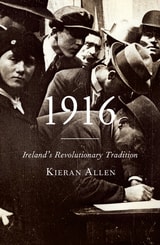
1916
Ireland's Revolutionary TraditionKieran Allen
Pluto Press, 2016
In 1916, Kieran Allen argues that this pivotal moment in Irish history has been obscured by those who see it only as a prelude for a war of independence. Emphasizing an often ignored social and political radicalism at the heart of the rebellion, he shows that it gave birth to a revolutionary tradition that continues to haunt the Irish elite. Socialist aspirations mixed, and sometimes clashed, with the republican current, but both were crushed in a counterrevolution that accompanied the Anglo-Irish treaty of 1921. The result today is a partitioned Ireland that acts as a neoliberal tax haven for multinational corporations—a state of affairs quite alien to both Connolly’s and Pearse’s vision.
Published to coincide with the Rising’s centennial, 1916: Ireland’s Revolutionary Tradition re-establishes the political role of socialist republican figures, offers a highly accessible history of the Easter Rising, and explores the militancy and radicalism that continues to haunt the Irish elite one hundred years later.
1989
Revolutionary Ideas and IdealsKrishan Kumar
University of Minnesota Press, 2001
In 1989, from East Berlin to Budapest and Bucharest to Moscow, communism was falling. The walls were coming down and the world was being changed in ways that seemed entirely new. The conflict of ideas and ideals that began with the French Revolution of 1789 culminated in these revolutions, which raised the prospects of the "return to Europe" of East and Central European nations, the "restarting of their history," even, for some, the "end of history." What such assertions and aspirations meant, and what the larger events that inspired them mean-not just for the world of history and politics, but for our very understanding of that world-are the questions Krishan Kumar explores in 1989.
A well-known and widely respected scholar, Kumar places these revolutions of 1989 in the broadest framework of political and social thought, helping us see how certain ideas, traditions, and ideological developments influenced or accompanied these movements-and how they might continue to play out. Asking questions about some of the central dilemmas facing modern society in the new century, Kumar offers critical insight into how these questions might be answered and how political, social, and historical ideas and ideals can shape our destiny.
Contradictions Series, volume 12