Results by title
3064 books match the query 'Social conditions' and 10 start with a non-letter
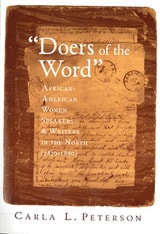
"Doers of the Word"
African-American Women Speakers and Writers in the North (1830-1880)Peterson, Carla L
Rutgers University Press, 1998
In situating these women within the emerging African-American urban communities of the free North, Doers of the Word provides an important counterweight to the vast scholarship on Southern slavery and argues that black "Civil Rights movements" cannot be seen as a purely modern phenomenon. In particular, the book examines the ways in which this Northern black population, despite its heterogeneity, came together and established social organizations that would facilitate community empowerment; yet Peterson's analysis also acknowledges, and seeks to explain, the highly complex relationship of black women to these institutions, a relationship that rendered their stance as public intellectuals all the more bold and defiant.
Peterson begins her study in the 1830s, when a substantial body of oratory and writing by black women first emerged, and traces the development of this writing through the shifting political climate up to the end of Reconstruction. She builds her analyses upon Foucault's interdisciplinary model of discourse with an explicitly feminist approach, drawing upon sermons, spiritual autobiographies, travel and slave narratives, journalism, essays, poetry, speeches, and fiction. From these, Peterson is able to answer several key questions. First, what empowered these women to act, to speak out, and to write? Why, and in what ways, were they marginalized within both the African-American and larger American communities? Where did they act, speak, and write from?
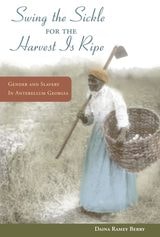
"Swing the Sickle for the Harvest is Ripe"
Gender and Slavery in Antebellum GeorgiaDaina Ramey Berry
University of Illinois Press, 2010
"Swing the Sickle for the Harvest Is Ripe" compares the work, family, and economic experiences of enslaved women and men in upcountry and lowland Georgia during the nineteenth century. Mining planters' daybooks, plantation records, and a wealth of other sources, Daina Ramey Berry shows how slaves' experiences on large plantations, which were essentially self-contained, closed communities, contrasted with those on small plantations, where planters' interests in sharing their workforce allowed slaves more open, fluid communications. By inviting readers into slaves' internal lives through her detailed examination of domestic violence, separation and sale, and forced breeding, Berry also reveals important new ways of understanding what it meant to be a female or male slave, as well as how public and private aspects of slave life influenced each other on the plantation.
A volume in the series Women in American History, edited by Anne Firor Scott, Susan Armitage, Susan K. Cahn, and Deborah Gray White
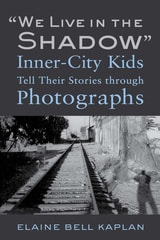
"We Live in the Shadow"
Inner-City Kids Tell Their Stories through PhotographsElaine Bell Kaplan
Temple University Press, 2013
Looking at their photo of railroad tracks, a group of preteen students in South Central Los Angeles see either "a way out of the ghetto," or a "dirty, bad environment." Such are the impressions expressed in the poignant "We Live in the Shadow": Inner-City Kids Tell Their Stories through Photographs.
In Elaine Bell Kaplan's perceptive book, at-risk youth were given five-dollar cameras to tell stories about their world. Their photos and stories show us their response to negative inner-city teen images. We follow them into their schools, and we hear about their creative coping strategies. While these kids see South Central as dangerous, they also see themselves as confident enough to not let the inner city take them down. They refuse to be labeled as "ghetto thugs," as outsiders sometimes do. These outsiders include police, teachers, and other groups representing the institutional voices governing their daily lives.
The kids in "We Live in the Shadow": Inner-City Kids Tell Their Stories through Photographs have developed a multilayered view of society. This impressive book gives voice to their resilience.
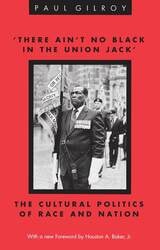
'There Ain't no Black in the Union Jack'
The Cultural Politics of Race and NationPaul Gilroy
University of Chicago Press, 1991
"Gilroy demonstrates effectively that cultural traditions are not static, but develop, grow and indeed mutate, as they influence and are influenced by the other changing traditions around them."—David Edgar, Listener Review of Books.
"A fascinating analysis of the discourses that have accompanied black settlement in Britain. . . . An important addition to the stock of critical works on race and culture."—David Okuefuna, Chicago Tribune
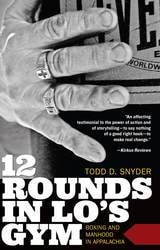
12 Rounds in Lo's Gym
Boxing and Manhood in AppalachiaTodd D. Snyder
West Virginia University Press, 2018
Part love letter to Appalachia, part rigorous social critique, readers may find 12 Rounds in Lo’s Gym—and its narrative of individual and community strength in the face of globalism’s headwinds—a welcome corrective to popular narratives that blame those in the region for their troubles.
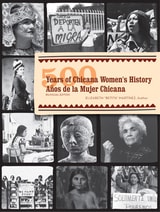
500 Years of Chicana Women's History / 500 Años de la Mujer Chicana
Bilingual EditionMartínez, Elizabeth "
Rutgers University Press, 2008
The history of Mexican Americans spans more than five centuries and varies from region to region across the United States. Yet most of our history books devote at most a chapter to Chicano history, with even less attention to the story of Chicanas.
500 Years of Chicana Women’s History offers a powerful antidote to this omission with a vivid, pictorial account of struggle and survival, resilience and achievement, discrimination and identity. The bilingual text, along with hundreds of photos and other images, ranges from female-centered stories of pre-Columbian Mexico to profiles of contemporary social justice activists, labor leaders, youth organizers, artists, and environmentalists, among others. With a distinguished, seventeen-member advisory board, the book presents a remarkable combination of scholarship and youthful appeal.
In the section on jobs held by Mexicanas under U.S. rule in the 1800s, for example, readers learn about flamboyant Doña Tules, who owned a popular gambling saloon in Santa Fe, and Eulalia Arrilla de Pérez, a respected curandera (healer) in the San Diego area. Also covered are the “repatriation” campaigns” of the Midwest during the Depression that deported both adults and children, 75 percent of whom were U.S.–born and knew nothing of Mexico. Other stories include those of the garment, laundry, and cannery worker strikes, told from the perspective of Chicanas on the ground.
From the women who fought and died in the Mexican Revolution to those marching with their young children today for immigrant rights, every story draws inspiration. Like the editor’s previous book, 500 Years of Chicano History (still in print after 30 years), this thoroughly enriching view of Chicana women’s history promises to become a classic.
¿Qué Onda?
Urban Youth Culture and Border IdentityCynthia L. Bejarano
University of Arizona Press, 2005
For Latina/o adolescents who already find life challenging, the borderland is a place that presents continual affirmations of and contradictions about identity—questions of who is more Mexican than American or vice versa. This book analyzes the construction of Mexicana/o and Chicana/o identities through a four-year ethnographic study in a representative American high school. It reveals how identity politics impacts young people’s forms of communication and the cultural spaces they occupy in the school setting. By showing how identities are created and directly influenced by the complexities of geopolitics and sociocultural influences, it stresses the largely unexplored divisions among youths whose identities are located along a wide continuum of “Mexicanness.”
Through in-depth interviews and focus groups with both Mexicana/o and Chicana/o students, Cynthia Bejarano explores such topics as the creation of distinct styles that reinforce differences between the two groups; the use of language to further distinguish themselves from one another; and social stratification perpetuated by internal colonialism and the “Othering” process. These and other issues are shown to complicate how Latinas/os ethnically identify as Mexicanas/os or Chicanas/os and help explain how they get to this point.
In contrast to research that views identity as a reflection of immigration or educational experiences, this study embraces border theory to frame the complex and conflicted relations of adolescents as a result of their identity-making processes. This intimate glimpse into their lives provides valuable information about the diversity among youths and their constant efforts to create, define, and shape their identities according to cultural and social structures.
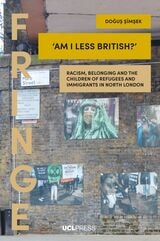
‘Am I Less British?’
Racism, Belonging, and the Children of Refugees and Immigrants in North LondonDogus Simsek
University College London, 2024
‘Am I Less British?’ focuses on the children of refugees and immigrants from Turkey in North London. Providing a rich ethnography of the lives of the children, the book studies their sense of identity and belonging, and their transnational experiences. It aims to understand how the children position themselves within a range of locations (London, North London, and Turkey), where they face class hierarchy, racism, and discrimination. Dogus Simsek explores how these children think about their sense of belonging within the contemporary political context in Britain and Turkey. De-identifying themselves from national identities and holding onto their oppressed identities appear as new forms of resistance in response to racism and exclusion.
The experiences of the young people reflect the complexity of their lives in changing political and social circumstances across the borders of nation-states, as well as the importance of other categories of identity, including local identities. Overall, the book argues that the intersections of local, national, and transnational approaches, the political context through which the lives of young people are framed, and their sophisticated engagement with ideas of race, class, ethnicity, and gender, are crucial to understanding their identity formation.

“A Good Poor Man’s Wife”
Being a Chronicle of Harriet Hanson Robinson and Her Family in Nineteenth-Century New EnglandClaudia L. Bushman
University Press of New England, 1998
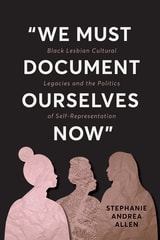
“We Must Document Ourselves Now”
Black Lesbian Cultural Legacies and the Politics of Self-RepresentationStephanie Andrea Allen
The Ohio State University Press, 2026
A long-overdue analysis of how Black lesbians have asserted their lived experience through creative practice, pushing back against heteropatriarchal systems that deny them visibility.
“We Must Document Ourselves Now” examines the essential but oft-ignored importance of Black lesbian literature and film in queer literary and film histories, arguing that Black lesbian cultural texts reflect creators’ lived experiences and resist the heteropatriarchal systems that deny Black lesbians visibility in popular culture. Stephanie Andrea Allen contends that these texts have three goals: to lay bare the experiences of Black lesbians in a raced, gendered, classed, and homophobic society; to challenge the notion that claiming Black lesbian identity is marginal or forbidden; and to take care of Black lesbians by bearing witness to their experiences through creative practice.
Insisting that Black feminist creative practice is an integral form of self and community care, Allen weaves analysis of cultural output spanning key sociocultural moments from 1974 to 2020 with interviews with Black lesbian cultural workers. “We Must Document Ourselves Now” examines the Black Arts / Black Power movement, the “boom” in lesbian and gay publishing, the so-called golden era of Black film, and twenty-first-century visual media to demonstrate how representations of Black lesbians, or lack thereof, were vital to constructing a cultural canon that focused on illuminating Black lesbian experiences in the United States.