Results by title
4155 books match the query 'State & Local' and 25 start with a non-letter
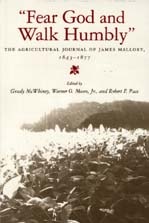
"Fear God and Walk Humbly"
The Agricultural Journal of James Mallory, 1843-1877James Mallory
University of Alabama Press, 1997
Most inhabitants of the Old South, especially the plain folk, devoted more time to leisurely activities—drinking, gambling, hunting, fishing, and just loafing—than did James Mallory, a workaholic agriculturalist, who experimented with new plants, orchards, and manures, as well as the latest farming equipment and techniques. A Whig and a Unionist, a temperance man and a peace lover, ambitious yet caring, business-minded and progressive, he supported railroad construction as well as formal education, even for girls. His cotton production—four bales per field hand in 1850, nearly twice the average for the best cotton lands in southern Alabama and Georgia--tells more about Mallory's steady work habits than about his class status.
But his most obvious eccentricity—what gave him reason to be remembered—was that nearly every day from 1843 until his death in 1877, Mallory kept a detailed journal of local, national, and often foreign news, agricultural activities, the weather, and especially events involving his family, relatives, slaves, and neighbors in Talladega County, Alabama. Mallory's journal spans three major periods of the South's history--the boom years before the Civil War, the rise and collapse of the Confederacy, and the period of Reconstruction after the Civil War. He owned slaves and raised cotton, but Mallory was never more than a hardworking farmer, who described agriculture in poetical language as “the greatest [interest] of all.”
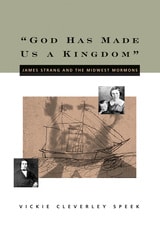
"God Has Made Us a Kingdom"
James Strang and the Midwest MormonsVickie Cleverley Speek
Signature Books, 2006
Strang was considered the prophetic successor to Joseph Smith for the Mormons of the Midwest who later formed the nucleus for the membership of what is now the Community of Christ. Today, 150 years after Strang’s death, about 100 faithful followers in the United States still await the emergence of another prophet to succeed Strang. In the prophetic tradition of Joseph Smith, Strang similarly excavated ancient metallic plates and translated them into the Book of the Law of the Lord and the Rajah Manchou of Vorito. Like Joseph Smith, Strang instigated polygamy, secret ceremonies, baptism for the dead, and communal living. He also introduced a bloomer-like fashion for women, as well as other innovations. Like Joseph Smith, he had himself crowned king of the world.
Where previous treatments of Strang have relied either on inside or outside sources to show either a prophet or charlatan, Speek utilizes all sources, updates the record, corrects previous errors, and shows diverse perspectives. She recounts the turbulent and dramatic events of the 1840s-50s, including the plot to murder Strang and the heartbreaking exile of the Saints from Beaver Island. She traces the dispersion of this once formidable colony of Mormons to the forests of northwest Wisconsin, the far-flung outposts of southwest New Mexico, the hills of Lamoni, Iowa, and to Salt Lake City, Utah.
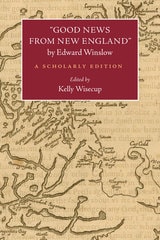
"Good News from New England" by Edward Winslow
A Scholarly EditionKelly Wisecup
University of Massachusetts Press, 2014
It was in the context of all of these roles that Winslow wrote Good News in an attempt to convince supporters in England that the colonists had established friendly relations with Native groups and, as a result, gained access to trade goods. Although clearly a work of diplomacy, masking as it did incidents of brutal violence against Indians as well as evidence of mutual mistrust, the work nevertheless offers, according to Kelly Wisecup, a more complicated and nuanced representation of the Pilgrims' first years in New England and of their relationship with Native Americans than other primary documents of the period.
In this scholarly edition, Wisecup supplements Good News with an introduction, additional primary texts, and annotations to bring to light multiple perspectives, including those of the first European travelers to the area, Native captives who traveled to London and shaped Algonquian responses to colonists, the survivors of epidemics that struck New England between 1616 and 1619, and the witnesses of the colonists' attack on the Massachusetts.
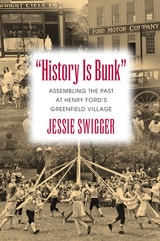
"History Is Bunk"
Assembling the Past at Henry Ford's Greenfield VillageJessie Swigger
University of Massachusetts Press, 2014
In 1916 a clearly agitated Henry Ford famously proclaimed that “history is more or less bunk.” Thirteen years later, however, he opened the outdoor history museum Greenfield Village in Dearborn, Michigan. It was written history's focus on politicians and military heroes that was bunk, he explained. Greenfield Village would correct this error by celebrating farmers and inventors.
The village eventually included a replica of Thomas Edison's Menlo Park, New Jersey, laboratory, the Wright brothers' cycle shop and home from Dayton, Ohio, and Ford's own Michigan birthplace. But not all of the structures were associated with famous men. Craft and artisan shops, a Cotswold cottage from England, and two brick slave cabins also populated the village landscape. Ford mixed replicas, preserved buildings, and whole-cloth constructions that together celebrated his personal worldview.
Greenfield Village was immediately popular. But that only ensured that the history it portrayed would be interpreted not only by Ford but also by throngs of visitors and the guides and publicity materials they encountered. After Ford's death in 1947, administrators altered the village in response to shifts in the museum profession at large, demographic changes in the Detroit metropolitan area, and the demands of their customers.
Jessie Swigger analyzes the dialogue between museum administrators and their audiences by considering the many contexts that have shaped Greenfield Village. The result is a book that simultaneously provides the most complete extant history of the site and an intimate look at how the past is assembled and constructed at history museums.
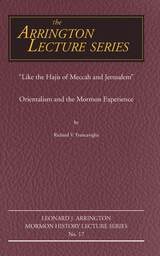
"Like the Hajis of Meccah and Jerusalem"
Orientalism and the Mormon ExperienceRichard Francaviglia
Utah State University Press, 2012
The series, established by one of the twentieth-century West's most distinguished historians, Leonard Arrington, has become a leading forum for prominent historians to address topics related to Mormon history. The first lecturer was Arrington himself. He was followed by Richard Lyman Bushman, Richard E. Bennett, Howard R. Lamar, Claudia L. Bushman, Kenneth W. Godfrey, Jan Shipps, Donald Worster, Laurel Thatcher Ulrich, and F. Ross Peterson. Utah State University hosts the Leonard J. Arrington Mormon History Lecture Series. The University Libraries' Special Collections and Archives houses the Arrington collection. The state's land grant university began collecting records very early, and in the 1960s became a major depository for Utah and Mormon records. Leonard and his wife Grace joined the USU faculty and family in 1946, and the Arringtons and their colleagues worked to collect original diaries, journals, letters, and photographs.
Although trained as an economist at the University of North Carolina, Arrington became a Mormon historian of international repute. Working with numerous colleagues, the Twin Falls, Idaho, native produced the classic Great Basin Kingdom: An Economic History of the Latter-day Saints in 1958. Utilizing available collections at USU, Arrington embarked on a prolific publishing and editing career. He and his close ally, Dr. S. George Ellsworth helped organize the Western History Association, and they created the Western Historical Quarterly as the scholarly voice of the WHA. While serving with Ellsworth as editor of the new journal, Arr ington also helped both the Mormon History Association and the independent journal Dialogue get established.
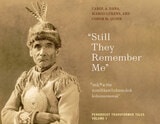
"Still They Remember Me"
Penobscot Transformer Tales, Volume 1Carol A. Dana, Margo Lukens, and Conor M. Quinn
University of Massachusetts Press, 2021
In "Still They Remember Me," stories are presented in the Penobscot language and English side-by-side, coupled with illustrations from members of the tribal community. For the first time, these stories are accessible to a young generation of Penobscot language learners and scholars of Native American literatures at all levels, from grade school to graduate school.
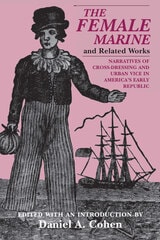
"The Female Marine" and Related Works
Narratives of Cross-Dressing and Urban Vice in America's Early RepublicDaniel A. Cohen
University of Massachusetts Press, 1997
The alternately racy and moralistic narrative recounts the adventures of a young woman from rural Massachusetts who is seduced by a false-hearted lover, flees to Boston, and is entrapped in a brothel. She eventually escapes by disguising herself as a man and serves with distinction on board the U.S. frigate Constitution during the War of 1812. After subsequent onshore adventures in and out of male dress, she is happily married to a wealthy New York gentleman.
In his introduction, Daniel A. Cohen situates the story in both its literary and historical contexts. He explains how the tale draws upon a number of popular Anglo-American literary genres, including the female warrior narrative, the sentimental novel, and the urban exposé. He then explores how The Female Marine reflects early-nineteenth-century anxieties concerning changing gender norms, the expansion of urban prostitution, the growth of Boston's African American community, and feelings of guilt aroused by New England's notoriously unpatriotic activities during the War of 1812.
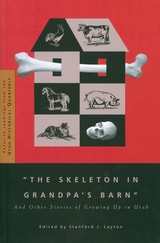
"The Skeleton in Grandpa's Barn"
And Other Stories of Growing Up in UtahStanford J. Layton
Signature Books, 2008

"The Whorehouse Bells Were Ringing" and Other Songs Cowboys Sing
Collected and edited by Guy Logsdon
University of Illinois Press, 1995
Winner of the Westerners International Co-Founders Awards of the Western History Association, 1990.

"They Tore the Heart Out"
A Story of Rural School ClosureJoshua Montgomery
University of Wyoming Press, 2027
What does a school mean in rural space? What happens when, despite the protests of a community, a school is closed? How does school closure uncover the cracks in the stories we tell about ourselves and our world? In “They Tore the Heart Out” Joshua Montgomery describes the impact of multiple rounds of school closure and school consolidation in the rural Wyoming community of Medicine Bow, reconstructing the story of the closure and the forces behind it through meeting minutes and other primary sources as well as interviews with past and present residents.
High schools in many small communities act as a surrogate identity and signifier of community success. The school building and the complex community it engenders play roles both prosaic, through school lunches, curriculum, and nurses, and productive, as an economic, political, social, and cultural engine. Montgomery illustrates the long-term impacts of school closure on Medicine Bow and tracks the existential tensions that persist to this day. The story that emerges exists in a rapidly changing cultural context that complicates not only the telling but also the interpreting. School closure, and its aftermath, forced community members to confront issues related to their ability to preserve and control their own destinies.
Told with a strong narrative flair that brings the story to life through dramatic events driven by colorful local characters, “They Tore the Heart Out” allows for a better understanding of the rural educational experience, leads to fundamental questions about who and what we are as a culture, and underscores the importance of maintaining rural space.
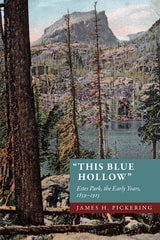
"This Blue Hollow"
Estes Park, the Early Years, 1859-1915James H. Pickering
University Press of Colorado, 2005
Based on Pickering's extensive use of primary sources, This Blue Hollow details the lives of such characters as Joel Estes and Griffith J. Evans, the valley's first residents; the "notorious" James Nugent ("Rocky Mountain Jim") and his short but tempestuous relationship with the celebrated English traveler Isabella Lucy Bird; and the Earl of Dunraven, a wealthy Irishman who was successful in his (illegal) attempt to secure control of as much of the park as possible for his own uses. The book also explores such significant events as the coming of the first pioneer families and permanent settlers, as well as their development of Estes Park as a place to farm, ranch, and entertain tourists; the conquest of Longs Peak and the first explorations of other high and remote places; and the people and circumstances that led to the establishment of the town of Estes Park in 1905 and Rocky Mountain National Park a decade later.
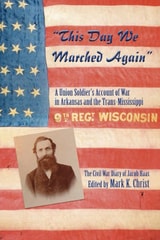
"This Day We Marched Again"
A Union Soldier's Account of War in Arkansas and the Trans-MississippiMark K. Christ
Butler Center for Arkansas Studies, 2014
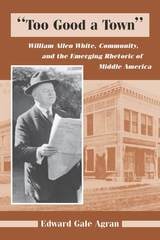
"Too Good a Town"
William Allen White, Community, and the Emerging Rhetoric of Middle AmericaEdward G. Agran
University of Arkansas Press, 1999
For fifty years, William Allen White, first as a reporter and later as the long-time editor of the Emporia Gazette, wrote of his small town and its Mid-American values. By tailoring his writing to the emerging urban middle class of the early twentieth century, he won his “gospel of Emporia” a nationwide audience and left a lasting impact on he way America defines itself.
Investigating White’s life and his extensive writings, Edward Gale Agran explores the dynamic thought of one of America’s best-read and most-respected social commentators. Agran shows clearly how White honed his style and transformed the myth of conquering the western frontier into what became the twentieth-century ideal of community building.
Once a confidante of and advisor to Theodore Roosevelt, White addressed, and reflected in his work, all the great social and political oscillations of his time—urbanization and industrialism, populism, and progressivism, isolationism internationalism, Prohibition, and New Deal reform. Again and again, he asked the question “What’s the matter?” about his times and townspeople, then found the middle ground. With great care and discernment, Agran gathers the man strains of White’s messages, demonstrating one writer’s pivotal contribution to our idea of what it means to be an American.
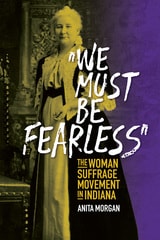
"We Must Be Fearless"
The Woman Suffrage Movement in IndianaAnita Morgan
Indiana Historical Society Press, 2020
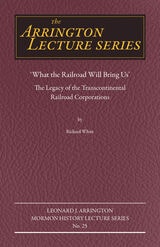
"What the Railroad Will Bring Us"
The Legacy of the Transcontinental Railroad CorporationsRichard White
Utah State University Press, 2020
The Arrington Lecture series, established by one of the twentieth-century West's most distinguished historians, Leonard Arrington, has become a leading forum for prominent historians to address topics related to Mormon history. Utah State University hosts the Leonard J. Arrington Mormon History Lecture Series through the Merrill-Cazier Library Special Collections and Archives department.
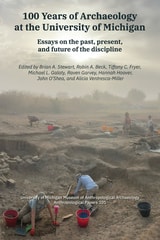
100 Years of Archaeology at the University of Michigan
Essays on the Past, Present, and Future of the DisciplineEdited by Brian A. Stewart, Robin A. Beck, Tiffany C. Fryer, Michael L. Galaty, Raven Garvey, Hannah Hoover, John O’Shea, and Alicia Ventresca-Miller
University of Michigan Press, 2025
The University of Michigan has been at the forefront of archaeological research for more than 100 years, since 1922, when the Museum of Anthropology (now the Museum of Anthropological Archaeology) was established on the Ann Arbor campus. The goal of its curators for many decades was to create a research and teaching program that emphasized methodological rigor in the analysis of archaeological materials, attempting to solve grand questions about human behavior through fieldwork, collections, and laboratory work. About fifty years ago, the Museum's emphasis shifted to developing archaeological theory when a new generation of curators with processualist leanings made Ann Arbor a testing ground for the so-called New Archaeology.
Now, archaeology stands at a crossroads. Some archaeologists refer to the death of archaeological theory. Others stake out opposed camps of generalists and particularists. At U-M, as at many other universities, the past decade has seen a new commitment to collaborative archaeology, working with descendant communities and acknowledging the discipline's roots in colonialism and extraction.
In 2022, to celebrate a century of existence, the University of Michigan Museum of Anthropological Archaeology (UMMAA) hosted an international conference to explore possibilities for a middle way: an archaeology for the next 100 years, combining humanistic and scientific approaches, which allows for both agents and systems, description and explanation, science and heritage. This volume is meant to be a snapshot of that conference and this moment in the development of the discipline. Included are most of the papers and posters presented, as well as photographs of the panels and the proceedings.

1001 Most Asked Questions American West
Harry E. Chrisman
Ohio University Press, 1982
Chrisman first encountered many of these questions in his monthly column "Roundup Time," which appeared in The West, a national monthly magazine.
Concentrating on the puzzlers, Chrisman has gathered in his illustrated volume over one thousand of the most frequently asked questions about the American West. Readers will find chapters devoted to the people of the West (cowboys, Indians, lawmen, outlaws, and gunfighters), chapters on the Western lifestyle (culture, pioneer life, folklore, and business and commerce), as well as chapters on the land (geography and geology, and towns and territories).
Here, then, is an entertaining volume to which readers can turn for information and recreation and which will remain a constant source for the younger generations who wish to learn of their forefathers and of the many problems they encountered and resolved during the settlement of the Great American West.
1001 Texas Place Names
By Fred Tarpley
University of Texas Press, 1980
From Notrees to Pine Island, from Scotland to Moscow, from Dickens to Tennyson, from Spur to Lariat, from Buck Naked to Bald Prairie—Texans are unsurpassed for the imaginative names they give their towns and cities. Fred Tarpley has chosen 1001 of the most unusual and interesting of the 75,000 place names that dot the Texas map.
The names of Texas communities and places can be traced to a number of basic sources, including people; landscapes; the Bible; literature and mythology; misunderstandings and errors; backward spellings and blends; and anecdotes and events. Each entry in 1001 Texas Place Names gives the official spelling of the name, phonetic pronunciation where necessary, dates of post office operation, and a short narrative about the origin of the name and the history of the place. Each of Texas's 254 counties is represented by at least two entries.
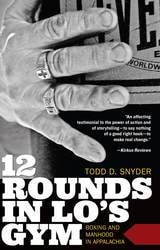
12 Rounds in Lo's Gym
Boxing and Manhood in AppalachiaTodd D. Snyder
West Virginia University Press, 2018
Part love letter to Appalachia, part rigorous social critique, readers may find 12 Rounds in Lo’s Gym—and its narrative of individual and community strength in the face of globalism’s headwinds—a welcome corrective to popular narratives that blame those in the region for their troubles.
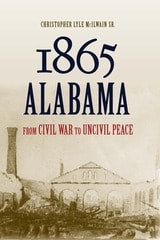
1865 Alabama
From Civil War to Uncivil PeaceChristopher Lyle McIlwain Sr.
University of Alabama Press, 2017
Unraveling the twelve months that forged modern Alabama.
To understand Alabama today, it's necessary to understand what happened in 1865. In 1865 Alabama: From Civil War to Uncivil Peace Christopher McIlwain examines the end of the Civil War and the early days of Reconstruction, tracing how the action—and inaction—of leaders in the state during those twelve months shaped the decades that followed as well as state politics today. McIlwain focuses on four factors: the immediate and unconditional emancipation of enslaved people, the destruction of Alabama’s industrial economy, significant broadening of northern support for suffrage rights for freedmen, and a long scarcity of investment capital. Each element proves important to understanding aspects of Alabama today.
Relevant events outside Alabama are woven into the narrative, including McIlwain’s controversial argument regarding the effect of Lincoln’s assassination. Most historians assume that Lincoln favored black suffrage and that he would have led the fight to impose that on the South. But he made it clear to his cabinet members that granting suffrage rights was a matter to be decided by the southern states, not the federal government. Thus, according to McIlwain, if Lincoln had lived, black suffrage would not have been the issue it became in Alabama.
In his fresh analysis of what really happened in Alabama in 1865 and why—McIlwain illuminates that Alabama's challenges were neither entirely the fault of northern or southern policies but rather the complex interaction between the two.

25th Street Confidential
Drama, Decadence, and Dissipation along Ogden's Rowdiest RoadVal Holley
University of Utah Press, 2013
25th Street Confidential traces Ogden’s transformation from quiet hamlet to chaotic transcontinental railroad junction as waves of non-Mormon fortune seekers swelled the city’s population. The street’s outsized role in Ogden annals illuminates larger themes in Utah and U.S. history. Most significantly, 25th Street was a crucible of Mormon-Gentile conflict, especially after the non-Mormon Liberal Party deprived its rival, the People’s Party, of long-standing control of Ogden’s municipal government in 1889. In the early twentieth-century the street was targeted in statewide Progressive Era reform efforts, and during Prohibition it would come to epitomize the futility of liquor abatement programs.
This first full-length treatment of Ogden’s rowdiest road spotlights larger-than-life figures whose careers were entwined with the street: Mayor Harman Ward Peery, who unabashedly filled the city treasury with fees and fines from vicious establishments; Belle London, the most successful madam in Utah history; and Rosetta Ducinnie Davie, the heiress to London’s legacy who became a celebrity on the street, in the courts, and in the press. Material from previously unexploited archives and more than one hundred historic photos enrich this narrative of a turbulent but unforgettable street.
Winner of the Utah Book Award in Nonfiction.
Chosen by Foreword as a finalist in the regional category for their IndieFab Book of the Year Award.
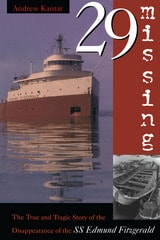
29 Missing
The True and Tragic Story of the Disappearance of the SS Edmund FitzgeraldAndrew Kantar
Michigan State University Press, 1998
On November 10, 1975, SS Edmund Fitzgerald, a giant freighter, sank with its entire crew of 29 aboard, in one of the most violent storms ever witnessed on Lake Superior. In 29 Missing, Kantar tells the "Fitz's" story from the christening in 1958 as the largest ship on the Great Lakes to the expedition in 1995 to recover the ship's bell in what proved to be a moving memorial to the lost crew. Using information from government investigative reports, the book provides a dramatic hour-by-hour account of what transpired during that terrible voyage, including dialogue from actual radio transmissions between the Fitzgerald and the Arthur Anderson, the freighter that followed behind the Fitz.
In his passionate retelling of the story, designed primarily for young adults, Kantar provides the facts leading up to the disappearance, detailing the subsequent expeditions to the wreck site as well as the leading theories about the sinking that have been debated by maritime experts.
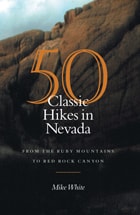
50 Classic Hikes In Nevada
From The Ruby Mountains To Red Rock CanyonMike White
University of Nevada Press, 2006

6000 Miles of Fence
By Cordia Sloan Duke
University of Texas Press, 1961
The fabulous XIT Ranch has been celebrated in song, story, and serious history. This book of reminiscences of old XIT cowmen puts on record the everyday life of the individuals who made the ranch run. Their forthright, yet picturesque, discussion of ranching hardships and dangers dissipates Hollywood and TV glamorizing. They relate in honest cowboy language what actually happened inside the XIT's 6,000 miles of fence.
Cordia Sloan Duke, wife of an XIT division manager, Robert L. Duke, many years ago realized that only those who had experienced ranch life could depict it with deep understanding. As the young wife of a rising young ranch hand, she kept in her apron pocket a notebook and pencil, recording all manner of interesting details as they caught her attention. This diary was the nucleus for the present book. Conceiving of an account of life on the XIT as presented by XIT cowboys, Mrs. Duke set about drawing from reticent, sometimes reluctant, ranch hands the impressions of the XIT (occasionally written down by their more literate wives or daughters) which they had retained through the years. Cordia Sloan Duke and Joe B. Frantz have organized the reminiscences around key aspects of ranch life, retaining the language of the cow hands.

9XM Talking
WHA Radio and the Wisconsin IdeaRandall Davidson
University of Wisconsin Press, 2017