Results by title
255 books match the query 'Church of Jesus Christ of Latter-day Saints (Mormon)' and 15 start with a
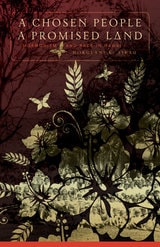
A Chosen People, a Promised Land
Mormonism and Race in Hawai’iHokulani K. Aikau
University of Minnesota Press, 2012
Christianity figured prominently in the imperial and colonial exploitation and dispossession of indigenous peoples worldwide, yet many indigenous people embrace Christian faith as part of their cultural and ethnic identities. A Chosen People, a Promised Land gets to the heart of this contradiction by exploring how Native Hawaiian members of the Church of Jesus Christ of Latter-Day Saints (more commonly known as Mormons) understand and negotiate their place in this quintessentially American religion.
Mormon missionaries arrived in Hawai‘i in 1850, a mere twenty years after Joseph Smith founded the church. Hokulani K. Aikau traces how Native Hawaiians became integrated into the religious doctrine of the church as a “chosen people”—even at a time when exclusionary racial policies regarding black members of the church were being codified. Aikau shows how Hawaiians and other Polynesian saints came to be considered chosen and how they were able to use their venerated status toward their own spiritual, cultural, and pragmatic ends.
Using the words of Native Hawaiian Latter-Day Saints to illuminate the intersections of race, colonization, and religion, A Chosen People, a Promised Land examines Polynesian Mormon articulations of faith and identity within a larger political context of self-determination.
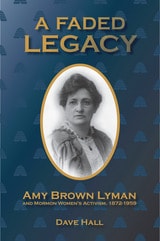
A Faded Legacy
Amy Brown Lyman and Mormon Women's Activism, 1872 - 1959Dave Hall
University of Utah Press, 2015
Placing Lyman’s story within a local and national context, award-winning author Dave Hall examines the roots and trajectory of Mormon women’s activism. Born into a polygamist family, Lyman entered the larger sphere of public life at the time when the practice of polygamy was ending and Mormonism had begun assimilating mainstream trends. The book follows her life as she prepared for a career, married, and sought meaning in a rapidly changing society. It recounts her involvement in the Relief Society, the Mormon women’s charity group that she led for many years and sought to transform into a force for social welfare, and it considers the influence of her connections with national and international women’s organizations. The final period of Lyman’s life, in which she resigned from the Relief Society amidst personal tragedy, offers insight into the reasons Mormon women abandoned their activist heritage for a more conservative role, a stance that is again evolving.
Winner of the Mormon History Association's Best First Book Award.
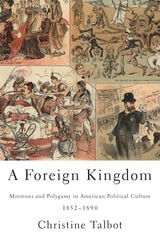
A Foreign Kingdom
Mormons and Polygamy in American Political Culture, 1852-1890Christine Talbot
University of Illinois Press, 2013
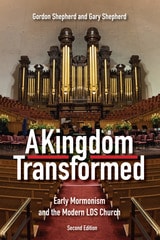
A Kingdom Transformed
Early Mormonism and the Modern LDS Church, New EditionGordon Shepherd and Gary Shepherd
University of Utah Press, 2015
The first edition showed how early twentieth century LDS leaders were fairly liberal in mainstreaming church doctrines and social teaching, but by mid-twentieth century, as the church became more stable, accepted, and successful, church authorities reversed several earlier modifications and began emphasizing a stricter, more conservative theology that coincided with an increasingly conservative political orientation. The new book adds current issues of concern, such as the role of women in the church and international growth versus member retention. It also introduces a new conceptual framework for interpreting findings.
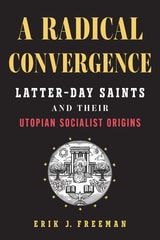
A Radical Convergence
Latter-day Saints and Their Utopian Socialist OriginsErik J. Freeman
University of Illinois Press, 2026
Erik J. Freeman uses the lives of radical converts to explore the international socialist politics that permeated the early Church. These energetic newcomers fueled LDS expansion even as they laid the foundation for a global religion. At the same time, utopian socialists within the Church helped lay the groundwork for later political and social movements and progressive ideas. The Church in the United States pivoted toward capitalism after the turn of the century, but socialist thought remained—and remain—an important thread throughout LDS communities around the world.
Provocative and sweeping, A Radical Convergence tells the surprising story of utopian socialism's place in Church history.
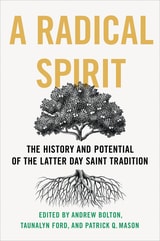
A Radical Spirit
The History and Potential of the Latter Day Saint TraditionEdited by Andrew Bolton, Taunalyn Ford, and Patrick Q. Mason
University of Illinois Press, 2027
Early followers of Joseph Smith believed their new faith could organize society from the ground up and create a religious community shaped by justice, equality, and spiritual transformation. The essayists look at the movement’s diverse influences—religious, philosophical, and cultural—alongside the economic, gender, and racial issues that informed its radicalism. They also trace the competing pressures inside and outside the movement that helped determine which radical ideas survived and which faded or were later enhanced.
Eye-opening and expansive, A Radical Spirit rediscovers implications of the original heart of the Restoration tradition that thrived among the marginalized poor in the USA, Canada and in Europe—a radical Spirit of Jesus that offers possibilities for our times.
Contributors: Andrew Bolton, Gerard Charmley, Rebekah Clark, Taunalyn Ford, Russell Arben Fox, Erik J. Freeman, David J. Howlett, Brad A. Martell, Lori Martell, Patrick Q. Mason, Michael Ratcliffe, Jennifer Reeder, Joseph M. Spencer, Jordan T. Watkins, Walker Wright
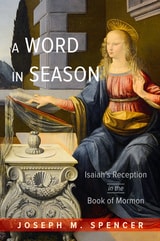
A Word in Season
Isaiah's Reception in the Book of MormonJoseph M. Spencer
University of Illinois Press, 2023
The Book of Mormon’s narrative privileges Isaiah over other sources, provocatively interpreting and at times inventively reworking the biblical text. Joseph M. Spencer sees within the Book of Mormon a programmatic investigation regarding the meaning and relevance of the Book of Isaiah in a world increasingly removed from the context of the times that produced it. Working from the crossroads of reception studies and Mormon studies, Spencer investigates and clarifies the Book of Mormon’s questions about the vitality of Isaiah’s prophetic project. Spencer’s analysis focuses on the Book of Mormon’s three interactions with the prophet: the character of Abinadi; the resurrected Jesus Christ; and the nation-founding figure of Nephi. Working from the Book of Mormon as it was dictated, Spencer details its vital and overlooked place in Isaiah’s reception while recognizing the interpretation of Isaiah as an organizing force behind the Book of Mormon.
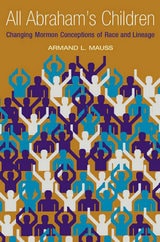
All Abraham's Children
Changing Mormon Conceptions of Race and LineageArmand L. Mauss
University of Illinois Press, 2003
Mauss describes a complex process of the broadening of these self-defined lineages during the last part of the twentieth century as the modern Mormon church continued its world-wide expansion through massive missionary work.
Mauss contends that Mormon constructions of racial identity have not necessarily affected actual behavior negatively and that in some cases Mormons have shown greater tolerance than other groups in the American mainstream.
Employing a broad intellectual historical analysis to identify shifts in LDS behavior over time, All Abraham’s Children is an important commentary on current models of Mormon historiography.
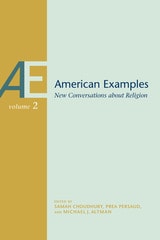
American Examples, Vol 2
New Conversations about ReligionEdited by Samah Choudhury, Prea Persaud, and Michael J. Altman
University of Alabama Press, 2022
Fresh new perspectives on the study of religion, ranging from SoulCycle to Mark Twain
American Examples: New Conversations about Religion, Volume Two, is the second in a series of annual anthologies produced by the American Examples workshop hosted by the Department of Religious Studies at The University of Alabama. In the latest volume from this dynamic academic project, nine scholars with diverse topics and methodologies vividly reimagine the meaning of all three words in the phrase “American religious history.” The essays use case studies from America, broadly conceived, to ask trenchant theoretical questions that are of interest to scholars and students beyond the subfield of American religious history.
Cody Musselman uses a Weberian analysis to explore questions of identity, authority, and authenticity in the world of SoulCycle while Zachary T. Smith finds commonality between the rhetoric and practices of scholarship and mixed martial arts. Erik Kline provides a new perspective on the psychedelic mysticism of the 1960s, and Brook Wilensky-Lanford takes stock of the cultural power of parody in Mark Twain’s last work of fiction. Christopher Cannon Jones examines the reciprocal relationship between religious texts and cultural contexts by comparing early Mormon missions to Hawai‘i and Jamaica and Lindsey Jackson explores what debates over circumcision can tell us about gender stereotypes and motherhood. Dana Lloyd uses the 1988 Supreme Court decision in Lyng v. Northwest Indian Cemetery Protective Association as a case study in order to consider how Indigenous religion and sovereignty have been understood and adjudicated in the American legal system. Matt Sheedy studies the identity categories of “atheist” and “ex-Muslim” and Brad Stoddard uses ethnographic fieldwork to evaluate the role of religious pluralism in regulating and policing correctional institutions. Editors Samah Choudhury and Prea Persaud provide an introduction that reconsiders the trajectory of the American Examples project in light of the siege on the US Capitol in January 2021 and the continuing COVID pandemic.
Visit americanexamples.ua.edu for more information on upcoming workshop dates and future projects.
CONTRIBUTORS
Michael J. Altman / Samah Choudhury / Lindsey Jackson / Christopher Cannon Jones / / Erik Kline / Dana Lloyd / Cody Musselman / Prea Persaud / Matt Sheedy / Zachary T. Smith / Brad Stoddard / Brook Wilensky-Lanford
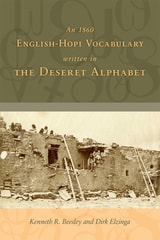
An 1860 English-Hopi Vocabulary Written in the Deseret Alphabet
Kenneth R. Beesley
University of Utah Press, 2014
The volume reproduces all 486 vocabulary entries of the original manuscript, presenting the Deseret and the modern English and Hopi translations. It explains the history of the Deseret Alphabet as well as that of the Mormon missions to the Hopi, while fleshing out the background of the two missionaries, Marion Jackson Shelton, who wrote the manuscript, and his companion, Thales Hastings Haskell. The book will be of interest to linguists, historians, ethnographers, and others who are curious about the unique combination of topics this work connects.
An Imperfect Book
What the Book of Mormon Tells Us about ItselfEarl M. Wunderli
Signature Books, 2013
Dale E. Luffman, Association for Mormon Letters
An Insider's View of Mormon Origins
Grant Palmer
Signature Books, 2002
He finds that much of what we take for granted as literal history has been tailored over the years—slightly modified, added to, one aspect emphasized over another—to the point that the original narratives have been nearly lost. What was experienced as a spiritual or metaphysical event, something from a different dimension, often has been refashioned as if it were a physical, objective occurrence. This is not how the first Saints interpreted these events. Historians who have looked closer at the foundational stories and source documents have restored elements, including a nineteenth-century world view, that have been misunderstood, if not forgotten.

Archiving Heaven and Earth
The Historian's Office and the Making of MormonismRobin Scott Jensen
University of Illinois Press, 2027
Robin Scott Jensen explores the Church Historian’s Office against the backdrop of how writing and archiving what was written shaped the growth, faith, and identity of the nineteenth-century Latter Day Saint movement. As Jensen shows, records simultaneously created and preserved history. Journal keeping and letter writing stood alongside official documents as an essential means for Saints to understand their mission and place in American society. Over time, the Church Historian’s Office evolved into a powerful institution that guided memory and authority by deciding what to collect, copy, or destroy. Jensen tells the stories of the forgotten archivists, many of them women, who built the Church Historian’s Office, while revealing the choices and conflicts that led to Native and other voices being marginalized or erased.
Detailed and candid, Archiving Heaven and Earth provides a rare look at a foundational organization.
At Last She Said It
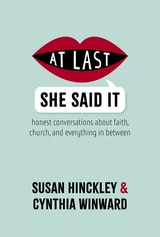
Honest Conversations About Faith, Church, and Everything in BetweenSusan Hinckley and Cynthia Winward
Signature Books, 2025
“Women of faith, discussing complicated things.” That’s how authors Susan Hinckley and Cynthia Winward describe At Last She Said It, and they don’t expect the knots to untangle themselves. Even with two very different personalities and a decade or so between them, as their friendship developed they kept stumbling onto what felt like an uncanny amount of common ground in their church experiences. Often their conversations ended with, “Why isn’t anyone talking about this? Someone should do a podcast!” So they did. They had a hunch they weren’t the only women wishing they had a place to discuss the things they were thinking about, a lot of which they’d never said—or heard—out loud. That hunch was right. Their 200-and-counting recorded conversations have been downloaded some two million times. Hinckley and Winward have learned, right along with their listeners, that there’s no power quite like finding out you’re not alone.
Their book now asks Latter-day Saints to think about old ideas in new ways. Stretching can be uncomfortable, but the willingness to consider diverse perspectives—even on the things we hold most dear—feels essential in an evolving world. So does being open to changing our minds, including how we think about ourselves. Faith is alive when it’s growing, and growing means change. Hopefully, these conversations will be the beginning of thousands more.
At Last She Said It
Honest Conversations About Faith, Church, and Everything in BetweenSusan Hinckley and Cynthia Winward
Signature Books, 2025
“Women of faith, discussing complicated things.” That’s how authors Susan Hinckley and Cynthia Winward describe At Last She Said It, and they don’t expect the knots to untangle themselves. Even with two very different personalities and a decade or so between them, as their friendship developed they kept stumbling onto what felt like an uncanny amount of common ground in their church experiences. Often their conversations ended with, “Why isn’t anyone talking about this? Someone should do a podcast!” So they did. They had a hunch they weren’t the only women wishing they had a place to discuss the things they were thinking about, a lot of which they’d never said—or heard—out loud. That hunch was right. Their 200-and-counting recorded conversations have been downloaded some two million times. Hinckley and Winward have learned, right along with their listeners, that there’s no power quite like finding out you’re not alone.
Their book now asks Latter-day Saints to think about old ideas in new ways. Stretching can be uncomfortable, but the willingness to consider diverse perspectives—even on the things we hold most dear—feels essential in an evolving world. So does being open to changing our minds, including how we think about ourselves. Faith is alive when it’s growing, and growing means change. Hopefully, these conversations will be the beginning of thousands more.