Results by title
231 books match the query 'Colonies' and 17 start with a
A Great Fear
Luís de Onís and the Shadow War against Napoleon in Spanish America, 1808–1812Timothy Hawkins
University of Alabama Press, 2019
How fear of Napoleon's shadow empire helped shape the fate of Spanish America.
A Great Fear: Luís de Onís and the Shadow War against Napoleon in Spanish America, 1808–1812 explores why Spanish Americans did not take the opportunity to seize independence in this critical period when Spain was overrun by French armies and, arguably, in its weakest state. In the first years after his appointment as Spanish ambassador to the United States, Luís de Onís claimed the heavy responsibility of defending Spanish America from the wave of French spies, subversives, and soldiers whom he believed Napoleon was sending across the Atlantic to undermine the empire.
As a leading representative of Spain’s loyalist government in the Americas, Onís played a central role in identifying, framing, and developing what soon became a coordinated response from the colonial bureaucracy to this perceived threat. This crusade had important short-term consequences for the empire. Since it paralleled the emergence of embryonic independence movements against Spanish rule, colonial officials immediately conflated these dangers and attributed anti-Spanish sentiment to foreign conspiracies.
Little direct evidence of Napoleon’s efforts at subversion in Spanish America exists. However, on the basis of prodigious research, Hawkins asserts that the fear of French intervention mattered far more than the reality. Reinforced by detailed warnings from Ambassador Onís, who found the United States to be the staging ground for many of the French emissaries, colonial officials and their subjects became convinced that Napoleon posed a real threat. The official reaction to the threat of French intervention increasingly led Spanish authorities to view their subjects with suspicion, as potential enemies rather than allies in the struggle to preserve the empire. In the long term, this climate of fear eroded the legitimacy of the Spanish Crown among Spanish Americans, a process that contributed to the unraveling of the empire by the 1820s.
This study draws on documents and official records from both sides of the Hispanic Atlantic, with extensive research conducted in Spain, Guatemala, Argentina, and the United States. Overall, it is a provocative interpretation of the repercussions of Napoleonic intrigue and espionage in the New World and a stellar examination of late Spanish colonialism in the Americas.
A History of the Twentieth Century in 100 Maps
Tim Bryars and Tom Harper
University of Chicago Press, 2014
As Bryars and Harper reveal, maps make ideal narrators, and the maps in this book tell the story of the 1900s—which saw two world wars, the Great Depression, the Swinging Sixties, the Cold War, feminism, leisure, and the Internet. Several of the maps have already gained recognition for their historical significance—for example, Harry Beck’s iconic London Underground map—but the majority of maps on these pages have rarely, if ever, been seen in print since they first appeared. There are maps that were printed on handkerchiefs and on the endpapers of books; maps that were used in advertising or propaganda; maps that were strictly official and those that were entirely commercial; maps that were printed by the thousand, and highly specialist maps issued in editions of just a few dozen; maps that were envisaged as permanent keepsakes of major events, and maps that were relevant for a matter of hours or days.
As much a pleasure to view as it is to read, A History of the Twentieth Century in 100 Maps celebrates the visual variety of twentieth century maps and the hilarious, shocking, or poignant narratives of the individuals and institutions caught up in their production and use.
A Nervous State
Violence, Remedies, and Reverie in Colonial CongoNancy Rose Hunt
Duke University Press, 2016
Abolitionism and Imperialism in Britain, Africa, and the Atlantic
Derek R. Peterson
Ohio University Press, 2010
The abolition of the slave trade is normally understood to be the singular achievement of eighteenth-century British liberalism. Abolitionism and Imperialism in Britain, Africa, and the Atlantic expands both the temporal and the geographic framework in which the history of abolitionism is conceived. Abolitionism was a theater in which a variety of actors—slaves, African rulers, Caribbean planters, working-class radicals, British evangelicals, African political entrepreneurs—played a part. The Atlantic was an echo chamber, in which abolitionist symbols, ideas, and evidence were generated from a variety of vantage points. These essays highlight the range of political and moral projects in which the advocates of abolitionism were engaged, and in so doing it joins together geographies that are normally studied in isolation.
Where empires are often understood to involve the government of one people over another, Abolitionism and Imperialism shows that British values were formed, debated, and remade in the space of empire. Africans were not simply objects of British liberals’ benevolence. They played an active role in shaping, and extending, the values that Britain now regards as part of its national character. This book is therefore a contribution to the larger scholarship about the nature of modern empires.
Contributors: Christopher Leslie Brown, Seymour Drescher, Jonathon Glassman, Boyd Hilton, Robin Law, Phillip D. Morgan, Derek R. Peterson, John K. Thornton
Accidental Pluralism
America and the Religious Politics of English Expansion, 1497-1662Evan Haefeli
University of Chicago Press, 2021
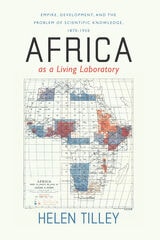
Africa as a Living Laboratory
Empire, Development, and the Problem of Scientific Knowledge, 1870-1950Helen Tilley
University of Chicago Press, 2011
Tropical Africa was one of the last regions of the world to experience formal European colonialism, a process that coincided with the advent of a range of new scientific specialties and research methods. Africa as a Living Laboratory is a far-reaching study of the thorny relationship between imperialism and the role of scientific expertise—environmental, medical, racial, and anthropological—in the colonization of British Africa.
A key source for Helen Tilley’s analysis is the African Research Survey, a project undertaken in the 1930s to explore how modern science was being applied to African problems. This project both embraced and recommended an interdisciplinary approach to research on Africa that, Tilley argues, underscored the heterogeneity of African environments and the interrelations among the problems being studied. While the aim of British colonialists was unquestionably to transform and modernize Africa, their efforts, Tilley contends, were often unexpectedly subverted by scientific concerns with the local and vernacular. Meticulously researched and gracefully argued, Africa as a Living Laboratory transforms our understanding of imperial history, colonial development, and the role science played in both.
African Underclass
Urbanization, Crime & Colonial Order in Dar es Salaam 1919-61Andrew Burton
Ohio University Press, 2005
Allegories of Empire
The Figure of Woman in the Colonial TextJenny Sharpe
University of Minnesota Press, 1993
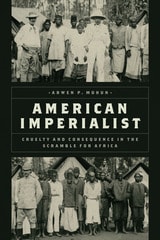
American Imperialist
Cruelty and Consequence in the Scramble for AfricaArwen P. Mohun
University of Chicago Press, 2023
Richard Dorsey Mohun spent his career circulating among the eastern United States, the cities and courts of Europe, and the African continent, as he served the US State Department at some points and King Leopold of Belgium at others. A freelance imperialist, he implemented the schemes of American investors and the Congo Free State alike. Without men like him, Africa’s history might have unfolded very differently. How did an ordinary son of a Washington bookseller become the agent of American corporate greed and European imperial ambition? Why did he choose to act in ways that ranged from thoughtless and amoral to criminal and unforgivable?
With unblinking clarity and precision, historian Arwen P. Mohun interrogates the life and actions of her great-grandfather in American Imperialist. She seeks not to excuse the man known as Dorsey but to understand how individual ambition and imperial lust fueled each other, to catastrophic ends. Ultimately, she offers a nuanced portrait of how her great-grandfather’s pursuit of career success and financial security for his family came at a tragic cost to countless Africans.

American Pentimento
The Invention of Indians and the Pursuit of RichesPatricia Seed
University of Minnesota Press, 2001
An Unformed Map
Geographies of Belonging between Africa and the CaribbeanPhilip Janzen
Duke University Press, 2025
Animalia
An Anti-Imperial Bestiary for Our TimesAntoinette Burton and Renisa Mawani, editors
Duke University Press, 2020
Contributors. Neel Ahuja, Tony Ballantyne, Antoinette Burton, Utathya Chattopadhyaya, Jonathan Goldberg-Hiller, Peter Hansen, Isabel Hofmeyr, Anna Jacobs, Daniel Heath Justice, Dane Kennedy, Jagjeet Lally, Krista Maglen, Amy E. Martin, Renisa Mawani, Heidi J. Nast, Michael A. Osborne, Harriet Ritvo, George Robb, Jonathan Saha, Sandra Swart, Angela Thompsell

Arabs of the Jewish Faith
The Civilizing Mission in Colonial AlgeriaSchreier, Joshua
Rutgers University Press, 2010
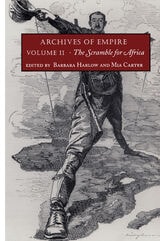
Archives of Empire
Volume 2. The Scramble for AfricaBarbara Harlow and Mia Carter, eds.
Duke University Press, 2004
While focusing on the expansion of the British Empire, The Scramble for Africa illuminates the intense nineteenth-century contest among European nations over Africa’s land, people, and resources. Highlighting the 1885 Berlin Conference in which Britain, France, Germany, Portugal, and Italy partitioned Africa among themselves, this collection follows British conflicts with other nations over different regions as well as its eventual challenge to Leopold of Belgium’s rule of the Congo. The reports, speeches, treatises, proclamations, letters, and cartoons assembled here include works by Henry M. Stanley, David Livingstone, Joseph Conrad, G. W. F. Hegel, Winston Churchill, Charles Darwin, and Arthur Conan Doyle. A number of pieces highlight the proliferation of companies chartered to pursue Africa’s gold, diamonds, and oil—particularly Cecil J. Rhodes’s British South Africa Company and Frederick Lugard’s Royal Niger Company. Other documents describe debacles on the continent—such as the defeat of General Gordon in Khartoum and the Anglo-Boer War—and the criticism of imperial maneuvers by proto-human rights activists including George Washington Williams, Mark Twain, Olive Schreiner, and E.D. Morel.
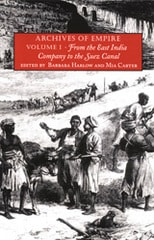
Archives of Empire
Volume I. From The East India Company to the Suez CanalBarbara Harlow and Mia Carter, eds.
Duke University Press, 2003
Tracing the beginnings of the British colonial enterprise in South Asia and the Middle East, From the Company to the Canal brings together key texts from the era of the privately owned British East India Company through the crises that led to the company’s takeover by the Crown in 1858. It ends with the momentous opening of the Suez Canal in 1869. Government proclamations, military reports, and newspaper articles are included here alongside pieces by Rudyard Kipling, Charles Dickens, John Stuart Mill, Karl Marx, Benjamin Disraeli, and many others. A number of documents chronicle arguments between mercantilists and free trade advocates over the competing interests of the nation and the East India Company. Others provide accounts of imperial crises—including the trial of Warren Hastings, the Indian Rebellion (Sepoy Mutiny), and the Arabi Uprising—that highlight the human, political, and economic costs of imperial domination and control.
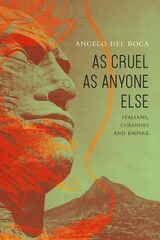
As Cruel as Anyone Else
Italians, Colonies and EmpireAngelo Del Boca
Seagull Books, 2024
Between the end of the nineteenth century and over the first half of the twentieth, Italy invaded and occupied the Horn of Africa, Libya, and several other territories. Yet recognition of this history of colonial destruction, racist violence, and genocidal aerial and chemical warfare—carried out not only during the Fascist dictatorship but also under preceding liberal governments—has been consistently repressed beneath the myth that the Italians never truly practiced colonialism.
The late journalist, historian, novelist, campaigner, and former Resistance fighter Angelo Del Boca dismantles this myth. He expertly narrates episodes of state violence committed by Italians both abroad—from Ethiopia to Slovenia, from China to Libya—and “at home” during the civil war following Unification in the 1860s or when the anti-Fascist Resistance faced off against the Republic of Salò after 1943. Attentive to the losses and pain suffered by all sides in war, Del Boca deftly demonstrates how such violence was not only a tool of domination but has also been central to creating and shaping an Italian “people.”
Drawing on a lifetime of interviews as a special correspondent, decades of work in private and state archives, and his own experiences during the Second World War, Del Boca’s popular and influential work has contributed to overturning views of Italian history. Presenting many historical episodes in English for the first time, As Cruel as Anyone Else provides a key to reading contemporary Italy, its place in international politics, and the disturbing permanence of the far-right within mainstream Italian politics.
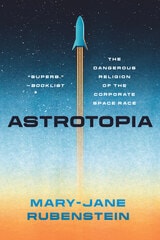
Astrotopia
The Dangerous Religion of the Corporate Space RaceMary-Jane Rubenstein
University of Chicago Press, 2022
As environmental, political, and public health crises multiply on Earth, we are also at the dawn of a new space race in which governments team up with celebrity billionaires to exploit the cosmos for human gain. The best-known of these pioneers are selling different visions of the future: while Elon Musk and SpaceX seek to establish a human presence on Mars, Jeff Bezos and Blue Origin work toward moving millions of earthlings into rotating near-Earth habitats. Despite these distinctions, these two billionaires share a core utopian project: the salvation of humanity through the exploitation of space.
In Astrotopia, philosopher of science and religion Mary-Jane Rubenstein pulls back the curtain on the not-so-new myths these space barons are peddling, like growth without limit, energy without guilt, and salvation in a brand-new world. As Rubenstein reveals, we have already seen the destructive effects of this frontier zealotry in the centuries-long history of European colonialism. Much like the imperial project on Earth, this renewed effort to conquer space is presented as a religious calling: in the face of a coming apocalypse, some very wealthy messiahs are offering an other-worldly escape to a chosen few. But Rubenstein does more than expose the values of capitalist technoscience as the product of bad mythologies. She offers a vision of exploring space without reproducing the atrocities of earthly colonialism, encouraging us to find and even make stories that put cosmic caretaking over profiteering.