Results by title
75 books match the query 'Confederate States of America' and 9 start with a
A Confederate Chronicle
The Life of a Civil War SurvivorPamela Chase Hain
University of Missouri Press, 2005
A Perfect Picture Of Hell
Eyewitness Accounts By Civil War Prisoners From 12Th IoTed Genoways
University of Iowa Press, 2000
From the shooting of an unarmed prisoner at Montgomery, Alabama, to a successful escape from Belle Isle, from the swelling floodwaters overtaking Cahaba Prison to the inferno that finally engulfed Andersonville, A Perfect Picture of Hell is a collection of harrowing narratives by soldiers from the 12th Iowa Infantry who survived imprisonment in the South during the Civil War.
Editors Ted Genoways and Hugh Genoways have collected the soldiers' startling accounts from diaries, letters, speeches, newspaper articles, and remembrances. Arranged chronologically, the eyewitness descriptions of the battles of Shiloh, Corinth, Jackson, and Tupelo, together with accompanying accounts of nearly every famous Confederate prison, create a shared vision
A Prussian Observes the American Civil War
The Military Studies of Justus ScheibertEdited & Translated by Frederic Trautmann
University of Missouri Press, 2001
Prussia, like much of nineteenth-century Germany, was governed by the belief that knowledge, and thus understanding, was best derived from direct observation and communicated through documentation. Justus Scheibert, an officer in the Royal Prussian Engineers, was therefore sent to the United States for seven months to observe the Civil War and report the effects of artillery on fortifications. His interests, however, surpassed that limited assignment, and his observations, as well as the writings translated in this work, went on to include tactics, strategy, logistics, intelligence, combined operations, and the medical service.
Scheibert, an expert on warfare, had access to the Confederate high command, including such luminaries as Robert E. Lee, J. E. B. Stuart, and Stonewall Jackson. He brought to the war not only the fresh perspective of a foreigner, but also the insightful eye of a career military officer and a skillful author and correspondent. Although he was personally sympathetic to the South, Scheibert researched both sides of the conflict in order to write unbiased, informed commentary for his fellow Prussian officers. His firsthand account of many aspects of the Civil War included a theoretical discussion of every branch of service and the Confederate high command, illustrated with his personal observations.
Sheibert's narrative portrays soldiers, weaponry, and battles, including the first, and one of the few, studies of combined operations in the Civil War. Trautmann combines two of Scheibert's publications, The Civil War in the North American States: A Military Study for the German Officer (1874) and Combined Operations by Army and Navy: A Study Illustrated by the War on the Mississippi, 1861-1863 (ca. 1887), which for decades influenced German military writing. Trautmann's translations evince the grace and achieve the readability of Scheibert's intricate and complex works.
A Prussian Observes the American Civil War makes an important addition to Civil War studies and will appeal greatly to professional historians and those interested in, and dedicated to, Civil War and military studies.
A Small but Spartan Band
The Florida Brigade in Lee's Army of Northern VirginiaZack C. Waters
University of Alabama Press, 2013
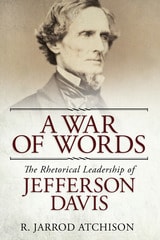
A War of Words
The Rhetorical Leadership of Jefferson DavisR. Jarrod Atchison
University of Alabama Press, 2017
Numerous biographies of Jefferson Davis have been penned; however, until now, there had been no substantive analysis of his public discourse as president of the Confederacy. R. Jarrod Atchison’s A War of Words uses concepts from rhetorical theory and public address to help answer a question that has intrigued scholars from a variety of disciplines since the collapse of the Confederacy: what role, if any, did Davis play in the collapse of Confederate nationalism?
Most discussions of Davis and nationalism focus on the military outcomes of his controversial wartime decisions. A War of Words focuses less on military outcomes and argues instead that, in the context of the Confederacy, Jefferson Davis’s rhetorical leadership should have been responsible for articulating a vision for the nation—including the core tenets of its identity, the values the nation should hold dear, the principles it should never compromise, and the goals it should set for its future. Undoubtedly, Davis possessed the skills necessary to make a persuasive public argument. It is precisely because Davis’s oratory skills were so powerful that there is room to judge how he used them. In short, being a great orator is not synonymous with successful rhetorical leadership.
Atchison posits that Davis’s initial successes constrained his rhetorical options later in the war. A War of Words concludes that, in the end, Davis’s rhetorical leadership was a failure because he was unable to articulate a coherent Confederate identity in light of the sacrifices endured by the populace in order to sustain the war effort.
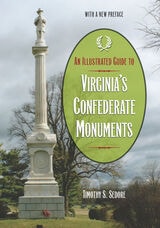
An Illustrated Guide to Virginia's Confederate Monuments
Timothy S. Sedore
Southern Illinois University Press, 2011
From well-known battlefields, such as Manassas, Fredericksburg, and Appomattox, to lesser-known sites, such as Sinking Spring Cemetery and Rude’s Hill, Sedore leads readers on a vivid journey through Virginia’s Confederate history. Tablets, monoliths, courthouses, cemeteries, town squares, battlefields, and more are cataloged in detail and accompanied by photographs and meticulous commentary. Each entry contains descriptions, fascinating historical information, and location, providing a complete portrait of each site.
Much more than a visual tapestry or a tourist’s handbook, An Illustrated Guide to Virginia’s Confederate Monuments draws on scholarly and field research to reveal these sites as public efforts to reconcile mourning with Southern postwar ideologies. Sedore analyzes in depth the nature of these attempts to publicly explain Virginia’s sense of grief after the war, delving deep into the psychology of a traumatized area. From commemorations of famous generals to memories of unknown soldiers, the dead speak from the pages of this sweeping companion to history.
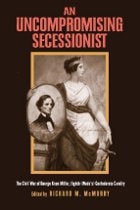
An Uncompromising Secessionist
The Civil War of George Knox Miller, Eighth (Wade's) Confederate CavalryGeorge Knox Miller, edited by Richard M. McMurry
University of Alabama Press, 2006
Offers significant insight into the life, heart, mind, and attitudes of an intelligent, educated, young mid-19th-century white Southerner
This book contains the letters of George Knox Miller who served as a line officer in the Confederate cavalry and participated in almost all of the major campaigns of the Army of Tennessee. He was, clearly, a very well-educated young man. Born in 1836 in Talladega, Alabama, he developed a great love for reading and the theater and set his sights upon getting an education that would lead to a career in law or medicine; meanwhile he worked as an apprentice in a painting firm to earn tuition. Miller then enrolled in the University of Virginia, where he excelled in his studies.
Eloquent, bordering on the lyrical, the letters provide riveting first-hand accounts of cavalry raids, the monotony of camp life, and the horror of battlefield carnage. Miller gives detailed descriptions of military uniforms, cavalry tactics, and prison conditions. He conveys a deep commitment to the Confederacy, but he was also critical of Confederate policies that he felt hindered the army's efforts. Dispersed among these war-related topics is the story of Miller's budding relationship with Celestine “Cellie” McCann, the love of his life, whom he would eventually marry.
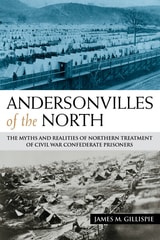
Andersonvilles of the North
The Myths and Realities of Northern Treatment of Civil War Confederate PrisonersJames M. Gillispie
University of North Texas Press, 2008
Autobiography of Samuel S. Hildebrand
The Renowned Missouri BushwhackerKirby Ross
University of Arkansas Press, 2016