Results by title
27 books match the query 'Roads'
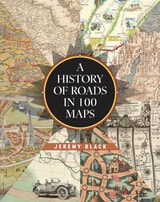
A History of Roads in 100 Maps
Jeremy Black
University of Chicago Press, 2026
A beautifully illustrated, first-of-its-kind chronicle of road maps through the ages.
Road maps are the most common form of map that most of us regularly interact with while we all seek to find our way from here to there. Today, the digital maps on our devices are just the latest in a series of cartographic innovations designed to make transportation of people and goods easier and more predictable. Whether traveling on foot, in a vehicle, or by animal, people have long created and relied on roads, and efforts to map these overland routes predate the invention of the printing press. Yet the vast majority of road maps have been produced only within the last five hundred years—and even more specifically within the last century.
Historian Jeremy Black is the first to chart the tale of road maps, beginning with the "Peutinger Map," which illustrated the roads famously connecting the Roman Empire. From the time of antiquity, Black guides the reader through the centuries all the way to the modern age, when the invention of the automobile spurred the creation of roads and road maps like nothing before. Over the course of this journey, Black illuminates the integral role maps played in the development of government infrastructures through time and across all the inhabited continents. And, arriving in the present day, Black shows how technology may soon make the paper road map obsolete even as it builds on the conventions of the preceding centuries.
Featuring a series of full-color maps from the British Library's collection and beyond, A History of Roads in 100 Maps is an eye-opening visual story of how modern civilizations traversed, constructed, and connected their worlds.
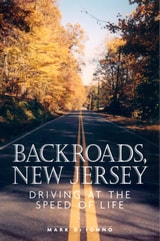
Backroads, New Jersey
Driving at the Speed of LifeDi Ionno, Mark
Rutgers University Press, 2002
Mark Di Ionno is a Jersey guy through and through. He’s lived in fifteen different towns in six different New Jersey counties. He’s been a journalist for the state’s top newspapers, currently the Star-Ledger, where his first job was to go out and write about things that were “interesting.” Who better to take readers on a personal tour of the backroads of New Jersey?
In Backroads, New Jersey, Di Ionno leads readers off the congested interstates with their commonplace scenery to the seldom-explored secondary roads, where the real life of the state can be found. These inter-county or 500 series roads are a 6,788-mile network of mostly one-lane highways. Marked by blue-and-yellow five-sided shields bearing county names, they make up more than 20 percent of New Jersey’s public roads. They are never the fastest or most direct way to get anywhere, but when you break out of the towns and hit the country, they are a pleasure to drive.
Travel with Di Ionno as he takes readers to see the state’s amazing beauty¾from the dizzying cliffs of the Palisades, to the blunted peaks of the Highlands and Kittatinny Ridges, to the rolling hills of Morris, Hunterdon, and Somerset counties, to the topsoil-wealthy agricultural belts of Monmouth and the southern counties, to the flat, sandy beaches of the 127-mile Jersey Shore. Travel with him as he shows us the homes of New Jersey’s culturally diverse population, whose men and women work at everything from farms to pharmacies, from banks to auto assembly lines. And travel with him as he recounts the history made along the back country roads in towns like Rocky Hill, where George Washington wrote his farewell orders. Di Ionno calls New Jersey “a place of infinite natural beauty, a place of intricate human patterns. A place where you can see a lot in a little time. This is, simply put, the overriding theme of this book. New Jersey is a restless state for restless people. A state for wanderers to explore.” Backroads, New Jersey is a rare chance to see it all through the eyes of a well-traveled Jerseyan. Happy wandering!
Building the King’s Highway
Labor, Society, and Family on Mexico’s Caminos Reales, 1757-1804Bruce A. Castleman
University of Arizona Press, 2005
Focusing on the camino real linking Mexico City and the port of Veracruz, Bruce Castleman has written a social history of road construction laborers in late Bourbon Mexico. He has drawn on employment and census records to study a major shift in methods used by the Spanish colonial regime to mobilize the supply of unskilled labor—and concomitant changes in the identities those laborers asserted for themselves.
Through a close analysis of wages actually paid to named individuals from one week to the next, Castleman opens a new window on Mexican history. In the 1760s, a free-wage labor regime replaced a draft-labor system, and by examining records of road construction he traces both this transformation and its implications. During this time, free-wage artisans saw their earnings reduced, and they were pushed into the labor pool, and Castleman reveals how a shift occurred in the way that laborers identified themselves as the Spanish casta system of racial classification became increasingly fluid.
In his study, Castleman introduces some of the principle players of eighteenth-century Mexico, from viceroys to tobacco planters to military engineers. He then fleshes out the lives of working persons, drawing on a complete set of construction records from the construction of the Puente de Escamela at Orizaba to forge a collective biography that considers their existences apart from the workplace. By linking census and employment records, he uncovers a host of social indicators such as marriage preference, family structure, and differences over time in how the caste system was used to classify people according to ancestry.
As Castleman shows, roads did not so much link Mexico to the global economy as forge regional markets within New Spain, and his work provides an astute analysis of struggles between the Bourbon colonial state, the important consulados of Mexico City and Veracruz, and more localized interests over road policy. More important, Building the King’s Highway provides a valuable new perspective on people’s lives as it advances our understanding of labor in late colonial Latin America.
Crooked Road
The Story of the Alaska HighwayDavid A. Remley
University of Alaska Press, 2008
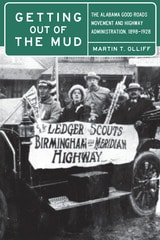
Getting Out of the Mud
The Alabama Good Roads Movement and Highway Administration, 1898–1928Martin T. Olliff, Foreword by David O. Whitten
University of Alabama Press, 2017
Recounts the history of the Good Roads Movement that arose in progressive-era Alabama, how it used the power of the state to achieve its objectives of improving market roads for farmers and highways for automobiles
Getting Out of the Mud: The Alabama Good Roads Movement and Highway Administration, 1898–1928 explores the history of the Good Roads Movement and investigates the nature of early twentieth-century progressivism in the state. Martin T. Olliff reveals how middle-class reformers secured political, economic, and social power not only by fighting against corporate domination and labor recalcitrance but also by proposing alternative projects like road improvement and identifying the interests of the rising middle class as being the most important to public interest.
With the development of national markets in the late nineteenth and early twentieth centuries, Americans began to regard the nation as a whole, rather than their state or region, as the most important political entity. Many Alabamians wished to travel beyond their local communities in all seasons without getting stuck in the mud of rudimentary rutted dirt roads. The onset of the automobile age bolstered the need for roadmaking, alerting both automobilists and good roads advocates to the possibility of a new transportation infrastructure. The Good Roads Movement began promoting farm-to-market roads, then highways that linked cities, then those that connected states. Federal matching funds for road construction after 1916 led state and federal governments to supplant the Good Roads Movement, building and administering the highway system that emerged by the late 1920s.
Olliff’s study of how Alabamians dealt with strained resources and overcame serious political obstacles in order to construct a road system that would accommodate economic growth in the twentieth century may offer clues to the resurrection of a similar strategy in our modern era. Many problems are unchanged over the hundred years between crises: Alabamians demand good roads and a government that has the capacity to build and maintain such an infrastructure while, at the same time, citizens are voting into office men and women who promise lower taxes and smaller government.
Getting There
The Epic Struggle between Road and Rail in the American CenturyStephen B. Goddard
University of Chicago Press, 1996
"This is a riveting story: of mighty railroads hamstrung almost overnight by government bureaucrats; of road interests led by General Motors Corp. conspiring in city after city to destroy efficient trolley systems . . . and of freeways that are far from free."—Bill Laitner, Detroit Free Press
"The combination of forces and fates that turned America into a giant parking lot from sea to shining sea is the subject of Stephen B. Goddard's lively pop history. . . . As Mr. Goddard ably points out, road-building and the creation of car-dependent suburbs have become ends in themselves."—James Howard Kunstler, Wall Street Journal
"The strength of Goddard's book is that he understands the complexities of manipulating public opinion to influence legislatures."—David Young, Chicago Tribune
"[Goddard's] book is a deft and easily read history of how transportation has shaped the nation and its economy, and ultimately, how a federation of truck and car interests drastically tilted national policies. . . . For many reasons this is an exceptionally important work."—Jim Dwyer, New York Newsday
Illinois Trails & Traces
Portraits and Stories along the State’s Historic RoutesText by Gary Marx and photographs by Daniel Overturf, with a foreword by Dick Durbin
Southern Illinois University Press, 2022
FINALIST, 2023 Society of Midland Authors Award in Adult Nonfiction!
Exploring Illinois history through the paths we travel
Illinois Trails & Traces partners the deft writing of Gary Marx with vivid photography by Daniel Overturf to illuminate ever evolving patterns of travel and settlement. Taking the reader on a journey down early buffalo traces and Native American trails, this book shows how these paths evolved into wagon roads and paved highways. Marx and Overturf explore historic routes ranging from Route 66 to the Underground Railroad, all the way back to post-Ice Age animal migration trails followed by Paleo-Indian people. The authors also examine how rivers, canals, and railroads spurred the rapid rise of Illinois as a modern state.
Marx and Overturf bring history into the present by including over forty photographic portraits and written profiles of individuals who live along these routes today. Many of the people you will meet on these pages work to preserve and honor the history of these passages. Others profiled here embody the spirit of the old roads and provide a vivid link between past and present. Through this journey, we discover that we’ve all been traveling the same road all along.
Infrastructural Attachments
Austerity, Sovereignty, and Expertise in KenyaEmma Park
Duke University Press, 2024
Our Way Or The Highway
Inside The Minnehaha Free StateMary Losure
University of Minnesota Press, 2002
An eyewitness account of this controversial environmental action.
Construction plans for the reroute of Highway 55 through south Minneapolis sparked an environmental movement that pitted activists against public authorities in one of the most dramatic episodes in the city’s history. Mary Losure was there; as a reporter for Minnesota Public Radio she witnessed the neighborhood’s transformation from a quiet street to the center of an emotionally charged standoff. Fueled by idealism and anger, a diverse coalition banded together to try to stop the highway expansion. Beginning in 1998, this group sustained protests for more than one year and eventually faced an unprecedented show of force by law enforcement.
In Our Way or the Highway Losure offers an inside view of the activist subculture that converged into a makeshift encampment dubbed the "Minnehaha Free State." Here, a retired stenographer befriended EarthFirst! members and appeared in the organization’s national journal, fist raised in protest of the destruction of her home. A pipe fitter abandoned his old life to defend what he believed to be the sacred sites of his Dakota ancestors. A dreamy, dreadlocked seeker hitchhiked to Minneapolis and spent days perched in a doomed cottonwood tree. A police lieutenant watched the trees fall and felt surprising sympathy for the activists’ beliefs. Engagingly written, Our Way or the Highway reveals the motivations, perceptions, and dynamics of those involved in this conflict of wills and ideals.Among the issues Losure explores are the roles of ecoanarchism and grassroots activism in the age of globalization. This fascinating subculture, brought to the spotlight during protests over the World Trade Organization in Seattle and Genoa, has been largely undocumented in the mainstream press. With a practiced reporter’s eye, Mary Losure shows the activists’ world and the way the establishment views them, and ultimately she lays bare the power of the existing order and the fragility and absolute necessity of dissent.
Reclaiming the Road
Mobility Justice beyond Complete StreetsDavid L Prytherch
University of Minnesota Press, 2025
Imagining equitable streets for all
For the past century, our roadways have been engineered as pipes for cars, but they offer vast potential as public spaces. From New York and Boston to Portland and Los Angeles, cities are rethinking their streets, going beyond sidewalks and bike lanes to welcome nonmotorists to share the asphalt roadway. Reclaiming the Road traces the historical evolution of America’s streets and explores contemporary movements to retake them from cars—temporarily and permanently—for diverse forms of mobility and community life. To share the street raises important questions of equity, in transportation and beyond. David L. Prytherch proposes a bold, intersectional vision of a more just street.
Reclaiming the Road connects cutting-edge theory, policy analysis, and firsthand accounts from those leading the charge in transforming our streets to advocate for changing how we think about and design roads. Prytherch features case studies of nine major cities in the United States to show how experiments in reclaiming streets accelerated during the Covid-19 pandemic to become lasting changes. Through in-depth interviews, he shares stories of how planners, transportation advocates, and community leaders have implemented innovative programs for slowing neighborhood streets, opening roads for walking and biking, and reconstructing roadways with public parklets and street plazas as social spaces for curbside conversation.
Examining movements to transform streets through the lenses of equity and justice, Reclaiming the Road tackles the conceptual challenge of defining mobility justice and the practicalities of planning a more just public street, offering a compelling vision for the future of America’s public spaces.
Retail e-book files for this title are screen-reader friendly with images accompanied by short alt text and/or extended descriptions.
Rethinking America's Highways
A 21st-Century Vision for Better InfrastructureRobert W. Poole Jr.
University of Chicago Press, 2018
In Rethinking America’s Highways, Poole examines how our current model of state-owned highways came about and why it is failing to satisfy its customers. He argues for a new model that treats highways themselves as public utilities—like electricity, telephones, and water supply. If highways were provided commercially, Poole argues, people would pay for highways based on how much they used, and the companies would issue revenue bonds to invest in facilities people were willing to pay for. Arguing for highway investments to be motivated by economic rather than political factors, this book makes a carefully-reasoned and well-documented case for a new approach to highways that is sure to inform future decisions and policies for U.S. infrastructure.
Roads in the Wilderness
Conflict in Canyon CountryJedediah S. Rogers
University of Utah Press, 2013
Winner of the Wallace Stegner Prize in American Environmental or Western History
The canyon country of southern Utah and northern Arizona—a celebrated desert of rock and sand punctuated by gorges and mesas—is a region hotly contested among vying and disparate interests, from industrial developers to wilderness preservation advocates. Roads are central to the conflicts raging in an area perceived as one of the last large roadless places in the continental United States. The canyon country in fact contains an extensive network of dirt trails and roads, many originally constructed under the authority of a one-sentence statute in an 1866 mining law, later known as R.S. 2477. While well-groomed and paved roads came to signify the industrialization of the modern age, twentiethcentury conservationists have regarded roads as intrusive human imprints on the nation’s wild lands. Roads connect rural communities, spur economic growth, and in some cases blend harmoniously into the landscape, but they also fracture and divide, disturb wildlife and habitat, facilitate industrial development, and spoil wilderness.
Roads of Excess, Palaces of Wisdom
Eroticism and Reflexivity in the Study of MysticismJeffrey J. Kripal
University of Chicago Press, 2001
In his new book, Kripal addresses the twentieth-century study of mysticism as a kind of mystical tradition in its own right, with its own unique histories, discourses, sociological dynamics, and rhetorics of secrecy. Fluidly combining autobiography and biography with scholarly exploration, Kripal takes us on a tour of comparative mystical thought by examining the lives and works of five major historians of mysticism—Evelyn Underhill, Louis Massignon, R. C. Zaehner, Agehananda Bharati, and Elliot Wolfson—as well as relating his own mystical experiences. The result, Kripal finds, is seven "palaces of wisdom": the religious power of excess, the necessity of distance in the study of mysticism, the relationship between the mystical and art, the dilemmas of male subjectivity and modern heterosexuality, a call for ethical criticism, the paradox of the insider-outsider problem in the study of religion, and the magical power of texts and their interpretation.
An original and penetrating analysis of modern scholarship and scholars of mysticism, Roads of Excess, Palaces of Wisdom is also a persuasive demonstration of the way this scholarly activity is itself a mystical phenomenon.
Roads of Home
Beck, Henry
Rutgers University Press, 1983
Long regarded as folklife classics, Henry Charlton Beck's books are vivid recreations of the back roads, small towns, and legends that give New Jersey its special character. Father Henry Charlton Beck, who lived in New Jersey nearly all his life, was the author of numerous books on New Jersey folklife, state editor of the Camden Courier-Post, and writer for the Newark Star-Ledger. He is considered New Jersey's first folklorist and his painstaking work has left us with a rich collection of tales.

Roads to Dystopia
Sociological Essays on the Postmodern ConditionStanford Lyman
University of Arkansas Press, 2001
Roads to Renewal
The Report of Activities and Accomplishments of the Civil Works Administration in Michigan, November 1933–March 1934James R. Anderson
Michigan State University Press, 2020

Roads to Rome
A Guide to Notable Converts from Britain and Ireland from the Reformation to theJohn Beaumont
St. Augustine's Press, 2010
To be a Christian is to be a convert. The word “convert” applies in a real sense both to cradle-born Catholics and to those, traditionally regarded as converts, who become Catholics as adults. The Catholic Church is the divinely established framework of the program of a conversion, which Christ presented as a thorough change of mind and heart (metanoia). While for a cradle-born Catholic the implementation of that program is usually a gradual process, for converts it contains a momentous act as they vote, so to speak, with their feet, on behalf of Truth, by joining the Church as the One True Fold, the Sole Ark of Salvation, to recall hallowed phrases dear to John Henry Newman, easily the greatest convert during the nineteenth century.
The aim of this book is to summarize the lives of notable converts from Britain and Ireland and explain (by reference to quotations from their writings) why they entered the Catholic Church. These reasons were many. Some looked chiefly at history and saw the apostolic Church in their day to be residing in the Catholic communion. Others, though appreciating the fact of the gift of faith, saw reason as the chief support of the step they were taking. To yet others it was the endurance of both the Church and that remarkable office of the papacy that proved the necessary stimulus. Many were inspired by the witness of some unsung saint in their neighbourhood. Some were eminent even before their “move to Rome,” others almost completely unknown. Some found fame on their conversion, others suffered greatly for their zeal for the one true fold of Christ. Some came into the Church relatively early in life, others entered at the final hour, even while on their death bed.
Taken altogether these accounts provide a profound and moving witness to the operation of divine grace in human souls.
Roads, Runways and Resistance
From the Newbury Bypass to Extinction RebellionSteve Melia
Pluto Press, 2021
'As a movement for social change it is important that we understand our own history. This is a compelling read.'
From the anti-roads protests of the 1990s to HS2 and Extinction Rebellion, conflict and protest have shaped the politics of transport. In 1989, Margaret Thatcher's government announced 'the biggest road-building programme since the Romans.' This is the inside story of the thirty tumultuous years that have followed.
Roads, Runways and Resistance draws on over 50 interviews with government ministers, advisors and protestors - many of whom, including 'Swampy', speak here for the first time about the events they describe. It is a story of transport ministers undermined by their own Prime Ministers, protestors attacked or quietly supported by the police, and smartly-dressed protestors who found a way onto the roof of the Houses of Parliament.
Today, as a new wave of road building and airport expansion threatens to bust Britain's carbon budgets, climate change protestors find themselves on a collision course with the government. Melia asks, what difference did the protests of the past make? And what impacts might today's protest movements have on the transport of the future?
Roads, Where There Are No Roads
A NovelAngela Jackson
Northwestern University Press, 2017
In this highly anticipated sequel to her acclaimed first novel, Where I Must Go, Angela Jackson continues the remarkable story of Magdalena Grace. As a black student at the predominantly white Eden University, Maggie found herself deeply involved in conflict. Now, out in the wider world, she and her beloved Treemont Stone evolve into agents of change as they become immersed in the historical events unfolding around them—the movements advocating for civil rights, black consciousness, black feminism, the rights of the poor, and an end to the war in Vietnam. Rendered in prose so lyrical and luminous as to suggest a dream, Roads, Where There Are No Roads is a love story in the greatest sense, celebrating love between a man and a woman, between family members, and among the members of a community whose pride pushes them to rise up and resist. This gorgeously written novel will resonate with readers today as incredibly relevant, uplifting hearts and causing eyes to water with sorrow and delight.

Snake's Daughter
The Roads in and out of WarGail Hosking Gilberg
University of Iowa Press, 1997
Gail Hosking Gilberg's father was a hero, a valiant soldier decorated posthumously with the Medal of Honor, a man who served his country throughout his entire adult life. But Charles Hosking was a mystery to his daughter. He was killed in Vietnam a week after her seventeenth birthday. She buried the war, the protests, the medal, and her military upbringing along with her father, so much so that she felt cut off from herself. It took more than twenty years for her to recognize the stirrings of a father and a daughter not yet at peace.
Gilberg began a journey—two journeys really—to find out who her father was and in the process to find herself. She explored her buried rage, shame, and silence, and examined how war had shaped her life. In studying the photo albums that her father had left behind, Gilberg found that the photographs demanded that she give voice to her feelings, then release her silent words, words that had no meaning in war for her father yet had all the meaning in the world for her. The result was an epiphany. The photographs became the roads she took in and out of war, and her words brought her father home. Snake's Daughter reveals the crossroads where a soldier father's life and a daughter's life connect.
Snake's Daughter is an arresting and anguished narrative that gives voice to an experience Gail Hosking Gilberg shares with thousands of Americans, including military “brats” whose parents served their country and often gave their lives in the process.
The Appian Way
Ghost Road, Queen of RoadsRobert A. Kaster
University of Chicago Press, 2012
The Roman poet Statius called the via Appia “the Queen of Roads,” and for nearly a thousand years that description held true, as countless travelers trod its path from the center of Rome to the heel of Italy. Today, the road is all but gone, destroyed by time, neglect, and the incursions of modernity; to travel the Appian Way today is to be a seeker, and to walk in the footsteps of ghosts.
Our guide to those ghosts—and the layers of history they represent—is Robert A. Kaster. In The Appian Way, he brings a lifetime of studying Roman literature and history to his adventures along the ancient highway. A footsore Roman soldier pushing the imperial power south; craftsmen and farmers bringing their goods to the towns that lined the road; pious pilgrims headed to Jerusalem, using stage-by-stage directions we can still follow—all come to life once more as Kaster walks (and drives—and suffers car trouble) on what’s left of the Appian Way. Other voices help him tell the story: Cicero, Goethe, Hawthorne, Dickens, James, and even Monty Python offer commentary, insight, and curmudgeonly grumbles, their voices blending like the ages of the road to create a telescopic, perhaps kaleidoscopic, view of present and past.
To stand on the remnants of the Via Appia today is to stand in the pathway of history. With The Appian Way, Kaster invites us to close our eyes and walk with him back in time, to the campaigns of Garibaldi, the revolt of Spartacus, and the glory days of Imperial Rome. No traveler will want to miss this fascinating journey.
The Cultural Life of the Automobile
Roads to ModernityBy Guillermo Giucci
University of Texas Press, 2012
From its invention in Europe at the end of the nineteenth century, the automobile crisscrossed the world, completely took over the cities, and became a feature of daily life. Considered basic to the American lifestyle, the car reflected individualism, pragmatism, comfort, and above all modernity. In Latin America, it served as a symbol of distinction, similar to jewelry or fine clothing. In The Cultural Life of the Automobile, Guillermo Giucci focuses on the automobile as an instrument of social change through its “kinetic modernity” and as an embodiment of the tremendous social impact of technology on cultural life.
Material culture—how certain objects generate a wide array of cultural responses—has been the focus of much scholarly discussion in recent years. The automobile wrought major changes and inspired images in language, literature, and popular culture. Focusing primarily on Latin America but also covering the United States, Europe, Asia, and Africa, Giucci examines how the automobile was variously adapted by different cultures and how its use shaped and changed social and economic relationships within them. At the same time, he shows how the “automobilization” of society became an essential support for the development of modern individualism, and the automobile its clearest material manifestation.
The Jefferson Highway
Blazing the Way from Winnepeg to New OrleansLyell D. Henry Jr.
University of Iowa Press, 2016
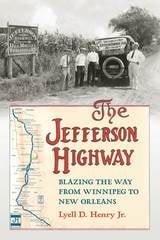
The plight of the rapidly rising numbers of early motorists soon spawned a “good roads” movement that included many efforts to build and pave long-distance, colorfully named auto trails across the length and breadth of the nation. Full of a can-do optimism, these early partisans of motoring sought to link together existing roads and then make them fit for automobile driving—blazing, marking, grading, draining, bridging, and paving them. The most famous of these named highways was the Lincoln Highway between New York City and San Francisco. By early 1916, a proposed counterpart coursing north and south from Winnipeg to New Orleans had also been laid out.
Called the Jefferson Highway, it eventually followed several routes through Minnesota, Iowa, Missouri, Kansas, Oklahoma, Texas, Arkansas, and Louisiana. The Jefferson Highway, the first book on this pioneering road, covers its origin, history, and significance, as well as its eventual fading from most memories following the replacement of names by numbers on long-distance highways after 1926. Saluting one of the most important of the early named highways on the occasion of its 100th anniversary, historian Lyell D. Henry Jr. contributes to the growing literature on the earliest days of road-building and long-distance motoring in the United States. For readers who might also want to drive the original route of the Jefferson Highway, three chapters trace that route through Iowa, pointing out many vintage features of the roadside along the way. The perfect book for a summer road trip!
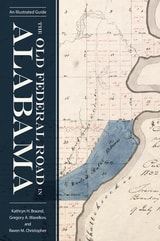
The Old Federal Road in Alabama
An Illustrated GuideKathryn H. Braund, Gregory A. Waselkov, and Raven M. Christopher
University of Alabama Press, 2019
A concise illustrated guidebook for those wishing to explore and know more about the storied gateway that made possible Alabama's development.
Forged through the territory of the Creek Nation by the United States federal government, the Federal Road was developed as a communication artery linking the east coast of the United States with Louisiana. Its creation amplified already tense relationships between the government, settlers, and the Creek Nation, culminating in the devastating Creek War of 1813–1814, and thereafter it became the primary avenue of immigration for thousands of Alabama settlers.
Central to understanding Alabama’s territorial and early statehood years, the Federal Road was both a physical and symbolic thoroughfare that cut a swath of shattering change through the land and cultures it traversed. The road revolutionized Alabama’s expansion, altering the course of its development by playing a significant role in sparking a cataclysmic war, facilitating unprecedented American immigration, and enabling an associated radical transformation of the land itself.
The first half of The Old Federal Road in Alabama: An Illustrated Guide offers a narrative history that includes brief accounts of the construction of the road, the experiences of historic travelers, and descriptions of major changes to the road over time. The authors vividly reconstruct the course of the road in detail and make use of a wealth of well-chosen illustrations. Along the way they give attention to the very terrain it traversed, bringing to life what traveling the road must have been like and illuminating its story in a way few others have ever attempted.
The second half of the volume is divided into three parts—Eastern, Central, and Southern—and serves as a modern traveler’s guide to the Federal Road. This section includes driving tours and maps, highlighting historical sites and surviving portions of the old road and how to visit them.
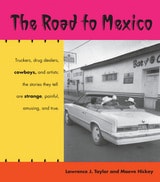
The Road to Mexico
Lawrence J. Taylor and Maeve Hickey
University of Arizona Press, 1997
Equipped with camera, pen, and a lively curiosity, photographer Maeve Hickey and writer Lawrence J. Taylor set out to capture whatever might come their way on the road to Mexico. They roamed and rambled, they stayed well off the beaten track, and they talked to nearly everyone they met, from wisecracking waitresses to landed gentry to street urchins dressed in rags. Their book brings to life the calf ropers and casinos, the saints and sinners, the mariachis and miracles in a no-man's-land that sometimes seems to belong neither to the United States nor to Mexico.
Following the footsteps of earlier travelers-traders, warriors, missionaries, and explorers-these modern pilgrims take a hands-on approach to their journey. Throughout, both writer and photographer convey the sizzle and spice of a land where Indian, Mexican, and Anglo worlds have collided, coexisted, and melted into each other for centuries. Their eye for the hidden telling detail carries the reader straight into the action, and their zest for excitement spurs any traveler to drop everything, grab a bag, and hit the road to Mexico.
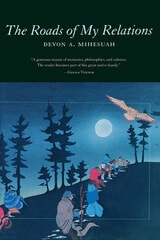
The Roads of My Relations
Devon A. Mihesuah
University of Arizona Press, 2001
"I've traveled a lot of roads, but never alone. My relations are with me," says Billie McKenney, one of the matriarchs of the complex family of Choctaws searching for peace as the white world rapidly encroaches on their tribal land, politics, and values. In her first collection of stories, Native American writer Devon A. Mihesuah chronicles the lives of several generations of a close-knit Choctaw family as they are forced from their traditional homeland in nineteenth-century Mississippi and endure unspeakable sorrows during their journey before settling in southeastern Oklahoma.
Blending family lore, stark realism, and vivid imagination, The Roads of My Relations relays a strong sense of Choctaw culture and world view in absorbing tales of history and legend. Unfolding through the voices and actions of family members, confused half-bloods, and unlikely heroes—not all of them living or even human—the stories tell of the horrors of forced removal, the turbulence of post Civil War Indian Territory, the terrifying violence suffered at the hands of immortal Crow witches, and the family's ultimate survival against forces of evil. Time-traveling ghosts, mysterious medicine men, and eerie shape-shifters share the pages with proud matriarchs, mischievous schoolgirls, and loving siblings.
Together, these interwoven stories express the strength and persistence of a tribe whose identity and pride have survived the disruptions of colonialism. With The Roads of My Relations, Devon A. Mihesuah has created a universal and timeless exploration of heritage, spirituality, and the importance of preserving and passing on tradition.
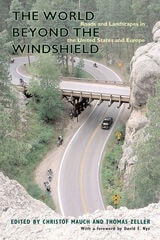
The World beyond the Windshield
Roads and Landscapes in the United States and EuropeChristof Mauch
Ohio University Press, 2008
For better or worse, the view through a car’s windshield has redefined how we see the world around us. In some cases, such as the American parkway, the view from the road was the be-all and end-all of the highway; in others, such as the Italian autostrada, the view of a fast, efficient transportation machine celebrating either Fascism or its absence was the goal. These varied environments are neither necessary nor accidental but the outcomes of historical negotiations, and whether we abhor them or take delight in them, they have become part of the fabric of human existence.
The World beyond the Windshield: Roads and Landscapes in the United States and Europe is the first systematic, comparative look at these landscapes. By looking at examples from the United States and Europe, the chapters in this volume explore the relationship between the road and the landscape thatit traverses, cuts through, defines, despoils, and enhances. The authors analyze the Washington Beltway and the Blue Ridge Parkway, as well as iconic roads in Italy, Nazi Germany, East Germany, and Great Britain. This is a story of the transatlantic exchange of ideas about environment and technology and of the national and nationalistic appropriations of such landscaping.