Results by title
120 books match the query 'Cultural Policy' and 11 start with a
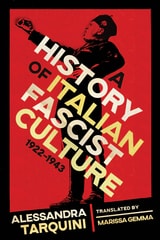
A History of Italian Fascist Culture, 1922–1943
Alessandra Tarquini, Translated by Marissa Gemma
University of Wisconsin Press, 2022
Tarquini sketches the universe of Italian fascism in three broad directions: the regime’s cultural policies, the condition of various art forms and scholarly disciplines, and the ideology underpinning the totalitarian state. She details the choices the ruling class made between 1922 and 1943, revealing how cultural policies shaped the country and how intellectuals and artists contributed to those decisions. The result is a view of fascist ideology as a system of visions, ideals, and, above all, myths capable of orienting political action and promoting a precise worldview.
Building on George L. Mosse’s foundational research, Tarquini provides the best single-volume work available to fully understand a complex and challenging subject. It reveals how the fascists used culture—art, cinema, music, theater, and literature—to build a conservative revolution that purported to protect the traditional social fabric while presenting itself as maximally oriented toward the future.
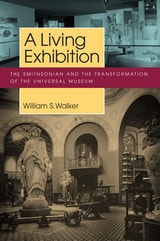
A Living Exhibition
The Smithsonian and the Transformation of the Universal MuseumWilliam S. Walker
University of Massachusetts Press, 2013
Since its founding in 1846 “for the increase and diffusion of knowledge,” the Smithsonian Institution has been an important feature of the American cultural landscape. In A Living Exhibition, William S. Walker examines the tangled history of cultural exhibition at the Smithsonian from its early years to the chartering of the National Museum of the American Indian in 1989. He tracks the transformation of the institution from its original ideal as a “universal museum” intended to present the totality of human experience to the variegated museum and research complex of today.
Walker pays particular attention to the half century following World War II, when the Smithsonian significantly expanded. Focusing on its exhibitions of cultural history, cultural anthropology, and folk life, he places the Smithsonian within the larger context of Cold War America and the social movements of the 1960s, '70s, and '80s. Organized chronologically, the book uses the lens of the Smithsonian's changing exhibitions to show how institutional decisions become intertwined with broader public debates about pluralism, multiculturalism, and decolonization.
Yet if a trend toward more culturally specific museums and exhibitions characterized the postwar history of the institution, its leaders and curators did not abandon the vision of the universal museum. Instead, Walker shows, even as the Smithsonian evolved into an extensive complex of museums, galleries, and research centers, it continued to negotiate the imperatives of cultural convergence as well as divergence, embodying both a desire to put everything together and a need to take it all apart.
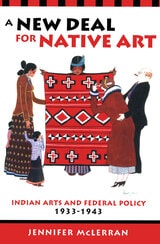
A New Deal for Native Art
Indian Arts and Federal Policy, 1933-1943Jennifer McLerran
University of Arizona Press, 2009
In A New Deal for Native Art, Jennifer McLerran reveals how positioning the native artist as a pre-modern Other served the goals of New Deal programs—and how this sometimes worked at cross-purposes with promoting native self-sufficiency. She describes federal policies of the 1930s and early 1940s that sought to generate an upscale market for Native American arts and crafts. And by unraveling the complex ways in which commodification was negotiated and the roles that producers, consumers, and New Deal administrators played in that process, she sheds new light on native art’s commodity status and the artist’s position as colonial subject.
In this first book to address the ways in which New Deal Indian policy specifically advanced commodification and colonization, McLerran reviews its multi-pronged effort to improve the market for Indian art through the Indian Arts and Crafts Board, arts and crafts cooperatives, murals, museum exhibits, and Civilian Conservation Corps projects. Presenting nationwide case studies that demonstrate transcultural dynamics of production and reception, she argues for viewing Indian art as a commodity, as part of the national economy, and as part of national political trends and reform efforts.
McLerran marks the contributions of key individuals, from John Collier and Rene d’Harnoncourt to Navajo artist Gerald Nailor, whose mural in the Navajo Nation Council House conveyed distinctly different messages to outsiders and tribal members. Featuring dozens of illustrations, A New Deal for Native Art offers a new look at the complexities of folk art “revivals” as it opens a new window on the Indian New Deal.
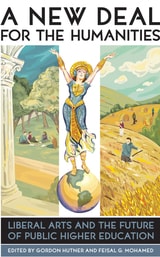
A New Deal for the Humanities
Liberal Arts and the Future of Public Higher EducationHutner, Gordon
Rutgers University Press, 2015
The contributors offer spirited and thought-provoking debates on a diverse range of topics. For instance, they deplore the push by administrations to narrow learning into quantifiable outcomes as well as the demands of state governments for more practical, usable training. Indeed, for those who suggest that a college education should be “practical”—that it should lean toward the sciences and engineering, where the high-paying jobs are—this book points out that while a few nations produce as many technicians as the United States does, America is still renowned worldwide for its innovation and creativity, skills taught most effectively in the humanities. Most importantly, the essays in this collection examine ways to make the humanities even more effective, such as offering a broader array of options than the traditional major/minor scheme, options that combine a student’s professional and intellectual interests, like the new medical humanities programs.
A democracy can only be as energetic as the minds of its citizens, and the questions fundamental to the humanities are also fundamental to a thoughtful life. A New Deal for the Humanities takes an intrepid step in making the humanities—and our citizens—even stronger in the future.
A Righteous Smokescreen
Postwar America and the Politics of Cultural GlobalizationSam Lebovic
University of Chicago Press, 2022
When the dust settled after World War II, the United States stood as the world’s unquestionably pre-eminent military and economic power. In the decades that followed, the country exerted its dominant force in less visible but equally powerful ways, too, spreading its trade protocols, its media, and—perhaps most importantly—its alleged values. In A Righteous Smokescreen, Sam Lebovic homes in on one of the most prominent, yet ethereal, of those professed values: the free flow of information. This trope was seen as capturing what was most liberal about America’s self-declared leadership of the free world. But as Lebovic makes clear, even though diplomats and public figures trumpeted the importance of widespread cultural exchange, these transmissions flowed in only one direction: outward from the United States. Though other countries did try to promote their own cultural visions, Lebovic shows that the US moved to marginalize or block those visions outright, highlighting the shallowness of American commitments to multilateral institutions, the depth of its unstated devotion to cultural and economic supremacy, and its surprising hostility to importing foreign cultures. His book uncovers the unexpectedly profound global consequences buried in such ostensibly mundane matters as visa and passport policy, international educational funding, and land purchases for embassies. Even more crucially, A Righteous Smokescreen does nothing less than reveal that globalization was not the inevitable consequence of cultural convergence or the natural outcome of putatively free flows of information—it was always political to its core.
A World Transformed
The Politics of Culture in Revolutionary Vietnam, 1945-1965Kim N. B. Ninh
University of Michigan Press, 2002
The study covers the period from the Vietnamese communists' initial ascent to power in 1945 to the beginning of the escalation of the American involvement in the country's conflict in 1965, by which time a full-fledged socialist state had been in place in North Vietnam for eleven years. Through a nuanced examination of critical intellectual works, A World Transformed presents a complex view of a period fraught with contradictory possibilities and tensions that continue to resonate in Vietnam today. The extensive use of Vietnamese-language materials, access to archival data never before available, and innovative incorporation of literary and historical sources combine to make this study an invaluable depiction of the Vietnamese revolution.
Kim N. B. Ninh is Assistant Director of the Governance, Law, and Civil Society Programs, The Asia Foundation, San Francisco.

Against the Tide
Immigrants, Day Laborers, and Community in Jupiter, FloridaSandra Lazo de la Vega and Timothy J. Steigenga
University of Wisconsin Press, 2013
At the beginning of the twenty-first century, Jupiter was in the throes of immigration debates. A decade earlier, this small town had experienced an influx of migrants from Mexico and Guatemala. Immigrants seeking work gathered daily on one of the city’s main streets, creating an ad-hoc, open-air labor market that generated complaints and health and human safety concerns. What began as a local debate rapidly escalated as Jupiter’s situation was thrust into the media spotlight and attracted the attention of state and national anti-immigrant groups. But then something unexpected happened: immigrants, neighborhood residents, university faculty and students, and town representatives joined together to mediate community tensions and successfully moved the informal labor market to the new El Sol Neighborhood Resource Center.
Timothy J. Steigenga, who helped found the center, and Lazo de la Vega, who organized students in support of its mission, describe how El Sol engaged the residents of Jupiter in a two-way process of immigrant integration and helped build trust on both sides. By examining one city’s search for a positive public policy solution, Against the Tide offers valuable practical lessons for other communities confronting similar challenges.
American Girls and Global Responsibility
A New Relation to the World during the Early Cold WarHelgren, Jennifer
Rutgers University Press, 2017
Jennifer Helgren argues that a new internationalist girl citizenship took root in the country in the years following World War II in youth organizations such as Camp Fire Girls, Girl Scouts, YWCA Y-Teens, schools, and even magazines like Seventeen. She shows the particular ways that girls’ identities and roles were configured, and reveals the links between internationalist youth culture, mainstream U.S. educational goals, and the U.S. government in creating and marketing that internationalist girl, thus shaping the girls’ sense of responsibilities as citizens.
Americans All
Good Neighbor Cultural Diplomacy in World War IIBy Darlene J. Sadlier
University of Texas Press, 2012
Cultural diplomacy—“winning hearts and minds” through positive portrayals of the American way of life—is a key element in U.S. foreign policy, although it often takes a backseat to displays of military might. Americans All provides an in-depth, fine-grained study of a particularly successful instance of cultural diplomacy—the Office of the Coordinator of Inter-American Affairs (CIAA), a government agency established by President Franklin D. Roosevelt in 1940 and headed by Nelson A. Rockefeller that worked to promote hemispheric solidarity and combat Axis infiltration and domination by bolstering inter-American cultural ties.
Darlene J. Sadlier explores how the CIAA used film, radio, the press, and various educational and high-art activities to convince people in the United States of the importance of good neighbor relations with Latin America, while also persuading Latin Americans that the United States recognized and appreciated the importance of our southern neighbors. She examines the CIAA’s working relationship with Hollywood’s Motion Picture Society of the Americas; its network and radio productions in North and South America; its sponsoring of Walt Disney, Orson Welles, John Ford, Gregg Toland, and many others who traveled between the United States and Latin America; and its close ties to the newly created Museum of Modern Art, which organized traveling art and photographic exhibits and produced hundreds of 16mm educational films for inter-American audiences; and its influence on the work of scores of artists, libraries, book publishers, and newspapers, as well as public schools, universities, and private organizations.
At the Core and in the Margins
Incorporation of Mexican Immigrants in Two Rural Midwestern CommunitiesJulia Albarracín
Michigan State University Press, 2016
Based on 260 surveys and 47 in-depth interviews, this study combines quantitative and qualitative research to explore the level and characteristics of immigrant incorporation in Beardstown and Monmouth. It assesses the advancement of immigrants in the immigration/ residency/citizenship process, the immigrants’ level of cultural integration (via language, their connectedness with other members of society, and their relationships with neighbors), the degree and characteristics of discrimination against immigrants in these two towns, and the extent to which immigrants participate in different social and political activities and trust government institutions.
Immigrants in new destinations are likely to be poorer, to be less educated, and to have weaker English-language skills than immigrants in traditional destinations. Studying how this population negotiates the obstacles to and opportunities for incorporation is crucial.
Authentically African
Arts and the Transnational Politics of Congolese CultureSarah Van Beurden
Ohio University Press, 2015
Together, the Royal Museum for Central Africa in Tervuren, Belgium, and the Institut des Musées Nationaux du Zaire (IMNZ) in the Congo have defined and marketed Congolese art and culture. In Authentically African, Sarah Van Beurden traces the relationship between the possession, definition, and display of art and the construction of cultural authenticity and political legitimacy from the late colonial until the postcolonial era. Her study of the interconnected histories of these two institutions is the first history of an art museum in Africa, and the only work of its kind in English.
Drawing on Flemish-language sources other scholars have been unable to access, Van Beurden illuminates the politics of museum collections, showing how the IMNZ became a showpiece in Mobutu’s effort to revive “authentic” African culture. She reconstructs debates between Belgian and Congolese museum professionals, revealing how the dynamics of decolonization played out in the fields of the museum and international heritage conservation. Finally, she casts light on the art market, showing how the traveling displays put on by the IMNZ helped intensify collectors’ interest and generate an international market for Congolese art.
The book contributes to the fields of history, art history, museum studies, and anthropology and challenges existing narratives of Congo’s decolonization. It tells a new history of decolonization as a struggle over cultural categories, the possession of cultural heritage, and the right to define and represent cultural identities.