230 books match the query 'Doctrines' and 25 start with a
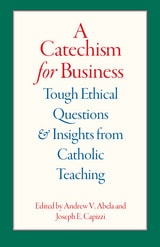
cover of A Catechism For Business

A Catechism For Business

Andrew V. Abela

Catholic University of America Press, 2014
A Catechism for Business presents the teachings of the Catholic Church as they relate to more than one hundred specific and challenging moral questions that have been asked by business leaders. Andrew V. Abela and Joseph E. Capizzi have assembled the relevant quotations from recent Catholic social teaching as responses to these questions. Questions and answers are grouped under major topics such as marketing, finance, and investment. Business ethics questions can be too subtle for definitive yes / no answers, so the book offers no more and no less than church teaching on each particular question. Where the church has offered definitive answers, the book provides them. When the church has not, the book offers guidelines for reflection and insights into what one should consider in given situations.
[more]
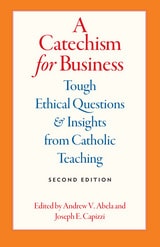
cover of A Catechism for Business

A Catechism for Business

Andrew V. Abela

Catholic University of America Press, 2016

This second edition streamlines some of the editing from the first addition, and more importantly, includes material from Pope Francis's encyclical, Laudato Si’, and his apostolic exhortation, Evangelii Gaudium. A Catechism for Business presents the teachings of the Catholic Church as they relate to more than one hundred specific and challenging moral questions as they have been asked by business leaders. Andrew V. Abela and Joseph E. Capizzi have assembled the relevant quotations from recent Catholic social teaching as responses to these questions. Questions and answers are grouped together under major topics such as marketing, finance and investment. The book's easy-to-use question and answer approach invites quick reference for tough questions and serves as a basis for reflection and deeper study in the rich Catholic tradition of social doctrine.
[more]
cover of A Catechism for Family Life

A Catechism for Family Life

Sarah Bartel

Catholic University of America Press, 2018

The purpose of A Catechism for Family Life: Insights from Catholic Teaching on Love, Marriage, Sex, and Parenting is to present the teachings of the Catholic Church as they relate to specific questions in marriage and family life. Many Catholics are under-catechized and have trouble both understanding and articulating Church teaching on sexuality and marriage to an increasingly challenging culture. Pope Francis, along with the fathers of the two recent Synods on the Family, have called for better formation for those who work in the area of marriage and family life (see Amoris Laetitia, 202).

To address this need, we gathered pertinent questions facing men, women, and pastoral workers in marriage and family life. We then found passages relevant to these questions by researching Church documents on marriage and family from the past one hundred years. These include papal encyclicals, apostolic exhortations, and addresses, Vatican II documents, and the Catechism of the Catholic Church.

Mainstream media coverage of Church events and Church teaching leads many to misunderstand Catholic positions on marriage and family life. While the Catholic Church has developed a rich, detailed, and positive teaching on marriage, family, and sexuality, many Catholics do not have access to this teaching, buried as it is in lengthy Church documents which many find intimidating. Finding the relevant teaching to address specific questions is not always a simple task, either. This book’s main contribution is to present Church teaching relevant to marriage and family in one volume clearly organized by topic and question.
[more]
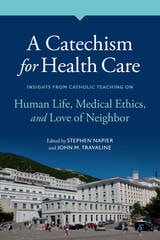
cover of A Catechism for Health Care: Insights from Catholic Teaching on Human Life, Medical Ethics, and Love of Neighbor

A Catechism for Health Care

Insights from Catholic Teaching on Human Life, Medical Ethics, and Love of Neighbor

Stephen Napier

Catholic University of America Press, 2024
The Catholic Church’s teachings on ethical issues arising in healthcare delivery and biomedical science are distributed across a plethora of different places ranging from papal allocutions, encyclicals, instructions by the Congregation for the Doctrine of the Faith, and guidance documents authored by various congregations of bishops. Furthermore, they are distributed throughout time ranging from, for example, the Didache (or teaching of the 12 apostles, circa 1st Century), to Pope Pius XII’s address in 1954 addressing ethical issues in transplantation, and onto the 2009 instruction entitled Dignitas personae. It is difficult for a wider audience to make sense of these sources on the various issues arising in healthcare delivery and scientific research, but the editors of A Catechism for Health Care have collated them in a way that makes them easier to understand The purpose of this book is to present the teachings of the Catholic Church as they pertain to ethical issues arising in the healthcare and biomedical sciences. The premise of the project is that the Catholic Church’s teaching speaks in an accessible way to a wide range of people concerned about healthcare ethics. It is important to present these teachings concisely. The book is ordered around numerous questions concerning the most common practices in health care that have ethical dimensions. It then provides concise answers to these questions as are found in various magisterial Church documents. These answers are refreshingly clear and to the point.
[more]
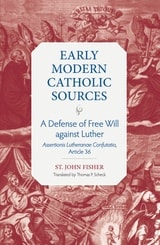
cover of A Defense of Free Will Against Luther: Assertionis Lutheranae Confutatio, Article 36

A Defense of Free Will Against Luther

Assertionis Lutheranae Confutatio, Article 36

Thomas P. St. John Fisher

Catholic University of America Press, 2024
Lord Acton said that of all the works written against Martin Luther in the beginning of the Reformation, Bishop John Fisher of Rochester's Assertionis Lutheranae Confutatio of 1523 was the most important. Oddly enough this massive work of Catholic apologetics, compsed in Latin, has never been rendered into the English language. It contains Fisher's detailed responses to all forty-one articles defended by Martin Luther against the censures of Pope Leo X found in the bull Exsurge Domine (1520). In this volume Thomas Scheck presents for the first time in English translation, introduced, and annotated, Fisher's Preface to the Reader, Ten Truths, and the most important single article found in Fisher's Confutation, namely his Confutation of Luther's Assertion of Article 36, in which Fisher defends the existence of free will against Luther's claim that free will is a fiction with no reality. Fisher's reply is thoroughly grounded in Scripture and in the interpretation of Scripture found in the ancient Fathers of the Church. Interestingly to defend free will be makes abundant use of Augustine, Origen, Jerome, Tertullian and John Chrysostom. Luther's controversy with the Catholic Church over free will is well known today from his debate with Erasmus of Rotterdam, which is easily accessible in English. Less well known is the fact that Bishop John Fisher's reply to Luther preceded Erasmus's by one year and was used extensively by Erasmus himself in arguing against Luther's positions. Also noteworthy is that Bishop John Fisher's particular response to Luther was well known to the bishops and theologians at the Council of Trent (1545-1563) and appears to have influenced the formulation of Catholic dogma in the Decree on Justification, where free will is affirmed and the power of human resistance recognized. Bishop John Fisher was canonized along with St. Thomas More in 1935, 400 years after their bloody martyrdoms under King Henry VIII. Their mutual feast day is on June 22.
[more]
cover of A Godly Humanism: Clarifying the Hope That Lies Within

A Godly Humanism

Clarifying the Hope That Lies Within

Francis E. George

Catholic University of America Press, 2015
For Francis Cardinal George, the Catholic Church is not a movement, built around ideas, but a communion, built around relationships. In A Godly Humanism, he shares his understanding of the Church in lively, compelling prose, presenting a way to understand and appreciate the relationships of God to human beings and of human beings to one another. These loving relationships are continually made present to us in and through the Church, from the time of Jesus' first disciples down to our own day. We are introduced to how the spiritual and intellectual life of Christians, aided in every generation by the Holy Spirit working through the Apostles and their successors, resist the danger of splitting apart from one another. Though they take different outward forms at different times, both wisdom and holiness are made possible for every Christian of every station of life. Sign-posting his conversation by the milestones of his own spiritual and intellectual journey, Cardinal George invites us to view the Church and her history in ways that go beyond the categories of politics - through which we find merely human initiative, contrivance, and adjustment - and rather to see the initiative as God's first and foremost. God is the non-stop giver, we are non-stop recipients of his gifts, and the recent popes, no less than the Father of the Church, have made every effort to make us aware of the graces - that is, of the unearned benefits - that God confers on us as Catholics, as Christians, as believers, and simply as human persons. Pope Francis, he reminds us, contrasts human planning with God's providence, and this book is at once an exposition of that providence and a personal response of gratitude for the way it has operated in one man's life.
[more]
cover of A Quest for the Historical Christ: Scientia Christi and the Modern Study of Jesus

A Quest for the Historical Christ

Scientia Christi and the Modern Study of Jesus

Anthony Giambrone, OP

Catholic University of America Press, 2021
A Catholic Quest for the Historical Christ brings together a collection of interrelated essays on the historical Jesus and primitive Christology. Sensitive to the diverse, but traditionally Protestant assumptions and perspectives of the "Quest" as well as to the widely lamented disconnect between New Testament exegesis and classical dogmatic theology, an alternative approach is proposed in these pages. Ecumenical and conciliar reference points, along with non-confessional historical methods (e.g. archeology) shape the basic project, which nevertheless assumes some distinctive and important Catholic contours. This particular synthesis injects the voice of a missing interlocutor into an established conversation that has not infrequently been both historically confused and dogmatically (and philosophically) numb. The book is divided into three sections: Historical Foundations, Theological Perspectives, and Jesus and the Scriptures. While the individual chapters represent independent probes, the cumulative argument and arc of the study drives in clear and concerted directions. After a first approach to the Gospel data, attentive at once to historiographical and historical questions, a series of interventions reorienting the present scholarly discussion are suggested. These various, foundational essays lead, finally, to a sustained mediation on the mind of Christ, considered as a unique reader of the Scriptures: a meditation having its proper reflex and reflection in the way Christians themselves, as readers of the Gospels, participate in the Lord's own encounter with the living Word.
[more]
cover of A Reason Open to God

A Reason Open to God

Pope Benedict XVI Brown

Catholic University of America Press, 2013
With clarity and wisdom, Pope Benedict XVI sets out his vision for Catholic higher education in this first and only collection of his major addresses on the topic. What is the mission and identity of a Catholic university? What are the responsibilities of administrators, teachers, and students in Catholic institutes of higher learning? Where does the central theme of "love of God and others" fit into academia?
[more]
cover of A Service of Love

A Service of Love

Paul McPartlan

Catholic University of America Press, 2013
In this short and penetrating study, Paul McPartlan, a member of the international Roman Catholic-Orthodox theological dialogue, presents a proposal, carefully argued both historically and theologically, for a primacy exercising a service of love in a reconciled church, West and East.
[more]
cover of A Service of Love

A Service of Love

Paul McPartlan

Catholic University of America Press, 2016
"Msgr Paul McPartlan's book constitutes a significant contribution to the theological dialogue between the Roman Catholic and the Orthodox Churches. It combines valuable historical information with deep theological insights by presenting the development of papal primacy in the two millennia of Church history in close connection with collegiality and the Eucharist. A scholarly work with particular importance for the discussion of one of the most crucial issues in ecclesiology and ecumenism. It is warmly recommended for study by all those interested in the promotion of Christian unity." -Metropolitan John (Zizioulas) of Pergamon
[more]
cover of A Shining Lamp

A Shining Lamp

Mary C. Sullivan

Catholic University of America Press, 2017
Catherine McAuley (1778-1841), the founder of the Sisters of Mercy in 1831, frequently gave oral instructions to the first Mercy community. Though she sometimes spoke explicitly about their religious vows, her words were always focused on the life, example, teachings, and evangelic spirit of Jesus Christ, emphasizing "resemblance" to him, and fidelity to the calls of the Gospel. Her instructions have, therefore, a broad present-day relevance that can be inspiring and encouraging for all Christians. They are the "shining" words of a companion, a soul-friend, who offers guiding light to those who wend their pilgrim way toward the full embrace of God's merciful reign.
[more]
cover of A Sustainable Life

A Sustainable Life

Douglas Gwyn

QuakerPress, 2014
[more]
cover of A Symphony of Distances: Patristic, Modern, and Gendered Dimensions of Balthasar's Trinitarian Theology

A Symphony of Distances

Patristic, Modern, and Gendered Dimensions of Balthasar's Trinitarian Theology

Christopher M. Hadley, SJ

Catholic University of America Press, 2022
The two-fold task of A Symphony of Distances is to provide an overview of Hans Urs von Balthasar’s use of distance imagery with regard to personal distinctions in the Holy Trinity and to offer a critical analysis of him as a modern Catholic theologian. A metaphor of “distance” integrates all of Balthasar’s theological thought as a primary cipher for the many symbols through which he reads the Christian theological tradition in a trinitarian and eschatological mode. The book follows a chronological, four-stage development of Balthasar’s trinitarianism through the lens of this distance metaphor as it occurs across representative texts. The critical analysis employs the conceit of a symphony of four musical movements that correspond to four varieties of theological distance. These distances show certain correspondences of God’s creation and redemption of the world—marked by the first two “distances”—with the relations of the divine persons to each other in the economy of salvation and in the eternal Trinity itself—marked by the third and fourth distances. “Listening” to the four movements of Balthasar’s theological distances enables his readers to “hear” the themes of all four movements in the ascending order of richness, complexity, and inclusivity over the long development of his thought. This fundamentally positive approach of A Symphony of Distances allows for a thorough critique of the internal consistency of Balthasar’s applied method, of the controversial use of gendered trinitarian notions in his speculations on divine pathos, and of his adequacy to the tasks of modern theology. The final judgment is that Balthasar’s theology of distance can be accepted, with reservations, as a positive element of his contribution to contemporary trinitarian theology. The book can thus serve as a critical reference for readers who find Balthasar’s notion of trinitarian distance, and indeed his trinitarianism as a whole, to be compelling, confusing, or frustrating.
[more]
cover of A Theology of the Christian Bible: Revelation - Inspiration - Canon

A Theology of the Christian Bible

Revelation - Inspiration - Canon

Denis Farkasfalvy

Catholic University of America Press, 2018
A Theology of the Christian Bible is built upon the thesis that divine revelation, the inspiration and canonization of Scripture should be viewed as “sequentially linked movements” of a single process wherein God reveals his Word in history and ensures permanent accessibility of revelation for his People, both of Israel and of the Church. The starting point is the view expressed in the Second Vatican Council’s document Dei Verbum that revelation consists of the “words and realities” of Salvation History. This marks a shift away from the neo-scholastic concept that approached revelation primarily as a set of propositional truths. Farkasfalvy begins with the notion of revelation as a historical process: God reveals his Word in a “salvation history,” which culminates in the Incarnation. The transmission of revelation always involves human mediation by chosen individuals or, in the language of the biblical and patristic tradition, “Prophets and Apostles.” Farkasfalvy then moves on to review some of the major contributors to the theology of inspiration around the time of Vatican II (Bea, Rahner, Alonso-Schökel), the teaching of Dei Verbum proper, and finally the 2014 document of the Pontifical Biblical Commission and biblical inspiration and the truth of the Bible, treating each of these in its individual context. According to Farkasfalvy, the theology of inspiration was greatly handicapped by the neo-scholastic notion of God as a “literary author” of the scriptural texts. Advocating God as true and genuine “author” of Scripture, but in a non-literary sense, Farkasfalvy also reviews afresh the tradition inspiration-incarnation analogy. Scripture should be thought of in light of God progressively revealing himself in limited and located contexts to chosen human beings, through whom revelation is transmitted in verbal and, eventually, written form. God guides the complex compositional processes of the biblical books so that his word becomes accessibly and permanently preserved in writing for his people, the Church. The final chapters of A Theology of the Christian Bible take up the extension of these dynamics into canonization. These largely exegetical and historical chapters focus on the transmission of the revelation in Christ through both Testaments by means of Jesus’ Apostles, embracing the Hebrew Scriptures and setting in motion the formation and, in early patristics, the canonization of the New Testament.
[more]
cover of A Thomistic Christocentrism: Recovering the Carmelites of Salamanca on the Logic of the Incarnation

A Thomistic Christocentrism

Recovering the Carmelites of Salamanca on the Logic of the Incarnation

Dylan Schrader

Catholic University of America Press, 2021
Saint Thomas Aquinas famously held the opinion that, in God’s actual plan for the world, the Word would not have become flesh except to redeem us from sin. Conversely, Blessed John Duns Scotus argued that God intended Christ first, such that Christ would have come even if there had been no sin. While Aquinas and Scotus were far from the first to consider this question, they became emblematic of two seemingly irreconcilable approaches. In this book, Father Dylan Schrader recovers the thought of the Salmanticenses, the Discalced Carmelites writing at the University of Salamanca in the seventeenth century. The Salmanticenses argue that Christ is primary in God’s intention precisely as redeemer, so that it is true both that God has made everything else for the sake of Christ and that Christ’s coming is essentially redemptive, connected with sin. In this way, the Salmanticenses offer a Thomistic Christocentrism. This book summarizes the historical background to the Salmanticenses, from the time of Anselm up through the early-modern period. Next, it presents and defends the Salmanticenses’ argument for the primacy of Christ the redeemer. A Thomistic Christocentrism then turns to two key post-conciliar figures, Karl Rahner and Hans Urs von Balthasar. Rahner sees Christ as the culmination of the world’s opening up to God. Balthasar sees Christ as the reconciler of divine and human freedom through his cross, descent, and resurrection. Both Christocentric approaches have good aspirations but suffer from serious flaws. In its final chapters, this book applies the Salamanca theory to Rahner and Balthasar, showing its enduring value for post-conciliar Christocentrism.
[more]
cover of A Trinitarian Anthropology: Adrienne von Speyr & Hans Urs von Balthasar in Dialogue with Thomas Aquinas

A Trinitarian Anthropology

Adrienne von Speyr & Hans Urs von Balthasar in Dialogue with Thomas Aquinas

Michele M. Schumacher

Catholic University of America Press, 2014
In this magisterial work, Michele M. Schumacher seeks to promote dialogue between disciples of the Swiss theologian Hans Urs von Balthasar (d. 1988) and those of the church's common doctor, St. Thomas Aquinas (d. 1274) on a critical theological question. How are analogies and metaphors from the philosophy and theology of the person (anthropology) rightly used to address the mystery of the Trinity? She does so by considering the specific setting of Balthasar's theology: the inseparability of his work from that of the Swiss physician and mystic Adrienne von Speyr (d. 1967).
[more]
cover of Al-Ghazali's "Moderation in Belief"

Al-Ghazali's "Moderation in Belief"

Al-Ghazali

University of Chicago Press, 2013

Centuries after his death, al-Ghazali remains one of the most influential figures of the Islamic intellectual tradition. Although he is best known for his Incoherence of the Philosophers, Moderation in Belief is his most profound work of philosophical theology. In it, he offers what scholars consider to be the best defense of the Ash'arite school of Islamic theology that gained acceptance within orthodox Sunni theology in the twelfth century, though he also diverges from Ash'arism with his more rationalist approach to the Quran. Together with The Incoherence of the Philosophers, Moderation in Belief informs many subsequent theological debates, and its influence extends beyond the Islamic tradition, informing broader questions within Western philosophical and theological thought.
           
The first complete English-language edition of Moderation in Belief, this new annotated translation by Aladdin M. Yaqub draws on the most esteemed critical editions of the Arabic texts and offers detailed commentary that analyzes and reconstructs the arguments found in the work’s four treatises. Explanations of the historical and intellectual background of the texts also enable readers with a limited knowledge of classical Arabic to fully explore al-Ghazali and this foundational text for the first time.
           
With the recent resurgence of interest in Islamic philosophy and the conflict between philosophy and religion, this new translation will be a welcome addition to the scholarship.  
[more]
cover of All Things Human: Henry Codman Potter and the Social Gospel in the Episcopal Church

All Things Human

Henry Codman Potter and the Social Gospel in the Episcopal Church

Michael Bourgeois

University of Illinois Press, 2004

In addition to being the sixth bishop of the Diocese of New York, Henry Codman Potter (1835-1908) was a prominent voice in the Social Gospel movement of the late nineteenth and early twentieth centuries. This book, the first in-depth study of Potter's life and work, examines his career in the Episcopal church as well as the origins and legacy of his progressive social views.

As industrialization and urbanization spread in the nineteenth century, the Social Gospel movement sought to apply Christian teachings to effect improvements in the lives of the less fortunate. Potter was firmly in this tradition, concerning himself especially with issues of race, the place of women in society, questions of labor and capital, and what he called "political righteousness." Placing Potter against the wider backdrop of nineteenth-century American Protestantism, Bourgeois explores the experiences and influences that led him to espouse these socially conscious beliefs, to work for social reform, and to write such works as  Sermons of the City (1881) and The Citizen in His Relation to the Industrial Situation (1902).

In telling Potter's remarkable story, All Things Human stands as a valuable contribution to intellectual and religious history as well as an exploration of the ways in which religion and society interact.
[more]
cover of Amen

Amen

Patrick J. Ryan SJ

Catholic University of America Press, 2018
Amen: Jews, Christians, and Muslims Keep Faith with God examines faith as it is understood by Jews, Christians and Muslims; it does not aim to be a work of systematic theology or a lengthy explication of the contents of different faith traditions. It offers Jews, Christians and Muslims several approaches to faith as a category of human experience open to God: a faithful God who reaches out to grasp the faithful human being at the same time that the faithful human being reaches out to grasp a faithful God. This two-sided faith, divine and human, lies at the center of each faith tradition. The book examines faith as one might examine a gem, gazing at different facets in turn.
[more]
cover of Analogies of Transcendence

Analogies of Transcendence

Stephen M. Fields

Catholic University of America Press, 2016
The problem of nature and grace lies at the heart of Christian theology. No dimension of divine revelation can be addressed without implicitly drawing reference to this issue.Analogies of Transcendence focuses on the central role that the analogies of being and faith play in developing a solution to the problem. These link God, as self-manifesting transcendence, to the human person as both fallen and justified, and to the material cosmos. Although the proposed solution draws on the work of Maréchal, de Lubac, Balthasar, and Rahner, it criticizes their approach for its underdeveloped analogies that diminish nature in grace's engagement with it. In redressing this weakness, Fr. Fields adapts its solution to the intellectual struggle of our time. This volume examines the origins and structure of modernity, which, it asserts, has not been superseded and is therefore critical of'‘postmodernism,' as well as of some ambiguous legacies of Thomism.
[more]
cover of Angels and Demons

Angels and Demons

Serge-Thomas Bonino

Catholic University of America Press, 2016
Angels occupy a significant space in contemporary popular spirituality. Yet, today more than ever, the belief in the existence of intermediary spirits between the human and divine realms needs to be evangelized and Christianized. Angels and Demons offers a detailed synthesis of the givens of the Christian tradition concerning the angels and demons, as systematized in its essential principles by St. Thomas Aquinas. Certainly, the doctrine of angels and demons is not at the heart of Christian faith, but its place is far from negligible. On the one hand, as part of faith seeking understanding, angelology has been and can continue to be a source of enrichment for philosophy. Thus, reflection on the ontological constitution of the angel, on the modes of angelic knowledge, and on the nature of the sin of Satan can engage and shed light on the most fundamental areas of metaphysics, epistemology, and ethics. On the other hand, angelology, insofar as it is inseparable from the ensemble of the Christian mystery (from the doctrine of creation to the Christian understanding of the spiritual life), can be envisioned from an original and fruitful perspective.
[more]
cover of Aquinas and the Early Chinese Masters: Chinese Philosophy and Catholic Theology

Aquinas and the Early Chinese Masters

Chinese Philosophy and Catholic Theology

Joshua Brown

Catholic University of America Press, 2025
Aquinas and the Early Chinese Masters lays intellectual foundations for the integration of Chinese philosophy into Catholic theology. Although Catholic theology in Chinese contexts has drawn upon Chinese philosophical concepts, few have attempted to develop a rigorous, systematic approach to testing what in the Chinese philosophical traditions can be fruitful or unfruitful for Catholic theological expression. This book attempts to model such an approach by engaging classical Chinese philosophy with the mind and spirit of St. Thomas Aquinas, who read Aristotle and other pagan philosophers with both charitable appreciation and a firm, critical eye. It applies this Thomistic lens through concrete comparative engagements with three main representatives of early Chinese philosophy: Mencius (Mengzi孟子), Xunzi荀子, and Mozi墨子. In each chapter, the book presents Aquinas’ thought as an evaluative frame for perceiving how Chinese philosophical commitments and concepts do or do not seem fit for adoption into Catholic theological science. Following the general structure of the Summa theologiae, the book is comprised of six chapters touching on the doctrine of God, morality, and Christology. The first two chapters engage Confucian master Mengzi’s notion of Heaven (Tian天), and then the Mohist doctrine of Heaven’s Will (Tian zhi天志). Chapter three provides a Thomistic assessment of the two main positions in the classical Confucian debate on the goodness of man’s moral nature (renxing人性). Chapter four compares Aquinas’ account of charity and Mozi’s doctrine of “universal love” (jian ai兼愛). Chapter 5 offers a Thomistic assessment of the possibility of understanding Christ in terms of Xunzi’s “sage” (shengren聖人). Finally, Chapter 6 explores Christ as a moral teacher by putting Aquinas’ reading of Matt 8:21-22 into conversation with Confucian ethics of filial virtue.
[more]
cover of Aquinas on Transubstantiation

Aquinas on Transubstantiation

Reinhard Hutter

Catholic University of America Press, 2019
Aquinas on Transubstantiation treats one of the most frequently mis-understood and mis-represented teachings of Thomas Aquinas—Eucharistic transubstantiation. The study interprets Aquinas’s teaching as an exercise of “holy teaching” (sacra doctrina) that intends to show theologically and back up philosophically the simple yet profound thesis that “transubstantiation” affirms nothing but the truth of Christ’s words at the Last Supper—“This is my body,” “This is my blood.” Yet in order to achieve a contemporary ressourcement of this simple yet profound truth, it is necessary to probe the depths of Thomas Aquinas’s philosophical interpretation of it. For Thomas Aquinas, in regarding the truth of Eucharistic conversion, it is faith that preserves the human intellect from missing or dismissing the mystery announced in Christ’s words. Faith, however, is not intellectually blind, a faith that, as is often erroneously held, is commanded by arbitrary divine dictates to which the will submits in blind obedience. Rather, Aquinas takes faith is sustained, but not constituted, by an intellectual contemplation of the proposed mystery of faith, by faith seeking understanding. Thomas Aquinas unfolds this exercise of understanding guided by faith in the medium of a metaphysical contemplation that affords a profound intellectual appreciation of this central mystery of faith—precisely as mystery. Thomas’s metaphysical contemplation of Eucharistic conversion gestures toward the blinding light of superintelligibility, experienced as the unique darkness that surrounds this sublime mystery of faith. A ressourcement in Thomas Aquinas’s doctrine of transubstantiation also affords an renewed appreciation of the Church’s affirmation of transubstantiation as the most apt term for the interpretation of the mystery of Eucharistic conversion and a greater precision of what is centrally at stake in this mystery in the ongoing ecumenical conversation of this most central Christian teaching. A doctrinally sound, ecumenically informed, and philosophically reflected contemporary Catholic theology cannot afford to ignore or dismiss Aquinas’s surpassing account of Eucharistic conversion.
[more]
cover of Aquinas's Summa: background, structure, & reception

Aquinas's Summa

background, structure, & reception

Jean-Pierre Torrell

Catholic University of America Press, 2005
In this concise new volume by the acclaimed author of the biography of Saint Thomas Aquinas, Jean-Pierre Torrell brings his expertise to bear on Aquinas's Summa Theologiae.
[more]
cover of At a Breezy Time of Day: Selected Schall Interviews on Just about Everything

At a Breezy Time of Day

Selected Schall Interviews on Just about Everything

James V. Schall

St. Augustine's Press, 2016

We have books that contain collected essays, verse, and humor. What we see less often are books that contain collected interviews on various topics. Interviews have a certain outside discipline about them. The one interviewed responds to a question someone else asks of him. Often the questions are unexpected, sometimes annoying. Answers have a freshness to them. They can be more personal, frank. 
            The responses in At a Breezy Time of Day are occasioned when someone writes or phones with a request for an interview. There may be a common theme but often side questions come up. We are curious about what someone has to say –  about sports, about God, about Plato, about education, about books, about just about anything. Usually central questions occur. The same question can be answered in different ways. We often have more to say on a given topic than we do say on our first being asked about it.
            These interviews appeared in various on-line and printed sources. Having them collected in one text makes the interview form itself seem more substantial. Interviews too often seem to be passing, ephemeral things, but often we want to hold on to them. There is something more existential about them. Yet there is also something more lightsome about them also. The truth of things seems more bearable when it is spoken, when it has a human voice. 
So, as the title of this collection intimates, we begin with the very first interview in the Garden of Eden. We touch many places and issues. The interview always has somewhere even in its written form the touch of the human voice. The one who interviews invites us to speak, to tell us what we hold, why we hold it. Interviews are themselves part of that engagement in conversation that defines our kind in its search for a full knowledge of what is. 
We know that when we have said the last word, much remains to be said. We can rejoice both in what we know, and in what we know that we do not know. I believe it was Socrates who, in an earlier form of interview at the end of The Apology, alerted us to be aware of what we know and to await the many other interviews that we hope to carry on with so many others of our kind in the Isles of the Blessed.
 
[more]