271 books match the query 'Employment' and 14 start with a
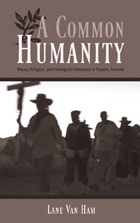
cover of A Common Humanity: Ritual, Religion, and Immigrant Advocacy in Tucson, Arizona

A Common Humanity

Ritual, Religion, and Immigrant Advocacy in Tucson, Arizona

Lane Van Ham

University of Arizona Press, 2011

As debate about immigration policy rages from small towns to state capitals, from coffee shops to Congress, would-be immigrants are dying in the desert along the US–Mexico border. Beginning in the 1990s, the US government effectively sealed off the most common border crossing routes. This had the unintended effect of forcing desperate people to seek new paths across open desert. At least 4,000 of them died between 1995 and 2009. While some Americans thought the dead had gotten what they deserved, other Americans organized humanitarian aid groups. A Common Humanity examines some of the most active aid organizations in Tucson, Arizona, which has become a hotbed of advocacy on behalf of undocumented immigrants.

This is the first book to examine immigrant aid groups from the inside. Author Lane Van Ham spent more than three years observing the groups and many hours in discussions and interviews. He is particularly interested in how immigrant advocates both uphold the legitimacy of the United States and maintain a broader view of its social responsibilities. By advocating for immigrants regardless of their documentation status, he suggests, advocates navigate the conflicting pulls of their own nation-state citizenship and broader obligations to their neighbors in a globalizing world. And although the advocacy organizations are not overtly religious, Van Ham finds that they do employ religious symbolism as part of their public rhetoric, arguing that immigrants are entitled to humane treatment based on universal human values.

Beautifully written and immensely engaging, A Common Humanity adds a valuable human dimension to the immigration debate.
[more]
cover of A Librarian's Guide to an Uncertain Job Market

A Librarian's Guide to an Uncertain Job Market

Jeannette American Library Association

American Library Association, 2011
[more]
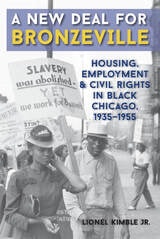
cover of A New Deal for Bronzeville: Housing, Employment, and Civil Rights in Black Chicago, 1935-1955

A New Deal for Bronzeville

Housing, Employment, and Civil Rights in Black Chicago, 1935-1955

Lionel Kimble Jr.

Southern Illinois University Press, 2015

Illinois State Historical Society Certificate of Excellence 2016

During the Great Migration of the 1920s and 1930s, southern African Americans flocked to the South Side Chicago community of Bronzeville, the cultural, political, social, and economic hub of African American life in the city, if not the Midwest. The area soon became the epicenter of community activism as working-class African Americans struggled for equality in housing and employment. In this study, Lionel Kimble Jr. demonstrates how these struggles led to much of the civil rights activism that occurred from 1935 to 1955 in Chicago and shows how this working-class activism and culture helped to ground the early civil rights movement. Despite the obstacles posed by the Depression, blue-collar African Americans worked with leftist organizations to counter job discrimination and made strong appeals to New Deal allies for access to public housing. Kimble details how growing federal intervention in local issues during World War II helped African Americans make significant inroads into Chicago’s war economy and how returning African American World War II veterans helped to continue the fight against discrimination in housing and employment after the war. The activism that appeared in Bronzeville was not simply motivated by the “class consciousness” rhetoric of the organized labor movement but instead grew out of everyday struggles for racial justice, citizenship rights, and improved economic and material conditions. With its focus on the role of working-class African Americans—as opposed to the middle-class leaders who have received the most attention from civil rights historians in the past—A New Deal for Bronzeville makes a significant contribution to the study of civil rights work in the Windy City and enriches our understanding of African American life in mid-twentieth-century Chicago. 

This publication is partially funded by a grant from Furthermore: a program of the J.M. Kaplan fund.

[more]
cover of A Poverty of Imagination: Bootstrap Capitalism, Sequel to Welfare Reform

A Poverty of Imagination

Bootstrap Capitalism, Sequel to Welfare Reform

David Stoesz

University of Wisconsin Press, 2000

Welfare reform was supposed to end welfare as we know it. And it has. The welfare poor have been largely transformed into the working poor, but their poverty persists. This hard-hitting book takes a close look at where we’ve gone wrong—and where we might go next if we truly want to improve the lot of America’s underclass.
    Tracing the roots of recent reforms to the early days of the war on poverty, A Poverty of Imagination describes a social welfare system grown increasingly inept, corrupt, and susceptible to conservative redesign. Investigating the causes of the ongoing failure of welfare assistance, Stoesz focuses on the economic barriers that impede movement out of poverty into the American mainstream. He explores such issues as the heterogeneity of welfare families, generational welfare, inadequate benefits, the negative effects of time limits on welfare recipients, a fringe banking industry that exploits low-income families, the limited capacity of low-wage markets, and the unavailability of credit.
    Stoesz suggests that a form of "bootstrap capitalism" would allow individuals and families to participate more fully in American society and achieve upward economic mobility and stability. This proposal, emphasizing wage supplements, asset building, and community capitalism, sets the stage for the next act in poverty policy in the United States. With its valuable insights on the American welfare system and its positive agenda for change, this book makes a significant intervention in our ongoing struggle to come to terms with widespread poverty in the wealthiest nation on earth.
[more]
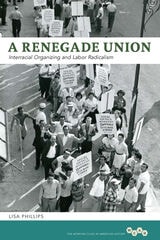
cover of A Renegade Union: Interracial Organizing and Labor Radicalism

A Renegade Union

Interracial Organizing and Labor Radicalism

Lisa Phillips

University of Illinois Press, 2013
Dedicated to organizing workers from diverse racial, ethnic, and religious backgrounds, many of whom were considered "unorganizable" by other unions, the progressive New York City-based labor union District 65 counted among its 30,000 members retail clerks, office workers, warehouse workers, and wholesale workers. In this book, Lisa Phillips presents a distinctive study of District 65 and its efforts to secure economic equality for minority workers in sales and processing jobs in small, low-end shops and warehouses throughout the city. Phillips shows how organizers fought tirelessly to achieve better hours and higher wages for "unskilled," unrepresented workers and to destigmatize the kind of work they performed.
 
Closely examining the strategies employed by District 65 from the 1930s through the early Cold War years, Phillips assesses the impact of the McCarthy era on the union's quest for economic equality across divisions of race, ethnicity, and skill. Though their stories have been overshadowed by those of auto, steel, and electrical workers who forced American manufacturing giants to unionize, the District 65 workers believed their union provided them with an opportunity to re-value their work, the result of an economy inclining toward fewer manufacturing jobs and more low-wage service and processing jobs.
 
Phillips recounts how District 65 first broke with the CIO over the latter's hostility to left-oriented politics and organizing agendas, then rejoined to facilitate alliances with the NAACP. In telling the story of District 65 and detailing community organizing efforts during the first part of the Cold War and under the AFL-CIO umbrella, A Renegade Union continues to revise the history of the left-led unions of the Congress of Industrial Organizations. 

[more]
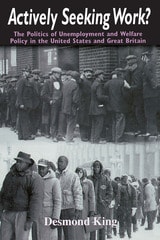
cover of Actively Seeking Work?: The Politics of Unemployment and Welfare Policy in the United States and Great Britain

Actively Seeking Work?

The Politics of Unemployment and Welfare Policy in the United States and Great Britain

Desmond King

University of Chicago Press, 1995

Why have both Great Britain and the United States been unable to create effective training and work programs for the unemployed? Desmond King contends that the answer lies in the liberal political origins of these programs. Integrating extensive, previously untapped archival and documentary materials with an analysis of the sources of political support for work-welfare programs, King shows that policymakers in both Great Britain and the United States have tried to achieve conflicting goals through these programs.

The goal of work-welfare policy in both countries has been to provide financial aid, training, and placement services for the unemployed. In order to muster support for these programs, however, work-welfare programs had to incorporate liberal requirements that they not interfere with private market forces, and that they prevent the "undeserving" from obtaining benefits. For King, the attempt to integrate these incompatible functions is the defining feature of British and American policies as well as the cause of their failure.
[more]
cover of Affirmative Action and the Stalled Quest for Black Progress

Affirmative Action and the Stalled Quest for Black Progress

W. Avon Drake and Robert D. Holsworth

University of Illinois Press, 1996

W. Avon Drake and Robert D. Holsworth focus on the landmark case of Richmond v. Croson. In that case, the Supreme Court ruled against the city of Richmond's set-aside program requiring that thirty percent of the money in municipal construction contracts go to minority-owned firms. The authors describe the politics that gave rise to the set-aside program, investigate its actual operation, explore its effects, and detail responses to it in both black and white communities. As they show, the program served important political purposes but produced limited economic benefits for the Black community. Drake and Holsworth conclude by examining the politics of development as an alternative to the set-aside framework.

Insightful and path-breaking, Affirmative Action and the Stalled Quest for Black Progress examines the accomplishments and limitations of the set-aside programs once at the center of political debates about affirmative action in the United States.
[more]
cover of Affirmative Action and the University: A Philosophical Inquiry

Affirmative Action and the University

A Philosophical Inquiry

edited by Steven M. Cahn

Temple University Press, 1995
"This book is recommended for anyone interested in understanding, questioning, articulating, and acting on the basis of their own and others' perspectives on sexism, racism, and affirmative action in American higher education." --Choice While equal opportunity for all candidates is widely recognized as a goal within academia, the implementation of specific procedures to achieve equality has resulted in vehement disputes regarding both the means and ends. To encourage a reexamination of this issue, Cahn asked three prominent American social philosophers--Leslie Pickering Francis, Robert L. Simon, and Lawrence C. Becker--who hold divergent views about affirmative action, to write extended essays presenting their views. Twenty-two other philosophers then respond to these three principal essays. While no consensus is reached, the resulting clash of reasoned judgments will serve to revitalize the issues raised by affirmative action. Contents Introduction - Steven M. Cahn Part I 1. In Defense of Affirmative Action - Leslie Pickering Francis 2. Affirmative Action and the University: Faculty Appointment and Preferential Treatment - Robert L. Simon 3. Affirmative Action and Faculty Appointments - Lawrence C. Becker Part II 4. What Good Am I? - Laurence Thomas 5. Who "Counts" on Campus? - Ann Hartle 6. Reflections on Affirmative Action in Academia - Robert G. Turnbull 7. The Injustice of Strong Affirmative Action - John Kekes 8. Preferential Treatment Versus Purported Meritocratic Rights - Richard J. Arneson 9. Faculties as Civil Societies: A Misleading Model for Affirmative Action - Jeffrie G. Murphy 10. Facing Facts and Responsibilities - The White Man's Burden and the Burden of Proof - Karen Hanson 11. Affirmative Action: Relevant Knowledge and Relevant Ignorance - Joel J. Kupperman 12. Remarks on Affirmative Action - Andrew Oldenquist 13. Affirmative Action and the Multicultural Ideal - Philip L. Quinn 14. "Affirmative Action" in the Cultural Wars - Frederick A. Olafson 15. Quotas by Any Name: Some Problems of Affirmative Action in Faculty Appointments - Tom L. Beauchamp 16. Are Quotas Sometimes Justified? - James Rachels 17. Proportional Representation of Women and Minorities - Celia Wolf-Devine 18. An Ecological Concept of Diversity - La Verne Shelton 19. Careers Open to Talent - Ellen Frankel Paul 20. Some Sceptical Doubts - Alasdair MacIntyre 21. Affirmative Action and Tenure Decisions - Richard T. De George 22. Affirmative Action and the Awarding of Tenure - Peter J. Markie 23. The Case for Preferential Treatment - James P. Sterba 24. Saying What We Think - Fred Sommers 25. Comments on Compromise and Affirmative Action - Alan H. Goldman About the Authors Index About the Author(s) Steven M. Cahn is Professor of Philosophy and former Provost and Vice President for Academic Affairs at the Graduate Center of the City University of New York. He has published numerous other books, including Morality, Responsibility, and the University (Temple). Contributors: Laurence Thomas, Ann Hartle, Robert G. Turnbull, John Kekes, Richard J. Arneson, Jeffrie G. Murphy, Karen Hanson, Joel J. Kupperman, Andrew Oldenquist, Philip L. Quinn, Frederick A. Olafson, Tom L. Beauchamp, James Rachels, Celia Wolf-Devine, La Verne Shelton, Ellen Frankel Paul, Alasdair MacIntyre, Richard T. De George, Peter J. Markie, James P. Sterba, Fred Sommers, Alan H. Goldman, and the editor.
[more]
cover of African American Females: Addressing Challenges and Nurturing the Future

African American Females

Addressing Challenges and Nurturing the Future

Edited by Eboni M. Zamani-Gallaher and Vernon C. Polite

Michigan State University Press, 2013

African American Females: Addressing Challenges and Nurturing the Future illustrates that across education, health, and other areas of social life, opportunities are stratified along gender as well as race lines. The unequal distribution of wealth, power, and privilege between men and women intersects with race and class to create multiple levels of disadvantage. This book is one result of a unique forum intended to bring into focus the K–12 and postsecondary schooling issues and challenges affecting African American girls and women. Focusing on the historical antecedents of African American female participation and the contemporary context of access and opportunity for black girls and women, the contributors to this collection pay particular attention to the interaction of gender with race/ethnicity, class, age, and health, with the central aim of encouraging thoughtful reading, critical thinking, and informed conversations about the necessity of exploring the lives of African American females. Additionally, the book frames important implications for recommended changes in policy and practice regarding a number of critical matters presently affecting African American females in schools and communities across the state of Michigan and nationwide.

[more]
cover of Airborne Dreams: "Nisei" Stewardesses and Pan American World Airways

Airborne Dreams

"Nisei" Stewardesses and Pan American World Airways

Christine R. Yano

Duke University Press, 2011
In 1955 Pan American World Airways began recruiting Japanese American women to work as stewardesses on its Tokyo-bound flights and eventually its round-the-world flights as well. Based in Honolulu, these women were informally known as Pan Am’s “Nisei”—second-generation Japanese Americans—even though not all of them were Japanese American or second-generation. They were ostensibly hired for their Japanese-language skills, but few spoke Japanese fluently. This absorbing account of Pan Am’s “Nisei” stewardess program suggests that the Japanese American (and later other Asian and Asian American) stewardesses were meant to enhance the airline’s image of exotic cosmopolitanism and worldliness. As its corporate archives demonstrate, Pan Am marketed itself as an iconic American company pioneering new frontiers of race, language, and culture. Christine R. Yano juxtaposes the airline’s strategies and practices with the recollections of former “Nisei” flight attendants. In interviews with the author, these women proudly recall their experiences as young women who left home to travel the globe with Pan American World Airways, forging their own cosmopolitan identities in the process. Airborne Dreams is the story of an unusual personnel program implemented by an American corporation intent on expanding and dominating the nascent market for international air travel. That program reflected the Jet Age dreams of global mobility that excited postwar Americans, as well as the inequalities of gender, class, race, and ethnicity that constrained many of them.
[more]
cover of All Ages Welcome: Recruiting and Retaining Younger Generations for Library Boards, Friends Groups, and Foundations

All Ages Welcome

Recruiting and Retaining Younger Generations for Library Boards, Friends Groups, and Foundations

Lina Bertinelli

American Library Association, 2020

According to 2016 Pew Research Center survey data, Millennials are more likely to have visited a public library in the past year than any other adult demographic. But despite being core library users, millennials and other younger generations are often underrepresented on library boards and library advocacy groups, including Friends groups and Foundations.  But you can change that, with the help of this planner’s hands-on worksheets, brainstorming activities, checklists, and expert advice. Using this toolkit from United for Libraries you will

  • understand generational differences and commonalities through statistics and analysis of Baby Boomers, Generation X, Millennials and Generation Z/post-Millennials;
  • learn how to navigate the challenges of fundraising with the “debt generations” by persuasively answering the question “what’s in it for me?”;
  • master the ABCs of recruitment and retention, tailoring them to fit your library;
  • craft several customized pitches, giving you confidence no matter the situation or audience;
  • discover how to cement buy-in from two key groups, current organization members and your new recruits, thereby ensuring acceptance and enthusiasm all around;
  • work towards defining and managing diversity for your advocacy group; and
  • use tried and true methods for successful onboarding of volunteers, including a Board Member Orientation Checklist and guidance on mentoring.

Using this resource, libraries of all kinds will be empowered to grow and strengthen their recruitment, retention, and training of Trustees, Friends, and Foundation members.
[more]
cover of American Idle: Late-Career Job Loss in a Neoliberal Era

American Idle

Late-Career Job Loss in a Neoliberal Era

Annette Nierobisz

Rutgers University Press, 2025

In American Idle, sociologists Annette Nierobisz and Dana Sawchuk report their findings from interviews with sixty-two mostly white-collar workers who experienced late-career job loss in the wake of the Great Recession. Without the benefits of planned retirement or time horizons favorable to recouping their losses, these employees experience an array of outcomes, from hard falls to soft landings. Notably, the authors find that when reflecting on the effects of job loss, fruitless job searches, and the overall experience of unemployment, participants regularly called on the frameworks instilled by neoliberalism. Invoking neoliberal rhetoric, these older Americans deferred to businesses’ need to prioritize bottom lines, accepted the shift toward precarious employment, or highlighted the importance of taking initiative and maintaining a positive mindset in the face of structural obstacles. Even so, participants also recognized the incompatibility between neoliberalism’s “one-size-fits-all” solutions and their own situations; this disconnect led them to consider their experiences through competing frameworks and to voice resistance to aspects of neoliberal capitalism. Employing a life course sociology perspective to explore older workers’ precarity in an age of rising economic insecurity, Nierobisz and Sawchuk shed light on a new wrinkle in American aging.
 
[more]
cover of Antidiscrimination Law and Minority Employment: Recruitment Practices and Regulatory Constraints

Antidiscrimination Law and Minority Employment

Recruitment Practices and Regulatory Constraints

Farrell Bloch

University of Chicago Press, 1994
A penetrating critique of thirty years of antidiscrimination law in the United States, this book explains why equal opportunity and affirmative action policies have failed to improve black employment since the 1964 Civil Rights Act. Farrell Bloch reviews the effects of hiring policies on minority employment and analyzes recruitment practices to reveal why current United States laws fail to address some of the most important obstacles preventing minorities from getting jobs.
[more]
cover of Aspiring Adults Adrift: Tentative Transitions of College Graduates

Aspiring Adults Adrift

Tentative Transitions of College Graduates

Richard Arum and Josipa Roksa

University of Chicago Press, 2014

Few books have ever made their presence felt on college campuses—and newspaper opinion pages—as quickly and thoroughly as Richard Arum and Josipa Roksa’s 2011 landmark study of undergraduates’ learning, socialization, and study habits, Academically Adrift: Limited Learning on College Campuses. From the moment it was published, one thing was clear: no university could afford to ignore its well-documented and disturbing findings about the failings of undergraduate education.
 
Now Arum and Roksa are back, and their new book follows the same cohort of undergraduates through the rest of their college careers and out into the working world. Built on interviews and detailed surveys of almost a thousand recent college graduates from a diverse range of colleges and universities, Aspiring Adults Adrift reveals a generation facing a difficult transition to adulthood. Recent graduates report trouble finding decent jobs and developing stable romantic relationships, as well as assuming civic and financial responsibility—yet at the same time, they remain surprisingly hopeful and upbeat about their prospects.
 
Analyzing these findings in light of students’ performance on standardized tests of general collegiate skills, selectivity of institutions attended, and choice of major, Arum and Roksa not only map out the current state of a generation too often adrift, but enable us to examine the relationship between college experiences and tentative transitions to adulthood. Sure to be widely discussed, Aspiring Adults Adrift will compel us once again to re-examine the aims, approaches, and achievements of higher education.
 
[more]