Results by title
3388 books match the query 'Fiction' and 293 start with a
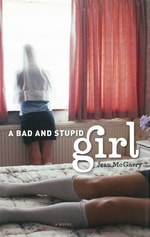
A Bad and Stupid Girl
Jean McGarry
University of Michigan Press, 2006
Brought together by chance, the girls soon become partners in a struggle to find their way in a world where neither Esther’s brains nor Siri’s beauty is enough. Never having been forced to work hard at anything, Siri must rely on Esther to teach her to learn and attend class. But as Siri wakes from her dream world to discover the life of the mind, Esther begins shedding her rational bonds to explore the mysteries of the soul. For both, some of the most devastating lessons in the attainment of worldly knowledge come from love.
Deadpan funny and bittersweet, A Bad and Stupid Girl is above all else a moving portrait of two friends helping each other to uncover the potential splendor of their lives.
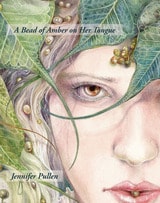
A Bead of Amber on Her Tongue
Jennifer Pullen
Omnidawn, 2019
In this fresh new take on the two women’s stories, Jennifer Pullen takes us away from the familiar and deeper into their experiences. Rewriting Homer, Pullen revitalizes these two figures for the contemporary era. In A Bead of Amber on Her Tongue, Aphrodite maintains autonomy through her experience of her own body, even when forced into marriage. Helen of Troy, meanwhile, harbors a love for her maid, Esme, that no conquering hero can vanquish. Revisiting these classic stories with an inventive twist, Pullen shows that, with a little imagination, the classics may yet bear new insights.
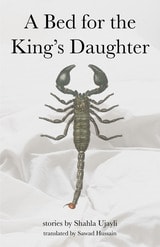
A Bed for the King's Daughter
Stories by Shahla Ujayli; translated by Sawad Hussain
University of Texas Press, 2020
A groundbreaking collection of experimental short fiction by award-winning Syrian author and Booker International Prize for Arabic Fiction nominee Shahla Ujayli, A Bed for the King’s Daughter uses surrealism and irony to examine such themes as women’s agency, the decline of collective life and imagination under modernity, and the effects of social and political corruption on daily life. In “The Memoir of Cinderella’s Shoes,” Cinderella uses her famous glass slipper as a weapon in order to take justice into her own hands. In “Tell Me About Surrealism,” an art history professor’s writing assignment reveals the slipperiness of storytelling, and in “Merry Christmas,” the realities of apartheid interfere with one family’s celebration. Through twenty-two short stories, Ujayli animates—with brevity and inventiveness—themes relevant to both the particularities of life in the Arab world and life outside it.
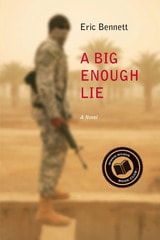
A Big Enough Lie
A NovelEric Bennett
Northwestern University Press, 2015
Awaiting a TV talk show appearance, John Townley is quaking with dread. He has published a best-selling memoir about the Iraq War, a page-turner climaxing in atrocity. In a green room beyond the soundstage, he braces himself to confront the charismatic soldier at the violent heart of it. But John has never actually seen the man before—nor served in Iraq, nor the military. Even so, and despite the deception, he knows his fabricated memoir contains stunning truths.
By turns comic, suspenseful, bitingly satirical, and emotionally potent, A Big Enough Lie pits personal mistruths against national ones of life-and-death consequence. Tracking a writer from the wilds of Florida to New York cubicles to Midwestern workshops to the mindscapes of Baghdad—and from love to heartbreak to solitary celebrity—Bennett’s novel probes our endlessly frustrated desire to grab hold of something (or somebody) true.
A Bird in the House
StoriesMargaret Laurence
University of Chicago Press, 1974
"Vanessa rebels against the dominance of age; she watches [her grandfather] imitate her aunt Edna; and her rage at times is such that she would gladly kick him. It takes great skill to keep this story within the expanding horizon of this young girl and yet make it so revealing of the adult world."—Atlantic
"A Bird in the House achieves the breadth of scope which we usually associate with the novel (and thereby is as psychologically valid as a good novel), and at the same time uses the techniques of the short story form to reveal the different aspects of the young Vanessa." —Kent Thompson, The Fiddlehead
"I am haunted by the women in Laurence's novels as if they really were alive—and not as women I've known, but as women I've been."—Joan Larkin, Ms. Magazine
"Not since . . . To Kill a Mockingbird has there been a novel like this. It should not be missed by anyone who has a child or was a child."—Pittsburgh Post-Gazette
One of Canada's most accomplished writers, Margaret Laurence (1926-87) was the recipient of many awards including Canada's prestigious Governor General's Literary Award on two separate occasions, once for The Diviners.
A Black Bridge
PoemsRalph Tejeda Wilson
University of Nevada Press, 2001
A Blue Tale and Other Stories
Marguerite Yourcenar
University of Chicago Press, 1995
Published to great acclaim in France in 1993, this collection is not only a delight for Marguerite Yourcenar fans but a welcome port of entry for any reader not yet familiar with the author's lengthier, more demanding works. This collection includes three stories written between 1927 and 1930 when the author was in her mid-twenties. These stories cover a range of themes, from an allegory on greed and a scene from the war of the sexes to a witch hunt that obsessively creates its own quarry.
For the devoted readers of Yourcenar, this collection allows a rare glimpse at the beginnings of a writer's craft. In these accomplished but forgotten pieces, edited and introduced by her biographer, Josyane Savigneau, readers will find the blend of fable and fairy tale of Oriental Tales, the psychological chronicle of Dear Departed, and the ironic realism of A Coin in Nine Hands. Read as an introduction to Yourcenar's work, the stories take us into the writer's workshop, as it were, to the early days of creation. A Blue Tale and Other Stories carries the unmistakable voice of a formidable and vastly talented writer.
Marguerite Yourcenar (her pseudonym was an anagram of her family name, Crayencour) was born in Brussels in 1903 and died in Maine in 1987. One of the most respected writers in the French language, she is best known as the author of the acclaimed Memoirs of Hadrian and The Abyss. She was awarded many literary honors, most notably election to the Académie Française in 1980, the first woman so honored.
A Bohemian Youth
Josef Hirsal
Northwestern University Press, 1997
Josef Hiršal's experimental novel is a Dada-like romp through the life of a young man born into a Bohemian peasant family. Told in five parts, A Bohemian Youth begins with a word to the wise, moves on to the text, continues with notes and with notes to the note, and ends with a note on the notes to the notes.
More than just a tongue-in-cheek parody of a literary memoir, A Bohemian Youth is a glimpse of the First Czechoslovak Republic as seen through the eyes of a young peasant from the provinces. Abounding in intimate details--the manners of a servant girl, the habits of the town homosexual, the sounds of popular music; the way people eat in wartime—Hiršal's novel is a wrenching and hilarious tale of a young man's emotional and sexual awakening.
A Brief Alphabet of Torture
StoriesVi Khi Nao
University of Alabama Press, 2017
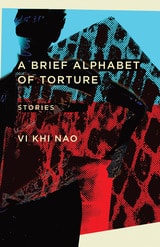
An unflinching and riveting meditation on the pain that attends every facet of existence—love and sacrifice and intimacy and beauty—a biography of torture.
Like all of Vi Khi Nao’s acclaimed and award-winning work, A Brief Alphabet of Torture bleeds across many modes and genres—poetry, essay, fiction, drama—and itself almost constitutes a novel of a different kind. Each tale captures the emotional, physical, psychological, political, and artistic concerns that pervade life like breath and which, even when very beautiful, are filled with pain.
These stories are all facets of Nao’s imagination that define the way she views creation, sexuality, violence, and the role of life in an ontological system that relies heavily on cultural, social, and artistic duress. Some stories like “Winter Rose” and “I Love You Me Neither” rise above the boundaries of pain to places of beauty and grace and love, where pain has no place, but make clear how rare such moments appear in life.
A Brief Excursion and Other Stories
Antun Soljan
Northwestern University Press, 2000
A Burnt Child
A NovelStig Dagerman
University of Minnesota Press, 2013
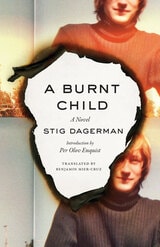
After the international success of his collection of World War II newspaper articles, German Autumn—a book that solidified his status as the most promising and exciting writer in Sweden—Stig Dagerman was sent to France with an assignment to produce more in this journalistic style. But he could not write the much-awaited follow-up. Instead, he holed up in a small French village and in the summer of 1948 created what would be his most personal, poignant, and shocking novel: A Burnt Child.
Set in a working-class neighborhood in Stockholm, the story revolves around a young man named Bengt who falls into deep, private turmoil with the unexpected death of his mother. As he struggles to cope with her loss, his despair slowly transforms to rage when he discovers his father had a mistress. But as Bengt swears revenge on behalf of his mother’s memory, he also finds himself drawn into a fevered and conflicted relationship with this woman—a turn that causes him to question his previous faith in morality, virtue, and fidelity.
Written in a taut and beautifully naturalistic tone, Dagerman illuminates the rich atmospheres of Bengt’s life, both internal and eternal: from his heartache and fury to the moody streets of Stockholm and the Hitchcockian shadows of tension and threat in the woods and waters of Sweden’s remote islands. A Burnt Child remains Dagerman’s most widely read novel, both in Sweden and worldwide, and is one of the crowning works of his short but celebrated career.
A Buyer's Market
Book 2 of A Dance to the Music of TimeAnthony Powell
University of Chicago Press, 1952
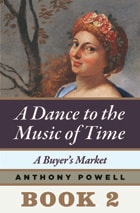
Anthony Powell’s universally acclaimed epic A Dance to the Music of Time offers a matchless panorama of twentieth-century London. Now, for the first time in decades, readers in the United States can read the books of Dance as they were originally published—as twelve individual novels—but with a twenty-first-century twist: they’re available only as e-books.
The second volume, A Buyer’s Market (1952),finds young Nick Jenkins struggling to establish himself in London. Amid the fever of the 1920s, he attends formal dinners and wild parties; makes his first tentative forays into the worlds of art, culture, and bohemian life; and suffers his first disappointments in love. Old friends come and go, but the paths they once shared are rapidly diverging: Stringham is settling into a life of debauchery and drink, Templer is plunging into the world of business, and Widmerpool, though still a figure of out-of-place grotesquerie, remains unbowed, confident in his own importance and eventual success. A Buyer’s Market is a striking portrait of the pleasures and anxieties of early adulthood, set against a backdrop of London life and culture at one of its most effervescent moments.
"Anthony Powell is the best living English novelist by far. His admirers are addicts, let us face it, held in thrall by a magician."--Chicago Tribune
"A book which creates a world and explores it in depth, which ponders changing relationships and values, which creates brilliantly living and diverse characters and then watches them grow and change in their milieu. . . . Powell's world is as large and as complex as Proust's."--Elizabeth Janeway, New York Times
"One of the most important works of fiction since the Second World War. . . . The novel looked, as it began, something like a comedy of manners; then, for a while, like a tragedy of manners; now like a vastly entertaining, deeply melancholy, yet somehow courageous statement about human experience."--Naomi Bliven, New Yorker
“The most brilliant and penetrating novelist we have.”--Kingsley Amis
A Cage in Search of a Bird
Florence Noiville
Seagull Books, 2016
Laura Wilmote is a television journalist living in Paris. Her life couldn’t be better—a stimulating job, a loving boyfriend, interesting friends—until her phone rings in the middle of one night. It is C., an old school friend whom Laura recently helped find a job at the same television station: “My phone rang. I knew right away it was you.”
Thus begins the story of C.’s unrelenting, obsessive, incurable love/hatred of Laura. She is convinced that Laura shares her love, but cannot—or will not—admit it. C. begins to dress as Laura, to make her friends and family her own, and even succeeds in working alongside Laura on the unique program that is Laura’s signature achievement. The obsession escalates, yet is artfully hidden. It is Laura who is perceived as the aggressor at work, Laura who appears unwell, Laura who is losing it. Even Laura’s adoring boyfriend begins to question her. Laura seeks the counsel of a psychiatrist who diagnoses C. with De Clérambault syndrome—she is convinced that Laura is in love with her. And worse, the syndrome can only end in one of two ways: the death of the patient, or that of the object of the obsession.
A Cage in Search of a Bird is the gripping story of two women caught in the vise of a terrible delusion. Florence Noiville brilliantly narrates this story of obsession and one woman’s attempts to escape the irrational love of another—an inescapable, never-ending love, a love that can only end badly.
A Century of November
A NovelW. D. Wetherell
University of Michigan Press, 2009
Across western Canada the Spanish flu rages - the very disease that claimed Marden's wife three weeks earlier. Upon arriving in England, he learns that his son left behind a pregnant girlfriend. Soon his search widens to include locating the girl, too. Nearing the front lines, Marden seems to descend into the fires of hell as he navigates the mine-strewn killing fields of the trenches, still reeking with poison gas. Will he find the girl, and will he find an answer to the forces that drove him halfway around the world?
Author W. D. Wetherell has given us a novel of terrifying beauty, one that seems to occupy the place between waking and dreams. Its haunting words will linger long after the book is shut.
A Certain Smile
A NovelFrançoise Sagan
University of Chicago Press, 2011
A neglected classic about a young French woman in the 1950s risking romance, from the author of Bonjour Tristesse
Françoise Sagan is best known for her first novel, Bonjour Tristesse, which caused a scandal when she first published it at the age of eighteen in 1953. But her second novel, A Certain Smile, less shocking and more psychologically convincing, was preferred by many critics. Like Bonjour Tristesse, this story is set in Paris in the 1950s and told by a young student bored by her law books, restless and curious about love and sex. She is fond of her loyal boyfriend, but he, too, bores her. His worldly uncle strikes her as more exciting, appealingly risky and forbidden. Frank and spontaneous, vulnerable and cruel, thoughtless and insightful, Sagan's young narrator explores such perennial themes as unrequited love and the precarious balance of irrational emotions and self-restraint.

A Coin in Nine Hands
A NovelMarguerite Yourcenar
University of Chicago Press, 1994
"A Coin in Nine Hands has . . . passages that move close to poetry and a story that belongs in both literature and history."—Doris Grumbach, Los Angeles Times Book Review
"What lingers at the end of A Coin in Nine Hands is the shadowiness and puppetlike vagueness of the Dictator, and the compelling specificity of the so-called 'common people' revolving all around him."—Anne Tyler, The New Republic
"Within a few pages we have met half the major characters in this haunting, brilliantly constructed novel. . . . The studied perfection, the structural intricacy and brevity remind one of Camus. Yet by comparison, Yourcenar's prose is lavish, emotional and imagistic."—Cynthia King, Houston Post
"Transcends its specific time and place to become a portrait of vividly delineated characters caught in the vise of a tragically familiar political situation."—Publisher's Weekly
Best known as the author of Memoirs of Hadrian and The Abyss, Marguerite Yourcenar (1903-87) achieved countless literary honors and was the first woman ever elected to the Académie Française.
A Cold, Hard Prayer
John Smolens
Michigan State University Press, 2023
A Constant Journey
The Fiction of Monique WittigErika Ostrovsky
Southern Illinois University Press, 1991
From the creation of a neuter pronoun in her earliest work, L’Opoponax, to the confusion of genres in her most recent fiction, Virgile, non, Monique Wittig uses literary subversion and invention to accomplish what Erika Ostrovsky appropriately defines as renversement, the annihilation of existing literary canons and the creation of highly innovative constructs.
Erika Ostrovsky explores those aspects of Wittig’s work that best illustrate her literary approach. Among the countless revolutionary devices that Wittig uses to achieve renversement are the feminization of masculine gender names, the reorganization of myth patterns, and the replacement of traditional punctuation with her own system of grammatical emphasis and separation. It is the unexpected quantity and quality of such literary devices that make reading Monique Wittig’s fiction a fresh and rewarding experience. Such literary devices have earned Wittig the acclaim of her critics and peers—Marguerite Duras, Mary McCarthy, Alain Robbe-Grillet, Nathalie Sarraute, and Claude Simon, to name a few.
While analyzing the intrinsic value of each of Wittig’s fictions separately, Erika Ostrovsky traces the progressive development of Wittig’s major literary devices as they appear and reappear in her fictions. Ostrovsky maintains that the seeds of those innovations that appear in Wittig’s most recent texts can be found as far back as L’Opoponax. This evidence of progression supports Ostrovsky’s theory that clues to Wittig’s future endeavors can be found in her past.
A Cup of Tea in Pamplona
Robert Laxalt
University of Nevada Press, 1993
A Curious Land
Stories from HomeSusan Muaddi Darraj
University of Massachusetts Press, 2015
Susan Muaddi Darraj's short story collection about the inhabitants of a Palestinian West Bank village, Tel al-Hilou, spans generations and continents to explore ideas of memory, belonging, connection, and, ultimately, the deepest and richest meaning of home. A Curious Land gives voice to the experiences of Palestinians in the last century.
An excerpt from A Curious Land:
When Rabab lowered the magad and clapped-clapped to the well in her mother's too-big slippers, the stone jar digging into her shoulder, she didn't, at first, see the body. The morning sun glazed everything around her—the cement homes, the iron rails along one wall, the bars on the windows, the stones around the well—and made her squint her itchy eyes.
She was hungry. That was all.
They'd arrived here only last night, stopping as soon as Awwad and the men were sure the army had moved south. It must have been the third time in just a few weeks—collapse the tents, load the mules, disappear into the sands. She hoped this war would end soon, and she didn't really care who won, as long as it ended because they hadn't eaten well in two years. In the past few months, her mother had sold all her gold, except for her bracelet made of liras. It was the only thing left, and she was holding onto it, and Rabab realized, so were they all; she imagined that, the day it was sold, when her mother's wrist was bare, would signal that they were at the end.
A Czech Dreambook
Ludvík Vaculík
Karolinum Press, 2018
Fifty-four weeks later, what Vaculík turns out to have written is a unique mixture of diary, dream journal, and outright fiction—an inverted roman à clef in which the author, his family, his mistresses, and the real leaders of the Czech underground play major roles. Undisputedly the most debated novel among the Prague dissident community of the 1980s, it is a work that Vaculík himself described as an amalgam of “hard-boiled documentary” and “magic fiction,” while Václav Havel called it “a truly profound and perceptive account. . . . A great novel about modern life and the crisis of contemporary humanity.”
A Czech Dreambook has been hailed as the most important work of Czech literature in the past forty years. And yet it has never before been available in English. Flawlessly translated by Gerald Turner, Vaculík’s masterpiece is a brilliant exercise in style, dry humor, and irony—an important portrait of the lives and longings of the dissidents and post-Communist elites.
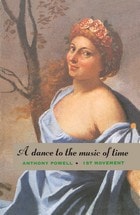
A Dance to the Music of Time
First MovementAnthony Powell
University of Chicago Press, 1995
A Dance to the Music of Time is a landmark work of fiction, praised by readers and critics and other novelists throughout the 75 years since the first volume was published. Equal parts funny and heartbreaking, clever and moving, Anthony Powell's universally acclaimed epic encompasses a four-volume panorama of twentieth century London.
Hailed by Time as "brilliant literary comedy as well as a brilliant sketch of the times," A Dance to the Music of Time opens just after World War I and carries through the 1950s, with all the changes of society, characters, and relationships that those shifting eras bring.
Four very different young men on the threshold of manhood dominate this opening volume of A Dance to the Music of Time. The narrator, Jenkins—a budding writer—shares a room with Templer, already a passionate womanizer, and Stringham, aristocratic and reckless. Widmerpool, as hopelessly awkward as he is intensely ambitious, lurks on the periphery of their world. Amid the fever of the 1920s and the first chill of the 1930s, these four gain their initiations into sex, society, business, and art. A masterpiece of modern fiction, Powell's epic creates a rich portrait of life in England between the wars.
"Reading Powell," says the New York Times, "is like living someone else's life, inextricably entangled with your own." Give this first volume a try, and you'll find characters and scenes and insights that will stay with you for the rest of your life.
Includes these novels:
A Question of Upbringing
A Buyer's Market
The Acceptance World
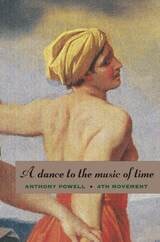
A Dance to the Music of Time
Fourth MovementAnthony Powell
University of Chicago Press, 1995
A Dance to the Music of Time is a landmark work of fiction, praised by readers and critics and other novelists throughout the 75 years since the first volume was published. Equal parts funny and heartbreaking, clever and moving, Anthony Powell's universally acclaimed epic encompasses a four-volume panorama of twentieth century London. Hailed by Time as "brilliant literary comedy as well as a brilliant sketch of the times," A Dance to the Music of Time opens just after World War I and carries through the 1950s, with all the changes to society, character, and relationships those shifting eras bring.
In this final volume of A Dance to the Music of Time, Nick Jenkins describes a world of ambition, intrigue, and dissolution. England has won the war, but its costs, physical and moral, were vast. Widmerpool's wife sets a snare for the young writer X. Trapnel, while her husband suffers private agony and public humiliation. Set against a background of politics, business, high society, and the counterculture in England and Europe, this magnificent work of art sounds an unforgettable requiem for an age.
"Reading Powell," says the New York Times, "is like living someone else's life, inextricably entangled with your own." Give this first volume a try, and you'll find characters and scenes and insights that will stay with you for the rest of your life.
Includes these novels:
Books Do Furnish a Room
Temporary Kings
Hearing Secret Harmonies
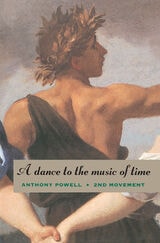
A Dance to the Music of Time
Second MovementAnthony Powell
University of Chicago Press, 1995
A Dance to the Music of Time is a landmark work of fiction, praised by readers and critics and other novelists throughout the 75 years since the first volume was published. Equal parts funny and heartbreaking, clever and moving, Anthony Powell's universally acclaimed epic encompasses a four-volume panorama of twentieth century London. Hailed by Time as "brilliant literary comedy as well as a brilliant sketch of the times," A Dance to the Music of Time opens just after World War I and continues through the 1950s.
In the background of this second volume of A Dance to the Music of Time, the rumble of distant events in Germany and Spain presages the storm of World War II. In England, even as the whirl of marriages and adulteries, fashions and frivolities, personal triumphs and failures gathers speed, men and women find themselves on the brink of fateful choices.
"Reading Powell," says the New York Times, "is like living someone else's life, inextricably entangled with your own." Give this first volume a try, and you'll find characters and scenes and insights that will stay with you for the rest of your life
Includes these novels:
At Lady Molly's
Casanova's Chinese Restaurant
The Kindly Ones
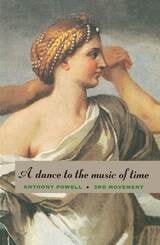
A Dance to the Music of Time
Third MovementAnthony Powell
University of Chicago Press, 1995
A Dance to the Music of Time is a landmark work of fiction, praised by readers and critics and other novelists throughout the 75 years since the first volume was published. Equal parts funny and heartbreaking, clever and moving, Anthony Powell's universally acclaimed epic encompasses a four-volume panorama of twentieth century London. Hailed by Time as "brilliant literary comedy as well as a brilliant sketch of the times," A Dance to the Music of Time opens just after World War I and continues through the 1950s and all the changes to life, society, and relationships those shifting eras bring.
In this third volume of A Dance to the Music of Time, we again meet Widmerpool, doggedly rising in rank; Jenkins, shifted from one dismal army post to another; Stringham, heroically emerging from alcoholism; Templer, still on his eternal sexual quest. Here, too, we are introduced to Pamela Flitton, one of the most beautiful and dangerous women in modern fiction. Wickedly barbed in its wit, uncanny in its seismographic recording of human emotions and social currents, this saga stands as an unsurpassed rendering of England's finest yet most costly hour.
"Reading Powell," says the New York Times, "is like living someone else's life, inextricably entangled with your own." Give Dance a try, and you'll find characters and scenes and insights that will stay with you for the rest of your life.
Includes these novels:
The Valley of Bones
The Soldier's Art
The Military Philosophers
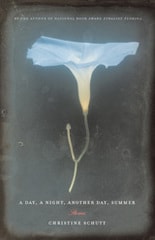
A Day, A Night, Another Day, Summer
StoriesChristine Schutt
Northwestern University Press, 2005
Schutt's indomitable, original talent is once again on full display in each of these deeply informed, intensely realized stories. Many of the narratives take place in a space as small as a house, where the doors are many and what is hidden behind these thin domestic barriers tends towards violence, abusive sex, and mental anguish. Schutt opens these doors in sudden, bold moments that also reveal how the characters are often hopeful, even optimistic. With a style that is at once sensual and spare, dreamlike and deliberate, she exposes the terrible intimacy of the rooms and corridors of our innermost lives.
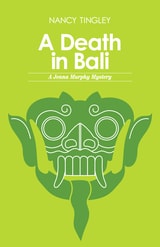
A Death in Bali
A Jenna Murphy MysteryNancy Tingley
Ohio University Press, 2018
Intrepid young curator-turned-private eye Jenna Murphy—whom readers first met in A Head in Cambodia—goes to the tourist town of Ubud to study early twentieth-century Balinese painting. But her first discovery when she arrives in Indonesia is the speared body of expat artist Flip Hendricks. She soon is working with an old friend, a detective for the Ubud police force, to seek the killer. Jenna suspects the motive for the killing has to do with Flip’s paintings. Detective Wayan Tyo is not so sure.
Is Jenna right, or are there other forces at work in this paradise overrun with tourists? The threats to Jenna’s safety pile up, until she can no longer deny that her life is in danger. Her entanglement with various men only clouds her judgment and complicates the situation.
As she did in the first Jenna Murphy book, in A Death in Bali, Nancy Tingley draws on her extensive experience as a scholar of Asian art to bring the armchair traveler an immersive, inside view of the art world.
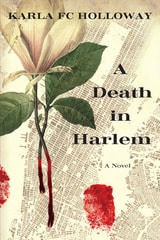
A Death in Harlem
A NovelKarla FC Holloway
Northwestern University Press, 2019
In A Death in Harlem, famed scholar Karla FC Holloway weaves a mystery in the bon vivant world of the Harlem Renaissance. Taking as her point of departure the tantalizingly ambiguous “death by misadventure” at the climax of Nella Larsen’s Passing, Holloway accompanies readers to the sunlit boulevards and shaded sidestreets of Jazz Age New York. A murder there will test the mettle, resourcefulness, and intuition of Harlem’s first “colored” policeman, Weldon Haynie Thomas.
Clear glass towers rising in Manhattan belie a city where people are often not what they seem. For some here, identity is a performance of passing—passing for another race, for another class, for someone safe to trust. Thomas’s investigation illuminates the societies and secret societies, the intricate code of manners, the world of letters, and the broad social currents of 1920s Harlem.
A Death in Harlem is an exquisitely crafted, briskly paced, and impeccably stylish journey back to a time still remembered as a peak of American glamour. It introduces Holloway as a fresh voice in storytelling, and Weldon Haynie Thomas as an endearing and unforgettable detective.
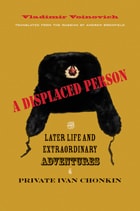
A Displaced Person
The Later Life and Extraordinary Adventures of Private Ivan ChonkinVladimir Voinovich
Northwestern University Press, 2012
In A Displaced Person—the third book in a trilogy that began with the modern classic The Life and Extraordinary Adventures of Private Ivan Chonkin and continued with Pretender to the Throne—author Vladimir Voinovich turns his satirical eye to the difficult last days of the Soviet Communism he so lampooned. Often absurd, A Displaced Person follows a series of random events that brings Chonkin to the United States, where he becomes a farmer and, eventually, a member of a congressional delegation sent to the Soviet Union in 1989, during perestroika, to discuss agriculture with the Soviet leader Mikhail Gorbachev. A Displaced Person carries on the rich Russian tradition of an essentially comic response to the absurdities inherent in totalitarian regimes.
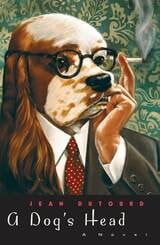
A Dog's Head
Jean Dutourd
University of Chicago Press, 1998
"Dutourd is a fine craftsman, whose work has the classic virtues of brevity, lucidity, and concentration. He has written a sardonic divertissement that concerns itself with fundamental problems of man's existence-a tale that is sad-eyed, witty, and often very funny."—Charles J. Rolo, New York Times Book Review
"A tiny masterpiece in the French classical tradition. . . . Stylish, elegant and witty, and told with an apparent lightheartedness that points to rather than obscures the hero's essential tragedy."—P. L. Travers, New York Herald Tribune
"Wit, a good deal of shrewd classical allusion, and a Voltarian satire are the book's assets."—Edmund Fuller, Chicago Tribune
"The work of an expert craftsman and of a careful writer of prose, ending with the rarest gift in modern letters: the comic spirit."—Henri Peyre, The Saturday Review
"Dutourd might well have dropped his story at this point, had it been his intention simply to excoriate the human race for its treatment of those who are physically afflicted. Instead, he presses on in his terse, deadpan prose to teach a lesson to the afflicted of the world as well."—Time
"A Dog's Head is one of the most curious, most beautifully conceived and written fantasies you've ever come across."—J. H. Jackson, San Francisco Chronicle
"A Dog's Head is an excellent joke in the worst possible taste, and its author, M. Jean Dutourd, is a satirist of the first rank."—New Yorker
A Driftless Murder
Jerry McGinley
University of Wisconsin Press, 2021
As strange details continue to emerge, the detectives enlist the help of city cop and data expert Shea Sommers. As the team crisscrosses the state to chase a few promising leads, their search expands beyond local guides and neighbors to members of a sinister, secret hunting society. When Duggan mysteriously disappears—and becomes a suspect himself—Donegal must take over the investigation. He soon realizes the case might not only be unsolvable but could land him in prison—or an early grave.
A Famous Broken Heart
A Fantasy NovelAnn Druyan
University of Minnesota Press, 2025
A whimsical journey into the realm of off-duty literary characters—and an ode to the power of reading
At twenty-four, Marina is at a crux in life. “I’m just at the age when time speeds up in an odd way. . . . The winters come closer together and you begin to accept that you’re not special anymore.” She’s cautious of her imaginative tendencies, unsure how she might make a difference in a world that feels increasingly big and small at the same time. At this uncertain precipice, nothing could come as a stranger surprise than waking up one sunny morning on a park bench in an entirely different world. Yet that’s where Marina finds herself: at a place called In The Beginning, populated by characters from literature waiting to be read—or, in some cases, written.
Although Marina is bewildered by her sudden and unexpected arrival in this bustling realm of overlapping possibilities, she soon learns that In The Beginning is facing an existential threat, and she is uniquely positioned to help. So begins her quest to find Pearl, the one person who may hold the key to saving everyone. Delving deeper into this unusual world in pursuit of answers, Marina’s journey leads her into the heart of herself and to a shocking truth.
Ann Druyan packs this compelling adventure story with characters both familiar and new, offering a profound testament to the cosmic powers of imagination and curiosity. First published in 1977, A Famous Broken Heart resounds with wit and wisdom that continue to connect with readers.
A Father's Words
A NovelRichard Stern
University of Chicago Press, 1990
"Richard Stern's novels are robustly intelligent, very funny, and beguilingly humane. He knows as much as anyone writing American prose about family mischief, intellectual shenanigans, love blunders—and about writing American prose."—Philip Roth
"A delectable rhetorical display. . . . "—The New Yorker
"Anyone who has read Richard Stern's previous novels won't need to be told he is an unusually crisp and intelligent writer, with a sharp edge to his wit; and in A Father's Words he runs true to form. Many of the book's pleasures are incidental: jokes, intellectual cadenzas, agile turns of phrase . . . The author's powers of farcical invention climax in a brilliant, bitter episode where . . . the younger man proclaims his final failure . . . Mr. Stern has written an excellent novel."—John Gross, New York Times
"Richard Stern is American letters' unsung comic writer about serious matters . . . [A Father's Words] produced in this reviewer an apostolic desire to convince a wider audience to try Stern, especially the vintage Stern."—Doris Grumbach, Chicago Tribune
A Fine Couple
Gert Loschütz
Seagull Books, 2023
As he clears out his parents’ house, Philipp, a photographer, comes across an object that has played a major role in his parents’ lives. Herta and Georg made a fine couple when they first met. Their son imagines the early days of their relationship and remembers how his father was forced to flee across the inner-German border to the West. When Herta and Philipp joined him a few days later, this could have signaled the start of a new era of happiness, but the seeds of their separation had already been sown. In gentle, probing prose, Gert Loschütz describes how Philipp gradually unravels the paradoxical nature of his parents’ relationship: it was love that destroyed their love. To his astonishment, Philipp discovers that Herta and Georg had been in contact all those years in a way they kept secret even from one another.

A Fool for Christmas
A Tale by Allan GurganusAllan Gurganus
Duke University Press, 0
Allan Gurganus’s “A Fool for Christmas” first charmed audiences when he read it on NPR’s “All Things Considered” in 2004. It appears here in print for the first time.
The publication of “A Fool for Christmas” is a partnership between Duke University Libraries (which acquired Gurganus's archives in 2018), Horse & Buggy Press, and Duke University Press.

A Frank Waters Reader
A Southwestern Life In WritingFrank Waters
Ohio University Press, 2000
Over the course of his life, Frank Waters amassed a body of work that has few equals in the literature of the American West. Because his was a writing that touched every facet of the Western experience, his voice still echoes throughout that region’s literary world.
Swallow Press is especially proud to present this generous sampling of Frank Waters’s writings. A Frank Waters Reader encompasses the full range of his work and draws from both his nonfiction and his many novels. It stands as a testament to his singular achievement and proof of the talent that established him as the foremost writer in the Southwest.
This collection spanning forty years of writing provides an excellent introduction for the uninitiated as well as a retrospective for those already familiar with this giant talent. His gift for achieving a delicate balance among the many contrary forces at work in the land and the people who inhabit it is as true and enduring as the region that inspired him.
A Frank Waters Reader
A Southwestern Life in WritingFrank Waters
Ohio University Press, 2000
Over the course of his life, Frank Waters amassed a body of work that has few equals in the literature of the American West. Because his was a writing that touched every facet of the Western experience, his voice still echoes throughout that region’s literary world.
Swallow Press is especially proud to present this generous sampling of Frank Waters’s writings. A Frank Waters Reader encompasses the full range of his work and draws from both his nonfiction and his many novels. It stands as a testament to his singular achievement and proof of the talent that established him as the foremost writer in the Southwest.
This collection spanning forty years of writing provides an excellent introduction for the uninitiated as well as a retrospective for those already familiar with this giant talent. His gift for achieving a delicate balance among the many contrary forces at work in the land and the people who inhabit it is as true and enduring as the region that inspired him.
A Friend of Kissinger
A NovelDavid Milofsky
University of Wisconsin Press, 2019
A Frieze of Girls
Memoirs as FictionAllan Seager
University of Michigan Press, 2004
A Frieze of Girls speaks with a fresh voice from an American era long past. This is more than Allan Seager's story of what happened; it is also about how "the feel of truth is very like the feel of fiction, especially when either is at all strange."
Seager gives us his coming-of-age story, from a high-school summer as a sometime cowboy in the Big Horn mountains to a first job at seventeen managing an antiquated factory in Memphis to a hard-drinking scholarship year in Oxford, cut short by tuberculosis. At once funny with an undercurrent of pain, the stories in A Frieze of Girls remind us of the realities we create to face the world and the past, and in turn of the realities of the world we must inevitably also confront. "Time makes fiction out of our memories," writes Seager. "We all have to have a self we can live with and the operation of memory is artistic---selecting, suppressing, bending, touching up, turning our actions inside out so that we can have not necessarily a likable, merely a plausible identity." A Frieze of Girls is Allan Seager at the top of his form, and a reminder that great writing always transcends mere fashion.
Allan Seager was Professor of English at the University of Michigan and author of many highly praised short stories and novels, including Amos Berry. He died in Tecumseh, Michigan, in 1968. Novelist Charles Baxter is the author of Saul and Patsy.
A Good Map of All Things
A Picaresque NovelAlberto Álvaro Ríos
University of Arizona Press, 2020
In Alberto Álvaro Ríos’s new picaresque novel, momentous adventure and quiet connection brings twenty people to life in a small town in northern Mexico. A Good Map of All Things is home to characters whose lives are interwoven but whose stories are their own, adding warmth and humor to this continually surprising communal narrative. The stories take place in the mid-twentieth century, in the high desert near the border—a stretch of land generally referred to as the Pimería Alta—an ancient passage through the desert that connected the territory of Tucson in the north and Guaymas and Hermosillo in the south. The United States is off in the distance, a little difficult to see, and, in the middle of the century, not the only thing to think about. Mexico City is somewhere to the south, but nobody can say where and nobody has ever seen it.
Ríos has created a whimsical yet familiar town, where brightly unique characters love fiercely and nurture those around them. The people in A Good Map of All Things have secrets and fears, successes and happiness, winters and summers. They are people who do not make the news, but who are living their lives for the long haul, without lotteries or easy answers or particular luck. Theirs is the everyday, with its small but meaningful joy. Whether your heart belongs to a small town in Mexico or a bustling metropolis, Alberto Álvaro Ríos has crafted a book that is overflowing with comfort, warmth, and the familiar embrace of a tightly woven community.

A Head in Cambodia
A Jenna Murphy MysteryNancy Tingley
Ohio University Press, 2017
When the alluring, eleventh-century Cambodian stone head of Radha, consort to Krishna, shows up at the Searles Museum, young curator Jenna Murphy doesn’t suspect that it will lead her to a murder. Asian art is her bailiwick, not criminal investigation, and her immediate concern is simply figuring out whether the head is one famously stolen from its body, or a fake.
When a second decapitation happens—this time of an art collector, not a statue—Jenna finds herself drawn into a different kind of mystery, and the stakes are life or death. It turns out that the same talents for research and for unraveling puzzles—the bread and butter of an art historian—have perfectly equipped her to solve crimes. She’s certain the sculpture provides clues to help her solve the case, which takes her to Thailand and Cambodia. But the collectors, dealers, and con artists of the Bangkok art world only compound her questions.
A Head in Cambodia is the fiction debut of noted Asian art expert Nancy Tingley. Readers will delight in the rarified world of collecting, as well as getting to know Jenna, an intrepid and shrewd observer who will easily find her place among V.I. Warshawski, Kinsey Milhone, and other great female sleuths.
A Heart Beating Hard
Lauren Foss Goodman
University of Michigan Press, 2014
A Hero in His Time
Arthur A. Cohen
University of Chicago Press, 1987
"Cohen has achieved here a tour de force, bringing the idea of poetry to life in a messy little man, no hero at all, not even that much of a poet. . . . [The novel] is stately as well as funny, an authentically noble account of a celebrant. . . . It is the true article."—Geoffrey Wolff, New York Times Book Review
"Arthur Cohen catches fire. . . . A Hero in His Time represents for him a great imaginative leap, for we are shown the interior mental landscape of a middle-aged Russian-Jewish minor poet and . . . most astonishing is that we believe, without question, in this poet."—Doris Grumbach, Village Voice
"A tremendous achievement. . . . To have made this tremendous imaginative leap from the heart of American Jewishness to the heart of Russian Jewishness was a daring thing to do, and it has been accomplished with absolute conviction."—The Sunday Times (London)
"A rich compound of high seriousness and robust comedy."—Newsweek
A Hero of Our Time
Mikhail Lermontov, Translated from the Russian and with an Introduction by Elizabeth Cheresh Allen
Northwestern University Press, 2016
Translated from the Russian by Elizabeth Cheresh Allen
Mikhail Lermontov’s A Hero of Our Time was the first modern Russian novel. Published in 1840, it set a model of penetrating observation and psychological depth that would come to typify Russian literature. Its "hero," Grigory Pechorin, also established a character type that became known in Russian fiction as "the superfluous man"—widely familiar from Dostoevsky’s Notes from Underground. At once driven by pride and wracked by self-doubt, both shockingly self-revealing and blindly self-deceived, he flounders to affirm himself in a social world he despises yet yearns to dominate. Pechorin is a troubling and unforgettable character. And A Hero of Our Time, which has provoked much controversy, is a novel not only central to Russian literature but fundamental to the Western literary tradition of the antihero.
A History of Hands
A NovelRod Val Moore
University of Massachusetts Press, 2014
Soon, however, an elderly and possibly criminal doctor, offering free therapy, moves in, much to the dismay of bedridden Virge. While the physician endeavors to restore the patient's hands with a series of highly suspect injections, Virge recovers his sense of autonomy and an urge to escape the suffocating domestic circumstances that have perhaps caused his illnesses in the first place.
A History of Hands is a novel that invites the reader into a richly and eccentrically detailed world where fevered imaginations and dark comedy prevail, but where the determination to escape the ambiguities of illness leads to the equal ambiguities of health and freedom.
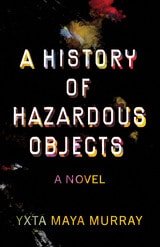
A History of Hazardous Objects
A NovelYxta Maya Murray
University of Nevada Press, 2024
Simultaneously, Laura is trying to write the history section of a Congressional report titled the National Near-Earth Object Preparedness Strategy and Action Plan. This report will advise Congress that it must develop a system to detect and deflect PHOs, and the section Laura is working on cites several historical meteorite impacts as proof that the Earth is now undefended against a significant impact event.
A story about family, love, risk, and science, A History of Hazardous Objects contemplates how experiencing trauma and pain may help us secure a safer and more just world.

A History of Light
Jan Nemec
Seagull Books, 2024
Have you ever wondered what a story written by a beam of light would be like? The story would be ordinary, but the course of events extraordinary. Its hero would be a photographer, a guardian of light. And, naturally, the tale would be full of shadow.
A History of Light delves into the fascinating life of František Drtikol (1883–1961), an important figure in early-twentieth-century photography who is all but forgotten in contemporary times. A dandy from a small mining town, a world-famous photographer whose business went bankrupt, a master of the nude who never had much luck with women, a mystic and a Buddhist who believed in communism—a man whose numerous contradictions were evident externally and synthesized internally.
A unique blend of fiction and biography, this novel vividly portrays Drtikol’s life, tracing the diverse stages of his career and offering detailed, almost encyclopedic insights into the times and places pivotal to his journey. Acclaimed Czech author Jan Němec narrates the story in the uncommon second-person singular, speaking directly to his subject. Fresco-like, this novel is an artistic and spiritual Bildungsroman that covers over half a century, bringing to life the silver mines of Príbram, Jugendstil Munich, and the Bohemianism of the First Czechoslovak Republic. Drtikol’s role as a photographer is set against the turbulent history of Central Europe through the two World Wars, and the events of those five decades form a riveting backdrop for an exploration of the artist’s work.

A Hole in the Heavens
Dyan Elliott
Arizona Center for Medieval and Renaissance Studies, 2017

A Hole in the Language
Marly Swick
University of Iowa Press, 1990
These stories are delicate seismographic meditations on disaster and its aftershocks. The characters are survivors, digging their way out of the past, shaken but hopeful. Despite all their tragic losses, there is a pervasive sense of humor, hope, and forgiveness: abandonment leads ultimately to reunion, grief to solace. This is contemporary America—a jigsaw puzzle of fragmented families constantly picking up the pieces and fitting themselves together in new ways to form unforgettable pictures.
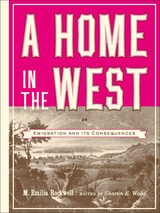
A Home in the West
Or, Emigration and Its ConsequencesRockwell, M. Emilia
University of Iowa Press, 2005