Results by title
86 books match the query 'Home' and 11 start with a
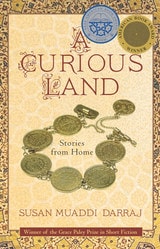
A Curious Land
Stories from HomeSusan Muaddi Darraj
University of Massachusetts Press, 2015
Susan Muaddi Darraj's short story collection about the inhabitants of a Palestinian West Bank village, Tel al-Hilou, spans generations and continents to explore ideas of memory, belonging, connection, and, ultimately, the deepest and richest meaning of home. A Curious Land gives voice to the experiences of Palestinians in the last century.
An excerpt from A Curious Land:
When Rabab lowered the magad and clapped-clapped to the well in her mother's too-big slippers, the stone jar digging into her shoulder, she didn't, at first, see the body. The morning sun glazed everything around her—the cement homes, the iron rails along one wall, the bars on the windows, the stones around the well—and made her squint her itchy eyes.
She was hungry. That was all.
They'd arrived here only last night, stopping as soon as Awwad and the men were sure the army had moved south. It must have been the third time in just a few weeks—collapse the tents, load the mules, disappear into the sands. She hoped this war would end soon, and she didn't really care who won, as long as it ended because they hadn't eaten well in two years. In the past few months, her mother had sold all her gold, except for her bracelet made of liras. It was the only thing left, and she was holding onto it, and Rabab realized, so were they all; she imagined that, the day it was sold, when her mother's wrist was bare, would signal that they were at the end.
A Home in the West
Or, Emigration and Its ConsequencesRockwell, M. Emilia
University of Iowa Press, 2005
A Home of Another Kind
One Chicago Orphanage and the Tangle of Child WelfareKenneth Cmiel
University of Chicago Press, 1995
The book begins with the fascinating history of the Chicago Nursery and Half-Orphan Asylum from 1860 through 1984, when it became a full-time research institute. Founded by a group of wealthy volunteers, the asylum was a Protestant institution for Protestant children—one of dozens around the country designed as places where single parents could leave their children if they were temporarily unable to care for them.
But the asylum, which later became known as Chapin Hall, changed dramatically over the years as it tried to respond to changing policies, priorities, regulations, and theories concerning child welfare. Cmiel offers a vivid portrait of how these changes affected the day-to-day realities of group living. How did the kind of care given to the children change? What did the staff and management hope to accomplish? How did they define "family"? Who were the children who lived in the asylum? What brought them there? What were their needs? How did outside forces change what went on inside Chapin Hall?
This is much more than a richly detailed account of one institution. Cmiel shatters a number of popular myths about orphanages. Few realize that almost all children living in nineteenth-century orphanages had at least one living parent. And the austere living conditions so characteristic of the orphanage were prompted as much by health concerns as by strict Victorian morals.
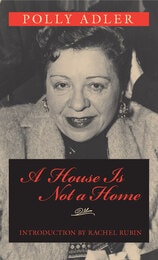
A House Is Not a Home
Polly Adler
University of Massachusetts Press, 2006
Polly Adler's “house”—the brothel that gave this best-selling 1953 autobiography its title—was a major site of New York City underworld activity from the 1920s through the 1940s. Adler's notorious Lexington Avenue house of prostitution functioned as a sort of social club for New York's gangsters and a variety of other celebrities, including Robert Benchley and his friend Dorothy Parker. According to one New York tabloid, it made Adler's name “synonymous with sin.”
This new edition of Adler's autobiography brings back into print a book that was a mass phenomenon, in both hardback and paperback, when it was first published. A self-consciously literary work, A House Is Not a Home provides an informal social history of immigrant mobility, prostitution, Jewish life in New York, police dishonesty, the “white slavery” scare of the early twentieth century, and political corruption.
Adler's story fills an important gap in the history of immigrant life, urban experience, and organized crime in New York City. While most other accounts of the New York underworld focus on the lives of men, from Herbert Asbury's Gangs of New York through more recent works on Jewish and Italian gangsters, this book brings women's lives and problems to the forefront.
A House Is Not a Home is compellingly readable and was popular enough to draw Hollywood's attention in the early 1960s—leading to a film starring Shelley Winters as Adler. The book has been largely forgotten in the ensuing decades, lost both to its initial audience of general readers and to scholars in women's studies, immigration history, and autobiography who are likely to find it a treasure trove. Now, with a new introduction by Rachel Rubin that contextualizes Adler's life and literary achievement, A House Is Not a Home is again available to the many readers who have come to understand such “marginal” life stories as a special refraction of the more typical American success narrative.

A House Is Not a Home
Polly Adler, with an Introduction by Rachel Rubin
University of Massachusetts Press, 2006
Polly Adler's “house”—the brothel that gave this best-selling 1953 autobiography its title—was a major site of New York City underworld activity from the 1920s through the 1940s. Adler's notorious Lexington Avenue house of prostitution functioned as a sort of social club for New York's gangsters and a variety of other celebrities, including Robert Benchley and his friend Dorothy Parker. According to one New York tabloid, it made Adler's name “synonymous with sin.”
This new edition of Adler's autobiography brings back into print a book that was a mass phenomenon, in both hardback and paperback, when it was first published. A self-consciously literary work, A House Is Not a Home provides an informal social history of immigrant mobility, prostitution, Jewish life in New York, police dishonesty, the “white slavery” scare of the early twentieth century, and political corruption.
Adler's story fills an important gap in the history of immigrant life, urban experience, and organized crime in New York City. While most other accounts of the New York underworld focus on the lives of men, from Herbert Asbury's Gangs of New York through more recent works on Jewish and Italian gangsters, this book brings women's lives and problems to the forefront.
A House Is Not a Home is compellingly readable and was popular enough to draw Hollywood's attention in the early 1960s—leading to a film starring Shelley Winters as Adler. The book has been largely forgotten in the ensuing decades, lost both to its initial audience of general readers and to scholars in women's studies, immigration history, and autobiography who are likely to find it a treasure trove. Now, with a new introduction by Rachel Rubin that contextualizes Adler's life and literary achievement, A House Is Not a Home is again available to the many readers who have come to understand such “marginal” life stories as a special refraction of the more typical American success narrative.
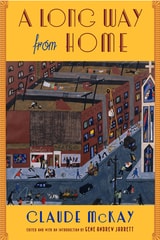
A Long Way From Home
Jarrett, Gene A
Rutgers University Press, 2007
Claude McKay (1889–1948) was one of the most prolific and sophisticated African American writers of the early twentieth century. A Jamaican-born author of poetry, short stories, novels, and nonfiction, McKay has often been associated with the “New Negro” or Harlem Renaissance, a movement of African American art, culture, and intellectualism between World War I and the Great Depression. But his relationship to the movement was complex. Literally absent from Harlem during that period, he devoted most of his time to traveling through Europe, Russia, and Africa during the 1920s and 1930s. His active participation in Communist groups and the radical Left also encouraged certain opinions on race and class that strained his relationship to the Harlem Renaissance and its black intelligentsia. In his 1937 autobiography, A Long Way from Home, McKay explains what it means to be a black “rebel sojourner” and presents one of the first unflattering, yet informative, exposés of the Harlem Renaissance. Reprinted here with a critical introduction by Gene Andrew Jarrett, this book will challenge readers to rethink McKay’s articulation of identity, art, race, and politics and situate these topics in terms of his oeuvre and his literary contemporaries between the world wars.
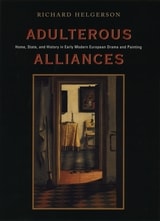
Adulterous Alliances
Home, State, and History in Early Modern European Drama and PaintingRichard Helgerson
University of Chicago Press, 2000

African Encounters with Domesticity
Karen Tranberg Hansen
Rutgers University Press, 1992
Anthropologists usually think of domesticity as the activities related to the home and the family. Such activities have complex meanings associated with the sense of space, work, gender, and power. The contributors to this interdisciplinary collection of papers examine how indigenous African notions of domesticity interact with Western notions to transform the meaning of such activities. They explore the interactions of notions of domesticity in a number of settings in the twentieth century and the kinds of personal troubles and public issues these interactions have provoked. They also demonstrate that domesticity, as it emerged in Africa through the colonial encounter, was culturally constructed, and they show how ideologies of work, space, and gender interact with broader political-economic processes.
In her introduction, Hansen explains how the meaning of domesticity has changed and been contested in the West, specifies which of these shifting meanings are relevant in the African context, and summarizes the historical processes that have affected African ideologies of domesticity.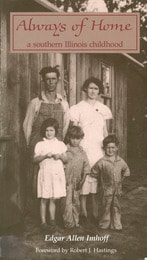
Always of Home
A Southern Illinois ChildhoodEdgar Allen Imhoff. Foreword by Robert J. Hastings
Southern Illinois University Press, 1992
Edgar Allen Imhoff renders a series of touching, colorful vignettes about growing up in southern Illinois during the Great Depression. He writes poignantly of his family and their struggles (including his father’s exhausting but successful effort at self-education) as he revisits his early childhood years in the country and his eventual move to the town of Murphysboro, where he encountered school bullies, outstanding teachers, first love, World War II, and adolescence.
Imhoff contrasts these memories of his youth with events, incidents, and thoughts from his more recent past. While writing a government check with six figures to the left of the decimal, he remembers how his mother once scrounged together thirty cents so Imhoff and his brother and sister could go to the circus with their classmates. Listening to President Carter give a speech in the Rose Garden reminds him of the contrasting elocutionary style of the Reverend William Boatman, the pastor at his country church, which was built by Imhoff’s great-great-grandfather and others.
Through such contrasts, Imhoff not only paints a loving picture of his past, he also comments on the alienation and emptiness that mark many lives in the United States, especially those of modern nomads. Imhoff has himself become a nomad, living far from the land of his birth, enjoying a successful and rewarding career. Yet he is drawn repeatedly to his past, his family, his childhood home, and the intricate combination of events, attitudes, values, and loyalties that influenced and molded him.

America's Working Man
Work, Home, and Politics Among Blue Collar Property OwnersDavid Halle
University of Chicago Press, 1984
At Home in the World
Michael Jackson
Duke University Press, 1995
Something of a nomad himself, having lived in New Zealand, Sierra Leone, England, France, Australia, and the United States, Jackson is deft at capturing the ambiguities of home as a lived experience among the Warlpiri. Blending narrative ethnography, empirical research, philosophy, and poetry, he focuses on the existential meaning of being at home in the world. Here home becomes a metaphor for the intimate relationship between the part of the world a person calls "self" and the part of the world called "other." To speak of "at-homeness," Jackson suggests, implies that people everywhere try to strike a balance between closure and openness, between acting and being acted upon, between acquiescing in the given and choosing their own fate. His book is an exhilarating journey into this existential struggle, responsive at every turn to the political questions of equity and justice that such a struggle entails.
A moving depiction of an aboriginal culture at once at home and in exile, and a personal meditation on the practice of ethnography and the meaning of home in our increasingly rootless age, At Home in the World is a timely reflection on how, in defining home, we continue to define ourselves.