Results by title
85 books match the query 'Humanities' and 6 start with a
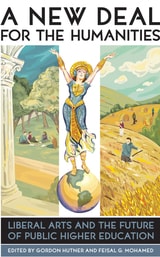
A New Deal for the Humanities
Liberal Arts and the Future of Public Higher EducationHutner, Gordon
Rutgers University Press, 2015
The contributors offer spirited and thought-provoking debates on a diverse range of topics. For instance, they deplore the push by administrations to narrow learning into quantifiable outcomes as well as the demands of state governments for more practical, usable training. Indeed, for those who suggest that a college education should be “practical”—that it should lean toward the sciences and engineering, where the high-paying jobs are—this book points out that while a few nations produce as many technicians as the United States does, America is still renowned worldwide for its innovation and creativity, skills taught most effectively in the humanities. Most importantly, the essays in this collection examine ways to make the humanities even more effective, such as offering a broader array of options than the traditional major/minor scheme, options that combine a student’s professional and intellectual interests, like the new medical humanities programs.
A democracy can only be as energetic as the minds of its citizens, and the questions fundamental to the humanities are also fundamental to a thoughtful life. A New Deal for the Humanities takes an intrepid step in making the humanities—and our citizens—even stronger in the future.
A Poetic for Sociology
Toward a Logic of Discovery for the Human SciencesRichard Harvey Brown
University of Chicago Press, 1989
By recognizing this "aesthetic" common ground between science and art, Brown demonstrates that a fusion can be achieved within the human sciences of these two principal ideals of knowledge—the scientific or positivist one and the artistic or intuitive one. A path, then, is opened for creating a knowledge of ourselves and society which is at once objective and subjective, at once valid scientifically and significantly humane.
Africa and the Disciplines
The Contributions of Research in Africa to the Social Sciences and HumanitiesEdited by Robert H. Bates, V. Y. Mudimbe, and Jean F. O'Barr
University of Chicago Press, 1993
African Studies, contrary to some accounts, is not a separate continent in the world of American higher education. Its intellectual borders touch those of economics, literature, history, philosophy, and art; its history is the story of the world, both ancient and modern. This is the clear conclusion of Africa and the Disciplines, a book that addresses the question: Why should Africa be studied in the American university?
This question was put to distinguished scholars in the social sciences and humanities, prominent Africanists who are also leaders in their various disciplines. Their responses make a strong and enlightening case for the importance of research on Africa to the academy.
Paul Collier's essay, for example, shows how studies of African economies have clarified our understanding of the small open economies, and contributed to the theory of repressed inflation and to a number of areas in microeconomics as well. Art historian Suzanne Blier uses the terms and concepts that her discipline has applied to Africa to analyze the habits of mind and social practice of her own field. Christopher L. Miller describes the confounding and enriching impact of Africa on European and American literary theory. Political scientist Richard Sklar outlines Africa's contributions to the study of political modernization, pluralism, and rational choice. These essays, together with others from scholars in history, anthropology, philosophy, and comparative literature, attest to the influence of African research throughout the curriculum.
For many, knowledge from Africa seems distant and exotic. These powerful essays suggest the contrary: that such knowledge has shaped the way in which scholars in various disciplines understand their worlds. Eloquent testimony to Africa's necessary place in the mainstream of American education, this book should alter the academy's understanding of the significance of African research, its definition of core and periphery in human knowledge.
"These essays are at once exceptionally thoughtful and remarkably comprehensive. Not only do they offer an unusually interesting overview of African studies; they are also striking for the depth and freshness of their insights. This is the sort of volume from which both seasoned regional experts and students stand to learn an enormous amount."—John Comaroff, University of Chicago
"These essays provide an important perspective on the evolution of African studies and offer insights into what Africa can mean for the different humanistic and social science disciplines. Many show in ingenious and subtle ways the enormous potential that the study of Africa has for confounding the main tenets of established fields. One could only hope that the strictures expressed here would be taken to heart in the scholarly world."—Robert L. Tignor, Princeton University

An African Voice
The Role of the Humanities in African IndependenceRobert W. July
Duke University Press, 1987

An Education in Judgment
Hannah Arendt and the HumanitiesD. N. Rodowick
University of Chicago Press, 2021
Rodowick takes after the theories of Hannah Arendt and argues that thinking is an art we practice with and for each other in our communities.
In An Education in Judgment, philosopher D. N. Rodowick makes the definitive case for a philosophical humanistic education aimed at the cultivation of a life guided by both self-reflection and interpersonal exchange. Such a life is an education in judgment, the moral capacity to draw conclusions alone and with others, and letting one’s own judgments be answerable to the potentially contrasting judgments of others. Thinking, for Rodowick, is an art we practice with and learn from each other on a daily basis.
In taking this approach, Rodowick follows the lead of Hannah Arendt, who made judgment the cornerstone of her conception of community. What is important for Rodowick, as for Arendt, is the cultivation of “free relations,” in which we allow our judgments to be affected and transformed by those of others, creating “an ever-widening fabric of intersubjective moral consideration.” That is a fragile fabric, certainly, but one that Rodowick argues is worth pursuing, caring for, and preserving. This original work thinks with and beyond Arendt about the importance of the humanities and what “the humanities” amounts to beyond the walls of the university.
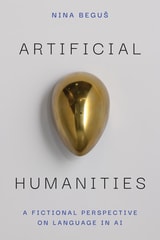
Artificial Humanities
A Fictional Perspective on Language in AINina Beguš
University of Michigan Press, 2025
Highlighting the impact of human-like AI design, from gendered virtual assistants to romanticized social robots, the book shows how these technologies intersect with longstanding humanistic questions about the concepts of creativity and language as well as the relations between humans and machines. Additionally, the book explores AI’s applications in medical fields, particularly psychiatry and neurotechnology, including how AI interacts with the human body and mind to address conditions like paralysis. By emphasizing the philosophical and cultural implications of these technologies, Beguš highlights the need for responsible innovation that prioritizes human well-being as well as machine potential outside of human imitation. Accessible and thought-provoking, Artificial Humanities offers tools for analyzing and assessing technologies while they are being developed and invites readers to see how the humanities can guide us toward a more thoughtful future for AI.