Results by title
220 books match the query 'Individual Artists' and 18 start with a
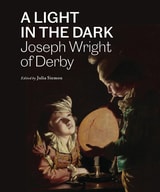
A Light in the Dark
Joseph Wright of DerbyJulia Siemon
J. Paul Getty Trust, The, 0
A timely reexamination of Joseph Wright’s captivating “candlelight” paintings, featuring the recently rediscovered Two Boys with a Bladder.
The dramatic “candlelight” paintings of Joseph Wright of Derby (1734–1797) cast a spell, enthralling viewers with striking scenes that portray human curiosity, the quiet intensity of domestic life, and the excitement of scientific discovery. With a variety of brushstrokes—dabbed here, whiskered there, and dragged elsewhere—Wright pushed boundaries with the transformative power of light. In 2020, the Getty Museum acquired the newly rediscovered Two Boys with a Bladder (1767), a luminous study of innovation, intimacy, and artistic brilliance that challenged established assumptions about Wright and sparked renewed interest in his experiments with light.
A Light in the Dark presents new research to uncover the origins of Two Boys and expand our understanding of Wright's early candlelights, tracing the invention and initial development of his distinctive style. Whereas recent scholarship has maintained an outward approach that ties the artist’s oeuvre to places that he visited, this volume returns the focus to Wright himself—his biography, technique, and hometown of Derby—in a much-needed reexamination. Complete with fresh historical and technical evidence, this is a fascinating look into the inspirations, aspirations, and experiments behind some of the most remarkable paintings in the history of British art.
This volume is published to accompany an exhibition on view at the J. Paul Getty Museum at the Getty Center from November 24, 2026, to March 14, 2027.
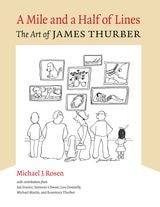
A Mile and a Half of Lines
The Art of James ThurberMichael J. Rosen, with contributions from Ian Frazier, Seymour Chwast, Liza Donnelly, Michael Maslin, and Rosemary Thurber
The Ohio State University Press, 2019
Including some 260 drawings, this collection is the first comprehensive focus on his work as an artist, a cartoonist, and an illustrator. With commentary from a host of preeminent cartoonists and writers, including Ian Frazier, Seymour Chwast, and Michael Maslin, A Mile and a Half of Lines celebrates the significance of Thurber’s spontaneous, unstudied, and novel drawing style that not only altered the nature of American cartooning but also expanded the very possibilities of an illustrated line. Coinciding with the first major retrospective of Thurber’s art presented by the Columbus Museum of Art in 2019, A Mile and a Half of Lines showcases both classic Thurber as well as visual material never before seen in print.
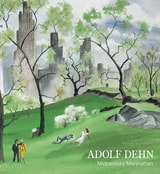
Adolf Dehn
Midcentury ManhattanAdolf Dehn
The Artist Book Foundation, 2017
Adolf Dehn (1895–1968), American painter in multimedia and acclaimed master lithographer, left his Minnesota hometown after formal training at the Minneapolis Art Institute to study at the Art Students League in New York. He toured Europe in the early 1920s, quickly acclimating to the continental lifestyle and adeptly depicting its nuances and idiosyncrasies with prolific lithographs and sketches. His critical and satirical renderings of the political movements, social conventions, and governmental policies in post-World War I Europe during "Le Crazy Years" gave the Midwestern artist ample material for his growing body of work.
Sailing back to the United States in 1929, Dehn survived the Great Depression with commercial artwork and contributions to popular magazines such as The New Yorker, Vogue, and Vanity Fair. His clever drawings that reflected the Jazz Age's culture and fashionable society made him a favorite of Frank Crowninshield, Vanity Fair's renowned editor.
During this time, while Dehn captured the heyday of Manhattan's burlesque theaters, lively Harlem nightclubs, impressive skyline, and busy harbor, he was continuously drawn to Central Park—his predilection for the city's magnificent green space was a sustaining source of inspiration and subject matter. Adolf Dehn: Midcentury Manhattan candidly examines the life and work of this exceptional, adventurous, and intrepid artist as he moved skillfully and capably between lithography, ink-wash drawings, gouache, casein painting, and watercolors. Combining numerous vintage photographs with newly discovered, Manhattan-inspired prints and drawings from the collections of, among others, the Whitney Museum of American Art, MoMA, and The Metropolitan Mesuem of Art, Adolf Dehn: Midcentury Manhattan traces how Dehn's art reflected the spirit, pulse, and uniquely American tonalities of The City of Dreams.
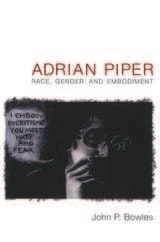
Adrian Piper
Race, Gender, and EmbodimentJohn P. Bowles
Duke University Press, 2011
Over the course of a decade, John P. Bowles and Piper conversed about her art and its meaning, reception, and relation to her scholarship on Kant’s philosophy. Drawing on those conversations, Bowles locates Piper’s work at the nexus of Conceptual and feminist art of the late 1960s and 1970s. Piper was the only African American woman associated with the Conceptual artists of the 1960s and one of only a few African Americans to participate in exhibitions of the nascent feminist art movement in the early 1970s. Bowles contends that Piper’s work is ultimately about our responsibility for the world in which we live.
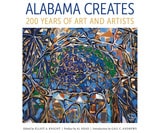
Alabama Creates
200 Years of Art and ArtistsEdited by Elliot A. Knight
University of Alabama Press, 2019
A visually rich survey of two hundred years of Alabama fine arts and artists
Alabama artists have been an integral part of the story of the state, reflecting a wide-ranging and multihued sense of place through images of the land and its people. Quilts, pottery, visionary paintings, sculpture, photography, folk art, and abstract art have all contributed to diverse visions of Alabama’s culture and environment. The works of art included in this volume have all emerged from a distinctive milieu that has nourished the creation of powerful visual expressions, statements that are both universal and indigenous.
Published to coincide with the state’s bicentennial, Alabama Creates: 200 Years of Art and Artists features ninety-four of Alabama’s most accomplished, noteworthy, and influential practitioners of the fine arts from 1819 to the present. The book highlights a broad spectrum of artists who worked in the state, from its early days to its current and contemporary scene, exhibiting the full scope and breadth of Alabama art.
This retrospective volume features biographical sketches and representative examples of each artist’s most masterful works. Alabamians like Gay Burke, William Christenberry, Roger Brown, Thornton Dial, Frank Fleming, the Gee’s Bend Quilters, Lonnie Holley, Dale Kennington, Charlie Lucas, Kerry James Marshall, David Parrish, and Bill Traylor are compared and considered with other nationally significant artists.
Alabama Creates is divided into four historical periods, each spanning roughly fifty years and introduced by editor Elliot A. Knight. Knight contextualizes each era with information about the development of Alabama art museums and institutions and the evolution of college and university art departments. The book also contains an overview of the state’s artistic heritage by Gail C. Andrews, director emerita of the Birmingham Museum of Art. Alabama Creates conveys in a sweeping and captivating way the depth of talent, the range of creativity, and the lasting contributions these artists have made to Alabama’s extraordinarily rich visual and artistic heritage.
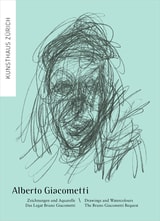
Alberto Giacometti
Drawings and Watercolours. The Bruno Giacometti BequestMonique Meyer
Scheidegger and Spiess, 2014
Comprising about one hundred of Giacometti’s works on paper, this well-guarded family treasure represents the artist’s entire life, from his youth in Stampa, Switzerland to his later years in Paris. This collection includes very early copies of works by old masters as well as studies of ancient Egyptian and Roman sculptures from the 1920s. It also shows how closely Giacometti looked at the art of Henri Matisse, Paul Cézanne, and Auguste Rodin, which then led to highly individual interpretations of their work. In addition, it contains important drawings of some of Giacometti’s relatives along with self-portraits, alpine landscapes from his native Val Bregaglia, and masterful figure studies from the 1950s and 60s.
Featuring 144 color images, this concise book features the first selection of these works the world has seen alongside an essay on their history and significance and an illustrated catalogue of the entire collection.

Albrecht Altdorfer and the Origins of Landscape
Christopher S. Wood
University of Chicago Press, 1993
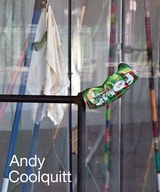
Andy Coolquitt
By Rachel Hooper
University of Texas Press, 2012
Andy Coolquitt makes objects and environments that exist in symbiosis with human relationships. During the 1990s, his life and work revolved around an expansive studio/artist commune/performance space/living sculpture/party place on the east side of Austin, Texas, where he continues to live, work, and host events. Intrigued by social contracts, Coolquitt creates artwork that facilitates conversation and interaction, augmenting the energy and frictions generated by individuals forming a community. He chooses materials that show the wear and tear of practical use, and, over the years, he has refined an artistic practice based on the collection, study, and reuse of things scavenged from the streets around him. Since his 2008 solo exhibition iight in New York City, Coolquitt’s work has gained a wide national and international audience.
Andy Coolquitt is the first comprehensive monograph on the artist’s work. Published in conjunction with a solo museum exhibition at Blaffer Art Museum, this volume displays the full range of Coolquitt’s work over the past twenty-five years, including images of site-specific installations that no longer exist. Accompanying the color plates are an introduction and chronology of the artist’s work by exhibition curator Rachel Hooper, an essay tracing Coolquitt’s connections to other contemporary artists and designers by Frieze magazine senior editor Dan Fox, an in-depth exploration of Coolquitt’s concepts and process by art writer Jan Tumlir, an interview with Coolquitt by director and chief curator of White Columns Matthew Higgs, and Coolquitt’s biography and bibliography.
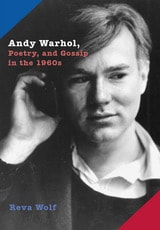
Andy Warhol, Poetry, and Gossip in the 1960s
Reva Wolf
University of Chicago Press, 1997
Wolf investigates the underground culture of poets, artists, and filmmakers who interacted with Warhol regularly. She claims that Warhol understood the literary imagination of his generation and that recognizing Warhol's literary activities is essential to understanding his art. Drawing on a wealth of unpublished material, including interviews, personal and public archives, tape recordings, documentary photographs, and works of art, Wolf offers dramatic evidence that Warhol's interactions with writers functioned like an extended conversation and details how this process impacted his work. This highly original and fascinating study gives us fresh insight into Warhol's art as practice and reformulates the myth that surrounds this popular American artist.
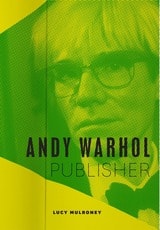
Andy Warhol, Publisher
Lucy Mulroney
University of Chicago Press, 2018
Journeying from the 1950s, when Warhol was starting to make his way through the New York advertising world, through the height of his career in the 1960s, to the last years of his life in the 1980s, Andy Warhol, Publisher unearths fresh archival material that reveals Warhol’s publications as complex projects involving a tantalizing cast of collaborators, shifting technologies, and a wide array of fervent readers.
Lucy Mulroney shows that whether Warhol was creating children’s books, his infamous “boy book” for gay readers, writing works for established houses like Grove Press and Random House, helping found Interview magazine, or compiling a compendium of photography that he worked on to his death, he readily used the elements of publishing to further and disseminate his art. Warhol not only highlighted the impressive variety in our printed culture but also demonstrated how publishing can cement an artistic legacy.
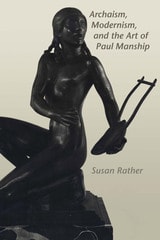
Archaism, Modernism, and the Art of Paul Manship
By Susan Rather
University of Texas Press, 1993
Archaism, an international artistic phenomenon from early in the twentieth century through the 1930s, receives its first sustained analysis in this book. The distinctive formal and technical conventions of archaic art, especially Greek art, particularly affected sculptors—some frankly modernist, others staunchly conservative, and a few who, like American Paul Manship, negotiated the distance between tradition and modernity. Susan Rather considers the theory, practice, and criticism of early twentieth-century sculpture in order to reveal the changing meaning and significance of the archaic in the modern world. To this end—and against the background of Manship’s career—she explores such topics as the archaeological resources for archaism, the classification of the non-Western art of India as archaic, the interest of sculptors in modem dance (Isadora Duncan and Ruth St. Denis), and the changing critical perception of archaism.
Rather rejects the prevailing conception of archaism as a sterile and superficial academic style to argue its initial importance as a modernist mode of expression. The early practitioners of archaism—including Aristide Maillol, André Derain, and Constantin Brancusi—renounced the rhetorical excess, overrefined naturalism, and indirect techniques of late nineteenth-century sculpture in favor of nonnarrative, stylized and directly carved works, for which archaic Greek art offered an important example. Their position found implicit support in the contemporaneous theoretical writings of Emmanuel Löwy, Wilhelm Worringer, and Adolf von Hildebrand.
The perceived relationship between archaic art and tradition ultimately compromised the modernist authority of archaism and made possible its absorption by academic and reactionary forces during the 1910s. By the 1920s, Paul Manship was identified with archaism, which had become an important element in the aesthetic of public sculpture of both democratic and totalitarian societies. Sculptors often employed archaizing stylizations as ends in themselves and with the intent of evoking the foundations of a classical art diminished in potency by its ubiquity and obsolescence. Such stylistic archaism was not an empty formal exercise but an urgent affirmation of traditional values under siege. Concurrently, archaism entered the mainstream of fashionable modernity as an ingredient in the popular and commercial style known as Art Deco. Both developments fueled the condemnation of archaism—and of Manship, its most visible exemplar—by the avant-garde. Rather’s exploration of the critical debate over archaism, finally, illuminates the uncertain relationship to modernism on the part of many critics and highlights the problematic positions of sculpture in the modernist discourse.
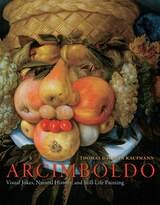
Arcimboldo
Visual Jokes, Natural History, and Still-Life PaintingThomas DaCosta Kaufmann
University of Chicago Press, 2010
In Giuseppe Arcimboldo’s most famous paintings, grapes, fish, and even the beaks of birds form human hair. A pear stands in for a man’s chin. Citrus fruits sprout from a tree trunk that doubles as a neck. All sorts of natural phenomena come together on canvas and panel to assemble the strange heads and faces that constitute one of Renaissance art’s most striking oeuvres. The first major study in a generation of the artist behind these remarkable paintings, Arcimboldo tells the singular story of their creation.
Drawing on his thirty-five-year engagement with the artist, Thomas DaCosta Kaufmann begins with an overview of Arcimboldo’s life and work, exploring the artist’s early years in sixteenth-century Lombardy, his grounding in Leonardesque traditions, and his tenure as a Habsburg court portraitist in Vienna and Prague. Arcimboldo then trains its focus on the celebrated composite heads, approaching them as visual jokes with serious underpinnings—images that poetically display pictorial wit while conveying an allegorical message. In addition to probing the humanistic, literary, and philosophical dimensions of these pieces, Kaufmann explains that they embody their creator’s continuous engagement with nature painting and natural history. He reveals, in fact, that Arcimboldo painted many more nature studies than scholars have realized—a finding that significantly deepens current interpretations of the composite heads.
Demonstrating the previously overlooked importance of these works to natural history and still-life painting, Arcimboldo finally restores the artist’s fantastic visual jokes to their rightful place in the history of both science and art.
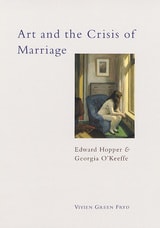
Art and the Crisis of Marriage
Edward Hopper and Georgia O'KeeffeVivien Green Fryd
University of Chicago Press, 2002
Vivien Green Fryd argues that this crisis played a crucial role in the lives and works of two of America's most familiar and beloved artists, Georgia O'Keeffe (1887-1986) and Edward Hopper (1882-1967). Combining biographical study of their marriages with formal and iconographical analysis of their works, Fryd shows how both artists expressed the pleasures and perils of their relationships in their paintings. Hopper's many representations of Victorian homes in sunny, tranquil landscapes, for instance, take on new meanings when viewed in the context of the artist's own tumultuous marriage with Jo and the widespread middle-class fears that the new urban, multidwelling homes would contribute to the breakdown of the family. Fryd also persuasively interprets the many paintings of skulls and crosses that O'Keeffe produced in New Mexico as embodying themes of death and rebirth in response to her husband Alfred Stieglitz's long-term affair with Dorothy Norman.
Art and the Crisis of Marriage provides both a penetrating reappraisal of the interconnections between Georgia O'Keeffe's and Edward Hopper's lives and works, as well as a vivid portrait of how new understandings of family, gender, and sexuality transformed American society between the wars in ways that continue to shape it today.
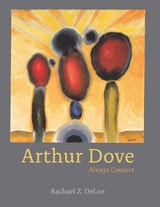
Arthur Dove
Always ConnectRachael Z. DeLue
University of Chicago Press, 2016
Rachael Z. DeLue rejects the traditional assumption that Dove can only be understood in terms of his nature paintings and association with photographer and gallerist Alfred Stieglitz and his circle. Instead, she uncovers deep and complex connections between Dove’s work and his world, including avant-garde literature, popular music, meteorology, mathematics, aviation, and World War II. Arthur Dove also offers the first sustained account of Dove’s Dadaesque multimedia projects and the first explorations of his animal imagery and the role of humor in his art. Beautifully illustrated with works from all periods of Dove’s career, this book presents a new vision of one of America’s most innovative and captivating artists—and reimagines how the story of modern art in the United States might be told.
Artifice and Illusion
The Art and Writing of Samuel van HoogstratenCeleste Brusati
University of Chicago Press, 1995
Analyzing van Hoogstraten's painting treatise, illusionistic pictures, ingenious perspective boxes, and witty trompe-l'oeil images, Brusati reveals the crucial role these endeavors played in the forging of van Hoogstraten's professional and social identity. Brusati looks at the historical circumstances of van Hoogstraten's career, which he fashioned from a convergence of Dutch cultural practices, family genealogy, and his considerable entrepreneurial acumen. She shows how Van Hoogstraten exploited the court patronage system to secure the worth of his work in the newer market culture of the Dutch Republic.
Brusati explores Van Hoogstraten's use of illusionistic artifice in his art and writing to shed new light on the much-disputed nature of Dutch "realism", and she discusses how a notion of "experimental artistry", which linked representational craft to the production of knowledge, informed Van Hoogstraten's many projects and framed the terms within which he and his colleagues understood artistic achievement during this period.
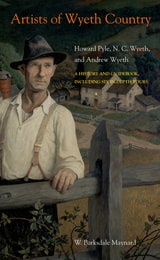
Artists of Wyeth Country
Howard Pyle, N. C. Wyeth, and Andrew WyethW. Barksdale Maynard
Temple University Press, 2021
Few artists have ever been so beloved—or so controversial among art critics—as Andrew Wyeth. The groundbreaking book Artists of Wyeth Country presents an unauthorized and unbiased biographical portrait of Wyeth, based on interviews with family, friends, neighbors—even actress Eva Marie Saint. Journalist W. Barksdale Maynard shines new light on the reclusive artist, emphasizing Wyeth’s artistic debt to Howard Pyle as well as his surprising interest in surrealism. The book is filled with brand-new information and fresh interpretations.
Artists of Wyeth Country also comprises the first-ever guidebook to the artistic world of Chadds Ford, Pennsylvania, center of the Brandywine Tradition begun by Howard Pyle. Six in-depth tours for walking or driving allow the reader to stand exactly where N. C. and Andrew Wyeth stood, as has never been fully possible before.
As Maynard explains, Andrew Wyeth’s artistic process was influenced by Henry David Thoreau’s nature-worship and by his habit of walking daily. Newly commissioned maps, rare aerial photographs, as well as glorious full-color images and artworks of the landscape (many never reproduced before) illustrate the text.
A fascinating exploration of the world of Andrew Wyeth, Artists of Wyeth Country is sure to become an essential new source for those who love American art as well as for admirers of the scenic landscapes of the Mid-Atlantic, of which the Brandywine Valley is an exceptional example. As a rare, unauthorized biography of Andrew Wyeth, it opens the door for an entirely new understanding of the American master.
Ash
Catastrophe, Performance, & the CraftDan O'Brien
Acre Books, 2027
In this collection of essays, an acclaimed poet and playwright searches for meaning amid catastrophe.
The twenty candid essays in Ash: Catastrophe, Performance, & the Craft are the culmination of a ten-year project by acclaimed poet and playwright Dan O’Brien. Divided into three parts, this volume—portions of which originally appeared in The New York Times, Esquire, and The Times Literary Supplement—combines the deeply personal with the artistic and professional, coalescing around the experience of trauma (physical, mental, moral) and the challenges presented by catastrophe and its aftermath.
In the title essay, O'Brien links the smoke and debris of the Los Angeles wildfires to the toxic legacy of September 11, tracing the lasting repercussions of collective disaster. In “Dear Brother,” he revisits a sibling’s suicide attempt and the family silences that shaped both his life and his writing. Elsewhere, in reflections on documentary theater, political violence, and a long collaboration with Pulitzer Prize–winning war reporter Paul Watson, he weighs the responsibility and the cost of bearing witness to suffering.
Running through the book, and indeed through O’Brien’s career as poet, playwright, essayist, and memoirist, is a search for meaning in the midst of calamity, whether it results from terrorism, from conflagration, from cancer, or from victimhood and abuse. Written over a decade marked by devastating illness, profound cultural upheaval, and hard-won hope, Ash is both an intimate record of survival and a searching meditation on the resilience and reinvention to be found in the creative act.
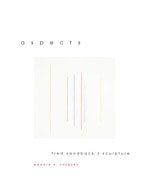
Aspects
Fred Sandback's SculptureEdward A. Vazquez
University of Chicago Press, 2017
Drawing on Sandback’s substantial archive, Edward A. Vazquez demonstrates that the artist’s work—with all its physical slightness and attentiveness to place, as well as its relationship to minimal and conceptual art of the 1960s—creates a link between viewers and space that is best understood as sculptural even as it almost surpasses physical form. At the same time, the economy of Sandback’s site-determined practice draws viewers’ focus to their connection to space and others sharing it. As Vazquez shows, Sandback’s art aims for nothing less than a total recalibration of the senses, as the spectator is caught on neither one side nor the other of an object or space, but powerfully within it.