Results by title
65 books match the query 'Melville, Herman' and 6 start with a
After the Whale
Melville in the Wake of Moby-DickClark Davis
University of Alabama Press, 1995
Beyond Moby-Dick: Reinterpreting Melville's later works through language, embodiment, and literary transformation.
The study focuses on Melville’s vision of the purpose and function of language from Moby-Dick through Billy Budd with a special emphasis on how language—in function and form—follows and depends on the function and form of the body, how Melville’s attitude toward words echoes his attitude toward fish. Davis begins by locating and describing the fundamental dialectic formulated in Moby-Dick in the characters of Ahab and Ishmael. This dialectic produces two visions of bodily reality and two corresponding visions of language: Ahab’s, in which language is both weapon and substitute body, and Ishmael’s, in which language is an extension of the body—a medium of explanation, conversation, and play. These two forms of language provide a key to understanding the difficult relationships and formal changes in Melville’s writings after Moby-Dick.
By following each work’s attitude toward the dialectic, we can see the contours of the later career more clearly and so begin a movement away from weakly contextualized readings of individual novels and short stories to a more complete consideration of Melville’s career. Since the rediscovery of Herman Melville in the early decades of this century, criticism has been limited to the prose in general and to a few major works in particular.
Those who have given significant attention to the short fiction and poetry have done so frequently out of context, that is, in multi-author works devoted exclusively to these genres. The result has been a criticism with large gaps, most especially for works from Melville’s later career. The relative lack of interest in the poetry has left us with little understanding of how Melville’s later voices developed, of how the novels evolved into tales, the tales into poetry, and the poetry back into prose. In short, the development of Melville’s art during the final three decades of his life remains a subject of which we have been afforded only glimpses, rarely a continuous attention. After the Whale provides a new, more comprehensive understanding of Melville’s growth as a writer.
Ahab Unbound
Melville and the Materialist TurnMeredith Farmer
University of Minnesota Press, 2021
Why Captain Ahab is worthy of our fear—and our compassion
Herman Melville’s Captain Ahab is perennially seen as the paradigm of a controlling, tyrannical agent. Ahab Unbound leaves his position as a Cold War icon behind, recasting him as a contingent figure, transformed by his environment—by chemistry, electromagnetism, entomology, meteorology, diet, illness, pain, trauma, and neurons firing—in ways that unexpectedly force us to see him as worthy of our empathy and our compassion.
In sixteen essays by leading scholars, Ahab Unbound advances an urgent inquiry into Melville’s emergence as a center of gravity for materialist work, reframing his infamous whaling captain in terms of pressing conversations in animal studies, critical race and ethnic studies, disability studies, environmental humanities, medical humanities, political theory, and posthumanism. By taking Ahab as a focal point, we gather and give shape to the multitude of ways that materialism produces criticism in our current moment. Collectively, these readings challenge our thinking about the boundaries of both persons and nations, along with the racist and environmental violence caused by categories like the person and the human.
Ahab Unbound makes a compelling case for both the vitality of materialist inquiry and the continued resonance of Melville’s work.
Contributors: Branka Arsić, Columbia U; Christopher Castiglia, Pennsylvania State U; Colin Dayan, Vanderbilt U; Christian P. Haines, Pennsylvania State U; Bonnie Honig, Brown U; Jonathan Lamb, Vanderbilt U; Pilar Martínez Benedí, U of L’Aquila, Italy; Steve Mentz, St. John’s College; John Modern, Franklin and Marshall College; Mark D. Noble, Georgia State U; Samuel Otter, U of California, Berkeley; Donald E. Pease, Dartmouth College; Ralph James Savarese, Grinnell College; Russell Sbriglia, Seton Hall U; Michael D. Snediker, U of Houston; Matthew A. Taylor, U of North Carolina at Chapel Hill; Ivy Wilson, Northwestern U.
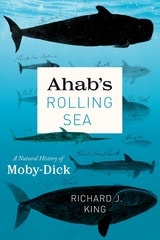
Ahab's Rolling Sea
A Natural History of "Moby-Dick"Richard J. King
University of Chicago Press, 2019
A revelation for Moby-Dick devotees and neophytes alike, Ahab’s Rolling Sea is a chronological journey through the natural history of Melville’s novel. From white whales to whale intelligence, giant squids, barnacles, albatross, and sharks, Richard J. King examines what Melville knew from his own experiences and the sources available to a reader in the mid-1800s, exploring how and why Melville might have twisted what was known to serve his fiction. King then climbs to the crow’s nest, setting Melville in the context of the American perception of the ocean in 1851—at the very start of the Industrial Revolution and just before the publication of On the Origin of Species. King compares Ahab’s and Ishmael’s worldviews to how we see the ocean today: an expanse still immortal and sublime, but also in crisis. And although the concept of stewardship of the sea would have been entirely foreign, if not absurd, to Melville, King argues that Melville’s narrator Ishmael reveals his own tendencies toward what we would now call environmentalism.
Featuring a coffer of illustrations and an array of interviews with contemporary scientists, fishers, and whale watch operators, Ahab’s Rolling Sea offers new insight not only into a cherished masterwork and its author but also into our evolving relationship with the briny deep—from whale hunters to climate refugees.
American Risorgimento
Herman Melville and the Cultural Politics of ItalyDennis Berthold
The Ohio State University Press, 2009
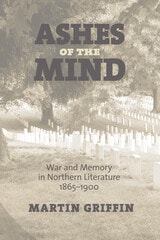
Ashes of the Mind
War and Memory in Northern Literature, 1865-1900Martin Griffin
University of Massachusetts Press, 2009
The memory of the American Civil War took many forms over the decades after the conflict ended: personal, social, religious, and political. It was also remembered and commemorated by poets and fiction writers who understood that the war had bequeathed both historical and symbolic meanings to American culture. Although the defeated Confederacy became best known for producing a literature of nostalgia and an ideological defensiveness intended to protect the South's own version of history, authors loyal to the Union also confronted the question of what the memory of the war signified, and how to shape the literary response to that individual and collective experience.
In Ashes of the Mind, Martin Griffin examines the work of five Northerners—three poets and two fiction writers—who over a period of four decades tried to understand and articulate the landscape of memory in postwar America, and in particular in that part of the nation that could, with most justification, claim the victory of its beliefs and values. The book begins with an examination of the rhetorical grandeur of James Russell Lowell's Harvard Commemoration Ode, ranges across Herman Melville's ironic war poetry, Henry James's novel of North-South reconciliation, The Bostonians, and Ambrose Bierce's short stories, and ends with the bitter meditation on race and nation presented by Paul Laurence Dunbar's elegy “Robert Gould Shaw.” Together these texts reveal how a group of representative Northern writers were haunted in different ways by the memory of the
conflict and its fraught legacy.
Griffin traces a concern with individual and community loss, ambivalence toward victory, and a changing politics of commemoration in the writings of Lowell, Melville, James, Bierce, and Dunbar. What links these very different authors is a Northern memory of the war that became more complex and more compromised as the century went on, often replacing a sense of justification and achievement with a perception of irony and failed promise.
Autistic Disturbances
Theorizing Autism Poetics from the DSM to Robinson CrusoeJulia Miele Rodas
University of Michigan Press, 2018