Results by title
364 books match the query 'Michigan' and 33 start with a

A Catalogue of Greek Manuscripts at the University of Michigan, Ann Arbor, Volume 1
Nadezhda Kavrus-Hoffmann with the collaboration of Pablo Alvarez
University of Michigan Press, 2021
A Catalogue of Greek Manuscripts at the University of Michigan, Ann Arbor is a comprehensive, fully illustrated catalogue of the largest collection of Greek manuscripts in America, including 110 codices and fragments ranging from the fourth to the nineteenth century. The collection, held in the Special Collections Research Center of the University of Michigan Library, contains many manuscripts from Epirus and the Meteora monasteries built on high pinnacles of rocks in Thessaly. Nadezhda Kavrus-Hoffmann has based the manuscript descriptions on the latest developments in the fields of paleography and codicology, including the newest recommendations of the Institute for Research and History of Texts in Paris. The catalogue includes high-resolution plates of all the manuscripts, allowing researchers to compare the entries with other Greek manuscripts around the world. This catalogue contains a trove of fascinating information related to Byzantine culture that will be available for the first time to scholars working on various disciplines of the humanities such as Classical and Byzantine Studies, Art History, Medieval Studies, Theology, and History.
This is the first volume of a projected two-volume set. Volume 2, also by Nadezhda Kavrus-Hoffmann, will contain descriptions of remaining Greek manuscripts in the Library’s collection, starting with Mich. Ms. 59 and ending with Mich. Ms. 238, for a total of 53 manuscripts and 8 fragments. Both volumes will have the same format – catalogue entries for each manuscript together with extensive illustrations. The publication date for Volume 2 has not been established.

A Catalogue of Greek Manuscripts at the University of Michigan, Ann Arbor, Volume 2
Nadezhda Kavrus-Hoffmann with the collaboration of Pablo Alvarez and Julia Miller
University of Michigan Press, 2026
A Catalogue of Greek Manuscripts at the University of Michigan, Ann Arbor, Volume II unveils the rich diversity and enduring legacy of the Greek manuscript tradition preserved in one of North America's largest collections. Building on the acclaimed first volume, this second and concluding volume offers comprehensive illustrated descriptions of eighty-four manuscripts and fragments housed in the University of Michigan Library's Special Collections Research Center. The discovery of twenty-three previously unknown manuscripts and fragments significantly expands our understanding of Byzantine and post-Byzantine book culture, illuminating the remarkable continuity of Greek scholarly, liturgical, and artistic traditions from the ninth through the nineteenth centuries.
Each entry integrates codicological features, handwriting analysis, textual content, decoration, binding, provenance, and references to earlier scholarship as well as high-quality color plates to illustrate representative pages, script types, and illuminations. Among the exceptional highlights are a fragment of The Great Calculation According to the Indians by Maximos Planoudes, preserving portions of this rare mathematical treatise otherwise lost; an illuminated 1371 copy of The Heavenly Ladder by John Klimax, created by the renowned scribe Joasaph II of the Hodegon Monastery in Constantinople; and a newly identified manuscript containing rare patristic homilies linked to the sixteenth-century Choniates scriptorium in Venice.

A City within a City
The Black Freedom Struggle in Grand Rapids, MichiganTodd E Robinson
Temple University Press, 2012
A City within a City cogently argues that the post-war political reform championed by local Republicans transformed the city's racial geography, creating a racialized "city within a city," featuring a system of "managerial racism" designed to keep blacks in declining inner-city areas. As Robinson indicates, this bold, provocative framework for understanding race relations in Grand Rapids has broader implications for illuminating the twentieth-century African American urban experience in secondary cities.
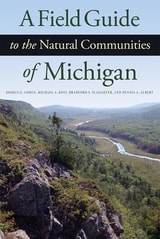
A Field Guide to the Natural Communities of Michigan
Joshua G. Cohen
Michigan State University Press, 2014
The culmination of three decades of work by Michigan Natural Features Inventory ecologists, this essential guidebook to the natural communities of Michigan introduces the diverse terrain of a unique state. Small enough to carry in a backpack, this field guide provides a system for dividing the complex natural landscape of Michigan into easily understood and describable components called natural communities. Providing a new way to explore Michigan’s many environments, this book details natural communities ranging from patterned fen to volcanic bedrock glade and beyond. The descriptions are supplemented with distribution maps, vibrant photographs, and comprehensive lists of characteristic plant species. The authors suggest places to visit to further study each type of natural community and provide a comprehensive glossary of ecological terms, as well as a dichotomous key for aiding field identification. An invaluable resource, this book is meant to serve as a tool for those seeking to understand, describe, document, conserve, and restore the diversity of natural communities native to Michigan.

A Field Guide to the Natural Communities of Michigan, 2nd edition
Joshua G. Cohen
Michigan State University Press, 2027
Discover Michigan’s rich ecological diversity with this indispensable field guide. Updated to reflect a decade of additional ecological surveys, continued learning, and new scientific discoveries, the second edition of A Field Guide to the Natural Communitiesof Michigan incorporates the latest understanding of the state’s natural landscapes. This revised edition adds three newly recognized natural community types; updates scientific nomenclature, photographs, distribution maps, species lists, and community descriptions; and refines the dichotomous keys to make field identification more accessible than ever. Drawing on more than four decades of intensive research by ecologists at the Michigan Natural Features Inventory, this essential guidebook introduces readers to Michigan’s remarkable ecological biodiversity. Compact enough to carry in a backpack, this field guide provides a practical framework for dividing Michigan’s complex natural landscape into easily understood and describable components called natural communities. Providing an enlightening way to explore Michigan’s many environments, this book details natural communities ranging from patterned fen to volcanic bedrock glade and beyond. The descriptions are supplemented with distribution maps, vibrant photographs, and comprehensive lists of characteristic plant species. The authors suggest places to visit to further study each natural community type and provide a comprehensive glossary of ecological terms, as well as dichotomous keys for aiding on-site classification. An invaluable resource, this book is meant to serve as a tool for those seeking to understand, describe, document, conserve, and restore the diversity of natural communities native to Michigan.

A Frieze of Girls
Memoirs as FictionAllan Seager
University of Michigan Press, 2004
A Frieze of Girls speaks with a fresh voice from an American era long past. This is more than Allan Seager's story of what happened; it is also about how "the feel of truth is very like the feel of fiction, especially when either is at all strange."
Seager gives us his coming-of-age story, from a high-school summer as a sometime cowboy in the Big Horn mountains to a first job at seventeen managing an antiquated factory in Memphis to a hard-drinking scholarship year in Oxford, cut short by tuberculosis. At once funny with an undercurrent of pain, the stories in A Frieze of Girls remind us of the realities we create to face the world and the past, and in turn of the realities of the world we must inevitably also confront. "Time makes fiction out of our memories," writes Seager. "We all have to have a self we can live with and the operation of memory is artistic---selecting, suppressing, bending, touching up, turning our actions inside out so that we can have not necessarily a likable, merely a plausible identity." A Frieze of Girls is Allan Seager at the top of his form, and a reminder that great writing always transcends mere fashion.
Allan Seager was Professor of English at the University of Michigan and author of many highly praised short stories and novels, including Amos Berry. He died in Tecumseh, Michigan, in 1968. Novelist Charles Baxter is the author of Saul and Patsy.

A Guide to Michigan's Endangered Wildlife
David C. Evers
University of Michigan Press, 1992
A Memoir
John A. Hannah
Michigan State University Press, 1980
This is a very personal look at the growth and evolution of Michigan State University, as seen from the eyes of its dynamic president. As twelfth president of Michigan State University, John Alfred Hannah served from July 1, 1941, to April 1, 1969. His tenure was characterized by extensive growth of the University, in both size and enrollments. President Hannah's activities were not limited to the University, as he filled a variety of positions in both the federal government and private industry.

A People's History of Detroit
Mark Jay and Philip Conklin
Duke University Press, 2020
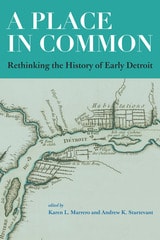
A Place in Common
Rethinking the History of Early DetroitKaren L. Marrero
Michigan State University Press, 2025

A Populist Assault
Sarah E. Van De Vort Emery on American Democracy 1862–1895Pauline Adams and Emma Thornton
University of Wisconsin Press, 1982
Sarah E. Van De Vort Emery, a Michigan woman transplanted from the Finger Lakes region of New York, was for many years a voice for Populism in the late 19th century. Emery was a woman who believed and acted on her beliefs that freedom and the flowering of the human potential should not five way to the demands of the "money power."
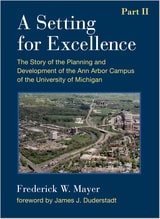
A Setting For Excellence, Part II
The Story of the Planning and Development of the Ann Arbor Campus of the University of MichiganFrederick W. Mayer
University of Michigan Press, 2017
By tracing the development of the Ann Arbor campus from its early days to the present, within the context of the evolution of higher education in America, Mayer provides a strong argument for the importance of rigorous and enlightened campus planning as a critical element of the learning environment of the university. His comprehensive history of campus planning, illustrated with photos, maps, and diagrams from Michigan’s history, is an outstanding contribution to the university’s history as it approaches its bicentennial.
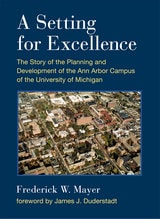
A Setting For Excellence
The Story of the Planning and Development of the Ann Arbor Campus of the University of MichiganFrederick W. Mayer
University of Michigan Press, 2015
By tracing the development of the Michigan campus from its early days to the present, within the context of the evolution of higher education in America, Mayer provides a strong argument for the importance of rigorous and enlightened campus planning as a critical element of the learning environment of the university. His comprehensive history of campus planning, illustrated with photos, maps, and diagrams from Michigan’s history, is an outstanding contribution to the university’s history as it approaches its bicentennial in 2017. Perhaps more important, Mayer’s book provides a valuable treatise on the evolution of campus planning as an architectural discipline.

A Spell on the Water
Marjorie Kowalski Cole
University of Michigan Press, 2011
"I couldn't put it down."
---Barbara Kingsolver
In 1955, Mary and Jim Leader have the American dream: careers in medicine; a young and healthy family; and even a vacation home---a shabby resort far from bustling Chicago. But one hot afternoon changes everything. Mary, now a widow, must find a path out of her grief into a future for herself and five small children.
In Michigan to sell the resort, Mary sees seven hawks riding the storm winds over the lake. This place, she thinks, can heal them with its wild beauty, so she moves her family to the northern lakeshore.
But Mary has forgotten what it's like to live in a tiny rural community, where almost everyone has a stake in maintaining the status quo. Secrets are kept at great cost as Mary's children often struggle to raise themselves. A coming-of-age story for each member of the family, this is a novel of quiet heroism and the power of personal freedom.
Praise for Marjorie Kowalski Cole and her previous novel, Correcting the Landscape:
". . . her writing is simple, vivid and gorgeous."
---Eugene Register-Guard
". . . a remarkable new talent. Critics have lined up to praise the book."
---Tucson Citizen
"Cole's style is subtle but engrossing . . . It is quite a debut."
---Booklist
Cover illustration: ©iStockphoto.com/ImagineGolf
A Study of the Glacial Kame Culture in Michigan, Ohio, and Indiana
Wilbur M. Cunningham
University of Michigan Press, 1948

A University Turns to the World
Ralph H. Smuckler
Michigan State University Press, 2003
A University Turns to the World examines the growth of Michigan State University’s pacesetting International program beginning in 1956, when President John Hannah named the nation’s first international dean, Glen Taggart, to head a university-wide effort. In the years that followed, MSU’s technical assistance projects in Asia, Africa, and Latin America were an important contribution to economic growth and development, and they were integral to broad efforts to strengthen the international dimension at home. The faculty members who went to Okinawa, Colombia, Brazil, South Vietnam, and Pakistan in the early years defined important goals and they learned much. As the years passed, their experiences led to increased sensitivity to the complexities of development activity and the need for patience.
Smuckler’s leadership of the international program and intimate involvement in MSU’s work at home and abroad enable him to recapture the dreams and disappointments of the development promise. Ultimately, Smuckler demonstrates that the development programs of the mid-twentieth century paved the way for valuable new research activities and long-term mutually beneficial ties between MSU faculty and institutions and colleagues overseas.

A University for the 21st Century
James J. Duderstadt
University of Michigan Press, 2000

Adeline & Julia
Growing Up in Michigan and on the Kansas Frontier: Diaries from 19th-Century AmericaJanet C. Coryell
Michigan State University Press, 2000
The keeping of journals and diaries became an almost everyday pastime for many Americans in the nineteenth century. Adeline and Julia Graham, two young women from Berrien Springs, Michigan, were both drawn to this activity, writing about the daily events in their lives, as well as their 'grand adventures.' These are fascinating, deeply personal accounts that provide an insight into the thoughts and motivation of two sisters who lived more than a century ago. Adeline began keeping a diary when she was sixteen, from mid-1880 through mid-1884; through it we see a young woman coming of age in this small community in western Michigan. Paired with Adeline's account is her sister Julia's diary, which begins in 1885 when she sets out with three other young women to homestead in Greeley County, Kansas, just east of the Colorado border. It is a vivid and colorful narrative of a young woman's journey into America's western landscape.

African Americans in Michigan
Lewis Walker
Michigan State University Press, 2001
African Americans, as free laborers and as slaves, were among the earliest permanent residents of Michigan, settling among the French, British, and Native people with whom they worked and farmed. Lewis Walker and Benjamin Wilson recount the long history of African American communities in Michigan, delineating their change over time, as migrants from the South, East, and overseas made their homes in the state. Moreover, the authors show how Michigan's development is inextricably joined with the vitality and strength of its African American residents. In a related chapter, Linwood Cousins examines youth culture and identity in African American schools, linking education with historical and contemporary issues of economics, racism, and power.

African Americans in the Furniture City
The Struggle for Civil Rights in Grand RapidsRandal Maurice Jelks
University of Illinois Press, 2006
Focusing on the intersection of African Americans' nineteenth-century cultural values and the changing social and political conditions in the first half of the twentieth century, Jelks pays particularly close attention to the religious community's influence during their struggle toward a respectable social identity and fair treatment under the law. He explores how these competing values defined the community's politics as it struggled to expand its freedoms and change its status as a subjugated racial minority.

After Prison
Navigating Adulthood in the Shadow of the Justice SystemDavid J. Harding
Russell Sage Foundation, 2020
The transition to young adulthood typically includes school completion, full-time employment, leaving the childhood home, marriage, and childbearing, events that are disrupted by incarceration. While one quarter of the young men who participated in the study successfully transitioned into adulthood—achieving employment and residential independence and avoiding arrest and incarceration—the same number of young men remained deeply involved with the criminal justice system, spending on average four out of the seven years after their initial release re-incarcerated. Not surprisingly, whites are more likely to experience success after prison. The authors attribute this racial disparity to the increased stigma of criminal records for blacks, racial discrimination, and differing levels of social network support that connect whites to higher quality jobs. Black men earn less than white men, are more concentrated in industries characterized by low wages and job insecurity, and are less likely to remain employed once they have a job.
The authors demonstrate that families, social networks, neighborhoods, and labor market, educational, and criminal justice institutions can have a profound impact on young people’s lives. Their research indicates that residential stability is key to the transition to adulthood. Harding and Harris make the case for helping families, municipalities, and non-profit organizations provide formerly incarcerated young people access to long-term supportive housing and public housing. A remarkably large number of men in this study eventually enrolled in college, reflecting the growing recognition of college as a gateway to living wage work. But the young men in the study spent only brief spells in college, and the majority failed to earn degrees. They were most likely to enroll in community colleges, trade schools, and for-profit institutions, suggesting that interventions focused on these kinds of schools are more likely to be effective. The authors suggest that, in addition to helping students find employment, educational institutions can aid reentry efforts for the formerly incarcerated by providing supports like childcare and paid apprenticeships.
After Prison offers a set of targeted policy interventions to improve these young people’s chances: lifting restrictions on federal financial aid for education, encouraging criminal record sealing and expungement, and reducing the use of incarceration in response to technical parole violations. This book will be an important contribution to the fields of scholarly work on the criminal justice system and disconnected youth.

Amish in Michigan
Gertrude Enders Huntington
Michigan State University Press, 2001
Driving the rural roads of Michigan one might suddenly come upon a black buggy driven by a bonneted woman or a bearded Amish man. In 1955 there were fewer than five hundred Amish in Michigan—in 2000 there were more than seven thousand. The Amish, with their unique life-style, are found only in North America where approximately 170,000 live in twenty-four states and one Canadian province. This sensitive and fascinating volume explores the Amish historical background, immigration into Michigan, occupations, marriage patterns, cultural conflicts, community-financed schools, medical practices, and cultural survival.

An Early Woodland Community at the Schultz Site 20SA2 in the Saginaw Valley and the Nature of the Early Woodland Adaptation in the Great Lakes Region
Doreen Ozker
University of Michigan Press, 1982

And Here
100 Years of Upper Peninsula Writing, 1917–2017Ronald Riekki
Michigan State University Press, 2017
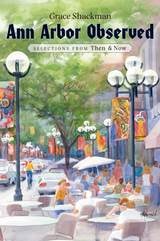
Ann Arbor Observed
Selections from Then and NowGrace Shackman
University of Michigan Press, 2010
Packed with photographs from Ann Arbor of yesteryear and the present day, Ann Arbor Observed compiles the best of Shackman’s articles in one book divided into eight sections: public buildings and institutions, the University of Michigan, transportation, industry, downtown Ann Arbor, recreation and culture, social fabric and communities, and architecture.
For long-time residents, Ann Arbor expatriates, University of Michigan alumni, and visitors alike, Ann Arbor Observed provides a rare glimpse of the bygone days of a town with a rich and varied history.
Grace Shackman is a history columnist for the Ann Arbor Observer, the Community Observer, and the Old West Side News, as well as a writer for University of Michigan publications. She is the author of two previous books: Ann Arbor in the 19th Century and Ann Arbor in the 20th Century.

Arab Americans in Michigan
Rosina J. Hassoun
Michigan State University Press, 2003
The state of Michigan hosts one of the largest and most diverse Arab American populations in the United States. As the third largest ethnic population in the state, Arab Americans are an economically important and politically influential group. It also reflects the diversity of national origins, religions, education levels, socioeconomic levels, and degrees of acculturation. Despite their considerable presence, Arab Americans have always been a misunderstood ethnic population in Michigan, even before September 11, 2001 imposed a cloud of suspicion, fear, and uncertainty over their ethnic enclaves and the larger community. In Arab Americans in Michigan Rosina J. Hassoun outlines the origins, culture, religions, and values of a people whose influence has often exceeded their visibility in the state.

Architectural Missionary
D. Fred Charlton in Michigan's Upper Peninsula, 1887–1918Steven C. Brisson
Michigan State University Press, 2021

Arthur Vandenberg
The Man in the Middle of the American CenturyHendrik Meijer
University of Chicago Press, 2017
Originally the editor and publisher of the Grand Rapids Herald, Vandenberg was appointed and later elected to the Senate in 1928, where he became an outspoken opponent of the New Deal and a leader among the isolationists who resisted FDR’s efforts to aid European allies at the onset of World War II. But Vandenberg soon recognized the need for unity at the dawn of a new world order; and as a Republican leader, he worked closely with Democratic administrations to build the strong bipartisan consensus that established the Marshall Plan, the United Nations, and NATO. Vandenberg, as Meijer reveals, was instrumental in organizing Congressional support for these monumental twentieth-century foreign policy decisions.
Vandenberg’s life and career offer powerful lessons for today, and Meijer has given us a story that suggests an antidote to our current democratic challenges. After reading this poignant biography, many will ask: Where is the Vandenberg of today?
As Sacred to Us
Simon Pokagon’s Birch Bark Stories in Their ContextsBlaire Morseau
Michigan State University Press, 2023

Asian Indians in Michigan
Arthur W. Helweg
Michigan State University Press, 2002
Since 1970, a growing number of Asian Indians have called Michigan home. Representative of the “new immigration,” Asian Indians come from a democratic country, are well-educated, and come from middle- and upper-class families. Unlike older immigrant groups, Asian Indians do not form urban ethnic enclaves or found their own communities to meet the challenges of living in a new society. As Arthur W. Helweg shows, Asian Indians contribute to the richness and diversity of Michigan’s culture through active participation in local institutions, while maintaining a strong ethnic identity rooted in India.
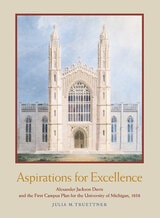
Aspirations for Excellence
Alexander Jackson Davis and the First Campus Plan for the University of Michigan, 1838Julia M. Truettner
University of Michigan Press, 2003

Assassination of a Michigan King
The Life of James Jesse StrangRoger Van Noord
University of Michigan Press, 1997
As a young man, Strang was a dreamer of grandiose dreams--dreams of power, of royalty, and of fame. For him, the dreams came true. But in his pursuit of those dreams, Strang walked a tightrope to avoid ever-impending doom. Strang's kingdom flourished despite perennial conflicts with non-Mormons, including a gun battle with mainlanders, and despite a major prosecution by the federal government. His kingdom was designed to be totally independent of the state and nation. And yet, he was a shrewd political tactician who took advantage of Michigan law to be twice elected to the state legislature and become what one Detroit newspaper called the most powerful politician in the state.
Here is Strang the man of contrasts and contradictions, the strident opponent of polygamy and the husband of five wives, the astute editor and the incendiary propagandist, the prophet and the scoundrel, the man who through the sheer force of his personality made his followers a group to be feared in his region.
Vast amount of fresh information, including contemporary journals, documents, and letters never before used by biographers help draw a portrait of one of the most complex and resourceful leaders in American history.

Assault with a Deadly Lie
A Nick Hoffman Novel of SuspenseLev Raphael
University of Wisconsin Press, 2014
A novel of suspense set in the academic world, Assault with a Deadly Lie probes the disturbing psychological impact of slander, harassment, stalking, police brutality, and the loss of personal safety. What will Nick do when his world threatens to collapse? How can he reestablish order in a suddenly chaotic life?
Assault with a Deadly Lie, the eighth installment of Lev Raphael's Nick Hoffman Mysteries, propels the series to a new level of danger and intrigue as Nick and Stefan are catapulted out of their tranquil existence by shocking accusations.
Finalist, Midwest Book Award for Mystery/Thriller Fiction, Midwest Independent Publishers Association
“A riveting great read for mystery/suspense fans, author Lev Raphael once again documents his impressive gifts as a storyteller, holding the reader’s rapt attention from beginning to end with unexpected plot twists and surprise twists.”—Jack Mason, Midwest Book Review
“Raphael portrays with frightening power the wrenching experience of victimization by the corporatized, PR-prioritized groves of academia, where both men teach, and by local authorities militarized into SWAT teams practicing police brutality. . . . The compelling core of this unusual novel is Raphael’s depiction of the agonizing reality of victims’ shame, in which someone ‘feels doubly exposed talking about the violation’ and so says nothing.”—Booklist
“Professor Nick Hoffman learns that even tenure can’t guarantee real security.”—Kirkus Reviews