683 books match the query 'Middle East' and 76 start with a
cover of A Calm Fire: and Other Travel Writings

A Calm Fire

and Other Travel Writings

Philippe Jaccottet

Seagull Books, 2018

In these times of heartbreaking violence, clashing religions, and a seemingly never-ending narrative of dichotomy between East and West, wonder at the religion and culture of the Middle East can be in short supply. However, the lyrical and philosophical travel writing in Swiss poet Philippe Jaccottet’s Calm Fire rekindles it, lifting us out of our ordinary locales and stories of violent conflict in the Middle East. Jaccottet’s poetic descriptions explore the rich cultural worlds of Syria, Lebanon, Egypt, and Israel, giving us uncommon glimpses into countries so often associated with turmoil, death and destruction. Expressing a poet’s admiration for the ecstasies of faith and a philosopher’s skepticism of these seemingly transformative feelings, Jaccottet dives deep into the religious cultures of the places he visits.
​
Ultimately, whether in his native Swiss Alps or among the cedars of Lebanon, the same question pervades Philippe Jaccottet’s work: How should we live? More than a simple palliative to a depressing news cycle, Calm Fire captures a true sense of place by celebrating and pondering ways of life through the immersive experience of travel.
[more]

cover of A Colored Man Round the World

A Colored Man Round the World

David F. Dorr

University of Michigan Press, 1999

This remarkable book, written by former slave David F. Dorr, published in the mid-nineteenth century and only recently rediscovered, is an uncommon travel narrative. In the 1850s Dorr accompanied Louisiana plantation owner Cornelius Fellowes on a tour of the world's major cities, with the promise that when they returned to the United States, Dorr would be given his freedom. When that promise was broken, Dorr escaped to Ohio and wrote of his experiences in A Colored Man Round the World.
Malini Johar Schueller has edited and annotated the 1858 text and added a critical introduction that provides a useful context for understanding and appreciating this important but heretofore neglected document. Her edition of A Colored Man Round the World provides a fascinating account of Dorr's negotiation of the conflicting roles of slave versus man, taking into account all of the racial complexities that existed at the time. As a traveler abroad, Dorr claimed an American selfhood that allowed him mobility in Europe, and he benefited from the privileges accorded American "Orientalists" venturing in the near East. However, any empowerment that Dorr experienced while a tourist vanished upon his return to America.
The book will be welcomed for the rare perspective it provides of the mid-nineteenth century, through the eyes of an African-American slave and for the light it casts on world and U.S. history as well as on questions of racial and national identity.
Malini Johar Schueller is Professor of English, University of Florida.
[more]
cover of A Curious Land: Stories from Home

A Curious Land

Stories from Home

Susan Muaddi Darraj

University of Massachusetts Press, 2015

Winner of the 2016 American Book Award, the 2016 Arab American Book Award, and the 2014 Grace Paley Prize in Short Fiction
Susan Muaddi Darraj's short story collection about the inhabitants of a Palestinian West Bank village, Tel al-Hilou, spans generations and continents to explore ideas of memory, belonging, connection, and, ultimately, the deepest and richest meaning of home. A Curious Land gives voice to the experiences of Palestinians in the last century.

An excerpt from A Curious Land:

When Rabab lowered the magad and clapped-clapped to the well in her mother's too-big slippers, the stone jar digging into her shoulder, she didn't, at first, see the body. The morning sun glazed everything around her—the cement homes, the iron rails along one wall, the bars on the windows, the stones around the well—and made her squint her itchy eyes.

She was hungry. That was all.

They'd arrived here only last night, stopping as soon as Awwad and the men were sure the army had moved south. It must have been the third time in just a few weeks—collapse the tents, load the mules, disappear into the sands. She hoped this war would end soon, and she didn't really care who won, as long as it ended because they hadn't eaten well in two years. In the past few months, her mother had sold all her gold, except for her bracelet made of liras. It was the only thing left, and she was holding onto it, and Rabab realized, so were they all; she imagined that, the day it was sold, when her mother's wrist was bare, would signal that they were at the end.
[more]
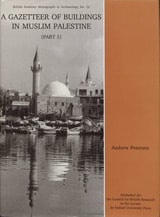
cover of A Gazetteer of Buildings in Muslim Palestine

A Gazetteer of Buildings in Muslim Palestine

Andrew Petersen

Council for British Research in the Levant, 2001

The aim of the survey on which this book is based was to make a record of all buildings constructed in Palestine during the medieval and Ottoman periods. The survey area covers the modern state of Israel excluding West Jerusalem and Ramla (which are covered in separate publications). The West Bank and Gaza will be the subject of Volume II.


Library of Congress subject headings for this publication:
Architecture, Islamic -- Palestine -- Guidebooks.
Architecture, Ottoman -- Palestine -- Guidebooks.
Architecture, Medieval -- Palestine -- Guidebooks.
Historic buildings -- Palestine -- Guidebooks.
[more]
cover of A Grammar of Ugaritic

A Grammar of Ugaritic

John Screnock

SBL Press, 2022

A Grammar of Ugaritic is an accessible yet academically rigorous textbook for first-year students of Ugaritic. Eight digestible lessons include more than 150 exercises to strengthen readers’ understanding through translation and composition of not only vocalized Ugaritic but also transcribed texts and cuneiform script—strategies that develop language skills and provide a sound basis for classroom teaching. Short stories interspersed among the lessons help students consolidate their knowledge and bolster recognition of forms. An introduction to the language and its historical context, glossaries, paradigms, and a bibliography and guide for further learning supplement the lessons. Students who work through the grammar in the classroom or individually will be rewarded with the ability to read real Ugaritic texts in cuneiform.
[more]
cover of A History of Modern Lebanon

A History of Modern Lebanon

Fawwaz Traboulsi

Pluto Press, 2012

[more]
cover of A History of Slavery and Emancipation in Iran, 1800-1929

A History of Slavery and Emancipation in Iran, 1800-1929

By Behnaz A. Mirzai

University of Texas Press, 2017

Shortlisted for the 2018 Wallace K. Ferguson Prize, Canadian Historical Association

The leading authority on slavery and the African diaspora in modern Iran presents the first history of slavery in this key Middle Eastern country and shows how slavery helped to shape the nation’s unique character.


Slavery in the Middle East is a growing field of study, but the history of slavery in a key country, Iran, has never before been written. This history extends to Africa in the west and India in the east, to Russia and Turkmenistan in the north, and to the Arab states in the south. As the slave trade between Iran and these regions shifted over time, it transformed the nation and helped forge its unique culture and identity. Thus, a history of Iranian slavery is crucial to understanding the character of the modern nation.

Drawing on extensive archival research in Iran, Tanzania, England, and France, as well as fieldwork and interviews in Iran, Behnaz A. Mirzai offers the first history of slavery in modern Iran from the early nineteenth century to emancipation in the mid-twentieth century. She investigates how foreign military incursion, frontier insecurity, political instability, and economic crisis altered the patterns of enslavement, as well as the ethnicity of the slaves themselves. Mirzai’s interdisciplinary analysis illuminates the complex issues surrounding the history of the slave trade and the process of emancipation in Iran, while also giving voice to social groups that have never been studied—enslaved Africans and Iranians. Her research builds a clear case that the trade in slaves was inexorably linked to the authority of the state. During periods of greater decentralization, slave trading increased, while periods of greater governmental autonomy saw more freedom and peace.

[more]
cover of A History of the Crusades, Volume I: The First Hundred Years

A History of the Crusades, Volume I

The First Hundred Years

Series Edited by Kenneth M. Setton; Volume Edited by Marshall W. Baldwin

University of Wisconsin Press, 1969

The six volumes of A History of the Crusades will stand as the definitive history of the Crusades, spanning five centuries, encompassing Jewish, Moslem, and Christian perspectives, and containing a wealth of information and analysis of the history, politics, economics, and culture of the medieval world.
[more]
cover of A History of the Crusades, Volume II: The Later Crusades, 1189-1311

A History of the Crusades, Volume II

The Later Crusades, 1189-1311

Series Edited by Kenneth M. Setton; Volume Edited by Wolff and Hazard

University of Wisconsin Press, 1969

The six volumes of A History of the Crusades will stand as the definitive history of the Crusades, spanning five centuries, encompassing Jewish, Moslem, and Christian perspectives, and containing a wealth of information and analysis of the history, politics, economics, and culture of the medieval world.
 
[more]
cover of A History of the Crusades, Volume III: The Fourteenth and Fifteenth Centuries

A History of the Crusades, Volume III

The Fourteenth and Fifteenth Centuries

Series Edited by Kenneth M. Setton; Volume Edited by Harry W. Hazard

University of Wisconsin Press, 1975

The six volumes of A History of the Crusades will stand as the definitive history of the Crusades, spanning five centuries, encompassing Jewish, Moslem, and Christian perspectives, and containing a wealth of information and analysis of the history, politics, economics, and culture of the medieval world.
[more]
cover of A History of the Crusades, Volume IV: The Art and Architecture of the Crusader States

A History of the Crusades, Volume IV

The Art and Architecture of the Crusader States

Series Edited by Kenneth M. Setton, Volume Edited by Harry W. Hazard

University of Wisconsin Press, 1977

The six volumes of A History of the Crusades will stand as the definitive history of the Crusades, spanning five centuries, encompassing Jewish, Moslem, and Christian perspectives, and containing a wealth of information and analysis of the history, politics, economics, and culture of the medieval world.
[more]
cover of A History of the Crusades, Volume V: The Impact of the Crusades on the Near East

A History of the Crusades, Volume V

The Impact of the Crusades on the Near East

Series Edited by Kenneth M. Setton, Volume Edited by Zacour and Hazard

University of Wisconsin Press, 1985

The six volumes of A History of the Crusades will stand as the definitive history of the Crusades, spanning five centuries, encompassing Jewish, Moslem, and Christian perspectives, and containing a wealth of information and analysis of the history, politics, economics, and culture of the medieval world.
[more]
cover of A History of the Crusades, Volume VI: The Impact of the Crusades on Europe

A History of the Crusades, Volume VI

The Impact of the Crusades on Europe

Series Edited by Kenneth M. Setton, Volume Edited by Hazard and Zacour

University of Wisconsin Press, 1990

The six volumes of A History of the Crusades will stand as the definitive history of the Crusades, spanning five centuries, encompassing Jewish, Moslem, and Christian perspectives, and containing a wealth of information and analysis of the history, politics, economics, and culture of the medieval world.
[more]
cover of A Home for All Jews: Citizenship, Rights, and National Identity in the New Israeli State

A Home for All Jews

Citizenship, Rights, and National Identity in the New Israeli State

Orit Rozin

Brandeis University Press, 2016

Orit Rozin’s inspired scholarship focuses on the construction and negotiation of citizenship in Israel during the state’s first decade. Positioning itself both within and against much of the critical sociological literature on the period, this work reveals the dire historical circumstances, the ideological and bureaucratic pressures, that limited the freedoms of Israeli citizens. At the same time it shows the capacity of the bureaucracy for flexibility and of the populace for protest against measures it found unjust and humiliating. Rozin sets her work within a solid analytical framework, drawing on a variety of historical sources portraying the voices, thoughts, and feelings of Israelis, as well as theoretical literature on the nature of modern citizenship and the relation between citizenship and nationality. She takes on both negative and positive freedoms (freedom from and freedom to) in her analysis of three discrete yet overlapping issues: the right to childhood (and freedom from coerced marriage at a tender age); the right to travel abroad (freedom of movement being a pillar of a liberal society); and the right to speak out—not only to protest without fear of reprisal, but to speak in the expectation of being heeded and recognized. This book will appeal to scholars and students of Israeli history, law, politics, and culture, and to scholars of nation building more generally.
[more]
cover of A Journey through Afghanistan

A Journey through Afghanistan

David Chaffetz

University of Chicago Press, 2002

Shortly before the Soviet invasion of Afghanistan, David Chaffetz slipped from the protection of Western culture and immersed himself in the customs, fears, and hopes of the Afghan people, setting out by car and on horseback for a long journey through the northwestern quarter of the country. A Journey through Afghanistan is the story, told in vivid, descriptive prose, of his experience—an account that reveals more about the Afghan people themselves than most books written either before or since.
[more]
cover of A Land of Two Peoples: Martin Buber on Jews and Arabs

A Land of Two Peoples

Martin Buber on Jews and Arabs

Martin Buber

University of Chicago Press, 2005

Theologian, philosopher, and political radical, Martin Buber (1878–1965) was actively committed to a fundamental economic and political reconstruction of society as well as the pursuit of international peace. In his voluminous writings on Arab-Jewish relations in Palestine, Buber united his religious and philosophical teachings with his politics, which he felt were essential to a life of public dialogue and service to God.

Collected in ALand of Two Peoples are the private and open letters, addresses, and essays in which Buber advocated binationalism as a solution to the conflict in the Middle East. A committed Zionist, Buber steadfastly articulated the moral necessity for reconciliation and accommodation between the Arabs and Jews. From the Balfour Declaration of November 1917 to his death in 1965, he campaigned passionately for a "one state solution.

With the Middle East embroiled in religious and ethnic chaos, A Land of Two Peoples remains as relevant today as it was when it was first published more than twenty years ago. This timely reprint, which includes a new preface by Paul Mendes-Flohr, offers context and depth to current affairs and will be welcomed by those interested in Middle Eastern studies and political theory.
[more]
cover of A New Orient: From German Scholarship to Middle Eastern Studies in Israel

A New Orient

From German Scholarship to Middle Eastern Studies in Israel

Amit Levy

Brandeis University Press, 2024

A history of knowledge transfer of Oriental Studies stretching along an axis from Germany to Palestine/Israel.
 
This study examines the history of Zionist academic Orientalism—referred to throughout as Oriental studies, the term contemporary English speakers would have used—in light of its German-Jewish background, as a history of knowledge transfer stretching along an axis from Germany to Palestine. The transfer, which took place primarily during the 1920s and 1930s, involved questions about the re-establishment, far from Germany, of a field of knowledge with deep German roots. Like other German-Jewish scholars arriving in Palestine at the time, some of the Orientalist agents of transfer did so out of Zionist conviction as olim (immigrants making aliyah, or literally “ascending” to the homeland), while others joined them later as refugees from Nazi Germany; both groups were integrated into the institutional apparatus of the Hebrew University. Unlike other fields of knowledge or professions, however, the transfer of Orientalist knowledge was unique in that the axis involved an essential change in the nature of its encounter with the Orient: from a textual-scientific encounter at German universities, largely disconnected from contemporary issues to a living, substantive, and unmediated encounter with an essentially Arab region—and the escalating Jewish-Arab conflict in the background. Within the new context, German-Jewish Orientalist expertise was charged with political and cultural significance it had not previously faced, fundamentally influencing the course of the discipline’s development in Palestine and Israel.
[more]
cover of A People Without a State: The Kurds from the Rise of Islam to the Dawn of Nationalism

A People Without a State

The Kurds from the Rise of Islam to the Dawn of Nationalism

By Michael Eppel

University of Texas Press, 2016

Numbering between 25 and 35 million worldwide, the Kurds are among the largest culturally and ethnically distinct people to remain stateless. A People Without a State offers an in-depth survey of an identity that has often been ignored in mainstream historiographies of the Middle East and brings to life the historical, social, and political developments in Kurdistani society over the past millennium.

Michael Eppel begins with the myths and realities of the origins of the Kurds, describes the effect upon them of medieval Muslim states under Arab, Persian, and Turkish dominance, and recounts the emergence of tribal-feudal dynasties. He explores in detail the subsequent rise of Kurdish emirates, as well as this people’s literary and linguistic developments, particularly the flourishing of poetry. The turning tides of the nineteenth century, including Ottoman reforms and fluctuating Russian influence after the Crimean War, set in motion an early Kurdish nationalism that further expressed a distinct cultural identity. Stateless, but rooted in the region, the Kurds never achieved independence because of geopolitical conditions, tribal rivalries, and obstacles on the way to modernization. A People Without a State captures the developments that nonetheless forged a vast sociopolitical system.

[more]
cover of A Poetics of Trauma: The Work of Dahlia Ravikovitch

A Poetics of Trauma

The Work of Dahlia Ravikovitch

Ilana Szobel

Brandeis University Press, 2013

The work of the renowned Israeli poet, translator, peace activist, and 1998 Israel Prize laureate Dahlia Ravikovitch (1936–2005) portrays the emotional structure of a traumatized and victimized female character. Ilana Szobel’s book, the first full-length study of Ravikovitch in English, offers a theoretical discussion of the poetics of trauma and the politics of victimhood, as well as a rethinking of the notions of activity and passivity, strength and weakness. Analyzing the deep structure embodied in Ravikovitch’s work, Szobel unearths the interconnectedness of Ravikovitch’s private-poetic subjectivity and Israeli national identity, and shows how her unique poetics can help readers overcome cultural biases and sympathetically engage otherness.
[more]
cover of A Political History of the Arameans: From Their Origins to the End of Their Polities

A Political History of the Arameans

From Their Origins to the End of Their Polities

K. Lawson Younger Jr.

SBL Press, 2016

An up-to-date analysis of the history of the ancient Near East and the Arameans

K. Lawson Younger Jr. presents a political history of the Arameans from their earliest origins to the demise of their independent entities. The book investigates their tribal structures, the development of their polities, and their interactions with other groups in the ancient Near East. Younger utilizes all of the available sources to develop a comprehensive picture of this complex, yet highly important, people whose influence and presence spanned the Fertile Cresent.

Features:

  • The best, recent understanding of tribal political structures, aspects of mobile pastoralism, and models of migration
  • A regional rather than a monolithic approach to the rise of Aramean polities
  • Thorough integration of the complex relationships and interactions of the Arameans with the Luwians, the Assyrians, the Israelites, and others
[more]
cover of A Portal in Space

A Portal in Space

By Mahmoud Saeed, Translated by William M. Hutchins

University of Texas Press, 2015

A Portal in Space, set in Basra, Iraq, during the Iran-Iraq War (1980–1988), follows the lives of Anwar, a newly minted architect, and the other members of his affluent family as they attempt to maintain a sense of normality during the frequent bombing attacks from Iran. When Anwar joins the Iraqi army and then goes missing in action, his family struggles to cope with uncertainty over his fate. His mother falls into depression and secludes herself in the family home, while his father shifts his attention from his duties as a judge to the weekly pilgrimage to Baghdad seeking information on his son—and to Zahra, the young widow he meets there.

Emotionally engaging, A Portal in Space is a wry, wise tale of human beings striving to retain their humanity during a war that is anything but humane. Mahmoud Saeed succeeds brilliantly in bringing the sights and sounds of Iraq to life on the page—whether in a bunker on the front lines of the Iran-Iraq War or in the parlor of a fortune-teller in Baghdad. As Zahra says of the novel she is writing: “It is a normal novel that contains love, war, life, deceit, and death.”

[more]
cover of A Religion, Not a State: Ali 'Abd al-Raziq's Islamic justification of Political Secularism

A Religion, Not a State

Ali 'Abd al-Raziq's Islamic justification of Political Secularism

Souad T Ali

University of Utah Press, 2009

Utah Series in Middle East Studies

In this notable work, Souad T. Ali examines the seminal writings of Egyptian reformist scholar Ali'Abd al-Raziq, often regarded as the intellectual father of Islamic secularism, and his controversial argument that the caliphate should be considered a human innovation, rather than a religious imperative. 'Abd al Raziq contended that Islam is "a religion, not a state; a message, not a government," a major departure from the traditional view that religious and political spheres are intertwined and inseparable in Islam.

Opponents denounced 'Abd al-Raziq's ideas as a foreign corruption imported from the West.  Ali's careful, objective, and scholarly examination of 'Abd al-Raziq's work, however, reveals that his arguments are not based in Western thought.  Rather, they sit firmly within the dictates of Islam's sacred texts, particularly the Quran and Hadith, and also enjoy considerable support from the historical record.

This analysis critically challenges prevalent misinterpretations of Islam that have endured for centuries.  Ali recognizes the varied models and discourses that have arisen throughout different epochs, especially so the role that Western intervention has played in placing the question of Islam's modernity at the forefront of intellectual debate.  Throughout, the study emphasizes the atmosphere of openness and tolerance that is a requisite for free, intelligent debate.

[more]
cover of A Restless Search: A History of Persian Translations of the Bible

A Restless Search

A History of Persian Translations of the Bible

Kenneth J. Thomas

SBL Press, 2015

A literary detective story, a historical survey, and an important contribution to translation studies

This book from Kenneth J. Thomas is both a philological and linguistic analysis of Persian translations and a call for interfaith cooperation. Thomas appraises biblical translation efforts from the fifth to the twenty-first centuries of Persian history when successive translators and groups of translators, sometimes of different faiths, worked to reshape and refine versions of the Bible in the supple Persian language of their times. Restless, impelled, and wide-ranging, this is a story of translations commissioned by shahs, undertaken by Christian and Jewish communities, and produced by teams working outside the country.

Features

  • Demonstration of the effects of the lack of a standard Persian vocabulary for key biblical terms on literary style and word choice
  • Technical analyses and overviews of Persian biblical translations
  • A careful examination of sixteen centuries' worth of Bible translations
[more]
cover of A Shi'ite Pilgrimage to Mecca, 1885-1886: The Safarnâmeh of Mirzâ Mo?ammad ?osayn Farâhâni

A Shi'ite Pilgrimage to Mecca, 1885-1886

The Safarnâmeh of Mirzâ Mo?ammad ?osayn Farâhâni

By Mirzâ Farâhâni

University of Texas Press, 1990

Western accounts of the Hajj, the ritual Muslim pilgrimage to Mecca, are rare, since access to Mecca is forbidden to non-Muslims. In the Muslim world, however, pilgrimage literature is a well-established genre, dating back to the earliest centuries of the Islamic era. A Shiʿite Pilgrimage to Mecca is taken from the original nineteenth-century Persian manuscript of the Safarnâmeh of Mirzâ Moḥammad Ḥosayn Farâhâni, a well-educated, keenly observant, Iranian Shiʿite gentleman.

This memoir holds a wealth of social and economic information about Czarist Russia, the Ottoman Empire, Egypt, Northern Iran, and Arabia. The author is a meticulous observer, recording details of distances, currencies, accommodations, modes of travel, and so on. He records the experiences encountered by pilgrims of his day: physical hardships, disease, generosity and compassion, banditry, hospitality, comradeship, and exaltation. And, without prejudice, he discusses the tensions between the Shiʿites and the Sunnites in the holy places—tensions that still exist and have erupted in bloody clashes during recent pilgrimages.

A Shiʿite Pilgrimage to Mecca will appeal to a wide audience of general readers, Middle Eastern scholars, anthropologists, and historians.

[more]
cover of A Small Door Set in Concrete: One Woman's Story of Challenging Borders in Israel/Palestine

A Small Door Set in Concrete

One Woman's Story of Challenging Borders in Israel/Palestine

Ilana Hammerman

University of Chicago Press, 2019

“I was taught from the start not to be silent.”

For years, renowned activist and scholar Ilana Hammerman has given the world remarkable translations of Kafka. With A Small Door Set in Concrete, she turns to the actual surreal existence that is life in the West Bank after decades of occupation.

After losing her husband and her sister, Hammerman set out to travel to the end of the world. She began her trip with the hope that it would reveal the right path to take in life. But she soon realized that finding answers was less important than experiencing the freedom to move from place to place without restriction. Hammerman returned to the West Bank with a renewed joie de vivre and a resolution: she would become a regular visitor to the men, women, and children who were on the other side of the wall, unable to move or act freely. She would listen to their dreams and fight to bring some justice into their lives.

A Small Door Set in Concrete is a moving picture of lives filled with destruction and frustration but also infusions of joy. Whether joining Palestinian laborers lining up behind checkpoints hours before the crack of dawn in the hope of crossing into Israel for a day’s work, accompanying a family to military court for their loved one’s hearing, or smuggling Palestinian children across borders for a day at the beach, Hammerman fearlessly ventures into territories where few Israelis dare set foot and challenges her readers not to avert their eyes in the face of injustice.

Hammerman neither preaches nor politicks. Instead, she engages in a much more personal, everyday kind of activism. Hammerman is adept at revealing the absurdities of a land where people are stripped of their humanity. And she is equally skilled at illuminating the humanity of those caught in this political web. To those who have become simply statistics or targets to those in Israel and around the world, she gives names, faces, dreams, desires.
This is not a book that allows us to sit passively. It is a slap in the face, a necessary splash of cold water that will reawaken the humanity inside all of us.
[more]
cover of A Social History of Iranian Cinema, Volume 1: The Artisanal Era, 1897-1941

A Social History of Iranian Cinema, Volume 1

The Artisanal Era, 1897-1941

Hamid Naficy

Duke University Press, 2011

Hamid Naficy is one of the world’s leading authorities on Iranian film, and A Social History of Iranian Cinema is his magnum opus. Covering the late nineteenth century to the early twenty-first and addressing documentaries, popular genres, and art films, it explains Iran’s peculiar cinematic production modes, as well as the role of cinema and media in shaping modernity and a modern national identity in Iran. This comprehensive social history unfolds across four volumes, each of which can be appreciated on its own.

Volume 1 depicts and analyzes the early years of Iranian cinema. Film was introduced in Iran in 1900, three years after the country’s first commercial film exhibitor saw the new medium in Great Britain. An artisanal cinema industry sponsored by the ruling shahs and other elites soon emerged. The presence of women, both on the screen and in movie houses, proved controversial until 1925, when Reza Shah Pahlavi dissolved the Qajar dynasty. Ruling until 1941, Reza Shah implemented a Westernization program intended to unite, modernize, and secularize his multicultural, multilingual, and multiethnic country. Cinematic representations of a fast-modernizing Iran were encouraged, the veil was outlawed, and dandies flourished. At the same time, photography, movie production, and movie houses were tightly controlled. Film production ultimately proved marginal to state formation. Only four silent feature films were produced in Iran; of the five Persian-language sound features shown in the country before 1941, four were made by an Iranian expatriate in India.

A Social History of Iranian Cinema
Volume 1: The Artisanal Era, 1897–1941
Volume 2: The Industrializing Years, 1941–1978
Volume 3: The Islamicate Period, 1978–1984
Volume 4: The Globalizing Era, 1984–2010

[more]
cover of A Social History of Iranian Cinema, Volume 2: The Industrializing Years, 1941–1978

A Social History of Iranian Cinema, Volume 2

The Industrializing Years, 1941–1978

Hamid Naficy

Duke University Press, 2011

Hamid Naficy is one of the world’s leading authorities on Iranian film, and A Social History of Iranian Cinema is his magnum opus. Covering the late nineteenth century to the early twenty-first and addressing documentaries, popular genres, and art films, it explains Iran’s peculiar cinematic production modes, as well as the role of cinema and media in shaping modernity and a modern national identity in Iran. This comprehensive social history unfolds across four volumes, each of which can be appreciated on its own.

Volume 2 spans the period of Mohammad Reza Shah’s rule, from 1941 until 1978. During this time Iranian cinema flourished and became industrialized, at its height producing more than ninety films each year. The state was instrumental in building the infrastructures of the cinema and television industries, and it instituted a vast apparatus of censorship and patronage. During the Second World War the Allied powers competed to control the movies shown in Iran. In the following decades, two distinct indigenous cinemas emerged. The more popular, traditional, and commercial filmfarsi movies included tough-guy films and the “stewpot” genre of melodrama, with plots reflecting the rapid changes in Iranian society. The new-wave cinema was a smaller but more influential cinema of dissent, made mostly by foreign-trained filmmakers and modernist writers opposed to the regime. Ironically, the state both funded and censored much of the new-wave cinema, which grew bolder in its criticism as state authoritarianism consolidated. A vital documentary cinema also developed in the prerevolutionary era.

A Social History of Iranian Cinema
Volume 1: The Artisanal Era, 1897–1941
Volume 2: The Industrializing Years, 1941–1978
Volume 3: The Islamicate Period, 1978–1984
Volume 4: The Globalizing Era, 1984–2010

[more]
cover of A Social History of Iranian Cinema, Volume 3: The Islamicate Period, 1978–1984

A Social History of Iranian Cinema, Volume 3

The Islamicate Period, 1978–1984

Hamid Naficy

Duke University Press, 2012

Hamid Naficy is one of the world’s leading authorities on Iranian film, and A Social History of Iranian Cinema is his magnum opus. Covering the late nineteenth century to the early twenty-first and addressing documentaries, popular genres, and art films, it explains Iran’s peculiar cinematic production modes, as well as the role of cinema and media in shaping modernity and a modern national identity in Iran. This comprehensive social history unfolds across four volumes, each of which can be appreciated on its own.

In Volume 3, Naficy assesses the profound effects of the Islamic Revolution on Iran's cinema and film industry. Throughout the book, he uses the term Islamicate, rather than Islamic, to indicate that the values of the postrevolutionary state, culture, and cinema were informed not only by Islam but also by Persian traditions. Naficy examines documentary films made to record events prior to, during, and in the immediate aftermath of the revolution. He describes how certain institutions and individuals, including prerevolutionary cinema and filmmakers, were associated with the Pahlavi regime, the West, and modernity and therefore perceived as corrupt and immoral. Many of the nation's moviehouses were burned down. Prerevolutionary films were subject to strict review and often banned, to be replaced with films commensurate with Islamicate values. Filmmakers and entertainers were thrown out of the industry, exiled, imprisoned, and even executed. Yet, out of this revolutionary turmoil, an extraordinary Islamicate cinema and film culture emerged. Naficy traces its development and explains how Iran's long war with Iraq, the gendered segregation of space, and the imposition of the veil on women encouraged certain ideological and aesthetic trends in film and related media. Finally, he discusses the structural, administrative, and regulatory measures that helped to institutionalize the new evolving cinema.

A Social History of Iranian Cinema
Volume 1: The Artisanal Era, 1897–1941
Volume 2: The Industrializing Years, 1941–1978
Volume 3: The Islamicate Period, 1978–1984
Volume 4: The Globalizing Era, 1984–2010

[more]
cover of A Social History of Iranian Cinema, Volume 4: The Globalizing Era, 1984–2010

A Social History of Iranian Cinema, Volume 4

The Globalizing Era, 1984–2010

Hamid Naficy

Duke University Press, 2012

Hamid Naficy is one of the world's leading authorities on Iranian film, and A Social History of Iranian Cinema is his magnum opus. Covering the late nineteenth century to the early twenty-first and addressing documentaries, popular genres, and art films, it explains Iran's peculiar cinematic production modes, as well as the role of cinema and media in shaping modernity and a modern national identity in Iran. This comprehensive social history unfolds across four volumes, each of which can be appreciated on its own.

The extraordinary efflorescence in Iranian film, TV, and the new media since the consolidation of the Islamic Revolution animates Volume 4. During this time, documentary films proliferated. Many filmmakers took as their subject the revolution and the bloody eight-year war with Iraq; others critiqued postrevolution society. The strong presence of women on screen and behind the camera led to a dynamic women's cinema. A dissident art-house cinema—involving some of the best Pahlavi-era new-wave directors and a younger generation of innovative postrevolution directors—placed Iranian cinema on the map of world cinemas, bringing prestige to Iranians at home and abroad. A struggle over cinema, media, culture, and, ultimately, the legitimacy of the Islamic Republic, emerged and intensified. The media became a contested site of public diplomacy as the Islamic Republic regime as well as foreign governments antagonistic to it sought to harness Iranian popular culture and media toward their own ends, within and outside of Iran. The broad international circulation of films made in Iran and its diaspora, the vast dispersion of media-savvy filmmakers abroad, and new filmmaking and communication technologies helped to globalize Iranian cinema.

A Social History of Iranian Cinema
Volume 1: The Artisanal Era, 1897–1941
Volume 2: The Industrializing Years, 1941–1978
Volume 3: The Islamicate Period, 1978–1984
Volume 4: The Globalizing Era, 1984–2010

[more]
cover of A Spectrum of Unfreedom: Captives and Slaves in the Ottoman Empire

A Spectrum of Unfreedom

Captives and Slaves in the Ottoman Empire

Leslie Peirce

Central European University Press, 2021

Without the labor of the captives and slaves, the Ottoman empire could not have attained and maintained its strength in early modern times. With Anatolia as the geographic focus, Leslie Peirce searches for the voices of the unfree, drawing on archives, histories written at the time, and legal texts.

Unfree persons comprised two general populations: slaves and captives. Mostly household workers, slaves lived in a variety of circumstances, from squalor to luxury. Their duties varied with the status of their owner. Slave status might not last a lifetime, as Islamic law and Ottoman practice endorsed freeing one’s slave.

Captives were typically seized in raids, generally to disappear, their fates unknown. Victims rarely returned home, despite efforts of their families and neighbors to recover them. The reader learns what it was about the Ottoman environment of the sixteenth and seventeenth centuries that offered some captives the opportunity to improve the conditions of their bondage. The book describes imperial efforts to fight against the menace of captive-taking despite the widespread corruption among the state’s own officials, who had their own interest in captive labor.

From the fortunes of captives and slaves the book moves to their representation in legend, historical literature, and law, where, fortunately, both captors and their prey are present.

[more]
cover of A Tribal Order: Politics and Law in the Mountains of Yemen

A Tribal Order

Politics and Law in the Mountains of Yemen

By Shelagh Weir

University of Texas Press, 2006

2008 — British-Kuwait Friendship Prize in Middle Eastern Studies – British Society for Middle Eastern Studies

A Tribal Order describes the politico-legal system of Jabal Razih, a remote massif in northern Yemen inhabited by farmers and traders. Contrary to the popular image of Middle Eastern tribes as warlike, lawless, and invariably opposed to states, the tribes of Razih have stable structures of governance and elaborate laws and procedures for maintaining order and resolving conflicts with a minimum of physical violence. Razihi leaders also historically cooperated with states, provided the latter respected their customs, ideals, and interests. Weir considers this system in the context of the rugged environment and productive agricultural economy of Razih, and of centuries of continuous rule by Zaydi Muslim regimes and (latterly) the republican governments of Yemen.

The book is based on Weir's extended anthropological fieldwork on Jabal Razih, and on her detailed study of hundreds of handwritten contracts and treaties among and between the tribes and rulers of Razih. These documents provide a fascinating insight into tribal politics and law, as well as state-tribe relations, from the early seventeenth to the late twentieth century. A Tribal Order is also enriched by case histories that vividly illuminate tribal practices. Overall, this unusually wide-ranging work provides an accessible account of a remarkable Arabian society through time.

[more]
cover of A Young Palestinian's Diary, 1941–1945: The Life of Sami 'Amr

A Young Palestinian's Diary, 1941–1945

The Life of Sami 'Amr

Translated, annotated, and with an introduction by Kimberly Katz

University of Texas Press, 2009

Writing in his late teens and early twenties, Sāmī ‘Amr gave his diary an apt subtitle: The Battle of Life, encapsulating both the political climate of Palestine in the waning years of the British Mandate as well as the contrasting joys and troubles of family life. Now translated from the Arabic, Sāmī's diary represents a rare artifact of turbulent change in the Middle East.

Written over four years, these ruminations of a young man from Hebron brim with revelations about daily life against a backdrop of tremendous transition. Describing the public and the private, the modern and the traditional, Sāmī muses on relationships, his station in life, and other universal experiences while sharing numerous details about a pivotal moment in Palestine's modern history. Making these never-before-published reflections available in translation, Kimberly Katz also provides illuminating context for Sāmī's words, laying out biographical details of Sāmī, who kept his diary private for close to sixty years. One of a limited number of Palestinian diaries available to English-language readers, the diary of Sāmī ‘Amr bridges significant chasms in our understanding of Middle Eastern, and particularly Palestinian, history.

[more]
cover of Abortion Pills, Test Tube Babies, and Sex Toys: Emerging Sexual and Reproductive Technologies in the Middle East and North Africa

Abortion Pills, Test Tube Babies, and Sex Toys

Emerging Sexual and Reproductive Technologies in the Middle East and North Africa

L. L. Wynn

Vanderbilt University Press, 2017

From Viagra to in vitro fertilization, new technologies are rapidly changing the global face of reproductive health. They are far from neutral: religious, cultural, social, and legal contexts condition their global transfer. The way a society interprets and adopts (or rejects) a new technology reveals a great deal about the relationship between bodies and the body politic. Reproductive health technologies are often particularly controversial because of their potential to reconfigure kinship relationships, sexual mores, gender roles, and the way life is conceptualized. This collection of original ethnographic research spans the region from Morocco and Tunisia to Israel and Iran and covers a wide range of technologies, including emergency contraception, medication abortion, gamete donation, hymenoplasty, erectile dysfunction, and gender transformation.
[more]
cover of About Antiquities: Politics of Archaeology in the Ottoman Empire

About Antiquities

Politics of Archaeology in the Ottoman Empire

By Zeynep Çelik

University of Texas Press, 2016

Antiquities have been pawns in empire-building and global rivalries; power struggles; assertions of national and cultural identities; and cross-cultural exchanges, cooperation, abuses, and misunderstandings—all with the underlying element of financial gain. Indeed, “who owns antiquity?” is a contentious question in many of today’s international conflicts.

About Antiquities offers an interdisciplinary study of the relationship between archaeology and empire-building around the turn of the twentieth century. Starting at Istanbul and focusing on antiquities from the Ottoman territories, Zeynep Çelik examines the popular discourse surrounding claims to the past in London, Paris, Berlin, and New York. She compares and contrasts the experiences of two museums—Istanbul’s Imperial Museum and the Metropolitan Museum of Art—that aspired to emulate European collections and gain the prestige and power of owning the material fragments of ancient history. Going beyond institutions, Çelik also unravels the complicated interactions among individuals—Westerners, Ottoman decision makers and officials, and local laborers—and their competing stakes in antiquities from such legendary sites as Ephesus, Pergamon, and Babylon.

Recovering perspectives that have been lost in histories of archaeology, particularly those of the excavation laborers whose voices have never been heard, About Antiquities provides important historical context for current controversies surrounding nation-building and the ownership of the past.

[more]
cover of Across the Green Sea: Histories from the Western Indian Ocean, 1440-1640

Across the Green Sea

Histories from the Western Indian Ocean, 1440-1640

Sanjay Subrahmanyam

University of Texas Press, 2024

A history of two centuries of interactions among the areas bordering the western Indian Ocean, including India, Iran, and Africa.

Beginning in the mid-fifteenth century, the regions bordering the western Indian Ocean—“the green sea,” as it was known to Arabic speakers—had increasing contact through commerce, including a slave trade, and underwent cultural exchange and transformation. Using a variety of texts and documents in multiple Asian and European languages, Across the Green Sea looks at the history of the ocean from a variety of shifting viewpoints: western India; the Red Sea and Mecca; the Persian Gulf; East Africa; and Kerala.

Sanjay Subrahmanyam sets the scene for this region starting with the withdrawal of China's Ming Dynasty and explores how the western Indian Ocean was transformed by the growth and increasing prominence of the Ottoman Empire and the continued spread of Islam into East Africa. He examines how several cities, including Mecca and the vital Indian port of Surat, grew and changed during these centuries, when various powers interacted until famines and other disturbances upended the region in the seventeenth century. Rather than proposing an artificial model of a dominant center and its dominated peripheries, Across the Green Sea demonstrates the complexity of a truly dynamic and polycentric system through the use of connected histories, a method pioneered by Subrahmanyam himself.

[more]
cover of Acting Egyptian: Theater, Identity, and Political Culture in Cairo, 1869–1930

Acting Egyptian

Theater, Identity, and Political Culture in Cairo, 1869–1930

By Carmen M. K. Gitre

University of Texas Press, 2019

In the late nineteenth and early twentieth centuries, during the “protectorate” period of British occupation in Egypt—theaters and other performance sites were vital for imagining, mirroring, debating, and shaping competing conceptions of modern Egyptian identity. Central figures in this diverse spectrum were the effendis, an emerging class of urban, male, anticolonial professionals whose role would ultimately become dominant. Acting Egyptian argues that performance themes, spaces, actors, and audiences allowed pluralism to take center stage while simultaneously consolidating effendi voices.

From the world premiere of Verdi’s Aida at Cairo’s Khedivial Opera House in 1871 to the theatrical rhetoric surrounding the revolution of 1919, which gave women an opportunity to link their visibility to the well-being of the nation, Acting Egyptian examines the ways in which elites and effendis, men and women, used newly built performance spaces to debate morality, politics, and the implications of modernity. Drawing on scripts, playbills, ads, and numerous other sources, the book brings to life provocative debates that fostered a new image of national culture and performances that echoed the events of urban life in the struggle for independence.

[more]
cover of Advanced Standard Arabic through Authentic Texts and Audiovisual Materials: Part One, Textual Materials

Advanced Standard Arabic through Authentic Texts and Audiovisual Materials

Part One, Textual Materials

Raji M. Rammuny

University of Michigan Press, 1994

A linguistic smorgasbord of real-life Arabic texts
[more]
cover of Afghanistan in the Cinema

Afghanistan in the Cinema

Mark Graham

University of Illinois Press, 2010

In this timely critical introduction to the representation of Afghanistan in film, Mark Graham examines the often surprising combination of propaganda and poetry in films made in Hollywood and the East. Through the lenses of postcolonial theory and historical reassessment, Graham analyzes what these films say about Afghanistan, Islam, and the West and argues that they are integral tools for forming discourse on Afghanistan, a means for understanding and avoiding past mistakes, and symbols of the country's shaky but promising future. Thoughtfully addressing many of the misperceptions about Afghanistan perpetuated in the West, Afghanistan in the Cinema incorporates incisive analysis of the market factors, funding sources, and political agendas that have shaped the films.

The book considers a range of films, beginning with the 1970s epics The Man Who Would Become King and The Horsemen and following the shifts in representation of the Muslim world during the Russian War in films such as The Beast and Rambo III. Graham then moves on to Taliban-era films such as Kandahar, Osama, and Ellipsis, the first Afghan film directed by a woman. Lastly, the book discusses imperialist nostalgia in films such as Charlie Wilson's War and destabilizing visions represented in contemporary works such as The Kite Runner.

[more]
cover of After Jews And Arabs: Remaking Levantine Culture

After Jews And Arabs

Remaking Levantine Culture

Ammiel Alcalay

University of Minnesota Press, 1992

By exposing the rich and diverse textual and cultural legacy of this time and space, Alcalay reassesses the exclusion of Semitic culture in Europe from the perspective of contemporary Arabic culture and opposing images of the Israeli-Palestinian conflict. This book will compel a revision of Jewish studies by placing contemporary Israeli culture within its Middle Eastern context and the terms of colonial, postcolonial, and multicultural discourse.

[more]
cover of After the Nobel Prize 1989-1994: The Non-fiction Writing of Naguib Mahfouz, Volume IV

After the Nobel Prize 1989-1994

The Non-fiction Writing of Naguib Mahfouz, Volume IV

Naguib Mahfouz

Gingko, 2015

Naguib Mahfouz, the Arab world’s only Nobel literature laureate, is best known internationally for his short stories and novels, including The Cairo Trilogy. But in Egypt he was equally familiar to newspaper readers for the column he wrote for many years in the leading daily Al-Ahram, in which he reflected on issues of the day from domestic and international events, politics, and economics to historic anniversaries, inspirational personalities, and questions of cultural freedom. This volume brings together the 285 articles he wrote between January 1989 and the near-fatal knife attack in October 1994.
 
In carefully crafted short texts, his social conscience is revealed as he highlights political shortcomings, economic injustice, and corruption in Egypt and the wider Arab world. His philosophical sensitivity comes to the fore as he contemplates the meaning of a historic events, contributions of an influential people, and what is required to lead a good life. The collapse of the Soviet Union, the Oslo peace accords, the spread of terrorism, the Cairo earthquake, the passing of Louis Awad, Yusuf Idris, Yahya Hakki, the third term of Hosni Mubarak, climate change, and more come under Naguib Mahfouz’s fine scrutiny. For any fan of Mahfouz’s fiction, this collection opens a window on a different side of his intellect, and it offers insights from one of the region’s greatest modern minds.
 
[more]
cover of All the Roads Are Open: The Afghan Journey

All the Roads Are Open

The Afghan Journey

Annemarie Schwarzenbach

Seagull Books, 2011

In June 1939 Annemarie Schwarzenbach and fellow writer Ella Maillart set out from Geneva in a Ford, heading for Afghanistan. The first women to travel Afghanistan’s Northern Road, they fled the storm brewing in Europe to seek a place untouched by what they considered to be Western neuroses.
 
The Afghan journey documented in All the Roads Are Open is one of the most important episodes of Schwarzenbach’s turbulent life. Her incisive, lyrical essays offer a unique glimpse of an Afghanistan already touched by the “fateful laws known as progress,” a remote yet “sensitive nerve centre of world politics” caught amid great powers in upheaval. In her writings, Schwarzenbach conjures up the desolate beauty of landscapes both internal and external, reflecting on the longings and loneliness of travel as well as its grace.
 
Maillart’s account of their trip, The Cruel Way, stands as a classic of travel literature, and, now available for the first time in English, Schwarzenbach’s memoir rounds out the story of the adventure.
 
Praise for the German Edition
 “Above all, [Schwarzenbach’s] discovery of the Orient was a personal one. But the author never loses sight of the historical and social context. . . . She shows no trace of colonialist arrogance. In fact, the pieces also reflect the experience of crisis, the loss of confidence which, in that decade, seized the long-arrogant culture of the West.”—Süddeutsche Zeitung
[more]
cover of Amazigh Arts in Morocco: Women Shaping Berber Identity

Amazigh Arts in Morocco

Women Shaping Berber Identity

By Cynthia Becker

University of Texas Press, 2006

In southeastern Morocco, around the oasis of Tafilalet, the Ait Khabbash people weave brightly colored carpets, embroider indigo head coverings, paint their faces with saffron, and wear ornate jewelry. Their extraordinarily detailed arts are rich in cultural symbolism; they are always breathtakingly beautiful—and they are typically made by women. Like other Amazigh (Berber) groups (but in contrast to the Arab societies of North Africa), the Ait Khabbash have entrusted their artistic responsibilities to women. Cynthia Becker spent years in Morocco living among these women and, through family connections and female fellowship, achieved unprecedented access to the artistic rituals of the Ait Khabbash. The result is more than a stunning examination of the arts themselves, it is also an illumination of women's roles in Islamic North Africa and the many ways in which women negotiate complex social and religious issues.

One of the reasons Amazigh women are artists is that the arts are expressions of ethnic identity, and it follows that the guardians of Amazigh identity ought to be those who literally ensure its continuation from generation to generation, the Amazigh women. Not surprisingly, the arts are visual expressions of womanhood, and fertility symbols are prevalent. Controlling the visual symbols of Amazigh identity has given these women power and prestige. Their clothing, tattoos, and jewelry are public identity statements; such public artistic expressions contrast with the stereotype that women in the Islamic world are secluded and veiled. But their role as public identity symbols can also be restrictive, and history (French colonialism, the subsequent rise of an Arab-dominated government in Morocco, and the recent emergence of a transnational Berber movement) has forced Ait Khabbash women to adapt their arts as their people adapt to the contemporary world. By framing Amazigh arts with historical and cultural context, Cynthia Becker allows the reader to see the full measure of these fascinating artworks.

[more]
cover of Amazigh Politics in the Wake of the Arab Spring

Amazigh Politics in the Wake of the Arab Spring

Bruce Maddy-Weitzman

University of Texas Press, 2022

On television, the Arab Spring took place in Cairo, Tunis, and the city-states of the Persian Gulf. Yet the drama of 2010, and the decade of subsequent activism, extended beyond the cities—indeed, beyond Arabs. Bruce Maddy-Weitzman brings to light the sustained post–Arab Spring political movement of North Africa’s Amazigh people.

The Amazigh movement did not begin with the Arab Spring, but it has changed significantly since then. Amazigh Politics in the Wake of the Arab Spring details the increasingly material goals of Amazigh activism, as protest has shifted from the arena of ethnocultural recognition to that of legal and socioeconomic equality. Amazigh communities responded to the struggles for freedom around them by pressing territorial and constitutional claims while rejecting official discrimination and neglect. Arab activists, steeped in postcolonial nationalism and protective of their hegemonic position, largely refused their support, yet flailing regimes were forced to respond to sharpening Amazigh demands or else jeopardize their threadbare legitimacy. Today the Amazigh question looms larger than ever, as North African governments find they can no longer ignore the movement’s interests.

[more]
cover of Ambiguities of Domination: Politics, Rhetoric, and Symbols in Contemporary Syria

Ambiguities of Domination

Politics, Rhetoric, and Symbols in Contemporary Syria

Lisa Wedeen

University of Chicago Press, 2015

Treating rhetoric and symbols as central rather than peripheral to politics, Lisa Wedeen’s groundbreaking book offers a compelling counterargument to those who insist that politics is primarily about material interests and the groups advocating for them. During the thirty-year rule of President Hafiz al-Asad’s regime, his image was everywhere. In newspapers, on television, and during orchestrated spectacles. Asad was praised as the “father,” the “gallant knight,” even the country’s “premier pharmacist.” Yet most Syrians, including those who create the official rhetoric, did not believe its claims. Why would a regime spend scarce resources on a personality cult whose content is patently spurious?

Wedeen shows how such flagrantly fictitious claims were able to produce a politics of public dissimulation in which citizens acted as if they revered the leader. By inundating daily life with tired symbolism, the regime exercised a subtle, yet effective form of power. The cult worked to enforce obedience, induce complicity, isolate Syrians from one another, and set guidelines for public speech and behavior. Wedeen‘s ethnographic research demonstrates how Syrians recognized the disciplinary aspects of the cult and sought to undermine them. In a new preface, Wedeen discusses the uprising against the Syrian regime that began in 2011 and questions the usefulness of the concept of legitimacy in trying to analyze and understand authoritarian regimes.
[more]
cover of American Egyptologist: The Life of James Henry Breasted and the Creation of His Oriental Institute

American Egyptologist

The Life of James Henry Breasted and the Creation of His Oriental Institute

Jeffrey Abt

University of Chicago Press, 2011

James Henry Breasted (1865–1935) had a career that epitomizes our popular image of the archaeologist. Daring, handsome, and charismatic, he traveled on expeditions to remote and politically unstable corners of the Middle East, helped identify the tomb of King Tut, and was on the cover of Time magazine. But Breasted was more than an Indiana Jones—he was an accomplished scholar, academic entrepreneur, and talented author who brought ancient history to life not just for students but for such notables as Teddy Roosevelt and Sigmund Freud.

In American Egyptologist, Jeffrey Abt weaves together the disparate strands of Breasted’s life, from his small-town origins following the Civil War to his evolution into the father of American Egyptology and the founder of the Oriental Institute in the early years of the University of Chicago. Abt explores the scholarly, philanthropic, diplomatic, and religious contexts of his ideas and projects, providing insight into the origins of America’s most prominent center for Near Eastern archaeology.
 
An illuminating portrait of the nearly forgotten man who demystified ancient Egypt for the general public, American Egyptologist restores James Henry Breasted to the world and puts forward a brilliant case for his place as one of the most important scholars of modern times.
[more]
cover of American Interests and Policies in the Middle East, 1900-1939

American Interests and Policies in the Middle East, 1900-1939

John A. DeNovo

University of Minnesota Press, 1963

American Interests and Policies in the Middle East, 1900-1939 was first published in

1963. Minnesota Archive Editions uses digital technology to make long-unavailable books once again accessible, and are published unaltered from the original University of Minnesota Press editions.

Scholars concerned with the diplomatic history of the United States have largely neglected the subject of American relations with the Middle East during the four decades before World War I. With this study, Professor DeNovo fills the gap by describing and assessing the United States' cultural, economic, and diplomatic relations with Turkey, Persia, and the Arab East in that period. He traces, chronologically and topically, the activities of such American interest groups as Protestant missionaries, educators, philanthropists, archaeologists, businessmen, and technical advisers, as well as the official actions of their government.

The account falls roughly into three chronological periods. The first section traces the interest groups through the pre-World War I years of political and cultural stirring in the Ottoman Empire and Persia. Special attention is given to the Chester Project for railroad development in Turkey. The second part deals with the upheavals accompanying World War I and the tasks of peacemaking from the Mudros armistice through the Lausanne settlement of 1923. The latter chapters detail the rise of the Turkish national movement, the deepening Persian and Arab nationalism, and the accommodation of American cultural and economic groups to these conditions. The author points out that before World War II began, Americans had acquired a significant interest in Middle Eastern oil and had become emotionally involved in the Arab-Zionist tension. In 1939 the United States was on the verge of a new phase in its Middle Eastern relations when that region would become more intimately linked to America's national security.

[more]
cover of American Missionaries and the Middle East: Foundational Encounters

American Missionaries and the Middle East

Foundational Encounters

Mehmet Ali Dogan

University of Utah Press, 2010

Utah Series in Middle East Studies

During the nineteenth and early twentieth centuries, American missionary encounters in the Middle East set foundations for later U.S.-Middle Eastern relations. Missionaries presented examples of American culture to Middle Eastern peoples, just as they interpreted the Middle East for Americans back home. These engagements prompt larger questions about the consequences of American Christian cultural projection into the wider world.

This volume focuses on regions that were once part of the Ottoman Empire in western Asia, the Balkans, and North Africa. Contributors explain the distinctly American dimensions of these missionary encounters, the cultural influences they exerted on the region, and their consequences for local nationalism, print culture, education, and more. This is an excellent resource for specialists in history, Middle Eastern studies, American studies, religious studies, missiology, and anyone interested more broadly in American engagement in the Middle East.

[more]
cover of An Aesthetic Occupation: The Immediacy of Architecture and the Palestine Conflict

An Aesthetic Occupation

The Immediacy of Architecture and the Palestine Conflict

Daniel Bertrand Monk

Duke University Press, 2002


In An Aesthetic Occupation Daniel Bertrand Monk unearths the history of the unquestioned political immediacy of “sacred” architecture in the conflict between Palestinians and Israelis. Monk combines groundbreaking archival research with theoretical insights to examine in particular the Mandate era—the period in the first half of the twentieth century when Britain held sovereignty over Palestine. While examining the relation between monuments and mass violence in this context, he documents Palestinian, Zionist, and British attempts to advance competing arguments concerning architecture’s utility to politics.
Succumbing neither to the view that monuments are autonomous figures onto which political meaning has been projected, nor to the obverse claim that in Jerusalem shrines are immediate manifestations of the political, Monk traces the reciprocal history of both these positions as well as describes how opponents in the conflict debated and theorized their own participation in its self-representation. Analyzing controversies over the authenticity of holy sites, the restorations of the Dome of the Rock, and the discourse of accusation following the Buraq, or Wailing Wall, riots of 1929, Monk discloses for the first time that, as combatants looked to architecture and invoked the transparency of their own historical situation, they simultaneously advanced—and normalized—the conflict’s inability to account for itself.
This balanced and unique study will appeal to anyone interested in Israel or Zionism, the Palestinians, the Middle East conflict, Jerusalem, or its monuments. Scholars of architecture, political theory, and religion, as well as cultural and critical studies will also be informed by its arguments.
[more]
cover of An Armchair Traveller's History of Istanbul: City of Remembering and Forgetting

An Armchair Traveller's History of Istanbul

City of Remembering and Forgetting

Richard Tillinghast

Haus Publishing, 2013

The author is an old Istanbul hand who has seen it change over the years from a provincial backwater to today's vibrant metropolis. With Tillinghast as a guide through Istanbul's cafés, mosques and palaces, and along its streets and waterways, readers will feel at home both in the Constantinople of bygone days and on the streets of the modern town.
[more]
cover of An Intellectual History of Turkish Nationalism: Between Turkish Ethnicity and Islamic Identity

An Intellectual History of Turkish Nationalism

Between Turkish Ethnicity and Islamic Identity

Umut Uzer

University of Utah Press, 2016

In this book, Umut Uzer examines the ideological evolution and transformation of Turkish nationalism from its early precursors to its contemporary protagonists. Turkish nationalism erupted onto the world stage in the late nineteenth and early twentieth centuries, as Greeks, Armenians, and other minority groups within the Ottoman Empire began to seek independence. Partly in response to the rising nationalist voices of these groups, Turkish intellectuals began propagating Turkish nationalism through academic as well as popular books, and later associations published semipropagandist journals with the support of the Unionist and Kemalist governments.
 
While predominantly a textual analysis of the primary sources written by the nationalists, this volume takes into account how political developments influenced Turkish nationalism and also tackles the question of how an ideology that began as a revolutionary, progressive, forward-looking ideal eventually transformed into one that is conservative, patriarchal, and nostalgic to the Ottoman and Islamic past. Between Islamic and Turkish Identity is the first book in any language to comprehensively analyze Turkish nationalism with such scope and engagement with primary sources; it aims to dissect the phenomenon in all its manifestations. 
[more]