Results by title
968 books match the query 'Movements' and 67 start with a
A Commentary on Jean-Paul Sartre's Critique of Dialectical Reason, Volume 1, Theory of Practical Ensembles
Joseph S. Catalano
University of Chicago Press, 1986
A Companion to Martin Buber
Edited by Paul Mendes-Flohr
University of Chicago Press, 2025
In his 1923 essay, I and Thou, the philosopher, theologian, and activist Martin Buber introduced a philosophy of dialogue that achieved a global, interdisciplinary resonance. For Buber, dialogue was more than a conversation; dialogue discloses something essential about our orientation and our lives with one another. This companion assembles twenty-six scholars from a dozen countries to explore Buber’s international reputation and legacy in education, interfaith relations, Judaism, philosophy, politics, and psychology. The result is an essential guide to one of the most influential Jewish thinkers of the twentieth century.
A Contextualistic Worldview
Essays by Lewis E. HahnLewis E. Hahn
Southern Illinois University Press, 2001
This selection of articles by Lewis E. Hahn addresses the philosophical school of contextualism and four contemporary American philosophers: John Dewey, Henry Nelson Wieman, Stephen C. Pepper, and Brand Blanshard.
Stressing the relatively recent contextualistic worldview, which he considers one of the best world hypotheses, Hahn seeks to achieve a broad perspective within which all things may be given their due place. After providing a brief outline, Hahn explains contextualism in relation to other philosophies. In his opening chapter, as in later chapters, he expresses contextualism as a form of pragmatic naturalism. In spite of Hahn’s high regard for contextualism, however, he does not think it would be good if we were limited to a single worldview. “The more different views we have and the more different sources of possible light we have, the better our chances that some of these cosmic maps will shed light on our world and our place in it.”
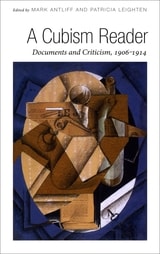
A Cubism Reader
Documents and Criticism, 1906-1914Mark Antliff and Patricia Leighten
University of Chicago Press, 2008
This definitive anthology covers the historical genesis of cubism from 1906 to 1914, with documents that range from manifestos and poetry to exhibition prefaces and reviews to articles that address the cultural, political, and philosophical issues related to the movement. Most of the texts Mark Antliff and Patricia Leighten have selected are from French sources, but their inclusion of carefully culled German, English, Czech, Italian, and Spanish documents speaks to the international reach of cubist art and ideas. Equally wide-ranging are the writers represented—a group that includes Guillaume Apollinaire, Gertrude Stein, Jean Metzinger, Albert Gleizes, Fernand Léger, Francis Picabia, André Salmon, Raymond Duchamp-Villon, Henri Le Fauconnier, and many others.
These diverse selections—unabridged and freshly translated—represent a departure from the traditional view of cubism as shaped almost exclusively by Picasso and Braque. Augmented by Antliff and Leighten’s insightful commentary on each entry, as well as many of the articles’ original illustrations, A Cubism Reader ultimately broadens the established history of the movement by examining its monumental contributions from a variety of contemporary perspectives.
A Dictatorship of Relativism ?
Symposium in Response to Cardinal Ratzinger’s Last Homily, Volume 13Jeffrey M. Perl, ed.
Duke University Press, 0
One essay relates the arguments of Ratzinger to those of two other German scholars—the conservative political theorist Ernst Wolfgang Böckenförde and the liberal philosopher and sociologist Jürgen Habermas—since all three men assume that social order depends on the existence of doctrinal authority (divine or otherwise). The contributors here argue for an intellectual and social life free of the desire for an “infantilizing” authority. One proposes that the Christian god is a relativist who prefers limitation and ambiguity; another, initially in agreement with Ratzinger about the danger relativism poses to faith and morals, then argues that this danger is what makes relativism valuable. The issue closes with the first English translation of an extract from a book on Catholic-Jewish relations by Cardinal Carlo Maria Martini, one of the Catholic Church’s most progressive figures.
Contributors. David Bloor, Daniel Boyarin, Mary Baine Campbell, Lorraine Daston, Arnold I. Davidson, John Forrester, Kenneth J. Gergen, Simon Goldhill, Jeffrey F. Hamburger, Julia Kristeva, Carlo Maria Cardinal Martini, Christopher Norris, Joseph Cardinal Ratzinger, Richard Shusterman, Barbara Herrnstein Smith, Jeffrey Stout, Gianni Vattimo
A Feast for the Eyes
Art, Performance, and the Late Medieval BanquetChristina Normore
University of Chicago Press, 2015
A Feast for the Eyes is the first book-length study of the court banquets of northwestern Europe in the fourteenth and fifteenth centuries. Christina Normore draws on an array of artworks, archival documents, chroniclers’ accounts, and cookbooks to re-create these events and reassess the late medieval visual culture in which banquets were staged. Feast participants, she shows, developed sophisticated ways of appreciating artistic skill and attending to their own processes of perception, thereby forging a court culture that delighted in the exercise of fine aesthetic judgment.
Challenging modern assumptions about the nature of artistic production and reception, A Feast for the Eyes yields fresh insight into the long history of multimedia work and the complex relationships between spectacle and spectators.

A Foray into the Worlds of Animals and Humans
with A Theory of MeaningJakob von Uexküll
University of Minnesota Press, 2010
A key document in the genealogy of posthumanist thought, A Foray into the Worlds of Animals and Humans advances Uexküll's revolutionary belief that nonhuman perceptions must be accounted for in any biology worth its name; it also contains his arguments against natural selection as an adequate explanation for the present orientation of a species' morphology and behavior. A Theory of Meaning extends his thinking on the umwelt, while also identifying an overarching and perceptible unity in nature. Those coming to Uexküll's work for the first time will find that his concept of the umwelt holds out new possibilities for the terms of animality, life, and the whole framework of biopolitics itself.
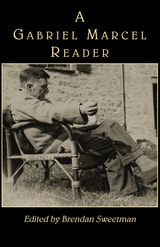
A Gabriel Marcel Reader
Gabriel Marcel
St. Augustine's Press, 2011
A God Torn to Pieces
The Nietzsche CaseGiuseppe Fornari
Michigan State University Press, 2013
Giuseppe Fornari’s groundbreaking inquiry shows that Friedrich Nietzsche’s neglected importance as a religious thinker and his “untimeliness” place him at the forefront of modern thought. Capable of exploiting his own failures as a cognitive tool to discover what other philosophers never wanted to see, Nietzsche ultimately drove himself to mental collapse. Fornari analyzes the tragic reports of Nietzsche’s madness and seeks out the cause of this self-destructive destiny, which, he argues, began earlier than his rivalry with the composer and polemicist Richard Wagner, dating back to the premature loss of Nietzsche’s father. Dramatic experience enabled Nietzsche to detect a more general tendency of European culture, leading to his archaeological and prophetic discovery of the death of God, which he understood as a primordial assassination from which all humankind took its origin. Fornari concludes that Nietzsche’s fatal rebellion against a Christian awareness, which he identified as the greatest threat to his plan, led him to become one and the same not only with Dionysus but also with the crucified Christ. His effort, Fornari argues, was a dramatic way to recognize the silent, inner meaning of Christ’s figure, and perhaps to be forgiven.
A History of Arcadia in Art and Literature
Volume I: Earlier RenaissancePaul Holberton
Paul Holberton Publishing, 2021
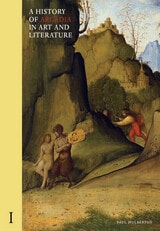
A History of Arcadia in Art and Literature is an unprecedented exploration of the pastoral through the close examination of original texts of classical and early and later modern pastoral poetry, literature, and drama in ancient Greek, Latin, Italian, French, Spanish, Portuguese, Dutch, German, and English, as well as of a wide range of visual imagery. The book is an iconographic study of Renaissance and Baroque pastoral and related subject matter, with an important chapter on the eighteenth century, both in the visual arts, where pastoral is poorly understood, and in words and performance, about which many false preconceptions prevail.
The book begins with Virgil’s use of Theocritus and an analysis of what basis Virgil provided for Renaissance pastoral and what, by contrast, stemmed from the medieval pastourelle. Paul Holberton then moves through a remarkable range of works, addressing authors such as Petrarch, Tasso, Guarino, Lope de Vega, Cervantes, and Shakespeare, and artists such as Giorgione, Claude, Poussin, Watteau, Gainsborough, and many more. The book serves simultaneously as a careful study, an art book full of beautiful reproductions, and an anthology, presenting all texts both in the original language and in English translation.
A History of Arcadia in Art and Literature
Volume II: Later Renaissance, Baroque and NeoclassicismPaul Holberton
Paul Holberton Publishing, 2021
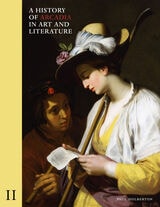
A History of Arcadia in Art and Literature is an unprecedented exploration of the pastoral through the close examination of original texts of classical and early and later modern pastoral poetry, literature, and drama in ancient Greek, Latin, Italian, French, Spanish, Portuguese, Dutch, German, and English, as well as of a wide range of visual imagery. The book is an iconographic study of Renaissance and Baroque pastoral and related subject matter, with an important chapter on the eighteenth century, both in the visual arts, where pastoral is poorly understood, and in words and performance, about which many false preconceptions prevail.
The book begins with Virgil’s use of Theocritus and an analysis of what basis Virgil provided for Renaissance pastoral and what, by contrast, stemmed from the medieval pastourelle. Paul Holberton then moves through a remarkable range of works, addressing authors such as Petrarch, Tasso, Guarino, Lope de Vega, Cervantes, and Shakespeare, and artists such as Giorgione, Claude, Poussin, Watteau, Gainsborough, and many more. The book serves simultaneously as a careful study, an art book full of beautiful reproductions, and an anthology, presenting all texts both in the original language and in English translation.
A History of the Crusades, Volume IV
The Art and Architecture of the Crusader StatesSeries Edited by Kenneth M. Setton, Volume Edited by Harry W. Hazard
University of Wisconsin Press, 1977
A Mythology of Forms
Selected Writings on ArtCarl Einstein
University of Chicago Press, 2019
A Perfectionist Impulse
The Art of Stopping Time in the Nineteenth CenturyEllery E. Foutch
University of Minnesota Press, 2026
Exploring a collection of wondrous objects to understand the nineteenth-century desire to preserve the perfect moment
Cultural studies of the nineteenth century often categorize their subjects as being motivated by one of two opposing notions: a wholehearted embrace of progress or an antimodernist nostalgia. A Perfectionist Impulse centers a different kind of response to the period’s newly intensified awareness of temporality and history: an obsession with preserving perfection. Engaging a diverse set of case studies, Ellery E. Foutch explores the era’s desire to forestall the march of time and immortalize the fleeting moment through art and technology.
Beginning with an investigation of artist and naturalist Titian Peale’s butterfly illustrations and specimen boxes, Foutch assesses the implications of attempts to fix animal life in the “perfect state.” She then turns to Harvard’s Ware Collection of Glass Flowers, botanical models meticulously crafted to serve as instructional tools but most famous internationally as a spectacle for tourists. Finally, she scrutinizes the period’s preoccupation with the fragility of the human body, examining artistic representations of the legendary bodybuilder Eugen Sandow, widely known during his time as the “Perfect Man.” Highlighting the paradoxical way in which these attempts at preservation ultimately sap the vitality from the organic processes they seek to arrest, Foutch uses these curious objects to unpack a deep set of cultural anxieties around decay and death.
By analyzing objects of mass culture and natural history using methods typically reserved for works of art, A Perfectionist Impulse provides a unique window into how nineteenth-century scientists, technologists, artists, and entertainers rendered a common desire for perfection and immortality. Itself a wondrous collection of attempts to capture the idealized moment, this extensively illustrated book serves as a shining example of our enduring fascination with the ephemeral.
Retail e-book files for this title are screen-reader friendly with images accompanied by short alt text and/or extended descriptions.
A Power to Translate the World
New Essays on Emerson and International CultureEdited by David LaRocca and Ricardo Miguel-Alfonso
Dartmouth College Press, 2016
A Process Model
Eugene T. Gendlin; Foreword by Robert A. Parker
Northwestern University Press, 2018
A Process Model, Gendlin’s magnum opus, offers no less than a new alternative to the dualism of mind and body. Beginning with living process, the body’s simultaneous interaction and identity with its environment, Gendlin systematically derives nonreductive concepts that offer novel and rigorous ways to think from within lived precision. In this way terms such as body, environment, time, space, behavior, language, culture, situation, and more can be understood with both great force and great subtlety.
Gendlin’s project is relevant to discussions not only in philosophy but in other fields in which life process is central—including biology, environmental management, environmental humanities, and ecopsychology. It provides a genuinely new philosophical approach to complex societal challenges and environmental issues.
A Search for Clarity
Science and Philosophy in Lacan's OeuvreJean-Claude Milner; Translated from the French by Ed Pluth
Northwestern University Press, 2021
In A Search for Clarity, Jean‑Claude Milner argues that although Jacques Lacan’s writing is notoriously obscure his oeuvre is entirely clear. In a discussion that considers the difference between the esoteric and exoteric works of Plato and Aristotle, Milner argues that Lacan’s oeuvre is to be found in his published writings alone, not his transcribed seminars, and that these published writings contain his official doctrine. Thus, Lacan’s oeuvre is already complete, even though many of his seminars remain unpublished.
According to Milner, Lacan’s fundamental idea is that the subject psychoanalysis works on is the subject of science. Milner suggests that this is a supplement to Alexandre Koyré’s and Alexandre Kojève’s accounts of modern science, for which mathematization and a break from the ancient episteme were key.
A Search for Clarity is the definitive statement on how Lacan viewed the relationship between psychoanalysis and science, and on how Lacan’s thinking evolved as he struggled to draw out the consequences of the equation he posited between psychoanalysis and science. Milner’s work on Lacan has been essential reading in French for decades. This English translation will make his illuminating work accessible to a broader audience.
A Short History of Thomism
Romanus Cessario, O.P.
Catholic University of America Press, 2005
A Stroll with William James
Jacques Barzun
University of Chicago Press, 1983
A Study of Husserl's Formal and Transcendental Logic
Suzanne Bachelard
Northwestern University Press, 1968
A View of Venice
Portrait of a Renaissance CityKristin Love Huffman, editor
Duke University Press, 2024
Contributors. Karen-edis Barzman, Andrea Bellieni, Patricia Fortini Brown, Valeria Cafà, Stanley Chojnacki, Tracy E. Cooper, Giada Damen, Julia A. DeLancey, Piero Falchetta, Ludovica Galeazzo, Maartje van Gelder, Jonathan Glixon, Richard Goy, Anna Christine Swartwood House, Kristin Love Huffman, Holly Hurlburt, Claire Judde de Larivière, Blake de Maria, Martina Massaro, Cosimo Monteleone, Monique O’Connell, Mary Pardo, Giorgio Tagliaferro, Saundra Weddle, Bronwen Wilson, Rangsook Yoon
Abductive Analysis
Theorizing Qualitative ResearchIddo Tavory and Stefan Timmermans
University of Chicago Press, 2014
Abolition Archives, Feminist Futures
Kathi Weeks
Duke University Press, 2026
About the Beginning of the Hermeneutics of the Self
Lectures at Dartmouth College, 1980Michel Foucault
University of Chicago Press, 2015
Foucault analyzes the practices of self-examination and confession in Greco-Roman antiquity and in the first centuries of Christianity in order to highlight a radical transformation from the ancient Delphic principle of “know thyself” to the monastic precept of “confess all of your thoughts to your spiritual guide.” His aim in doing so is to retrace the genealogy of the modern subject, which is inextricably tied to the emergence of the “hermeneutics of the self”—the necessity to explore one’s own thoughts and feelings and to confess them to a spiritual director—in early Christianity. According to Foucault, since some features of this Christian hermeneutics of the subject still determine our contemporary “gnoseologic” self, then the genealogy of the modern subject is both an ethical and a political enterprise, aiming to show that the “self” is nothing but the historical correlate of a series of technologies built into our history. Thus, from Foucault’s perspective, our main problem today is not to discover what “the self” is, but to try to analyze and change these technologies in order to change its form.
Accounting for Fundamentalisms
The Dynamic Character of MovementsEdited by Martin E. Marty and R. Scott Appleby
University of Chicago Press, 1994
Addressing Levinas
Eric Sean Nelson
Northwestern University Press, 2005
In their radical singularity, these essays reveal the inalienable alterity at the heart of Levinas's ethics. At the same time, each essay remains open to the others, and to the perspectives and positions they advocate. Thus the volume, in its quality and diversity, enacts an authentic encounter with Levinas's thought, embodying an intellectual ethics by virtue of its style. Bringing together contributions from philosophy, theology, literary theory, gender studies, and political theory, this book offers a deeper and more thorough encounter with Levinas's ethics than any yet written.
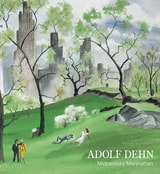
Adolf Dehn
Midcentury ManhattanAdolf Dehn
The Artist Book Foundation, 2017
Adolf Dehn (1895–1968), American painter in multimedia and acclaimed master lithographer, left his Minnesota hometown after formal training at the Minneapolis Art Institute to study at the Art Students League in New York. He toured Europe in the early 1920s, quickly acclimating to the continental lifestyle and adeptly depicting its nuances and idiosyncrasies with prolific lithographs and sketches. His critical and satirical renderings of the political movements, social conventions, and governmental policies in post-World War I Europe during "Le Crazy Years" gave the Midwestern artist ample material for his growing body of work.
Sailing back to the United States in 1929, Dehn survived the Great Depression with commercial artwork and contributions to popular magazines such as The New Yorker, Vogue, and Vanity Fair. His clever drawings that reflected the Jazz Age's culture and fashionable society made him a favorite of Frank Crowninshield, Vanity Fair's renowned editor.
During this time, while Dehn captured the heyday of Manhattan's burlesque theaters, lively Harlem nightclubs, impressive skyline, and busy harbor, he was continuously drawn to Central Park—his predilection for the city's magnificent green space was a sustaining source of inspiration and subject matter. Adolf Dehn: Midcentury Manhattan candidly examines the life and work of this exceptional, adventurous, and intrepid artist as he moved skillfully and capably between lithography, ink-wash drawings, gouache, casein painting, and watercolors. Combining numerous vintage photographs with newly discovered, Manhattan-inspired prints and drawings from the collections of, among others, the Whitney Museum of American Art, MoMA, and The Metropolitan Mesuem of Art, Adolf Dehn: Midcentury Manhattan traces how Dehn's art reflected the spirit, pulse, and uniquely American tonalities of The City of Dreams.
Adventures of the Dialectic
Maurice Merleau-Ponty
Northwestern University Press, 1973

After Poststructuralism
Transitions and TransformationsEdited by Rosi Braidotti
University of Chicago Press, 2010
From Kant to Kierkegaard, from Hegel to Heidegger, continental philosophers have indelibly shaped the trajectory of Western thought since the eighteenth century. Although much has been written about these monumental thinkers, students and scholars lack a definitive guide to the entire scope of the continental tradition. The most comprehensive reference work to date, this eight-volume History of Continental Philosophy will both encapsulate the subject and reorient our understanding of it. Beginning with an overview of Kant’s philosophy and its initial reception, the History traces the evolution of continental philosophy through major figures as well as movements such as existentialism, phenomenology, hermeneutics, and poststructuralism. The final volume outlines the current state of the field, bringing the work of both historical and modern thinkers to bear on such contemporary topics as feminism, globalization, and the environment. Throughout, the volumes examine important philosophical figures and developments in their historical, political, and cultural contexts.
The first reference of its kind, A History of Continental Philosophy has been written and edited by internationally recognized experts with a commitment to explaining complex thinkers, texts, and movements in rigorous yet jargon-free essays suitable for both undergraduates and seasoned specialists. These volumes also elucidate ongoing debates about the nature of continental and analytic philosophy, surveying the distinctive, sometimes overlapping characteristics and approaches of each tradition. Featuring helpful overviews of major topics and plotting road maps to their underlying contexts, A History of Continental Philosophy is destined to be the resource of first and last resort for students and scholars alike.
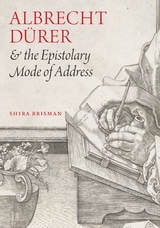
Albrecht Dürer and the Epistolary Mode of Address
Shira Brisman
University of Chicago Press, 2016
In the early modern period, before the establishment of a reliable postal system, letters faced risks of interception and delay. During the Reformation, the printing press threatened to expose intimate exchanges and blur the line between public and private life. Exploring the complex travel patterns of sixteenth-century missives, Brisman explains how these issues of sending and receiving informed Dürer’s artistic practices. His success, she contends, was due in large part to his development of pictorial strategies—an epistolary mode of address—marked by a direct, intimate appeal to the viewer, an appeal that also acknowledged the distance and delay that defers the message before it can reach its recipient. As images, often in the form of prints, coursed through an open market, and artists lost direct control over the sale and reception of their work, Germany’s chief printmaker navigated the new terrain by creating in his images a balance between legibility and concealment, intimacy and public address.
All Thoughts Are Equal
Laruelle and Nonhuman PhilosophyJohn Ó Maoilearca
University of Minnesota Press, 2015
All Thoughts Are Equal is both an introduction to the work of French philosopher François Laruelle and an exercise in nonhuman thinking. For Laruelle, standard forms of philosophy continue to dominate our models of what counts as exemplary thought and knowledge. By contrast, what Laruelle calls his “non-standard” approach attempts to bring democracy into thought, because all forms of thinking—including the nonhuman—are equal.
John Ó Maoilearca examines how philosophy might appear when viewed with non-philosophical and nonhuman eyes. He does so by refusing to explain Laruelle through orthodox philosophy, opting instead to follow the structure of a film (Lars von Trier’s documentary The Five Obstructions) as an example of the non-standard method. Von Trier’s film is a meditation on the creative limits set by film, both technologically and aesthetically, and how these limits can push our experience of film—and of ourselves—beyond what is normally deemed “the perfect human.”
All Thoughts Are Equal adopts film’s constraints in its own experiment by showing how Laruelle’s radically new style of philosophy is best presented through our most nonhuman form of thought—that found in cinema.
Althusser and His Contemporaries
Philosophy's Perpetual WarWarren Montag
Duke University Press, 2013
Althusser, The Infinite Farewell
Emilio de Ipola
Duke University Press, 2018
American Orient
Imagining the East from the Colonial Era through the Twentieth CenturyDavid Weir
University of Massachusetts Press, 2011
Surveying the American fascination with the Far East since the mid-eighteenth century, this book explains why the Orient had a fundamentally different meaning in the United States than in Europe or Great Britain. David Weir argues that unlike their European counterparts, Americans did not treat the East simply as a site of imperialist adventure; on the contrary, colonial subjugation was an experience that early Americans shared with the peoples of China and India.
In eighteenth-century America, the East was, paradoxically, a means of reinforcing the enlightenment values of the West: Franklin, Jefferson, and other American writers found in Confucius a complement to their own political and philosophical beliefs. In the nineteenth century, with the shift from an agrarian to an industrial economy, the Hindu Orient emerged as a mystical alternative to American reality. During this period, Emerson, Thoreau, and other Transcendentalists viewed the “Oriental” not as an exotic other but as an image of what Americans could be, if stripped of all the commercialism and materialism that set them apart from their ideal. A similar sense of Oriental otherness informed the aesthetic discoveries of the early twentieth century, as Pound, Eliot, and other poets found in Chinese and Japanese literature an artistic purity and intensity absent from Western tradition. For all of these figures the Orient became a complex fantasy that allowed them to overcome something objectionable, either in themselves or in the culture of which they were a part, in order to attain some freer, more genuine form of philosophical, religious, or artistic expression.
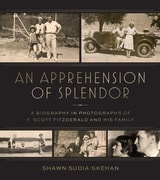
An Apprehension of Splendor
A Biography in Photographs of F. Scott Fitzgerald and His FamilyShawn Sudia-Skehan; Foreword by Jackson R. Bryer; Introduction by Eleanor Lanahan
University of Alabama Press, 2025
A unique collection of Fitzgerald family photographs, many never before published, hand selected by a curator of the Scott and Zelda Fitzgerald Museum.
Enter the Jazz Age glamour of F. Scott and Zelda Fitzgerald and their daughter, Scottie. An Apprehension of Splendor is a rich pictorial biography that illuminates the lives of this brilliant literary family in 344 rare photographs, 180 of which have never been published.
The Fitzgeralds are chiefly known from a small number of iconic, posed images, but the dashing couple and their daughter amassed hundreds of candid snapshots now housed in archives and university library collections throughout North America. These rare photos reveal the full, vivid lives behind the icons—a Buffalo boy cradling a velvety puppy, a jaunty southern gamine in the shade of a loblolly pine laughing at a secret, the stoic gloom of an enlistee in a scratchy woolen uniform, a plot taking shape in the mind of a fledgling writer with bed-tousled hair, an amorous young couple struggling to light a cigarette in the chiaroscuro of a Riviera beach, an unhappy baby tugged through the snow in a laundry basket lashed to a sled, and a myriad of other images that will rekindle fascination with the Fitzgeralds and their time.
With unparalleled access to the family’s personal papers and photographs, Shawn Sudia-Skehan, former director of acquisitions at the Scott and Zelda Fitzgerald Museum, handpicked and annotated this collection of images that brings readers closer to the Fitzgeralds than any other work. Readers of Tender Is the Night, The Beautiful and Damned, and many other works by F. Scott and Zelda will recognize some of the places and experiences that inspired their unforgettable fictions.
A captivating portrait of Jazz Age celebrity, young passion, and artistic ambition, An Apprehension of Splendor returns the perfume to the luminous flower of the Fitzgeralds.
An Innocent Abroad
Lectures in ChinaJ. Hillis Miller
Northwestern University Press, 2015
Since 1988, J. Hillis Miller has traveled to China to lecture on literary theory, especially the role of globalization in literary theory. Over time, he has assisted in the development of distinctively Chinese forms of literary theory, Comparative Literature, and World Literature. The fifteen lectures gathered in An Innocent Abroad span both time and geographic location, reflecting his work at universities across China for more than twenty-five years. More important, they reflect the evolution of Miller’s thinking and of the lectures’ contexts in China as these have markedly changed over the years, especially on either side of Tiananmen Square and in light of China’s economic growth and technological change. A foreword by the leading theorist Fredric Jameson provides additional context.

An Introduction To Hegel
The Stages of Modern PhilosophyHoward P. Kainz
Ohio University Press, 1996
In a sense it would be inappropriate to speak of “Hegel’s system of philosophy,” because Hegel thought that in the strict sense there is only one system of philosophy evolving in the Western world. In Hegel’s view, although at times philosophy’s history seems to be a chaotic series of crisscrossing interpretations of meanings and values, with no consensus, there has been a teleological development and consistent progress in philosophy and philosophizing from the beginning; Hegel held that his own version of “German idealism” was simply bringing to final expression the latest refinements of an ongoing, perennial system.
If we take Hegel at his word, then one of the best entries into his system would be through the history of philosophy, showing how systems and schools of thought prior to Hegel led up to his system. The most important currents to focus on, however, would be in modern philosophy, in which especially intensive changes led ultimately to German idealism and Hegel’s immediate predecessors.
Fortunately, Hegel lectured extensively on the history of modern philosophy and structured his lectures in such a way as to throw light on the status of the “one system” of Western philosophy at the time — the status to which Hegel felt he had been contributing and was continuing to contribute. These lectures are of interest, first of all, as a systematic chronicle of philosophical positions in the heyday of modern philosophy, from Bacon to Hegel. Second, they are interesting because Hegel’s critical comments on his predecessors clarify his own positions: for example, the dialectic method and the importance of triplicity, the relationship of philosophy to the scientific method, the necessity for avoidance of the extremes of empiricism and of idealism, the subject/object problematic, the “identity” of rationality and reality, and the technical meaning in Hegel’s philosophy of “absolute,” “infinity,” and the “idea.”
Anaesthetics of Existence
Essays on Experience at the EdgeCressida J. Heyes
Duke University Press, 2020
“Experience” is a thoroughly political category, a social and historical product not authored by any individual. At the same time, “the personal is political,” and one's own lived experience is an important epistemic resource. In Anaesthetics of Existence Cressida J. Heyes reconciles these two positions, drawing on examples of things that happen to us but are nonetheless excluded from experience. If for Foucault an “aesthetics of existence” was a project of making one's life a work of art, Heyes's “anaesthetics of existence” describes antiprojects that are tacitly excluded from life—but should be brought back in. Drawing on critical phenomenology, genealogy, and feminist theory, Heyes shows how and why experience has edges, and she analyzes phenomena that press against those edges. Essays on sexual violence against unconscious victims, the temporality of drug use, and childbirth as a limit-experience build a politics of experience while showcasing Heyes's much-needed new philosophical method.
Animal Skins and the Reading Self in Medieval Latin and French Bestiaries
Sarah Kay
University of Chicago Press, 2017
Bestiaries present accounts of animals whose fantastic behaviors should be imitated or avoided, depending on the given trait. In a highly original argument, Kay suggests that the association of beasts with books is here both literal and material, as nearly all surviving bestiaries are copied on parchment made of animal skin, which also resembles human skin. Using a rich array of examples, she shows how the content and materiality of bestiaries are linked due to the continual references in the texts to the skins of other animals, as well as the ways in which the pages themselves repeatedly—and at times, it would seem, deliberately—intervene in the reading process. A vital contribution to animal studies and medieval manuscript studies, this book sheds new light on the European bestiary and its profound power to shape readers’ own identities.
Annotations
On the Early Thought of W. E. B. Du BoisNahum Dimitri Chandler
Duke University Press, 2022
Another World Was Possible
A Century of Movements, Volume 2005Duane J. Corpis and Ian Christopher Fletcher, eds.
Duke University Press, 0
The collection argues that radical movements offer an intriguing counternarrative to the more familiar history of imperialism and globalization in the twentieth century. One essay illuminates the radical anticolonial and diasporic South Asian Ghadar movement, which worked to free India from British rule. Another delves into the global politics of South African radicalism between antifascism and apartheid in the 1940s and 1950s. A third essay explores the encounter between U.S. black activists and Cuban revolutionaries in the 1960s. In an interview, a Latina activist illustrates the transnational scope of contemporary social movements by describing her organizing work among immigrants in Atlanta, Georgia.
Contributors. Adina Black, Mansour Bonakdarian, Duane J. Corpis, Ian Christopher Fletcher, Yael Simpson Fletcher, Robert Gregg, Bob Hannigan, Chia Yin Hsu, Madhavi Kale, R. J. Lambrose, Christopher Joon-Hai Lee, Teresa Meade, Adelina Nicholls, Enrique C. Ochoa, Susan D. Pennybacker, Maia Ramnath, Besenia Rodriguez
Another World Was Possible is the companion issue to Two, Three, Many Worlds (Radical History Review, #91).
Anthropocene Islands
Entangled WorldsJonathan Pugh and David Chandler
University of Westminster Press, 2021
‘Ambitious, sophisticated, timely and downright inspirational.’ – Philip Hayward, University of Technology Sydney, Okinawan Journal of Island Studies
'A must read … a new analytical agenda for the Anthropocene, coherently drawing out the power of thinking with islands.' – Elena Burgos Martinez, Leiden University
‘This is an essential book. [The] analytics they propose … offer both a critical agenda for island studies and compass points through which to navigate the haunting past, troubling present, and precarious future.’ – Craig Santos Perez, University of Hawai’i, Manoa
‘All academic books should be like this: hard to put down. Informative, careful, sometimes devasting, yet absolutely necessary - if you read one book about the Anthropocene let it be this. You will never think of islands in the same way again.’ – Kimberley Peters, University of Oldenburg
‘ … a unique journey into the Anthropocene. Critical, generous and compelling’. — Nigel Clark, Lancaster University
The island has become a key figure of the Anthropocene – an epoch in which human entanglements with nature come increasingly to the fore. For a long time, islands were romanticised or marginalised, seen as lacking modernity’s capacities for progress, vulnerable to the effects of catastrophic climate change and the afterlives of empire and coloniality. Today, however, the island is increasingly important for both policy-oriented and critical imaginaries that seek, more positively, to draw upon the island’s liminal and disruptive capacities, especially the relational entanglements and sensitivities its peoples and modes of life are said to exhibit.
Anthropocene Islands: Entangled Worlds explores the significant and widespread shift to working with islands for the generation of new or alternative approaches to knowledge, critique and policy practices. It explains how contemporary Anthropocene thinking takes a particular interest in islands as ‘entangled worlds’, which break down the human/nature divide of modernity and enable the generation of new or alternative approaches to ways of being (ontology) and knowing (epistemology). The book draws out core analytics which have risen to prominence (Resilience, Patchworks, Correlation and Storiation) as contemporary policy makers, scholars, critical theorists, artists, poets and activists work with islands to move beyond the constraints of modern approaches. In doing so, it argues that engaging with islands has become increasingly important for the generation of some of the core frameworks of contemporary thinking and concludes with a new critical agenda for the Anthropocene.
Anthropological Futures
Michael M. J. Fischer
Duke University Press, 2009
Fischer is particularly concerned with cultural anthropology’s interactions with science studies, and throughout the book he investigates how emerging knowledge formations in molecular biology, environmental studies, computer science, and bioengineering are transforming some of anthropology’s key concepts including nature, culture, personhood, and the body. In an essay on culture, he uses the science studies paradigm of “experimental systems” to consider how the social scientific notion of culture has evolved as an analytical tool since the nineteenth century. Charting anthropology’s role in understanding and analyzing the production of knowledge within the sciences since the 1990s, he highlights anthropology’s aptitude for tracing the transnational collaborations and multi-sited networks that constitute contemporary scientific practice. Fischer investigates changing ideas about cultural inscription on the human body in a world where genetic engineering, robotics, and cybernetics are constantly redefining our understanding of biology. In the final essay, Fischer turns to Kant’s philosophical anthropology to reassess the object of study for contemporary anthropology and to reassert the field’s primacy for answering the largest questions about human beings, societies, culture, and our interactions with the world around us. In Anthropological Futures, Fischer continues to advance what Clifford Geertz, in reviewing Fischer’s earlier book Emergent Forms of Life and the Anthropological Voice, called “a broad new agenda for cultural description and political critique.”
Anthropology from a Pragmatic Point of View
Immanuel Kant. Translated by Victor Lyle Dowdell. Revised and Edited by Hans H. Rudnick
Southern Illinois University Press, 1996
In the fall semester of 1772/73 at the Albertus University of Königsberg, Immanuel Kant, metaphysician and professor of logic and metaphysics, began lectures on anthropology, which he continued until 1776, shortly before his retirement from public life. His lecture notes and papers were first published in 1798, eight years after the publication of the Critique of Judgment, the third of his famous Critiques. The present edition of the Anthropology is a translation of the text found in volume 7 of Kants gesammelte Schriften, edited by Oswald Külpe.
Kant describes the Anthropology as a systematic doctrine of the knowledge of humankind. (He does not yet distinguish between the academic discipline of anthropology as we understand it today and the philosophical.) Kant’s lectures stressed the "pragmatic" approach to the subject because he intended to establish pragmatic anthropology as a regular academic discipline. He differentiates the physiological knowledge of the human race—the investigation of "what Nature makes of man"—from the pragmatic—"what man as a free being makes of himself, what he can make of himself, and what he ought to make of himself." Kant believed that anthropology teaches the knowledge of humankind and makes us familiar with what is pragmatic, not speculative, in relation to humanity. He shows us as world citizens within the context of the cosmos.
Summarizing the cloth edition of the Anthropology, Library Journal concludes: "Kant’s allusions to such issues as sensation, imagination, judgment, (aesthetic) taste, emotion, passion, moral character, and the character of the human species in regard to the ideal of a cosmopolitan society make this work an important resource for English readers who seek to grasp the connections among Kant’s metaphysics of nature, metaphysics of morals, and political theory. The notes of the editor and translator, which incorporate material from Ernst Cassirer’s edition and from Kant’s marginalia in the original manuscript, shed considerable light on the text."
Antidiets of the Avant-Garde
From Futurist Cooking to Eat ArtCecilia Novero
University of Minnesota Press, 2009
Discussing an aspect of the European avant-garde that has often been neglected-its relationship to the embodied experience of food, its sensation, and its consumption-Cecilia Novero exposes the surprisingly key roles that food plays in the theoretical foundations and material aesthetics of a broad stratum of works ranging from the Italian Futurist Cookbook to the magazine Dada, Walter Benjamin's writings on eating and cooking, Daniel Spoerri's Eat Art, and the French New Realists.
Starting from the premise that avant-garde art involves the questioning of bourgeois aesthetics, Novero demonstrates that avant-garde artists, writers, and performers have produced an oppositional aesthetics of indigestible art. Through the rhetoric of incorporation and consumption and the use of material ingredients in their work, she shows, avant-garde artists active in the 1920s and 1930s as well as the neo-avant-garde movements engaged critically with consumer culture, memory, and history.
Attention to food in avant-garde aesthetics, Novero asserts, reveals how these works are rooted in a complex temporality that associates memory and consumption with dynamics of change.
Antigone as Political Philosophy
Gregor Moder, Tanja Dominko
Northwestern University Press, 2026
Offering a new perspective on Sophocles’s Antigone as a model for reimagining humanity’s future—and its end
Why read Antigone today? The premise of this accessible, essayistic work is that humanity finds itself at a crossroads, where it must reinvent itself or perish—a condition similar to Antigone’s own. Rereading Antigone via Hegel’s engagement with the text can help us understand what it means for a human age to come to an end: that is, to think of our age as an episode whose collapse is also an engine of historical change.
Gregor Moder argues that the task of humanity today may not be to defend the minimal remnants of our civilization but to say farewell to it—to give it a proper burial. As Moder explicates, the central problem of this foundational tragedy lies in the positions of brother and sister, man and woman, representing human and divine law and the institutions of the state and the family. Through a fresh reading of both Sophocles’s play and Hegel’s productive reworking of the Greek myth, Moder’s analysis shows that sometimes the only way through deep social contradictions is in unraveling the framework that has constructed them.
Antiquarians of Nineteenth-Century Japan
The Archaeology of Things in the Late Tokugawa and Early Meiji PeriodsHiroyuki Suzuki
J. Paul Getty Trust, The, 2022
Originally published in Japanese, Antiquarians of Nineteenth-Century Japan looks at the approach toward object-based research across the late Tokugawa and early Meiji periods, which were typically kept separate, and elucidates the intellectual continuities between these eras. Focusing on the top-down effects of the professionalizing of academia in the political landscape of Meiji Japan, which had advanced by attacking earlier modes of scholarship by antiquarians, Suzuki shows how those outside the government responded, retracted, or challenged new public rules and values. He explores the changing process of evaluating objects from the past in tandem with the attitudes and practices of antiquarians during the period of Japan’s rapid modernization. He shows their roots in the intellectual sphere of the late Tokugawa period while also detailing how they adapted to the new era. Suzuki also demonstrates that Japan’s antiquarians had much in common with those from Europe and the United States.
Art historian Maki Fukuoka provides an introduction to the English translation that highlights the significance of Suzuki’s methodological and intellectual analyses and shows how his ideas will appeal to specialists and nonspecialists alike.
Apollo and Vulcan
The Art Markets in Italy, 1400-1700Guido Guerzoni
Michigan State University Press, 2011
Apprehending the Inaccessible
Freudian Psychoanalysis and Existential PhenomenologyRichard Askay and Jensen Farquhar
Northwestern University Press, 2006
With its unique perspective on Freud's work, Apprehending the Inaccessible puts readers in a better position to appreciate his contributions and evaluate the relationship between his and other philosophical world views. The authors, both of whom have extensive backgrounds in philosophy and psychology, present balanced critical analyses of crucial developments in, for example, the evolution of the Freudian notion of the unconscious, and the engagement of existential phenomenology with Freudian psychoanalysis. Askay and Farquhar then consider—often for the first time—individual thinkers' reflections on and interpretations of Freud, ranging from the primary figures in existential phenomenology to the most prominent figures in the existential psychoanalytic movement. Even as their work offers a new approach to Freudian thought, it reasserts the importance of alternative views found in existential phenomenology as those views pertain to psychoanalysis and the question of apprehending the inaccessible.

Archive Fever
A Freudian ImpressionJacques Derrida
University of Chicago Press, 1996
"Judaic mythos, Freudian psychoanalysis, and e-mail all get fused into another staggeringly dense, brilliant slab of scholarship and suggestion."—The Guardian
"[Derrida] convincingly argues that, although the archive is a public entity, it nevertheless is the repository of the private and personal, including even intimate details."—Choice
"Beautifully written and clear."—Jeremy Barris, Philosophy in Review
"Translator Prenowitz has managed valiantly to bring into English a difficult but inspiring text that relies on Greek, German, and their translations into French."—Library Journal