Results by title
175 books match the query 'Narration (Rhetoric)' and 10 start with a

A Glance Beyond Doubt
Narration, Representation, SubjectivityShlomith Rimmon-Kenan
The Ohio State University Press, 1900
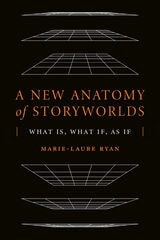
A New Anatomy of Storyworlds
What Is, What If, As IfMarie-Laure Ryan
The Ohio State University Press, 2022
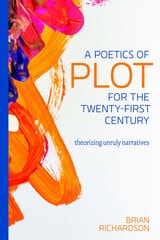
A Poetics of Plot for the Twenty-First Century
Theorizing Unruly NarrativesBrian Richardson
The Ohio State University Press, 2019
Story, in the largest sense of the term, is arguably the single most important aspect of narrative. But with the proliferation of antimimetic writing, traditional narrative theory has been inadequate for conceptualizing and theorizing a vast body of innovative narratives. In A Poetics of Plot for the Twenty-First Century: Theorizing Unruly Narratives, Brian Richardson proposes a new model for evaluating literature—returning to the basis of narrative theory to illuminate how authors play with and help clarify the boundaries of narrative theory. While he focuses on late modernist, postmodern, and contemporary narratives, the study also includes many earlier works, spanning from Aristophanes and Shakespeare through James Joyce and Virginia Woolf to Salman Rushdie and Angela Carter.
By exploring fundamental questions about narrative, Richardson provides a detailed, nuanced, and comprehensive theory that includes neglected categories of storytelling and significantly enhances our treatment of traditional areas of analysis. Ultimately, this book promises to transform and expand the study of story and plot.
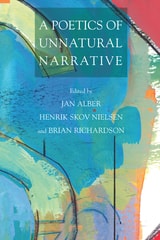
A Poetics of Unnatural Narrative
Edited by Jan Alber, Henrik Skov Nielsen, and Brian Richardson
The Ohio State University Press, 2013
A Poetics of Unnatural Narrative offers a collection of foundational essays introducing the reader to the full scope of unnatural narrative theory: its meaning, its goals, its extent, its paradoxes. This volume brings together a distinguished group of international critics, scholars, and historians that includes several of the world’s leading narrative theorists. Together, they survey many basic areas of narrative studies from an unnatural perspective: story, time, space, voice, minds, narrative levels, “realism,” nonfiction, hyperfiction, and narrative poetry. Rarely have these fundamental concepts been subjected to such an original and thoroughgoing reconceptualization. Much of the book is directed toward an investigation of experimental and antirealist work. Each essay focuses on texts and episodes that narrative theory has tended to neglect, and each provides theoretical formulations that are commensurate with such exceptional, albeit neglected, works. A Poetics of Unnatural Narrative articulates and delineates the newest and most radical movement in narrative studies. This anthology will be of great interest to students and scholars of narrative studies and of the history and theory of modern fiction.
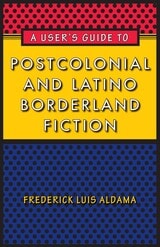
A User's Guide to Postcolonial and Latino Borderland Fiction
By Frederick Luis Aldama
University of Texas Press, 2009
Why are so many people attracted to narrative fiction? How do authors in this genre reframe experiences, people, and environments anchored to the real world without duplicating "real life"? In which ways does fiction differ from reality? What might fictional narrative and reality have in common—if anything?
By analyzing novels such as Arundhati Roy's The God of Small Things, Amitav Ghosh's The Glass Palace, Zadie Smith's White Teeth, and Hari Kunzru's The Impressionist, along with selected Latino comic books and short fiction, this book explores the peculiarities of the production and reception of postcolonial and Latino borderland fiction. Frederick Luis Aldama uses tools from disciplines such as film studies and cognitive science that allow the reader to establish how a fictional narrative is built, how it functions, and how it defines the boundaries of concepts that appear susceptible to limitless interpretations.
Aldama emphasizes how postcolonial and Latino borderland narrative fiction authors and artists use narrative devices to create their aesthetic blueprints in ways that loosely guide their readers' imagination and emotion. In A User's Guide to Postcolonial and Latino Borderland Fiction, he argues that the study of ethnic-identified narrative fiction must acknowledge its active engagement with world narrative fictional genres, storytelling modes, and techniques, as well as the way such fictions work to move their audiences.
American Gothic
New Interventions in a National NarrativeRobert K. Martin
University of Iowa Press, 1998
In America as in Britain, the rise of the Gothic represented the other—the fearful shadows cast upon Enlightenment philosophies of common sense, democratic positivism, and optimistic futurity. Many critics have recognized the centrality of these shadows to American culture and self-identification. American Gothic, however, remaps the field by offering a series of revisionist essays associated with a common theme: the range and variety of Gothic manifestations in high and popular art from the roots of American culture to the present.
The thirteen essayists approach the persistence of the Gothic in American culture by providing a composite of interventions that focus on specific issues—the histories of gender and race, the cultures of cities and scandals and sensations—in order to advance distinct theoretical paradigms. Each essay sustains a connection between a particular theoretical field and a central problem in the Gothic tradition.
Drawing widely on contemporary theory—particularly revisionist views of Freud such as those offered by Lacan and Kristeva—this volume ranges from the well-known Gothic horrors of Edgar Allan Poe and Nathaniel Hawthorne to the popular fantasies of Stephen King and the postmodern visions of Kathy Acker. Special attention is paid to the issues of slavery and race in both black and white texts, including those by Ralph Ellison and William Faulkner. In the view of the editors and contributors, the Gothic is not so much a historical category as a mode of thought haunted by history, a part of suburban life and the lifeblood of films such as The Exorcist and Fatal Attraction.
An Aesthetics of Narrative Performance
Transnational Theater, Literature, and Film in Contemporary GermanyClaudia Breger
The Ohio State University Press, 2012
Analyzing World Fiction
New Horizons in Narrative TheoryEdited by Frederick Luis Aldama
University of Texas Press, 2011
Why are many readers drawn to stories that texture ethnic experiences and identities other than their own? How do authors such as Salman Rushdie and Maxine Hong Kingston, or filmmakers in Bollywood or Mexico City produce complex fiction that satisfies audiences worldwide? In Analyzing World Fiction, fifteen renowned luminaries use tools of narratology and insights from cognitive science and neurobiology to provide answers to these questions and more.
With essays ranging from James Phelan's "Voice, Politics, and Judgments in Their Eyes Were Watching God" and Hilary Dannenberg's "Narrating Multiculturalism in British Media: Voice and Cultural Identity in Television" to Ellen McCracken's exploration of paratextual strategies in Chicana literature, this expansive collection turns the tide on approaches to postcolonial and multicultural phenomena that tend to compress author and narrator, text and real life. Striving to celebrate the art of fiction, the voices in this anthology explore the "ingredients" that make for powerful, universally intriguing, deeply human story-weaving.
Systematically synthesizing the tools of narrative theory along with findings from the brain sciences to analyze multicultural and postcolonial film, literature, and television, the contributors pioneer new techniques for appreciating all facets of the wonder of storytelling.
Audionarratology
Lessons from Radio DramaEdited by Lars Bernaerts and Jarmila Mildorf
The Ohio State University Press, 2021
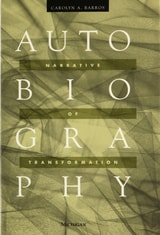
Autobiography
Narrative of TransformationCarolyn A. Barros
University of Michigan Press, 1997