Results by title
65 books match the query 'Oral tradition' and 4 start with a
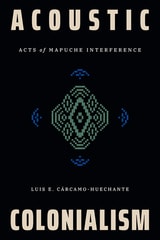
Acoustic Colonialism
Acts of Mapuche InterferenceLuis E. Cárcamo-Huechante
Duke University Press, 2025
In Acoustic Colonialism, Luis E. Cárcamo-Huechante examines the role of sound in Chilean and Mapuche cultural production over the last two centuries. Cárcamo-Huechante theorizes sound as a territory of racial, patriarchal, and colonial hegemony as well as of Mapuche struggle, agency, and response to what he calls "acoustic colonialism." From the mid-nineteenth century to the present, Chilean literature, radio, and other media have exerted a historic role in disseminating distorted visual and sonic representations of the Mapuche. The enduring effects of what Cárcamo-Huechante defines as the colonial ear—the entry point for these misrepresentations—reflect the logic of the Chilean settler nation-state. In response to these aural and sonorous figurations, contemporary Mapuche writers, artists, and activists have produced their own literary, radiophonic, vocal, and musical expressions. The voices, sounds, and discourses of these Mapuche productions contest and disrupt the acoustic colonialism that has dominated the soundscape of the territory designated in present-day cartography as central and southern Chile.
[more]
Amkoullel, the Fula Boy
Amadou Hampâté Bâ
Duke University Press, 2021
Born in 1900 in French West Africa, Malian writer Amadou Hampâté Bâ was one of the towering figures in the literature of twentieth-century Francophone Africa. In Amkoullel, the Fula Boy, Bâ tells in striking detail the story of his youth, which was set against the aftermath of war between the Fula and Toucouleur peoples and the installation of French colonialism. A master storyteller, Bâ recounts pivotal moments of his life, and the lives of his powerful and large family, from his first encounter with the white commandant through the torturous imprisonment of his stepfather and to his forced attendance at French school. He also charts a larger story of life prior to and at the height of French colonialism: interethnic conflicts, the clash between colonial schools and Islamic education, and the central role indigenous African intermediaries and interpreters played in the functioning of the colonial administration. Engrossing and novelistic, Amkoullel, the Fula Boy is an unparalleled rendering of an individual and society under transition as they face the upheavals of colonialism.
[more]
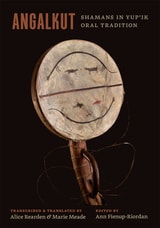
Angalkut/Shamans in Yup'ik Oral Tradition
Ann Fienup-Riordan
University of Alaska Press, 2025
Angalkut/Shamans in Yup’ik Oral Tradition collects over thirty years’ worth of shaman stories, told as part of gatherings organized by Calista Education and Culture to document Yup’ik traditional knowledge. These conversations highlight the critical role angalkut played in Yup’ik life—healing the sick, interpreting dreams and unusual experiences, requesting future abundance through masked dances and other ceremonies, protecting the lives of young children, and dealing with the dead.
The book begins with an English introduction that places Yup’ik oral traditions in the context of shamanism in Alaska and other parts of the Arctic. Then first-person accounts presented in the original Yup’ik with accompanying English translations discuss the importance of shamans and shamanism in general, good and bad shamans, and shamans as healers. Narratives from Nelson Island, Canineq, Kuskokwim River, Akulmiut, and Yukon River describe shamans as healers, shaman journeys and performances, shamans and masked dances requesting abundance, shamans and the dead, malicious shamans, shaman confrontations, becoming a shaman, and those who have shaman abilities today. A detailed glossary and references are also included.
Today, not only are these angalkut gone, but so are those who witnessed and participated in their activities. Angalkut/Shamans in Yup’ik Oral Tradition is the first book devoted exclusively to Yup’ik angalkut; never before has the variety of angalkut roles been profiled in publication, including the richness of elders’ recollections of these individuals and their roles. There is great value in the stories they left behind. This fine-grained presentation of unique, bilingual first-person narratives is an essential resource for scholars and students interested in Yup’ik heritage, Yugtun language, shaman ethnography, and Alaska Native oral traditions.
[more]
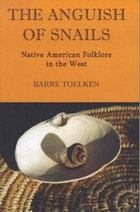
Anguish of Snails
Native American Folklore in the WestBarre Toelken
Utah State University Press, 2003
After a career working and living with American Indians and studying their traditions, Barre Toelken has written this sweeping study of Native American folklore in the West. Within a framework of performance theory, cultural worldview, and collaborative research, he examines Native American visual arts, dance, oral tradition (story and song), humor, and patterns of thinking and discovery to demonstrate what can be gleaned from Indian traditions by Natives and non-Natives alike. In the process he considers popular distortions of Indian beliefs, demystifies many traditions by showing how they can be comprehended within their cultural contexts, considers why some aspects of Native American life are not meant to be understood by or shared with outsiders, and emphasizes how much can be learned through sensitivity to and awareness of cultural values.
Winner of the 2004 Chicago Folklore Prize, The Anguish of Snails is an essential work for the collection of any serious reader in folklore or Native American studies.
Winner of the 2004 Chicago Folklore Prize, The Anguish of Snails is an essential work for the collection of any serious reader in folklore or Native American studies.
[more]