Results by title
2018 books match the query 'Political aspects' and 179 start with a
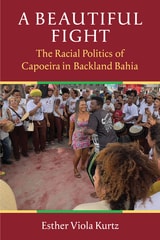
A Beautiful Fight
The Racial Politics of Capoeira in Backland BahiaEsther Viola Kurtz
University of Michigan Press, 2025
2026 Dance Studies Association de la Torre Bueno First Book Award Shortlist Finalist
A Beautiful Fight examines the potentials and limits of capoeira Angola to cohere a multiracial community committed to antiracist struggle. Capoeira, a musical fight-game that originated among enslaved Africans in Brazil, holds special significance for Black Brazilian activists as a spiritual and political practice that affirms the value of Black lives, thus countering anti-Black violence sanctioned by the Brazilian state. However, many capoeira groups count more white practitioners than Black, especially groups of the politicized, Afrocentric style capoeira Angola, raising debates about appropriation of Black culture that resonate across the Americas. A Beautiful Fight addresses these tensions. Drawing on ethnographic research with a multiracial capoeira Angola group in Brazil’s Bahian sertão or backlands, Esther Viola Kurtz explores diverse group members’ understandings of capoeira’s spiritual and political meanings and considers how white participation impacts capoeira’s antiracist politics. A Beautiful Fight argues that white practitioners occupying space in capoeira divert attention from Black members’ concerns and reproduce racist and colonialist ideologies, albeit unintentionally. In this way, the book complicates claims that shared music and dance bridge differences and facilitate cross-racial unity, yet Kurtz proposes that capoeira still transmits knowledge and tools that, when used with intention, commitment, and care, can be wielded to collaboratively contest racism and imagine a more just world.
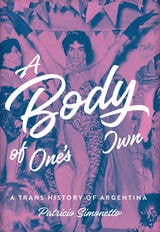
A Body of One's Own
A Trans History of ArgentinaPatricio Simonetto
University of Texas Press, 2024
2026 Silver Medal for the Best LGBTQ+ Themed Book, Conference on Latin American History (CLAH)
2026 Honorable Mention, Book Award, Social History Society
2025 Best Book in Social Sciences Award, Southern Cone Section, Latin American Studies Association
2024 Sylvia Rivera Award in Transgender Studies, The Center for LGBTQ Studies at the Graduate Center, CUNY
A history of Argentina that examines how trans bodies were understood, policed, and shaped in a country that banned medically assisted gender affirmation practices and punished trans lives.
As a trans history of Argentina, a country that banned medically assisted gender affirmation practices and punished trans lives, A Body of One’s Own places the histories of trans bodies at the core of modern Argentinian history. Patricio Simonetto documents the lives of people who crossed the boundaries of gender from the early twentieth century to the present. Based on extensive archival research in public and community-based archives, this book explores the mainstream medical and media portrayals of trans or travesti people, the state policing of gender embodiment, the experiences of those transgressing the boundaries of gender, and the development of homemade technologies from prosthetics to the self-injection of silicone. A Body of One's Own explores how trans activists' challenges to the exclusionary effects of Argentina’s legal, cultural, social, and political cisgender order led to the passage of the Gender Identity Law in 2012. Analyzing the decisive yet overlooked impact of gender transformation in the formation of the nation-state, gender-belonging, and citizenship, this book ultimately shows that supposedly abstract struggles to define the shifting notions of "sex," citizenship, and nationhood are embodied material experiences.
A COVID Charter, A Better World
Toby Miller
Rutgers University Press, 2021
A COVID Charter, A Better World outlines the steps needed to reform public policies and fix the structural vulnerabilities that the current pandemic has made so painfully clear. Leading scholar Toby Miller argues that we must resist neoliberalism’s tendency to view health in terms of individual choices and market-driven solutions, because that fails to preserve human rights. He addresses the imbalance of geopolitical power to explain how we arrived at this point and shows that the pandemic is more than just a virus—it’s a social disease. By examining how the U.S., Britain, Mexico, and Colombia have responded to the COVID-19 crisis, Miller investigates corporate, scientific, and governmental decision-making and the effects those decisions have had on disadvantaged local communities. Drawing from human rights charters ratified by various international organizations, he then proposes a COVID charter, calling for a new world that places human lives above corporate profits.
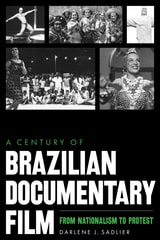
A Century of Brazilian Documentary Film
From Nationalism to ProtestDarlene J. Sadlier
University of Texas Press, 2022
Since the late nineteenth century, Brazilians have turned to documentaries to explain their country to themselves and to the world. In a magisterial history covering one hundred years of cinema, Darlene J. Sadlier identifies Brazilians’ unique contributions to a diverse genre while exploring how that genre has, in turn, contributed to the making and remaking of Brazil.
A Century of Brazilian Documentary Film is a comprehensive tour of feature and short films that have charted the social and political story of modern Brazil. The Amazon appears repeatedly and vividly. Sometimes—as in a prize-winning 1922 feature—the rainforest is a galvanizing site of national pride; at other times, the Amazon has been a focus for land-reform and Indigenous-rights activists. Other key documentary themes include Brazil’s swings from democracy to dictatorship, tensions between cosmopolitanism and rurality, and shifting attitudes toward race and gender. Sadlier also provides critical perspectives on aesthetics and media technology, exploring how documentaries inspired dramatic depictions of poverty and migration in the country’s Northeast and examining Brazilians’ participation in streaming platforms that have suddenly democratized filmmaking.
A Civil Economy
Transforming the Marketplace in the Twenty-First CenturySeveryn T. Bruyn
University of Michigan Press, 2000
A Democratic Theory of Judgment
Linda M. G. Zerilli
University of Chicago Press, 2016
Zerilli deftly outlines the limitations of existing debates, both those that concern themselves with the impossibility of judging across cultures and those that try to find transcendental, rational values to anchor judgment. Looking at Kant through the lens of Arendt, Zerilli develops the notion of a public conception of truth, and from there she explores relativism, historicism, and universalism as they shape feminist approaches to judgment. Following Arendt even further, Zerilli arrives at a hopeful new pathway—seeing the collapse of philosophical criteria for judgment not as a problem but a way to practice judgment anew as a world-building activity of democratic citizens. The result is an astonishing theoretical argument that travels through—and goes beyond—some of the most important political thought of the modern period.
A Democratic Theory of Truth
Linda M. G. Zerilli
University of Chicago Press, 2025
We say that we live in a “post-truth” era because disinformation threatens our confidence in the existence of a shared public world. Affirming objective truth may, therefore, seem necessary to save democracy. According to political theorist Linda M. G. Zerilli, such affirmation can stifle political debate and silence dissent. In fact, Zerilli argues that the unqualified insistence on objective truth is as dangerous for democracy as denying it.
Drawing on Arendt, Foucault, and Wittgenstein, A Democratic Theory of Truth challenges the concept of truth presupposed by the post-truth debate. It argues that we, the people, have an essential role in discovering and evaluating any truth relevant to the political realm. The result is a striking defense of plurality, dissent, and opinion in contemporary democratic societies.

A Divided World
Hollywood Cinema and Emigré Directors in the Era of Roosevelt and Hitler, 1933-1948Nick Smedley
Intellect Books, 2011
The New Deal introduced sweeping social, political, and cultural change across the United States, which Hollywood embraced enthusiastically. Then, when the heady idealism of the 1930s was replaced by the paranoia of the postwar years, Hollywood became an easy target for the anticommunists. A Divided World examines some of the important programs of the New Deal and the subsequent response of the film community—especially in relation to social welfare, women’s rights, and international affairs. The book also provides an analysis of the major works of three European directors—Billy Wilder, Ernst Lubitsch, and Fritz Lang—compared and contrasted with the products of mainstream Hollywood. This is a new interpretation of an influential period in American film history and it is sure to generate further debate and scholarship.
A Fan's Life
The Agony of Victory and the Thrill of DefeatPaul Campos
University of Chicago Press, 2022
The Pass. The Curse. The Double Doink. A sports fan’s life is not just defined by intense moments on a field, it’s scarred by them. For a real fan, winning isn’t everything—losing is. The true fans, it’s said, are those who have suffered the most, enduring lives defined by irrational obsession, fervid hopes, and equally gut-wrenching misery. And as Paul Campos shows, those deep feelings are windows not just onto an individual fan’s psychology but onto some of our shared concepts of community, identity, and belonging—not all of which are admirable. In A Fan’s Life, he seeks not to exalt a particular team but to explore fandom’s thorniest depths, excavating the deeper meanings of the fan’s inherently unhappy life.
A Fan’s Life dives deep into the experience of being an ardent fan in a world defined more and more by the rhetoric of “winners” and “losers.” In a series of tightly argued chapters that suture together memoir and social critique, Campos chronicles his lifelong passion for University of Michigan football while meditating on fandom in the wake of the unprecedented year of 2020—when, for a time, a global pandemic took away professional and collegiate sports entirely. Fandom isn’t just leisure, he shows; it’s part of who we are, and part of even our politics, which in the age of Donald Trump have become increasingly tribal and bloody. Campos points toward where we might be heading, as our various partisan affiliations—fandoms with a grimly national significance—become all the more intense and bitterly self-defining. As he shows, we’re all fans of something, and making sense of fandom itself might offer a way to wrap our heads around our increasingly divided reality, on and off the field.
A Fire Bell in the Past
The Missouri Crisis at 200, Volume I, Western Slavery, National ImpasseJeffrey L. Pasley
University of Missouri Press, 2021
Drawing on the participants in two landmark conferences held at the University of Missouri and the City University of New York, this first of two volumes finds myriad new perspectives on the Missouri Crisis. Celebrating Missouri’s bicentennial the scholarly way, with fresh research and unsparing analysis, this eloquent collection of essays from distinguished historians gives the epochal struggle over Missouri statehood its due as a major turning point in American history.
Contributors include the editors, Christa Dierksheide, David N. Gellman, Sarah L. H. Gronningsater, Robert Lee, Donald Ratcliffe, Andrew Shankman, Anne Twitty, John R. Van Atta, and David Waldstreicher.
A Fire Bell in the Past
The Missouri Crisis at 200, Volume II: “The Missouri Question” and Its AnswersJeffrey L. Pasley
University of Missouri Press, 2021
Drawn from the of participants in two landmark conferences held at the University of Missouri and the City University of New York, those who contributed original essays to this second of two volumes—a group that includes young scholars and foremost authorities in the field—answer the Missouri “Question,” in bold fashion, challenging assumptions both old and new in the long historiography by approaching the event on its own terms, rather than as the inevitable sequel of the flawed founding of the republic or a prequel to its near destruction.
This second volume of A Fire Bell in the Past features a foreword by Daive Dunkley. Contributors include Dianne Mutti Burke, Christopher Childers, Edward P. Green, Zachary Dowdle, David J. Gary, Peter Kastor, Miriam Liebman, Matthew Mason, Kate Masur, Mike McManus, Richard Newman, and Nicholas Wood.
A Forgetful Nation
On Immigration and Cultural Identity in the United StatesAli Behdad
Duke University Press, 2005
Behdad shows how political, cultural, and legal texts have articulated American anxiety about immigration from the Federalist period to the present day. He reads texts both well-known—J. Hector St. John de Crèvecoeur’s Letters from an American Farmer, Alexis de Tocqueville’s Democracy in America, and Walt Whitman’s Leaves of Grass—and lesser-known—such as the writings of nineteenth-century nativists and of public health officials at Ellis Island. In the process, he highlights what is obscured by narratives and texts celebrating the United States as an open-armed haven for everyone: the country’s violent beginnings, including its conquest of Native Americans, brutal exploitation of enslaved Africans, and colonialist annexation of French and Mexican territories; a recurring and fierce strand of nativism; the need for a docile labor force; and the harsh discipline meted out to immigrant “aliens” today, particularly along the Mexican border.
A Fragile Inheritance
Radical Stakes in Contemporary Indian ArtSaloni Mathur
Duke University Press, 2019
A Future History of Water
Andrea Ballestero
Duke University Press, 2019
A Good Place to Do Business
The Politics of Downtown Renewal since 1945Roger Biles and Mark H. Rose
Temple University Press, 2022
The “Pittsburgh Renaissance,” an urban renewal effort launched in the late 1940s, transformed the smoky rust belt city’s downtown. Working-class residents and people of color saw their neighborhoods cleared and replaced with upscale, white residents and with large corporations housed in massive skyscrapers. Pittsburgh’s Renaissance’s apparent success quickly became a model for several struggling industrial cities, including St. Louis, Cleveland, Detroit, Chicago, and Philadelphia.
In A Good Place to Do Business, Roger Biles and Mark Rose chronicle these urban “makeovers” which promised increased tourism and fashionable shopping as well as the development of sports stadiums, convention centers, downtown parks, and more. They examine the politics of these government-funded redevelopment programs and show how city politics (and policymakers) often dictated the level of success.
As city officials and business elites determined to reorganize their downtowns, a deeply racialized politics sacrificed neighborhoods and the livelihoods of those pushed out. Yet, as A Good Place to Do Business demonstrates, more often than not, costly efforts to bring about the hoped-for improvements failed to revitalize those cities, or even their downtowns.
A Guilted Age
Apologies for the PastAshraf A. H. Rushdy
Temple University Press, 2015
Public apologies have become increasingly common scenes and representative moments in what appears to be a global process of forgiveness. The apology-forgiveness dynamic is familiar to all of us, but what do these rituals of atonement mean when they are applied to political and historical events?
In his timely, topical, and incisive book A Guilted Age, Ashraf Rushdy argues that the proliferation of apologies by politicians, nations, and churches for past events—such as American slavery or the Holocaust—can be understood as a historical phenomenon. In our post–World War II world, Rushdy claims that we live in a “guilted age.”
A Guilted Age identifies the two major forms of apologies—political and historical—and Rushdy defines the dynamics and strategies of each, showing how the evolution of one led to the other. In doing so, he reveals what apology and forgiveness do to the past events they respectively apologize for and forgive—and what happens when they fail.
A History of Trust in Ancient Greece
Steven Johnstone
University of Chicago Press, 2011
A History of the Second World War in 100 Maps
Jeremy Black
University of Chicago Press, 2020
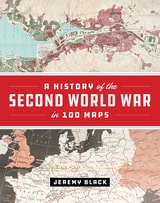
The First World War was marked by an exceptional expansion in the use and production of military cartography. But World War II took things even further, employing maps, charts, reconnaissance, and the systematic recording and processing of geographical and topographical information on an unprecedented scale. As Jeremy Black—one of the world’s leading military and cartographic historians—convincingly shows in this lavish full-color book, it is impossible to understand the events and outcomes of the Second World War without deep reference to mapping at all levels. In World War II, maps themselves became the weapons.
A History of the Second World War in 100 Maps traces how military cartography developed from simply recording and reflecting history to having a decisive impact on events of a global scale. Drawing on one hundred key maps from the unparalleled collections of the British Library and other sources—many of which have never been published in book form before--Jeremy Black takes us from the prewar mapping programs undertaken by both Germany and the United Kingdom in the mid-1930s through the conflict’s end a decade later. Black shows how the development of maps led directly to the planning of the complex and fluid maneuvers that defined the European theater in World War II: for example, aerial reconnaissance photography allowed for the charting of beach gradients and ocean depths in the runup to the D-Day landings, and the subsequent troop movements at Normandy would have been impossible without the help of situation maps and photos. In the course of the conflict, both in Europe and the Pacific, the realities of climate, terrain, and logistics—recorded on maps—overcame the Axis powers. Maps also became propaganda tools as the pages of Time outlined the directions of the campaigns and the Allies dropped maps from their aircraft.
In this thrilling and unique book, Jeremy Black blends his singular cartographic and military expertise into a captivating overview of World War II from the air, sea, and sky, making clear how fundamental maps were to every aspect of this unforgettable global conflict.

A Jewish Orchestra in Nazi Germany
Musical Politics and the Berlin Jewish Culture LeagueLily E. Hirsch
University of Michigan Press, 2011
"Offers a clear introduction to a fascinating, yet little known, phenomenon in Nazi Germany, whose very existence will be a surprise to the general public and to historians. Easily blending general history with musicology, the book provides provocative yet compelling analysis of complex issues."
---Michael Meyer, author of The Politics of Music in the Third Reich
"Hirsch poses complex questions about Jewish identity and Jewish music, and she situates these against a political background vexed by the impossibility of truly viable responses to such questions. Her thorough archival research is complemented by her extensive use of interviews, which gives voice to those swept up in the Holocaust. A Jewish Orchestra in Nazi Germany is a book filled with the stories of real lives, a collective biography in modern music history that must no longer remain in silence."
---Philip V. Bohlman, author of Jewish Music and Modernity
"An engaging and downright gripping history. The project is original, the research is outstanding, and the presentation lucid."
---Karen Painter, author of Symphonic Aspirations: German Music and Politics, 1900-1945
The Jewish Culture League was created in Berlin in June 1933, the only organization in Nazi Germany in which Jews were not only allowed but encouraged to participate in music, both as performers and as audience members. Lily E. Hirsch's A Jewish Orchestra in Nazi Germany is the first book to seriously investigate and parse the complicated questions the existence of this unique organization raised, such as why the Nazis would promote Jewish music when, in the rest of Germany, it was banned. The government's insistence that the League perform only Jewish music also presented the organization's leaders and membership with perplexing conundrums: what exactly is Jewish music? Who qualifies as a Jewish composer? And, if it is true that the Nazis conceived of the League as a propaganda tool, did Jewish participation in its activities amount to collaboration?
Lily E. Hirsch is Assistant Professor of Music at Cleveland State University.
A Kinder, Gentler America
Melancholia and the Mythical 1950sMary Caputi
University of Minnesota Press, 2005
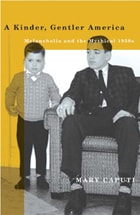
Analyzing these competing uses of the past, A Kinder, Gentler America reveals how longing for the era of “the greatest generation” actually exposes a disillusionment with the present. Caputi draws on the theoretical frameworks of Julia Kristeva and Walter Benjamin to look at how the decade has been portrayed in movies such as Pleasantville and Far from Heaven and delves further to investigate our disenchantment’s lost origins in early modernity through a reading of the poetry of Baudelaire. What emerges is a stark contrast between the depictions of a melancholic present and a cheerful, shiny past. In the right’s invocation of the mythical 1950s and the left’s criticism of the same, Caputi recognizes a common unfulfilled desire, and proposes that by understanding this loss both sides can begin to accept that American identity, despite chaos and confusion, lies in the here and now.
Mary Caputi is professor of political science at California State University, Long Beach, and is author of Voluptuous Yearnings: A Feminist Theory of the Obscene.
A Living Exhibition
The Smithsonian and the Transformation of the Universal MuseumWilliam S. Walker
University of Massachusetts Press, 2013
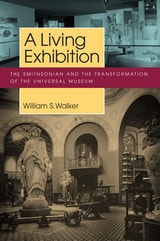
Since its founding in 1846 “for the increase and diffusion of knowledge,” the Smithsonian Institution has been an important feature of the American cultural landscape. In A Living Exhibition, William S. Walker examines the tangled history of cultural exhibition at the Smithsonian from its early years to the chartering of the National Museum of the American Indian in 1989. He tracks the transformation of the institution from its original ideal as a “universal museum” intended to present the totality of human experience to the variegated museum and research complex of today.
Walker pays particular attention to the half century following World War II, when the Smithsonian significantly expanded. Focusing on its exhibitions of cultural history, cultural anthropology, and folk life, he places the Smithsonian within the larger context of Cold War America and the social movements of the 1960s, '70s, and '80s. Organized chronologically, the book uses the lens of the Smithsonian's changing exhibitions to show how institutional decisions become intertwined with broader public debates about pluralism, multiculturalism, and decolonization.
Yet if a trend toward more culturally specific museums and exhibitions characterized the postwar history of the institution, its leaders and curators did not abandon the vision of the universal museum. Instead, Walker shows, even as the Smithsonian evolved into an extensive complex of museums, galleries, and research centers, it continued to negotiate the imperatives of cultural convergence as well as divergence, embodying both a desire to put everything together and a need to take it all apart.
A More Conservative Place
Intellectual Culture in the Bush EraPaul A. Bové
Dartmouth College Press, 2013
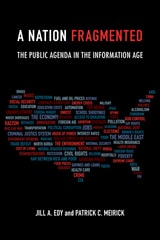
A Nation Fragmented
The Public Agenda in the Information AgeJill Edy
Temple University Press, 2019
The transformation from an undifferentiated public to a surfeit of interest groups has become yet another distinguishing feature of the increasing polarization of American politics. Jill Edy and Patrick Meirick contend that the media has played a key role in this splintering. A Nation Fragmented reveals how the content and character of the public agenda has transformed as the media environment evolved from network television and daily newspapers in the late 1960s to today’s saturated social media world with 200 cable channels.
The authors seek to understand what happened as the public’s sense of shared priorities deteriorated. They consider to what extent our public agenda has “fallen apart” as attention to news has declined, and to what extent we have been “driven apart” by changes in the issue agendas of news. Edy and Meirick also show how public attention is limited and spread too thin except in cases where a highly consistent news agenda can provoke a more focused public agenda.
A Nation Fragmented explores the media’s influence and political power and, ultimately, how contemporary democracy works.
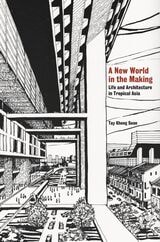
A New World in the Making
Life and Architecture in Tropical AsiaTay Kheng Soon
National University of Singapore Press, 2023
According to architect Tay Kheng Soon, the time has come to change and build a new world. The feeling has impelled him to write this book, bringing together memoir and writings on identity, landscape and belonging, and on architecture and urbanism. Born in British-ruled Singapore, Soon was deeply engaged in the debates about building a new world that attended the end of colonialism. His focus, but far from his only concern, was Singapore's built environment—and its spiritual one—since the early 1960s. A New World in the Making is a must-read reflection on tropical Asia, on architecture and urbanism, and on looking ahead to the always urgent task of building a new world.
A Not So Foreign Affair
Fascism, Sexuality, and the Cultural Rhetoric of American DemocracyAndrea Slane
Duke University Press, 2001
World War II marked a turning point in the cultural rhetoric of democracy, Slane claims, because it intensified a preoccupation with the political role of private life and pushed sexuality to the center of democratic discourse. Having created tremendous anxiety—and fascination—in American culture, Nazism became associated with promiscuity, sexual perversionand the destruction of the family. Slane reveals how this particular imprint of fascism is used in progressive as well as conservative imagery and language to further their domestic agendas and shows how our cultural engagement with Nazism reflects the inherent tension in democracy between the value of diversity, individual freedoms national identity, and notions of the common good. Finally, she applies her analysis of wartime narratives to contemporary texts, examining anti-abortion, anti-gay, and anti-federal rhetoric, as well as the psychic life of skinheads, censorship debates, and the contemporary fascination with incest.
An invaluable resource for understanding the language we use—both visual and narrative—to describe and debate democracy in the United States today, A Not So Foreign Affair will appeal to those interested in cultural studies, film and video studies, American studies, twentieth century history, German studies, rhetoric, and sexuality studies.
A Peaceful Conquest
Woodrow Wilson, Religion, and the New World OrderCara Lea Burnidge
University of Chicago Press, 2016
With A Peaceful Conquest, Cara Lea Burnidge presents the most detailed analysis yet of how Wilson’s religious beliefs affected his vision of American foreign policy, with repercussions that lasted into the Cold War and beyond. Framing Wilson’s intellectual development in relationship to the national religious landscape, and paying greater attention to the role of religion than in previous scholarship, Burnidge shows how Wilson’s blend of Southern evangelicalism and social Christianity became a central part of how America saw itself in the world, influencing seemingly secular policy decisions in subtle, lasting ways. Ultimately, Burnidge makes a case for Wilson’s religiosity as one of the key drivers of the emergence of the public conception of America’s unique, indispensable role in international relations.
As the presidential election cycle once again raises questions of America’s place in the world, A Peaceful Conquest offers a fascinating excavation of its little-known roots.

A People's History of the Second World War
Resistance Versus EmpireDonny Gluckstein
Pluto Press, 2012
A People's History of the Second World War unearths the fascinating history of the war as fought 'from below'. Until now, the vast majority of historical accounts have focussed on the conflict between the Allied and Axis powers for imperialist mastery. Donny Gluckstein shows that in fact between 1939 and 1945 two distinct wars were fought – one ‘from above’ and one ‘from below’.
Using examples from countries under the Nazi heel, in the colonies and within the Axis and Allied camps, Gluckstein brings to life the very different struggle of the people's and resistance movements which proliferated during the war. He shows how they fought not just fascism, but colonialism and empire, and were betrayed by the Allies at the war’s end.
This book will fundamentally challenge our understanding of the Second World War – both about the people who fought it and the reasons for which it was fought.
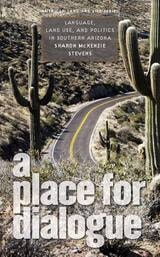
A Place for Dialogue
Language, Land Use, and Politics in Southern ArizonaSharon McKenzie Stevens
University of Iowa Press, 2007
In A Place for Dialogue, Sharon McKenzie Stevens views the contradictions and collaborations involved in the management of public land in southern Arizona—and by extension the entire arid West—through the lens of political rhetoric. Revealing the socioecological relationships among cattlemen and environmentalists as well as developers and recreationists, she analyzes the ways that language shapes landscape by shaping decisions about land use.
Stevens focuses on the collaborative Sonoran Desert Conservation Plan initiated by Pima County, Arizona, the ubiquitous use of scientific argument to defend contradictory practices, and the construction and negotiation of rancher/environmentalist identities to illuminate both literally and metaphorically the dynamics of land use politics. Drawing specifically upon extensive interviews with a diverse array of agents on all sides of the debate—ranchers, environmentalists, scientists, land managers, government officials—on historical narratives, and on her own conflicting experiences as someone who grew up with those who work the western lands, she demonstrates that it is possible to use differences to solve, rather than to aggravate, the entrenched problems that bridge land and language.
By integrating her richly textured case study of a fragile region with rhetorical approaches to narrative, science-based argument, and collective identities, Stevens makes a significant contribution to the fields of rhetoric, land management, and cultural studies.
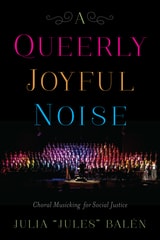
A Queerly Joyful Noise
Choral Musicking for Social JusticeJulia "Jules" Balén
Rutgers University Press, 2017
Honorable Mention, 2019 Herndon Book Prize - (SEM-GST)
A Queerly Joyful Noise examines how choral singing can be both personally transformative and politically impactful. As they blend their different voices to create something beautiful, LGBTIQ singers stand together and make themselves heard. Comparing queer choral performances to the uses of group singing within the civil rights and labor movements, Julia “Jules” Balén maps the relationship between different forms of oppression and strategic musical forms of resistance. She also explores the potential this queer communal space creates for mobilizing progressive social action.
A proud member of numerous queer choruses, Balén draws from years of firsthand observations, archival research, and extensive interviews to reveal how queer chorus members feel shared vulnerability, collective strength, and even moments of ecstasy when performing. A Queerly Joyful Noise serves as a testament to the power of music, intimately depicting how participation in a queer chorus is more than a pastime, but a meaningful form of protest through celebration.
A Quiet Victory for Latino Rights
FDR and the Controversy Over "Whiteness"Patrick D. Lukens
University of Arizona Press, 2012
In 1935 a federal court judge handed down a ruling that could have been disastrous for Mexicans, Mexican Americans, and all Latinos in the United States. However, in an unprecedented move, the Roosevelt administration wielded the power of "administrative law" to neutralize the decision and thereby dealt a severe blow to the nativist movement. A Quiet Victory for Latino Rights recounts this important but little-known story.
To the dismay of some nativist groups, the Immigration Act of 1924, which limited the number of immigrants who could be admitted annually, did not apply to immigrants from Latin America. In response to nativist legal maneuverings, the 1935 decision said that the act could be applied to Mexican immigrants. That decision, which ruled that the Mexican petitioners were not "free white person[s]," might have paved the road to segregation for all Latinos.
The League of United Latin American Citizens (LULAC), founded in 1929, had worked to sensitize the Roosevelt administration to the tenuous position of Latinos in the United States. Advised by LULAC, the Mexican government, and the US State Department, the administration used its authority under administrative law to have all Mexican immigrants—and Mexican Americans—classified as "white." It implemented the policy when the federal judiciary "acquiesced" to the New Deal, which in effect prevented further rulings.
In recounting this story, complete with colorful characters and unlikely bedfellows, Patrick D. Lukens adds a significant chapter to the racial history of the United States.
A Resonant Ecology
Max Ritts
Duke University Press, 2024
A Revolution in Fragments
Traversing Scales of Justice, Ideology, and Practice in BoliviaMark Goodale
Duke University Press, 2019
A Rhetorical Crime
Genocide in the Geopolitical Discourse of the Cold WarWeiss-Wendt, Anton
Rutgers University Press, 2018
A Rhetorical Crime shows how genocide morphed from a legal concept into a political discourse used in propaganda battles between the United States and the Soviet Union. Over the course of the Cold War era, nearly eighty countries were accused of genocide, and yet there were few real-time interventions to stop the atrocities committed by genocidal regimes like the Cambodian Khmer Rouge.
Renowned genocide scholar Anton Weiss-Wendt employs a unique comparative approach, analyzing the statements of Soviet and American politicians, historians, and legal scholars in order to deduce why their moral posturing far exceeded their humanitarian action.
A Righteous Smokescreen
Postwar America and the Politics of Cultural GlobalizationSam Lebovic
University of Chicago Press, 2022
When the dust settled after World War II, the United States stood as the world’s unquestionably pre-eminent military and economic power. In the decades that followed, the country exerted its dominant force in less visible but equally powerful ways, too, spreading its trade protocols, its media, and—perhaps most importantly—its alleged values. In A Righteous Smokescreen, Sam Lebovic homes in on one of the most prominent, yet ethereal, of those professed values: the free flow of information. This trope was seen as capturing what was most liberal about America’s self-declared leadership of the free world. But as Lebovic makes clear, even though diplomats and public figures trumpeted the importance of widespread cultural exchange, these transmissions flowed in only one direction: outward from the United States. Though other countries did try to promote their own cultural visions, Lebovic shows that the US moved to marginalize or block those visions outright, highlighting the shallowness of American commitments to multilateral institutions, the depth of its unstated devotion to cultural and economic supremacy, and its surprising hostility to importing foreign cultures. His book uncovers the unexpectedly profound global consequences buried in such ostensibly mundane matters as visa and passport policy, international educational funding, and land purchases for embassies. Even more crucially, A Righteous Smokescreen does nothing less than reveal that globalization was not the inevitable consequence of cultural convergence or the natural outcome of putatively free flows of information—it was always political to its core.
A Slaveholders' Union
Slavery, Politics, and the Constitution in the Early American RepublicGeorge William Van Cleve
University of Chicago Press, 2010
After its early introduction into the English colonies in North America, slavery in the United States lasted as a legal institution until the passage of the Thirteenth Amendment to the Constitution in 1865. But increasingly during the contested politics of the early republic, abolitionists cried out that the Constitution itself was a slaveowners’ document, produced to protect and further their rights. A Slaveholders’ Union furthers this unsettling claim by demonstrating once and for all that slavery was indeed an essential part of the foundation of the nascent republic.
In this powerful book, George William Van Cleve demonstrates that the Constitution was pro-slavery in its politics, its economics, and its law. He convincingly shows that the Constitutional provisions protecting slavery were much more than mere “political” compromises—they were integral to the principles of the new nation. By the late 1780s, a majority of Americans wanted to create a strong federal republic that would be capable of expanding into a continental empire. In order for America to become an empire on such a scale, Van Cleve argues, the Southern states had to be willing partners in the endeavor, and the cost of their allegiance was the deliberate long-term protection of slavery by America’s leaders through the nation’s early expansion. Reconsidering the role played by the gradual abolition of slavery in the North, Van Cleve also shows that abolition there was much less progressive in its origins—and had much less influence on slavery’s expansion—than previously thought.
Deftly interweaving historical and political analyses, A Slaveholders’ Union will likely become the definitive explanation of slavery’s persistence and growth—and of its influence on American constitutional development—from the Revolutionary War through the Missouri Compromise of 1821.
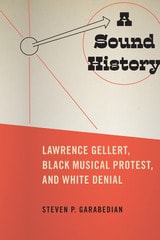
A Sound History
Lawrence Gellert, Black Musical Protest, and White DenialSteven P. Garabedian
University of Massachusetts Press, 2020
Lawrence Gellert has long been a mysterious figure in American folk and blues studies, gaining prominence in the left-wing folk revival of the 1930s for his fieldwork in the U.S. South. A “lean, straggly-haired New Yorker,” as Time magazine called him, Gellert was an independent music collector, without formal training, credentials, or affiliation. At a time of institutionalized suppression, he worked to introduce white audiences to a tradition of black musical protest that had been denied and overlooked by prior white collectors.
By the folk and blues revival of the 1960s, however, when his work would again seem apt in the context of the civil rights movement, Gellert and his collection of Negro Songs of Protest were a conspicuous absence. A few leading figures in the revival defamed Gellert as a fraud, dismissing his archive of black vernacular protest as a fabrication—an example of left-wing propaganda and white interference. A Sound History is the story of an individual life, an excavation of African American musical resistance and dominant white historiography, and a cultural history of radical possibility and reversal in the defining middle decades of the U.S. twentieth century.
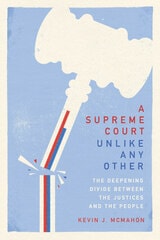
A Supreme Court Unlike Any Other
The Deepening Divide Between the Justices and the PeopleKevin J. McMahon
University of Chicago Press, 2024
A data-rich examination of the US Supreme Court's unprecedented detachment from the democratic processes that buttress its legitimacy.
Today’s Supreme Court is unlike any other in American history. This is not just because of its jurisprudence but also because the current Court has a tenuous relationship with the democratic processes that help establish its authority. Historically, this “democracy gap” was not nearly as severe as it is today. Simply put, past Supreme Courts were constructed in a fashion far more in line with the promise of democracy—that the people decide and the majority rules.
Drawing on historical and contemporary data alongside a deep knowledge of court battles during presidencies ranging from FDR to Donald Trump, Kevin J. McMahon charts the developments that brought us here. McMahon offers insight into the altered politics of nominating and confirming justices, the shifting pool of Supreme Court hopefuls, and the increased salience of the Court in elections. A Supreme Court Unlike Any Other is an eye-opening account of today’s Court within the context of US history and the broader structure of contemporary politics.
A Task for Sisyphus
Why Europe’s Roma Policies FailIulius Rostas
Central European University Press, 2020
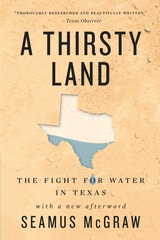
A Thirsty Land
The Fight for Water in TexasBy Seamus McGraw
University of Texas Press, 2018
As a changing climate threatens the whole country with deeper droughts and more furious floods that put ever more people and property at risk, Texas has become a bellwether state for water debates. Will there be enough water for everyone? Is there the will to take the steps necessary to defend ourselves against the sea? Is it in the nature of Americans to adapt to nature in flux?
The most comprehensive—and comprehensible—book on contemporary water issues, A Thirsty Land delves deep into the challenges faced not just by Texas but by the nation as a whole, as we struggle to find a way to balance the changing forces of nature with our own ever-expanding needs. Part history, part science, part adventure story, and part travelogue, this book puts a human face on the struggle to master that most precious and capricious of resources, water. Seamus McGraw goes to the taproots, talking to farmers, ranchers, businesspeople, and citizen activists, as well as to politicians and government employees. Their stories provide chilling evidence that Texas—and indeed the nation—is not ready for the next devastating drought, the next catastrophic flood. Ultimately, however, A Thirsty Land delivers hope. This deep dive into one of the most vexing challenges facing Texas and the nation offers glimpses of the way forward in the untapped opportunities that water also presents.
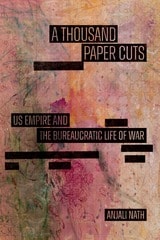
A Thousand Paper Cuts
US Empire and the Bureaucratic Life of WarAnjali Nath
Duke University Press, 2025

A Thousand Pieces of Paradise
Landscape and Property in the Kickapoo ValleyLynne Heasley
University of Wisconsin Press, 2012
A Thousand Pieces of Paradise is an ecological history of property and a cultural history of rural ecosystems set in one of the Midwest’s most historically significant regions, the Kickapoo River Valley. Whether examining the national war on soil erosion, Amish migration, a Corps of Engineers dam project, or Native American land claims, Lynne Heasley traces the history of modern American property debates. Her book holds powerful lessons for rural communities seeking to reconcile competing values about land and their place in it.
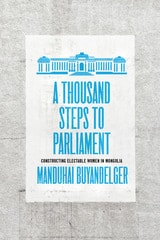
A Thousand Steps to Parliament
Constructing Electable Women in MongoliaManduhai Buyandelger
University of Chicago Press, 2022
Mongolia has often been deemed an “island of democracy,” commended for its rapid adoption of free democratic elections in the wake of totalitarian socialism. The democratizing era, however, brought alongside it a phenomenon that Manduhai Buyandelger terms “electionization”—a restructuring of elections from time-grounded events into a continuous neoliberal force that governs everyday life beyond the electoral period. In this way, electoral campaigns have come to substitute for the functions of governing, from social welfare to the private sector, requiring an accumulation of wealth and power beyond the reach of most women candidates. In A Thousand Steps to Parliament, Buyandelger shows how successful women candidates instead use strategies of self-polishing to cultivate charisma and a reputation for being oyunlag, or intellectful. This carefully crafted identity can be called the “electable self”: treating their bodies and minds as pliable and renewable, women candidates draw from the same practices of neoliberalism that have unsustainably commercialized elections. By tracing the complicated, contradictory paths to representation that women in Mongolia must walk, A Thousand Steps to Parliament holds a mirror up to democracies the world over, revealing an urgent need to grapple with the encroaching effects of neoliberalism in our global political systems.
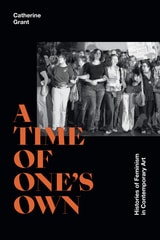
A Time of One's Own
Histories of Feminism in Contemporary ArtCatherine Grant
Duke University Press, 2022
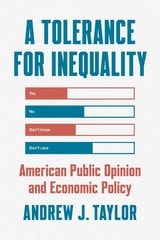
A Tolerance for Inequality
American Public Opinion and Economic PolicyAndrew J. Taylor
University of Chicago Press, 2025
A nuanced reassessment of US democratic responsiveness and public opinion on economic policy that explores the real reasons government does not do more to mitigate inequality.
Many believe that the United States’ growing economic inequality is the result of a political system that has been captured by wealthy elites. But is economic capture actually the problem? In A Tolerance for Inequality, Andrew J. Taylor examines this question from multiple angles, drawing on public opinion data and analyses of representation in Congress. Taylor finds that economic policy outcomes are more reflective of public opinion than the common wisdom suggests.
Broadly, less-affluent Americans’ policy preferences are not meaningfully different from the preferences of other Americans, and Washington is responsive to these preferences. Although politicians are more affluent, on average, than most Americans, this does not prevent them from representing the economic views of their poorer constituents. Today’s Democratic Party is more interested in regulation and supplying public goods than redistributing wealth downwards, and political reforms designed to provide more equal outcomes are largely misguided. In short, Americans get the kind of economy they at least say they want.

A Vital Frontier
Water Insurgencies in EuropeAndrea Muehlebach
Duke University Press, 2023
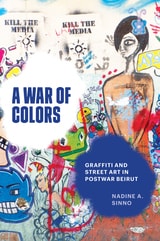
A War of Colors
Graffiti and Street Art in Postwar BeirutNadine A. Sinno
University of Texas Press, 2024
Demonstrates the role of Beirut’s postwar graffiti and street art in transforming the cityscape and animating resistance.
Over the last two decades in Beirut, graffiti makers have engaged in a fierce “war of colors,” seeking to disrupt and transform the city’s physical and social spaces. In A War of Colors, Nadine Sinno examines how graffiti and street art have been used in postwar Beirut to comment on the rapidly changing social dynamics of the country and region. Analyzing how graffiti makers can reclaim and transform cityscapes that were damaged or monopolized by militias during the war, Sinno explores graffiti’s other roles, including forging civic engagement, commemorating cultural icons, protesting political corruption and environmental violence, and animating resistance. In addition, she argues that graffiti making can offer voices to those who are often marginalized, especially women and LGBTQ people. Copiously illustrated with images of graffiti and street art, A War of Colors is a visually captivating and thought-provoking journey through Beirut, where local and global discourses intersect on both scarred and polished walls in the city.
A Will for the Machine
Computerization, Automation, and the Arts in South AfricaMark Sanders
University of Chicago Press, 2026
There are many books about the history and discourses of computerization in the United States but relatively little about these phenomena anywhere in the Global South. In A Will for the Machine, Mark Sanders outlines South Africa’s entry into the computer age in the 1960s and ’70s and explains how it coincided with the high point of apartheid. South Africa’s government viewed automation and computerization as one way of barring Black Africans from skilled work and reserving it for whites. Sanders unpacks this peculiar history, relates it to early twentieth-century struggles around mechanization in mining and telephony in South Africa, and analyzes responses to it by the writers Miriam Tlali and J. M. Coetzee, the artist William Kentridge, and Handspring Puppet Company. Showing how the arts realize ideas about the ethics and politics of automation, Sanders contributes to debates about locally divergent understandings of computer technology and human-computer interaction.
A William V. Spanos Reader
Humanist Criticism and the Secular ImperativeEdited by Daniel T. O'Hara, Donald E. Pease, Michelle Martin
Northwestern University Press, 2015
The American critic William V. Spanos, a pioneer of postmodern theory and co-founder of one of its principal organs, the journal boundary 2, is, in the words of A William V. Spanos Reader coeditor Daniel T. O’Hara, everything that current post-modern theory is accused of not being: polemical, engaged, prophetic, passionate. Informed by his experience as a prisoner of war in Dresden, Spanos saw dire con-sequences for life in modernist aesthetic experiments, and he thereafter imbued his work with a constructive aspect ever in the name of more life.
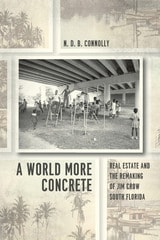
A World More Concrete
Real Estate and the Remaking of Jim Crow South FloridaN. D. B. Connolly
University of Chicago Press, 2014
A World More Concrete argues that black and white landlords, entrepreneurs, and even liberal community leaders used tenements and repeated land dispossession to take advantage of the poor and generate remarkable wealth. Through a political culture built on real estate, South Florida’s landlords and homeowners advanced property rights and white property rights, especially, at the expense of more inclusive visions of equality. For black people and many of their white allies, uses of eminent domain helped to harden class and color lines. Yet, for many reformers, confiscating certain kinds of real estate through eminent domain also promised to help improve housing conditions, to undermine the neighborhood influence of powerful slumlords, and to open new opportunities for suburban life for black Floridians.
Concerned more with winners and losers than with heroes and villains, A World More Concrete offers a sober assessment of money and power in Jim Crow America. It shows how negotiations between powerful real estate interests on both sides of the color line gave racial segregation a remarkable capacity to evolve, revealing property owners’ power to reshape American cities in ways that can still be seen and felt today.
A World of Becoming
William E. Connolly
Duke University Press, 2010
Attunement to a world of becoming, Connolly argues, may help us address dangerous resonances between global finance capital, cross-regional religious resentments, neoconservative ideology, and the 24-hour mass media. Coming to terms with subliminal changes in the contemporary experience of time that challenge traditional images can help us grasp how these movements have arisen and perhaps even inspire creative counter-movements. The book closes with the chapter “The Theorist and the Seer,” in which Connolly draws insights from early Greek ideas of the Seer and a Jerry Lewis film, The Nutty Professor, to inform the theory enterprise today.