Results by title
214 books match the query 'Presidents & Heads of State' and 28 start with a
A Government as Good as Its People
Jimmy Carter
University of Arkansas Press, 1996
A Life for Belarus
The Fall and Postmortal Rise of the USSRStanislau Shushkevich
Central European University Press, 2025
This memoir of the first president of an independent Belarus (1991-1994) tells about the revival of independent Belarus, the difficulties in establishing a democracy and a market economy, a hardened Soviet mentality, and the political immaturity of the intelligentsia and obduracy of the old nomenklatura.
Stanislau Shushkevich, born in 1934, narrates his path from a son of an “enemy of the people” to a doctorate in physics, and then to be the first head of independent Belarus. A series of entertaining essays discuss some major events as well as some minor ones that are barely known. The book describes Shushkevich’s role in hosting the Belavezha Accords, which brought about the end of the Soviet Union, and explores the motivation behind the decision for the de jure dissolution of the empire at a time when the major world leaders were categorically against the division of the USSR into independent states. The author draws particular attention to the role of the Baltic States in the late perestroika period. He also addresses the political passivity of the Soviet intelligentsia and the reasons for the revival of the Soviet Union in Russia and Belarus.
Shushkevich, who lives in Minsk, also provides valuable insights into contemporary Belarus, including an assessment of Lukashenka’s controversial role in recent events.
A Peaceful Conquest
Woodrow Wilson, Religion, and the New World OrderCara Lea Burnidge
University of Chicago Press, 2016
With A Peaceful Conquest, Cara Lea Burnidge presents the most detailed analysis yet of how Wilson’s religious beliefs affected his vision of American foreign policy, with repercussions that lasted into the Cold War and beyond. Framing Wilson’s intellectual development in relationship to the national religious landscape, and paying greater attention to the role of religion than in previous scholarship, Burnidge shows how Wilson’s blend of Southern evangelicalism and social Christianity became a central part of how America saw itself in the world, influencing seemingly secular policy decisions in subtle, lasting ways. Ultimately, Burnidge makes a case for Wilson’s religiosity as one of the key drivers of the emergence of the public conception of America’s unique, indispensable role in international relations.
As the presidential election cycle once again raises questions of America’s place in the world, A Peaceful Conquest offers a fascinating excavation of its little-known roots.
A Portrait of Abraham Lincoln
Eyewitness AccountsEdited by Jonathan W. White, Lainey Hostetler, and Alanna Griffin, with a foreword by Michael Burlingame
University of Illinois Press, 2027
Deeply researched and accessible, A Portrait of Abraham Lincoln is a valuable collection for anyone interested in a towering historical figure.
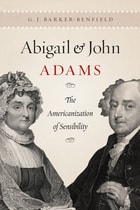
Abigail and John Adams
The Americanization of SensibilityG. J. Barker-Benfield
University of Chicago Press, 2010
During the many years that they were separated by the perils of the American Revolution, John and Abigail Adams exchanged hundreds of letters. Writing to each other of public events and private feelings, loyalty and love, revolution and parenting, they wove a tapestry of correspondence that has become a cherished part of American history and literature.
With Abigail and John Adams, historian G. J. Barker-Benfield mines those familiar letters to a new purpose: teasing out the ways in which they reflected—and helped transform—a language of sensibility, inherited from Britain but, amid the revolutionary fervor, becoming Americanized. Sensibility—a heightened moral consciousness of feeling, rooted in the theories of such thinkers as Descartes, Locke, and Adam Smith and including a “moral sense” akin to the physical senses—threads throughout these letters. As Barker-Benfield makes clear, sensibility was the fertile, humanizing ground on which the Adamses not only founded their marriage, but also the “abhorrence of injustice and inhumanity” they and their contemporaries hoped to plant at the heart of the new nation. Bringing together their correspondence with a wealth of fascinating detail about life and thought, courtship and sex, gender and parenting, and class and politics in the revolutionary generation and beyond, Abigail and John Adams draws a lively, convincing portrait of a marriage endangered by separation, yet surviving by the same ideas and idealism that drove the revolution itself.
A feast of ideas that never neglects the real lives of the man and woman at its center, Abigail and John Adams takes readers into the heart of an unforgettable union in order to illuminate the first days of our nation—and explore our earliest understandings of what it might mean to be an American.
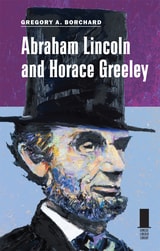
Abraham Lincoln and Horace Greeley
Gregory A. Borchard
Southern Illinois University Press, 2011
Borchard begins with an overview of the lives of both Lincoln and Greeley, delving particularly into their mutual belief in Henry Clay’s much-debated American System, and investigating the myriad similarities between the two political giants, including their comparable paths to power and their statuses as self-made men, their reputations as committed reformers, and their shared dedication to social order and developing a national infrastructure. Also detailed are Lincoln’s and Greeley’s personal quests to end slavery in the United States, as well as their staunch support of free-soil homesteads in the West.
Yet despite their ability to work together productively, both men periodically found themselves on opposite ends of the political spectrum. Their by turns harmonious and antagonistic relationship often played out on the front pages of Greeley’s influential newspaper, the New York Tribune. Drawing upon historical gems from the Tribune, as well as the personal papers of both Lincoln and Greeley, Borchard explores in depth the impact the two men had on their times and on each other, and how, as Lincoln’s and Greeley’s paths often crossed—and sometimes diverged—they personified the complexities, virtues, contradictions, and faults of their eras.
Abraham Lincoln and Horace Greeley goes beyond tracing each man’s personal and political evolution to offer a new perspective on the history-changing events of the times, including the decline of the Whig Party and the rise of the Republicans, the drive to extend American borders into the West; and the bloody years of the Civil War. Borchard finishes with reflections on the deaths of Lincoln and Greeley and how the two men have been remembered by subsequent generations.
Sure to become an essential volume in the annals of political history and journalism, Abraham Lincoln and Horace Greeley is a compelling testament to the indelible mark these men left on both their contemporaries and the face of America’s future.
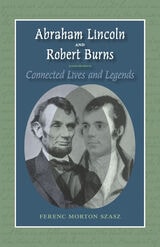
Abraham Lincoln and Robert Burns
Connected Lives and LegendsFerenc Morton Szasz
Southern Illinois University Press, 2008
Today the images of Robert Burns and Abraham Lincoln are recognized worldwide, yet few are aware of the connection between the two. In Abraham Lincoln and Robert Burns: Connected Lives and Legends, author Ferenc Morton Szasz reveals how famed Scots poet Robert Burns—and Scotland in general—influenced the life and thought of one of the most beloved and important U.S. presidents and how the legends of the two men became intertwined after their deaths. This is the first extensive work to link the influence, philosophy, and artistry of these two larger-than-life figures.
Lacking a major national poet of their own in the early nineteenth century, Americans in the fledgling frontier country ardently adopted the poignant verses and songs of Scotland’s Robert Burns. Lincoln, too, was fascinated by Scotland’s favorite son and enthusiastically quoted the Scottish bard from his teenage years to the end of his life. Szasz explores the ways in which Burns’s portrayal of the foibles of human nature, his scorn for religious hypocrisy, his plea for nonjudgmental tolerance, and his commitment to social equality helped shape Lincoln’s own philosophy of life. The volume also traces how Burns’s lyrics helped Lincoln develop his own powerful sense of oratorical rhythm, from his casual anecdotal stories to his major state addresses.
Abraham Lincoln and Robert Burns connects the poor-farm-boy upbringings, the quasi-deistic religious views, the shared senses of destiny, the extraordinary gifts for words, and the quests for social equality of two respected and beloved world figures. This book is enhanced by twelve illustrations and two appendixes, which include Burns poems Lincoln particularly admired and Lincoln writings especially admired in Scotland.
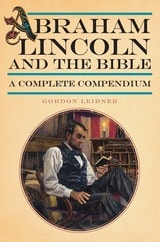
Abraham Lincoln and the Bible
A Complete CompendiumGordon Leidner
Southern Illinois University Press, 2023
How did Abraham Lincoln’s lifelong study of scripture influence him as a man and, ultimately, as president? Historian Gordon Leidner believes the impact was profound—more than previously recognized—and has investigated all the known writings of Abraham Lincoln to identify, catalog, and study every instance in which Lincoln quoted from or alluded to the Bible. Rather than dwelling on the never-ending debate about Lincoln’s religious beliefs, Leidner shows how scripture affected Lincoln personally, professionally, and politically.
Leidner offers first a short biography that focuses on Lincoln’s use of the Bible, how it shaped him as a person, how its influence changed over time, and how biblical quotations peppered his letters, speeches, and conversations. The book concludes with an unparalleled appendix that tabulates nearly 200 instances of Lincoln’s quoting from or alluding to scripture, giving locators for the Bible and Roy P. Basler’s nine volume Collected Works of Abraham Lincoln and quotations from both sources. The appendix also includes when and where Lincoln used each quote, providing valuable context, whether the use was in personal letters such as one to Queen Victoria after the death of Prince Albert, political speeches such as the Gettysburg Address, or state addresses such as the Second Inaugural Address.
By showcasing Lincoln’s specific biblical references and influences, Leidner reframes the question of Lincoln’s religious beliefs so that readers may evaluate for themselves what solace and guidance the Bible afforded the sixteenth president.
Abraham Lincoln and the Forge of National Memory
Barry Schwartz
University of Chicago Press, 2000
Schwartz draws on a wide array of materials—painting and sculpture, popular magazines and school textbooks, newspapers and oratory—to examine the role that Lincoln's memory has played in American life. He explains, for example, how dramatic funeral rites elevated Lincoln's reputation even while funeral eulogists questioned his presidential actions, and how his reputation diminished and grew over the next four decades. Schwartz links transformations of Lincoln's image to changes in the society. Commemorating Lincoln helped Americans to think about their country's development from a rural republic to an industrial democracy and to articulate the way economic and political reform, military power, ethnic and race relations, and nationalism enhanced their conception of themselves as one people.
Lincoln's memory assumed a double aspect of "mirror" and "lamp," acting at once as a reflection of the nation's concerns and an illumination of its ideals, and Schwartz offers a fascinating view of these two functions as they were realized in the commemorative symbols of an ever-widening circle of ethnic, religious, political, and regional communities. The first part of a study that will continue through the present, Abraham Lincoln and the Forge of National Memory is the story of how America has shaped its past selectively and imaginatively around images rooted in a real person whose character and achievements helped shape his country's future.
Abraham Lincoln in the Post-Heroic Era
History and Memory in Late Twentieth-Century AmericaBarry Schwartz
University of Chicago Press, 2008
Abraham Lincoln, Philosopher Statesman
Joseph R. Fornieri
Southern Illinois University Press, 2014
2015 ISHS Superior Achievement Award
What constitutes Lincoln’s political greatness as a statesman? As a great leader, he saved the Union, presided over the end of slavery, and helped to pave the way for an interracial democracy. His great speeches provide enduring wisdom about human equality, democracy, free labor, and free society. Joseph R. Fornieri contends that Lincoln’s political genius is best understood in terms of a philosophical statesmanship that united greatness of thought and action, one that combined theory and practice. This philosophical statesmanship, Fornieri argues, can best be understood in terms of six dimensions of political leadership: wisdom, prudence, duty, magnanimity, rhetoric, and patriotism. Drawing on insights from history, politics, and philosophy, Fornieri tackles the question of how Lincoln’s statesmanship displayed each of these crucial elements.
Providing an accessible framework for understanding Lincoln’s statesmanship, this thoughtful study examines the sixteenth president’s political leadership in terms of the traditional moral vision of statecraft as understood by epic political philosophers such as Aristotle and St. Thomas Aquinas. Fornieri contends that Lincoln’s character is best understood in terms of Aquinas’s understanding of magnanimity or greatness of soul, the crowning virtue of statesmanship. True political greatness, as embodied by Lincoln, involves both humility and sacrificial service for the common good. The enduring wisdom and timeless teachings of these great thinkers, Fornieri shows, can lead to a deeper appreciation of statesmanship and of its embodiment in Abraham Lincoln.
With the great philosophers and books of western civilization as his guide, Fornieri demonstrates the important contribution of normative political philosophy to an understanding of our sixteenth president. Informed by political theory that draws on the classics in revealing the timelessness of Lincoln’s example, his interdisciplinary study offers profound insights for anyone interested in the nature of leadership, statesmanship, political philosophy, political ethics, political history, and constitutional law.
Abraham Lincoln, Statesman Historian
Jesse Derber
University of Illinois Press, 2024
Abraham Lincoln drew upon history in his political career and particularly when crafting the rhetorical masterpieces that still resonate in the present day. Jesse Derber explores how Lincoln’s views of the limits of human understanding drove a belief in--and untiring pursuit of--historical truth.
Lincoln embraced the traditional ideas that good history made good statesmanship and that an understanding of the past informed decision-making in the present. Seeing history as a source of wisdom, Lincoln strove for accuracy through a combination of research, reasoning ability, emotional maturity, and a willingness to admit his mistakes and challenge his biases. His philosophy flowed from an idea that authentic history could enlighten people about human nature. Though he revered precedents, Lincoln understood the past could be imperfect, and that progress through change was an ineffable part of building a better nation.
Perceptive and revealing, Abraham Lincoln, Statesman Historian looks at how the Lincoln practiced history and applied its lessons to politics and leadership.
Abraham Lincoln
A BiographyBenjamin P. Thomas. Foreword by Michael Burlingame
Southern Illinois University Press, 1952
Long considered a classic, Benjamin P. Thomas's Abraham Lincoln: A Biography takes an incisive look at one of American history's greatest figures. Originally published in 1952 to wide acclaim, this eloquent account rises above previously romanticized depictions of the sixteenth president to reveal the real Lincoln: a complex, shrewd, and dynamic individual whose exceptional life has long intrigued the public.
Thomas traces the president from his hardscrabble beginnings and early political career, through his years as an Illinois lawyer and his presidency during the Civil War. Although Lincoln is appropriately placed against the backdrop of the dramatic times in which he lived, the author's true focus is on Lincoln the man and his intricate personality. While Thomas pays tribute to Lincoln's many virtues and accomplishments, he is careful not to dramatize a persona already larger than life in the American imagination. Instead he presents a candid and balanced representation that provides compelling insight into Lincoln's true character and the elements that forged him into an extraordinary leader. Thomas portrays Lincoln as a man whose conviction, resourcefulness, and inner strength enabled him to lead the nation through the most violent crossroads in its history.
Thomas's direct, readable narrative is concise while losing none of the crucial details of Lincoln's remarkable life. The volume's clarity of style makes it accessible to beginners, but it is complex and nuanced enough to interest longtime Lincoln scholars. After more than half a century, Abraham Lincoln: A Biography is still an essential source for anyone interested in learning more about the many facets of the sixteenth president, and it remains the definitive single-volume work on the life of an American legend.
Abraham Lincoln
The Observations of John G. Nicolay and John HayEdited by Michael Burlingame
Southern Illinois University Press, 2007
Editor Michael Burlingame sifted through the original forty-seven-hundred-page work and selected only the personal observations of the secretaries during the Lincoln presidency, placing ten excerpts in chronological order in Abraham Lincoln: The Observations of John G. Nicolay and John Hay. The result is an important collection of Nicolay and Hay’s interpretations of Lincoln’s character, actions, and reputation, framed by Burlingame’s compelling preface, introduction, chapter introductions, and notes. The volume provides vivid descriptions of such events as Election Day in 1860, the crisis at Fort Sumter, the first major battle of the war at Bull Run, and Lincoln’s relationship with Edwin Stanton and George McClellan.
In this clear and captivating new work, Burlingame has made key portions of Nicolay and Hay’s immense biography available to a wide audience of today’s readers.
Abraham Lincoln’s Statesmanship and the Limits of Liberal Democracy
Jon D. Schaff
Southern Illinois University Press, 2019
Though Lincoln’s presidency is inextricably linked to the Civil War, and he is best known for his defense of the Union and executive wartime leadership, Lincoln believed that Congress should be at the helm of public policy making. Likewise, Lincoln may have embraced limited government in vague terms, but he strongly supported effective rule of law and distribution of income and wealth. Placing the Lincoln presidency within a deeper and more meaningful historical context, Abraham Lincoln’s Statesmanship and the Limits of Liberal Democracy highlights Lincoln’s significance in the development of American power institutions and social movement politics.
Using Lincoln’s prepresidential and presidential words and actions, this book argues that decent government demands a balance of competing goods and the strong statesmanship that Lincoln exemplified. Instead of relying too heavily on the will of the people and institutional solutions to help prevent tyranny, Jon D. Schaff proposes that American democracy would be better served by a moderate and prudential statesmanship such as Lincoln’s, which would help limit democratic excesses.
Schaff explains how Lincoln’s views on prudence, moderation, natural rights, and economics contain the notion of limits, then views Lincoln’s political and presidential leadership through the same lens. He compares Lincoln’s views on governmental powers with the defense of unlimited government by twentieth-century progressives and shows how Lincoln’s theory of labor anticipated twentieth-century distributist economic thought. Schaff’s unique exploration falls squarely between historians who consider Lincoln a protoprogressive and those who say his presidency was a harbinger of industrialized, corporatized America.
In analyzing Lincoln’s approach, Abraham Lincoln’s Statesmanship and the Limits of Liberal Democracy rejects the idea he was a revolutionary statesman and instead lifts up Lincoln’s own affinity for limited presidential power, making the case for a modest approach to presidential power today based on this understanding of Lincoln’s statesmanship. As a counterpoint to the contemporary landscape of bitter, uncivil politics, Schaff points to Lincoln’s statesmanship as a model for better ways of engaging in politics in a democracy.
Abraham among the Yankees
Lincoln's 1848 Visit to MassachusettsWilliam F. Hanna
Southern Illinois University Press, 1983
Hanna provides excellent context on the politics of the era, particularly the question of slavery, both in Massachusetts and nationwide, and he features the people Lincoln met and the cities or towns in which he spoke. Lincoln stumped for Taylor in Worcester, New Bedford, Boston, Lowell, Dorchester, Chelsea, Dedham, Cambridge, and Taunton. He gave twelve speeches in eleven days to audiences who responded with everything from catcalls to laughter to applause. Whatever they thought of Lincoln’s arguments, those who saw him were impressed by his unusual western style and remembered his style more than the substance of his talks.
Meticulously researched, Abraham among the Yankees invites readers to take an East Coast journey with a thirty-nine-year-old Lincoln during election season in 1848 to see how Massachusetts audiences responded to the humorous, informal approach that served Lincoln well during the rest of his political career.
Abraham and Mary Lincoln
Kenneth J. Winkle
Southern Illinois University Press, 2011
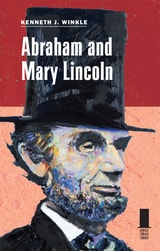
When the awkward but ambitious Lincoln landed Mary Todd, people were surprised by their seeming incompatibility. Lincoln, lacking in formal education and social graces, came from the world of hardscrabble farmers on the American frontier. Mary, by contrast, received years of schooling and came from an established, wealthy, slave-owning family. Yet despite the social gulf between them, these two formidable personalities forged a bond that proved unshakable during the years to come. Mary provided Lincoln with the perfect partner in ambition—one with connections, political instincts, and polish. For Mary, Lincoln was her “diamond in the rough,” a man whose ungainly appearance and background belied a political acumen to match her own.
While each played their role in the marriage perfectly— Lincoln doggedly pursuing success and Mary hosting lavish political soirées—their partnership was not without contention. Mary—once described as “the wildcat of her age”—frequently expressed frustration with the limitations placed on her by Victorian social strictures, exhibiting behavior that sometimes led to public friction between the couple. Abraham’s work would at times keep him away from home for weeks, leaving Mary alone in Springfield.
The true test of the Lincolns’ dedication to each other began in the White House, as personal tragedy struck their family and civil war erupted on American soil. The couple faced controversy and heartbreak as the death of their young son left Mary grief-stricken and dependent upon séances and spiritualists; as charges of disloyalty hounded the couple regarding Mary’s young sister, a Confederate widow; and as public demands grew strenuous that their son Robert join the war. The loss of all privacy and the constant threat of kidnapping and assassination took its toll on the entire family. Yet until a fateful night in the Ford Theatre in 1865, Abraham and Mary Lincoln stood firmly together—he as commander-in-chief during America’s gravest military crisis, and she as First Lady of a divided country that needed the White House to emerge as a respected symbol of national unity and power.
Despite the challenges they faced, the Lincolns’ life together fully embodied the maxim engraved on their wedding bands: love is eternal. Abraham and Mary Lincoln is a testament to the power of a stormy union that held steady through the roughest of seas.
Afonso Costa
PortugalFilipe Ribeiro de Meneses
Haus Publishing, 2010

African Leaders of the Twentieth Century
Biko, Selassie, Lumumba, SankaraLindy Wilson
Ohio University Press, 2015
Aleksandur Stamboliiski
BulgariaRichard Crampton
Haus Publishing, 2009
America’s Hardscrabble General
Ulysses S. Grant, from Farm Boy to ShilohJack Hurst
Southern Illinois University Press, 2022
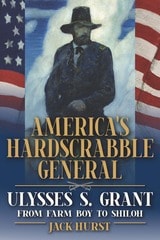
Renowned for his skill, courage, and indomitability during the Civil War, Ulysses S. Grant is considered a model for outstanding American generalship. However, unlike most of his fellow officers, Grant came from humble Midwestern beginnings and experienced a number of professional failures before rising to military prominence.
Grant grew up on a farm on the Ohio frontier and reluctantly attended West Point, where he finished in the middle of his class. In his early army career, he was often underestimated by his peers despite valiant service. After the Mexican War Grant’s “Hardscrabble” farm outside St. Louis failed, and when he decided to rejoin the U.S. army, he was given the unenviable command of a rowdy volunteer regiment, the 21st Illinois.
How did Grant—an average student, failed farmer, and common man—turn the 21st Illinois into a showcase regiment and become a successful general? In this engaging analysis, Jack Hurst argues that Grant’s military brilliance stemmed not from his West Point education but rather from his roots in America’s lower middle class and its commonsense values. His upbringing in the antebellum rural Midwest undergirded his military skill and helped him develop an innate humility, sense of justice, and ability to focus, leading him to form close relationships with his men.
Through a detailed account of Grant’s early years, from boyhood through the Battle of Shiloh, Hurst explores how Grant’s modest start and experiences in the Mexican War prefigured his greatest military triumphs. Ultimately Grant abandoned the traditional military practice of his time, which relied upon maneuver, and instead focused on fighting. His strategy to always move forward, win or lose, turned even his losses into essential elements of victory and characterized the aggressive, relentless approach that would ultimately win the Civil War and save the Union.
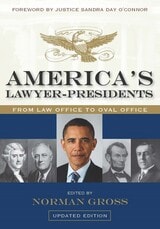
America’s Lawyer-Presidents
From Law Office to Oval OfficeNorman Gross
Northwestern University Press, 2009
The historic election of Barack Obama was rife with references to Abraham Lincoln, perhaps the greatest lawyer-president, whose legal career spanned 25 years and 5,100 cases. President Obama’s ties to Lincoln are part of a great tradition begun by John Adams, the first lawyer-president, who combined a twenty-year law practice with major contributions to our nation’s founding charters. His son, John Quincy Adams, argued landmark U.S. Supreme Court cases both before and after his presidency, one of eight lawyer-presidents to appear as counsel before the highest court in the land. And Rutherford B. Hayes and Benjamin Harrison were among those lawyer-presidents who handled notable high-profile cases, including sensational murder trials.
These are but a few of the fascinating—yet still largely unknown—stories about America’s lawyer-presidents. Now available in an updated, expanded paperback edition, America’s Lawyer-Presidents sheds light on the legal backgrounds of each of these chief executives and how their experiences as lawyers impacted and shaped their presidencies. Written by historians and presidential scholars and featuring an engaging and image-rich presentation, America’s Lawyer-Presidents provides unique insights into our national leaders and their lives and times, from colonial days to the present.
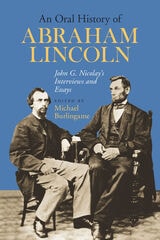
An Oral History of Abraham Lincoln
John G. Nicolay's Interviews and EssaysEdited by Michael Burlingame
Southern Illinois University Press, 2006
John C. Nicolay, who had known Lincoln in Springfield, Illinois, served as chief White House secretary from 1861 to 1865. Trained as a journalist, Nicolay had hoped to write a campaign biography of Lincoln in 1860, a desire that was thwarted when an obscure young writer named William Dean Howells got the job. Years later, however, Nicolay fulfilled his ambition; with John Hay, he spent the years from 1872 to 1890 writing a monumental ten-volume biography of Lincoln.
In preparation for this task, Nicolay interviewed men who had known Lincoln both during his years in Springfield and later when he became the president of the United States. "When it came time to write their massive biography, however," Burlingame notes, "he and Hay made sparing use of the interviews" because they had become "skeptical about human memory." Nicolay and Hay also feared that Robert Todd Lincoln might censor material that reflected "poorly on Lincoln or his wife."
Nicolay had interviewed such Springfield friends as Lincoln’s first two law partners, John Todd Stuart and Stephen T. Logan. At the Illinois capital in June and July 1875, he talked to a number of others including Orville H. Browning, U.S. senator and Lincoln’s close friend and adviser for over thirty-five years, and Ozias M. Hatch, Lincoln’s political ally and Springfield neighbor. Four years later he returned briefly and spoke with John W. Bunn, a young political "insider" from Springfield at the time Lincoln was elected president, and once again with Hatch.
Browning shed new light on Lincoln’s courtship and marriage, telling Nicolay that Lincoln often told him "that he was constantly under great apprehension lest his wife should do something which would bring him into disgrace" while in the White House. During their research, Nicolay and Hay also learned of Lincoln’s despondency and erratic behavior following his rejection by Matilda Edwards, and they were subsequently criticized by friends for suppressing the information. Burlingame argues that this open discussion of Lincoln’s depression of January 1841 is "perhaps the most startling new information in the Springfield interviews."
Briefer and more narrowly focused than the Springfield interviews, the Washington interviews deal with the formation of Lincoln’s cabinet, his relations with Congress, his behavior during the war, his humor, and his grief. In a reminiscence by Robert Todd Lincoln, for example, we learn of Lincoln’s despair at General Lee's escape after the Battle of Gettysburg: "I went into my father’s office ... and found him in [much] distress, his head leaning upon the desk in front of him, and when he raised his head there were evidences of tears upon his face. Upon my asking the cause of his distress he told me that he had just received the information that Gen. Lee had succeeded in escaping across the Potomac river. . ."
To supplement these interviews, Burlingame has included Nicolay’s unpublished essays on Lincoln during the 1860 campaign and on Lincoln’s journey from Springfield to Washington in 1861, essay’s based on firsthand testimony.
An Outdoor Journal
Adventures and ReflectionsJimmy Carter
University of Arkansas Press, 1994
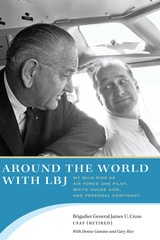
Around the World with LBJ
My Wild Ride as Air Force One Pilot, White House Aide, and Personal ConfidantBy Brigadier General James U. Cross, USAF (retired), with Denise Gamino and Gary Rice
University of Texas Press, 2008
When Lyndon Baines Johnson wanted to go somewhere, there was no stopping him. This dynamic president called for Air Force One as others summon a taxi—at a moment's notice, whatever the hour or the weather. And the man who made sure that LBJ got his ride was General James U. Cross, the president's hand-picked pilot, top military assistant, and personal confidante. One of the few Air Force One pilots to have a position, simultaneously, in the White House, General Cross is also the only member of LBJ's inner circle who has not publicly offered his recollections of the president. In this book, he goes on the record, creating a fascinating, behind-the-scenes portrait of America's complex, often contradictory, always larger-than-life thirty-sixth president.
General Cross tells an engrossing story. In addition to piloting Air Force One around the globe, he served President Johnson in multiple capacities, including directing the Military Office in the White House; managing a secret two-million-dollar presidential emergency fund; supervising the presidential retreat at Camp David, the president's entire transportation fleet, and the presidential bomb shelters; running the White House Mess; hiring White House social aides, including the president's future son-in-law, Charles Robb; and writing condolence letters to the families of soldiers killed in Vietnam. This wide-ranging, around-the-clock access to President Johnson allowed Cross to witness events and share moments that add color and depth to our understanding of America's arguably most demanding and unpredictable president.
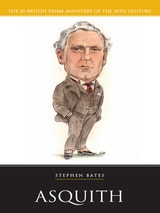
Asquith
Stephen Bates
Haus Publishing, 2006
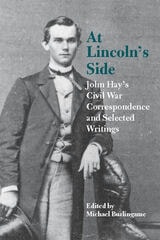
At Lincoln's Side
John Hay's Civil War Correspondence and Selected WritingsEdited by Michael Burlingame
Southern Illinois University Press, 2006
John Hay believed that “real history is told in private letters,” and the more than 220 surviving letters and telegrams from his Civil War days prove that to be true, showing Abraham Lincoln in action: “The Tycoon is in fine whack. I have rarely seen him more serene & busy. He is managing this war, the draft, foreign relations, and planning a reconstruction of the Union, all at once. I never knew with what tyrannous authority he rules the Cabinet, till now. The most important things he decides & there is no cavil.”
Along with Hay’s personal correspondence, Burlingame includes his surviving official letters. Though lacking the “literary brilliance of [Hay’s] personal letters,” Burlingame explains, “they help flesh out the historical record.” Burlingame also includes some of the letters Hay composed for Lincoln’s signature, including the celebrated letter of condolence to the Widow Bixby.
More than an inside glimpse of the Civil War White House, Hay’s surviving correspondence provides a window on the world of nineteenth-century Washington, D.C.
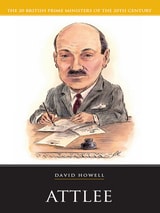
Attlee
David Howell
Haus Publishing, 2006