Results by title
288 books match the query 'Rise' and 19 start with a
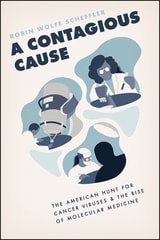
A Contagious Cause
The American Hunt for Cancer Viruses and the Rise of Molecular MedicineRobin Wolfe Scheffler
University of Chicago Press, 2019
A Contagious Cause is the first book to trace the century-long hunt for a human cancer virus in America, an effort whose scale exceeded that of the Human Genome Project. The government’s campaign merged the worlds of molecular biology, public health, and military planning in the name of translating laboratory discoveries into useful medical therapies. However, its expansion into biomedical research sparked fierce conflict. Many biologists dismissed the suggestion that research should be planned and the idea of curing cancer by a vaccine or any other means as unrealistic, if not dangerous. Although the American hunt was ultimately fruitless, this effort nonetheless profoundly shaped our understanding of life at its most fundamental levels. A Contagious Cause links laboratory and legislature as has rarely been done before, creating a new chapter in the histories of science and American politics.
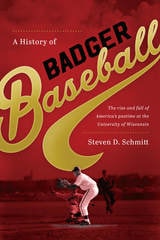
A History of Badger Baseball
The Rise and Fall of America's Pastime at the University of WisconsinSteven D. Schmitt
University of Wisconsin Press, 2017
There is painful history here, too. African Americans played on Wisconsin's first Big Ten championship team in 1902, including team captain Julian Ware, but there were none on the team between 1904 and 1960. Heartbreaking to many fans was the 1991 decision to discontinue baseball as a varsity sport at the university. Today, Wisconsin is the only member of the Big Ten conference without a men's baseball team.
Appendixes provide details of team records and coaches, All Big Ten and All American selections, Badgers in the major leagues, and Badgers in the amateur free-agent draft.
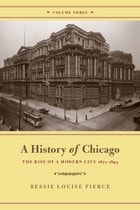
A History of Chicago, Volume III
The Rise of a Modern City, 1871-1893Bessie Louise Pierce
University of Chicago Press, 1957
Originally conceived as a centennial history of Chicago, the project became, under the guidance of renowned historian Bessie Louise Pierce, a definitive, three-volume set describing the city’s growth—from its humble frontier beginnings to the horrors of the Great Fire, the construction of some of the world’s first skyscrapers, and the opulence of the 1893 World’s Fair. Pierce and her assistants spent over forty years transforming historical records into an inspiring human story of growth and survival.
Rich with anecdotal evidence and interviews with the men and women who made Chicago great, all three volumes will now be available for the first time in years. A History of Chicago will be essential reading for anyone who wants to know this great city and its place in America.
“With this rescue of its history from the bright, impressionable newspapermen and from the subscription-volumes, Chicago builds another impressive memorial to its coming of age, the closing of its first ‘century of progress.’”—E. D. Branch, New York Times (1937)
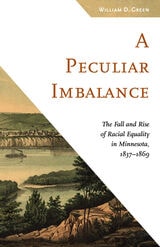
A Peculiar Imbalance
The Fall and Rise of Racial Equality in Minnesota, 1837–1869William D. Green
University of Minnesota Press, 2015
A Peculiar Imbalance is the little-known history of the black experience in Minnesota in the mid-1800s, a time of dramatic change in the region. William D. Green explains how, as white progressive politicians pushed for statehood, black men who had been integrated members of the community, owning businesses and maintaining good relationships with their neighbors, found themselves denied the right to vote or to run for office in those same communities.
As Minnesota was transformed from a wilderness territory to a state, the concepts of race and ethnicity and the distinctions among them made by Anglo-Americans grew more rigid and arbitrary. A black man might enjoy economic success and a middle-class lifestyle but was not considered a citizen under the law. In contrast, an Irish Catholic man was able to vote—as could a mixed-blood Indian—but might find himself struggling to build a business because of the ethnic and religious prejudices of the Anglo-American community. A Peculiar Imbalance examines these disparities, reflecting on the political, social, and legal experiences of black men from 1837 to 1869, the year of black suffrage.
A People Without a State
The Kurds from the Rise of Islam to the Dawn of NationalismBy Michael Eppel
University of Texas Press, 2016
Numbering between 25 and 35 million worldwide, the Kurds are among the largest culturally and ethnically distinct people to remain stateless. A People Without a State offers an in-depth survey of an identity that has often been ignored in mainstream historiographies of the Middle East and brings to life the historical, social, and political developments in Kurdistani society over the past millennium.
Michael Eppel begins with the myths and realities of the origins of the Kurds, describes the effect upon them of medieval Muslim states under Arab, Persian, and Turkish dominance, and recounts the emergence of tribal-feudal dynasties. He explores in detail the subsequent rise of Kurdish emirates, as well as this people’s literary and linguistic developments, particularly the flourishing of poetry. The turning tides of the nineteenth century, including Ottoman reforms and fluctuating Russian influence after the Crimean War, set in motion an early Kurdish nationalism that further expressed a distinct cultural identity. Stateless, but rooted in the region, the Kurds never achieved independence because of geopolitical conditions, tribal rivalries, and obstacles on the way to modernization. A People Without a State captures the developments that nonetheless forged a vast sociopolitical system.
A Philosopher's Economist
Hume and the Rise of CapitalismMargaret Schabas and Carl Wennerlind
University of Chicago Press, 2020
Although David Hume’s contributions to philosophy are firmly established, his economics has been largely overlooked. A Philosopher’s Economist offers the definitive account of Hume’s “worldly philosophy” and argues that economics was a central preoccupation of his life and work. Margaret Schabas and Carl Wennerlind show that Hume made important contributions to the science of economics, notably on money, trade, and public finance. Hume’s astute understanding of human behavior provided an important foundation for his economics and proved essential to his analysis of the ethical and political dimensions of capitalism. Hume also linked his economic theory with policy recommendations and sought to influence people in power. While in favor of the modern commercial world, believing that it had and would continue to raise standards of living, promote peaceful relations, and foster moral refinement, Hume was not an unqualified enthusiast. He recognized many of the underlying injustices of capitalism, its tendencies to promote avarice and inequality, as well as its potential for political instability and absolutism.
Hume’s imprint on modern economics is profound and far-reaching, whether through his close friend Adam Smith or later admirers such as John Maynard Keynes and Friedrich Hayek. Schabas and Wennerlind’s book compels us to reconsider the centrality and legacy of Hume’s economic thought—for both his time and ours—and thus serves as an important springboard for reflections on the philosophical underpinnings of economics.
A Power to Do Justice
Jurisdiction, English Literature, and the Rise of Common LawBradin Cormack
University of Chicago Press, 2008
A Power to Do Justice shows how Renaissance writers engaged the practical and conceptual dynamics of jurisdiction, both as a subject for critical investigation and as a frame for articulating literature’s sense of itself. Reassessing the relation between English literature and law from More to Shakespeare, Cormack argues that where literary texts attend to jurisdiction, they dramatize how boundaries and limits are the very precondition of law’s power, even as they clarify the forms of intensification that make literary space a reality.
Tracking cultural responses to Renaissance jurisdictional thinking and legal centralization, A Power to Do Justice makes theoretical, literary-historical, and methodological contributions that set a new standard for law and the humanities and for the cultural history of early modern law and literature.
A Sacred Kingdom
Bishops and the Rise of Frankish Kingship, 300-850Michael Edward Moore
Catholic University of America Press, 2011
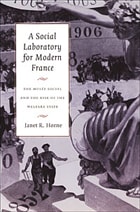
A Social Laboratory for Modern France
The Musée Social and the Rise of the Welfare StateJanet R. Horne
Duke University Press, 2001
Horne explains how Musée founders believed—and convinced others to believe—that the Third Republic would carry out the social mission of the French Revolution and create a new social contract for modern France, one based on the rights of citizenship and that assumed collective responsibility for the victims of social change. Challenging the persistent notion of the Third Republic as the stagnant backwater of European social reform, Horne instead depicts the intellectually sophisticated and progressive political culture of a generation that laid the groundwork for the rise of a hybrid welfare system, characterized by a partnership between private agencies and government. With a focus on the cultural origins of turn-of-the-century thought—including religion, republicanism, liberalism, solidarism, and early sociology—A Social Laboratory for Modern France demonstrates how French reformers grappled with social problems that are still of the utmost relevance today and how they initiated a process that gave the welfare state the task of achieving social cohesion within an industrializing republic.

A Sporting Time
New York City and the Rise of Modern Athletics, 1820-70Melvin L. Adelman
University of Illinois Press, 1986
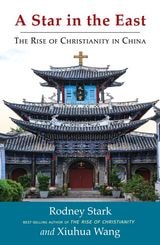
A Star in the East
The Rise of Christianity in ChinaRodney Stark
Templeton Press, 2015
What is the state of Christianity in China? Some scholars say that China is invulnerable to religion. In contrast, others say that past efforts of missionaries have failed, writing off those converted as nothing more than “rice Christians” or cynical souls who had frequented the missions for the benefits they provided. Some wonder if the Cultural Revolution extinguished any chances of Christianity in China.
Rodney Stark and Xiuhua Wang offer a different perspective, arguing that Christianity is alive, well, and on the rise. Stark approaches the topic from an extensive research background in Christianity and Chinese history, and Wang provides an inside look at Christianity and its place in her home country of China. Both authors cover the history of religion in China, disproving older theories concerning the number of Christians and the kinds of Christians that have emerged in the past 155 years. Stark and Wang claim that when just considering the visible Christians—those not part of underground churches—thousands of Chinese are still converted to Christianity daily, and forty new churches are opening each week.
A Star in the East draws on two major national surveys to sketch a close-up of religion in China. A reliable estimate is that by 2007 there were approximately 60 million Christians in China. If the current growth rate were to hold until 2030, there would be more Christians in China—about 295 million—than in any other nation. This trend has significant implications, not just for China but for the greater world order. It is probable that Chinese Christianity will splinter into denominations, likely leading to the same political, social, and economic ramifications seen in the West today.
Whether you’re new to studying Christianity in China or whether this has been your area of interest for years, A Star in the East provides a reliable, thought-provoking, and engaging account of the resilience of the Christian faith in China and the implications it has for the future.
Allies and Rivals
German-American Exchange and the Rise of the Modern Research UniversityEmily J. Levine
University of Chicago Press, 2021
During the nineteenth century, nearly ten thousand Americans traveled to Germany to study in universities renowned for their research and teaching. By the mid-twentieth century, American institutions led the world. How did America become the center of excellence in higher education? And what does that story reveal about who will lead in the twenty-first century?
Allies and Rivals is the first history of the ascent of American higher education seen through the lens of German-American exchange. In a series of compelling portraits of such leaders as Wilhelm von Humboldt, Martha Carey Thomas, and W. E. B. Du Bois, Emily J. Levine shows how academic innovators on both sides of the Atlantic competed and collaborated to shape the research university. Even as nations sought world dominance through scholarship, universities retained values apart from politics and economics. Open borders enabled Americans to unite the English college and German PhD to create the modern research university, a hybrid now replicated the world over.
In a captivating narrative spanning one hundred years, Levine upends notions of the university as a timeless ideal, restoring the contemporary university to its rightful place in history. In so doing she reveals that innovation in the twentieth century was rooted in international cooperation—a crucial lesson that bears remembering today.
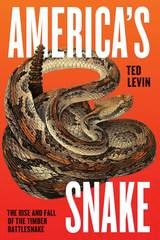
America's Snake
The Rise and Fall of the Timber RattlesnakeTed Levin
University of Chicago Press, 2016
Yet most of us have never seen a timber rattler. Though they’re found in thirty-one states, and near many major cities, in contemporary America timber rattlesnakes are creatures mostly of imagination and innate fear.
Ted Levin aims to change that with America’s Snake, a portrait of the timber rattlesnake, its place in America’s pantheon of creatures and in our own frontier history—and of the heroic efforts to protect it against habitat loss, climate change, and the human tendency to kill what we fear. Taking us from labs where the secrets of the snake’s evolutionary history are being unlocked to far-flung habitats whose locations are fiercely protected by biologists and dedicated amateur herpetologists alike, Levin paints a picture of a fascinating creature: peaceable, social, long-lived, and, despite our phobias, not inclined to bite. The timber rattler emerges here as emblematic of America and also, unfortunately, of the complicated, painful struggles involved in protecting and preserving the natural world.
A wonderful mix of natural history, travel writing, and exemplary journalism, America’s Snake is loaded with remarkable characters—none more so than the snake at its heart: frightening, perhaps; endangered, certainly; and unquestionably unforgettable.
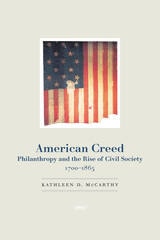
American Creed
Philanthropy and the Rise of Civil Society, 1700-1865Kathleen D. McCarthy
University of Chicago Press, 2003
The market revolution, participatory democracy, and voluntary associations have all been closely linked since the birth of the United States. American Creed explores the relationships among these three institutions, showing how charities and reform associations forged partnerships with government, provided important safety valves for popular discontent, and sparked much-needed economic development. McCarthy also demonstrates how the idea of philanthropy became crucially wedded to social activism during the Jacksonian era. She explores how acts of volunteerism and charity became involved with the abolitionist movement, educational patronage, the struggle against racism, and female social justice campaigns. What resulted, she contends, were heated political battles over the extent to which women and African Americans would occupy the public stage.
Tracing, then, the evolution of civil society and the pivotal role of philanthropy in the search for and exercise of political and economic power, this book will prove essential to anyone interested in American history and government.
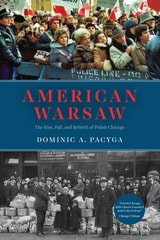
American Warsaw
The Rise, Fall, and Rebirth of Polish ChicagoDominic A. Pacyga
University of Chicago Press, 2019
Every May, a sea of 250,000 people decked out in red and white head to Chicago’s Loop to celebrate the Polish Constitution Day Parade. In the city, you can tune in to not one but four different Polish-language radio stations or jam out to the Polkaholics. You can have lunch at pierogi food trucks or pick up pączkis at the grocery store. And if you’re lucky, you get to take off work for Casimir Pulaski Day. For more than a century, Chicago has been home to one of the largest Polish populations outside of Poland, and the group has had an enormous influence on the city’s culture and politics. Yet, until now, there has not been a comprehensive history of the Chicago Polonia.
With American Warsaw, award-winning historian and Polish American Dominic A. Pacyga chronicles more than a century of immigration, and later emigration back to Poland, showing how the community has continually redefined what it means to be Polish in Chicago. He takes us from the Civil War era until today, focusing on how three major waves of immigrants, refugees, and fortune seekers shaped and then redefined the Polonia. Pacyga also traces the movement of Polish immigrants from the peasantry to the middle class and from urban working-class districts dominated by major industries to suburbia. He documents Polish Chicago’s alignments and divisions: with other Chicago ethnic groups; with the Catholic Church; with unions, politicians, and city hall; and even among its own members. And he explores the ever-shifting sense of Polskość, or “Polishness.”
Today Chicago is slowly being eclipsed by other Polish immigrant centers, but it remains a vibrant—and sometimes contentious—heart of the Polish American experience. American Warsaw is a sweeping story that expertly depicts a people who are deeply connected to their historical home and, at the same time, fiercely proud of their adopted city. As Pacyga writes, “While we were Americans, we also considered ourselves to be Poles. In that strange Chicago ethnic way, there was no real difference between the two.”
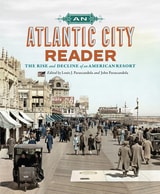
An Atlantic City Reader
The Rise and Decline of an American ResortLouis J. Parascandola
Rutgers University Press, 2026
As Atlantic City grew to become one of the largest tourist destinations on the East Coast, it loomed ever larger in the imaginations of American writers. Generation upon generation of novelists, journalists, musicians, and poets visited Atlantic City and left with vivid impressions of its kaleidoscopic delights and its seedy underbelly.
This new reader collects all of these diverse perspectives on the city in one place, including accounts of Atlantic City by such famous visitors as Walt Whitman, William Carlos Williams, Fanny Hurst, Arthur Conan Doyle, Damon Runyon, Langston Hughes, Elmore Leonard, and Bruce Springsteen. Arranged chronologically, the anthology traces the city’s history from its humble beginnings as a quiet health resort to its rapid ascent to the world’s playground, its gradual decline, and its hopeful if tenuous future. Together, the pieces in this collection take us inside the city’s glitz, glamor, and gambling palaces, but they also don’t shy away from its troubling histories of racial discrimination, political corruption, and urban decay. Compiling fiction, poetry, drama, memoirs, newspaper stories, and magazine reports, The Atlantic City Reader presents an engaging and multifaceted portrait of this iconic resort town.
Anatomy of a Train Wreck
The Rise and Fall of Priming ResearchRuth Leys
University of Chicago Press, 2024
In 2012, a team of Belgian scientists reported that they had been unable to replicate a canonical experiment in the field of psychology known as “priming.” The original experiment, performed by John Bargh in the nineties, had purported to show that words connoting old age unconsciously influenced—or primed—research subjects, causing them to walk more slowly. When subsequent researchers could not replicate these results, Nobel-winning psychologist Daniel Kahneman warned of a “train wreck looming” if Bargh and his colleagues could not address doubts about their work. Since then, the inability to replicate other well-known priming experiments has helped precipitate an ongoing debate over what has gone wrong in psychology, raising fundamental questions about the soundness of research practices in the field.
Anatomy of a Train Wreck offers the first detailed history of priming research from its origins in the early 1980s to its recent collapse. Ruth Leys places priming experiments in the context of contemporaneous debates over not only the nature of automaticity but also the very foundations of social psychology. While these latest discussions about priming have largely focused on methodology—including sloppy experimental practices, inadequate statistical methods, and publication bias—Leys offers a genealogy of the theoretical expectations and scientific paradigms that have guided and motivated priming research itself. Examining scientists’ intellectual strategies, their responses to criticism, and their assumptions about the nature of subjectivity, Anatomy of a Train Wreck raises crucial questions about the evidence surrounding unconscious influence and probes the larger stakes of the replication crisis: psychology’s status as a science.
Arkansas’s Gilded Age
The Rise, Decline, and Legacy of Populism and Working-Class ProtestMatthew Hild
University of Missouri Press, 2018
The story of farmer and labor protest in Arkansas during the late nineteenth century offers lessons relevant to contemporary
working-class Americans in what some observers have called the “new Gilded Age.”
Artisan/Practitioners and the Rise of the New Sciences, 1400-1600
Pamela O. Long
Oregon State University Press, 2011