Results by title
3027 books match the query 'Sociology' and 223 start with a
A Century of Violence in a Red City
Popular Struggle, Counterinsurgency, and Human Rights in ColombiaLesley Gill
Duke University Press, 2016
A City on a Lake
Urban Political Ecology and the Growth of Mexico CityMatthew Vitz
Duke University Press, 2018
A Civil Economy
Transforming the Marketplace in the Twenty-First CenturySeveryn T. Bruyn
University of Michigan Press, 2000
A Community Guide to Social Impact Assessment
Fourth EditionRabel J. Burdge
University Press of Colorado, 2018
A Concise Field Guide to Post-Communist Regimes
Actors, Institutions, and DynamicsBálint Madlovics
Central European University Press, 2022
While the literature of hybrid regimes has given up the presumption that post-communist countries must democratize, its language and concepts still mostly relate to Western democracies. Magyar and Madlovics strongly argue for a vocabulary and grammar tailored to the specifics of the region. In 120 theses they unfold a conceptual framework with (1) a typology of post-communist regimes and (2) a detailed presentation of ideal-type actors and the political, economic, and social phenomena in these regimes. The book is a more digestible companion to the 800-page The Anatomy of Post-Communist Regimes (CEU Press, 2020), which was a detailed theoretical study with plenty of empirical illustrations.
Each of the 120 theses contains a statement and its concise discussion supported by illustrative tables, figures, and QR-codes that connect the interested reader to the more detailed analysis in the Anatomy. In a condensed variety, this book has kept the holistic approach of the Anatomy and treats the spheres of political, market, and communal action as parts of a single, coherent whole. The endeavor to synthesize a vast range of ideas does not, however, result in a too complicated text. On the contrary, freed from the implicit presumptions of democracy theory, the new terminology yields a readily usable toolkit of unambiguous means of expression to speak about post-communism.
A Contest without Winners
How Students Experience Competitive School ChoiceKate Phillippo
University of Minnesota Press, 2019
Seeing the consequences of competitive school choice policy through students’ eyes
While policymakers often justify school choice as a means to alleviate opportunity and achievement gaps, an unanticipated effect is increased competition over access to coveted, high-performing schools. In A Contest without Winners, Kate Phillippo follows a diverse group of Chicago students through the processes of researching, applying to, and enrolling in public high school. Throughout this journey, students prove themselves powerful policy actors who carry out and redefine competitive choice.
Phillippo’s work amplifies the voices of students—rather than the parents, educators, public intellectuals, and policymakers who so often inform school choice research—and investigates how students interact with and emerge from competitive choice academically, developmentally, and civically. Through students’ experiences, she shows how competitive choice legitimates and exacerbates existing social inequalities; collides with students’ developmental vulnerability to messages about their ability, merit, and potential; and encourages young people’s individualistic actions as they come to feel that they must earn their educational rights. From urban infrastructure to income inequality to racial segregation, Phillippo examines the factors that shape students’ policy enactment and interpretation, as policymakers and educators ask students to compete for access to public resources.
With competitive choice, even the winners—the lucky few admitted to their dream schools—don’t outright win. A Contest without Winners challenges meritocratic and market-driven notions of opportunity creation for young people and raises critical questions about the goals we have for public schooling.
A Contested Borderland
Competing Russian and Romanian Visions of Bessarabia in the Second Half of the 19th and Early 20th CenturyAndrei Cusco
Central European University Press, 2017

A Critical Dictionary of Sociology
Raymond Boudon and François Bourricaud
University of Chicago Press, 1989
A Critical Synergy
Race, Decoloniality, and World CrisesMeghji, Ali
Temple University Press, 2023
The differences between decolonial thought and CRT, Meghji insists, does not necessarily imply one approach is stronger. Rather, he asserts, they often provide alternative but not incompatible viewpoints of the same social problem. Meghji presents case studies of capitalism, the COVID-19 pandemic, climate crisis, and twenty-first-century far-right populism to show that with both theories, we can understand more, as insights may be lost by using only one.
Meghji is not calling for a universal theoretical synthesis in A Critical Synergy, but rather a practice that can help open sociology and social science to the tradition of pluriversality much more broadly.
A Day in "The Hole"
Risk, Loss, and Excess in Downtown LimaDaniella Gandolfo
University of Chicago Press, 2025
A single day in a semilegal market in Lima, Peru, reveals a social world that defies conventional economic logic.
In the heart of Lima’s historic center, the markets of El Hueco (“The Hole”) and sprawling Mesa Redonda pulse with life, with thousands of vendors selling everything from knockoff electronics to religious icons. In A Day in “The Hole,” anthropologist Daniella Gandolfo immerses readers in a single, tumultuous day—the thirty-fourth anniversary of a vendors’ cooperative—while examining the dynamics that sustain these marketplaces.
Through a blend of cinematic storytelling and incisive anthropological insight, Gandolfo reveals a world with its own unique codes. She inspects how vendors embrace expenditure over profit and instability over order, and moving through the sights and sounds of El Hueco and Mesa Redonda, she finds a dissident economy that is as much about survival as it is about spectacle. Gandolfo redefines how we think about urban economies and the unexpected ways these defiant communities thrive in this textured portrait of Lima’s markets and the people who animate them.
A Faith Of Our Own
Second-Generation Spirituality in Korean American ChurchesKim, Sharon
Rutgers University Press, 2010
A Faith of Our Own investigates the development and growth of these houses of worship, a recent and rapidly increasing phenomenon in major cities throughout the United States.
Immigration historians have depicted the second-generation as a transitional generation--on the steady march toward the inevitable decline of ethnic identity and allegiance. Sharon Kim suggests an alternative path. By harnessing religion and innovatively creating hybrid religious institutions, second-generation Korean Americans are assertively defining and shaping their own ethnic and religious futures. Rather than assimilating into mainstream American evangelical churches or inheriting the churches of their immigrant parents, second-generation pastors are creating their own hybrid third space--new autonomous churches that are shaped by multiple frames of reference.
Including data gathered over ten years at twenty-two churches, A Faith of Our Own is the most comprehensive study of this topic that addresses generational, identity, political, racial, and empowerment issues.
A Fatal Drifting Apart
Democratic Social Knowledge and Chicago ReformLaura M. Westhoff
The Ohio State University Press, 2007
A Fatal Drifting Apart: Democratic Social Knowledge and Chicago Reform explores the efforts of diverse groups within Chicago during the Progressive Era. This backdrop of industrialization, emerging classes, and ethnic and racial pluralism frequently riven with class conflict set the stage on which Chicago reformers took up the seemingly impossible challenge of enacting democracy. Laura M. Westhoff examines historic events and well-known individuals of the period and brings them together in an unusual framework that offers a new perspective on the reorientation of knowledge, civic identity, and democratic culture at the dawn of the twentieth century, which she terms democratic social knowledge. The book raises important questions that continue to resonate: In a democracy, who has the power to define social problems and offer solutions, and whose experience and knowledge are seen as legitimate?
A Foreign Kingdom
Mormons and Polygamy in American Political Culture, 1852-1890Christine Talbot
University of Illinois Press, 2013
A Genealogy of Manners
Transformations of Social Relations in France and England from the Fourteenth to the Eighteenth CenturyJorge Arditi
University of Chicago Press, 1998
Analyzing courtesy manuals and etiquette books from the thirteenth to the eighteenth century, Arditi shows how the dominant classes of a society were able to create a system of social relations and put it into operation. The result was an infrastructure in which these classes could successfully exert power. He explores how the ecclesiastical authorities of the Middle Ages, the monarchies from the fifteenth through the seventeenth century, and the aristocracies during the early stages of modernity all forged their own codes of manners within the confines of another, dominant order. Arditi goes on to describe how each of these different groups, through the sustained deployment of their own forms of relating with one another, gradually moved into a position of dominance.
A Good Place to Do Business
The Politics of Downtown Renewal since 1945Roger Biles and Mark H. Rose
Temple University Press, 2022
The “Pittsburgh Renaissance,” an urban renewal effort launched in the late 1940s, transformed the smoky rust belt city’s downtown. Working-class residents and people of color saw their neighborhoods cleared and replaced with upscale, white residents and with large corporations housed in massive skyscrapers. Pittsburgh’s Renaissance’s apparent success quickly became a model for several struggling industrial cities, including St. Louis, Cleveland, Detroit, Chicago, and Philadelphia.
In A Good Place to Do Business, Roger Biles and Mark Rose chronicle these urban “makeovers” which promised increased tourism and fashionable shopping as well as the development of sports stadiums, convention centers, downtown parks, and more. They examine the politics of these government-funded redevelopment programs and show how city politics (and policymakers) often dictated the level of success.
As city officials and business elites determined to reorganize their downtowns, a deeply racialized politics sacrificed neighborhoods and the livelihoods of those pushed out. Yet, as A Good Place to Do Business demonstrates, more often than not, costly efforts to bring about the hoped-for improvements failed to revitalize those cities, or even their downtowns.
A Good Reputation
How Residents Fight for an American BarrioElizabeth Korver-Glenn and Sarah Mayorga
University of Chicago Press, 2024
Neighborhoods have the power to form significant parts of our worlds and identities. A neighborhood’s reputation, however, doesn’t always match up to how residents see themselves or wish to be seen. The distance between residents’ desires and their environment can profoundly shape neighborhood life.
In A Good Reputation, sociologists Elizabeth Korver-Glenn and Sarah Mayorga delve into the development and transformation of the reputation of Northside, a predominantly Latinx barrio in Houston. Drawing on two years of ethnographic research and in-depth interviews with residents, developers, and other neighborhood stakeholders, the authors show that people’s perceptions of their neighborhoods are essential to understanding urban inequality and poverty. Korver-Glenn and Mayorga’s empirically detailed account of disputes over neighborhood reputation helps readers understand the complexity of high-poverty urban neighborhoods, demonstrating that gentrification is a more complicated and irregular process than existing accounts of urban inequality would suggest. Offering insightful theoretical analysis and compelling narrative threads from understudied communities, A Good Reputation will yield insights for scholars of race and ethnicity, urban planning, and beyond.
A Guilted Age
Apologies for the PastAshraf A. H. Rushdy
Temple University Press, 2015
Public apologies have become increasingly common scenes and representative moments in what appears to be a global process of forgiveness. The apology-forgiveness dynamic is familiar to all of us, but what do these rituals of atonement mean when they are applied to political and historical events?
In his timely, topical, and incisive book A Guilted Age, Ashraf Rushdy argues that the proliferation of apologies by politicians, nations, and churches for past events—such as American slavery or the Holocaust—can be understood as a historical phenomenon. In our post–World War II world, Rushdy claims that we live in a “guilted age.”
A Guilted Age identifies the two major forms of apologies—political and historical—and Rushdy defines the dynamics and strategies of each, showing how the evolution of one led to the other. In doing so, he reveals what apology and forgiveness do to the past events they respectively apologize for and forgive—and what happens when they fail.
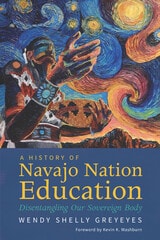
A History of Navajo Nation Education
Disentangling Our Sovereign BodyWendy Shelly Greyeyes; Foreword by Kevin K. Washburn
University of Arizona Press, 2022
On the heels of the fiftieth anniversary of the founding of the Department of Diné Education, this important education history explains how the current Navajo educational system is a complex terrain of power relationships, competing agendas, and jurisdictional battles influenced by colonial pressures and tribal resistance. An iron grip of colonial domination over Navajo education remains, thus inhibiting a unified path toward educational sovereignty. In providing the historical roots to today’s challenges, Wendy Shelly Greyeyes clears the path and provides a go-to reference to move discussions forward.
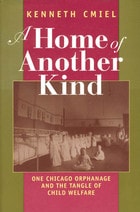
A Home of Another Kind
One Chicago Orphanage and the Tangle of Child WelfareKenneth Cmiel
University of Chicago Press, 1995
The book begins with the fascinating history of the Chicago Nursery and Half-Orphan Asylum from 1860 through 1984, when it became a full-time research institute. Founded by a group of wealthy volunteers, the asylum was a Protestant institution for Protestant children—one of dozens around the country designed as places where single parents could leave their children if they were temporarily unable to care for them.
But the asylum, which later became known as Chapin Hall, changed dramatically over the years as it tried to respond to changing policies, priorities, regulations, and theories concerning child welfare. Cmiel offers a vivid portrait of how these changes affected the day-to-day realities of group living. How did the kind of care given to the children change? What did the staff and management hope to accomplish? How did they define "family"? Who were the children who lived in the asylum? What brought them there? What were their needs? How did outside forces change what went on inside Chapin Hall?
This is much more than a richly detailed account of one institution. Cmiel shatters a number of popular myths about orphanages. Few realize that almost all children living in nineteenth-century orphanages had at least one living parent. And the austere living conditions so characteristic of the orphanage were prompted as much by health concerns as by strict Victorian morals.
A Mad Mess
Community Mental Health in CrisisOwen Whooley
University of Chicago Press, 2026
A sobering assessment of the systematic failures of mental health work.
The United States is in the midst of a mental health crisis that cannot be ignored. Its effects are visible in overcrowded emergency rooms, homeless encampments, and frequent encounters between police and people with serious mental illness. And yet, our attempts to support people with mental illness—from medical care to housing support to basic hygiene—seem to never take meaningful hold despite the tireless work of professionals who attempt to help people bring together the pieces of a life. The problem is not in any individual effort though; it’s in the many ways these programs fail to work together. For those with serious mental illness, and those who work to ameliorate it, there is no system. There is only mess.
In A Mad Mess, sociologist Owen Whooley uncovers the exasperating barriers, bureaucratic mismatches, and threadbare resources that have made a mess of what should be a supportive system. Set in Albuquerque, New Mexico—a city whose struggles echo those of communities nationwide—the book reveals the challenges mental health workers face daily, from tedious paperwork to occasional violence. Whooley follows workers across local outpatient service organizations, specialized police mental health units, and a psychiatric emergency department. Despite mostly good intentions and sometimes heroic efforts, he shows why this important work so often ends in failure.
Written with deep sympathy and unflinching honesty, A Mad Mess reveals how the lack of a cohesive mental health system obstructs critical care and places roadblocks before front-line mental health workers at every turn. Most critically, for those who suffer from severe mental illness, these setbacks are a constant reminder that the institutions charged with helping them have left them on their own.
A Mass Conspiracy to Feed People
Food Not Bombs and the World-Class Waste of Global CitiesDavid Boarder Giles
Duke University Press, 2021
A Mayor for All the People
Kenneth Gibson's NewarkRobert C. Holmes
Rutgers University Press, 2020
In 1970, Kenneth Gibson was elected as Newark, New Jersey’s first African-American mayor, a position he held for an impressive sixteen years. Yet even as Gibson served as a trailblazer for black politicians, he presided over a troubled time in the city’s history, as Newark’s industries declined and its crime and unemployment rates soared.
This book offers a balanced assessment of Gibson’s leadership and his legacy, from the perspectives of the people most deeply immersed in 1970s and 1980s Newark politics: city employees, politicians, activists, journalists, educators, and even fellow big-city mayors like David Dinkins. The contributors include many of Gibson’s harshest critics, as well as some of his closest supporters, friends, and family members—culminating in an exclusive interview with Gibson himself, reflecting on his time in office.
Together, these accounts provide readers with a compelling inside look at a city in crisis, a city that had been rocked by riots three years before Gibson took office and one that Harper’s magazine named “America’s worst city” at the start of his second term. At its heart, it raises a question that is still relevant today: how should we evaluate a leader who faced major structural and economic challenges, but never delivered all the hope and change he promised voters?
A Misfit's Manifesto
The Sociological Memoir of a Rock & Roll HeartGaines, Donna
Rutgers University Press, 2007
Dubbed the Margaret Mead of heavy metal, Donna Gaines is a walking, talking oxymoron, a turnpike intellectual. A Misfit's Manifesto is the story of her wild-in-the-burbs odyssey-from overweight yeshiva girl to savvy street-punk sociologist. Isolated, angry, and depressed through most of her adolescence and early adulthood, she found truth and beauty in the least likely places. Wandering the craggy terrain of Rockaway Beach, Queens, Gaines embarked upon a path to enlightenment involving sex, drugs, rock & roll, sociology, cosmetology, True Love, the occult, tattoos, science fiction, pizza, guns, comic books, and surfing-by Web and by sea.
For Gaines, dignity, joy, and communion came not from family, organized religion, or mandatory schooling, but in the sound of doo-wop, surf music, acid rock, then punk, trash metal, and hardcore. "For most of my life," she writes, "music was the only way to connect that wouldn't eventually kill me."
Through all the ripped nights of binge-drinking, pill-popping, and nightclubbing, Gaines became an acclaimed author, scholar, and expert on teen suicide. In an age of conformity and censorship, she defends popular culture as a powerful spiritual force-a vibrant, valid connection to God. A meditation on alienation and engagement, this memoir is an outcast's journey into the black-hole sun, where Divine love and light are found-even in Ramones songs.
This edition includes a scholarly introduction that considers memoir as a sociological as well as literary genre, as a reflexive means of understanding the self in social context while nurturing a sociological imagination. Social memoir, Gaines argues, illuminates problems like alienation, marginality, addiction, and suicide, while making sociology more user-friendly and public. Now this work of dazzling originality and iconoclasm that has inspired misfits everywhere is an ideal text for classroom use, making complex social theory exciting, timely, and relevant for students.
A Nation of Bookworms?
Czechs as ReadersJirí Trávnícek
Karolinum Press, 2021
A Nation of Neighborhoods
Imagining Cities, Communities, and Democracy in Postwar AmericaBenjamin Looker
University of Chicago Press, 2015
Looker investigates the cultural, social, and political complexities of the idea of “neighborhood” in postwar America and how Americans grappled with vast changes in their urban spaces from World War II to the Reagan era. In the face of urban decline, competing visions of the city neighborhood’s significance and purpose became proxies for broader debates over the meaning and limits of American democracy. By studying the way these contests unfolded across a startling variety of genres—Broadway shows, radio plays, urban ethnographies, real estate documents, and even children’s programming—Looker shows that the neighborhood ideal has functioned as a central symbolic site for advancing and debating theories about American national identity and democratic practice.
A Nation on the Line
Call Centers as Postcolonial Predicaments in the PhilippinesJan M. Padios
Duke University Press, 2018
A Neighborhood That Never Changes
Gentrification, Social Preservation, and the Search for AuthenticityJaponica Brown-Saracino
University of Chicago Press, 2009
Newcomers to older neighborhoods are usually perceived as destructive, tearing down everything that made the place special and attractive. But as A Neighborhood That Never Changes demonstrates, many gentrifiers seek to preserve the authentic local flavor of their new homes, rather than ruthlessly remake them. Drawing on ethnographic research in four distinct communities—the Chicago neighborhoods of Andersonville and Argyle and the New England towns of Provincetown and Dresden—Japonica Brown-Saracino paints a colorful portrait of how residents new and old, from wealthy gay homeowners to Portuguese fishermen, think about gentrification.
The new breed of gentrifiers, Brown-Saracino finds, exhibits an acute self-consciousness about their role in the process and works to minimize gentrification’s risks for certain longtime residents. In an era of rapid change, they cherish the unique and fragile, whether a dilapidated house, a two-hundred-year-old landscape, or the presence of people deeply rooted in the place they live. Contesting many long-standing assumptions about gentrification, Brown-Saracino’s absorbing study reveals the unexpected ways beliefs about authenticity, place, and change play out in the social, political, and economic lives of very different neighborhoods.
A New Conscience and an Ancient Evil
Jane Addams
University of Illinois Press, 2002
Addams offers lurid accounts–-drawn from the records of Chicago's Juvenile Protection Association–-of young women coerced into lives of prostitution by men who lurked outside hotels and sweatshops. Because they lacked funds for proper recreation, Addams argues, poor and socially marginalized women were susceptible to sexual slavery, and without radical social change they would perhaps be "almost as free" as young men. In addition to promoting higher wages and better living conditions, Addams suggests that a longer period of public education for young women would deter them from the dangers of city life.
Despite its appeal to middle–class readers eager for tales of sexual excess and the rape of innocence, the press and prominent intellectuals criticized A New Conscience and an Ancient Evil for being disproportionately hysterical to its philosophical weight. Katherine Joslin's introduction considers the controversial reactions to the book and the circumstances of its publication. Behind the sensationalism of the narratives, Joslin locates themes including the commodification of sex and the importance of marriage for young women.
A New Deal for All?
Race and Class Struggles in Depression-Era BaltimoreAndor Skotnes
Duke University Press, 2012
A New Type of Womanhood
Discursive Politics and Social Change in Antebellum AmericaNatasha Kirsten Kraus
Duke University Press, 2008
Enabling Kraus’s retelling of the 1850s woman’s rights movement is her theory of “structural aporias,” which takes the institutional structures of any particular society as fully imbricated with the force of language. Kraus reads the antebellum relations of womanhood, contract, property, the economy, and the nation as a fruitful site for analysis of the interconnected power of language, culture, and the law. She combines poststructural theory, particularly deconstructive approaches to discourse analysis; the political economic history of the antebellum era; and the interpretation of archival documents, including woman’s rights speeches, petitions, pamphlets, and convention proceedings, as well as state legislative debates, reports, and constitutional convention proceedings. Arguing that her method provides critical insight not only into social movements and cultural changes of the past but also of the present and future, Kraus concludes A New Type of Womanhood by considering the implications of her theory for contemporary feminist and queer politics.
A Nice Place to Visit
Tourism and Urban Revitalization in the Postwar RustbeltAaron Cowan
Temple University Press, 2016
How did tourism gain a central role in the postwar American Rustbelt city? And how did tourism development reshape the meaning and function of these cities? These are the questions at the heart of Aaron Cowan’s groundbreaking book, A Nice Place to Visit.
Cowan provides an insightful, comparative look at the historical development of Cincinnati, St. Louis, Pittsburgh, and Baltimore in the post–World War II period to show how urban tourism provided a potential solution to the economic woes of deindustrialization. A Nice Place to Visit chronicles the visions of urban leaders who planned hotels, convention centers, stadiums, and festival marketplaces to remake these cities as tourist destinations. Cowan also addresses the ever-present tensions between tourist development and the needs and demands of residents in urban communities.
A Nice Place to Visit charts how these Rustbelt cities adapted to urban decline and struggled to meet the challenge of becoming an appealing place to visit, as well as good and just communities in which to live.
A People's History of Detroit
Mark Jay and Philip Conklin
Duke University Press, 2020
A Place at the Multicultural Table
The Development of an American HinduismKurien, Prema
Rutgers University Press, 2007
In A Place at the Multicultural Table, Prema A. Kurien shows how various Hindu American organizations--religious, cultural, and political--are attempting to answer the puzzling questions of identity outside their homeland. Drawing on the experiences of both immigrant and American-born Hindu Americans, Kurien demonstrates how religious ideas and practices are being imported, exported, and reshaped in the process. The result of this transnational movement is an American Hinduism--an organized, politicized, and standardized version of that which is found in India.
This first in-depth look at Hinduism in the United States and the Hindu Indian American community helps readers to understand the private devotions, practices, and beliefs of Hindu Indian Americans as well as their political mobilization and activism. It explains the differences between immigrant and American-born Hindu Americans, how both understand their religion and their identity, and it emphasizes the importance of the social and cultural context of the United States in influencing the development of an American Hinduism.

A Place on the Corner
Elijah Anderson
University of Chicago Press, 1978
A Place to Be
Brazilian, Guatemalan, and Mexican Immigrants in Florida's New DestinationsEdited by Philip J. Williams, Timothy J. Steigenga, and Manuel A. Vásquez
Rutgers University Press, 2009
Contributors to this volume include Patricia Fortuny Loret de Mola, Carol Girón Solórzano, Silvia Irene Palma, Lúcia Ribeiro, Mirian Solfs Lizama, José Claúdio Souza Alves, Timothy J. Steigenga, Manuel A. Vásquez, and Philip J. Williams.
A Poetic for Sociology
Toward a Logic of Discovery for the Human SciencesRichard Harvey Brown
University of Chicago Press, 1989
By recognizing this "aesthetic" common ground between science and art, Brown demonstrates that a fusion can be achieved within the human sciences of these two principal ideals of knowledge—the scientific or positivist one and the artistic or intuitive one. A path, then, is opened for creating a knowledge of ourselves and society which is at once objective and subjective, at once valid scientifically and significantly humane.
A Pound of Flesh
Monetary Sanctions as Punishment for the PoorAlexes Harris
Russell Sage Foundation, 2016
Over seven million Americans are either incarcerated, on probation, or on parole, with their criminal records often following them for life and affecting access to higher education, jobs, and housing. Court-ordered monetary sanctions that compel criminal defendants to pay fines, fees, surcharges, and restitution further inhibit their ability to reenter society. In A Pound of Flesh, sociologist Alexes Harris analyzes the rise of monetary sanctions in the criminal justice system and shows how they permanently penalize and marginalize the poor. She exposes the damaging effects of a little-understood component of criminal sentencing and shows how it further perpetuates racial and economic inequality.
Harris draws from extensive sentencing data, legal documents, observations of court hearings, and interviews with defendants, judges, prosecutors, and other court officials. She documents how low-income defendants are affected by monetary sanctions, which include fees for public defenders and a variety of processing charges. Until these debts are paid in full, individuals remain under judicial supervision, subject to court summons, warrants, and jail stays. As a result of interest and surcharges that accumulate on unpaid financial penalties, these monetary sanctions often become insurmountable legal debts which many offenders carry for the remainder of their lives. Harris finds that such fiscal sentences, which are imposed disproportionately on low-income minorities, help create a permanent economic underclass and deepen social stratification.
A Pound of Flesh delves into the court practices of five counties in Washington State to illustrate the ways in which subjective sentencing shapes the practice of monetary sanctions. Judges and court clerks hold a considerable degree of discretion in the sentencing and monitoring of monetary sanctions and rely on individual values—such as personal responsibility, meritocracy, and paternalism—to determine how much and when offenders should pay. Harris shows that monetary sanctions are imposed at different rates across jurisdictions, with little or no state government oversight. Local officials’ reliance on their own values and beliefs can also push offenders further into debt—for example, when judges charge defendants who lack the means to pay their fines with contempt of court and penalize them with additional fines or jail time.
A Pound of Flesh provides a timely examination of how monetary sanctions permanently bind poor offenders to the judicial system. Harris concludes that in letting monetary sanctions go unchecked, we have created a two-tiered legal system that imposes additional burdens on already-marginalized groups.
A Promise in Haiti
A Reporter's Notes on Families and Daily LivesMark Curnutte
Vanderbilt University Press, 2011
A Promise in Haiti is Curnutte's story of his time, spanning the last decade, living among several families in Gonaives, a city of 200,000 people a hundred kilometers north of Port-au-Prince. He began traveling to Haiti as a volunteer with the aid organization Hands Together, eventually building trust and credibility with many Haitians. Curnutte introduces the reader to the Cenecharles family, strained by entrenched unemployment and the need to continually travel for work. He is invited into the home of the Henrisma family, and is forced to reconcile journalistic detachment with basic compassion as he contributes financially to help them. The reader is confronted with a complicated, conflicted written and photographic record of a worldview that evolves right on the page. As a reporter, Curnutte found parallels between the lives he encountered in Gonaives and the world of the Great Depression recounted in James Agee and Walker Evans's Let Us Now Praise Famous Men. Agee and Evans loom large as a challenge and inspiration to Curnutte.
The result is equal parts homage to that historic chronicle, on-the-ground reporting, and introspective narrative on the lessons Gonaives taught Curnutte about his own life and family. In late February 2010, Curnutte went back to Haiti on assignment, but conditions made it impossible for him to return to Gonaives. The resulting frustration provoked a meditation on the monumental challenges that face Haiti -- and on the destructive cycle of international attention that constantly moves on to "The Next Big Story."

A Psalm for Cottondale
PoemsSharony A. Green
University of Alabama Press, 2026
A lyrical journey through memory, place, and resilience in the heart of Alabama
A Psalm for Cottondale is a lyrical meditation on memory, place, and survival in the American South. Through a sequence of interconnected free-verse poems, Sharony Green reflects on life in Cottondale, Alabama, where change unfolds in ways that can be both poignant and unexpected. Rooted in the histories, landscapes, and cultural currents of an Alabama college town, the collection explores how one place can evoke the memory of many others, inviting readers to consider broader questions of identity, belonging, and endurance.
Written in a clear, steady voice, these poems balance intimacy with historical awareness, allowing inherited stories, silences, and everyday moments to emerge with quiet power. Green’s careful craftsmanship and emotional restraint lend authority to the collection, while a subtle psalmic undercurrent adds spiritual depth without sacrificing nuance. As the poems move through themes of joy, grief, witness, and renewal, Cottondale becomes both a physical community and a symbolic terrain shaped by race, land, memory, and hope.
Inspired by writings that engage history, geography, and culture, A Psalm for Cottondale offers an elegant and deeply attentive reflection on Southern and American life, illuminating the ways people endure, adapt, and find meaning in a changing world. Ideal for readers of contemporary poetry, Southern literature, African American studies, place-based writing, and works that explore history, memory, faith, and community through a lyrical lens.
A Quieter Illness
Narratives, Selves, and SilencesArthur W. Frank
University of Chicago Press, 0
In this sequel to The Wounded Storyteller, Arthur W. Frank reminds us of the power of narrative in the lives of ill people and those who care for them.
The Wounded Storyteller became a classic by witnessing the voices of ill people, recognizing how they express themselves in three prevalent narratives: restitution stories, evocations of chaos, and quest stories. Thirty years later, Frank expands this framework. He proposes a fourth narrative: one that seeks no restitution, claims no quest, yet feels no chaos—the stillness narrative. This story allows us to see more clearly our interdependence as well as the wisdom of uncertainty; it also teaches the value of letting go and waiting.
In the stillness narrative, Frank finds new opportunities for dialogue with clinical professionals. They too need healing, and healing moments occur when everyone recognizes their mutual, if asymmetrical, dependence. As Frank tells the stories that won’t leave him, he guides readers toward understanding how the stories they tell and hear affect their capacity to heal both themselves and others.
A Revolution in Fragments
Traversing Scales of Justice, Ideology, and Practice in BoliviaMark Goodale
Duke University Press, 2019
A Right to Housing
Foundation for a New Social AgendaRachel Bratt
Temple University Press, 2006
The contributors to A Right to Housing consider the key issues related to America's housing crisis, including income inequality and insecurity, segregation and discrimination, the rights of the elderly, as well as legislative and judicial responses to homelessness. The book offers a detailed examination of how access to adequate housing is directly related to economic security.
With essays by leading activists and scholars, this book presents a powerful and compelling analysis of the persistent inability of the U.S. to meet many of its citizens' housing needs, and a comprehensive proposal for progressive change.
A Second Chicago School?
The Development of a Postwar American SociologyEdited by Gary Alan Fine
University of Chicago Press, 1995
Like its predecessor earlier in the century, the postwar department was again the center for qualitative social research—on everything from mapping the nuances of human behavior in small groups to seeking solutions to problems of race, crime, and poverty. Howard Becker, Joseph Gusfield, Herbert Blumer, David Riesman, Erving Goffman, and others created a large, enduring body of work.
In this book, leading sociologists critically confront this legacy. The eight original chapters survey the issues that defined the department's agenda: the focus on deviance, race and ethnic relations, urban life, and collective behavior; the renewal of participant observation as a method and the refinement of symbolic interaction as a guiding theory; and the professional and institutional factors that shaped this generation, including the leadership of Louis Wirth and Everett C. Hughes; the role of women; and the competition for national influence Chicago sociology faced from survey research at Columbia and grand theory at Harvard. The contributors also discuss the internal conflicts that call into question the very idea of a unified "school."
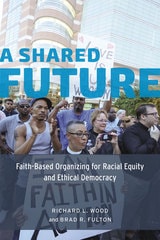
A Shared Future
Faith-Based Organizing for Racial Equity and Ethical DemocracyRichard L. Wood and Brad R. Fulton
University of Chicago Press, 2015
In A Shared Future, Richard L. Wood and Brad R. Fulton draw on a new national study of community organizing coalitions and in-depth interviews of key leaders in this field to show how faith-based organizing is creatively navigating the competing aspirations of America’s universalist and multiculturalist democratic ideals, even as it confronts three demons bedeviling American politics: economic inequality, federal policy paralysis, and racial inequity. With a broad view of the entire field and a distinct empirical focus on the PICO National Network, Wood and Fulton’s analysis illuminates the tensions, struggles, and deep rewards that come with pursuing racial equity within a social change organization and in society. Ultimately, A Shared Future offers a vision for how we might build a future that embodies the ethical democracy of the best American dreams.
An interview of the authors on the subject of faith leaders organizing for justice (Peace Talks Radio, copyright Good Radio Shows, Inc.) can be heard at this link: https://beta.prx.org/stories/190030
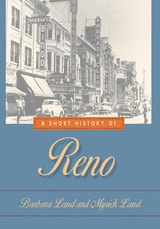
A Short History Of Reno
Barbara Land
University of Nevada Press, 1995
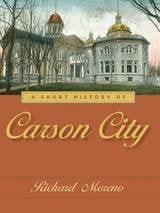
A Short History of Carson City
Richard Moreno
University of Nevada Press, 2011

A Short History of Denver
Stephen J. Leonard
University of Nevada Press, 2016
A Short History of Denver portrays the city’s twentieth-century ups and downs, including the City Beautiful movement, political corruption, the rise of the Ku Klux Klan in the 1920s, and the Great Depression of the 1930s. Here readers will find the meat and potatoes of economic and political history and much more, including sports history, social history, and the history of metropolitan-wide efforts to preserve the past.
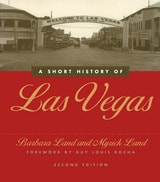
A Short History of Las Vegas
Barbara Land
University of Nevada Press, 2004
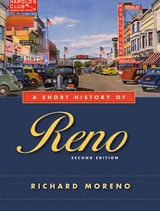
A Short History of Reno, Second Edition
Richard Moreno
University of Nevada Press, 2015
Moreno brings the city’s history up-to-date with coverage of the businesspeople and civic leaders who helped make Reno an attraction that still lures millions of visitors each year. Today’s travelers and residents explore Reno’s flamboyant heart and scenic wonders, topics the author examines in an accessible and lively fashion.
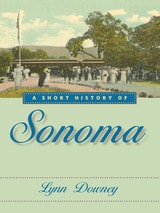
A Short History of Sonoma
Lynn Downey
University of Nevada Press, 2013
The book also addresses such topics as the development of local ranching and businesses and of transportation links to San Francisco that helped to make Sonoma and the surrounding Valley of the Moon a popular location for summer homes and resorts. It discusses the role of the nearby hot springs in attracting visitors and permanent residents, including people seeking cures for various ailments. There are also accounts of some of the famous people who lived in or near Sonoma and helped establish its mystique, including Mexican general Mariano Vallejo, the town’s first leader; Hungarian winemaker Agoston Haraszthy, who first saw the region’s potential for producing superior wines; and writers Jack London and M. F. K. Fisher, who made their homes in the Valley of the Moon, drawn by its beauty and bucolic lifestyle.
A Short History of Sonoma is generously illustrated with vintage photographs. It is a delightful account of one of America’s most charming towns and its evolution from rowdy frontier settlement to the paragon of sophisticated living that it is today.