Results by title
8113 books match the query 'Literary Criticism' and 619 start with a
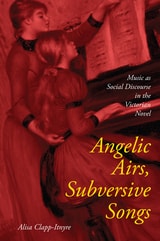
Angelic Airs, Subversive Songs
Music as Social Discourse in the Victorian NovelAlisa Clapp-Itnyre
Ohio University Press, 2027
Music was at once one of the most idealized and one of the most contested art forms of the Victorian period. Yet this vitally important nineteenth-century cultural form has been studied by literary critics mainly as a system of thematic motifs. Angelic Airs, Subversive Songs positions music as a charged site of cultural struggle, promoted concurrently as a transcendent corrective to social ills and as a subversive cause of those ills. Alisa Clapp-Itnyre examines Victorian constructions of music to advance patriotism, Christianity, culture, and domestic harmony, and suggests that often these goals were undermined by political tensions in song texts or “immoral sensuality” in the “spectacle” of live music-making. Clapp-Itnyre turns her focus to the novels of Elizabeth Gaskell, George Eliot, and Thomas Hardy, who present complex engagements with those musical genres most privileged by Victorian society: folk songs, religious hymns, and concert music. Angelic Airs, Subversive Songs recovers the pervasive ambiguities of the Victorian musical period, ambiguities typically overlooked by both literary scholars and musicologists. To the literary critic and cultural historian, Clapp-Itnyre demonstrates the necessity of further exploring the complete aesthetic climate behind some of the Victorian period’s most powerful literary works. And to the feminist scholar and the musicologist, Clapp-Itnyre reveals the complexities of music as both an oppressive cultural force and an expressive, creative outlet for women.
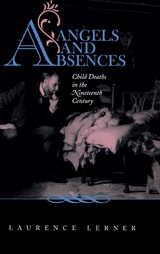
Angels and Absences
Child Deaths in the Nineteenth CenturyLaurence Lerner
Vanderbilt University Press, 1997
What is the difference between public and private feeling, and how far can we deduce past feelings from the words that have been left us? Why do child deaths figure so often and so prominently in the literature of the nineteenth century, and how was the theme of the death of a child used to elicit such poignant responses in the readers of that era? In this fascinating new book, Laurence Lerner vividly contrasts the contempt with which twentieth- century criticism so often dismisses such works as mere sentimentality with the enthusiasm and tears of nineteenth-century contemporaries.
Drawing examples from both real and literary deaths, Lerner delves into the writings of well-known authors such as Dickens, Coleridge, Shelley, Flaubert, Mann, Huxley, and Hesse, as well as lesser known writers like Felicia Hemans and Lydia Sigourney. In the process, he synthesizes fresh ideas about the thorny subjects of sentimentality, aesthetic judgment, and the function of religion in literature.
Lerner's forthright and evocative prose style is enjoyable reading, and he excels in teasing out the moral implications and the psychosocial entanglements of his chosen narrative and lyrical texts. This is a book that will illuminate an important aspect of the history of private life. It should have wide application for those interested in the history, sociology, and literature of the nineteenth century.
Anglo-American Feminist Challenges to the Rhetorical Traditions
Virginia Woolf, Mary Daly, Adrienne RichKrista Ratcliffe
Southern Illinois University Press, 1996
Although women and men have different relationships to language and to each other, traditional theories of rhetoric do not foreground such gender differences. Krista Ratcliffe argues that because feminists generally have not conceptualized their language theories from the perspective of rhetoric and composition studies, rhetoric and composition scholars must construct feminist theories of rhetoric by employing a variety of interwoven strategies: recovering lost or marginalized texts; rereading traditional rhetoric texts; extrapolating rhetorical theories from such nonrhetoric texts as letters, diaries, essays, cookbooks, and other sources; and constructing their own theories of rhetoric.
Focusing on the third option, Ratcliffe explores ways in which the rhetorical theories of Virginia Woolf, Mary Daly, and Adrienne Rich may be extrapolated from their Anglo-American feminist texts through examination of the interrelationship between what these authors write and how they write. In other words, she extrapolates feminist theories of rhetoric from interwoven claims and textual strategies. By inviting Woolf, Daly, and Rich into the rhetorical traditions and by modeling the extrapolation strategy/methodology on their writings, Ratcliffe shows how feminist texts about women, language, and culture may be reread from the vantage point of rhetoric to construct feminist theories of rhetoric. She also outlines the pedagogical implications of these three feminist theories of rhetoric, thus contributing to ongoing discussions of feminist pedagogies.
Traditional rhetorical theories are gender-blind, ignoring the reality that women and men occupy different cultural spaces and that these spaces are further complicated by race and class, Ratcliffe explains. Arguing that issues such as who can talk, where one can talk, and how one can talk emerge in daily life but are often disregarded in rhetorical theories, Ratcliffe rereads Roland Barthes’ "The Old Rhetoric" to show the limitations of classical rhetorical theories for women and feminists. Discovering spaces for feminist theories of rhetoric in the rhetorical traditions, Ratcliffe invites readers not only to question how women have been located as a part of— and apart from—these traditions but also to explore the implications for rhetorical history, theory, and pedagogy.
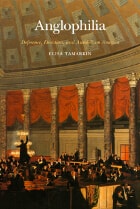
Anglophilia
Deference, Devotion, and Antebellum AmericaElisa Tamarkin
University of Chicago Press, 2008

Anglophone Literatures and Global Culture, Volume 100
Imre Szeman and Susie O’Brien, eds.
Duke University Press, 0
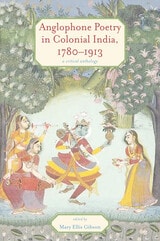
Anglophone Poetry in Colonial India, 1780–1913
A Critical AnthologyMary Ellis Gibson
Ohio University Press, 2011
Anglophone Poetry in Colonial India, 1780–1913: A Critical Anthology makes accessible for the first time the entire range of poems written in English on the subcontinent from their beginnings in 1780 to the watershed moment in 1913 when Rabindranath Tagore won the Nobel Prize in Literature.Mary Ellis Gibson establishes accurate texts for such well-known poets as Toru Dutt and the early nineteenth-century poet Kasiprasad Ghosh. The anthology brings together poets who were in fact colleagues, competitors, and influences on each other. The historical scope of the anthology, beginning with the famous Orientalist Sir William Jones and the anonymous “Anna Maria” and ending with Indian poets publishing in fin-de-siècle London, will enable teachers and students to understand what brought Kipling early fame and why at the same time Tagore’s Gitanjali became a global phenomenon. Anglophone Poetry in Colonial India, 1780–1913 puts all parties to the poetic conversation back together and makes their work accessible to American audiences.With accurate and reliable texts, detailed notes on vocabulary, historical and cultural references, and biographical introductions to more than thirty poets, this collection significantly reshapes the understanding of English language literary culture in India. It allows scholars to experience the diversity of poetic forms created in this period and to understand the complex religious, cultural, political, and gendered divides that shaped them.
Angry Planet
Decolonial Fiction and the American Third WorldAnne Stewart
University of Minnesota Press, 2022
Before the idea of the Anthropocene, there was the angry planet
How might we understand an earthquake as a complaint, or erosion as a form of protest—in short, the Earth as an angry planet? Many novels from the end of the millennium did just that, centering around an Earth that acts, moves, shapes human affairs, and creates dramatic, nonanthropogenic change.
In Angry Planet, Anne Stewart uses this literature to develop a theoretical framework for reading with and through planetary motion. Typified by authors like Colson Whitehead, Octavia Butler, and Leslie Marmon Silko, whose work anticipates contemporary critical concepts of entanglement, withdrawal, delinking, and resurgence, angry planet fiction coalesced in the 1990s and delineated the contours of a decolonial ontology. Stewart shows how this fiction brought Black and Indigenous thought into conversation, offering a fresh account of globalization in the 1990s from the perspective of the American Third World, construing it as the era that first made connections among environmental crises and antiracist and decolonial struggles.
By synthesizing these major intersections of thought production in the final decades of the twentieth century, Stewart offers a recent history of dissent to the young movements of the twenty-first century. As she reveals, this knowledge is crucial to incipient struggles of our contemporary era, as our political imaginaries grapple with the major challenges of white nationalism and climate change denial.
Animal Advocacy and Englishwomen, 1780-1900
Patriots, Nation, and EmpireMoira Ferguson
University of Michigan Press, 1998
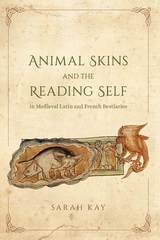
Animal Skins and the Reading Self in Medieval Latin and French Bestiaries
Sarah Kay
University of Chicago Press, 2017
Bestiaries present accounts of animals whose fantastic behaviors should be imitated or avoided, depending on the given trait. In a highly original argument, Kay suggests that the association of beasts with books is here both literal and material, as nearly all surviving bestiaries are copied on parchment made of animal skin, which also resembles human skin. Using a rich array of examples, she shows how the content and materiality of bestiaries are linked due to the continual references in the texts to the skins of other animals, as well as the ways in which the pages themselves repeatedly—and at times, it would seem, deliberately—intervene in the reading process. A vital contribution to animal studies and medieval manuscript studies, this book sheds new light on the European bestiary and its profound power to shape readers’ own identities.
Animal Stories
Narrating across Species LinesSusan McHugh
University of Minnesota Press, 2010
McHugh’s investigations into fictions of people relying on animals in civic and professional life—most obviously those of service animal users and female professional horse riders—showcase distinctly modern and human–animal forms of intersubjectivity. But increasingly graphic violence directed at these figures indicates their ambivalent significance to changing configurations of species.
Reading these developments with narrative adaptations of traditional companion species relations during this period— queer pet memoirs and farm animal fictions—McHugh clarifies the intercorporeal intimacies—the perforations of species boundaries now proliferating in genetic and genomic science—and embeds the representation of animals within biopolitical frameworks.
Animal, Vegetable, Digital
Experiments in New Media Aesthetics and Environmental PoeticsElizabeth Swanstrom
University of Alabama Press, 2016
An audacious, interdisciplinary study that combines the burgeoning fields of digital aesthetics and eco-criticism
In Animal, Vegetable, Digital, Elizabeth Swanstrom makes a confident and spirited argument for the use of digital art in support of ameliorating human engagement with the environment and suggests a four-part framework for analyzing and discussing such applications.
Through close readings of a panoply of texts, artworks, and cultural artifacts, Swanstrom demonstrates that the division popular culture has for decades observed between nature and technology is artificial. Not only is digital technology not necessarily a brick in the road to a dystopian future of environmental disaster, but digital art forms can be a revivifying bridge that returns people to a more immediate relationship to nature as well as their own embodied selves.
To analyze and understand the intersection of digital art and nature, Animal, Vegetable, Digital explores four aesthetic techniques: coding, collapsing, corresponding, and conserving. “Coding” denotes the way artists use operational computer code to blur distinctions between the reader and text, and, hence, the world. Inviting a fluid conception of the boundary between human and technology, “collapsing” voids simplistic assumptions about the human body’s innate perimeter. The process of translation between natural and human-readable signs that enables communication is described as “corresponding.” “Conserving” is the application of digital art by artists to democratize large- and small-scale preservation efforts.
A fascinating synthesis of literary criticism, communications and journalism, science and technology, and rhetoric that draws on such disparate phenomena as simulated environments, video games, and popular culture, Animal, Vegetable, Digital posits that partnerships between digital aesthetics and environmental criticism are possible that reconnect humankind to nature and reaffirm its kinship with other living and nonliving things.
Animate Literacies
Literature, Affect, and the Politics of HumanismNathan Snaza
Duke University Press, 2019
Anna Karenina and Others
Liza Knapp
University of Wisconsin Press, 2018
Knapp provides a series of readings of Anna Karenina that draw on other works that were critical to Tolstoy’s understanding of the interconnectedness of human lives. Among the texts she considers are The Scarlet Letter, a novel of adultery with a divided plot; Middlemarch, a multiplot novel with neighborly love as its ideal; and Blaise Pascal’s Pensées, which fascinated Tolstoy during his own religious crisis. She concludes with a tour-de-force reading of Mrs. Dalloway that shows Virginia Woolf constructing this novel in response to Tolstoy’s treatment of Anna Karenina and others.

Anna Livia Plurabelle
The Making of a ChapterFred Higginson
University of Minnesota Press, 1960
Anna Trapnel’s Report and Plea; or, A Narrative of Her Journey from London into Cornwall
Anna Trapnel
Iter Press, 2016
In 1654, Anna Trapnel — a Baptist, Fifth Monarchist, millenarian, and visionary from London — fell into a trance during which she prophesied passionately and at length against Oliver Cromwell and his government. The prophecies attracted widespread public attention, and resulted in an invitation to travel to Cornwall. Her Report and Plea, republished here for the first time, is a lively and engaging firsthand account of the visit, which concluded in her arrest, a court hearing, and imprisonment. Part memoir, part travelogue, and part impassioned defense of her beliefs and actions, the Report and Plea offers vivid and fascinating insight into the life and times of an early modern woman claiming her place at the center of the tumultuous political events of mid-seventeenth-century England.
Annali d'italianistica
Urban Space and the BodyEdited by Silvia Ross and Giulio Giovannoni
Arizona Center for Medieval and Renaissance Studies, 2019
Anne Carson and the Unknown
Contemporary Perspectives on Poetic ExperimentationEdited by Helena Van Praet and Christine Wiesenthal
University of Michigan Press, 2026
Making art relies on a process of intuitive discovery that begins prior to knowing and overrides intention. Anne Carson and the Unknown delves into the varied ways the contemporary poet and classicist Anne Carson engages with the unknown, both as a philosophical concept and as a method of creative practice. Bringing together various contemporary perspectives, ranging from the world of quantum physics to feminist literary criticism and media studies, this volume considers how contemporary poets like Anne Carson continue to show the relevance of the unknown in our turbulent times of global upheaval.
It covers Carson’s unusual travelogue about the collapse of civilizations and knowledge, positions her oeuvre in the context of a wider debate on post-critique, and reads her work as an engagement with a radically formalist Classics that goes back to ancient Greek’s etymological complexity. Taking an interdisciplinary approach, the volume dives into her work’s ambiguous relationships with trans experience and religion, the centrality of the psychoanalytical concept of the caesura, and her use of figures like Helen of Troy and Herakles. It also discusses the unknown as a visual mechanism in her recent creative collaboration with comics creator Rosanna Bruno. In this way, Carson provides a necessary counter to both Western scientific knowledge’s goals of predictability and rationality, and to the algorithmic certitudes sought by the engineering culture of technologists who prevail today.
Anne’s Bohemia
Czech Literature And Society, 1310-1420Alfred Thomas
University of Minnesota Press, 1998
The first book in English on medieval Czech literature.
Anne’s Bohemia is the first general book in English to introduce the little-known riches of medieval Bohemian culture. Alfred Thomas considers the development of Czech literature and society from the election of Count John of Luxembourg as king of Bohemia in 1310 to the year 1420, when the papacy declared a Catholic crusade against the Hussite reformers. This period is of particular relevance to the study of medieval England because of the marriage of Richard II to Anne of Bohemia, the figure around whom this book is focused.
Anne’s Bohemia provides a social context for the most important works of literature written in the Czech language, from the earliest spiritual songs and prayers to the principal Hussite and anti-Hussite tracts of the fifteenth century. The picture that emerges from Thomas’s close readings of these texts is one of a society undergoing momentous political and religious upheavals in which kings, queens, clergy, and heretics all played crucial roles. During the reign of Charles IV (1346-78), the Bohemian Lands became the administrative and cultural center of the Holy Roman Empire and Prague its splendid capital. Comparing and contrasting the situation in Bohemia with the England of Richard II, Anne’s Bohemia charts the growth and decline of the international court culture and the gradual ascendancy of the Hussite reformers in the fifteenth century. Expert but accessibly written, the book offers an engaging overview of medieval Bohemian culture for specialist and nonspecialist alike.ISBN 0-8166-3053-4 Cloth $49.95xxISBN 0-8166-3054-2 Paper $19.95x232 pages 6 black-and-white photos 5 7/8 x 9 AprilMedieval Cultures Series, volume 13Translation inquiries: University of Minnesota Press
Annotations
On the Early Thought of W. E. B. Du BoisNahum Dimitri Chandler
Duke University Press, 2022
Anomalous States
Irish Writing and the Post-Colonial MomentDavid Lloyd
Duke University Press, 1993
Beginning with Heaney and Beckett, Lloyd shows how in these authors the question of identity connects with the dominance of conservative cultural nationalism and argues for the need to understand Irish culture in relation to the wider experience of colonized societies. A central essay reads Yeats's later works as a profound questioning of the founding of the state. Final essays examine the gradual formation of the state and nation as one element in a cultural process that involves conflict between popular cultural forms and emerging political economies of nationalism and the colonial state. Modern Ireland is thus seen as the product of a continuing process in which, Lloyd argues, the passage to national independence that defines Ireland's post-colonial status is no more than a moment in its continuing history.
Anomalous States makes an important contribution to the growing body of work that connects cultural theory with post-colonial historiography, literary analysis, and issues in contemporary politics. It will interest a wide readership in literary studies, cultural studies, anthropology, and history.
Anonymous Connections
The Body and Narratives of the Social in Victorian BritainTina Young Choi
University of Michigan Press, 2016
Another Freedom
The Alternative History of an IdeaSvetlana Boym
University of Chicago Press, 2010
By offering a fresh look at the strange history of this idea, Another Freedom delivers a nuanced portrait of freedom, one whose repercussions will be felt well into the future.

Another Hill
AN AUTOBIOGRAPHICAL NOVELMilton Wolff
University of Illinois Press, 1994
Another Part of a Long Story
Literary Traces of Eugene O'Neill and Agnes BoultonWilliam Davies King
University of Michigan Press, 2010
---Stephen Wilmer, Trinity College, Dublin
Biographers of American playwright Eugene O'Neill have been quick to label his marriage to actress Carlotta Monterey as the defining relationship of his illustrious career. But in doing so, they overlook the woman whom Monterey replaced---Agnes Boulton, O'Neill's wife of over a decade and mother to two of his children. O'Neill and Boulton were wed in 1918---a time when she was a successful pulp novelist and he was still a little-known writer of one-act plays. During the decade of their marriage, he gained fame as a Broadway dramatist who rejected commercial compromise, while she mapped that contentious territory known as the literary marriage. His writing reflected her, and hers reflected him, as they tried to realize progressive ideas about what a marriage should be. But after O'Neill left the marriage, he and new love Carlotta Monterey worked diligently to put Boulton out of sight and mind---and most O'Neill biographers have been quick to follow suit.
William Davies King has brought Agnes Boulton to light again, providing new perspectives on America's foremost dramatist, the dynamics of a literary marriage, and the story of a woman struggling to define herself in the early twentieth century. King shows how the configuration of O'Neill and Boulton's marriage helps unlock many of O'Neill's plays. Drawing on more than sixty of Boulton's published and unpublished writings, including her 1958 memoir, Part of a Long Story, and an extensive correspondence, King rescues Boulton from literary oblivion while offering the most radical revisionary reading of the work of Eugene O'Neill in a generation.
William Davies King is Professor of Theater at the University of California, Santa Barbara, and author of several books, most recently Collections of Nothing, chosen by Amazon.com as one of the Best Books of 2008.
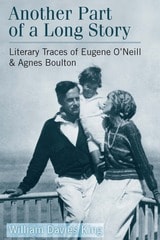
Illustration: Eugene O'Neill, Shane O'Neill, and Agnes Boulton ca. 1923. Eugene O'Neill Collection, Beinecke Rare Book and Manuscript Library, Yale University.
Answerable Style
Essays on Paradise LostArnold Stein
University of Minnesota Press, 1953
Answerable Style was first published in 1953. Minnesota Archive Editions uses digital technology to make long-unavailable books once again accessible, and are published unaltered from the original University of Minnesota Press editions.
By the use of both new and traditional techniques of critical analysis, Arnold Stein presents in this volume of six essays a fresh interpretation of Milton's epic.
Beginning with the assumption that style is "answerable" to idea, he has tried to trace Milton's epic vision as it is bodied forth in patterns of structure (the ideas tested in action) and patterns of expression (the ideas tested in style). Mr. Stein explains: "My approach is in part based on an attempt to accept as fact both that I am a twentieth century reader and that this is a seventeenth-century poem. Milton is, I think, illuminated by some modern critical considerations; and some of those considerations are in turn illuminated, and some are found wanting."
Answerable Style
The Idea of the Literary in Medieval EnglandFrank Grady and Andrew Galloway
The Ohio State University Press, 2013
Antebellum American Women's Poetry
A Rhetoric of SentimentWendy Dasler Johnson
Southern Illinois University Press, 2016
Considering the logos, ethos, and pathos—aims, writing personae, and audience appeal—of poems by African American abolitionist Frances Watkins Harper, working-class prophet Lydia Huntley Sigourney, and feminist socialite Julia Ward Howe, Wendy Dasler Johnson demonstrates that sentimental poetry was an inportant component of antebellum social activism. She articulates the ethos of the poems of Harper, who presents herself as a properly domestic black woman, nevertheless stepping boldly into Northern pulpits to insist slavery be abolished; the poetry of Sigourney, whose speaker is a feisty, working-class, ambiguously gendered prophet; and the works of Howe, who juggles her fame as the reformist “Battle Hymn” lyricist and motherhood of five children with an erotic Continental sentimentalism.
Antebellum American Women's Poetry makes a strong case for restoration of a compelling system of persuasion through poetry usually dismissed from studies of rhetoric. This remarkable book will change the way we think about women’s rhetoric in the nineteenth century, inviting readers to hear and respond to urgent, muffled appeals for justice in our own day.
Antebellum at Sea
Maritime Fantasies in Nineteenth-Century AmericaJason Berger
University of Minnesota Press, 2012
In the antebellum years, the Western world’s symbolic realities were expanded and challenged as merchant, military, and scientific activity moved into Pacific and Arctic waters. In Antebellum at Sea, Jason Berger explores the roles that early nineteenth-century maritime narratives played in conceptualizing economic and social transitions in the developing global market system and what these chronicles disclose about an era marked by immense change.
Focusing on the work of James Fenimore Cooper and Herman Melville, Berger enhances our understanding of how the nineteenth century negotiated its own tenuous progress by portraying how a wide range of maritime stories lays bare disturbing experiences of the new. Berger draws on Slavoj Žižek’s Lacanian notion of fantasy in order to reconsider the complex way maritime accounts operated in the political landscape of antebellum America, examining topics such as the function of maritime labor know-how within a transformation of scientific knowledge, anxiety produced by conflict between gender-specific and culture-specific forms of enjoyment, and how legal practices illuminate troubling juridical paradoxes at the heart of Polk-era political life.
Addressing the ideas of the antebellum age from unexpected and revealing perspectives, Berger calls on the conception of fantasy to consider how antebellum maritime literature disputes conventional views of American history, literature, and national identity.

Anthem Quality
National Songs: A Theoretical SurveyChristopher Kelen
Intellect Books, 2014
Thought of most often in the context of the Olympics or other sporting events, national anthems are a significant way for a nation and its citizens to express their identity and unity. Despite their prevalence, anthems as an expression of national self-image and culture have rarely been examined—until now. Anthem Quality analyzes the lyrics of many anthems in order to explore their historical and contemporary context. Christopher Kelen’s research reveals how many of the world’s most famous and best-known national anthems, including “The Marseillaise,” “The Star-Spangled Banner,” and “God Save the Queen” deal with such topics as authority, religion, and political devotion.
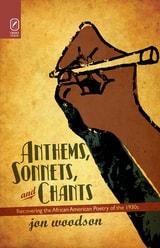
Anthems, Sonnets, and Chants
Recovering the African American Poetry of the 1930sJon Woodson
The Ohio State University Press, 2011

Anthropocene Poetics
Deep Time, Sacrifice Zones, and ExtinctionDavid Farrier
University of Minnesota Press, 2019
How poetry can help us think about and live in the Anthropocene by reframing our intimate relationship with geological time
The Anthropocene describes how humanity has radically intruded into deep time, the vast timescales that shape the Earth system and all life-forms that it supports. The challenge it poses—how to live in our present moment alongside deep pasts and futures—brings into sharp focus the importance of grasping the nature of our intimate relationship with geological time. In Anthropocene Poetics, David Farrier shows how contemporary poetry by Elizabeth Bishop, Seamus Heaney, Evelyn Reilly, and Christian Bök, among others, provides us with frameworks for thinking about this uncanny sense of time.
Looking at a diverse array of lyric and avant-garde poetry from three interrelated perspectives—the Anthropocene and the “material turn” in environmental philosophy; the Plantationocene and the role of global capitalism in environmental crisis; and the emergence of multispecies ethics and extinction studies—Farrier rethinks the environmental humanities from a literary critical perspective. Anthropocene Poetics puts a concern with deep time at the center, defining a new poetics for thinking through humanity’s role as geological agents, the devastation caused by resource extraction, and the looming extinction crisis.
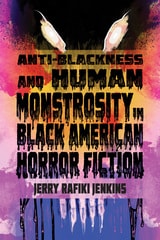
Anti-Blackness and Human Monstrosity in Black American Horror Fiction
Jerry Rafiki Jenkins
The Ohio State University Press, 2024
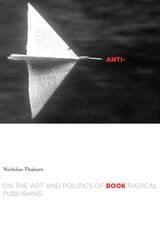
Anti-Book
On the Art and Politics of Radical PublishingNicholas Thoburn
University of Minnesota Press, 2016
No, Anti-Book is not a book about books. Not exactly. And yet it is a must for anyone interested in the future of the book. Presenting what he terms “a communism of textual matter,” Nicholas Thoburn explores the encounter between political thought and experimental writing and publishing, shifting the politics of text from an exclusive concern with content and meaning to the media forms and social relations by which text is produced and consumed. Taking a “post-digital” approach in considering a wide array of textual media forms, Thoburn invites us to challenge the commodity form of books—to stop imagining books as transcendent intellectual, moral, and aesthetic goods unsullied by commerce. His critique is, instead, one immersed in the many materialities of text.
Anti-Book engages with an array of writing and publishing projects, including Antonin Artaud’s paper gris-gris, Valerie Solanas’s SCUM Manifesto, Guy Debord’s sandpaper-bound Mémoires, the collective novelist Wu Ming, and the digital/print hybrid of Mute magazine. Empirically grounded, it is also a major achievement in expressing a political philosophy of writing and publishing, where the materiality of text is interlaced with conceptual production. Each chapter investigates a different form of textual media in concert with a particular concept: the small-press pamphlet as “communist object,” the magazine as “diagrammatic publishing,” political books in the modes of “root” and “rhizome,” the “multiple single” of anonymous authorship, and myth as “unidentified narrative object.”
An absorbingly written contribution to contemporary media theory in all its manifestations, Anti-Book will enrich current debates about radical publishing, artists’ books and other new genre and media forms in alternative media, art publishing, media studies, cultural studies, critical theory, and social and political theory.
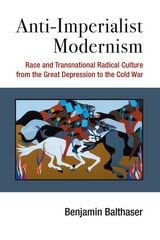
Anti-Imperialist Modernism
Race and Transnational Radical Culture from the Great Depression to the Cold WarBenjamin Balthaser
University of Michigan Press, 2015
Anti-Nazi Modernism
The Challenges of Resistance in 1930s FictionMia Spiro
Northwestern University Press, 2013
Antigone
Sophocles; A verse translation by David Mulroy, with introduction and notes
University of Wisconsin Press, 2013
David Mulroy’s translation of Antigone faithfully reproduces the literal meaning of Sophocles’ words while also reflecting his verbal pyrotechnics. Using fluid iambic pentameters for the spoken passages and rhyming stanzas for the songs, it is true to the letter and the spirit of the great Greek original.
Antigone
Sophocles
University of Chicago Press, 2013
Drawn from the authoritative third edition of the University of Chicago Press’s Complete Greek Tragedies series, this stand-alone edition of Elizabeth Wyckoff’s elegant rendition of Antigone reminds readers why it endures as one of the most widely read and admired of Sophocles’s plays. Though the story unfolds in the aftermath of Oedipus the King, Antigone was the first of the Theban Plays written by Sophocles.
Mark Griffith and Glenn W. Most’s introduction to the story of one woman’s brave resistance in the face of unfathomable loss provides essential information about the play’s first production, plot, and reception in antiquity.
Antigone's Ghosts
The Long Legacy of War and Genocide in Five CountriesWolfgram, Mark A
Bucknell University Press, 2019
Published by Bucknell University Press. Distributed worldwide by Rutgers University Press.
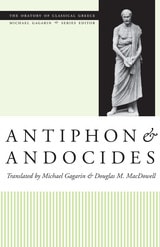
Antiphon and Andocides
Translated by Michael Gagarin and Douglas M. MacDowell
University of Texas Press, 1998
Classical oratory is an invaluable resource for the study of ancient Greek life and culture. The speeches offer evidence on Greek moral views, social and economic conditions, political and social ideology, and other aspects of Athenian culture that have been largely ignored: women and family life, slavery, and religion, to name just a few.
This volume contains the works of the two earliest surviving orators, Antiphon and Andocides. Antiphon (ca. 480-411) was a leading Athenian intellectual and creator of the profession of logography ("speech writing"), whose special interest was law and justice. His six surviving works all concern homicide cases. Andocides (ca. 440-390) was involved in two religious scandals—the mutilation of the Herms (busts of Hermes) and the revelation of the Eleusinian Mysteries—on the eve of the fateful Athenian expedition to Sicily in 415. His speeches are a defense against charges relating to those events.
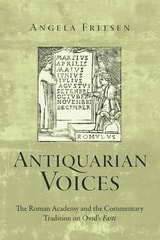
Antiquarian Voices
The Roman Academy and the Commentary Tradition on Ovid's FastiAngela Fritsen
The Ohio State University Press, 2015
Angela Fritsen’s Antiquarian Voices:The Roman Academy and the Commentary Tradition on Ovid’s Fasti offers the first study of the Renaissance exegesis and imitation of Ovid as antiquarian. Fritsen analyzes the Fasti commentaries by Paolo Marsi (1440–1484) and Antonio Costanzi (1436–1490) as well as the connections between the two works. It situates Ovidian Fasti studies in the Roman Academy under the mentorship of Pomponio Leto. Nowhere could the investigation of the Fasti be carried out better than in Rome. The humanists had a guide to the City in Ovid. They also regarded the Fasti as well suited to the ideology of the ancient Roman imperium’s renewal in modern papal Rome.
Antiquarian Voices illustrates how in reviving the Fasti, the humanists returned Rome to its original splendor. The book demonstrates that the humanists were eager to relate the Fasti to their antiquarian pursuits—as well as to their rising personal fame.

Antisatire
In Defense of Women, against Francesco BuoninsegniArcangela Tarabotti
Iter Press, 2020
The Other Voice in Early Modern Women: The Toronto Series volume 70
Antisthenes of Athens
Texts, Translations, and CommentarySusan H. Prince
University of Michigan Press, 2015
Anton Chekhov's Life and Thought
Selected Letters and CommentariesAnton Chekhov
Northwestern University Press, 1996
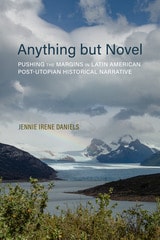
Anything but Novel
Pushing the Margins in Latin American Post-Utopian Historical NarrativeJennie Irene Daniels
University of Alabama Press, 2024
The first in-depth study in English to analyze post-utopian historical novels written during and in the wake of brutal Latin American dictatorships and authoritarian regimes
During neoliberal reforms in the 1980s and 1990s, murder, repression, and exile had reduced the number of intellectuals and Leftists, and many succumbed to or were coopted by market forces and ideologies. The opposition to the economic violence of neoliberal projects lacked a united front, and feasible alternatives to the contemporary order no longer seemed to exist. In this context, some Latin American literary intellectuals penned post-utopian historical novels as a means to reconstruct memory of significant moments in national history. Through the distortion and superimposition of distinct genres within the narratives, authors of post-utopian historical novels incorporated literary, cultural, and political traditions to expose contemporary challenges that were rooted in unresolved past conflicts.
In Anything but Novel, Jennie Irene Daniels closely examines four post-utopian novels—César Aira’s Ema, la cautiva, Rubem Fonseca’s O Selvagem da Ópera, José Miguel Varas’s El correo de Bagdad, and Santiago Páez’s Crónicas del Breve Reino—to make their contributions more accessible and to synthesize and highlight the literary and social interventions they make. Although the countries the novels focus on (Argentina, Brazil, Chile, and Ecuador) differ widely in politics, regime changes, historical precedents, geography, and demographics, the development of a shared subgenre among the literary elite suggests a common experience and interpretation of contemporary events across Latin America. These novels complement one another, extending shared themes and critiques.
Daniels argues the novels demonstrate that alternatives exist to neoliberalism even in times when it appears there are none. Another contribution of these novels is their repositioning of the Latin American literary intellectuals who have advocated for the marginalized in their societies. Their work has opened new avenues and developed previous lines of research in feminist, queer, and ethnic studies and for nonwhite, nonmale writers.
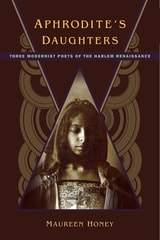
Aphrodite's Daughters
Three Modernist Poets of the Harlem RenaissanceHoney, Maureen
Rutgers University Press, 2016
Apocalypse South
Judgment, Cataclysm, and Resistance in the Regional ImaginaryAnthony Dyer Hoefer
The Ohio State University Press, 2012
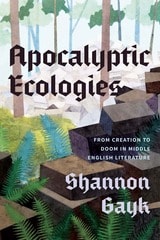
Apocalyptic Ecologies
From Creation to Doom in Middle English LiteratureShannon Gayk
University of Chicago Press, 2024
When a series of ecological disasters swept medieval England, writers turned to religious storytelling for precedents. Their depictions of biblical floods, fires, storms, droughts, and plagues reveal an unsettled relationship to the natural world, at once unchanging and bafflingly unpredictable. In Apocalyptic Ecologies, Shannon Gayk traces representations of environmental calamities through medieval plays, sermons, and poetry such as Cleanness and Piers Plowman. In premodern disaster writing, she recovers a vision of environmental flourishing that could inspire new forms of ecological care today: a truly apocalyptic sensibility capable of seeing in every ending, every emergency a new beginning waiting to emerge.
Apocryphal Lorca
Translation, Parody, KitschJonathan Mayhew
University of Chicago Press, 2009
Federico García Lorca (1898–1936) had enormous impact on the generation of American poets who came of age during the cold war, from Robert Duncan and Allen Ginsberg to Robert Creeley and Jerome Rothenberg. In large numbers, these poets have not only translated his works, but written imitations, parodies, and pastiches—along with essays and critical reviews. Jonathan Mayhew’s Apocryphal Lorca is an exploration of the afterlife of this legendary Spanish writer in the poetic culture of the United States.
The book examines how Lorca in English translation has become a specifically American poet, adapted to American cultural and ideological desiderata—one that bears little resemblance to the original corpus, or even to Lorca’s Spanish legacy. As Mayhew assesses Lorca’s considerable influence on the American literary scene of the latter half of the twentieth century, he uncovers fundamental truths about contemporary poetry, the uses and abuses of translation, and Lorca himself.
Apology for the Woman Writing and Other Works
Marie le Jars de Gournay
University of Chicago Press, 2002
This volume presents translations of four of Gournay's works that address feminist issues. Two of these appear here in English for the first time—The Promenade of Monsieur de Montaigne and The Apology for the Woman Writing. One of the first modern psychological novels, the best-selling Promenade was also the first to explore female sexual feeling. With the autobiographical Apology, Gournay defended every aspect of her life, from her moral conduct to her household management. The book also includes Gournay's last revisions (1641) of her two best-known feminist treatises, The Equality of Men and Women and The Ladies' Complaint. The editors provide a general overview of Gournay's career, as well as individual introductions and extensive annotations for each work.
Apology to Apostrophe
Autobiography and the Rhetoric of Self-Representation in SpainJames D. Fernandez
Duke University Press, 1992
As Fernández demonstrates, recent developments in critical theory provide new and fruitful approaches to autobiographical works that have long been neglected, misunderstood, or, in some cases, virtually unknown. Focusing primarily but not exclusively on nineteenth-century Spain, Fernández exposes a rhetorical tension that often occurs in autobiographical discourse, between self-justification, or "apology," and the transcendence of this worldly impulse, or "apostrophe." This tension, he argues, is of particular interest in the case of Spain, but not peculiar to that nation, and his attention to the theoretical nature of autobiography leads to insightfl considerations of many canonical European autobiographies, including those of Saint Augustine, Rousseau, Saint Teresa, and Cardinal Newman.
Considering Spanish autobiography in the context of first-person narrative in Europe and in the terms of current debates on the relationship between writing and selfhood, Apology to Apostrophe marks a significant advance in our historical understanding and critical discussion of the genre. The book will be of great value not only to Hispanists but also to those interested in autobiography and cultural history.