Results by title
22279 books match the query 'Social Science' and 1819 start with a
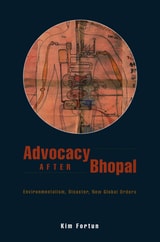
Advocacy after Bhopal
Environmentalism, Disaster, New Global OrdersKim Fortun
University of Chicago Press, 2001
Kim Fortun explores these claims by focusing on the dynamics and paradoxes of advocacy in competing power domains. She moves from hospitals in India to meetings with lawyers, corporate executives, and environmental justice activists in the United States to show how the disaster and its effects remain with us. Spiraling outward from the victims' stories, the innovative narrative sheds light on the way advocacy works within a complex global system, calling into question conventional notions of responsibility and ethical conduct. Revealing the hopes and frustrations of advocacy, this moving work also counters the tendency to think of Bhopal as an isolated incident that "can't happen here."
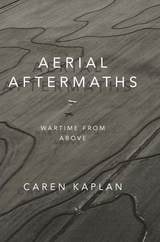
Aerial Aftermaths
Wartime from AboveCaren Kaplan
Duke University Press, 2018

Aesop's Anthropology
A Multispecies ApproachJohn Hartigan Jr.
University of Minnesota Press, 0
Forerunners: Ideas First is a thought-in-process series of breakthrough digital publications. Written between fresh ideas and finished books, Forerunners draws on scholarly work initiated in notable blogs, social media, conference plenaries, journal articles, and the synergy of academic exchange. This is gray literature publishing: where intense thinking, change, and speculation take place in scholarship.

Aesopica
A Series of Texts Relating to Aesop or Ascribed to HimEdited by Ben Edwin Perry
University of Illinois Press, 1952
Ben Edwin Perry's Aesopica remains the definitive edition of all fables reputed to be by Aesop. The volume begins traditionally with a life of Aesop, but in two different and previously unedited Greek versions, with collations that record variations in the major recensions. It includes 179 proverbs attributed to Aesop and 725 carefully organized fables, for which Perry also provides their eldest known sources. To better evaluate the place of Aesop in literary history, Perry includes testimonies about Aesop made by Greek and Latin authors, from Herodotus to Maximus Planudes.
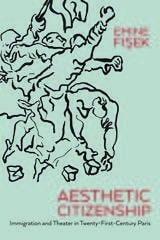
Aesthetic Citizenship
Immigration and Theater in Twenty-First-Century ParisEmine Fisek
Northwestern University Press, 2017
From neighborhood associations and humanitarian alliances to arts organizations both large and small, Fisek traces how theater has emerged as a practice with the perceived capacity to address questions regarding immigrant rights, integration, and experience. In Aesthetic Citizenship, she explores how the stage, one of France’s most evocative cultural spaces, has come to play a role in contemporary questions about immigration, citizenship and national identity. Yet Fişek’s insightful research also illuminates Paris’s broader historical, political, and cultural through-lines that continue to shape the relationship between theater and migration in France.
By focusing on how French public discourses on immigration are not only rendered meaningful but also inhabited and modified in the context of activist and arts practice, Aesthetic Citizenship seeks to answer the fundamental question: is theater a representational act or can it also be a transformative one?

Aesthetic Journalism
How to Inform Without InformingAlfredo Cramerotti
Intellect Books, 2009
Addressing a growing area of focus in contemporary art, Aesthetic Journalism investigates why contemporary art exhibitions often consist of interviews, documentaries, and reportage. Art theorist and critic Alfredo Cramerotti traces the shift in the production of truth from the domain of the news media to that of art and aestheticism—a change that questions the very foundations of journalism and the nature of art. This volume challenges the way we understand art and journalism in contemporary culture and suggests future developments of this new relationship.
Aestheticizing Public Space
Street Visual Politics in East Asian CitiesLu Pan
Intellect Books, 2015
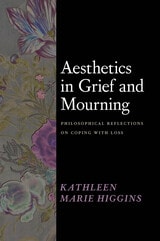
Aesthetics in Grief and Mourning
Philosophical Reflections on Coping with LossKathleen Marie Higgins
University of Chicago Press, 2024
In Aesthetics of Grief and Mourning, philosopher Kathleen Marie Higgins reflects on the ways that aesthetics aids people experiencing loss. Some practices related to bereavement, such as funerals, are scripted, but many others are recursive, improvisational, mundane—telling stories, listening to music, and reflecting on art or literature. Higgins shows how these grounding, aesthetic practices can ease the disorienting effects of loss, shedding new light on the importance of aesthetics for personal and communal flourishing.
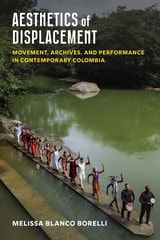
Aesthetics of Displacement
Movement, Archives, and Performance in Contemporary ColombiaMelissa Blanco Borelli
University of Michigan Press, 2026
Aesthetics of Displacement centers the embodied aesthetic practices of Afro-Colombian people and their experiences, asking readers to reassess Colombian national history, legacies of colonialism and racism, politics of memory, and the inheritances of violence related to the Colombian armed conflict. Through a theoretical frame of destierro or “displacement” and an examination of the Afro-Colombian philosophy vivir sabroso or “to live harmoniously,” Aesthetics of Displacement focuses on how theatre-makers, choreographers, filmmakers, activist groups, and photojournalists create an embodied Colombian perspective informed by decolonial practices and thinking that rely on movement as a strategy for existence and that counter European hegemonic aesthetics as the major foundations of taste and value. This approach not only enhances our understanding of contemporary Colombian culture, but also highlights the importance of performance as a means of resistance and identity formation.

Aesthetics of Excess
The Art and Politics of Black and Latina EmbodimentJillian Hernandez
Duke University Press, 2020
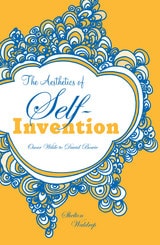
Aesthetics of Self-Invention
Oscar Wilde To David BowieShelton Waldrep
University of Minnesota Press, 2004
Traces the influence of Oscar Wilde as the precursor of twentieth-century artists of self-performance
By printing the title “Professor of Aesthetics” on his visiting cards, Oscar Wilde announced yet another transformation—and perhaps the most significant of his career, proclaiming his belief that he could redesign not just his image but his very self. Shelton Waldrep explores the cultural influences at play in Wilde’s life and work and his influence on the writing and performance of the twentieth century, particularly on the lives and careers of some of its most aestheticized performers: Truman Capote, Andy Warhol, David Hockney, and David Bowie. As Waldrep reveals, Wilde’s fusing of art with commerce foresaw the coming century’s cultural producers who would blend works of both “high art” and mass-market appeal.
Whether as a gay man or as a postmodern performance artist ahead of his time, Wilde ultimately emerges here as the embodiment of the twentieth-century media-savvy artist who is both subject and object of the aesthetic and economic systems in which he is enmeshed.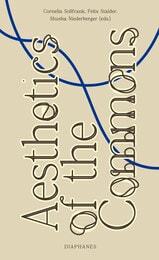
Aesthetics of the Commons
Edited by Cornelia Sollfrank, Felix Stalder, and Shusha Niederberger
Diaphanes, 2021
Aesthetics of the Commons examines a series of artistic and cultural projects—drawn from what can loosely be called the (post)digital—that take up this challenge in different ways. What unites them, however, is that they all have a double character. They are art in the sense that they place themselves in relation to (Western) cultural and art systems, developing discursive and aesthetic positions, but, at the same time, they are operational in that they create recursive environments and freely available resources whose uses exceed these systems. The first aspect raises questions about the kind of aesthetics that are being embodied, the second creates a relation to the larger concept of the commons. In Aesthetics of the Commons, the commons are understood not as a fixed set of principles that need to be adhered to in order to fit a definition, but instead as a thinking tool—in other words, the book’s interest lies in what can be made visible by applying the framework of the commons as a heuristic device.
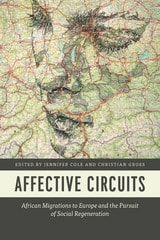
Affective Circuits
African Migrations to Europe and the Pursuit of Social RegenerationEdited by Jennifer Cole and Christian Groes
University of Chicago Press, 2016
The contributors point to the intersecting streams of goods, people, ideas, and money as they circulate between African migrants and their kin who remain back home. They also show the complex ways that emotions become entangled in these exchanges. Examining how these circuits operate in domains of social life ranging from child fosterage to binational marriages, from coming-of-age to healing and religious rituals, the book also registers the tremendous impact of state officials, laws, and policies on migrant experience. Together these essays paint an especially vivid portrait of new forms of kinship at a time of both intense mobility and ever-tightening borders.
Affective Intellectuals and the Space of Catastrophe in the Americas
Judith Sierra-Rivera
The Ohio State University Press, 2018
Pursuing this argument, Sierra-Rivera examines print, radio, and web materials by authors whose emotional discourses have also had a measurable impact on the formation of communities that demand their full political inclusion in society. This book therefore fills a significant gap in the study of the relationship between materiality (space and bodies), emotions, and the political imagination. Affective Intellectuals demonstrates that writers and intellectuals themselves are vital in reshaping their communities and fighting for social justice in the Hemispheric Americas.

Affective Justice
The International Criminal Court and the Pan-Africanist PushbackKamari Maxine Clarke
Duke University Press, 2019
Affective Trajectories
Religion and Emotion in African CityscapesHansjörg Dilger, Astrid Bochow, Marian Burchardt, and Matthew Wilhelm-Solomon, editors
Duke University Press, 2019
Contributors. Astrid Bochow, Marian Burchardt, Rafael Cazarin, Hansjörg Dilger, Alessandro Gusman, Murtala Ibrahim, Peter Lambertz, Isabelle L. Lange, Isabel Mukonyora, Benedikt Pontzen, Hanspeter Reihling, Matthew Wilhelm-Solomon
Affirmative Action and Minority Enrollments in Medical and Law Schools
Susan Welch and John Gruhl
University of Michigan Press, 1998

Affirmative Action in Medicine
Improving Health Care for EveryoneJames L. Curtis, M.D.
University of Michigan Press, 2003
Affirmative Advocacy
Race, Class, and Gender in Interest Group PoliticsDara Z. Strolovitch
University of Chicago Press, 2007
The United States boasts scores of organizations that offer crucial representation for groups that are marginalized in national politics, from women to racial minorities to the poor. Here, in the first systematic study of these organizations, Dara Z. Strolovitch explores the challenges and opportunities they face in the new millennium, as waning legal discrimination coincides with increasing political and economic inequalities within the populations they represent.
Drawing on rich new data from a survey of 286 organizations and interviews with forty officials, Strolovitch finds that groups too often prioritize the interests of their most advantaged members: male rather than female racial minorities, for example, or affluent rather than poor women. But Strolovitch also finds that many organizations try to remedy this inequity, and she concludes by distilling their best practices into a set of principles that she calls affirmative advocacy—a form of representation that aims to overcome the entrenched but often subtle biases against people at the intersection of more than one marginalized group. Intelligently combining political theory with sophisticated empirical methods, Affirmative Advocacy will be required reading for students and scholars of American politics.
Affirmative Reaction
New Formations of White MasculinityHamilton Carroll
Duke University Press, 2011
Throughout Affirmative Reaction, Carroll examines the kinds of difference white masculinity claims for itself as it attempts to hold onto or maintain majority privilege. Whether these are traditional sites of minority difference—such as Irishness, white trash, or domestic melodrama—or reworked sites of masculinist investment—including laboring bodies, public-sphere politics, and vigilantism—the outcome is the same: the foregrounding of white masculinity over and against women, people of color, and the non-heteronormative. By revealing the strategies through which white masculinity is produced as a formal difference, Carroll sheds new light on the ways that privilege is accrued and maintained.

Affording Justice
How the Legal Profession Is Failing America's Middle Class and What to Do About ItSheldon Krantz
Duke University Press, 2027

Affrilachia
PoemsFrank X Walker
Ohio University Press, 2000
Africa & Africans in Antiquity
Edwin M. Yamauchi
Michigan State University Press, 2001
Africa and Africans in Antiquity assesses recent historical research and archaeology under way in Egypt, North Africa, the Sudan, and the Horn of Africa. Whereas many European and American scholars of earlier generations believed that Egyptian contacts with Africa to the south were not culturally significant, research contained in this important collection rejects such notions. At the same time, the volume takes issue with Afrocentric scholars who argue that most Egyptians were 'black' and that blacks are the rightful heirs to Egypt's past grandeur. These ten thought-provoking essays demonstrate that this large region was an ethnic and cultural mosaic in antiquity, a place where Phoenicians, Berbers, Greeks, as well as Egyptians and Nubians interacted.
Africa Every Day
Fun, Leisure, and Expressive Culture on the ContinentOluwakemi M. Balogun
Ohio University Press, 2019
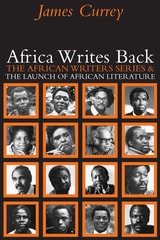
Africa Writes Back
The African Writers Series and the Launch of African LiteratureJames Currey
Ohio University Press, 2008
June 17, 2008, is the fiftieth anniversary of the publication of Chinua Achebe’s Things Fall Apart by Heinemann. This publication provided the impetus for the foundation of the African Writers Series in 1962 with Chinua Achebe as the editorial adviser.
Africa Writes Back: The African Writers Series and the Launch of African Literature captures the energy of literary publishing in a new and undefined field. Portraits of the leading characters and the many consultants and readers providing reports and advice to new and established writers make Africa Writes Back a stand-out book. James Currey’s voice and insights are an added bonus.
CONTENTS
Publishing and selling the African Writers Series
The African Writers Series Portfolio & George Hallett’s covers
Main dates for the African Writers Series
INTRODUCTION: The establishment of African Literature
Publishing Chinua Achebe
1. WRITERS FROM WEST AFRICA
Nigeria: The country where so much started
Negritude from Senegal to Cameroun
Magic & realism from Ghana, The Gambia & Sierra Leone
2. WRITERS FROM EASTERN AFRICA
Towards the oral & the popular in Kenya, Uganda & Tanzania
Publishing Ngugi
3. WRITERS FROM THE HORN & NORTH-EASTERN AFRICA
Emperors in Ethiopia
Publishing Nuruddin Farah
Arab authors in Egypt & Sudan
4. WRITERS FROM SOUTH AFRICA
Resistance in South Africa
Publishing Alex la Guma
Publishing Dennis Brutus
Publishing Bessie Head
Publishing Masizi Kunene
5. WRITERS FROM SOUTHERN AFRICAN
Guns & Guerrillas in Mozambique &Angola
Zambia Shall be Free
Death & detention in Malawi
The struggle to become Zimbabwe
Publishing Dambudzo Marechera
CONCLUSION: Is there still a role for the African Writers Series?

Africa and the Olympics
Winning Away from the PodiumTodd Cleveland
Ohio University Press, 2024
At the 2020 Tokyo Olympic Games (held in 2021 due to COVID-19), the fifty-four African countries that participated finished the tournament with the lowest medal haul for any continent, continuing a historic trend since the inception of the modern Games in 1896. Reflecting this relative lack of sporting success, African Olympians—aside from elite Kenyan distance runners—rarely register in the minds of even the most dedicated followers of the Games. Yet for all their seeming invisibility on the Olympic landscape, African states, athletes, and officials have long been “winning” at the Olympics, albeit often far removed from the medal podium. Africa and the Olympics shows how African actors have achieved these nonsporting victories and examines how they have used the Olympics to engage in transformative political activity, realize social mobility, and enhance the quality of life for individuals, communities, and entire nations. In tracing these historical and contemporary processes and the motivations that underlie them, the book complicates reductive notions of the Olympics as solely a sporting competition and instead considers Africa’s engagement with the Games as a series of opportunities to improve personal, communal, ethnic, national, and even continental plights. If few sports fans have thought extensively about Africa and the Olympics, scholars have been only slightly more engaged with the subject. Most of this scholarship focuses on the International Olympic Committee’s ban of apartheid South Africa from 1964 to 1988. Other works that consider the Olympics more broadly tend to deal with Africa only summarily, further reducing its already low profile. As a result, the academic literature resembles a patchwork of circumscribed studies dispersed in a range of fields and disciplines. Not since the publication of Africa at the Olympics almost fifty years ago has a single volume featured a comprehensive history of the continent and the Games. This book both updates and expands previous work and, most importantly, reframes the analytical engagement with this topic.
Africa in America
Slave Acculturation and Resistance in the American South and the British Caribbean, 1736-1831Michael Mullin
University of Illinois Press, 1992
Africa in the World’s Time
Rewriting the Past Beyond Colonial NarrativesMamadou Diouf
Seagull Books, 2025
Mamadou Diouf unearths the intellectual and cultural traditions that have long defined Africa, proving that history was never just written about Africa, but also by it.
For too long, Africa has been framed as an afterthought in world history—a continent written into the margins of time. In Africa in the World’s Time, renowned historian Mamadou Diouf dismantles these colonial narratives and reclaims Africa’s rightful place at the center of global historical thought. Moving beyond Western frameworks, Diouf examines the continent’s intellectual traditions and demonstrates how African artists and historians have shaped and reshaped how we understand the past.
Tracing central debates from the independence era to today, Diouf examines figures like Cheikh Anta Diop and Samir Amin, as well as the vital role of literature and film in contesting predominant histories. He challenges the linear, Eurocentric timelines that have long governed historical discourse, and puts forward a vision of Africa as a force that has always been influencing and reimagining the world.
African American Arts
Activism, Aesthetics, and Futurityweems, carrie mae
Bucknell University Press, 2020
Contributors: Carrie Mae Weems, Carmen Gillespie, Rikki Byrd, Amber Lauren Johnson, Doria E. Charlson, Florencia V. Cornet, Daniel McNeil, Lucy Caplan, Genevieve Hyacinthe, Sammantha McCalla, Nettrice R. Gaskins, Abby Dobson, J. Michael Kinsey, Shondrika Moss-Bouldin, Julie B. Johnson, Sharrell D. Luckett, Jasmine Eileen Coles, Tawnya Pettiford-Wates, Rickerby Hinds.
Published by Bucknell University Press. Distributed worldwide by Rutgers University Press.
African American Females
Addressing Challenges and Nurturing the FutureEdited by Eboni M. Zamani-Gallaher and Vernon C. Polite
Michigan State University Press, 2013
African American Females: Addressing Challenges and Nurturing the Future illustrates that across education, health, and other areas of social life, opportunities are stratified along gender as well as race lines. The unequal distribution of wealth, power, and privilege between men and women intersects with race and class to create multiple levels of disadvantage. This book is one result of a unique forum intended to bring into focus the K–12 and postsecondary schooling issues and challenges affecting African American girls and women. Focusing on the historical antecedents of African American female participation and the contemporary context of access and opportunity for black girls and women, the contributors to this collection pay particular attention to the interaction of gender with race/ethnicity, class, age, and health, with the central aim of encouraging thoughtful reading, critical thinking, and informed conversations about the necessity of exploring the lives of African American females. Additionally, the book frames important implications for recommended changes in policy and practice regarding a number of critical matters presently affecting African American females in schools and communities across the state of Michigan and nationwide.
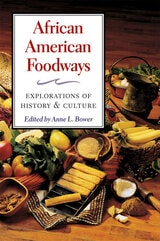
African American Foodways
Explorations of History and CultureEdited by Anne L. Bower
University of Illinois Press, 2006
Ranging from seventeenth-century West African fare to contemporary fusion dishes using soul food ingredients, the essays in this book provide an introduction to many aspects of African American foodways and an antidote to popular misconceptions about soul food. Examining the combination of African, Caribbean, and South American traditions, the volume's contributors offer lively insights from history, literature, sociology, anthropology, and African American studies to demonstrate how food's material and symbolic values have contributed to African Americans' identity for centuries. Individual chapters examine how African foodways survived the passage into slavery, cultural meanings associated with African American foodways, and the contents of African American cookbooks, both early and recent.
Contributors are Anne L. Bower, Robert L. Hall, William C. Whit, Psyche Williams-Forson, Doris Witt, Anne Yentsch, Rafia Zafar.

African American Fraternal Associations and the History of Civil Society in the United States, Volume 28
Katherine A. Lynch, ed.
Duke University Press, 0
The contributors construct a historical portrait of black fraternal orders during the nineteenth and twentieth centuries. They argue that African Americans were more likely than whites to form fraternal orders and to sustain them, using them to guard members against unemployment and other misfortunes. They examine the ritual life of fraternal organizations, paying particular attention to rites of initiation and to the values they reflected about collective identity, gender relations, equality, and collective action. Finally, they show how social networks that black fraternal organizations fostered led to successful legal battles for the right to assemble and to the later civil rights movement of the twentieth century.
Contributors. Bayliss J. Camp, Marshall Ganz, Orit Kent, Ariane Liazos, Jennifer Lynn Oser, Theda Skocpol, Joe W. Trotter
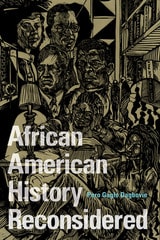
African American History Reconsidered
Pero Gaglo Dagbovie
University of Illinois Press, 2010
This groundbreaking volume establishes new perspectives on black history--its scholarship and pedagogy, scholars and interpreters, and evolution as a profession.
Pero Gaglo Dagbovie discusses a wide range of issues and themes for understanding and analyzing African American history, the twentieth century black historical enterprise, and the teaching of African American history for the twenty-first century. Additional topics include the hip-hop generation's relationship to and interpretations of African American history; past, present, and future approaches to the subject; and the social construct of knowledge in African American historiography. An examination of definitions of black history from W. E. B. Du Bois's The Souls of Black Folk and a survey of early black women historians lend further dimension and authenticity to the volume. A bold contribution to the growing fields of African American historiography and the philosophy of black history, African American History Reconsidered offers numerous analytical frameworks for understanding and delving into a variety of dimensions of the African American historical experience.

African American Jeremiad Rev
Appeals For Justice In AmericaDavid Howard-Pitney
Temple University Press, 2005
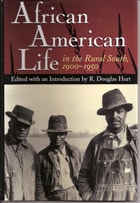
African American Life in the Rural South, 1900-1950
Edited with an introduction by R. Douglas Hurt
University of Missouri Press, 2003
African American Organized Crime
A Social HistorySchatzberg, Rufus
Rutgers University Press, 1997
While stories of organized crime most often dwell on groups like the Mafia and Chinese Triad or Tongs, African Americans also have a long history of organized crime. Why have scholars and journalists paid so little attention to African American organized crime? What can a history of these criminal networks teach us about the social, political, and economic challenges that face African Americans today? What is specific to African American organized crime, and how do these networks differ from the criminal organizations of other racial and ethnic groups? How can a historical study of African American organized crime enrich our understanding of all criminal activity?
Rufus Schatzberg and Robert Kelly take us through almost a century of African American organized crime. Chapters focus on the numbers gambling that took place in New York City from 1920 to 1940, the criminal groups that operated in ghettos from the 1940s to the 1970s, and the gang activities that began in the 1970s and continues today. While providing a compelling analysis of African American organized crime, the authors also challenge existing stereotypes of African Americans and demonstrate the importance of studying any criminal activity within its historical and social context.
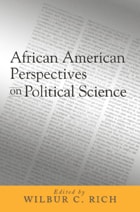
African American Perspectives on Political Science
edited by Wilbur C. Rich, foreword by Charles V. Hamilton
Temple University Press, 2007
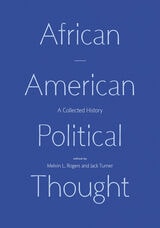
African American Political Thought
A Collected HistoryEdited by Melvin L. Rogers and Jack Turner
University of Chicago Press, 2021
While African American political thought is inextricable from the historical movement of American political thought, this volume stresses the individuality of Black thinkers, the transnational and diasporic consciousness, and how individual speakers and writers draw on various traditions simultaneously to broaden our conception of African American political ideas. This landmark volume gives us the opportunity to tap into the myriad and nuanced political theories central to Black life. In doing so, African American Political Thought: A Collected History transforms how we understand the past and future of political thinking in the West.
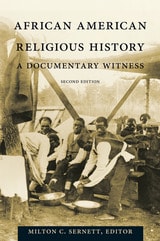
African American Religious History
A Documentary WitnessMilton C. Sernett, ed.
Duke University Press, 2000
Originally published in 1985, this expanded second edition includes new sources on women, African missions, and the Great Migration. Milton C. Sernett provides a general introduction as well as historical context and comment for each document.
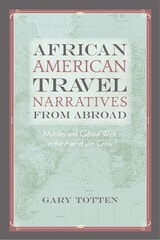
African American Travel Narratives from Abroad
Mobility and Cultural Work in the Age of Jim CrowGary Totten
University of Massachusetts Press, 2015
In this book, Gary Totten examines the global travel narratives of a diverse set of African American writers, including Ida B. Wells, Booker T. Washington, Matthew Henson, Jessie Redmon Fauset, and Zora Neale Hurston. While these writers deal with issues of identity in relation to a reimagined sense of self—in a way that we might expect to find in travel narratives—they also push against the constraints and conventions of the genre, reconsidering discourses of tourism, ethnography, and exploration. This book not only offers new insights about African American writers and mobility, it also charts the ideological distinctions and divergent agendas within this group of writers. Totten demonstrates how these travelers and their writings challenged dominant ideologies about African American experience, expression, and identity in a period of escalating racial violence. By setting these texts in their historical context and within the genre of travel writing, Totten presents a nuanced understanding of both popular and recovered work of the period.
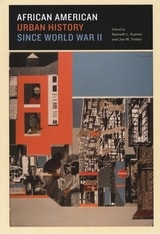
African American Urban History since World War II
Edited by Kenneth L. Kusmer and Joe W. Trotter
University of Chicago Press, 2009
Historians have devoted surprisingly little attention to African American urban history ofthe postwar period, especially compared with earlier decades. Correcting this imbalance, African American Urban History since World War II features an exciting mix of seasoned scholars and fresh new voices whose combined efforts provide the first comprehensive assessment of this important subject.
The first of this volume’s five groundbreaking sections focuses on black migration and Latino immigration, examining tensions and alliances that emerged between African Americans and other groups. Exploring the challenges of residential segregation and deindustrialization, later sections tackle such topics as the real estate industry’s discriminatory practices, the movement of middle-class blacks to the suburbs, and the influence of black urban activists on national employment and social welfare policies. Another group of contributors examines these themes through the lens of gender, chronicling deindustrialization’s disproportionate impact on women and women’s leading roles in movements for social change. Concluding with a set of essays on black culture and consumption, this volume fully realizes its goal of linking local transformations with the national and global processes that affect urban class and race relations.
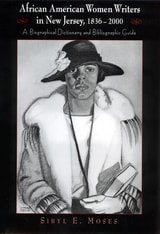
African American Women Writers in New Jersey, 1836-2000
A Biographical Dictionary and Bibliographic GuideMoses, Sibyl E
Rutgers University Press, 2006
Selected as a "New Jersey Notable Book for 1995-2005" by the New Jersey Center for the Book
Awarded the 2004 Certificate of Commendation by the American Association for State and Local History
African American Women Writers in New Jersey, 1836-2000 is the first and only reference book to identify and document the lives, intellectual contributions, and publications of over one hundred African American women writers in the Garden State from 1836 through 2000. Many, such as Jessie Redmon Fauset, Alice Perry Johnson, Sharon Bell Mathis, Ntozake Shange, Claudia C. Tate, Ruby Ora Williams, and Marion Thompson Wright, were born in the state. Others, like Amina Baraka, E. Alma Flagg, Helen Jackson Lee, Gertrude Williams Pitts, and Dorothy Porter Wesley, although not born there, were residents of New Jersey for more than fifteen years, and made significant contributions during that time.
This volume contains biographical and bibliographical information for each author. There are photographs of the writers as well as citations for their published pamphlets, books, reports, and articles. Sibyl E. Moses has enhanced the text with characteristic excerpts from the poetry and prose of selected writers. The two appendixes highlight the distribution of African American women writers in New Jersey both by city or town, and by genre.
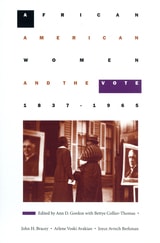
African American Women and the Vote, 1837–1965
Ann D. Gordon
University of Massachusetts Press, 1997
Written by leading scholars of African American and women's history, the essays in this volume seek to reconceptualize the political history of black women in the United States by placing them “at the center of our thinking.” The book explores how slavery, racial discrimination, and gender shaped the goals that African American women set for themselves, their families, and their race and looks at the political tools at their disposal. By identifying key turning points for black women, the essays create a new chronology and a new paradigm for historical analysis. The chronology begins in 1837 with the interracial meeting of antislavery women in New York City and concludes with the civil rights movement of the 1960s.
The contributors focus on specific examples of women pursuing a dual ambition: to gain full civil and political rights and to improve the social conditions of African Americans. Together, the essays challenge us to rethink common generalizations that govern much of our historical thinking about the experience of African American women.
Contributors include Bettina Aptheker, Elsa Barkley Brown, Willi Coleman, Gerald R. Gill, Ann D. Gordon, Evelyn Brooks Higginbotham, Cynthia Neverdon-Morton, Martha Prescod Norman, Janice Sumler-Edmond, Rosalyn Terborg-Penn, and Bettye Collier-Thomas.
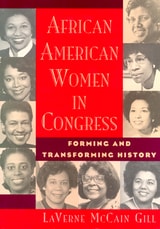
African American Women in Congress
Gill, LaVerne McCain
Rutgers University Press, 1997
African American Women in Congress details the life and career histories of Shirley Chisholm, Barbara Jordan, Yvonne Burke, Cardiss Collins, Katie Hall, Eleanor Holmes Norton, Maxine Waters, Barbara-Rose Collins, Carol Moseley-Braun, Corinne Brown, Carrie Meek, Cynthia McKinney, Eva Clayton, Eddie Bernice Johnson, and Sheila Jackson-Lee. Each profile contains a picture of its subject, interview material, and resumés. Arranged chronologically, the book introduces the reader to issues of vital importance to the Black community—Reconstruction, enfranchisement, lynchings and harassment, civil rights struggles, the founding of advocacy groups, the power of the Congressional Black Caucus, the creation of majority minority districts that allowed greater representation in Congress, the struggle of largely Black Washington, D.C., for representation, and the recent dismantling of past gains by a Republican majority. Gill also describes the uphill battles for social justice and the rights of women that the fifteen women had to wage even within their own political parties, political organizations, and districts.
For general readers, high school and college students, and anyone interested in the political process, this book is illuminating and inspiring reading.
African Americans and Jews in the Twentieth Century
Studies in Convergence and ConflictEdited by V.P. Franklin, Nancy L. Grant, Harold M. Kletnick, & Genna Rae McNeil
University of Missouri Press, 1998
In 1993 distinguished historian Nancy L. Grant organized "Blacks and Jews: An American Historical Perspective," a conference held at Washington University in St. Louis and dedicated to the exploration of Black-Jewish relations in twentieth-century America. Featuring presentations by historians, sociologists, and political scientists, this conference reflected Grant's devotion to scholarship on multicultural relations and the continuing struggle for racial equality in the United States. After Grant's untimely death in 1995, V. P. Franklin and the other contributors completed the work of readying these essays for publication with the assistance of the coeditors. African Americans and Jews in the Twentieth Century is the culmination of the innovative research and ideas presented at the conference.
In the long struggle to bring social justice to American society, Blacks and Jews have often been close allies. In both the past and the present, however, there has also been serious conflict and competition between the groups in social, economic, and political spheres.
Focusing on the complexity of the relationships between Blacks and Jews in America, these essays examine the convergence and conflict that have characterized Black-Jewish interactions over the past century. African Americans and Jews in the Twentieth Century provides an intellectual foundation for continued dialogue and future cooperative efforts to improve social justice in this society and will be an invaluable resource for the study of race relations in the United States in the twentieth century.
African Americans in U.S. Foreign Policy
From the Era of Frederick Douglass to the Age of ObamaEdited by Linda Heywood, Allison Blakely, Charles Stith, and Joshua C. Yesnowitz
University of Illinois Press, 2015
Groundbreaking and critical, African Americans in U.S. Foreign Policy expands on the scope and themes of recent collections to offer the most up-to-date scholarship to students in a range of disciplines, including U.S. and African American history, Africana studies, political science, and American studies.
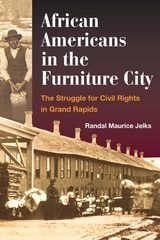
African Americans in the Furniture City
The Struggle for Civil Rights in Grand RapidsRandal Maurice Jelks
University of Illinois Press, 2006
Focusing on the intersection of African Americans' nineteenth-century cultural values and the changing social and political conditions in the first half of the twentieth century, Jelks pays particularly close attention to the religious community's influence during their struggle toward a respectable social identity and fair treatment under the law. He explores how these competing values defined the community's politics as it struggled to expand its freedoms and change its status as a subjugated racial minority.

African Animation
History, Culture, and IndustryBoukary Sawadogo
Rutgers University Press, 2027
Against the backdrop of the rising interest in African stories in mainstream media, African Animation looks at a more than century-old animation practice that remains largely unknown. Carefully organized, this book offers a comprehensive treatment that canvases animation from all over the continent, analyzing its history, socio-political contexts, artistic and technological development, visual cultures, and economic market conditions. African animation also contributes to the broader landscape of animation studies: how does our view of the history of animation change when we add an African perspective to the otherwise dominating perspectives of Hollywood, Japanese, and Korean animation? What does animation look and feel like in other parts of the world? African animation has always been there; this book helps us pay attention to it. This is a must-read for those interested in African animation, including artists, industry insiders, and fans.
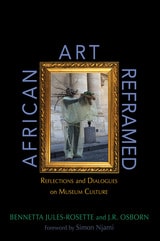
African Art Reframed
Reflections and Dialogues on Museum CultureBennetta Jules-Rosette and J. R. Osborn; Foreword by Simon Njami
University of Illinois Press, 2020
The authors take a three-pronged approach. Part One ranges from curiosity cabinets to virtual websites to offer a history of ethnographic and art museums and look at their organization and methods of reaching out to the public. In the second part, the authors examine museums as ecosystems and communities within communities, and they use semiotic methods to analyze images, signs, and symbols drawn from the experiences of curators and artists. The third part introduces innovative strategies for displaying, disseminating, and reclaiming African art. The authors also propose how to reinterpret the art inside and outside the museum and show ways of remixing the results.
Drawing on extensive conversations with curators, collectors, and artists, African Art Reframed is an essential guide to building new exchanges and connections in the dynamic worlds of African and global art.

African Democracies and African Politics
M. A. Mohamed Salih
Pluto Press, 2001