Results by title
28167 books match the query 'History' and 2536 start with a
A Slaveholders' Union
Slavery, Politics, and the Constitution in the Early American RepublicGeorge William Van Cleve
University of Chicago Press, 2010
After its early introduction into the English colonies in North America, slavery in the United States lasted as a legal institution until the passage of the Thirteenth Amendment to the Constitution in 1865. But increasingly during the contested politics of the early republic, abolitionists cried out that the Constitution itself was a slaveowners’ document, produced to protect and further their rights. A Slaveholders’ Union furthers this unsettling claim by demonstrating once and for all that slavery was indeed an essential part of the foundation of the nascent republic.
In this powerful book, George William Van Cleve demonstrates that the Constitution was pro-slavery in its politics, its economics, and its law. He convincingly shows that the Constitutional provisions protecting slavery were much more than mere “political” compromises—they were integral to the principles of the new nation. By the late 1780s, a majority of Americans wanted to create a strong federal republic that would be capable of expanding into a continental empire. In order for America to become an empire on such a scale, Van Cleve argues, the Southern states had to be willing partners in the endeavor, and the cost of their allegiance was the deliberate long-term protection of slavery by America’s leaders through the nation’s early expansion. Reconsidering the role played by the gradual abolition of slavery in the North, Van Cleve also shows that abolition there was much less progressive in its origins—and had much less influence on slavery’s expansion—than previously thought.
Deftly interweaving historical and political analyses, A Slaveholders’ Union will likely become the definitive explanation of slavery’s persistence and growth—and of its influence on American constitutional development—from the Revolutionary War through the Missouri Compromise of 1821.
A Small Corner of Hell
Dispatches from ChechnyaAnna Politkovskaya
University of Chicago Press, 2003
Chechnya, a 6,000-square-mile corner of the northern Caucasus, has struggled under Russian domination for centuries. The region declared its independence in 1991, leading to a brutal war, Russian withdrawal, and subsequent "governance" by bandits and warlords. A series of apartment building attacks in Moscow in 1999, allegedly orchestrated by a rebel faction, reignited the war, which continues to rage today. Russia has gone to great lengths to keep journalists from reporting on the conflict; consequently, few people outside the region understand its scale and the atrocities—described by eyewitnesses as comparable to those discovered in Bosnia—committed there.
Anna Politkovskaya, a correspondent for the liberal Moscow newspaper Novaya gazeta, was the only journalist to have constant access to the region. Her international stature and reputation for honesty among the Chechens allowed her to continue to report to the world the brutal tactics of Russia's leaders used to quell the uprisings. A Small Corner of Hell: Dispatches from Chechnya is her second book on this bloody and prolonged war. More than a collection of articles and columns, A Small Corner of Hell offers a rare insider's view of life in Chechnya over the past years. Centered on stories of those caught-literally-in the crossfire of the conflict, her book recounts the horrors of living in the midst of the war, examines how the war has affected Russian society, and takes a hard look at how people on both sides are profiting from it, from the guards who accept bribes from Chechens out after curfew to the United Nations. Politkovskaya's unflinching honesty and her courage in speaking truth to power combine here to produce a powerful account of what is acknowledged as one of the most dangerous and least understood conflicts on the planet.

A Small Door Set in Concrete
One Woman's Story of Challenging Borders in Israel/PalestineIlana Hammerman
University of Chicago Press, 2019
For years, renowned activist and scholar Ilana Hammerman has given the world remarkable translations of Kafka. With A Small Door Set in Concrete, she turns to the actual surreal existence that is life in the West Bank after decades of occupation.
After losing her husband and her sister, Hammerman set out to travel to the end of the world. She began her trip with the hope that it would reveal the right path to take in life. But she soon realized that finding answers was less important than experiencing the freedom to move from place to place without restriction. Hammerman returned to the West Bank with a renewed joie de vivre and a resolution: she would become a regular visitor to the men, women, and children who were on the other side of the wall, unable to move or act freely. She would listen to their dreams and fight to bring some justice into their lives.
A Small Door Set in Concrete is a moving picture of lives filled with destruction and frustration but also infusions of joy. Whether joining Palestinian laborers lining up behind checkpoints hours before the crack of dawn in the hope of crossing into Israel for a day’s work, accompanying a family to military court for their loved one’s hearing, or smuggling Palestinian children across borders for a day at the beach, Hammerman fearlessly ventures into territories where few Israelis dare set foot and challenges her readers not to avert their eyes in the face of injustice.
Hammerman neither preaches nor politicks. Instead, she engages in a much more personal, everyday kind of activism. Hammerman is adept at revealing the absurdities of a land where people are stripped of their humanity. And she is equally skilled at illuminating the humanity of those caught in this political web. To those who have become simply statistics or targets to those in Israel and around the world, she gives names, faces, dreams, desires.
This is not a book that allows us to sit passively. It is a slap in the face, a necessary splash of cold water that will reawaken the humanity inside all of us.

A Small World
Smart Houses and the Dream of the Perfect DayDavin Heckman
Duke University Press, 2007
Heckman’s narrative stretches from the early-twentieth-century introduction into the home of electric appliances and industrial time-management techniques, through the postwar advent of television and the space-age “house of tomorrow,” to the contemporary automated, networked “smart home.” He considers all these developments in relation to lifestyle and consumer narratives. Building on the tension between agency and control within the walls of homes designed to anticipate and fulfill desires, Heckman engages debates about lifestyle, posthumanism, and rights under the destabilizing influences of consumer technologies, and he considers the utopian and dystopian potential of new media forms. Heckman argues that the achievement of an environment completely attuned to its inhabitants’ specific wants and needs—what he calls the “Perfect Day”—institutionalizes everyday life as the ultimate consumer practice.

A Small but Spartan Band
The Florida Brigade in Lee's Army of Northern VirginiaZack C. Waters
University of Alabama Press, 2013

A Social History of Iranian Cinema, Volume 1
The Artisanal Era, 1897-1941Hamid Naficy
Duke University Press, 2011
Volume 1 depicts and analyzes the early years of Iranian cinema. Film was introduced in Iran in 1900, three years after the country’s first commercial film exhibitor saw the new medium in Great Britain. An artisanal cinema industry sponsored by the ruling shahs and other elites soon emerged. The presence of women, both on the screen and in movie houses, proved controversial until 1925, when Reza Shah Pahlavi dissolved the Qajar dynasty. Ruling until 1941, Reza Shah implemented a Westernization program intended to unite, modernize, and secularize his multicultural, multilingual, and multiethnic country. Cinematic representations of a fast-modernizing Iran were encouraged, the veil was outlawed, and dandies flourished. At the same time, photography, movie production, and movie houses were tightly controlled. Film production ultimately proved marginal to state formation. Only four silent feature films were produced in Iran; of the five Persian-language sound features shown in the country before 1941, four were made by an Iranian expatriate in India.
A Social History of Iranian Cinema
Volume 1: The Artisanal Era, 1897–1941
Volume 2: The Industrializing Years, 1941–1978
Volume 3: The Islamicate Period, 1978–1984
Volume 4: The Globalizing Era, 1984–2010
A Social History of Iranian Cinema, Volume 2
The Industrializing Years, 1941–1978Hamid Naficy
Duke University Press, 2011
Volume 2 spans the period of Mohammad Reza Shah’s rule, from 1941 until 1978. During this time Iranian cinema flourished and became industrialized, at its height producing more than ninety films each year. The state was instrumental in building the infrastructures of the cinema and television industries, and it instituted a vast apparatus of censorship and patronage. During the Second World War the Allied powers competed to control the movies shown in Iran. In the following decades, two distinct indigenous cinemas emerged. The more popular, traditional, and commercial filmfarsi movies included tough-guy films and the “stewpot” genre of melodrama, with plots reflecting the rapid changes in Iranian society. The new-wave cinema was a smaller but more influential cinema of dissent, made mostly by foreign-trained filmmakers and modernist writers opposed to the regime. Ironically, the state both funded and censored much of the new-wave cinema, which grew bolder in its criticism as state authoritarianism consolidated. A vital documentary cinema also developed in the prerevolutionary era.
A Social History of Iranian Cinema
Volume 1: The Artisanal Era, 1897–1941
Volume 2: The Industrializing Years, 1941–1978
Volume 3: The Islamicate Period, 1978–1984
Volume 4: The Globalizing Era, 1984–2010

A Social History of Iranian Cinema, Volume 3
The Islamicate Period, 1978–1984Hamid Naficy
Duke University Press, 2012
In Volume 3, Naficy assesses the profound effects of the Islamic Revolution on Iran's cinema and film industry. Throughout the book, he uses the term Islamicate, rather than Islamic, to indicate that the values of the postrevolutionary state, culture, and cinema were informed not only by Islam but also by Persian traditions. Naficy examines documentary films made to record events prior to, during, and in the immediate aftermath of the revolution. He describes how certain institutions and individuals, including prerevolutionary cinema and filmmakers, were associated with the Pahlavi regime, the West, and modernity and therefore perceived as corrupt and immoral. Many of the nation's moviehouses were burned down. Prerevolutionary films were subject to strict review and often banned, to be replaced with films commensurate with Islamicate values. Filmmakers and entertainers were thrown out of the industry, exiled, imprisoned, and even executed. Yet, out of this revolutionary turmoil, an extraordinary Islamicate cinema and film culture emerged. Naficy traces its development and explains how Iran's long war with Iraq, the gendered segregation of space, and the imposition of the veil on women encouraged certain ideological and aesthetic trends in film and related media. Finally, he discusses the structural, administrative, and regulatory measures that helped to institutionalize the new evolving cinema.
A Social History of Iranian Cinema
Volume 1: The Artisanal Era, 1897–1941
Volume 2: The Industrializing Years, 1941–1978
Volume 3: The Islamicate Period, 1978–1984
Volume 4: The Globalizing Era, 1984–2010

A Social History of Iranian Cinema, Volume 4
The Globalizing Era, 1984–2010Hamid Naficy
Duke University Press, 2012
The extraordinary efflorescence in Iranian film, TV, and the new media since the consolidation of the Islamic Revolution animates Volume 4. During this time, documentary films proliferated. Many filmmakers took as their subject the revolution and the bloody eight-year war with Iraq; others critiqued postrevolution society. The strong presence of women on screen and behind the camera led to a dynamic women's cinema. A dissident art-house cinema—involving some of the best Pahlavi-era new-wave directors and a younger generation of innovative postrevolution directors—placed Iranian cinema on the map of world cinemas, bringing prestige to Iranians at home and abroad. A struggle over cinema, media, culture, and, ultimately, the legitimacy of the Islamic Republic, emerged and intensified. The media became a contested site of public diplomacy as the Islamic Republic regime as well as foreign governments antagonistic to it sought to harness Iranian popular culture and media toward their own ends, within and outside of Iran. The broad international circulation of films made in Iran and its diaspora, the vast dispersion of media-savvy filmmakers abroad, and new filmmaking and communication technologies helped to globalize Iranian cinema.
A Social History of Iranian Cinema
Volume 1: The Artisanal Era, 1897–1941
Volume 2: The Industrializing Years, 1941–1978
Volume 3: The Islamicate Period, 1978–1984
Volume 4: The Globalizing Era, 1984–2010
A Social History of Modern Art, Volume 1
Art in an Age of Revolution, 1750-1800Albert Boime
University of Chicago Press, 1990
This inaugural volume explores the artistic repercussions of the major political and economic events of the latter half of the eighteenth century: the Seven Years' War, the French Revolution, and the English industrial revolution. Boime examines the prerevolutionary popularity of the rococo style and the emergence of the cult of antiquity that followed the Seven Years' War. He shows how the continual experiments of Jacques-Louis David and others with neoclassical symbols and themes in the latter part of the century actively contributed to the transformation of French and English politics. Boime's analyses reveal the complex relationship of art with a wide range of contemporary attitudes and conditions—technological innovation, social and political tensions, commercial expansion, and the growth of capitalism.
"Provocative and endlessly revealing."—Christopher Knight, Los Angeles Herald Examiner
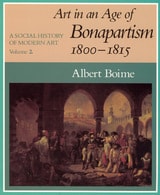
A Social History of Modern Art, Volume 2
Art in an Age of Bonapartism, 1800-1815Albert Boime
University of Chicago Press, 1990
Heavily illustrated, this volume is an invaluable social history of modern art during the Napoleonic era.
Stimulating and informative, this volume will become a valuable resource for faculty and undergraduates.—R. W. Liscombe, Choice

A Social History of Truth
Civility and Science in Seventeenth-Century EnglandSteven Shapin
University of Chicago Press, 1994
In A Social History of Truth, Shapin engages these universal questions through an elegant recreation of a crucial period in the history of early modern science: the social world of gentlemen-philosophers in seventeenth-century England. Steven Shapin paints a vivid picture of the relations between gentlemanly culture and scientific practice. He argues that problems of credibility in science were practically solved through the codes and conventions of genteel conduct: trust, civility, honor, and integrity. These codes formed, and arguably still form, an important basis for securing reliable knowledge about the natural world.
Shapin uses detailed historical narrative to argue about the establishment of factual knowledge both in science and in everyday practice. Accounts of the mores and manners of gentlemen-philosophers are used to illustrate Shapin's broad claim that trust is imperative for constituting every kind of knowledge. Knowledge-making is always a collective enterprise: people have to know whom to trust in order to know something about the natural world.
A Social Laboratory for Modern France
The Musée Social and the Rise of the Welfare StateJanet R. Horne
Duke University Press, 2001
Horne explains how Musée founders believed—and convinced others to believe—that the Third Republic would carry out the social mission of the French Revolution and create a new social contract for modern France, one based on the rights of citizenship and that assumed collective responsibility for the victims of social change. Challenging the persistent notion of the Third Republic as the stagnant backwater of European social reform, Horne instead depicts the intellectually sophisticated and progressive political culture of a generation that laid the groundwork for the rise of a hybrid welfare system, characterized by a partnership between private agencies and government. With a focus on the cultural origins of turn-of-the-century thought—including religion, republicanism, liberalism, solidarism, and early sociology—A Social Laboratory for Modern France demonstrates how French reformers grappled with social problems that are still of the utmost relevance today and how they initiated a process that gave the welfare state the task of achieving social cohesion within an industrializing republic.

A Socialist History of the French Revolution
Jean Jaurés
Pluto Press, 2021
Jean Jaurès was the celebrated French Socialist Party leader, assassinated in 1914 for trying to use diplomacy and industrial action to prevent the outbreak of war. Published just a few years before his death, his magisterial A Socialist History of the French Revolution has endured for over a century.
Written in the midst of his activities as leader of the Socialist Party and editor of its newspaper, L'Humanite, Jaurès intended the book to serve as both a guide and an inspiration to political activity; even now it can serve to do just that.
Jaurès's verve, originality, and willingness to criticize all players in this epic drama make this a truly moving addition to the shelf of great books on the French Revolution. Mitchell Abidor's abridged translation of Jaurès's original six volumes makes this exceptional work truly accessible to an Anglophone audience.

A Socialist Peace?
Explaining the Absence of War in an African CountryMike McGovern
University of Chicago Press, 2017
Guinea is rich in resources, but its people are some of the poorest in the world. Its political situation is polarized by fiercely competitive ethnic groups. Weapons flow freely through its lands and across its borders. And, finally, it is still recovering from the oppressive regime of Sékou Touré. McGovern argues that while Touré’s reign was hardly peaceful, it was successful—often through highly coercive and violent measures—at establishing a set of durable national dispositions, which have kept the nation at peace. Exploring the ambivalences of contemporary Guineans toward the afterlife of Touré’s reign as well as their abiding sense of socialist solidarity, McGovern sketches the paradoxes that undergird political stability.

A Socialist Utopia in the New South
The Ruskin Colonies in Tennessee and Georgia, 1894-1901W. Fitzhugh Brundage
University of Illinois Press, 1996
This first book-length study of the Ruskin colonies shows how several hundred utopian socialists gathered as a cooperative community in Tennessee and Georgia in the late nineteenth century. The communitarians' noble but fatally flawed act of social endeavor revealed the courage and desperation they felt as they searched for alternatives to the chaotic and competitive individualism of the age of robber barons and for a viable model for a just and humane society at a time of profound uncertainty about public life in the United States.
A Society Transformed
Hungary in Time-Space PerspectiveRichard Rose
Central European University Press, 1999

A Soldier in World War I
The Diary of Elmer W. SherwoodRobert H. Ferrell
Indiana Historical Society Press, 2004
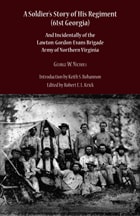
A Soldier's Story of His Regiment (61st Georgia)
And Incidentally of the Lawton-Gordon-Evans Brigade Army of Northern VirginiaGeorge W. Nichols
University of Alabama Press, 2011
Nichol’s 61st Georgia fought in the renowned brigade commanded consecutively by generals Alexander R. Lawton, John B. Gordon, and Clement A. Evans.
Framed without any excess of sentimental hindsight, in addition to reporting on great battles and dramatic moments, Nichol’s told the story of two cousins killing each other in a quarrel about cooking duties and described maggot-infested corpses around Spotsylvania’s Bloody Angle.
Includes an annotated roster of the 61st supplies which details about Nichol’s fellow veterans, some of which is not available anywhere else.
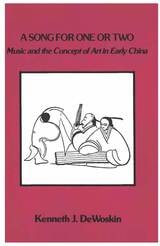
A Song for One or Two
Music and the Concept of Art in Early ChinaKenneth J. DeWoskin
University of Michigan Press, 1982
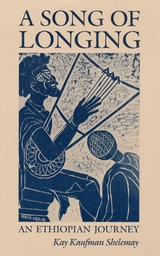
A Song of Longing
AN ETHIOPIAN JOURNEYKay Kaufman Shelemay
University of Illinois Press, 1992
-- Library Journal
"Highly recommended to generalists in music as well as to specialists interested in Ethiopia. . . . Also makes an excellent case study text for university-level courses examining fieldwork issues and conditions."
-- Notes
"Highly recommended for both undergraduate and graduate collections in ethnomusicology, anthropology, African, and Judaic studies."
-- Choice
A Sound History
Lawrence Gellert, Black Musical Protest, and White DenialSteven P. Garabedian
University of Massachusetts Press, 2020
Lawrence Gellert has long been a mysterious figure in American folk and blues studies, gaining prominence in the left-wing folk revival of the 1930s for his fieldwork in the U.S. South. A “lean, straggly-haired New Yorker,” as Time magazine called him, Gellert was an independent music collector, without formal training, credentials, or affiliation. At a time of institutionalized suppression, he worked to introduce white audiences to a tradition of black musical protest that had been denied and overlooked by prior white collectors.
By the folk and blues revival of the 1960s, however, when his work would again seem apt in the context of the civil rights movement, Gellert and his collection of Negro Songs of Protest were a conspicuous absence. A few leading figures in the revival defamed Gellert as a fraud, dismissing his archive of black vernacular protest as a fabrication—an example of left-wing propaganda and white interference. A Sound History is the story of an individual life, an excavation of African American musical resistance and dominant white historiography, and a cultural history of radical possibility and reversal in the defining middle decades of the U.S. twentieth century.
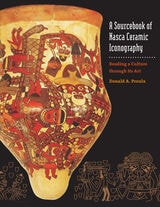
A Sourcebook of Nasca Ceramic Iconography
Reading a Culture through Its ArtProulx, Donald A.
University of Iowa Press, 2006

A Southern Illinois Album
Farm Security Administration Photographs, 1936-1943Herbert K. Russell. Foreword by F. Jack Hurley
Southern Illinois University Press, 1990

A Southern Record
The History of the Third Regiment Louisiana InfantryWilliam Tunnard
University of Arkansas Press, 1997
Originally published in a limited edition in 1866, this memoir of Will Tunnard’s experiences and observations of the Civil War in the West, where he served in the famed Third Louisiana Infantry, is one of only a handful of chronicles left by western Confederate soldiers. His first-person account of the battles of Wilson’s Creek, Pea Ridge, Iuka, and Corinth as well as the seige of Vicksburg, is a vivid history of these hard-fought campaigns which determined the outcome of the war in the Trans-Mississippi theater.
Using letters and diaries assembled from former comrades as well as his own daily journal, Tunnard tells the story of his regiment and its extraordinary odyssey from the Gulf of Mexico to the Ozark Plateau and from the Indian Territory to Mobile Bay. He offers an extensive and valuable account of capture and parole at Vicksburg and includes muster rolls which will interest genealogists as well as Civil War scholars and history enthusiasts. With a clear eye for detail and an engaging, objective style, Tunnard conveys the pathos of war and recounts the trials of camp life, social conditions, and the war’s affect on the civilian population.
Noted Civil War scholar William L. Shea supports the original text with background on the regiment and the time period, sketching a helpful chronology of events. In retelling this remarkable story of comradeship, hardship, endurance, courage, pride, and eventual defeat, Tunnard and Shea give modern readers a rare glimpse of the war in the West.
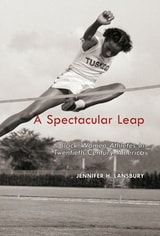
A Spectacular Leap
Black Women Athletes in Twentieth-Century AmericaJennifer H. Lansbury
University of Arkansas Press, 2014

A Spectacular Secret
Lynching in American Life and LiteratureJacqueline Goldsby
University of Chicago Press, 2006
To pursue this argument, Goldsby traces lynching's history by taking up select mob murders and studying them together with key literary works. She focuses on three prominent authors—Ida B. Wells-Barnett, Stephen Crane, and James Weldon Johnson—and shows how their own encounters with lynching influenced their analyses of it. She also examines a recently assembled archive of evidence—lynching photographs—to show how photography structured the nation's perception of lynching violence before World War I. Finally, Goldsby considers the way lynching persisted into the twentieth century, discussing the lynching of Emmett Till in 1955 and the ballad-elegies of Gwendolyn Brooks to which his murder gave rise.
An empathic and perceptive work, A Spectacular Secret will make an important contribution to the study of American history and literature.
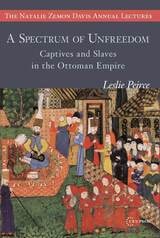
A Spectrum of Unfreedom
Captives and Slaves in the Ottoman EmpireLeslie Peirce
Central European University Press, 2021
Without the labor of the captives and slaves, the Ottoman empire could not have attained and maintained its strength in early modern times. With Anatolia as the geographic focus, Leslie Peirce searches for the voices of the unfree, drawing on archives, histories written at the time, and legal texts.
Unfree persons comprised two general populations: slaves and captives. Mostly household workers, slaves lived in a variety of circumstances, from squalor to luxury. Their duties varied with the status of their owner. Slave status might not last a lifetime, as Islamic law and Ottoman practice endorsed freeing one’s slave.
Captives were typically seized in raids, generally to disappear, their fates unknown. Victims rarely returned home, despite efforts of their families and neighbors to recover them. The reader learns what it was about the Ottoman environment of the sixteenth and seventeenth centuries that offered some captives the opportunity to improve the conditions of their bondage. The book describes imperial efforts to fight against the menace of captive-taking despite the widespread corruption among the state’s own officials, who had their own interest in captive labor.
From the fortunes of captives and slaves the book moves to their representation in legend, historical literature, and law, where, fortunately, both captors and their prey are present.

A Spiritual Revolution
The Impact of Reformation and Enlightenment in Orthodox Russia, 1700–1825Andrey V. Ivanov
University of Wisconsin Press, 2023
Embedded with lively portrayals of historical actors and vivid descriptions of political details, A Spiritual Revolution is the first large-scale effort to fully identify exactly how Western progressive thought influenced the Russian Church. These new ideas played a foundational role in the emergence of the country as a modernizing empire and the rise of the Church hierarchy as a forward-looking agency of institutional and societal change. Ivanov addresses this important debate in the scholarship on European history, firmly placing Orthodoxy within the much wider European and global continuum of religious change.
A Sporting Time
New York City and the Rise of Modern Athletics, 1820-70Melvin L. Adelman
University of Illinois Press, 1986

A Sportswriter's Life
From the Desk of a New York Times ReporterGerald Eskenazi
University of Missouri Press, 2004
In 1959, Gerald Eskenazi dropped out of City College, not for the first time, and made his way to the New York Times. That day the paper had two openings—one in news and one in sports. Eskenazi was offered either for thirty-eight dollars a week. He chose sports based on his image of the sports department as a cozier place than the news department. Forty-one years and more than eighty-four hundred stories later, New Yorkers know he made the right decision.
A Stage of Their Own
Feminist Playwrights of the Suffrage EraSheila Stowell
University of Michigan Press, 1994
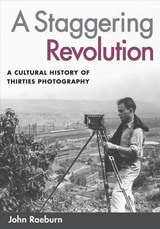
A Staggering Revolution
A Cultural History of Thirties PhotographyJohn Raeburn
University of Illinois Press, 2006
While other studies of thirties photography have concentrated on the documentary work of the Farm Security Administration (FSA), no previous book has considered it alongside so many of the decade's other important photographic projects. A Staggering Revolution includes individual chapters on Edward Steichen's celebrity portraiture; Berenice Abbott's Changing New York project; the Photo League's ethnography of Harlem; and Edward Weston's western landscapes, made under the auspices of the first Guggenheim Fellowship awarded to a photographer. It also examines Margaret Bourke-White's industrial and documentary pictures, the collective undertakings by California's Group f.64, and the fashion magazine specialists, as well as the activities of the FSA and the Photo League.

A State of Health
New Jersey's Medical HeritageReeds, Karen
Rutgers University Press, 2002
Did you know that New Jersey spearheaded the discovery of antibiotics? Or that the Garden State had the first state hospital serving the mentally ill and the first community rescue squad? And did you know that close to a million people around the world can walk again, thanks to the New Jersey Knee?
New Jersey is a small state that has played a big role in the history of medicine. Adrenalin, streptomycin, pure milk, tranquilizers, malaria control, cortisone, vitamins, revelations of radium's dangers—New Jersey’s impressive contributions to American health have been on display in a major traveling exhibition, “A State of Health: New Jersey’s Medical Heritage.” By 2002, more than twelve sites throughout New Jersey and Philadelphia will have hosted this display.
This catalogue to the exhibition celebrates more than four centuries of New Jersey medicine through original essays and 150-plus striking illustrations of artifacts, manuscripts, books, photographs, works of art, and postcards. Taking subjects of perennial interest—epidemics, children’s health, public health, hospitals, and biomedical research—curator Karen Reeds explores the state’s rich medical heritage and its uniqueplace as the heart of the world’s pharmaceutical industry.
Engagingly written and handsomely produced, A State of Health: New Jersey’s
Medical Heritage is at once a lasting resource for students, teachers, and historians and the perfect gift to your favorite healthcare professional or local history buff.
A Stitch in Time
The Needlework of Aging Women in Antebellum AmericaAimee E. Newell
Ohio University Press, 2014
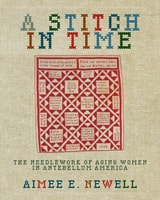
Drawing from 167 examples of decorative needlework—primarily samplers and quilts from 114 collections across the United States—made by individual women aged forty years and over between 1820 and 1860, this exquisitely illustrated book explores how women experienced social and cultural change in antebellum America.
The book is filled with individual examples, stories, and over eighty fine color photographs that illuminate the role that samplers and needlework played in the culture of the time. For example, in October 1852, Amy Fiske (1785–1859) of Sturbridge, Massachusetts, stitched a sampler. But she was not a schoolgirl making a sampler to learn her letters. Instead, as she explained, “The above is what I have taken from my sampler that I wrought when I was nine years old. It was w[rough]t on fine cloth [and] it tattered to pieces. My age at this time is 66 years.”
Situated at the intersection of women’s history, material culture study, and the history of aging, this book brings together objects, diaries, letters, portraits, and prescriptive literature to consider how middle-class American women experienced the aging process. Chapters explore the physical and mental effects of “old age” on antebellum women and their needlework, technological developments related to needlework during the antebellum period and the tensions that arose from the increased mechanization of textile production, and how gift needlework functioned among friends and family members. Far from being solely decorative ornaments or functional household textiles, these samplers and quilts served their own ends. They offered aging women a means of coping, of sharing and of expressing themselves. These “threads of time” provide a valuable and revealing source for the lives of mature antebellum women.
Publication of this book was made possible in part through generous funding from the Coby Foundation, Ltd and from the Quilters Guild of Dallas, Helena Hibbs Endowment Fund.

A Store Almost in Sight
The Economic Transformation of Missouri from the Lousiana Purchase to the Civil WarJeff Bremer
University of Iowa Press, 2014
Most Missourians welcomed the opportunity to take part in commercial markets. Farmwomen sold eggs or butter to peddlers and in nearby towns, while men took surplus corn or pork to stores for credit. Immigrants searched for the most fertile land closest to waterways, to ensure they would have large harvests and an easy way to ship them to market. Families floated farm goods downriver until steamboats transformed rural life by drastically reducing the cost of transportation and boosting farm production and consumption. Traders also trekked west across the plains to trade at the inland entrepôt of Santa Fe. The waves of migrants headed for Oregon and California in the 1840s and 1850s further encouraged commercial development. However, most white settlers lacked the necessary financial means to be capitalists in a technical sense, seeking instead a “competency,” or comfortable independence.
This fresh reinterpretation of the American frontier will interest anyone who wants to understand the economic and social significance of westward migration in U.S. history. It gives the reader a gritty, grassroots sense of how ordinary people made their livings and built communities in the lands newly opened to American settlement.
A Storied Sage
Canon and Creation in the Making of a Japanese BuddhaMicah L. Auerback
University of Chicago Press, 2016
Micah L. Auerback follows the changing fortune of the Buddha through the novel uses for the Buddha’s story in high and low culture alike, often outside of the confines of the Buddhist establishment. Auerback argues for the Buddha’s continuing relevance during Japan’s early modern period and links the later Buddhist tradition in Japan to its roots on the Asian continent. Additionally, he examines the afterlife of the Buddha in hagiographic literature, demonstrating that the late Japanese Buddha, far from fading into a ghost of his former self, instead underwent an important reincarnation. Challenging many established assumptions about Buddhism and its evolution in Japan, A Storied Sage is a vital contribution to the larger discussion of religion and secularization in modernity.

A Stranger in the Hague
The Letters of Queen Sophie of the Netherlands to Lady Malet, 1842–1877S. W. Jackman and Hella Haasse, eds.
Duke University Press, 1989
Sophie met her friend and confidant Marina Dora Spading, Lady Malt, when the latter was at the Hague with her diplomat husband in 1842. A lifelong friendship ensued, although they saw each other only infrequently thereafter. Sophie’s letters to Lady Malt are an extraordinary combination of comments on her personal situation and shrewd analyses of the European political arena. This selection of her surviving correspondence is opinionated, frank, and perceptive, and her letters are a unique commentary on the affairs of the Europe of the mid-nineteenth century.
A Stricken Field
A NovelMartha Gellhorn
University of Chicago Press, 2011
Martha Gellhorn was one of the first—and most widely read—female war correspondents of the twentieth century. She is best known for her fearless reporting in Europe before and during WWII and for her brief marriage to Ernest Hemingway, but she was also an acclaimed novelist.
A Strike Like No Other Strike
Law and Resistance During the Pittston Coal Strike of 1989-1990Richard A. Brisbin, Jr.
West Virginia University Press, 2010
The miners' strike against Pittston Coal in 1989–1990, which spread throughout southwestern Virginia, southern West Virginia, and eastern Kentucky, was one of the most important strikes in the history of American labor, and, as Richard Brisbin observes, "one of the longest and largest incidents of civil disorder and civil disobedience in the United States in the second half of the twentieth century." The company aggressively sought to break the strike, and workers and their families used a variety of tactics—lawful and unlawful—to resist Pittston's efforts as the situation quickly turned ugly.
In A Strike like No Other Strike: Law and Resistance during the Pittston Coal Strike of 1989–1990, Richard Brisbin offers a compelling study of the exercise of political power. In considering the legal significance of the strike, Brisbin asks the larger question of whether even extreme transgression or resistance can fracture the "imagined coherence of the law." He shows how each party in the strike invoked the law to justify its actions while attacking those of the other side as unlawful. In the end, both sides lost; although the U.S. Supreme Court ultimately ruled in favor of the union, most of the strikers faced elimination of their jobs and an ongoing struggle for pensions and health benefits.

A Stroll with William James
Jacques Barzun
University of Chicago Press, 1983

A Strong-Minded Woman
The Life of Mary LivermoreWendy Hamand Venet
University of Massachusetts Press, 2005
When Mary Livermore died in 1905 at age 84, a Boston newspaper praised her as “America's foremost woman.” A leading figure in the struggle for woman's rights as well as in the temperance movement, she was as widely recognized during her lifetime as Susan B. Anthony, and for a time the most popular and highly paid female orator in the country. Yet aside from Civil War historians familiar with her service as a wartime nurse, few today remember even her name.
In this book, Wendy Hamand Venet reconstructs Mary Livermore's remarkable story and explores how and why she became so renowned in her day. Born and raised in Boston, Livermore left home at age eighteen to become the private schoolteacher to a wealthy tobacco planter's children in Virginia, an experience that afforded her an intimate look at slave-based society in the 1840s. Returning to New England, she married and lived a conventional life as the wife of a minister and mother of three daughters. With the coming of the Civil War, however, Livermore's life changed dramatically when she became active with the United States Sanitary Commission, an organization that would propel her into the public limelight and cause her to challenge society's traditional view of the role of women.
After the war Livermore became deeply involved in the woman's rights movement, serving as editor of the newspaper Woman's Journal and later as president of three major suffrage organizations—the American, New England, and Massachusetts Woman Suffrage Associations. She was also founder and president of the Massachusetts Women's Christian Temperance Union, and became active in the Society of Christian Socialists in Boston. Her frequent speaking appearances on behalf of these causes eventually earned her the nickname “Queen of the Platform.” Although she may not have been as radical as some other early feminists, Livermore's ideas resonated with thousands of middle-class women whose experiences paralleled her own. For that reason alone, Venet shows, her life and legacy are worthy of our attention.
A Student Commentary on Pausanias Book 1
Patrick Paul Hogan
University of Michigan Press, 2014
A Study of Some Michigan Indians
Frances Densmore
University of Michigan Press, 1949

A Study of Southwestern Archaeology
Stephen H. Lekson
University of Utah Press, 2018
Focusing on the enigmatic monumental center at Chaco Canyon, the book provides a historical analysis of how Southwest archaeology confined itself, how it can break out of those confines, and how it can proceed into the future. Lekson suggests that much of what we believe about the ancient Southwest should be radically revised. Looking past old preconceptions brings a different Chaco Canyon into view: more than an eleventh-century Pueblo ritual center, Chaco was a political capital with nobles and commoners, a regional economy, and deep connections to Mesoamerica. By getting the history right, a very different science of the ancient Southwest becomes possible and archaeology can be reinvented as a very different discipline.
Notes
https://uofupress.lib.utah.edu/wp-content/uploads/sites/21/2019/04/Lekson-Notes.pdf

A Study of War
Quincy Wright
University of Chicago Press, 1983
"The most comprehensive work ever published in any language on the history, the nature, the causes, and the cure of war. . . . A Study of War is a liberal education in the social disciplines."—Frederick L. Schuman
"A major contribution to the realistic study of international relations."—Garrett Mattingly, New York Times
A Study of the Glacial Kame Culture in Michigan, Ohio, and Indiana
Wilbur M. Cunningham
University of Michigan Press, 1948

A Suburb of Europe
Nineteenth-Century Polish Approaches to Western CivilizationJerzy Jedlicki
Central European University Press, 2000
In this lively and original book, the distinguished Polish historian Jerzy Jedlicki tells the story of a century-long Polish dispute over the merits and demerits of the Western model of liberal progress and industrial civilization.
As in several countries of Europe, also in Poland, intellectuals--conservatives, liberals, and (later) socialists--quarrelled about whether such a model would suit and benefit their nation, or whether it would spell the ruin of its distinctive cultural features.
This heated debate revolved around several pairs of opposing ideas: native cultures v. cosmopolitan civilization; natural v. artificial ways of economic development; Christian morals v. capitalist laissez-faire; traditional customs v. mobile society; romanticism v. scientism, and so on. It is these various aspects of the main issue which the author analyzes and links together here. He describes how difficult and painful the process of modernization was in a nation deprived of its political independence and cultural autonomy.
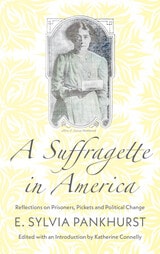
A Suffragette in America
Reflections on Prisoners, Pickets and Political ChangeSylvia Pankhurst
Pluto Press, 2019
This book gathers Pankhurst’s writings from the year-long visit, in which she reveals her shock at the darkness hidden in American life, and draws parallels to her experiences of imprisonment and misogyny in her own country. Never before published, these writings mark an important stage in the development of the suffragette's thought, which she brought back to Britain to inform the burgeoning suffrage campaign there.
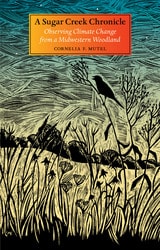
A Sugar Creek Chronicle
Observing Climate Change from a Midwestern WoodlandCornelia F. Mutel
University of Iowa Press, 2016
Moving between two timelines, Mutel pairs chapters about a single year in her Iowa woodland with chapters about her life as a fledgling and then professional student of nature. Stories of her childhood ramblings in Wisconsin and the solace she found in the Colorado mountains during early adulthood are merged with accounts of global environmental dilemmas that have redefined nature during her lifespan. Interwoven chapters bring us into her woodland home to watch nature’s cycles of life during a single year, 2012, when weather records were broken time and time again. Throughout, in a straightforward manner for a concerned general audience, Mutel integrates information about the science of climate change and its dramatic alteration of the planet in ways that clarify its broad reach, profound impact, and seemingly relentless pace.
It is not too late, she informs us: we can still prevent the most catastrophic changes. We can preserve a world full of biodiversity, one that supports human lives as well as those of our myriad companions on this planet. In the end, Mutel offers advice about steps we can all take to curb our own carbon emissions and strategies we can suggest to our policy-makers.