Results by title
1218 books match the query 'African Americans' and 119 start with a
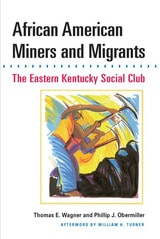
African American Miners and Migrants
THE EASTERN KENTUCKY SOCIAL CLUBThomas E. Wagner and Phillip J. Obermiller; Afterword by William H. Turner
University of Illinois Press, 2004
Bound together by segregation, the inherent dangers of mining, and coal company paternalism, it might seem that black miners and mountaineers would be eager to forget their past. Instead, members of the EKSC have chosen to celebrate their Harlan County roots. African American Miners and Migrants uses historical and archival research and extensive personal interviews to explore their reasons and the ties that still bind them to eastern Kentucky. The book also examines life in the model coal towns of Benham and Lynch in the context of Progressive Era policies, the practice of welfare capitalism, and the contemporary national trend of building corporate towns and planned communities.
African American Organized Crime
A Social HistorySchatzberg, Rufus
Rutgers University Press, 1997
While stories of organized crime most often dwell on groups like the Mafia and Chinese Triad or Tongs, African Americans also have a long history of organized crime. Why have scholars and journalists paid so little attention to African American organized crime? What can a history of these criminal networks teach us about the social, political, and economic challenges that face African Americans today? What is specific to African American organized crime, and how do these networks differ from the criminal organizations of other racial and ethnic groups? How can a historical study of African American organized crime enrich our understanding of all criminal activity?
Rufus Schatzberg and Robert Kelly take us through almost a century of African American organized crime. Chapters focus on the numbers gambling that took place in New York City from 1920 to 1940, the criminal groups that operated in ghettos from the 1940s to the 1970s, and the gang activities that began in the 1970s and continues today. While providing a compelling analysis of African American organized crime, the authors also challenge existing stereotypes of African Americans and demonstrate the importance of studying any criminal activity within its historical and social context.
African American Political Thought
A Collected HistoryEdited by Melvin L. Rogers and Jack Turner
University of Chicago Press, 2021
While African American political thought is inextricable from the historical movement of American political thought, this volume stresses the individuality of Black thinkers, the transnational and diasporic consciousness, and how individual speakers and writers draw on various traditions simultaneously to broaden our conception of African American political ideas. This landmark volume gives us the opportunity to tap into the myriad and nuanced political theories central to Black life. In doing so, African American Political Thought: A Collected History transforms how we understand the past and future of political thinking in the West.
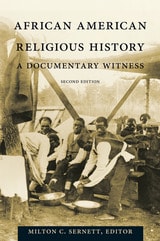
African American Religious History
A Documentary WitnessMilton C. Sernett, ed.
Duke University Press, 2000
Originally published in 1985, this expanded second edition includes new sources on women, African missions, and the Great Migration. Milton C. Sernett provides a general introduction as well as historical context and comment for each document.
African American Religious Studies
An Interdisciplinary AnthologyGayraud Wilmore, editor
Duke University Press, 1989
African American Satire
The Sacredly Profane NovelDarryl Dickson-Carr
University of Missouri Press, 2001
Satire's real purpose as a literary genre is to criticize through humor, irony, caricature, and parody, and ultimately to defy the status quo. In African American Satire, Darryl Dickson-Carr provides the first book-length study of African American satire and the vital role it has played. In the process he investigates African American literature, American literature, and the history of satire.
Dickson-Carr argues that major works by such authors as Rudolph Fisher, Ishmael Reed, Ralph Ellison, Langston Hughes, and George S. Schuyler should be read primarily as satires in order to avoid misinterpretation and to gain a greater understanding of their specific meanings and the eras in which they were written. He also examines the satirical rhetoric and ideological bases of complex works such as John Oliver Killens's The Cotillion and Cecil Brown's The Life and Loves of Mr. Jiveass Nigger—books that are currently out of print and that have received only scant critical attention since they were first published.
Beginning with the tradition of folk humor that originated in West Africa and was forcibly transplanted to the Americas through chattel slavery, Dickson-Carr focuses in each chapter on a particular period of the twentieth century in which the African American satirical novel flourished. He analyzes the historical contexts surrounding African American literature and culture within discrete crucial movements, starting with the Harlem Renaissance of the 1920s and ending in the present. He also demonstrates how the political, cultural, and literary ethos of each particular moment is manifested and contested in each text.
By examining these texts closely within their historical and ideological contexts, Dickson-Carr shows how African American satirical novels provide the reader of African American literature with a critique of popular ideologies seldom found in nonsatirical works. Providing a better understanding of what satire is and why it is so important for fulfilling many of the goals of African American literature, African American Satire will be an important addition to African American studies.
African American Women and the Vote, 1837–1965
Ann D. Gordon
University of Massachusetts Press, 1997
Written by leading scholars of African American and women's history, the essays in this volume seek to reconceptualize the political history of black women in the United States by placing them “at the center of our thinking.” The book explores how slavery, racial discrimination, and gender shaped the goals that African American women set for themselves, their families, and their race and looks at the political tools at their disposal. By identifying key turning points for black women, the essays create a new chronology and a new paradigm for historical analysis. The chronology begins in 1837 with the interracial meeting of antislavery women in New York City and concludes with the civil rights movement of the 1960s.
The contributors focus on specific examples of women pursuing a dual ambition: to gain full civil and political rights and to improve the social conditions of African Americans. Together, the essays challenge us to rethink common generalizations that govern much of our historical thinking about the experience of African American women.
Contributors include Bettina Aptheker, Elsa Barkley Brown, Willi Coleman, Gerald R. Gill, Ann D. Gordon, Evelyn Brooks Higginbotham, Cynthia Neverdon-Morton, Martha Prescod Norman, Janice Sumler-Edmond, Rosalyn Terborg-Penn, and Bettye Collier-Thomas.
African American Workers and the Appalachian Coal Industry
Joe William Trotter
West Virginia University Press, 2024
This collection brings together nearly three decades of research on the African American experience, class, and race relations in the Appalachian coal industry. It shows how, with deep roots in the antebellum era of chattel slavery, West Virginia’s Black working class gradually picked up steam during the emancipation years following the Civil War and dramatically expanded during the late nineteenth and early twentieth centuries.
From there, African American Workers and the Appalachian Coal Industry highlights the decline of the region’s Black industrial proletariat under the impact of rapid technological, social, and political changes following World War II. It underscores how all miners suffered unemployment and outmigration from the region as global transformations took their toll on the coal industry, but emphasizes the disproportionately painful impact of declining bituminous coal production on African American workers, their families, and their communities. Joe Trotter not only reiterates the contributions of proletarianization to our knowledge of US labor and working-class history but also draws attention to the gender limits of studies of Black life that focus on class formation, while calling for new transnational perspectives on the subject. Equally important, this volume illuminates the intellectual journey of a noted labor historian with deep family roots in the southern Appalachian coalfields.
African Americans and Jews in the Twentieth Century
Studies in Convergence and ConflictEdited by V.P. Franklin, Nancy L. Grant, Harold M. Kletnick, & Genna Rae McNeil
University of Missouri Press, 1998
In 1993 distinguished historian Nancy L. Grant organized "Blacks and Jews: An American Historical Perspective," a conference held at Washington University in St. Louis and dedicated to the exploration of Black-Jewish relations in twentieth-century America. Featuring presentations by historians, sociologists, and political scientists, this conference reflected Grant's devotion to scholarship on multicultural relations and the continuing struggle for racial equality in the United States. After Grant's untimely death in 1995, V. P. Franklin and the other contributors completed the work of readying these essays for publication with the assistance of the coeditors. African Americans and Jews in the Twentieth Century is the culmination of the innovative research and ideas presented at the conference.
In the long struggle to bring social justice to American society, Blacks and Jews have often been close allies. In both the past and the present, however, there has also been serious conflict and competition between the groups in social, economic, and political spheres.
Focusing on the complexity of the relationships between Blacks and Jews in America, these essays examine the convergence and conflict that have characterized Black-Jewish interactions over the past century. African Americans and Jews in the Twentieth Century provides an intellectual foundation for continued dialogue and future cooperative efforts to improve social justice in this society and will be an invaluable resource for the study of race relations in the United States in the twentieth century.
African Americans and the Color Line in Ohio
1915–1930William W. Giffin
The Ohio State University Press, 2005
African Americans in Michigan
Lewis Walker
Michigan State University Press, 2001
African Americans, as free laborers and as slaves, were among the earliest permanent residents of Michigan, settling among the French, British, and Native people with whom they worked and farmed. Lewis Walker and Benjamin Wilson recount the long history of African American communities in Michigan, delineating their change over time, as migrants from the South, East, and overseas made their homes in the state. Moreover, the authors show how Michigan's development is inextricably joined with the vitality and strength of its African American residents. In a related chapter, Linwood Cousins examines youth culture and identity in African American schools, linking education with historical and contemporary issues of economics, racism, and power.
African Americans in U.S. Foreign Policy
From the Era of Frederick Douglass to the Age of ObamaEdited by Linda Heywood, Allison Blakely, Charles Stith, and Joshua C. Yesnowitz
University of Illinois Press, 2015
Groundbreaking and critical, African Americans in U.S. Foreign Policy expands on the scope and themes of recent collections to offer the most up-to-date scholarship to students in a range of disciplines, including U.S. and African American history, Africana studies, political science, and American studies.
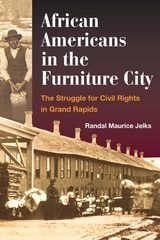
African Americans in the Furniture City
The Struggle for Civil Rights in Grand RapidsRandal Maurice Jelks
University of Illinois Press, 2006
Focusing on the intersection of African Americans' nineteenth-century cultural values and the changing social and political conditions in the first half of the twentieth century, Jelks pays particularly close attention to the religious community's influence during their struggle toward a respectable social identity and fair treatment under the law. He explores how these competing values defined the community's politics as it struggled to expand its freedoms and change its status as a subjugated racial minority.
African Americans in the Reconstruction of Florida, 1865-1877
Joe M. Richardson
University of Alabama Press, 2008
Exploration of African American contributions to the state of Florida during the era of Reconstruction
Despite their shortcomings, “radical” politicians, including African Americans, made worthy contributions to the state of Florida during the era of Reconstruction. Joe Richardson disputes many of the misconceptions about the state’s debt and corruption by exploring how some African American politicians were quite capable and learned their duties quickly. Even more remarkable was the rapidity with which the unlettered ex-slaves absorbed education and adjusted to their status as free men. African Americans in the Reconstruction of Florida delves into the problems encountered by the freed men and traces their successes and failures during the first decade after emancipation.
African Intellectual Heritage
Molefi Asante
Temple University Press, 1996
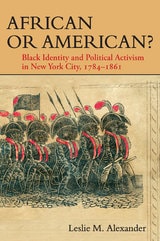
African or American?
Black Identity and Political Activism in New York City, 1784-1861Leslie M. ALexander
University of Illinois Press, 2012
During the early national and antebellum eras, black leaders in New York City confronted the tenuous nature of Northern emancipation. Despite the hope of freedom, black New Yorkers faced a series of sociopolitical issues including the persistence of Southern slavery, the threat of forced removal, racial violence, and the denial of American citizenship. Even efforts to create community space within the urban landscape, such as the African Burial Ground and Seneca Village, were eventually demolished to make way for the city's rapid development. In this illuminating history, Leslie M. Alexander chronicles the growth and development of black activism in New York from the formation of the first black organization, the African Society, in 1784 to the eve of the Civil War in 1861. In this critical period, black activists sought to formulate an effective response to their unequal freedom. Examining black newspapers, speeches, and organizational records, this study documents the creation of mutual relief, religious, and political associations, which black men and women infused with African cultural traditions and values.
As Alexander reveals, conflicts over early black political strategy foreshadowed critical ideological struggles that would bedevil the black leadership for generations to come. Initially, black leaders advocated racial uplift through a sense of communalism and connection to their African heritage. Yet by the antebellum era, black activists struggled to reconcile their African identity with a growing desire to gain American citizenship. Ultimately, this battle resulted in competing agendas; while some leaders argued that the black community should dedicate themselves to moral improvement and American citizenship, others began to consider emigrating to Africa or Haiti. In the end, the black leadership resolved to assert an American identity and to expand their mission for full equality and citizenship in the United States. This decision marked a crucial turning point in black political strategy, for it signaled a new phase in the quest for racial advancement and fostered the creation of a nascent Black Nationalism.
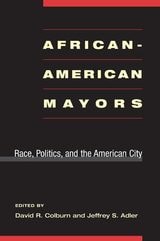
African-American Mayors
Race, Politics, and the American CityEdited by David R. Colburn and Jeffrey S. Adler
University of Illinois Press, 2001
Once in office, African-American mayors faced vexing challenges. In large and small cities from the Sunbelt to the Rustbelt, black mayors assumed office during economic downturns and confronted the intractable problems of decaying inner cities, white flight, a dwindling tax base, violent crime, and diminishing federal support for social programs. Many encountered hostility from their own parties, city councils, and police departments; others worked against long-established power structures dominated by local business owners or politicians. Still others, while trying to respond to multiple demands from a diverse constituency, were viewed as traitors by blacks expecting special attention from a leader of their own race. All struggled with the contradictory mandate of meeting the increasing needs of poor inner-city residents while keeping white businesses from fleeing to the suburbs.
This is the first comprehensive treatment of the complex phenomenon of African-American mayors in the nation's major urban centers. Offering a diverse portrait of leadership, conflict, and almost insurmountable obstacles, this volume assesses the political alliances that brought black mayors to office as well as their accomplishments--notably, increased minority hiring and funding for minority businesses--and the challenges that marked their careers. Mayors profiled include Carl B. Stokes (Cleveland), Richard G. Hatcher (Gary), "Dutch" Morial (New Orleans), Harold Washington (Chicago), Tom Bradley (Los Angeles), Marion Barry (Washington, D.C.), David Dinkins (New York City), Coleman Young (Detroit), and a succession of black mayors in Atlanta (Maynard Jackson, Andrew Young, and Bill Campbell).Probing the elusive economic dimension of black power, African-American Mayors demonstrates how the same circumstances that set the stage for the victories of black mayors exaggerated the obstacles they faced.

African-American Poetry of the Nineteenth Century
AN ANTHOLOGYEdited by Joan R. Sherman
University of Illinois Press, 1992
from first editions and are annotated in detail.
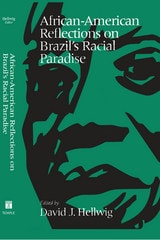
African-American Reflections on Brazil's Racial Paradise
David Hellwig
Temple University Press, 1992

Africana Studies
Theoretical FuturesEdited by Grant Farred
Temple University Press, 2022
As Africana Studies celebrates its fiftieth anniversary throughout the United States, this invigor ating collection presents possibilities for the future of the discipline’s theoretical paths. The essays in Africana Studies focus on philosophy, science, and technology; poetry, literature, and music; the crisis of the state; issues of colonialism, globalization, and neoliberalism; and the ever-expanding diaspora. The editor and contributors to this volume open exciting avenues for new narratives, philosophies, vision, and scale in this critical field of study—formed during the 1960s around issues of racial injustice in America—to show what Africana Studies is already in the process of becoming.
Africana Studies recognizes how the discipline has been shaped, changing over the decades as scholars have opened new modes of theoretical engagement such as addressing issues of gender and sexuality, politics, and cultural studies. The essays debate and (re)consider black and diasporic life to sustain, provoke, and cultivate Africana Studies as a singular yet polyvalent mode of thinking.
Contributors: Akin Adeṣọkan, John E. Drabinski, Zeyad El Nabolsy, Pierre-Philippe Fraiture, Kasareka Kavwahirehi, Gregory Pardlo, Radwa Saad, Sarah Then Bergh, and the editor
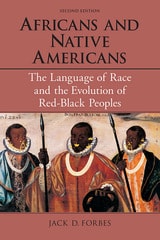
Africans and Native Americans
The Language of Race and the Evolution of Red-Black PeoplesJack D. Forbes
University of Illinois Press, 1993
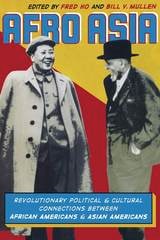
Afro Asia
Revolutionary Political and Cultural Connections between African Americans and Asian AmericansFred Ho and Bill V. Mullen, eds.
Duke University Press, 2008
Afro Asia opens with analyses of historical connections between people of African and of Asian descent. An account of nineteenth-century Chinese laborers who fought against slavery and colonialism in Cuba appears alongside an exploration of African Americans’ reactions to and experiences of the Korean “conflict.” Contributors examine the fertile period of Afro-Asian exchange that began around the time of the 1955 Bandung Conference, the first meeting of leaders from Asian and African nations in the postcolonial era. One assesses the relationship of two important 1960s Asian American activists to Malcolm X and the Black Panthers. Mao Ze Dong’s 1963 and 1968 statements in support of black liberation are juxtaposed with an overview of the influence of Maoism on African American leftists.
Turning to the arts, Ishmael Reed provides a brief account of how he met and helped several Asian American writers. A Vietnamese American spoken-word artist describes the impact of black hip-hop culture on working-class urban Asian American youth. Fred Ho interviews Bill Cole, an African American jazz musician who plays Asian double-reed instruments. This pioneering collection closes with an array of creative writing, including poetry, memoir, and a dialogue about identity and friendship that two writers, one Japanese American and the other African American, have performed around the United States.
Contributors: Betsy Esch, Diane C. Fujino, royal hartigan, Kim Hewitt, Cheryl Higashida, Fred Ho,
Everett Hoagland, Robin D. G. Kelley, Bill V. Mullen, David Mura, Ishle Park, Alexs Pate, Thien-bao Thuc Phi, Ishmael Reed, Kalamu Ya Salaam, Maya Almachar Santos, JoYin C. Shih, Ron Wheeler, Daniel Widener, Lisa Yun
Afro Orientalism
Bill V. Mullen
University of Minnesota Press, 2004
Reveals a century of political solidarity uniting Asians and African Americans
As early as 1914, in his pivotal essay “The World Problem of the Color Line,” W. E. B. Du Bois was charting a search for Afro-Asian solidarity and for an international anticolonialism. In Afro-Orientalism, Bill Mullen traces the tradition of revolutionary thought and writing developed by African American and Asian American artists and intellectuals in response to Du Bois’s challenge.
Afro-Orientalism unfolds here as a distinctive strand of cultural and political work that contests the longstanding, dominant discourse about race and nation first fully named in Edward Said’s Orientalism. Mullen tracks Afro-Asian engagement with U.S. imperialism—including writings by Richard Wright, Grace and James Boggs, Robert F. Williams, and Fred Ho—and companion struggles against racism and capitalism around the globe. To this end, he offers Afro-Orientalism as an antidote to essentialist, race-based, or narrow conceptions of ethnic studies and postcolonial studies, calling on scholars in these fields to re-imagine their critical enterprises as mutually constituting and politically interdependent.
Afro-American Literary Study in the 1990s
Edited by Houston A. Baker Jr. and Patricia Redmond
University of Chicago Press, 1989
"This diverse and inspired collection . . . testifies to the Afro-Am academy's extraordinary vitality."—Voice Literary Supplement
Afro-Nostalgia
Feeling Good in Contemporary Black CultureBadia Ahad-Legardy
University of Illinois Press, 2021
Badia Ahad-Legardy mines literature, visual culture, performance, and culinary arts to form an archive of black historical joy for use by the African-descended. Her analysis reveals how contemporary black artists find more than trauma and subjugation within the historical past. Drawing on contemporary African American culture and recent psychological studies, she reveals nostalgia’s capacity to produce positive emotions. Afro-nostalgia emerges as an expression of black romantic recollection that creates and inspires good feelings even within our darkest moments.
Original and provocative, Afro-Nostalgia offers black historical pleasure as a remedy to contend with the disillusionment of the present and the traumas of the past.
Afrocentric Idea Revised
Molefi Asante
Temple University Press, 1998
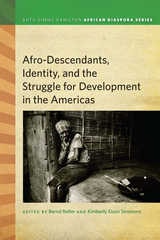
Afrodescendants, Identity, and the Struggle for Development in the Americas
Bernd Reiter
Michigan State University Press, 2012
Indigenous people and African descendants in Latin America and the Caribbean have long been affected by a social hierarchy established by elites, through which some groups were racialized and others were normalized. Far from being “racial paradises” populated by an amalgamated “cosmic race” of mulattos and mestizos, Latin America and the Caribbean have long been sites of shifting exploitative strategies and ideologies, ranging from scientific racism and eugenics to the more sophisticated official denial of racism and ethnic difference. This book, among the first to focus on African descendants in the region, brings together diverse reflections from scholars, activists, and funding agency representatives working to end racism and promote human rights in the Americas. By focusing on the ways racism inhibits agency among African descendants and the ways African-descendant groups position themselves in order to overcome obstacles, this interdisciplinary book provides a multi-faceted analysis of one of the gravest contemporary problems in the Americas.
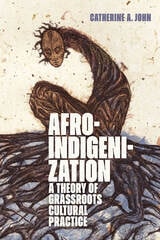
Afroindigenization
A Theory of Grassroots Cultural PracticeCatherine A. John
Duke University Press, 2026
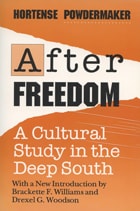
After Freedom
A Cultural Study In The Deep SouthHortense Powdermaker
University of Wisconsin Press, 1993
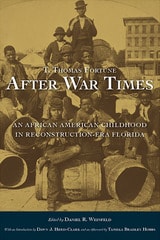
After War Times
An African American Childhood in Reconstruction-Era FloridaT. Thomas Fortune
University of Alabama Press, 2014
A firsthand account of African American childhood, freedom, and resilience in Reconstruction-era Florida.
T. Thomas Fortune was a leading African American publisher, editor, and journalist of the late nineteenth and early twentieth centuries, who was born a slave in antebellum Florida, lived through emancipation, and rose to become a literary lion of his generation. In T. Thomas Fortune's “After War Times,” Daniel R. Weinfeld brings together a series of twenty-three autobiographical articles Fortune wrote about his formative childhood during Reconstruction and subsequent move to Washington, DC.
By 1890, Fortune had founded a predecessor organization to the National Association for the Advancement of Colored People, known as the National Afro-American League, but his voice found its most powerful expression and influence in poetry, prose, and journalism. It was as a journalist that Fortune stirred national controversy by issuing a passionate appeal to African American southerners: “I propose to start a crusade,” he proclaimed in June 1900, “to have the negroes of the South leave that section and to come north or go elsewhere. It is useless to remain in the South and cry Peace! Peace! When there is no peace.” The movement he helped propel became known as “the Great Migration.”
By focusing on Thomas’s ruminations about his disillusion with post–Civil War Florida, Weinfeld highlights the sources of Fortune’s deep disenchantment with the South, which intensified when the Reconstruction order gave way to Jim Crow–era racial discrimination and violence. Decades after he left the South, Fortune’s vivid memories of incidents and personalities in his past informed his political opinions and writings. Scholars and readers interested in Southern history in the aftermath of the Civil War, especially the experiences of African Americans, will find much of interest in this vital collection of primary writings.
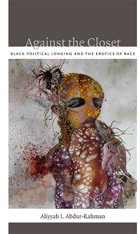
Against the Closet
Black Political Longing and the Erotics of RaceAliyyah I. Abdur-Rahman
Duke University Press, 2012
Abdur-Rahman brings black feminist, psychoanalytic, critical race, and poststructuralist theories to bear on literary genres from slave narratives to science fiction. Analyzing works by African American writers, including Frederick Douglass, Pauline Hopkins, Harriet Jacobs, James Baldwin, and Octavia Butler, she shows how literary representations of transgressive sexuality expressed the longings of African Americans for individual and collective freedom. Abdur-Rahman contends that those representations were fundamental to the development of African American forms of literary expression and modes of political intervention and cultural self-fashioning.
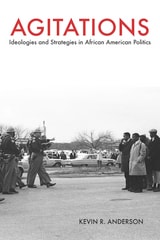
Agitations
Ideologies and Strategies in African American PoliticsKevin R. Anderson
University of Arkansas Press, 2010
Though the activities of the National Association for the Advancement of Colored People (NAACP), the Southern Christian Leadership Conference (SCLC), and the Student Nonviolent Coordinating Committee (SNCC) were unified in their common idea of resistance to oppression, these groups fought their battles on multiple fronts. The NAACP filed lawsuits and aggressively lobbied Congress and state legislatures, while Martin Luther King Jr. and SCLC challenged the racial status quo through nonviolent mass action, and the SNCC focused on community empowerment activities. In Agitations, Kevin Anderson studies these various activities in order to trace the ideological foundations of these groups and to understand how diversity among African Americans created multiple political strategies.
Agitations goes beyond the traditionally acknowledged divide between integrationist and accommodationist wings of African American politics to explore the diverse fundamental ideologies and strategic outcomes among African American activists that still define, influence, and complicate political life today.
Ain't But a Few of Us
Black Music Writers Tell Their StoryWillard Jenkins, editor
Duke University Press, 2022
Contributors
Eric Arnold, Bridget Arnwine, Angelika Beener, Playthell Benjamin, Herb Boyd, Bill Brower, Jo Ann Cheatham, Karen Chilton, Janine Coveney, Marc Crawford, Stanley Crouch, Anthony Dean-Harris, Jordannah Elizabeth, Lofton Emenari III, Bill Francis, Barbara Gardner, Farah Jasmine Griffin, Jim Harrison, Eugene Holley Jr., Haybert Houston, Robin James, Willard Jenkins, Martin Johnson, LeRoi Jones, Robin D. G. Kelley, Tammy Kernodle, Steve Monroe, Rahsaan Clark Morris, John Murph, Herbie Nichols, Don Palmer, Bill Quinn, Guthrie P. Ramsey Jr., Ron Scott, Gene Seymour, Archie Shepp, Wayne Shorter, A. B. Spellman, Rex Stewart, Greg Tate, Billy Taylor, Greg Thomas, Robin Washington, Ron Welburn, Hollie West, K. Leander Williams, Ron Wynn
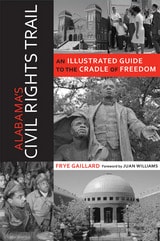
Alabama's Civil Rights Trail
An Illustrated Guide to the Cradle of FreedomFrye Gaillard
University of Alabama Press, 2009
Alabama’s great civil rights events in a compact and accessible narrative, paired with a practical guide to Alabama’s preserved civil rights sites and monuments
No other state has embraced and preserved its civil rights history more thoroughly than Alabama. Nor is there a place where that history is richer. Alabama’s Civil Rights Trail tells of Alabama’s great civil rights events, as well as its lesser-known moments, in a compact and accessible narrative, paired with a practical guide to Alabama’s preserved civil rights sites and monuments.
In this history of Alabama’s civil rights movement, Cradle of Freedom (University of Alabama Press, 2004), Frye Gaillard contends that Alabama played the lead role in a historic movement that made all citizens of the nation, black and white, more free. This book, geared toward the casual traveler and the serious student alike, showcases in a vividly illustrated and compelling manner, valuable and rich details. It provides a user-friendly, graphic tool for the growing number of travelers, students, and civil rights pilgrims who visit the state annually.
The story of the civil rights movement in Alabama is told city by city, region by region, and town by town, with entries on Montgomery, Birmingham, Selma, Tuscaloosa, Tuskegee, and Mobile, as well as chapters on the Black Belt and the Alabama hill country. Smaller but important locales such as Greensboro, Monroeville, and Scottsboro are included, as are more obscure sites like Hale County’s Safe House Black History Museum and the birthplace of the Black Panther Party in Lowndes County.
AlabamaNorth
African-American Migrants, Community, and Working-Class Activism in Cleveland, 1915-45Kimberley L. Phillips
University of Illinois Press, 1999
Langston Hughes called it "a great dark tide from the South": the unprecedented influx of blacks into Cleveland that gave the city the nickname "Alabama North." Kimberley L. Phillips reveals the breadth of working class black experiences and activities in Cleveland and the extent to which these were shaped by traditions and values brought from the South.
Migrants' moves north established complex networks of kin and friends and infused Cleveland with a highly visible southern African American culture. Phillips examines the variety of black fraternal, benevolent, social, and church-based organizations that working class migrants created and demonstrates how these groups prepared the way for new forms of individual and collective activism in workplaces and the city. Giving special consideration to the experiences of working class black women, AlabamaNorth reveals how migrants' expressions of tradition and community gave them a new consciousness of themselves as organized workers and created the underpinning for new forms of black labor activism.
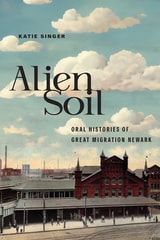
Alien Soil
Oral Histories of Great Migration NewarkKatie Singer
Rutgers University Press, 2024
The book begins with the Krueger-Scott Mansion’s deep history, followed by the sequence of events surrounding the proposed Cultural Center. Last owned by African-American millionaire and beauty-culture entrepreneur Louise Scott, the Victorian Krueger-Scott Mansion was built by beer baron Gottfried Krueger in 1888. Through the history of the Mansion, and the ultimately failed Cultural Center project, one learns about the Newark that African Americans migrated to, what they found when they got there, how living in the city changed them, and how they, individually and collectively, changed Newark.
After the Cultural Center project was officially halted in 2000, the cassette tapes of the oral history interviews were stored away at the Newark Public Library. Ten years later they were unearthed, and ultimately digitized. As of yet, no one has applied these sources directly to their research. Deeply committed to these rich, insightful stories, Singer calls for a more thoughtful consideration of all cities, reminding us that Newark is much more than its 1967 rebellion.
Alive in the Sound
Black Music as CounterhistoryRonald Radano
Duke University Press, 2025
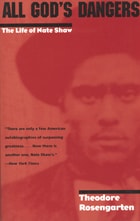
All God's Dangers
The Life of Nate ShawTheodore Rosengarten
University of Chicago Press, 2000
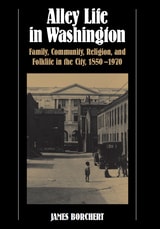
Alley Life in Washington
Family, Community, Religion, and Folklife in the City, 1850-1970James Borchert
University of Illinois Press, 1980
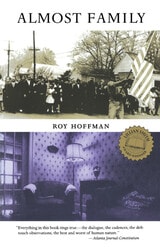
Almost Family
Roy Hoffman
University of Alabama Press, 2000
Nebraska Waters is black. Vivian Gold is Jewish. In an Alabama kitchen where, for nearly thirty years, they share cups of coffee, fret over their children, and watch the civil rights movement unfold out their window, and into their homes, they are like family—almost.
As Nebraska makes her way, day in and out, to Vivian’s house to cook and help tend the Gold children, the “almost” threatens to widen into a great divide. The two women’s husbands affect their relationship, as do their children, Viv Waters and Benjamin Gold, born the same year and coming of age in a changing South. The bond between the women both strengthens and frays.
Winner of the Lillian Smith Book Award and Alabama Library Association Award for fiction, Roy Hoffman’s Almost Family explores the relationship that begins when one person goes to work for another, and their friendship—across lines of race, income, and religion—develops degrees of understanding yet growing misunderstanding.
Almost Family
35th Anniversary EditionRoy Hoffman
University of Alabama Press, 2018
Nebraska Waters is black. Vivian Gold is Jewish. In an Alabama kitchen where, for nearly thirty years, they share cups of coffee, fret over their children, and watch the civil rights movement unfold out their window, and into their homes, they are like family—almost.
As Nebraska makes her way, day in and out, to Vivian’s house to cook and help tend the Gold children, the “almost” threatens to widen into a great divide. The two women’s husbands affect their relationship, as do their children, Viv Waters and Benjamin Gold, born the same year and coming of age in a changing South. The bond between the women both strengthens and frays.
Winner of the Lillian Smith Book Award and Alabama Library Association Award for fiction, Roy Hoffman’s Almost Family explores the relationship that begins when one person goes to work for another, and their friendship—across lines of race, income, and religion—develops degrees of understanding yet growing misunderstanding. This edition commemorates the 35th anniversary of the book’s publication and features a foreword by the author and includes a discussion guide for readers and book clubs.
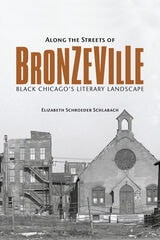
Along the Streets of Bronzeville
Black Chicago's Literary LandscapeElizabeth Schroeder Schlabach
University of Illinois Press, 2017
In this significant recovery project, Elizabeth Schroeder Schlabach investigates the institutions and streetscapes of Black Chicago that fueled an entire literary and artistic movement. She argues that African American authors and artists--such as Gwendolyn Brooks, Richard Wright, Langston Hughes, painter Archibald Motley, and many others--viewed and presented black reality from a specific geographic vantage point: the view along the streets of Bronzeville. Schlabach explores how the particular rhythms and scenes of daily life in Bronzeville locations, such as the State Street "Stroll" district or the bustling intersection of 47th Street and South Parkway, figured into the creative works and experiences of the artists and writers of the Black Chicago Renaissance. She also covers in detail the South Side Community Art Center and the South Side Writers' Group, two institutions of art and literature that engendered a unique aesthetic consciousness and political ideology for which the Black Chicago Renaissance would garner much fame.
Life in Bronzeville also involved economic hardship and social injustice, themes that resonated throughout the flourishing arts scene. Schlabach explores Bronzeville's harsh living conditions, exemplified in the cramped one-bedroom kitchenette apartments that housed many of the migrants drawn to the city's promises of opportunity and freedom. Many struggled with the precariousness of urban life, and Schlabach shows how the once vibrant neighborhood eventually succumbed to the pressures of segregation and economic disparity. Providing a virtual tour South Side African American urban life at street level, Along the Streets of Bronzeville charts the complex interplay and intersection of race, geography, and cultural criticism during the Black Chicago Renaissance's rise and fall.
America's First Black Town
Brooklyn, Illinois, 1830-1915Sundiata Keita Cha-Jua
University of Illinois Press, 2000
Sundiata Keita Cha-Jua traces Brooklyn's transformation from a freedom village into a residential commuter satellite that supplied cheap labor to the city and the region. He examines why Brooklyn remained unindustrialized while factories and industrial complexes were built in nearly all the neighboring white-majority towns. As Brooklyn's population tilted more heavily toward single young men employed in the factories and as the city's cheaper retail businesses drew the town's consumer dollars, local businesses--except those catering to nightlife and vice--withered away.
Drawing on town records, regional and African American newspapers, census data, and other sources, Cha-Jua provides a detailed social and political history of America's first Black town. He places Brooklyn in the context of Black-town development and African American nationalism and documents the dedicated efforts of its Black citizens to achieve political control and build a thriving, autonomous, Black-majority community.
America's First Black Town challenges scholarly assumptions that Black political control necessarily leads to internal unity and economic growth. Outlining dynamics that presaged the post-1960s plight of Gary, Detroit, and other Black-dominated cities, Cha-Jua confirms that, despite Brooklyn's heroic struggle for autonomy, Black control was not enough to stem the corrosive tide of internal colonialism.

American Allegory
Lindy Hop and the Racial ImaginationBlack Hawk Hancock
University of Chicago Press, 2013
In American Allegory, Black Hawk Hancock offers an embedded and embodied ethnography that situates dance within a larger Chicago landscape of segregated social practices. Delving into two Chicago dance worlds, the Lindy and Steppin’, Hancock uses a combination of participant-observation and interviews to bring to the surface the racial tension that surrounds white use of black cultural forms. Focusing on new forms of appropriation in an era of multiculturalism, Hancock underscores the institutionalization of racial disparities and offers wonderful insights into the intersection of race and culture in America.
American Atrocity
The Types of Violence in LynchingGuy Lancaster
University of Arkansas Press, 2021
Lynching is often viewed as a narrow form of violence: either the spontaneous act of an angry mob against accused individuals, or a demonstration of white supremacy against an entire population considered subhuman. However, in this new treatise, historian Guy Lancaster exposes the multiple forms of violence hidden beneath the singular label of lynching.
Lancaster, who has written extensively on racial violence, details several lynchings of Blacks by white posses in post-Reconstruction Arkansas. Drawing from the fields of history, philosophy, cognitive science, sociology, and literary theory, and quoting chilling contemporary accounts, he argues that the act of lynching encompasses five distinct but overlapping types of violence. This new framework reveals lynching to be even more of an atrocity than previously understood: that mobs did not disregard the humanity of their victims but rather reveled in it; that they were not simply enacting personal vengeance but manifesting an elite project of subjugation. Lancaster thus clarifies and connects the motives and goals of seemingly isolated lynch mobs, embedding the practice in the ongoing enforcement of white supremacy. By interrogating the substance of lynching, American Atrocity shines new light on both past anti-Black violence and the historical underpinnings of our present moment.
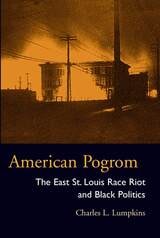
American Pogrom
The East St. Louis Race Riot and Black PoliticsCharles L. Lumpkins
Ohio University Press, 2008
Charles Lumpkins shows that black residents of East St. Louis had engaged in formal politics since the 1870s, exerting influence through the ballot and through patronage in a city dominated by powerful real estate interests even as many African Americans elsewhere experienced setbacks in exercising their political and economic rights.
While Lumpkins asserts that the race riots were a pogrom—an organized massacre of a particular ethnic group—orchestrated by certain businessmen intent on preventing black residents from attaining political power and on turning the city into a “sundown” town permanently cleared of African Americans, he also demonstrates how the African American community survived. He situates the activities of the black citizens of East St. Louis in the context of the larger story of the African American quest for freedom, citizenship, and equality.
Amid the Fall, Dreaming of Eden
Du Bois, King, Malcolm X, and Emancipatory CompositionBradford T. Stull
Southern Illinois University Press, 1999
Whom, or what, does composition—defined here as an intentional process of study, either oral or written—serve? Bradford T. Stull contends that composition would do well to articulate, in theory and practice, what could be called "emancipatory composition." He argues that emancipatory composition is radically theopolitical: it roots itself in the foundational theological and political language of the American experience while it subverts this language in order to emancipate the oppressed and, thereby, the oppressors.
To articulate this vision, Stull looks to those who compose from an oppressed place, finding in the works of W. E. B. Du Bois, Martin Luther King Jr., and Malcolm X radical theopolitical practices that can serve as a model for emancipatory composition. While Stull acknowledges that there are many sites of oppression, he focuses on what Du Bois has called the problem of the twentieth century: the color line, positing that the unique and foundational nature of the color line provides a fecund place in which, from which, a theory and practice of emancipatory composition might be elucidated.
By focusing on four key theopolitical tropes—The Fall, The Orient, Africa, and Eden—that inform the work of Du Bois, King, and Malcolm X, Stull discovers the ways in which these civil rights leaders root themselves in the vocabulary of the American experience in order to subvert it so that they might promote emancipation for African Americans, and thus all Americans.
In drawing on the work of Paulo Freire, Kenneth Burke, Edward Said, Christopher Miller, Ernst Bloch, and others, Stull also locates this study within the larger cultural context. By reading Du Bois, King, and Malcolm X together in a way that they have never before been read, Stull presents a new vision of composition practice to the African American studies community and a reading of African American emancipatory composition to the rhetoric and composition community, thus extending the question of emancipatory composition into new territory.
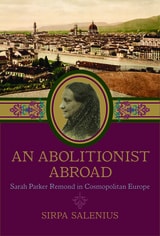
An Abolitionist Abroad
Sarah Parker Remond in Cosmopolitan EuropeSirpa Salenius
University of Massachusetts Press, 2016
Remond's extensive travels and diverse acquaintances demonstrate that the nineteenth-century grand tour of Europe was not exclusively the privilege of white intellectuals but included African American travelers, among them women. This biography, based on international archival research, tells the fascinating story of how Remond forged a radical path, establishing relationships with fellow activists, artists, and intellectuals across Europe.
An American Dilemma Revisited
Race Relations in a Changing WorldObie, Jr. Clayton
Russell Sage Foundation, 1996
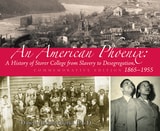
An American Phoenix
A History of Storer College from Slavery to Desegregation 1865-1955, Commemorative EditionDawne Raines Burke
West Virginia University Press, 2015
In the first book-length study of Storer College, Dawne Raines Burke tells the story of the historically black institution from its Reconstruction origins to its demise in 1955. Established by Northern Baptists in the abolitionist flashpoint of Harpers Ferry, Storer was the first college open to African Americans in West Virginia, and it played a central role in regional and national history. In addition to educating generations of students of all races, genders, and creeds, Storer served as the second meeting place (and the first on U.S. soil) for the Niagara Movement, a precursor to the NAACP.
An American Phoenix provides a comprehensive and extensively illustrated history of this historically black college, bringing to life not just the institution but many of the individuals who taught or were educated there. It fills a significant gap in our knowledge of African American history and the struggle for rights in West Virginia and the wider world.