Results by title
5550 books match the query 'Biography & Autobiography' and 577 start with a
A Deaf Adult Speaks Out
Leo Jacobs
Gallaudet University Press, 1989
This new edition includes an update of services by and for deaf people, and an expanded chapter on legislation and social issues that have had an impact on the Deaf community in the last ten years.
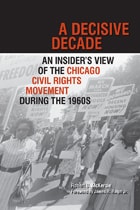
A Decisive Decade
An Insider's View of the Chicago Civil Rights Movement during the 1960sRobert B. McKersie, Foreword by James R. Ralph Jr.
Southern Illinois University Press, 2013
The deeply personal story of a historic time in Chicago, Robert B. McKersie’s A Decisive Decade follows the unfolding action of the Civil Rights Movement as it played out in the Windy City. McKersie’s participation as a white activist for black rights offers a unique, firsthand viewpoint on the debates, boycotts, marches, and negotiations that would forever change the face of race relations in Chicago and the United States at large.
Described within are McKersie’s intimate observations on events as they developed during his participation in such historic occasions as the impassioned marches for open housing in Chicago; the campaign to end school segregation under Chicago Schools Superintendent Benjamin Willis; Operation Breadbasket’s push to develop economic opportunities for black citizens; and dialogs with corporations to provide more jobs for blacks in Chicago. In addition, McKersie provides up close and personal descriptions of the iconic Civil Rights leaders who spearheaded some of the most formative battles of Chicago’s Civil Rights movement, including Dr. Martin Luther King, Jr., Reverend Jesse Jackson, Timuel Black Jr. and W. Alvin Pitcher. The author illumines the tensions experienced by two major institutions in responding to the demands of the civil rights movement: the university and the church. Packed with historical detail and personal anecdotes of these history-making years, A Decisive Decade offers a never-before-seen perspective on one of our nation’s most tumultuous eras.

A Doctor in Galilee
The Life and Struggle of a Palestinian in IsraelHatim Kanaaneh
Pluto Press, 2008
Hatim Kanaaneh is a Palestinian doctor who has struggled for over 35 years to bring medical care to Palestinians in Galilee, against a culture of anti-Arab discrimination. This is the story of how he fought for the human rights of his patients and overcame the Israeli authorities' cruel indifference to their suffering.
Kanaaneh is a native of Galilee, born before the creation of Israel. He left to study medicine at Harvard, before returning to work as a public health physician with the intention of helping his own people. He discovered a shocking level of disease and malnutrition in his community and a shameful lack of support from the Israeli authorities. After doing all he could for his patients by working from inside the system, Kanaaneh set up The Galilee Society, an NGO working for equitable health, environmental and socio-economic conditions for Palestinian Arabs in Israel.
This is a brilliant memoir that shows how grass roots organisations can loosen the Zionist grip upon Palestinian lives.
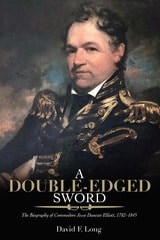
A Double-Edged Sword
The Biography of Commodore Jesse Duncan Elliott, 1782–1845David F. Long
University of Alabama Press, 2026
An overdue reassessment of one of the US Navy’s most decorated—and divisive—early commanders, whose legacy remains teetering between heroism and scandalous.
A Double-Edged Sword: The Biography of Commodore Jesse Duncan Elliott, 1782–1845 is a comprehensive and long-overdue portrait of one of the most polarizing figures in early US naval history. Written over the course of a decade and completed shortly before the author’s death, this meticulously researched biography revisits the career of a man once hailed for his military exploits—and later condemned for a myriad of personal controversies—including his perceived missteps while in command.
David F. Long traces Elliott’s rise from promising young officer to commodore, chronicling his leadership during key moments such as the capture of the brig Caledonia, the defense of Fort Erie, and his central—but contested—role in the Battle of Lake Erie. Despite notable contributions to the Navy’s early successes, including his diplomatic work and restoration of the USS Constitution, Elliott’s legacy was clouded by scandal: accusations of cowardice, a notorious duel, a contentious command style, and a drawn-out court-martial that ended his career in disgrace.
Serving as both biography and reflective historical analysis, Long paints a vivid picture of the early US Navy—its rivalries, growing pains, and evolving institutional identity. His balanced account of Elliott’s life, neither excusing his faults nor downplaying his achievements, places the commodore’s story in direct conversation with the challenges and ambitions of a rapidly expanding American maritime power. This is a must read for scholars of naval and military history, early American politics, or anyone interested in the brazen albeit controversial legacy of a forgotten national hero.
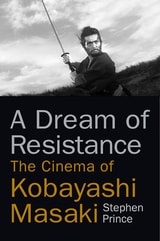
A Dream of Resistance
The Cinema of Kobayashi MasakiPrince, Stephen
Rutgers University Press, 2017
A Dream of Resistance is the first book in English to explore Kobayashi’s entire career, from the early films he made at Shochiku studio, to internationally-acclaimed masterpieces like The Human Condition, Harakiri, and Samurai Rebellion, and on to his final work for NHK Television. Closely examining how Kobayashi’s upbringing and intellectual history shaped the values of his work, Stephen Prince illuminates the political and religious dimensions of Kobayashi’s films, interpreting them as a prayer for peace in troubled times. Prince draws from a wealth of rare archives, including previously untranslated interviews, material that Kobayashi wrote about his films, and even the young director’s wartime diary. The result is an unprecedented portrait of this singular filmmaker.
A Drop of Treason
Philip Agee and His Exposure of the CIAJonathan Stevenson
University of Chicago Press, 2021
The first biography of this contentious, legendary man, Jonathan Stevenson’s A Drop of Treason is a thorough portrait of Agee and his place in the history of American foreign policy and the intelligence community during the Cold War and beyond. Unlike mere whistleblowers, Agee exposed American spies by publicly blowing their covers. And he didn’t stop there—his was a lifelong political struggle that firmly allied him with the social movements of the global left and against the American project itself from the early 1970s on. Stevenson examines Agee’s decision to turn, how he sustained it, and how his actions intersected with world events.
Having made profound betrayals and questionable decisions, Agee lived a rollicking, existentially fraught life filled with risk. He traveled the world, enlisted Gabriel García Márquez in his cause, married a ballerina, and fought for what he believed was right. Raised a conservative Jesuit in Tampa, he died a socialist expat in Havana. In A Drop of Treason, Stevenson reveals what made Agee tick—and what made him run.
A Drunkard's Story
Life on the Nineteenth-Century Public StageThomas Augst
University of Chicago Press, 2026
An unparalleled portrait of nineteenth-century social reform and the magnetic oratory that gave it force, told through the career of temperance advocate John B. Gough.
John B. Gough was perhaps nineteenth-century America’s most famous ex-drunkard—a man who had hit rock bottom but then found the determination to recover and preach sobriety with unusual scope and impact. Through an exploration of Gough’s life, Thomas Augst investigates a world in which a public speaker could achieve immense fame by delivering a remarkable 12,000 popular lectures over his lifetime across the United States, Canada, and Great Britain. Gough kept a voluminous archive of his comings and goings, day after day, speech after speech. Augst is among the first scholars to fully mine these materials, and he uses them to illuminate the redemptive power of storytelling in the lives of citizens. In the process, A Drunkard’s Story follows an itinerant journey through the cultural history of social reform.
John Gough’s life was fascinating in its own right, but Augst’s exploration of it also opens a window onto a rich interplay among performance, autobiography, and celebrity. The ways that people flocked to hear Gough tell his tale, and the contagious enthusiasm with which he was greeted far and wide, might seem from another time—but also surprisingly contemporary in the age of the influencer.

A Family Practice
The Russell Doctors and the Evolving Business of Medicine, 1799-1989William D. Lindsey
University of Arkansas Press, 2020
The authors take a wide-ranging look at the meaning of intergenerational vocations and the role of family, the economy, and social issues on the evolution of medical education and practice in the United States.
A Fan's Life
The Agony of Victory and the Thrill of DefeatPaul Campos
University of Chicago Press, 2022
The Pass. The Curse. The Double Doink. A sports fan’s life is not just defined by intense moments on a field, it’s scarred by them. For a real fan, winning isn’t everything—losing is. The true fans, it’s said, are those who have suffered the most, enduring lives defined by irrational obsession, fervid hopes, and equally gut-wrenching misery. And as Paul Campos shows, those deep feelings are windows not just onto an individual fan’s psychology but onto some of our shared concepts of community, identity, and belonging—not all of which are admirable. In A Fan’s Life, he seeks not to exalt a particular team but to explore fandom’s thorniest depths, excavating the deeper meanings of the fan’s inherently unhappy life.
A Fan’s Life dives deep into the experience of being an ardent fan in a world defined more and more by the rhetoric of “winners” and “losers.” In a series of tightly argued chapters that suture together memoir and social critique, Campos chronicles his lifelong passion for University of Michigan football while meditating on fandom in the wake of the unprecedented year of 2020—when, for a time, a global pandemic took away professional and collegiate sports entirely. Fandom isn’t just leisure, he shows; it’s part of who we are, and part of even our politics, which in the age of Donald Trump have become increasingly tribal and bloody. Campos points toward where we might be heading, as our various partisan affiliations—fandoms with a grimly national significance—become all the more intense and bitterly self-defining. As he shows, we’re all fans of something, and making sense of fandom itself might offer a way to wrap our heads around our increasingly divided reality, on and off the field.
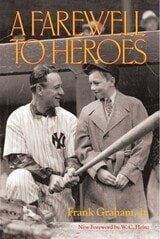
A Farewell to Heroes
Frank Graham Jr. Foreword by W.C. Heinz
Southern Illinois University Press, 2003
Originally published in 1981 and long out of print, this dual autobiography covers five unforgettable decades of the New York sporting life from 1915 to 1965. Told initially from the point of view of Frank Graham, premier sportswriter for TheNew York Sun, A Farewell to Heroes also includes the chronicles of Frank, Jr., who picks up the narrative as he becomes a sports journalist in his own right.
Frank Graham, Sr., was a self-taught writer known for his uncanny ability to capture the high drama of a game-winning play or the color of a fight mob’s conversation in spare, straightforward prose. As a reporter, he covered the rough-and-tumble Giants of John McGraw’s day and continued through boxing’s greatest era, spanning the reigns of Jack Dempsey and Joe Louis.
As the younger Frank tells more of the story, we watch Lou Gehrig take Babe Ruth’s place as the Yankees’ star and then trace his glorious career to its tragic conclusion. We see firsthand the legendary Branch Rickey and Jackie Robinson and boxing’s brief but golden age on television in the 1950s.
Aided by sixteen photographs and preserving the most masterful of his father’s writing while adding to it the best of his own, Frank Graham, Jr., has given the sports fan A Farewell to Heroes, perhaps the ultimate sports reminiscence of a time when the romance of sport gave life a golden hue, when heroes still roamed the earth.
“In what he calls this ‘kind of dual autobiography,’ he is his father’s son, having learned to look and listen as his father did and still go his own way,” says W. C. Heinz, longtime sportswriter for The New York Sun, in his new foreword to this paperback edition.
A Fatherless Child
Autobiographical Perspectives of African American MenTara T. Green
University of Missouri Press, 2009
Through her analysis, Green emphasizes the role of community as a father-substitute in producing successful black men, the impact of fatherlessness on self-perceptions and relationships with women, and black men’s engagement with healing the pain of abandonment. She also looks at why these four men visited Africa to reclaim a cultural history and identity, showing how each developed a clearer understanding of himself as an American man of African descent.
A Feast of Astonishments
Charlotte Moorman and the Avant-Garde, 1960s-1980sEdited by Lisa Graziose Corrin and Corrine Granof
Northwestern University Press, 2015
Charlotte Moorman was a bold, barrier-breaking musician and performance artist and a tireless champion of experimental art, whose avant-garde festivals in New York City brought new art forms to a broad public. To date, recognition of Moorman has been limited mostly to her collaborations with other artists, including composer John Cage and pioneering multimedia artist Nam June Paik, and to her 1967 performance of Paik’s "Opera Sextronique," for which she became known as the "topless cellist" after being arrested on indecency charges. A Feast of Astonishments looks deeper to portray Moorman as a leading international figure in her own right.
With more than 150 color images and essays by art historians, curators, and musicologists, this catalog will offer a fresh perspective and complement an exhibition that opens at Northwestern University’s Mary and Leigh Block Museum of Art in January 2016 before traveling to New York University’s Grey Art Gallery in Manhattan and the Museum der Moderne in Salzburg, Austria. The exhibition will feature original sculptures, photographs, video, props and costumes, annotated music scores, archival materials, film clips, and audio recordings, many drawn from the Charlotte Moorman Archive at the Charles Deering McCormick Library of Special Collections, Northwestern University Library. The exhibition is a partnership between the Block Museum and the Northwestern University Libraries.
A Feminist Legacy
The Rhetoric and Pedagogy of Gertrude BuckSuzanne Bordelon
Southern Illinois University Press, 2007
The first book-length investigation of a pioneering English professor and theorist at Vassar College, A Feminist Legacy: The Rhetoric and Pedagogy of Gertrude Buck explores Buck’s contribution to the fields of education and rhetoric during the Progressive Era. By contextualizing Buck’s academic and theoretical work within the rise of women’s educational institutions like Vassar College, the social and political movement toward suffrage, and Buck’s own egalitarian political and social ideals, Suzanne Bordelon offers a scholarly and well-informed treatment of Buck’s achievements that elucidates the historical and contemporary impact of her work and life.
Bordelon argues that while Buck did not call herself a feminist, she embodied feminist ideals by demanding the full participation of her female students and by challenging power imbalances at every academic, social, and political level.
A Feminist Legacy reveals that Vassar College is an undervalued but significant site in the history of women’s argumentation and pedagogy. Drawing on a rich variety of archival sources, including previously unexamined primary material, A Feminist Legacy traces the beginnings of feminist theories of argumentation and pedagogy and their lasting legacy within the fields of education and rhetoric.
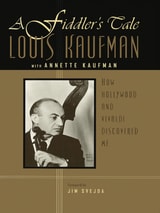
A Fiddler's Tale
How Hollywood and Vivaldi Discovered MeLouis Kaufman with Annette Kaufman; Foreword by Jim Svejda
University of Wisconsin Press, 2003
Once called by the New York Times "a violinist's violinist and a musician's musician," Louis Kaufman was born in 1905 in Portland, Oregon. He studied violin with Franz Kneisl at New York's Institute of Musical Art. He was the original violist of the Musical Art Quartet (1926-1933) and won the Naumburg Award in 1928, the year of his American solo recital debut in New York's Town Hall.
During these early years, he played chamber music with Pablo Casals, Mischa Elman, Jascha Heifetz, Fritz Kreisler, Gregor Piatigorsky, and Efrem Zimbalist, among others. After performing the violin solos for Ernst Lubitsch's 1934 film The Merry Widow, Kaufman became the most sought after violin soloist in Hollywood, playing in some 500 films, including Casablanca, Gone with the Wind, The Diary of Anne Frank, Wuthering Heights, The Grapes of Wrath, and Spartacus. He worked closely with Robert Russell Bennett, Bernard Herrmann, Erich Wolfgang Korngold, Alfred Newman, Miklós Rózsa, Max Steiner, Franz Waxman, and Victor Young.
Extraordinary as it seems today, Kaufman was largely responsible for bringing the once-forgotten music of Antonio Vivaldi to its current popularity worldwide among both classical musicians and the general population of music lovers.
The book includes a music CD with Kaufman’s performances of Vivaldi’s Concerto 2 of op. 9, Havanaise by Camille Saint Saëns, Nocturne for Violin and Piano by Aaron Copland, Much Ado about Nothing Suite for violin and piano by Erich Wolfgang Korngold, and Smoke Gets in Your Eyes by Jerome Kern, among other favorites.
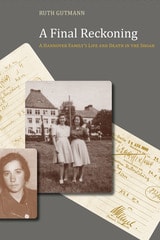
A Final Reckoning
A Hannover Family's Life and Death in the ShoahRuth Gutmann, Foreword by Kenneth Waltzer
University of Alabama Press, 2013
A work of both childhood memory and adult reflection undergirded with scholarly research
Ruth Herskovits Gutmann’s powerful memoir recounts her life not only as a concentration camp inmate and survivor, but also as a sister and daughter. Born in 1928, Gutmann and her twin sister, Eva, escaped the growing Nazi threat in Germany on a Kindertransport to Holland in 1939.
Gutmann’s compelling story captures many facets of the Jewish experience in Nazi Germany. She describes her early life in Hannover as the daughter of a prominent and patriotic member of the Jewish community. Her flight on the Kindertransport offers a vivid, firsthand account of that effort to save the children of Jewish families. Her memories of the camps include coming to the attention of Josef Mengele, who often used twins in human experiments. Gutmann writes with moving clarity and nuance about the complex feelings of survivorship.
A Final Reckoning provides not only insights into Gutmann’s own experience as a child in the midst of the atrocities of the Holocaust, but also a window into the lives of those, like her father, who were forced to carry on and comply with the regime that would ultimately bring about their demise.
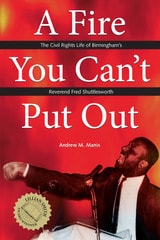
A Fire You Can't Put Out
The Civil Rights Life of Birmingham's Reverend Fred ShuttlesworthAndrew M. Manis
University of Alabama Press, 2001
WINNER, LILLIAN SMITH AWARD
WINNER, JAMES F. SULZBY, JR. AWARD
The fire of freedom that changed Birmingham—and America.
When Fred Shuttlesworth suffered only a bump on the head in the 1956 bombing of his home, members of his church called it a miracle. Shuttlesworth took it as a sign that God would protect him on the mission that had made him a target that night. Standing in front of his demolished home, Shuttlesworth vigorously renewed his commitment to integrate Birmingham's buses, lunch counters, police force, and parks. The incident transformed him, in the eyes of Birmingham's blacks, from an up-and-coming young minister to a virtual folk hero and, in the view of white Birmingham, from obscurity to rabble-rouser extraordinaire.
From his 1956 founding of the Alabama Christian Movement for Human Rights through the historic demonstrations of 1963, driven by a sense of divine mission, Shuttlesworth pressured Jim Crow restrictions in Birmingham with radically confrontational acts of courage. His intensive campaign pitted him against the staunchly segregationist police commissioner Eugene "Bull" Connor and ultimately brought him to the side of Martin Luther King Jr. and to the inner chambers of the Kennedy White House.
First published in 1999, Andrew Manis's award-winning biography of "one of the nation's most courageous freedom fighters" demonstrates compellingly that Shuttleworth's brand of fiery, outspoken confrontation derived from his prophetic understanding of the pastoral role. Civil rights activism was tantamount to salvation in his understanding of the role of Christian minister.
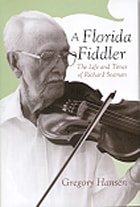
A Florida Fiddler
The Life and Times of Richard SeamanGregory Hansen
University of Alabama Press, 2007
Exploring Florida's cultural landscape through the life of a legendary fiddler.
This biography of 97-year-old Richard Seaman, who grew up in Kissimmee Park, Florida, relies on oral history and folklore research to define the place of musicianship and storytelling in the state's history from one artist's perspective. Gregory Hansen presents Seaman’s assessment of Florida’s changing cultural landscape through his tall tales, personal experience narratives, legends, fiddle tune repertory, and descriptions of daily life.
Seaman’s childhood memories of fiddling performances and rural dances explain the role such gatherings played in building and maintaining social order within the community. As an adult, Seaman moved to Jacksonville, Florida, where he worked as a machinist and performed with his family band. The evolution of his musical repertory from the early 1920s through the 1950s provides a resource for reconstructing social life in the rural south and for understanding how changes in musical style reflect the state's increasingly urban social structure. Hansen includes a set of Seaman's fiddle tunes, transcribed for the benefit of performer and researcher alike. The thirty tall tales included in the volume constitute a representative sample of Florida’s oral tradition in the early years of the 20th century.
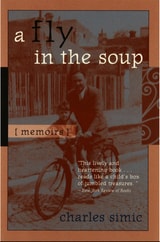
A Fly in the Soup
MemoirsCharles Simic
University of Michigan Press, 2003
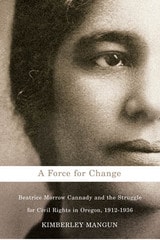
A Force for Change
Beatrice Morrow Cannady and the Struggle for Civil Rights in Oregon, 1912-1936Kimberley Mangun
Oregon State University Press, 2010
A Force for Change is the first full-length study of the life and work of one of Oregon’s most dynamic civil rights activists, African American journalist Beatrice Morrow Cannady. Between 1912 and 1936, Cannady tirelessly promoted interracial goodwill and fought segregation and discrimination.
She gave hundreds of lectures to high school and college students and shared her message with radio listeners across the Pacific Northwest. She was assistant editor, and later publisher, of The Advocate, Oregon’s largest African American newspaper. Cannady was the first black woman to graduate from law school in Oregon, and the first to run for state representative. She held interracial teas in her home in Northeast Portland and protested repeated showings of the racist film The Birth of a Nation. And when the Ku Klux Klan swept into Oregon, she urged the governor to act quickly to protect black Oregonians’ right to live and work without fear. Despite these accomplishments—and many more during her twenty-five-year career—Beatrice Cannady fell into obscurity when she left Oregon in about 1938.
A Force for Change illuminates Cannady’s important role in advocating for better race relations in Oregon in the early decades of the twentieth century. It describes her encounters with the period’s leading black artists, editors, politicians, and intellectuals, including W.E.B. Du Bois, Langston Hughes, A. Philip Randolph, Oscar De Priest, Roland Hayes, and James Weldon Johnson. It dispels the myth that African Americans played little part in Oregon’s history and enriches our understanding of the black experience in Oregon.
A Force for Change is an invaluable resource for students and scholars of women’s history, gender studies, African American history, journalism history, and Pacific Northwest history. It belongs on the shelf of any reader interested in a richer understanding of the civil rights movement in Oregon and across the country.
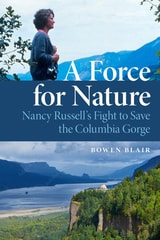
A Force for Nature
Nancy Russell's Fight to Save the Columbia GorgeBowen Blair
Oregon State University Press, 2022
The 85-mile-long Columbia Gorge forms part of the border between Oregon and Washington and is one of the nation’s most historic and scenic landscapes. Many of the region’s cultural divisions boil over here—urban versus rural, west of the mountains versus east—as well as clashes over private property rights, management of public lands, and tribal treaty rights.
In the early 1980s, as a new interstate bridge linked the City of Portland to rural counties in Washington, the Gorge’s renowned vistas were on the brink of destruction. Nancy Russell, forty-eight years old and with no experience in advocacy, fundraising, or politics, built a grassroots movement that overcame 70 years of failed efforts and bitter opposition from both Oregon and Washington governors, five of the six Gorge counties, 41,000 Gorge residents, and the Reagan administration. While building her campaign, Russell stopped subdivisions, factories, and government neglect through litigation brought by her organization, Friends of the Columbia Gorge, and last-second land purchases by the Trust for Public Land (TPL). Initially ignored, then demonized, Russell’s tires were slashed and her life threatened.
The Columbia River Gorge National Scenic Area Act barely passed—on the last day of the congressional session in 1986—and was signed by a reluctant President Reagan hours before the bill would die. Russell positioned the Friends to be a watchdog and orchestrated the purchase of thousands of acres of land for the public. Bowen Blair, an attorney, former executive director of Friends of the Columbia Gorge, and TPL senior vice president, brings an insider’s perspective to the tumultuous and inspiring story of this conservation battle.
A Force for Nature
Nancy Russell's Fight to Save the Columbia GorgeBowen Blair
Oregon State University Press, 2022
The 85-mile-long Columbia Gorge forms part of the border between Oregon and Washington and is one of the nation’s most historic and scenic landscapes. Many of the region’s cultural divisions boil over here—urban versus rural, west of the mountains versus east—as well as clashes over private property rights, management of public lands, and tribal treaty rights.
In the early 1980s, as a new interstate bridge linked the City of Portland to rural counties in Washington, the Gorge’s renowned vistas were on the brink of destruction. Nancy Russell, forty-eight years old and with no experience in advocacy, fundraising, or politics, built a grassroots movement that overcame 70 years of failed efforts and bitter opposition from both Oregon and Washington governors, five of the six Gorge counties, 41,000 Gorge residents, and the Reagan administration. While building her campaign, Russell stopped subdivisions, factories, and government neglect through litigation brought by her organization, Friends of the Columbia Gorge, and last-second land purchases by the Trust for Public Land (TPL). Initially ignored, then demonized, Russell’s tires were slashed and her life threatened.
The Columbia River Gorge National Scenic Area Act barely passed—on the last day of the congressional session in 1986—and was signed by a reluctant President Reagan hours before the bill would die. Russell positioned the Friends to be a watchdog and orchestrated the purchase of thousands of acres of land for the public. Bowen Blair, an attorney, former executive director of Friends of the Columbia Gorge, and TPL senior vice president, brings an insider’s perspective to the tumultuous and inspiring story of this conservation battle.
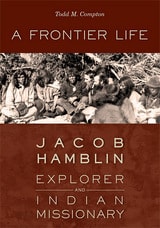
A Frontier Life
Jacob Hamblin, Explorer and Indian MissionaryTodd M. Compton
University of Utah Press, 2013
Winner of the Evans Biography Award, the John Whitmer Historical Society Best Biography Award, and the Francis Armstrong Madsen Best Book Award
Frontiersman, colonizer, missionary to the Indians, and explorer of the American West, Jacob Hamblin has long been one of the most enigmatic figures in Mormon history. In this defining biography, Todd Compton examines and disentangles many of the myths and controversies surrounding Hamblin. His Grand Canyon adventures and explorations as a guide alongside John Wesley Powell are well documented, as are his roles as a missionary, cultural liaison, and negotiator to the Indian tribes of southern Utah and Arizona. Hamblin struggled in this latter role, sometimes unable to bridge the gulf between Mormonism and Indian culture. He disavowed violent conflict and ceaselessly sought peaceful resolutions where others resorted to punitive action. He strove above all for mutual understanding in the absence of conversion.
A Frontier Life provides a rich narrative that fleshes out a picture of a sometimes vilified figure, particularly in regard to his connection to the infamous Mountain Meadows Massacre, where Compton provides nuanced discussion clarifying Hamblin’s post-massacre role—he was not present at the massacre, but reported on it to both Brigham Young and military investigators. Compton’s engagement with Mormon historiography and previous Hamblin portrayals will make this work of particular interest to both scholars and students. The casual reader will take pleasure in learning of a true pioneer who lived life at the geographical, cultural, and spiritual boundaries of his era. This dramatic, entertaining biography is a truly significant contribution to Mormon history.
A Gambler’s Instinct
The Story of Broadway Producer Cheryl CrawfordMilly S. Barranger
Southern Illinois University Press, 2010
Broadway producer Cheryl Crawford (1902–1986) declared in her 1977 autobiography, “The theatre has been my life.” Crawford was notoriously circumspect about her private life, and only now, with Milly S. Barranger’s insightful biography, is her full story revealed.
A major Broadway producer in an era when women producers were exceedingly rare, Crawford found unprecedented success with the plays of Tennessee Williams, including The Rose Tattoo and Sweet Bird of Youth, but her enduring legend is as a musical producer, having brought Kurt Weill’s One Touch of Venus, Lerner and Loewe’s Brigadoon and Paint Your Wagon to the stage. Her commercial success, though, was balanced with the founding of studios that would enable actors to explore their art outside the strictures of commercial theater. She cofounded the Group Theatre with Harold Clurman and Lee Strasberg, the American Repertory Theatre with Margaret Webster and Eva Le Gallienne, and the Actors Studio with Elia Kazan and Robert Lewis, but her idealism was constantly frustrated by unfulfilled artistic promises from her male counterparts and by the chronic shortage of funding for the nonprofit enterprises.
As Barranger traces Crawford’s career as an independent producer, she tells the parallel story of American theater in the mid-twentieth century, making A Gambler’s Instinct both an enjoyable and informative biography of a remarkable woman and an important addition to the literature of the modern theater.
A Generous Nature
Lives Transformed by OregonMarcy Cottrell Houle
Oregon State University Press, 2019
A Generous Nature: Lives Transformed by Oregon offers profiles of twenty-one conservationists and activists who have made enduring contributions to the preservation of Oregon’s wild and natural places and high quality of life. These stories speak to their courage, foresight, and actions—at times against great odds— to enact legislation and motivate others to cherish and protect the places that make Oregon unique.
Taken from personal interviews conducted by the author over a decade, these stories will help readers understand the histories of Oregon’s exceptional places, innovative planning efforts, and laws. They provide insight into the principles and values that motivated individuals to preserve the beauty and natural resources of Oregon, craft legislation to further protect them, and educate others about their value. Houle features locations as diverse as the Columbia River Gorge Natural Scenic Area, the wild and scenic Sandy River, and Tryon Creek State Park, along with background on critical laws and organizations such as the Beach Bill, Diack Act, Senate Bill 100, SOLVE, and the High Desert Partnership.
These stories do more than educate. They will inspire readers and demonstrate that individually we can make a difference. A Generous Nature is a crucial reminder of our responsibility to stand for and defend the places, ideals, and laws that make Oregon a progressive model for the rest of the nation.
A Gentleman of the Law
Essays in Memory of Tan Yock LinEdited by Hock Lai Ho and Kelvin Low
National University of Singapore Press, 2026
Singaporean legal scholar Tan Yock Lin (1953–2023) was a distinguished figure in Singapore’s legal community and an emeritus professor at the Faculty of Law, National University of Singapore. Known for his unparalleled knowledge of Singaporean law, intellectual rigor, and deep personal integrity, Tan’s scholarship helped define and advance the study of law in Singapore. This volume brings together twelve essays by eminent legal scholars addressing the wide-ranging fields in which Tan made lasting scholarly contributions: equity and trusts, personal property, international law, and the law of evidence and criminal justice. Alongside these are personal tributes that offer glimpses into the ways Tan touched the lives of those around him as a student, teacher, mentor, and colleague.
At once an academic contribution and a work of remembrance, A Gentleman of the Law honours the legacy of a scholar whose impact will long continue to shape the legal landscape in Singapore and beyond. This volume is an essential addition to any collection on Singapore law.
A Government as Good as Its People
Jimmy Carter
University of Arkansas Press, 1996
A Great Big Girl Like Me
The Films of Marie DresslerVictoria Sturtevant
University of Illinois Press, 2008
This premier analysis of her body of work explores how Dressler refocused the generic frame of her films beyond the shallow problems of the rich and beautiful, instead dignifying the marginalized, the elderly, women, and the poor. Sturtevant inteprets the meanings of Dressler's body through different genres, venues, and historical periods by looking at her vaudeville career, her transgressive representation of an "unruly" yet sexual body in Emma and Christopher Bean, ideas of the body politic in the films Politics and Prosperity, and Dressler as a mythic body in Min and Bill and Tugboat Annie.
A Great Restlessness
The Life and Politics of Dorise NielsenFaith Johnston
University of Manitoba Press, 2006
A Gringa in Bogotá
Living Colombia's Invisible WarBy June Carolyn Erlick
University of Texas Press, 2010
To many foreigners, Colombia is a nightmare of drugs and violence. Yet normal life goes on there, and, in Bogotá, it's even possible to forget that war still ravages the countryside. This paradox of perceptions—outsiders' fears versus insiders' realities—drew June Carolyn Erlick back to Bogotá for a year's stay in 2005. She wanted to understand how the city she first came to love in 1975 has made such strides toward building a peaceful civil society in the midst of ongoing violence. The complex reality she found comes to life in this compelling memoir.
Erlick creates her portrait of Bogotá through a series of vivid vignettes that cover many aspects of city life. As an experienced journalist, she lets the things she observes lead her to larger conclusions. The courtesy of people on buses, the absence of packs of stray dogs and street trash, and the willingness of strangers to help her cross an overpass when vertigo overwhelms her all become signs of convivencia—the desire of Bogotanos to live together in harmony despite decades of war. But as Erlick settles further into city life, she finds that "war in the city is invisible, but constantly present in subtle ways, almost like the constant mist that used to drip down from the Bogotá skies so many years ago."
Shattering stereotypes with its lively reporting, A Gringa in Bogotá is must-reading for going beyond the headlines about the drug war and bloody conflict.
A Grotesque Animal
Amy Lee Lillard
University of Iowa Press, 2024
A Grotesque Animal explores the making, unmaking, and making again of a woman with an undiagnosed disorder. How did a working- class background and a deep-rooted Midwest culture of silence lead to hiding in plain sight for decades? How did sexuality and anger hide the roots of trauma among the women in her family? And what does it mean to be a queer, disabled, aging woman, a descendent of wild but tamed mothers and a survivor of the things patriarchy inflicts?
Through wide-ranging styles and a combination of personal storytelling and cultural analysis, Lillard dissects anger, sexuality, autistic masking, bodies, punk, and female annihilation to create a new picture of modern women.
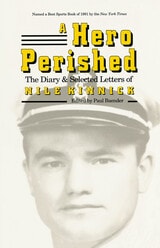
A Hero Perished
The Diary and Selected Letters of Nile KinnickPaul Baender
University of Iowa Press, 1992
A Hero Perished tells Nile Kinnick's story. This grandson of an Iowa governor, the son of parents who disciplined him to strive for his measure of greatness, became a Heisman Trophy winner and national celebrity through a combination of talent and circumstance. Following his college successes, Kinnick began legal study to prepare for a political career, but with the approach of war he entered the Navy Air Corps to refashion himself as a fighter pilot. Assigned to the carrier USS Lexington on its premier cruise, he took off in a defective plane—and his death shocked a nation grown almost used to tragic loss.
For the first time, Kinnick tells his own tale through his engaging letters—all but one previously unpublished—and his diary, printed in its entirety for the first time. The result is a human, intimate look at the true person behind the myth, revealing both his foibles and his essential principles. A Hero Perished also includes a definitive text of Kinnick's moving Heisman Award acceptance speech and his impassioned commencement supper address, calling on the new Iowa graduates to achieve moral courage in a time of depression and war.
An illuminating comment on a time and attitude that have passed, A Hero Perished is of and about a football player, but it is not a football book—it is far more. This volume displays Kinnick—who was, despite his great gifts and achievements, a vulnerable and decent young man—in a time of great change and peril when a phase of our culture was passing away.
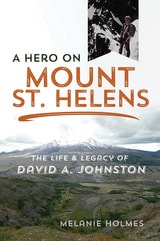
A Hero on Mount St. Helens
The Life and Legacy of David A. JohnstonMelanie Holmes. Foreword by Jeff Renner
University of Illinois Press, 2019
Melanie Holmes tells the story of Johnston's journey from a nature-loving Boy Scout to a committed geologist. Blending science with personal detail, Holmes follows Johnston through his encounters with Aleutian volcanoes, his work helping the Portuguese government assess the geothermal power of the Azores, and his dream job as a volcanologist with the U.S. Geological Survey. Interviews and personal writings reveal what a friend called “the most unjaded person I ever met,” an imperfect but kind and intelligent young scientist passionately in love with his life and work and determined to make a difference.
A Hero on Mount St. Helens
The Life and Legacy of David A. JohnstonMelanie Holmes. Narrated by Jeff Renner. Foreword by Jeff Renner
University of Illinois Press, 2024
Melanie Holmes tells the story of Johnston's journey from a nature-loving Boy Scout to a committed geologist. Blending science with personal detail, Holmes follows Johnston through his encounters with Aleutian volcanoes, his work helping the Portuguese government assess the geothermal power of the Azores, and his dream job as a volcanologist with the U.S. Geological Survey. Interviews and personal writings reveal what a friend called “the most unjaded person I ever met,” an imperfect but kind and intelligent young scientist passionately in love with his life and work and determined to make a difference.

A Historian and His World
A Life of Christopher Dawson, 1889-1970Christina Scott
Catholic University of America Press, 2023
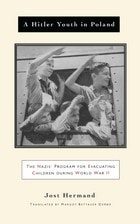
A Hitler Youth in Poland
The Nazi Children's Evacuation Program During World War IIJost Hermand
Northwestern University Press, 1997
During the Nazi era, millions of German children between the ages of seven and sixteen were taken from their homes and sent to Hitler Youth paramilitary camps to be toughened up and taught how to be "German." Separated from their families and sent to the far-flung corners of Europe, these children often endured incredible abuse by the adults in charge. In this memoir, Jost Hermand, a cultural critic and historian who spent much of his youth in five different camps, writes about his experiences as a small, unathletic boy thrown into a "wolf pack" governed by brutalization, dreary routine, and sadism.
Intelligent and persuasive, A Hitler Youth in Poland should be read by anyone interested in psychology or the history of everyday life in Hitler's Germany and the mental scars of adults born during the Nazi regime.
A Homesteader's Portfolio
Alice Day Pratt
Oregon State University Press, 1993
“So much is so skillfully crammed into this little book that the reader comes to admire Pratt’s zest while wondering how she could possibly have endured. . . . A splendid introduction by Molly Gloss, author of The Jump-Off Creek, enhances the book with a biography of the author and a study of her writings.” —Oregon Historical Quarterly
In 1911 Alice Day Pratt, single and nearing forty, boarded a train and left the east coast to file claim on 160 acres of land in the Central Oregon high desert. She was one among tens of thousands of people who took up homesteads in the arid West in the early twentieth century. Perhaps as many as 20 percent of these settlers were single women. Yet homesteading women are largely missing from the literature and histories of the West.
The commonly held image of frontier women as powerless and dependent helpmates stems in part from the scarcity of written accounts by homesteading women. Alice Day Pratt’s powerful memoir presents a rare, fascinating account of the life of a woman homesteader and chronicles her single-handed efforts to overcome the obstacles that faced all homesteaders—men and women—in the dryland West.
Pratt’s independent and adventurous spirit allowed her to hang on to her “homesteading dream” for more than a decade after most other homesteaders had packed their belongings and left the desert. By exploring the life she lived and the choices she made, Pratt offers an important glimpse into the social and cultural history of the American West.
A House Is Not a Home
Polly Adler
University of Massachusetts Press, 2006
Polly Adler's “house”—the brothel that gave this best-selling 1953 autobiography its title—was a major site of New York City underworld activity from the 1920s through the 1940s. Adler's notorious Lexington Avenue house of prostitution functioned as a sort of social club for New York's gangsters and a variety of other celebrities, including Robert Benchley and his friend Dorothy Parker. According to one New York tabloid, it made Adler's name “synonymous with sin.”
This new edition of Adler's autobiography brings back into print a book that was a mass phenomenon, in both hardback and paperback, when it was first published. A self-consciously literary work, A House Is Not a Home provides an informal social history of immigrant mobility, prostitution, Jewish life in New York, police dishonesty, the “white slavery” scare of the early twentieth century, and political corruption.
Adler's story fills an important gap in the history of immigrant life, urban experience, and organized crime in New York City. While most other accounts of the New York underworld focus on the lives of men, from Herbert Asbury's Gangs of New York through more recent works on Jewish and Italian gangsters, this book brings women's lives and problems to the forefront.
A House Is Not a Home is compellingly readable and was popular enough to draw Hollywood's attention in the early 1960s—leading to a film starring Shelley Winters as Adler. The book has been largely forgotten in the ensuing decades, lost both to its initial audience of general readers and to scholars in women's studies, immigration history, and autobiography who are likely to find it a treasure trove. Now, with a new introduction by Rachel Rubin that contextualizes Adler's life and literary achievement, A House Is Not a Home is again available to the many readers who have come to understand such “marginal” life stories as a special refraction of the more typical American success narrative.

A House Is Not a Home
Polly Adler, with an Introduction by Rachel Rubin
University of Massachusetts Press, 2006
Polly Adler's “house”—the brothel that gave this best-selling 1953 autobiography its title—was a major site of New York City underworld activity from the 1920s through the 1940s. Adler's notorious Lexington Avenue house of prostitution functioned as a sort of social club for New York's gangsters and a variety of other celebrities, including Robert Benchley and his friend Dorothy Parker. According to one New York tabloid, it made Adler's name “synonymous with sin.”
This new edition of Adler's autobiography brings back into print a book that was a mass phenomenon, in both hardback and paperback, when it was first published. A self-consciously literary work, A House Is Not a Home provides an informal social history of immigrant mobility, prostitution, Jewish life in New York, police dishonesty, the “white slavery” scare of the early twentieth century, and political corruption.
Adler's story fills an important gap in the history of immigrant life, urban experience, and organized crime in New York City. While most other accounts of the New York underworld focus on the lives of men, from Herbert Asbury's Gangs of New York through more recent works on Jewish and Italian gangsters, this book brings women's lives and problems to the forefront.
A House Is Not a Home is compellingly readable and was popular enough to draw Hollywood's attention in the early 1960s—leading to a film starring Shelley Winters as Adler. The book has been largely forgotten in the ensuing decades, lost both to its initial audience of general readers and to scholars in women's studies, immigration history, and autobiography who are likely to find it a treasure trove. Now, with a new introduction by Rachel Rubin that contextualizes Adler's life and literary achievement, A House Is Not a Home is again available to the many readers who have come to understand such “marginal” life stories as a special refraction of the more typical American success narrative.
A House on Stilts
Mothering in the Age of Opioid AddictionPaula Becker
University of Iowa Press, 2019
More than 2.5 million Americans are addicted to opioids, some half-million of these to heroin. For many of them, their drug addiction leads to lives of demoralization, homelessness, and constant peril. For parents, a child’s addiction upends family life, catapulting them onto a path no longer prescribed by Dr. Spock, but by Dante’s Inferno. Within this ten-year crucible, Paula is transformed by an excruciating, inescapable truth: the difference between what she can do and what she cannot do.
A Hunger for High Country
One Woman’s Journey to the Wild in Yellowstone CountrySusan Marsh
Oregon State University Press, 2014
A Jewish Family in Germany Today
An Intimate PortraitY. Michal Bodemann
Duke University Press, 2005
Among the Kalman cousins are an art gallery owner, a body builder, a radio personality, a former chief financial officer of a prominent U.S. bank, and a sculptor. They discuss Zionism, anti-Semitism, what it means to root for the German soccer team, Schindler’s List, money, success, marriage and intermarriage, and family history. They reveal their different levels of engagement with Judaism and involvement with local Jewish communities. Kalman is a pseudonym, and their anonymity allows the family members to talk with passion and candor about their relationships and their lives as Jews.
A Journey to Point Omega
Autobiography from 1964Josef Pieper
St. Augustine's Press, 2018
Themes with which the reader of his previous works would be well acquainted recur in this volume. The dedicated Catholic philosopher, who preferred his independence as a trainer of teachers to the less independent role of a professor in a Catholic university, was quite prepared to criticize developments in the Church which resulted from Vatican II. In his defense of the sacred, which he deemed threatened by popularizing trends in the Church, he criticized what he saw as the watered down language in modern German translations of Church liturgical texts; the growing preference for secular garb; and the compromising developments which saw the sacramental signs – surrounding baptism, for instance – being reduced to such an extent that they no longer had the power to signify their sacred meaning even to a well-intentioned congregation.
A great lover of the philosophy of Plato, Augustine, and Aquinas – among many others –, Pieper highlighted the need for living a life of truth. He did not consider truth to be merely something abstract but as something to be lived existentially. While he could explain his philosophy in clear rational terms, something which especially stood to him in his post-war lectures to eager students who were hungry for intellectual guidance and leadership, the great interest of his philosophy was, possibly, his preoccupation with mystery – that which impinges on our inner lives but frustrates all our attempts to account for it in purely rational terms.
As a philosopher – one might say a Christian philosopher – Pieper seems to have observed the traditional boundaries drawn between philosophy and theology. His generation was exposed to the modernist debates in the Church. It would have been deemed heretical to say that the Divine could be grasped by our purely human thought processes – access to the Divine being only possible through faith and grace. Pieper was no heretic. But he was also not altogether conservative. In fact, his philosophy, closely allied to existentialism – despite his care, for instance, to distance himself from the negative existentialism of Sartre – focused on the individual’s inner existential grasp of the most profound reality. Truth is to be found within us, even if it remains a mystery. What lies beyond death is, for the individual, the ultimate mystery.
A Just and Righteous Cause
Benjamin H. Grierson’s Civil War MemoirEdited by Bruce J. Dinges and Shirley A. Leckie
Southern Illinois University Press, 2008
General Benjamin H. Grierson is most widely known as the brilliant cavalryman whose actions in the Civil War's Mississippi Valley campaign facilitated Ulysses S. Grant's capture of Vicksburg. There is, however, much more to this key Union officer than a successful raid into Confederate-held Mississippi. In A Just and Righteous Cause: Benjamin H. Grierson's Civil War Memoir, edited by Bruce J. Dinges and Shirley A. Leckie, Grierson tells his story in forceful, direct, and highly engaging prose.
A Just and Righteous Cause paints a vivid picture of Grierson's prewar and Civil War career, touching on his antislavery views, Republican Party principles, and military strategy and tactics. His story begins with his parents' immigration to the United States and follows his childhood, youth, and career as a musician; the early years of his arriage; his business failures prior to becoming a cavalry officer in an Illinois regiment; his experiences in battle; and his Reconstruction appointment. Grierson also provides intimate accounts of his relationships with such prominent politicians and Union leaders as Abraham Lincoln, Richard Yates, Andrew Johnson, William T. Sherman, Ulysses S.
Grant, John C. Frémont, and Benjamin Prentiss.
Because Grierson wrote the memoir mainly with his family as the intended audience, he manages to avoid the self-promotion that plagues many of his contemporaries' chronicles. His reliance on military records and correspondence, along with family letters, lends an immediacy rarely found in military memoirs. His reminiscences also add fuel to a reemerging debate on soldiers' motivations for enlisting—in Grierson's case, patriotism and ideology—and shed new light on the Western theater of the Civil War, which has seen a recent surge in interest among Civil War enthusiasts.
A non-West Point officer, Grierson owed his developing career to his independent studies of the military and his connections to political figures in his home state of Illinois and later to important Union leaders. Dinges and Leckie provide a helpful introduction, which gives background on the memoir and places Grierson's career into historical context. Aided by fourteen photos and two maps, as well as the editors' superb annotations, A Just and Righteous Cause is a valuable addition to Civil War history.
A Key to the World
Victor Abbou
Gallaudet University Press, 2021
Published by Eyes Editions.
Includes links to two hours of video in International Sign.

A Key to the World
Victor Abbou
Gallaudet University Press, 2021
Published by Eyes Editions.
Includes links to two hours of video in International Sign.
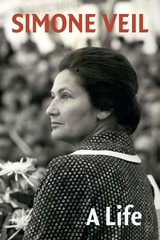
A Life
Simone Veil
Haus Publishing, 2009
Veil was one of France’s most beloved public figures, most admired for her personal and political courage. Her memoir, published here in English for the first time, is a sincere and candid account of an extraordinary life and career, reflecting both her humanity and her determination to improve social standards at home and maintain economic and political stability in Europe. In the wake of her passing in 2017, this translation of her memoir stands as a fitting tribute to an unparalleled life of survival, selflessness, and unwavering public service.
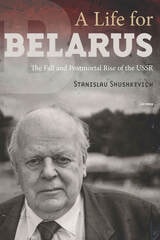
A Life for Belarus
The Fall and Postmortal Rise of the USSRStanislau Shushkevich
Central European University Press, 2025
This memoir of the first president of an independent Belarus (1991-1994) tells about the revival of independent Belarus, the difficulties in establishing a democracy and a market economy, a hardened Soviet mentality, and the political immaturity of the intelligentsia and obduracy of the old nomenklatura.
Stanislau Shushkevich, born in 1934, narrates his path from a son of an “enemy of the people” to a doctorate in physics, and then to be the first head of independent Belarus. A series of entertaining essays discuss some major events as well as some minor ones that are barely known. The book describes Shushkevich’s role in hosting the Belavezha Accords, which brought about the end of the Soviet Union, and explores the motivation behind the decision for the de jure dissolution of the empire at a time when the major world leaders were categorically against the division of the USSR into independent states. The author draws particular attention to the role of the Baltic States in the late perestroika period. He also addresses the political passivity of the Soviet intelligentsia and the reasons for the revival of the Soviet Union in Russia and Belarus.
Shushkevich, who lives in Minsk, also provides valuable insights into contemporary Belarus, including an assessment of Lukashenka’s controversial role in recent events.
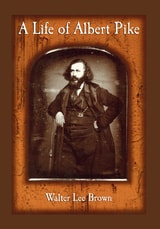
A Life of Albert Pike
Walter Lee Brown
University of Arkansas Press, 1997
Drawing on original documents, Pike’s copious writings, and interviews with Pike’s descendants, Walter Lee Brown presents a fascinating personal history that also serves as a rich compendium of Arkansas’s antebellum history.
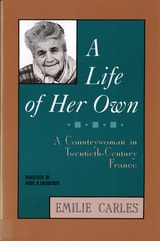
A Life of Her Own
A Countrywoman in Twentieth-Century FranceCarles, Émilie
Rutgers University Press, 1991
A Life of Solitude
Stanislawa Przybyszewska, a Biographical Study with Selected LettersJadwiga Kosicka
Northwestern University Press, 1986