1049 books match the query 'English, Irish, Scottish, Welsh' and 65 start with a
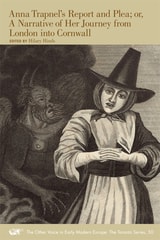
cover of Anna Trapnel’s Report and Plea; or, A Narrative of Her Journey from London into Cornwall

Anna Trapnel’s Report and Plea; or, A Narrative of Her Journey from London into Cornwall

Anna Trapnel

Iter Press, 2016

In 1654, Anna Trapnel — a Baptist, Fifth Monarchist, millenarian, and visionary from London — fell into a trance during which she prophesied passionately and at length against Oliver Cromwell and his government. The prophecies attracted widespread public attention, and resulted in an invitation to travel to Cornwall. Her Report and Plea, republished here for the first time, is a lively and engaging firsthand account of the visit, which concluded in her arrest, a court hearing, and imprisonment. Part memoir, part travelogue, and part impassioned defense of her beliefs and actions, the Report and Plea offers vivid and fascinating insight into the life and times of an early modern woman claiming her place at the center of the tumultuous political events of mid-seventeenth-century England.
[more]
cover of Anomalous States: Irish Writing and the Post-Colonial Moment

Anomalous States

Irish Writing and the Post-Colonial Moment

David Lloyd

Duke University Press, 1993

Anomalous States is an archeology of modern Irish writing. David Lloyd commences with recent questioning of Irish identity in the wake of the northern conflict and returns to the complex terrain of nineteenth-century culture in which those questions of identity were first formed. In five linked essays, he explores modern Irish literature and its political contexts through the work of four Irish writers—Heaney, Beckett, Yeats, and Joyce.
Beginning with Heaney and Beckett, Lloyd shows how in these authors the question of identity connects with the dominance of conservative cultural nationalism and argues for the need to understand Irish culture in relation to the wider experience of colonized societies. A central essay reads Yeats's later works as a profound questioning of the founding of the state. Final essays examine the gradual formation of the state and nation as one element in a cultural process that involves conflict between popular cultural forms and emerging political economies of nationalism and the colonial state. Modern Ireland is thus seen as the product of a continuing process in which, Lloyd argues, the passage to national independence that defines Ireland's post-colonial status is no more than a moment in its continuing history.
Anomalous States makes an important contribution to the growing body of work that connects cultural theory with post-colonial historiography, literary analysis, and issues in contemporary politics. It will interest a wide readership in literary studies, cultural studies, anthropology, and history.
[more]
cover of Anonymous Connections: The Body and Narratives of the Social in Victorian Britain

Anonymous Connections

The Body and Narratives of the Social in Victorian Britain

Tina Young Choi

University of Michigan Press, 2016

Anonymous Connections asks how the Victorians understood the ethical, epistemological, and biological implications of social belonging and participation. Specifically, Tina Choi considers the ways nineteenth-century journalists, novelists, medical writers, and social reformers took advantage of spatial frames-of-reference in a social landscape transforming due to intense urbanization and expansion. New modes of transportation, shifting urban demographics, and the threat of epidemics emerged during this period as anonymous and involuntary forms of contact between unseen multitudes. While previous work on the early Victorian social body have tended to describe the nineteenth-century social sphere in static political and class terms, Choi’s work charts new critical terrain, redirecting attention to the productive—and unpredictable—spaces between individual bodies as well as to the new narrative forms that emerged to represent them. Anonymous Connections makes a significant contribution to scholarship on nineteenth-century literature and British cultural and medical history while offering a timely examination of the historical forebears to modern concerns about the cultural and political impact of globalization.

[more]
cover of Answerable Style: Essays on Paradise Lost

Answerable Style

Essays on Paradise Lost

Arnold Stein

University of Minnesota Press, 1953

Answerable Style was first published in 1953. Minnesota Archive Editions uses digital technology to make long-unavailable books once again accessible, and are published unaltered from the original University of Minnesota Press editions.

By the use of both new and traditional techniques of critical analysis, Arnold Stein presents in this volume of six essays a fresh interpretation of Milton's epic.

Beginning with the assumption that style is "answerable" to idea, he has tried to trace Milton's epic vision as it is bodied forth in patterns of structure (the ideas tested in action) and patterns of expression (the ideas tested in style). Mr. Stein explains: "My approach is in part based on an attempt to accept as fact both that I am a twentieth century reader and that this is a seventeenth-century poem. Milton is, I think, illuminated by some modern critical considerations; and some of those considerations are in turn illuminated, and some are found wanting."
[more]
cover of Anti-Nazi Modernism: The Challenges of Resistance in 1930s Fiction

Anti-Nazi Modernism

The Challenges of Resistance in 1930s Fiction

Mia Spiro

Northwestern University Press, 2013
Mia Spiro's Anti-Nazi Modernism marks a major step forward in the critical debates over the relationship between modernist art and politics. Spiro analyzes the antifascist, and particularly anti-Nazi, narrative methods used by key British and American fiction writers in the 1930s. Focusing on works by Djuna Barnes, Christopher Isherwood, and Virginia Woolf, Spiro illustrates how these writers use an "anti-Nazi aesthetic" to target and expose Nazism’s murderous discourse of exclusion. The three writers challenge the illusion of harmony and unity promoted by the Nazi spectacle in parades, film, rallies, and propaganda. Spiro illustrates how their writings, seldom read in this way, resonate with the psychological and social theories of the period and warn against Nazism’s suppression of individuality.  Her approach also demonstrates how historical and cultural contexts complicate the works, often reinforcing the oppressive discourses they aim to attack. This book explores the textual ambivalences toward the "Others" in society—most prominently the Modern Woman, the homosexual, and the Jew. By doing so, Spirouncovers important clues to the sexual and racial politics that were widespread in Europe and the United States in the years leading up to World War II.


[more]
cover of Antony and Cleopatra

Antony and Cleopatra

William Shakespeare

Arizona Center for Medieval and Renaissance Studies, 2023

A lively contemporary translation of Shakespeare’s sexiest play.
 
In Antony and Cleopatra, Christopher Chen tackles the sweeping epic of love and betrayal at the center of the story of the rulers Antony of Rome and Cleopatra of Egypt. In this contemporary translation of the play, Chen brings the political intrigue and historical storytelling of Shakespeare to modern audiences while preserving the poetic foundation of the play’s language.
 
This translation of Antony and Cleopatra was written as part of the Oregon Shakespeare Festival’s Play On! project, which commissioned new translations of thirty-nine Shakespeare plays. These translations present the work of “The Bard” in language accessible to modern audiences while never losing the beauty of Shakespeare’s verse. Enlisting the talents of a diverse group of contemporary playwrights, screenwriters, and dramaturges from diverse backgrounds, this project reenvisions Shakespeare for the twenty-first century. These volumes make these works available for the first time in print—a new First Folio for a new era.
[more]
cover of Apocalyptic Ecologies: From Creation to Doom in Middle English Literature

Apocalyptic Ecologies

From Creation to Doom in Middle English Literature

Shannon Gayk

University of Chicago Press, 2024

A meditative reflection on what medieval disaster writing can teach us about how to respond to the climate emergency.
 
When a series of ecological disasters swept medieval England, writers turned to religious storytelling for precedents. Their depictions of biblical floods, fires, storms, droughts, and plagues reveal an unsettled relationship to the natural world, at once unchanging and bafflingly unpredictable. In Apocalyptic Ecologies, Shannon Gayk traces representations of environmental calamities through medieval plays, sermons, and poetry such as Cleanness and Piers Plowman. In premodern disaster writing, she recovers a vision of environmental flourishing that could inspire new forms of ecological care today: a truly apocalyptic sensibility capable of seeing in every ending, every emergency a new beginning waiting to emerge.
[more]
cover of Apropos of Something: A History of Irrelevance and Relevance

Apropos of Something

A History of Irrelevance and Relevance

Elisa Tamarkin

University of Chicago Press, 2022

A history of the idea of “relevance” since the nineteenth century in art, criticism, philosophy, logic, and social thought.
 
Before 1800 nothing was irrelevant. So argues Elisa Tamarkin’s sweeping meditation on a key shift in consciousness: the arrival of relevance as the means to grasp how something that was once disregarded, unvalued, or lost to us becomes interesting and important. When so much makes claims to our attention every day, how do we decide what is most valuable right now?

Relevance, Tamarkin shows, was an Anglo-American concept, derived from a word meaning “to raise or to lift up again,” and also “to give relief.” It engaged major intellectual figures, including Ralph Waldo Emerson and pragmatists and philosophers—William James, Alain Locke, John Dewey, and Alfred North Whitehead—as well as a range of critics, phenomenologists, linguists, and sociologists. Relevance is a struggle for recognition, especially in the worlds of literature, art, and criticism. Poems and paintings in the nineteenth century could now be seen as pragmatic works that make relevance and make interest—that reveal versions of events that feel apropos of our lives the moment we turn to them.

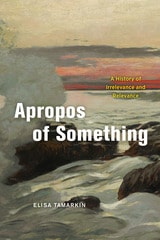
Vividly illustrated with paintings by Winslow Homer, Henry Ossawa Tanner, and others, Apropos of Something is a searching philosophical and poetic study of relevance—a concept calling for shifts in both attention and perceptions of importance with enormous social stakes.  It remains an invitation for the humanities and for all of us who feel tasked every day with finding the point.
 
[more]
cover of Are We There Yet?: Virtual Travel and Victorian Realism

Are We There Yet?

Virtual Travel and Victorian Realism

Alison Byerly

University of Michigan Press, 2012

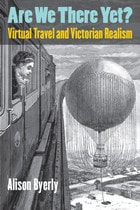
Are We There Yet? Virtual Travel and Victorian Realismconnects the Victorian fascination with "virtual travel" with the rise of realism in nineteenth-century fiction and twenty-first-century experiments in virtual reality. Even as the expansion of river and railway networks in the nineteenth century made travel easier than ever before, staying at home and fantasizing about travel turned into a favorite pastime. New ways of representing place—360-degree panoramas, foldout river maps, exhaustive railway guides—offered themselves as substitutes for actual travel. Thinking of these representations as a form of "virtual travel" reveals a surprising continuity between the Victorian fascination with imaginative dislocation and twenty-first -century efforts to use digital technology to expand the physical boundaries of the self.
[more]
cover of Arras Hanging: The Textile That Determined Early Modern Literature and Drama

Arras Hanging

The Textile That Determined Early Modern Literature and Drama

Rebecca Olson

University of Delaware Press, 2014

Textiles have long provided metaphors for storytelling: a compelling novel “weaves a tapestry” and we enjoy hearing someone “spin” a tale. To what extent, however, should we take these metaphors seriously? Arras Hanging: The Textile That Determined Early Modern Literature and Drama reveals that in the early modern period, when cloth-making was ubiquitous and high-quality tapestries called arras hangings were the most valuable objects in England, such metaphors were literal. The arras in particular provided a narrative model for writers such as Edmund Spenser and William Shakespeare, who exploited their audience’s familiarity with weaving to engage them in highly idiosyncratic and “hands on” ways. Specifically, undescribed or “blank” tapestries in the period’s fiction presented audiences with opportunities to “see” whatever they desired, and thus weave themselves into the story. Far more than background objects, literary and dramatic arras hangings have much to teach us about the intersections between texts and textiles at the dawn of print, and, more broadly, about the status of visual art in post-Reformation England.

Published by University of Delaware Press. Distributed worldwide by Rutgers University Press.
 
[more]
cover of Art and Artifact in Austen

Art and Artifact in Austen

Anna Battigelli

University of Delaware Press, 2020

Jane Austen distinguished herself with genius in literature, but she was immersed in all of the arts. Austen loved dancing, played the piano proficiently, meticulously transcribed piano scores, attended concerts and art exhibits, read broadly, wrote poems, sat for portraits by her sister Cassandra, and performed in theatricals. For her, art functioned as a social bond, solidifying her engagement with community and offering order. And yet Austen’s hold on readers’ imaginations owes a debt to the omnipresent threat of disorder that often stems—ironically—from her characters’ socially disruptive artistic sensibilities and skill. Drawing from a wealth of recent historicist and materialist Austen scholarship, this timely work explores Austen’s ironic use of art and artifact to probe selfhood, alienation, isolation, and community in ways that defy simple labels and acknowledge the complexity of Austen’s thought.

Published by University of Delaware Press. Distributed worldwide by Rutgers University Press.
 
[more]
cover of Arts of Dying: Literature and Finitude in Medieval England

Arts of Dying

Literature and Finitude in Medieval England

D. Vance Smith

University of Chicago Press, 2020

People in the Middle Ages had chantry chapels, mortuary rolls, the daily observance of the Office of the Dead, and even purgatory—but they were still unable to talk about death. Their inability wasn’t due to religion, but philosophy: saying someone is dead is nonsense, as the person no longer is. The one thing that can talk about something that is not, as D. Vance Smith shows in this innovative, provocative book, is literature.

Covering the emergence of English literature from the Old English to the late medieval periods, Arts of Dying argues that the problem of how to designate death produced a long tradition of literature about dying, which continues in the work of Heidegger, Blanchot, and Gillian Rose. Philosophy’s attempt to designate death’s impossibility is part of a literature that imagines a relationship with death, a literature that intensively and self-reflexively supposes that its very terms might solve the problem of the termination of life. A lyrical and elegiac exploration that combines medieval work on the philosophy of language with contemporary theorizing on death and dying, Arts of Dying is an important contribution to medieval studies, literary criticism, phenomenology, and continental philosophy.
[more]
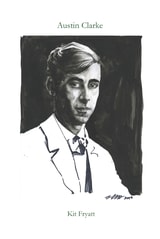
cover of Austin Clarke

Austin Clarke

Kit Fryatt

Aberdeen University Press, 2020
This is the first book to examine the work of Austin Clarke (1896-1974) in the light of modern critical and theoretical perspectives. Clarke was one of Ireland's major writers whose career was devoted as much to fiction, drama and autobiography as to poetry. Kit Fryatt assesses Clarke's work in its entirety but focuses on key works which reveal how resourcefully Clarke explored themes such as the coherence of the personality, the inner lives of women and the roots of repression.
[more]
cover of Authorship in the Long Eighteenth Century

Authorship in the Long Eighteenth Century

Dustin Griffin

University of Delaware Press, 2014

This book deals with changing conditions and conceptions of authorship in the long eighteenth century, a period often said to have witnessed the birth of the modern author. It focuses not on authorial self-presentation or self-revelation but on an author’s interactions with booksellers, collaborators, rivals, correspondents, patrons, and audiences. Challenging older accounts of the development of authorship in the period as well as newer claims about the “public sphere” and the “professional writer,” it engages with recent work on print culture and the history of the book. Methodologically eclectic, it moves from close readings to strategic contextualization. The book is organized both chronologically and topically. Early chapters deal with writers – notably Milton and Dryden – at the beginning of the long eighteenth century, and later chapters focus more on writers — among them Johnson, Gray, and Gibbon — toward its end. Looking beyond the traditional canon, it considers a number of little-known or little-studied writers, including Richard Bentley, Thomas Birch, William Oldys, James Ralph, and Thomas Ruddiman. Some of the essays are organized around a single writer, but most deal with a broad topic – literary collaboration, literary careers, the republic of letters, the alleged rise of the “professional writer,” and the rather different figure of the “author by profession.”

Published by University of Delaware Press. Distributed worldwide by Rutgers University Press.
 
[more]
cover of Autobiography: Narrative of Transformation

Autobiography

Narrative of Transformation

Carolyn A. Barros

University of Michigan Press, 1997

In Autobiography: Narrative of Transformation, Carolyn Barros creates a primer for the study of autobiography, a genre many consider highly problematic. She sees autobiography as a "narrative of transformation"--a text that presents the "before" and "after" of an individual's life. Focusing on autobiography as narrative, of something that "happened to me," Barros highlights the various metamorphoses that are emplotted, bounded, and framed by the author's language and demonstrates that change is the operative metaphor in autobiographical discourse. The study focuses primarily on autobiographies from the rich Victorian period. Thomas Carlyle's Sartor Resartus, as it self-consciously fictionalized the composition of Diogenes Teufelsdröckh's life narrative, provides a striking analog and paradigm for introducing the study and its methodological approach. Barros's major chapters on John Henry Cardinal Newman, John Stuart Mill, Charles Darwin, and Margaret Oliphant detail four very different types of autobiographical transformation -- religious, philosophical, scientific, and literary -- and in Barros's judgment establish benchmarks for considering autobiographies from antiquity to the present. A final chapter discusses autobiography's significance to an individual writer's corpus, to a particular culture, and finally to a history of "narratives of transformation."
[more]