Results by title
406 books match the query 'Greece' and 61 start with a
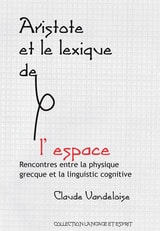
Aristote et le lexique de l'espace
Claude Vandeloise
CSLI, 2001
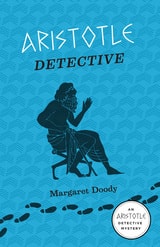
Aristotle Detective
An Aristotle Detective NovelMargaret Doody
University of Chicago Press, 2014
In Aristotle Detective, we first meet Stephanos—naive Watson to Aristotle’s learned Holmes—a young landed Athenian and student of Aristotle. With the aid of his cunning, olive-loving teacher, Stephanos must clear his exiled cousin of murder and save his family’s honor in a tense public trial. Will Stephanos survive to cinch the case?
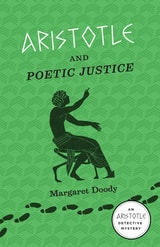
Aristotle and Poetic Justice
An Aristotle Detective NovelMargaret Doody
University of Chicago Press, 2014
Stephanos and his teacher return in Aristotle and Poetic Justice, when a party given by wealthy Athenian silver miners leads to kidnapping, a ghost, a road trip to Delphi, and, of course, murder. More historical fiction than a detective novel, this sequel runs the gamut of Athenian social customs, myth, politics, and economics—from the trials of virgin love to the dangers of silver lust.
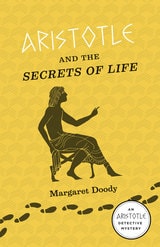
Aristotle and the Secrets of Life
An Aristotle Detective NovelMargaret Doody
University of Chicago Press, 2014
With Aristotle and the Secrets of Life, tensions between the Athenians and the Makedonians—followers of another of Aristotle’s former students, Alexander the Great—draw our heroes across the Aegean Sea. Even as Aristotle and Stephanos escape from pirates, uncover conspiracy, and face the horrors of war, Aristotle finds time to discuss his studies of the natural world in this gripping tale of their quest into darkness.
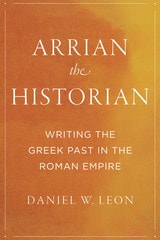
Arrian the Historian
Writing the Greek Past in the Roman EmpireBy Daniel W. Leon
University of Texas Press, 2021
During the first centuries of the Roman Empire, Greek intellectuals wrote a great many texts modeled on the dialect and literature of Classical Athens, some 500 years prior. Among the most successful of these literary figures were sophists, whose highly influential display oratory has been the prevailing focus of scholarship on Roman Greece over the past fifty years. Often overlooked are the period’s historians, who spurned sophistic oral performance in favor of written accounts. One such author is Arrian of Nicomedia.
Daniel W. Leon examines the works of Arrian to show how the era's historians responded to their sophistic peers’ claims of authority and played a crucial role in theorizing the past at a time when knowledge of history was central to defining Greek cultural identity. Best known for his history of Alexander the Great, Arrian articulated a methodical approach to the study of the past and a notion of historical progress that established a continuous line of human activity leading to his present and imparting moral and political lessons. Using Arrian as a case study in Greek historiography, Leon demonstrates how the genre functioned during the Imperial Period and what it brings to the study of the Roman world in the second century.
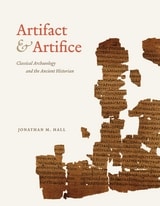
Artifact and Artifice
Classical Archaeology and the Ancient HistorianJonathan M. Hall
University of Chicago Press, 2013
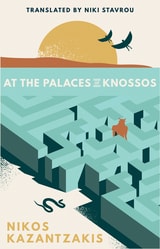
At the Palaces of Knossos
Nikos Kazantzakis
Ohio University Press, 2025
A captivating retelling—newly translated—of the rise and fall of the Minoan civilization interwoven with some of ancient Greece’s most enduring myths
At the Palaces of Knossos is a vivid reimagining of ancient Crete, blending history and mythology into an epic tale of heroism, love, and destiny. Set against the grandeur of the Minoan court, the novel brings to life the legendary stories of Theseus, the Minotaur, Ariadne, Daedalus, and Icarus.
The story follows Theseus, the prince of Athens, who arrives in Crete as part of the annual tribute of young Athenians sent to feed the monstrous Minotaur. Determined to end this brutal cycle, he infiltrates the labyrinthine palace of Knossos, where he crosses paths with Princess Ariadne. Struggling between loyalty to her people and her love for the courageous stranger, Ariadne risks everything to help Theseus in his quest.
Through the eyes of palace attendants, acrobats, and the inventor Daedalus and his son Icarus, Kazantzakis transports readers into the splendor of Minoan culture—its sacred rituals, breathtaking bull-leaping ceremonies, and vibrant city life. But as Theseus prepares to face his destiny, a tragic chain of events unfolds, leading to heartbreak, betrayal, and the downfall of a once-mighty civilization.
Rich with philosophical depth and lyrical prose, At the Palaces of Knossos is more than a mythological retelling—it is a meditation on power, freedom, and the eternal struggle between fate and human will. Perfect for fans of historical fiction and Greek mythology, this novel offers a compelling journey into one of the ancient world’s most fascinating eras.
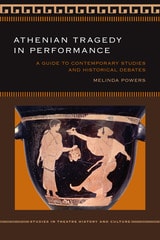
Athenian Tragedy in Performance
A Guide to Contemporary Studies and Historical DebatesMelinda Powers
University of Iowa Press, 2014
A case study of Euripides’s Bacchae, which provides more information about performance than any other extant tragedy, demonstrates possible methods for reconstructing the play’s historical performance and also the inevitable challenges inherent in that task, from the limited sources and the difficulty of interpreting visual material, to the risks of conflating actor with character and extrapolating backward from contemporary theatrical experience.
As an inquiry into the study of theatre and performance, an introduction to historical writing, a reference for further reading, and a clarification of several general misconceptions about Athenian tragedy and its performance, this historiographical analysis will be useful to specialists, practitioners, and students alike.
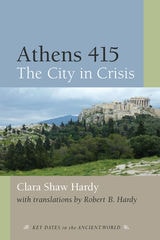
Athens 415
The City in CrisisClara Shaw Hardy, with translations by Robert B. Hardy
University of Michigan Press, 2020
On a summer night in 415 BCE, unknown persons systematically mutilated most of the domestic “herms”—guardian statues of the god Hermes—in Athens. The reaction was immediate and extreme: the Athenians feared a terrifying conspiracy was underway against the city and its large fleet—and possibly against democracy itself. The city established a board of investigators, which led to informants, accusations, and flight by many of the accused. Ultimately, dozens were exiled or executed, their property confiscated.
This dramatic period offers the opportunity to observe the city in crisis. Sequential events allow us to see the workings of the major institutions of the city (assembly, council, law courts, and theater, as well as public and private religion). Remarkably, the primary sources for these tumultuous months name conspirators and informants from a very wide range of status-groups: citizens, women, slaves, and free residents. Thus the incident provides a particularly effective entry-point into a full multifaceted view of the way Athens worked in the late fifth century.
Designed for classroom use, Athens 415 is no potted history, but rather a source-based presentation of ancient urban life ideal for the study of a people and their institutions and beliefs. Original texts—all translated by poet Robert B. Hardy—are presented along with thoughtful discussion and analyses by Clara Shaw Hardy in an engaging narrative that draws students into Athens’ crisis.
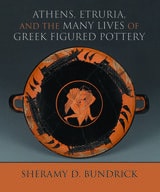
Athens, Etruria, and the Many Lives of Greek Figured Pottery
Sheramy D. Bundrick
University of Wisconsin Press, 2021
Thousands of Greek painted vases have emerged from excavations of tombs, sanctuaries, and settlements throughout Etruria, from southern coastal centers to northern communities in the Po Valley. Using documented archaeological assemblages, especially from tombs in southern Etruria, Bundrick challenges the widely held assumption that Etruscans were hellenized through Greek imports. She marshals evidence to show that Etruscan consumers purposefully selected figured pottery that harmonized with their own local needs and customs, so much so that the vases are better described as etruscanized. Athenian ceramic workers, she contends, learned from traders which shapes and imagery sold best to the Etruscans and employed a variety of strategies to maximize artistry, output, and profit.
Automated Athens
Ancient Greek Ideals in the Early Age of AutomationMichele Kennerly
University of Chicago Press, 2026
A critical history of the recurring idea that technology will free us from work and bring about a truly democratic society.
In popular thought, ancient Athens endures as a place ahead of its time—the birthplace of democracy, a cultural center, and a model toward which modern societies should strive. In Automated Athens, Michele Kennerly examines the many and frequent appeals to this nostalgic vision of the ancient city-state throughout the early age of computerized automation. In the mid-twentieth century, people hoped that automation would free us from mindless, dehumanizing work so that we could attend to creative and communal pursuits. Proponents appealed to ancient Athens, saying automated systems and machines would stand in for the craftsmen, enslaved people, and subordinated women who performed the undesirable work that enabled that city-state’s flourishing. Automated Athens scrutinizes this appeal as it moves chronologically into present debates about the promise of automation and AI. For Kennerly, our inability to settle debates about where accelerating automation may take us, especially politically, reveals a deeper cultural indecisiveness about how to live well and live well together.