Results by title
4030 books match the query 'Language Arts & Disciplines' and 351 start with a
A Literary History of Iowa
Clarence A. Andrews
University of Iowa Press, 1972
A Manual for Writers of Research Papers, Theses, and Dissertations, Ninth Edition
Chicago Style for Students and ResearchersKate L. Turabian
University of Chicago Press, 2018
This new edition filters decades of expertise into modern standards. While previous editions incorporated digital forms of research and writing, this edition goes even further to build information literacy, recognizing that most students will be doing their work largely or entirely online and on screens. Chapters include updated advice on finding, evaluating, and citing a wide range of digital sources and also recognize the evolving use of software for citation management, graphics, and paper format and submission. The ninth edition is fully aligned with the recently released Chicago Manual of Style, 17th edition, as well as with the latest edition of The Craft of Research.
Teachers and users of the previous editions will recognize the familiar three-part structure. Part 1 covers every step of the research and writing process, including drafting and revising. Part 2 offers a comprehensive guide to Chicago’s two methods of source citation: notes-bibliography and author-date. Part 3 gets into matters of editorial style and the correct way to present quotations and visual material. A Manual for Writers also covers an issue familiar to writers of all levels: how to conquer the fear of tackling a major writing project.
Through eight decades and millions of copies, A Manual for Writers has helped generations shape their ideas into compelling research papers. This new edition will continue to be the gold standard for college and graduate students in virtually all academic disciplines.
- Bestselling, trusted, and time-tested advice for writing research papers
- The best interpretation of Chicago style for higher education students and researchers
- Definitive, clear, and easy to read, with plenty of examples
- Shows how to compose a strong research question, construct an evidence-based argument, cite sources, and structure work in a logical way
- Essential for anyone interested in learning about research
- Everything any student or teacher needs to know concerning paper writing

A Manual for Writers of Research Papers, Theses, and Dissertations, Tenth Edition
"The Chicago Manual of Style" for Student ResearchersKate L. Turabian
University of Chicago Press, 2026
The gold standard for generations of college and graduate students writing research papers, now thoroughly updated to reflect today’s expectations.
Whether you are writing your first college research paper or your dissertation, A Manual for Writers of Research Papers, Theses, and Dissertations—also known as “Turabian”—remains a classic resource because of its timeless focus on the fundamentals of good research writing. For more than eight decades, it has offered comprehensive guidance on current expectations for academic writing. Based on the idea that writing a paper means engaging in a conversation with others in your field, it shows you how to conduct research, craft an argument, and produce an original work based on evidence and reasoning that responds to and builds on what others have previously written. Along the way, it also serves as a reference for cultivating consistent and respectful practices toward your readers in citations, language choices, and paper format.
This new edition reflects the continuing evolution in academic writing conventions. It has been updated to reflect the most current editions of The Craft of Research and The Chicago Manual of Style and features the following additional changes:
- A redesign for easier navigation
- Extensive coverage of the appropriate use of generative AI
- A rewritten chapter on visual communication
- Greater attention to writing centers and tutors
- New notes for students and instructors on how to use the book
- Refreshed examples throughout
Further, new ancillary written and video materials to support your use of the book are available online at Turabian.org.
With nearly 10 million copies sold, A Manual for Writers remains the most trusted and time-tested reference for writing research papers. Authoritative, clear, and easy to read with plenty of examples, it is the essential guide for any student or teacher concerned with research and good writing.

A Matter of Facts
The Value of Evidence in an Information AgeLaura A. Millar
American Library Association, 2019
The safeguarding of authentic facts is essential, especially in this disruptive Orwellian age, where digital technologies have opened the door to a post-truth world in which “alternative facts” can be so easily accepted as valid. And because facts matter, evidence matters. In this urgent manifesto, archives luminary Millar makes the case that authentic and accurate records, archives, data, and other sources of documentary proof are crucial in supporting and fostering a society that is respectful, democratic, and self-aware. An eye-opening treatise for the general public, an invaluable resource for archives students, and a provocative call-to-arms for information and records professionals, Millar’s book
- explains the concept of evidence and discusses the ways in which records, archives, and data are not just useful tools for our daily existence but also essential sources of evidence both today and in the future;
- includes plentiful examples that illustrate the critical role evidence plays in upholding rights, enforcing responsibilities, tracing family or community stories, and capturing and sharing memories; and
- examines the impact of digital technologies on how records and information are created and used.
With documentary examples ranging from Mesopotamian clay tablets to World War II photographs to today’s Twitter messages and Facebook posts, Millar’s stirring book will encourage readers to understand more fully the importance of their own records and archives, for themselves and for future generations.
A Minefield of Dreams
Triumphs and Travails of Independent Writing ProgramsJustin Everett
University Press of Colorado, 2017
A More Dangerous Game
How a Young Sportswriter Met Patty Hearst and Landed in Federal PrisonJay Weiner
University of Minnesota Press, 2027
From precocious sportswriter to Federal Prisoner #01150-134: The intersection of sports and the revolutionary 1970s, with one ambitious young man caught in the middle
Jay Weiner was an aspiring teenage sportswriter when he met Jack Scott, the charismatic, activist journalist who would become his mentor, immersing him in the political and social issues roiling sports—and so much else—in the late 1960s and 1970s. Weiner became a zealous student of Scott, joining a new tradition of sports journalism that interrogated questions of race, power, and politics alongside the games themselves. But his blind devotion took a treacherous turn when Scott took Weiner, as a surprise for his twentieth birthday, to a secluded Pennsylvania farmhouse where heiress-turned-FBI-most-wanted Patty Hearst was hiding out with her Symbionese Liberation Army kidnappers-turned-comrades.
A More Dangerous Game is Weiner’s story of coming of age in a shocking fashion. A wild mosaic of sports, journalism, betrayal, justice, courage, and redemption, his memoir charts the meeting of sports and the radical left in the 1970s, with Weiner unwittingly caught in the middle and left behind by his mentor. In the engaged, edgy style of a seasoned sportswriter, Weiner describes the fallout after that fateful encounter with the country’s most wanted fugitives: three years of federal subpoenas, impossible decisions, and, ultimately, four months in prison for refusing to testify before a grand jury.
With exhaustive background reporting, Weiner fits together the seemingly disparate pieces of his unlikely journey from young sportswriter to frightened FBI target to emboldened Federal Prisoner #01150-134. From its examination of the life and work of Jack Scott to its surprising angle on the well-chronicled saga of Patty Hearst, A More Dangerous Game is the engrossing story of a time when examining sports as a mirror of society put a writer on the cutting edge of one of the most notorious stories of a generation.
Retail e-book files for this title are screen-reader friendly with images accompanied by short alt text and/or extended descriptions.
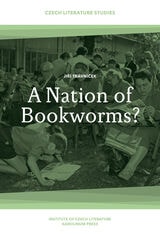
A Nation of Bookworms?
Czechs as ReadersJirí Trávnícek
Karolinum Press, 2021
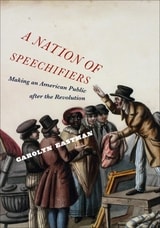
A Nation of Speechifiers
Making an American Public after the RevolutionCarolyn Eastman
University of Chicago Press, 2009
In the decades after the American Revolution, inhabitants of the United States began to shape a new national identity. Telling the story of this messy yet formative process, Carolyn Eastman argues that ordinary men and women gave meaning to American nationhood and national belonging by first learning to imagine themselves as members of a shared public.
She reveals that the creation of this American public—which only gradually developed nationalistic qualities—took place as men and women engaged with oratory and print media not only as readers and listeners but also as writers and speakers. Eastman paints vibrant portraits of the arenas where this engagement played out, from the schools that instructed children in elocution to the debating societies, newspapers, and presses through which different groups jostled to define themselves—sometimes against each other. Demonstrating the previously unrecognized extent to which nonelites participated in the formation of our ideas about politics, manners, and gender and race relations, A Nation of Speechifiers provides an unparalleled genealogy of early American identity.
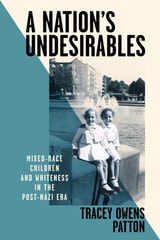
A Nation’s Undesirables
Mixed-Race Children and Whiteness in the Post-Nazi EraTracey Owens Patton
The Ohio State University Press, 2024
An innovative investigation of the entangled histories of race, transnational adoption, and post-Nazi Germany.
In a moving blend of family history and cutting-edge scholarship, Tracey Owens Patton’s A Nation’s Undesirables synthesizes work in rhetorical postmemory studies, critical adoption studies, Afrofuturism, and more to tell the story of her mother and aunt, Lore and Lilli. Two of thousands of children born to white German women and Black American men after World War II, the twins moved to the United States at age seven, where their mother renounced her parental rights and put them into the adoption system. They did not see her again for fifty-two years.Patton takes up the twins’ story and their reckoning with their mixed-race, Black German identity to disrupt standard narratives around World War II, Black experiences in Germany, and race and adoption. Combining family interviews, historical artifacts, and autoethnographic reflection, Patton composes a new narrative of women and Black German children in the postwar era. In examining the systemic racism of Germany’s efforts to move children like Lore and Lilli out of the country—and the suppression of German women’s bodily autonomy—Patton amplifies the once unacknowledged identities of these Black German children to broaden our understanding of citizenship, racism, and sexism after World War II.
A Natural History of Negation
Laurence R. Horn
CSLI, 1989
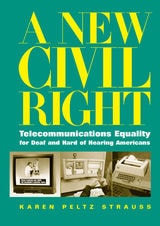
A New Civil Right
Telecommunications Equality for Deaf and Hard of Hearing AmericansKaren Peltz Strauss
Gallaudet University Press, 2006
When three deaf men in the 1960s invented and sold TTYs, the first teletypewriting devices that allowed deaf people to communicate by telephone, they started a telecommunications revolution for deaf people throughout America. A New Civil Right: Telecommunications Equality for Deaf and Hard of Hearing Americans chronicles the history of this movement, which lagged behind new technical developments decades after the advent of TTYs.
In this highly original work, Author Karen Peltz Strauss reveals how the paternalism of the hearing-oriented telecommunications industries slowed support for technology for deaf users. Throughout this comprehensive account, she emphasizes the grassroots efforts behind all of the eventual successes. A New Civil Right recounts each advance in turn, such as the pursuit of special customer premises equipment (SCPE) from telephone companies; the Telecommunications Act of 1982 and the Telecommunications Accessibility Enhancement Act of 1988 and the 1990 Americans with Disabilities Act, which required nationwide relay telephone services for deaf and hard of hearing users.
Strauss painstakingly details how all of these advances occurred incrementally, first on local and state levels, and later through federal law. It took exhaustive campaigning to establish 711 for nationwide relay dialing, while universal access to television captioning required diligent legal and legislative work to pass the Decoder Circuitry Act in 1990. The same persistence resulted in the enactment of the Telecommunications Act of 1996, which required all off-the-shelf communications equipment, including new wireless technology, to be readily accessible to deaf users.
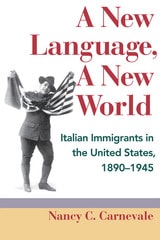
A New Language, A New World
Italian Immigrants in the United States, 1890-1945Nancy C. Carnevale
University of Illinois Press, 2012
A Paradigm for Program Semantics
Chris Brink and Ingrid Rewitsky
CSLI, 2001
A Pedagogy of Possibility
Bakhtinian Perspectives on Composition StudiesKay Halasek
Southern Illinois University Press, 1999
In a book that itself exemplifies the dialogic scholarship it proposes, Kay Halasek reconceives composition studies from a Bakhtinian perspective, focusing on both the discipline's theoretical assumptions and its pedagogies.
Framing her discussions at every level of the discipline—theoretical, historical, pedagogical—Halasek provides an overview of portions of the Bakhtinian canon relevant to composition studies, explores the implications of Mikhail Bakhtin's work in the teaching of writing and for current debates about the role of theory in composition studies, and provides a model of scholarship that strives to maintain dialogic balance between practice and theory, between composition studies and Bakhtinian thought.
Halasek's study ranges broadly across the field of composition, painting in wide strokes a new picture of the discipline, focusing on the finer details of the rhetorical situation, and teasing out the implications of Bakhtinian thought for classroom practice by examining the nature of critical reading and writing, the efficacy and ethics of academic discourse, student resistance, and critical and conflict pedagogy. The book ends by setting out a pedagogy of possibility, what Halasek terms elsewhere a "post-critical pedagogy" that redefines and redirects current discussions of home versus academic literacies and discourses.
A Place for Dialogue
Language, Land Use, and Politics in Southern ArizonaSharon McKenzie Stevens
University of Iowa Press, 2007
In A Place for Dialogue, Sharon McKenzie Stevens views the contradictions and collaborations involved in the management of public land in southern Arizona—and by extension the entire arid West—through the lens of political rhetoric. Revealing the socioecological relationships among cattlemen and environmentalists as well as developers and recreationists, she analyzes the ways that language shapes landscape by shaping decisions about land use.
Stevens focuses on the collaborative Sonoran Desert Conservation Plan initiated by Pima County, Arizona, the ubiquitous use of scientific argument to defend contradictory practices, and the construction and negotiation of rancher/environmentalist identities to illuminate both literally and metaphorically the dynamics of land use politics. Drawing specifically upon extensive interviews with a diverse array of agents on all sides of the debate—ranchers, environmentalists, scientists, land managers, government officials—on historical narratives, and on her own conflicting experiences as someone who grew up with those who work the western lands, she demonstrates that it is possible to use differences to solve, rather than to aggravate, the entrenched problems that bridge land and language.
By integrating her richly textured case study of a fragile region with rhetorical approaches to narrative, science-based argument, and collective identities, Stevens makes a significant contribution to the fields of rhetoric, land management, and cultural studies.
A Poet's Guide to Poetry, Second Edition
Mary Kinzie
University of Chicago Press, 2013
The three parts of A Poet’s Guide to Poetry lead the reader through a carefully planned introduction to the ways we understand poetry. The first section provides careful, step-by-step instruction to familiarize students with the formal elements of poems, from the most obvious feature through the most subtle. The second part carefully examines meter and rhythm, as well as providing a theoretical and practical overview of free verse. The final section offers helpful chapters on writing in form. Rounding out the volume are writing exercises for beginning and advanced writers, a dictionary of poetic terms, and a bibliography of further reading.
For this new edition, Kinzie has carefully reworked the introductory material and first chapter, as well as amended the annotated bibliography to include the most recent works of criticism. The updated guide also contains revised exercises and adjustments throughout the text to make the work as lucid and accessible as possible.
A Reference Grammar of Chinese Sentences with Exercises
Henry Hung-Yeh Tiee
University of Arizona Press, 1986

A Rhetoric of Doing
Essays on Written Discourse in Honor of James L. KinneavyEdited by Stephen P. Witte, Neil Nakadate, and Roger D. Cherry
Southern Illinois University Press, 1992
Concerned with both the nature and the practice of discourse, the eighteen essays collected here treat rhetoric as a dynamic enterprise of inquiry, exploration, and application, and in doing so reflect James L. Kinneavy’s firm belief in the vital relationship between theory and practice, his commitment to a spirit of accommodation and assimilation that promotes the development of ever more powerful theories and ever more useful practices.
A thorough introduction provides the reader with clear summaries of the essays by leading-edge theorists, researchers, and teachers of writing and rhetoric. A "field context" for the ideas presented in this book is provided through the division of the various chapters into four major sections that focus on classical rhetoric and rhetorical theory in historical contexts; on dimensions of discourse theory, aspects of discourse communities, and the sorts of knowledge people access and use in producing written texts; on writing in school-related contexts; and on several dimensions of nonacademic writing. A fifth section contains a bibliographic survey and an appreciation of James Kinneavy’s work. The exceptional range of these essays makes A Rhetoric of Doing an ecumenical examination of the current state of mind in rhetoric and written communication, a survey and description of what discourse and those in the field of discourse are, in fact, doing.
A Rhetoric of Irony
Wayne C. Booth
University of Chicago Press, 1975
In the first and longer part of his work, Booth deals with the workings of what he calls "stable irony," irony with a clear rhetorical intent. He then turns to intended instabilities—ironies that resist interpretation and finally lead to the "infinite absolute negativities" that have obsessed criticism since the Romantic period.
Professor Booth is always ironically aware that no one can fathom the unfathomable. But by looking closely at unstable ironists like Samuel Becket, he shows that at least some of our commonplaces about meaninglessness require revision. Finally, he explores—with the help of Plato—the wry paradoxes that threaten any uncompromising assertion that all assertion can be undermined by the spirit of irony.
A Rhetoric of Style
Barry Brummett
Southern Illinois University Press, 2008
Exploring style in a global culture
In A Rhetoric of Style, Barry Brummett illustrates how style is increasingly a global system of communication as people around the world understand what it means to dress a certain way, to dance a certain way, to decorate a certain way, to speak a certain way. He locates style at the heart of popular culture and asserts that it is the basis for social life and politics in the twenty-first century.
Brummett sees style as a system of signification grounded largely in image, aesthetics, and extrarational modes of thinking. He discusses three important aspects of this system—its social and commercial structuring, its political consequences, and its role as the chief rhetorical system of the modern world. He argues that aesthetics and style are merging into a major engine of the global economy and that style is becoming a way to construct individual identity, as well as social and political structures of alliance and opposition. It is through style that we stereotype or make assumptions about others’ political identities, their sexuality, their culture, and their economic standing.
To facilitate theoretical and critical analysis, Brummett develops a systematic rhetoric of style and then demonstrates its use through an in-depth exploration of gun culture in the United States. Armed with an understanding of how this rhetoric of style works methodologically, students and scholars alike will have the tools to do their own analyses. Written in clear and engaging prose, A Rhetoric of Style presents a novel discussion of the workings of style and sheds new light on a venerable and sometimes misunderstood rhetorical concept by illustrating how style is the key to constructing a rhetoric for the twenty-first century.
A Right to Read
Segregation and Civil Rights in Alabama's Public Libraries, 1900–1965Patterson Toby Graham
University of Alabama Press, 2006
This original and significant contribution to the historiography of the civil rights movement and education in the South details a dramatic and disturbing chapter in American cultural history.
The tradition of American public libraries is closely tied to the perception that these institutions are open to all without regard to social background. Such was not the case in the segregated South, however, where public libraries barred entry to millions of African Americans and provided tacit support for a culture of white supremacy. A Right to Read is the first book to examine public library segregation from its origins in the late 19th century through its end during the tumultuous years of the 1960s civil rights movement. Graham focuses on Alabama, where African Americans, denied access to white libraries, worked to establish and maintain their own "Negro branches." These libraries-separate but never equal-were always underfunded and inadequately prepared to meet the needs of their constituencies.
By 1960, however, African Americans turned their attention toward desegregating the white public libraries their taxes helped support. They carried out "read-ins" and other protests designed to bring attention and judicial pressure upon the segregationists. Patterson Toby Graham contends that, for librarians, the civil rights movement in their institutions represented a conflict of values that pitted their professional ethics against regional mores. He details how several librarians in Alabama took the dangerous course of opposing segregationists, sometimes with unsettling results.
This groundbreaking work built on primary evidence will have wide cross-disciplinary appeal. Students and scholars of southern and African-American history, civil rights, and social science, as well as academic and public librarians, will appreciate Graham's solid research and astute analysis.
A Saturnalia of Bunk
Selections from The Free Lance, 1911–1915H. L. Mencken
Ohio University Press, 2017
H. L. Mencken’s reputation as a journalist and cultural critic of the twentieth century has endured well into the twenty-first. His early contributions as a writer, however, are not very well known. He began his journalistic career as early as 1899 and in 1910 cofounded the Baltimore Evening Sun. The next year he initiated a column—The Free Lance—that ran six days a week for four and a half years, until the Sun discontinued it, partially in response to Mencken’s controversial defense of Germany during World War One.
In this early forum for his renowned wit, Mencken broached many of the issues to which he would return again and again over his career, establishing himself as a fearless iconoclast willing to tackle the most divisive subjects and apply a heady mix of observation, satire, and repartee to clear away what he regarded as the “saturnalia of bunk” that clouded American thinking. The Free Lance reveals Mencken at his scintillating best as a journalist, polemicist, and satirist.
These columns are collected here for the first time, edited and annotated by Mencken expert and critic S. T. Joshi. This extraordinary collection is an invaluable resource for Mencken scholars and fans and provides an entertaining immersion into the early twentieth-century American zeitgeist.
A Sense of Urgency
How the Climate Crisis Is Changing RhetoricDebra Hawhee
University of Chicago Press, 2023
Why is it difficult to talk about climate change? Debra Hawhee argues that contemporary rhetoric relies on classical assumptions about humanity and history that cannot conceive of the present crisis. How do we talk about an unprecedented future or represent planetary interests without privileging our own species? A Sense of Urgency explores four emerging answers, their sheer novelty a record of both the devastation and possible futures of climate change. In developing the arts of magnitude, presence, witness, and feeling, A Sense of Urgency invites us to imagine new ways of thinking with our imperiled planet.
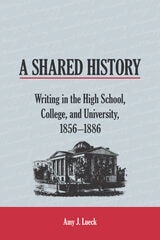
A Shared History
Writing in the High School, College, and University, 1856-1886Amy J. Lueck
Southern Illinois University Press, 2020
Lueck explores Civil War- and Reconstruction-era challenges to the University of Louisville and nearby local high schools, their curricular transformations, and their fate in regard to national education reform efforts. These institutions reflect many of the educational trends and developments of the day: college and university building, the emergence of English education as the dominant curriculum for higher learning, student-centered pedagogies and educational theories, the development and transformation of normal schools, the introduction of manual education and its mutation into vocational education, and the extension of advanced education to women, African American, and working-class students.
Lueck demonstrates a complex genealogy of interconnections among high schools, colleges, and universities that demands we rethink our categories and standards of assessment and our field’s history. A shift in our historical narrative would promote a move away from an emphasis on the preparation, transition, and movement of student writers from high school to college or university and instead allow a greater focus on the fostering of rich rhetorical practices and pedagogies at all educational levels. As the definition of college-level writing becomes increasingly contested once again, Lueck invites a reassessment of the discipline’s understanding of contemporary programs based in high schools like dual-credit and concurrent enrollment.
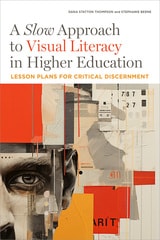
A Slow Approach to Visual Literacy in Higher Education
Lesson Plans for Critical DiscernmentDana Statton Thompson and Stephanie Beene
American Library Association, 2024
- dozens of flexible lesson plans for teaching visual literacy, scaffolded by competency levels: novice, intermediate, and advanced;
- ways to integrate slow looking into the classroom, emphasizing careful observation and the sustained act of looking;
- techniques for showing learners how to select images with intention, as well as carefully determine when and how to share those images;
- reasons why slow creating is essential to understanding and applying visual literacy in the twenty-first century; and
- a look at how increasing access to internet connectivity, generative artificial intelligence (AI), and new ethics for sharing and using information online will affect the future of visual literacy.
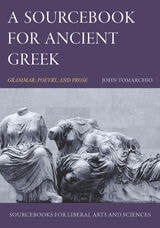
A Sourcebook for Ancient Greek
Grammar, Poetry, and ProseJohn Tomarchio
Catholic University of America Press, 2022
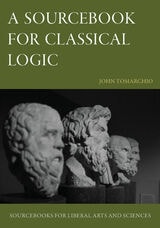
A Sourcebook for Classical Logic
John Tomarchio
Catholic University of America Press, 2023
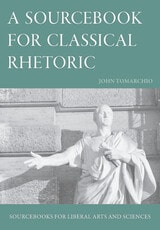
A Sourcebook for Classical Rhetoric
John Tomarchio
Catholic University of America Press, 2023
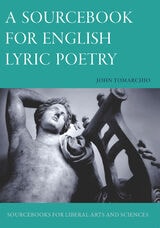
A Sourcebook for English Lyric Poetry
John Tomarchio
Catholic University of America Press, 2023
A Starter's Guide for Academic Library Leaders
Advice in ConversationAmanda Clay Powers
American Library Association, 2019
The path towards leadership starts with you. But you don’t have to go it alone. For this book, the authors sat down with many of the library leaders they most admire for a series of conversations about the aspects of the job that they find the most fascinating (and challenging). Much like the chats you might have over coffee at a conference or with a mentor, these frank discussions will nourish you with nuts-and-bolts wisdom on a diverse range of academic library management issues. Among the topics and situations broached are
- balancing personal values against the common refrain “you don’t get to be who you want to be in positions like ours”;
- five questions to ask that reveal much about organizational culture and climate;
- creating a culture of change, including why a newly promoted director chose to make the most drastic changes in the first 100 days;
- forming a “dean team” to help frame responses with consideration to institutional culture;
- the value of demystifying the budget for the entire library staff;
- using tools such as a personal “learning journal” to fuel professional development;
- cultivating a personal network by setting up meetings at local libraries during conferences;
- the risks that result from jumping into a situation too fast and boxing yourself into a corner;
- lessons learned from failed initiatives;
- examples of navigating controversies, such as a director’s response to a WPA mural with a racist message; and
- managing facilities, with an example of how injecting a previously ignored library voice into a building project led to a tripling of the space.
Between these covers you’ll find guidance, ideas, and inspiration as you continue your leadership journey.
A Tanizaki Feast
The International Symposium in VeniceAdriana Boscaro and Anthony Hood Chambers, Editors
University of Michigan Press, 1998
A Taste for Language
Literacy, Class, and English StudiesJames Ray Watkins Jr.
Southern Illinois University Press, 2009
“This is a book about the American Dream as it has become embodied in the university in general and in the English department in particular,” writes James Ray Watkins at the start of A Taste for Language: Literacy, Class, and English Studies. In it, Watkins argues that contemporary economic and political challenges require a clear understanding of the identity of English studies, making elementary questions about literacy, language, literature, education, and class once again imperative.
A personal history of university-level English studies in the twentieth century, A Taste for Language combines biography, autobiography, and critical analysis to explore the central role of freshman English and literary studies in the creation and maintenance of the middle class. It tells a multi-generational story of the author and his father, intertwined with close reading of texts and historical analysis. The story moves from depression-era Mississippi, where the author's father was born, to a contemporary English department, where the author now teaches.
Watkins looks at not only textbooks, scholars, and the academy but also at families and other social institutions. A rich combination of biography, autobiography, and critical analysis, A Taste for Language questions what purpose an education in English language and literature serves in the lives of the educated in a class-based society and whether English studies has become wholly irrelevant in the twenty-first century.
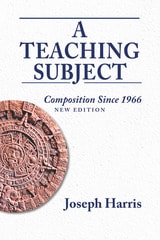
A Teaching Subject
Composition Since 1966, New EditionJoseph Harris
Utah State University Press, 2012
In this classic text, Joseph Harris traces the evolution of college writing instruction since the Dartmouth Seminar of 1966. A Teaching Subject offers a brilliant interpretive history of the first decades during which writing studies came to be imagined as a discipline separable from its partners in English studies. Postscripts to each chapter in this new edition bring the history of composition up to the present.
Reviewing the development of the field through five key ideas, Harris unfolds a set of issues and tensions that continue to shape the teaching of writing today. Ultimately, he builds a case, now deeply influential in its own right, that composition defines itself through its interest and investment in the literacy work that students and teachers do together. Unique among English studies fields, composition is, Harris contends, a teaching subject.
A Thousand and One Afternoons in Chicago
Ben Hecht
University of Chicago Press, 1992
“The hardboiled audacity and wit that became Hecht’s signature as Hollywood’s most celebrated screen-writer are conspicuous in these vignettes. Most of them are comic and sardonic, some strike muted tragic or somber atmospheric notes. . . . The best are timeless character sketches that have taken on an added interest as shards of social history.”—L. S. Klepp, Voice Literary Supplement
A Thousand and One Afternoons in Chicago
Ben Hecht
University of Chicago Press, 2009
“The hardboiled audacity and wit that became Hecht’s signature as Hollywood’s most celebrated screen-writer are conspicuous in these vignettes. Most of them are comic and sardonic, some strike muted tragic or somber atmospheric notes. . . . The best are timeless character sketches that have taken on an added interest as shards of social history.”—L. S. Klepp, Voice Literary Supplement
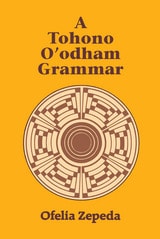
A Tohono O'odham Grammar
Ofelia Zepeda
University of Arizona Press, 1983
A Translation of Lao-tzu’s Tao Te Ching and Wang Pi’s Commentary
Translated by Paul J. Lin
University of Michigan Press, 1977

A Trauma-Informed Approach to Library Services
Rebecca Tolley
American Library Association, 2014
We are only now coming to terms with how common trauma really is; a landmark Kaiser study that surveyed patients receiving physicals found that almost two-thirds had experienced at least one form of abuse, neglect, or other trauma as a child. Though originating in the fields of health and social services, trauma-informed care is a framework that holds great promise for application to library work. Empathetic service, positive patron encounters, and a more trusting workplace are only a few of the benefits that this approach offers. In this important book Tolley, experienced in both academic and public libraries, brings these ideas into the library context. Library administrators, directors, and reference and user services staff will all benefit from learning
- the six key principles of trauma-informed care;
- characteristics of a trusting and transparent library organization, plus discussion questions to promote a sense of psychological safety among library workers;
- how certain language and labels can undermine mutuality, with suggested phrases that will help library staff demonstrate neutrality to patron ideas and views during information requests;
- delivery models that empower patrons;
- advice on balancing free speech on campus with students’ need for safety;
- how appropriate furniture arrangement can help people suffering from PTSD feel safe;
- guidance on creating safe zones for LGBTQIA+ children, teens, and adults; and
- self-assessment tools to support change toward trauma-responsive library services.
A Trauma-Informed Framework for Supporting Patrons
The PLA Workbook of Best PracticesThe Public Library Association Social Worker Task Force
American Library Association, 2022
- delve into what trauma is and how it impacts library work;
- be introduced to a framework for utilizing a trauma-informed lens in your interactions;
- practice exercises to spur personal reflection on common concerns bound up with library work and the policies relating to these issues; and
- gain hand-on tools and techniques, including strategies for de-escalation and guidance on the impacts of involving law-enforcement and banning patrons.
You will also explore various scenarios which provide the opportunity to integrate what you’ve learned and practice responding through a trauma-informed lens, including
- Mental Health Challenges
- Sleeping at the Library
- Strong Personal Odor
- Personal Belongings
- Suspected Intoxication/Under the Influence
- Substance Use
- Threatening Verbal and Nonverbal Behavior
- Unsheltered Teens
- Adult Self-Neglect
- Child Abuse or Assault
- Solicitation or Panhandling
- Stealing
- Child Unattended After Closing
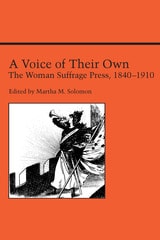
A Voice Of Their Own
The Woman Suffrage Press, 1840-1910Martha Solomon
University of Alabama Press, 1991
A War of Words in the Discourse of Trade
The Rhetorical Constitution of MetaphorPhilip Eubanks
Southern Illinois University Press, 2000
This study by Phillip Eubanks challenges traditional accounts of metaphor and significantly expands theories of "conceptual" metaphor by examining Trade Is War metaphor as it occurs in concrete discourse.
Although scholarly interest in metaphor as an aesthetic, linguistic, and cognitive phenomenon has long endured, Eubanks is among the first to consider metaphor in its sociohistorical role. Questioning major accounts of metaphor from Aristotle to the present, Eubanks argues that metaphor is not just influenced by but actually is constituted by its concrete operation.
Far-reaching in its implications for our understanding of metaphor, Eubanks’s premise enables us to see metaphor as a sweeping rhetorical entity even as it accounts for the more localized operations of metaphor of interest to linguists, philosophers of language, and cognitive scientists. Providing a new model of metaphoric functioning, Eubanks reconsiders the most promising account of metaphor to date, the notion of "conceptual metaphor.”
Eubanks focuses on the conceptual metaphor Trade Is War—a metaphor found wherever people discuss business and commerce—to develop his rhetorical model of metaphor. He analyzes Trade Is War as it occurs in the print news media, on television discussion shows, in academic works, in popular nonfiction and novels, in historic economic commentary, and in focus group talk. While these examples do reveal a rich variety in the make-up of Trade Is War, much more than mere variety is at stake.
Trade Is War is implicated in an extended and rhetorically complex conversation with other metaphors and literal concepts: trade is peace, Trade Is a Game, Trade Is Friendship, Trade is a Journey, and Markets Are Containers. The recognition and analysis of this constituting conversation furthers a reevaluation theory. What also emerges, however, is a valuable portrait of the discourse of trade itself, a discourse that depends importantly upon a responsive interchange of metaphors.
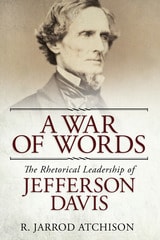
A War of Words
The Rhetorical Leadership of Jefferson DavisR. Jarrod Atchison
University of Alabama Press, 2017
Numerous biographies of Jefferson Davis have been penned; however, until now, there had been no substantive analysis of his public discourse as president of the Confederacy. R. Jarrod Atchison’s A War of Words uses concepts from rhetorical theory and public address to help answer a question that has intrigued scholars from a variety of disciplines since the collapse of the Confederacy: what role, if any, did Davis play in the collapse of Confederate nationalism?
Most discussions of Davis and nationalism focus on the military outcomes of his controversial wartime decisions. A War of Words focuses less on military outcomes and argues instead that, in the context of the Confederacy, Jefferson Davis’s rhetorical leadership should have been responsible for articulating a vision for the nation—including the core tenets of its identity, the values the nation should hold dear, the principles it should never compromise, and the goals it should set for its future. Undoubtedly, Davis possessed the skills necessary to make a persuasive public argument. It is precisely because Davis’s oratory skills were so powerful that there is room to judge how he used them. In short, being a great orator is not synonymous with successful rhetorical leadership.
Atchison posits that Davis’s initial successes constrained his rhetorical options later in the war. A War of Words concludes that, in the end, Davis’s rhetorical leadership was a failure because he was unable to articulate a coherent Confederate identity in light of the sacrifices endured by the populace in order to sustain the war effort.
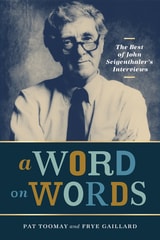
A Word on Words
The Best of John Seigenthaler's InterviewsEdited by Pat Toomay and Frye Gaillard; Epilogue by Andrew Maraniss
Vanderbilt University Press, 2023
Featuring interviews with:
Arna Bontemps • Marshall Chapman • Pat Conroy • Rodney Crowell • John Egerton • Jesse Hill Ford • Charles Fountain • William Price Fox • Kinky Friedman • Frye Gaillard • Nikki Giovanni • Doris Kearns Goodwin • David Halberstam • Waylon Jennings • John Lewis • David Maraniss • William Marshall • Jon Meacham • Ann Patchett • Alice Randall • Dori Sanders • John Seigenthaler Sr. • Marty Stuart • Pat Toomay
A Working Model for Contingent Faculty
Robert Samuels
University Press of Colorado, 2023
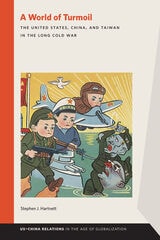
A World of Turmoil
The United States, China, and Taiwan in the Long Cold Warstephen hartnett
Michigan State University Press, 2021
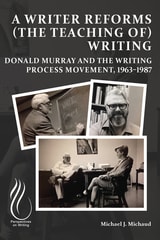
A Writer Reforms (the Teaching of) Writing
Donald Murray and the Writing Process Movement, 1963–1987Michael J. Michaud
University Press of Colorado, 2024
A Writer's Guide to Mindful Reading
Ellen C. Carillo
University Press of Colorado, 2017
A Year in the Story Room
Ready-to-Use Programs for ChildrenDawn R. Roginski
American Library Association, 2014
A Year of Programs for Millennials and More
Amy Alessio
American Library Association, 2015
A Year of Programs for Teens 2
Amy Alessio
American Library Association, 2011