Results by title
618 books match the query 'Motion pictures' and 60 start with a
Art Direction and Production Design
Fischer, Lucy
Rutgers University Press, 2015
Art, Politics, and Commerce in Chinese Cinema
Edited by Ying Zhu and Stanley Rosen
Hong Kong University Press, 2010
Arthouse
A NovelJeffrey DeShell
University of Alabama Press, 2011
From film to film, Jeffrey DeShell follows a forty-something failed film studies academic—The Professor. While The Professor is reinvented with each new chapter (or film), what remains is DeShell’s inventive deconstruction and representation of modern cinema. At times borrowing imagery, plot, or character elements, and at times rendering lighting, rhythm, costuming, or shot sequences into fictional language, The Professor’s journey sends him from the Southwestern town of Pueblo, Colorado, into the role of rescuer as he aids an attempted-rape victim, and finally to Italy. Ultimately though, The Professor is left alone, struggling to reconcile the real world with his life in cinema.
Artificial Generation
Photogenic French Literature and the Prehistory of Cinematic ModernityChristina Parker-Flynn
Rutgers University Press, 2022
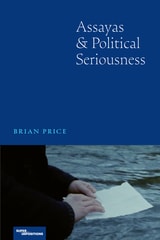
Assayas and Political Seriousness
Brian Price
Northwestern University Press, 2026
A cogent reconsideration of Assayas’s cinematic oeuvre and what it teaches us about the political today
The films of Olivier Assayas are widely celebrated for their complex responses to the many shifts that globalization has introduced in our time. Brian Price contends that they offer a different way of regarding the so-called problem of cultural and political enmeshment that Carl Schmitt and other conservative thinkers fear, including a contention that enmeshment is not a problem at all, in fact, but rather a different mode of social and political organization. Price puts Assayas’s films in dialogue not only with Schmitt’s theory of the political but also with the history of political philosophy after Schmitt, especially in the work of Hannah Arendt, Jacques Derrida, and Chantal Mouffe, all of whom have attempted to reckon with the friend/enemy dynamic at the core of the political.
At the heart of Assayas’s cinematic oeuvre, and of this book, is a reflection on what it means to be politically serious, which, Price shows, cannot be reduced to criteria that can simply be applied or repeated. The boundaries between the political and the varied forms of the social demand a sensitivity to change and the unknown, none of which can be accessed in the states of absolute certainty that are derived from crises that do not repeat in the same ways. The messiness and nuances of modern life are held together by moving images, which insist that we know why we value what we demand and seek to protect.
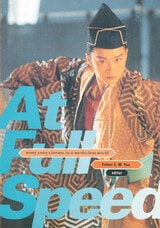
At Full Speed
Hong Kong Cinema in a Borderless WorldEsther Yau
University of Minnesota Press, 2001

Australian Film Theory and Criticism
Volume 1: Critical PositionsNoel King, Constantine Verevis, and Deane Williams
Intellect Books, 2013
Australian Film Theory and Criticism
Volume 2: InterviewsEdited by Noel King and Deane Williams
Intellect Books, 2014
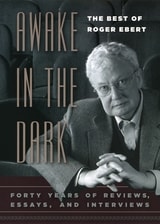
Awake in the Dark
The Best of Roger EbertRoger Ebert
University of Chicago Press, 2006
Roger Ebert has been writing film reviews for the Chicago Sun-Times for nearly forty years. And during those four decades, his wide knowledge, keen judgment, prodigious energy, and sharp sense of humor have made him America’s most celebrated film critic. He was the first such critic to win a Pulitzer Prize—one of just three film critics ever to receive that honor—and the only one to have a star dedicated to him on the Hollywood Walk of Fame. His groundbreaking hit TV show, At the Movies, meanwhile, has made “two thumbs up” one of the most coveted hallmarks in the entire industry.
No critic alive has reviewed more movies than Roger Ebert, and yet his essential writings have never been collected in a single volume—until now. With Awake in the Dark, both fans and film buffs can finally bask in the best of Ebert’s work. The reviews, interviews, and essays collected here present a picture of this indispensable critic’s numerous contributions to the cinema and cinephilia. From The Godfather to GoodFellas, from Cries and Whispers to Crash, the reviews in Awake in the Dark span some of the most exceptional periods in film history, from the dramatic rise of rebel Hollywood and the heyday of the auteur, to the triumph of blockbuster films such as Star Wars and Raiders of the Lost Ark, to the indie revolution that is still with us today.
The extraordinary interviews gathered in Awake in the Dark capture Ebert engaging not only some of the most influential directors of our time—Martin Scorsese, Steven Spielberg, Woody Allen, Robert Altman, Werner Herzog, and Ingmar Bergman—but also some of the silver screen’s most respected and dynamic personalities, including actors as diverse as Robert Mitchum, James Stewart, Warren Beatty, and Meryl Streep. Ebert’s remarkable essays play a significant part in Awake in the Dark as well. The book contains some of Ebert’s most admired pieces, among them a moving appreciation of John Cassavetes and a loving tribute to the virtues of black-and-white films.
If Pauline Kael and Andrew Sarris were godmother and godfather to the movie generation, then Ebert is its voice from within—a writer whose exceptional intelligence and daily bursts of insight and enthusiasm have shaped the way we think about the movies. Awake in the Dark, therefore, will be a treasure trove not just for fans of this seminal critic, but for anyone desiring a fascinating and compulsively readable chronicle of film since the late 1960s.
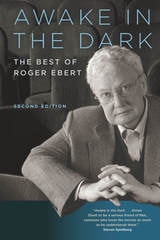
Awake in the Dark
The Best of Roger Ebert: Second EditionRoger Ebert
University of Chicago Press, 2017
Arriving fifty years after Ebert published his first film review in 1967, this second edition of Awake in the Dark collects Ebert’s essential writings into a single, irresistible volume. Featuring new Top Ten Lists and reviews of the years’ finest films through 2012, this edition allows both fans and film buffs to bask in the best of an extraordinary lifetime’s work. Including reviews from The Godfather to GoodFellas and interviews with everyone from Martin Scorsese to Meryl Streep, as well as showcasing some of Ebert’s most admired essays—among them a moving appreciation of John Cassavetes and a loving tribute to the virtues of black-and-white films—Ebert’s Awake in the Dark is a treasure trove not just for fans of this era-defining critic, but for anyone desiring a compulsively readable chronicle of the silver screen.
Stretching from the dramatic rise of rebel Hollywood and the heyday of the auteur to the triumph of blockbuster films such as Star Wars and Raiders of the Lost Ark, to the indie revolution that is still with us today, Awake in the Dark reveals a writer whose exceptional intelligence and daily bursts of insight and enthusiasm helped shape the way we think about the movies. But more than this, Awake in the Dark is a celebration of Ebert’s inimitable voice—a voice still cherished and missed.