Results by title
15 books match the query 'Aeronautics'
Air Transport Labor Relations
Robert W. Kaps
Southern Illinois University Press, 1997
Robert W. Kaps examines air transport labor law in the United States as well as the underlying legislative and policy directives established by the federal government. The body of legislation governing labor relations in the private sector of the U.S. economy consists of two separate and distinct acts: the Railway Labor Act (RLA), which governs labor relations in the railroad and airline industries, and the National Labor Relations Act (NLRA), which governs labor relations in all other industrial sectors.
Although the NLRA closely follows the pattern established by the RLA, Kaps notes that the two laws are distinguishable in several important areas. Labor contracts negotiated under the RLA continue in perpetuity, for example, whereas all other labor contracts expire at a specified date. Other important areas of difference relate to the collective bargaining process itself, the procedures for the arbitration of disputes and grievances, and the spheres of authority and jurisdiction to consider such matters as unfair labor practices.
Congress established a special labor law for railroad and airline workers for several reasons. Because of transportation’s critical importance to the economy, an essential goal of public policy has been to ensure that both passenger and freight transportation services continue without interruption. Production can cease—at least temporarily—in most other industries without causing significant harm to the economy. When transportation stops, however, production stops. Thus Congress saw fit to enact a statute that contained provisions to ensure that labor strife would not halt rail services. Primarily because of the importance of air mail transportation, the Railway Labor Act of 1926 was extended to the airline industry in 1936.
The first section of this book introduces labor policy and presents a history of the labor movement in the United States. Discussing early labor legislation, Kaps focuses on unfair labor practices and subsequent major labor statutes.
The second section provides readers with a comparison of labor provisions that apply to the railroad and airline industries as well as to the remainder of the economy.
The final section centers on the evolution of labor in the airline industry. The author pays particular attention to recent events affecting labor in commercial aviation, particularly the effect of airline deregulation on airline labor.
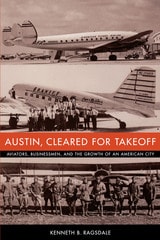
Austin, Cleared for Takeoff
Aviators, Businessmen, and the Growth of an American CityBy Kenneth B. Ragsdale
University of Texas Press, 2004
Austin, Texas, entered the aviation age on October 29, 1911, when Calbraith Perry Rodgers landed his Wright EX Flyer in a vacant field near the present-day intersection of Duval and 45th Streets. Some 3,000 excited people rushed out to see the pilot and his plane, much like the hundreds of thousands who mobbed Charles A. Lindbergh and The Spirit of St. Louis in Paris sixteen years later. Though no one that day in Austin could foresee all the changes that would result from manned flight, people here—as in cities and towns across the United States—realized that a new era was opening, and they greeted it with all-out enthusiasm.
This popularly written history tells the story of aviation in Austin from 1911 to the opening of Austin-Bergstrom International Airport in 1999. Kenneth Ragsdale covers all the significant developments, beginning with military aviation activities during World War I and continuing through the barnstorming era of the 1920s, the inauguration of airmail service in 1928 and airline service in 1929, and the dedication of the first municipal airport in 1930. He also looks at the University of Texas's role in training pilots during World War II, the growth of commercial and military aviation in the postwar period, and the struggle over airport expansion that occupied the last decades of the twentieth century. Throughout, he shows how aviation and the city grew together and supported each other, which makes the Austin aviation experience a case study of the impact of aviation on urban communities nationwide.

Aviation Weather Surveillance Systems
Advanced radar and surface sensors for flight safety and air traffic managementPravas Mahapatra
The Institution of Engineering and Technology, 1999

Aviation's Golden Age
Portraits From 1920S And 1930SWilliam M. Leary
University of Iowa Press, 1989
Fatal Words
Communication Clashes and Aircraft CrashesSteven Cushing
University of Chicago Press, 1994
In Fatal Words, Steven Cushing explains how miscommunication has led to dozens of aircraft disasters, and he proposes innovative solutions for preventing them. He examines ambiguities in language when aviation jargon and colloquial English are mixed, when a word is used that has different meanings, and when different words are used that sound alike. To remedy these problems, Cushing proposes a visual communication system and a computerized voice mechanism to help clear up confusing language.
Fatal Words is an accessible explanation of some of the most notorious aircraft tragedies of our time, and it will appeal to scholars in communications, linguistics, and cognitive science, to aviation experts, and to general readers.
Labor Relations in the Aviation and Aerospace Industries
Robert W. Kaps, J. Scott Hamilton, Timm J. Bliss
Southern Illinois University Press, 2012
In this textbook designed for courses on aviation labor relations, the authors-experts with many years of experience in these sectors-examine and evaluate the labor process for all aspects of the aviation and aerospace industries, including aerospace manufacturing, airlines, general aviation, federal and state administrative agencies, and public airports.
Divided into three parts-Public Policy and Labor Law; Principles, Practices and Procedures in Collective Bargaining and Dispute Resolution; and the Changing Labor Relations Environment-the book provides an overview of the industries and the development of US labor law and policy, then explores the statutory, regulatory, and case laws applicable to each industry segment before concluding with an examination of current and developing issues and trends. The authors present the evolution of aviation and aerospace labor laws, going as far back as the early nineteenth century to lay the historical foundation, and cover the development and main features of the principal statutes governing labor relations in the United States today, the Railway Labor Act, the National Labor Relations Act, and the Civil Service Reform Act. They also investigate the growth of the industries and their impact on labor relations, as well as the current issues and challenges facing management and labor in each segment of this dynamic, sometimes volatile, business and their implications for collective bargaining. Twenty case studies not only illuminate practical applications of such fundamental concepts as unfair labor practices and unions' duty of fair representation but also enliven the subject, preparing the reader to use the concepts in real-world decision making.
A study guide with review questions, online assignments, supplemental readings, and exercises is available for students. For those teachers using the textbook in their courses, there is an instructor's manual with additional resources for developing courses in the classroom, online, or by blended learning, as well as a variety of assignments and materials to enhance and vary the mock negotiation exercise.
A revision and expansion of Robert W. Kaps's Air Transport Labor Relations, this outstanding new volume provides students and teachers with valuable information and perspectives on industries that are highly dependent on technologically skilled labor. Labor Relations in the Aviation and Aerospace Industries offers a sweeping and thorough treatment of labor relations, public policy, law, and practice and is the definitive work on the labor process in the aviation and aerospace sectors.
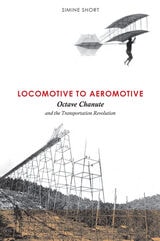
Locomotive to Aeromotive
Octave Chanute and the Transportation RevolutionSimine Short. Foreword by Tom D. Crouch
University of Illinois Press, 2014
Aviation researcher and historian Simine Short brings to light in colorful detail many previously overlooked facets of Chanute's professional and personal life. In the late nineteenth century, few considered engineering as a profession on par with law or medicine, but Chanute devoted much time and energy to the newly established professional societies that were created to set standards and serve the needs of civil engineers. Though best known for his aviation work, he became a key figure in the opening of the American continent by laying railroad tracks and building bridges, experiences that later gave him the engineering knowledge to build the first stable aircraft structure. Chanute also introduced a procedure to treat wooden railroad ties with an antiseptic that increased the wood’s lifespan in the tracks. Establishing the first commercial plants, he convinced railroad men that it was commercially feasible to make money by spending money on treating ties to conserve natural resources. He next introduced the date nail to help track the age and longevity of railroad ties.
A versatile engineer, Chanute was known as a kind and generous colleague during his career. Using correspondence and other materials not previously available to scholars and biographers, Short covers Chanute's formative years in antebellum America as well as his experiences traveling from New Orleans to New York, his apprenticeship on the Hudson River Railroad, and his early engineering successes. His multiple contributions to railway expansion, bridge building, and wood preservation established his reputation as one of the nation's most successful and distinguished civil engineers. Instead of retiring, he utilized his experiences and knowledge as a bridge builder in the development of motorless flight. Through the reflections of other engineers, scientists, and pioneers in various fields who knew him, Short characterizes Chanute as a man who believed in fostering and supporting people who were willing to learn. This well-researched biography cements Chanute's place as a preeminent engineer and mentor in the history of transportation in the United States and the development of the airplane.
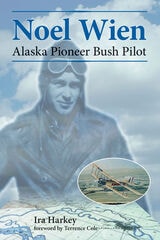
Noel Wien
Alaska Pioneer Bush PilotIra Harkey
University of Alaska Press, 1999
On the Wing
American Poems of Air and Space FlightOlsen, Karen Yelena
University of Iowa Press, 2005
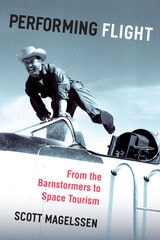
Performing Flight
From the Barnstormers to Space TourismScott Magelssen
University of Michigan Press, 2020

Texas Takes Wing
A Century of Flight in the Lone Star StateBy Barbara Ganson
University of Texas Press, 2014
This book celebrates the aviators, astronauts, airline executives, and other innovators who have made Texas an influential world leader in the aerospace industry over the past century.
Tracing the hundred-year history of aviation in Texas, aviator and historian Barbara Ganson brings to life the colorful personalities that shaped the phenomenally successful development of this industry in the state. Weaving stories and profiles of aviators, designers, manufacturers, and those in related services, Texas Takes Wing covers the major trends that propelled Texas to the forefront of the field. Covering institutions from San Antonio’s Randolph Air Force Base (the West Point of this branch of service) to Brownsville’s airport with its Pan American Airlines instrument flight school (which served as an international gateway to Latin America as early as the 1920s) to Houston’s Johnson Space Center, home of Mission Control for the U.S. space program, the book provides an exhilarating timeline and engaging history of dozens of unsung pioneers as well as their more widely celebrated peers.
Drawn from personal interviews as well as major archives and the collections of several commercial airlines, including American, Southwest, Braniff, Pan American Airways, and Continental, this sweeping history captures the story of powered flight in Texas since 1910. With its generally favorable flying weather, flat terrain, and wide open spaces, Texas has more airports than any other state and is often considered one of America’s most aviation-friendly places. Texas Takes Wing also explores the men and women who made the region pivotal in military training, aircraft manufacturing during wartime, general aviation, and air servicing of the agricultural industry. The result is a soaring history that will delight aviators and passengers alike.
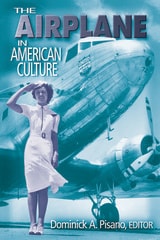
The Airplane in American Culture
Dominick A. Pisano, Editor
University of Michigan Press, 2003
Although countless books for aviation buffs have appeared since World War II, none has attempted to place the airplane in its full social, cultural, and interdisciplinary context until now. The first book of its kind, The Airplane in American Culture presents essays by distinguished contributors including historians, literary scholars, scholars of American studies, art historians, and museum professionals that explore a range of topics, including the connections between flying and race and gender; aviation's role in forming perceptions of the landscape; the airplane's significance to the culture of war; and the influence of flight on literature and art.
A must-read collection for anyone fascinated by the airplane, The Airplane in American Culture represents a dramatic new approach to writing the history of aviation, and makes an important contribution to American social and cultural history.
Dominick A. Pisano is Curator of the Aeronautics Department at the National Air and Space Museum, Smithsonian Institution.
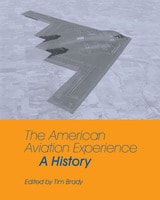
The American Aviation Experience
A HistoryEdited by Tim Brady
Southern Illinois University Press, 2000
This book is designed to be a primary text for courses in aviation history and development and aviation in America.
The seventeen chapters in The American Aviation Experience: A History range chronologically from ancient times through the Wright brothers through both world wars, culminating with the development of the U.S. space program. Contributors also cover balloons and dirigibles, African American pioneers in aviation, and women in aviation. These essayists—leading scholars in the field—present the history of aviation mainly from an American perspective.
The American Aviation Experience includes 335 black-and-white photographs, two maps, and an appendix, “Leonardo da Vinci and the Science of Flight.”.
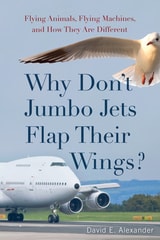
Why Don't Jumbo Jets Flap Their Wings?
Flying Animals, Flying Machines, and How They Are DifferentDavid E. Alexander
Rutgers University Press, 2009
Why Don’t Jumbo Jets Flap Their Wings? offers a fascinating explanation of how nature and human engineers each arrived at powered flight. What emerges is a highly readable account of two very different approaches to solving the same fundamental problems of moving through the air, including lift, thrust, turning, and landing. The book traces the slow and deliberate evolutionary process of animal flight—in birds, bats, and insects—over millions of years and compares it to the directed efforts of human beings to create the aircraft over the course of a single century.
Among the many questions the book answers:
- Why are wings necessary for flight?
- How do different wings fly differently?
- When did flight evolve in animals?
- What vision, knowledge, and technology was needed before humans could learn to fly?
- Why are animals and aircrafts perfectly suited to the kind of flying they do?
David E. Alexander first describes the basic properties of wings before launching into the diverse challenges of flight and the concepts of flight aerodynamics and control to present an integrated view that shows both why birds have historically had little influence on aeronautical engineering and exciting new areas of technology where engineers are successfully borrowing ideas from animals.
Wings Over Illinois
Arthur E. Abney
Southern Illinois University Press, 2007