Results by title
828 books match the query 'Research' and 66 start with a
Archaeological Remote Sensing in North America
Innovative Techniques for Anthropological ApplicationsEdited by Duncan P. McKinnon and Bryan S. Haley
University of Alabama Press, 2017
Updating the highly praised 2006 publication Remote Sensing in Archaeology, edited by Jay K. Johnson, Archaeological Remote Sensing in North America: Innovative Techniques for Anthropological Applications is a must-have volume for today’s archaeologist. Targeted to practitioners of archaeological remote sensing as well as students, this suite of current and exemplary applications adheres to high standards for methodology, processing, presentation, and interpretation.
The use of remote sensing technologies to address academic and applied archaeological and anthropological research problems is growing at a tremendous rate in North America. Fueling this growth are new research paradigms using innovative instrumentation technologies and broader-area data collection methods. Increasingly, investigators pursuing these new approaches are integrating remote sensing data collection with theory-based interpretations to address anthropological questions within larger research programs.
In this indispensable volume, case studies from around the country demonstrate the technically diverse and major remote sensing methods and their integration with relevant technologies, such as geographic information systems (GIS) and global positioning systems (GPS), and include various uses of the “big four”: magnetometry, resistivity, ground-penetrating radar (GPR), and electromagnetic induction.
The study explores four major anthropological themes: site structure and community organization; technological transformation and economic change; archaeological landscapes; and earthen mound construction and composition. Concluding commentary from renowned expert Kenneth L. Kvamme overviews the practices, advances, and trends of geophysics and remote sensing in the past decade.
Archaeologists as Activists
Can Archaeologists Change the World?Edited by M. Jay Stottman
University of Alabama Press, 2011
Could archaeologists benefit contemporary cultures and be a factor in solving world problems? Can archaeologists help individuals? Can archaeologists change the world? These questions form the root of “archaeology activism” or “activist archaeology”: using archaeology to advocate for and affect change in contemporary communities.
Archaeologists currently change the world through the products of their archaeological research that contribute to our collective historical and cultural knowledge. Their work helps to shape and reshape our perceptions of the past and our understanding of written history. Archaeologists affect contemporary communities through the consequences of their work as they become embroiled in controversies over negotiating the past and the present with native peoples. Beyond the obvious economic contributions to local communities caused by heritage tourism established on the research of archaeologists at cultural sites, archaeologists have begun to use the process of their work as a means to benefit the public and even advocate for communities.
In this volume, Stottman and his colleagues examine the various ways in which archaeologists can and do use their research to forge a partnership with the past and guide the ongoing dialogue between the archaeological record and the various contemporary stakeholders. They draw inspiration and guidance from applied anthropology, social history, public history, heritage studies, museum studies, historic preservation, philosophy, and education to develop an activist approach to archaeology—theoretically, methodologically, and ethically.
Archaeology, History, and Predictive Modeling
Research at Fort Polk, 1972-2002David G. Anderson and Steven D. Smith
University of Alabama Press, 2003
Fort Polk Military Reservation encompasses approximately 139,000 acres in western Louisiana 40 miles southwest of Alexandria. As a result of federal mandates for cultural resource investigation, more archaeological work has been undertaken there, beginning in the 1970s, than has occurred at any other comparably sized area in Louisiana or at most other localities in the southeastern United States. The extensive program of survey, excavation, testing, and large-scale data and artifact recovery, as well as historic and archival research, has yielded a massive amount of information. While superbly curated by the U.S. Army, the material has been difficult to examine and comprehend in its totality.
With this volume, Anderson and Smith collate and synthesize all the information into a comprehensive whole. Included are previous investigations, an overview of local environmental conditions, base military history and architecture, and the prehistoric and historic cultural sequence. An analysis of location, environmental, and assemblage data employing a sample of more than 2,800 sites and isolated finds was used to develop a predictive model that identifies areas where significant cultural resources are likely to occur. Developed in 1995, this model has already proven to be highly accurate and easy to use.
Archaeology, History, and Predictive Modeling will allow scholars to more easily examine the record of human activity over the past 13,000 or more years in this part of western Louisiana and adjacent portions of east Texas. It will be useful to southeastern archaeologists and anthropologists, both professional and amateur.
Are You Sure About That?
Discerning Fact from FictionKaren A. Cerulo
Rutgers University Press, 2027
Phone in hand, TV on, we wake up and fall asleep to endless information. There’s no escape—we are drowning in a sea of breaking news, notifications, and popular beliefs and claims. Every day, we encounter hundreds of posts and podcasts on politics, celebrities, or current events. People share links to “expert” recommendations on Instagram or Reddit. YouTube and TikTok bring us those who want to instruct us on the realities of the world or pass on longstanding conventional wisdom, all in the hopes of influencing our decisions and actions.
The information overload of the constant news and information cycle is exhausting and extremely frustrating. You may ask: Just what or whom should we believe? Are You Sure About That? Discerning Fact from Fiction helps readers navigate the perilous informational terrain of contemporary life. We provide a game plan of strategies and guidance for easily and reliably assessing the accuracy of any claim, helping readers to cut through the noise and adjust what they know.
Argumentative Writing in a Second Language
Perspectives on Research and PedagogyAlan R. Hirvela and Diane D. Belcher
University of Michigan Press, 2021
Part I of the volume is topic-oriented and focuses on explorations of important issues and perspectives, while Part II features several chapters reporting classroom-based studies of a variety of instructional approaches that expand our understanding of how argumentative writing can be taught. The book will be of value to pre-service and in-service teachers in varying instructional contexts, as well as teacher educators and L2 writing scholars/researchers.
Around the Texts of Writing Center Work
An Inquiry-Based Approach to Tutor EducationR. Mark Hall
Utah State University Press, 2017
Around the Texts of Writing Center Work reveals the conceptual frameworks found in and created by ordinary writing center documents. The values and beliefs underlying course syllabi, policy statements, website copy and comments, assessment plans, promotional flyers, and annual reports critically inform writing center practices, including the vital undertaking of tutor education.
In each chapter, author R. Mark Hall focuses on a particular document. He examines its origins, its use by writing center instructors and tutors, and its engagement with enduring disciplinary challenges in the field of composition, such as tutoring and program assessment. He then analyzes each document in the contexts of the conceptual framework at the heart of its creation and everyday application: activity theory, communities of practice, discourse analysis, reflective practice, and inquiry-based learning.
Around the Texts of Writing Center Work approaches the analysis of writing center documents with an inquiry stance—a call for curiosity and skepticism toward existing and proposed conceptual frameworks—in the hope that the theoretically conscious evaluation and revision of commonplace documents will lead to greater efficacy and more abundant research by writing center administrators and students.

Art as Research
Opportunities and ChallengesEdited by Shaun McNiff
Intellect Books, 2013
Artist Scholar
Reflections on Writing and ResearchG. James Daichendt
Intellect Books, 2012
Artist Scholar: Reflections on Writing and Research is part history, introduction, and discussion for artists and designers entering, graduating, and employed by the contemporary art academy in the United States. The evolution of art education in the university continues to expand in the 21st century as the variables of craft, skill, technique, theory, history and criticism shift and expand as the perspective of arts-based research is introduced into this professionalized environment. Given this context: what can M.F.A. students do to improve their understanding of writing and research without sacrificing their commitment to their studio art process?
Through a series of essays, the text argues for better writing at the M.F.A. level with the purpose of becoming better artists. By contextualizing art practice in the university and providing a foundation for future artist scholarship, it serves as an invitation to artist scholars to push their work further and develop the confidence to situate their art in the university context.
As Far as the Eye Can See
Stephen Pradarelli
University of Iowa Press, 2019
Aspects of Article Introductions, Michigan Classics Ed.
John M. Swales
University of Michigan Press, 2011
Aspects of Article Introductions has bee reissued to make it more easily available than it has ever been, particularly for the use of university libraries and for younger and newer practitioners and researchers in the rapidly expanding and increasingly global field of EAP.
The original Aspects of Article Introductions appeared in fall 1981 as a ring-bound 90-page monograph. The “publisher” was the Language Studies Unit at the University of Aston in Birmingham. Although essentially an “underground” work, it has remained a relevant part of the short intellectual history of English for Academic Purposes, particularly as genre-based or genre-driven approaches to EAP research and pedagogical practice have become more popular. Its longevity is also a testament to the genre analysis work of John Swales, but in addition, the research article has become the most influential genre in most areas of scholarship, and introductions are at least supposed to be read first and to be designed in such a way as to attract as large readership as possible.
“If I were asked to list the most influential texts in applied linguistics over the last 30 years, John Swales' Aspects of Article Introductions would be in the top three or four. This was a seminal work which not only presented a novel way of analysing texts and a commentary on academic discourse, but one which helped to establish a foundation for the massive interest we see today in describing the structure and features of academic articles. This is not just a text which offers us a glimpse of an intellectual history, but it remains full of fascinating insights and observations about texts and the workings of academic discourse. While the ideas may have evolved and the genre it describes moved on, both the style of writing and the methodology it describes are as fresh and as revealing as anything written on the topic since.” ---Ken Hyland, Hong Kong University

Aspects of Land Grant College Education
With Special Reference to the University of MinnesotaPalmer Johnson
University of Minnesota Press, 1934

Assessing Liaison Librarians
Documenting Impact ForDaniel Mack
American Library Association, 2014

Assessing Liaison Librarians
Documenting Impact for Positive ChangeDaniel C. Mack
Assoc of College & Research Libraries, 2014
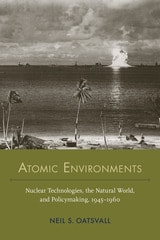
Atomic Environments
Nuclear Technologies, the Natural World, and Policymaking, 1945–1960Neil S. Oatsvall
University of Alabama Press, 2023
Demonstrates how policymakers influenced environmental science during the early nuclear age
In Atomic Environments: Nuclear Technologies, the Natural World, and Policymaking, 1945–1960, Neil S. Oatsvall examines how top officials in the Truman and Eisenhower administrations used environmental science to develop nuclear strategy at the beginning of the Cold War. While many people were involved in research and analysis during the period in question, it was at highest levels of executive decision-making where environmental science and nuclear science most clearly combined to shape the nation’s policies.
Oatsvall clearly demonstrates how the natural world and the scientific disciplines that study it became integral parts of nuclear science rather than adversarial fields of knowledge. But while nuclear technologies heavily depended on environmental science to develop, those same technologies frequently caused great harm to the natural world. Moreover, while some individuals expressed real anxieties about the damage wrought by nuclear technologies, policymakers as a class consistently made choices that privileged nuclear boosterism and secrecy, prioritizing institutional values over the lives and living systems that they were ostensibly charged to protect.
By scrutinizing institutional policymaking practices and agendas at the birth of the nuclear age, a constant set of values becomes clear. Oatsvall reveals an emerging technocratic class that routinely valued knowledge about the environment to help create and maintain a nuclear arsenal, despite its existential threat to life on earth and the negative effects many nuclear technologies had on ecosystems and the American people alike. Although policymakers took their charge to protect and advance the welfare of the United States and its people seriously, Atomic Environments demonstrates how they often failed to do so because their allegiance to the US nuclear hierarchy blinded them to the real risks and dangers of the nuclear age.
Attachment in the Preschool Years
Theory, Research, and InterventionEdited by Mark T. Greenberg, Dante Cicchetti, and E. Mark Cummings
University of Chicago Press, 1993
"There is a wealth of information and thought in this book; it does not have a weak or uninteresting chapter, starting with the Preface by Emde, and as a whole, it forms a sort of seminar."—John E. Bates, Contemporary Psychology
Attitudes on Altitude
Pioneers of Medical Research in Colorado's High MountainsJohn T. Reeves
University Press of Colorado, 2001