Results by title
28167 books match the query 'History' and 2536 start with a
Advances in Titicaca Basin Archaeology–III
Edited by Alexei Vranich, Elizabeth A. Klarich and Charles Stanish
University of Michigan Press, 2012
Advancing Immigrant Rights in Houston
Els de Graauw and Shannon Gleeson
Temple University Press, 2024
In Advancing Immigrant Rights in Houston, Els de Graauw and Shannon Gleeson recount how local and multi-level contexts shape the creation, contestation, and implementation of immigrant rights policies and practices in the city. They examine the development of a city immigrant affairs office, interactions between local law enforcement and federal immigration enforcement officials, local public-private partnerships around federal immigration benefits, and collaborations between labor, immigrant rights, faith, and business leaders to combat wage theft.
The case study of Houston provides a bellwether for how other U.S. cities will deal with their growing immigrant populations and underscores the importance of public-private collaborations to advance immigrant rights.
Adventures in Shondaland
Identity Politics and the Power of RepresentationGriffin, Rachel Alicia
Rutgers University Press, 2018
Shonda Rhimes is one of the most powerful players in contemporary American network television. Beginning with her break-out hit series Grey’s Anatomy, she has successfully debuted Private Practice, Scandal, How to Get Away with Murder, The Catch, For The People, and Station 19. Rhimes’s work is attentive to identity politics, “post-” identity politics, power, and representation, addressing innumerable societal issues. Rhimes intentionally addresses these issues with diverse characters and story lines that center, for example, on interracial friendships and relationships, LGBTIQ relationships and parenting, the impact of disability on familial and work dynamics, and complex representations of womanhood. This volume serves as a means to theorize Rhimes’s contributions and influence by inspiring provocative conversations about television as a deeply politicized institution and exploring how Rhimes fits into the implications of twenty-first century television.
Adventures in the Archaic
Primitivism, Degrowth, and the French Social Sciences, 1945–1975Ryan L. Allen
University of Chicago Press, 2026
We tend to associate primitivism with the nostalgic idealization of origins, often aimed at parts of the world that are viewed as closer to that idealized past than modern post-industrial society. Primitivist impulses still exist in popular culture, whether in paleo diets or returns to foraging, and they can also be seen in intellectual and political circles in debates around the possibility of degrowth. In this book, historian Ryan L. Allen examines primitivism anew through four fascinating figures: Georges Bataille, Henri Lefebvre, Georges Devereux, and Mircea Eliade.
In the postwar period, Allen shows, the French social sciences reappraised the primitive and archaic from anthropological, sociological, psychiatric, and religious angles. These four thinkers sought past alternatives to midcentury hypermodernization and capitalist excess. They put forth trenchant critiques of contemporary society and sought in the archaic past a way to imagine a more sustainable future. Adventures in the Archaic rehabilitates these thinkers, showing how their critique of growth and consumerism was nourished by an engagement with primitive cultures as potential sources of cultural and ecological wisdom. As we confront planetary crisis, Allen suggests, there is still much we can learn from these iconoclastic approaches.
Adventures of Rabbah and Friends
The Talmud's Strange Tales and Their ReadersJames Adam Redfield
SBL Press, 2025
Advertising Revolutionary
The Life and Work of Tom BurrellJason P. Chambers
University of Illinois Press, 2024
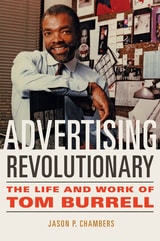
Over a forty-year career, Chicagoan Tom Burrell changed the face of advertising and revolutionized the industry’s approach to African Americans as human beings and consumers. Jason P. Chambers offers a biography of the groundbreaking creator and entrepreneur that explores Burrell’s role in building brands like McDonald’s and Coca-Cola within a deeply felt vision of folding positive images of Black people into mainstream American life. While detailing Burrell’s successes, Chambers tells a parallel story of what Burrell tried to do that sheds light on the motivations of advertising creators who viewed their work as being about more than just selling. Chambers also highlights how Burrell used his entrepreneurial gifts to build an agency that opened the door for Black artists, copywriters, directors, and other professionals to earn livings, build careers, and become leaders within the industry.
Compelling and multidimensional, Advertising Revolutionary combines archival research and interviews with Burrell and his colleagues to provide a long overdue portrait of an advertising industry legend and his times.
Advertising at War
Business, Consumers, and Government in the 1940sInger L. Stole
University of Illinois Press, 2012
Using archival sources, newspapers accounts, and trade publications, Stole demonstrates that the war elevated and magnified the seeming contradictions of advertising and allowed critics of these practices one final opportunity to corral and regulate the institution of advertising. Exploring how New Dealers and consumer advocates such as the Consumers Union battled the advertising industry, Advertising at War traces the debate over two basic policy questions: whether advertising should continue to be a tax-deductible business expense during the war, and whether the government should require effective standards and labeling for consumer products, which would render most advertising irrelevant. Ultimately the postwar climate of political intolerance and reverence for free enterprise quashed critical investigations into the advertising industry. While advertising could be criticized or lampooned, the institution itself became inviolable.

Advertising on Trial
Consumer Activism and Corporate Public Relations in the 1930sInger L. Stole
University of Illinois Press, 2006
Inger L. Stole examines how consumer activists sought to limit corporate influence by rallying popular support to moderate and change advertising. Stole weaves the story through the extensive use of primary sources, including archival research done with consumer and trade group records, as well as trade journals and engagement with the existing literature. Her account of the struggle also demonstrates how public relations developed in order to justify laissez-faire corporate advertising in light of a growing consumer rights movement, and how the failure to rein in advertising was significant not just for civic life in the 1930s but for our era as well.
Advertising the Self in Renaissance France
Lemaire, Marot, and RabelaisScott Francis
University of Delaware Press, 2019
Published by University of Delaware Press. Distributed worldwide by Rutgers University Press.
Advocacy after Bhopal
Environmentalism, Disaster, New Global OrdersKim Fortun
University of Chicago Press, 2001
Kim Fortun explores these claims by focusing on the dynamics and paradoxes of advocacy in competing power domains. She moves from hospitals in India to meetings with lawyers, corporate executives, and environmental justice activists in the United States to show how the disaster and its effects remain with us. Spiraling outward from the victims' stories, the innovative narrative sheds light on the way advocacy works within a complex global system, calling into question conventional notions of responsibility and ethical conduct. Revealing the hopes and frustrations of advocacy, this moving work also counters the tendency to think of Bhopal as an isolated incident that "can't happen here."
Aerial Aftermaths
Wartime from AboveCaren Kaplan
Duke University Press, 2018
Aeschylus I
The Persians, The Seven Against Thebes, The Suppliant Maidens, Prometheus BoundEdited and Translated by David Grene, Richmond Lattimore, Mark Griffith, and Glenn W. Most
University of Chicago Press, 2013
The most engaging and authoritative translation of some of the foundational works of Western culture
This volume collects careful, readable translations of some of the key works of Aeschylus by experts in the language and culture of the ancient Greek world in which he lived and wrote. Aeschylus I contains “The Persians,” translated by Seth Benardete; “The Seven Against Thebes,” translated by David Grene; “The Suppliant Maidens,” translated by Seth Benardete; and “Prometheus Bound,” translated by David Grene.
For this edition, series editors Mark Griffith and Glenn W. Most have carefully updated the translations to bring them even closer to the ancient Greek while retaining the vibrancy for which our English versions are famous.New introductions for each play offer essential information about its first production, plot, and reception in antiquity and beyond. In addition, each volume includes an introduction to the life and work of its tragedian, as well as notes addressing textual uncertainties and a glossary of names and places mentioned in the plays.
Aeschylus II
The OresteiaEdited and Translated by David Grene, Richmond Lattimore, Mark Griffith, and Glenn W. Most
University of Chicago Press, 2013
Aeschylus II contains “The Oresteia,” translated by Richmond Lattimore, and fragments of “Proteus,” translated by Mark Griffith.
Many years ago, the University of Chicago Press undertook a momentous project: a new translation of the Greek tragedies that would be the ultimate resource for teachers, students, and readers. They succeeded. Under the expert management of eminent classicists David Grene and Richmond Lattimore, those translations combined accuracy, poetic immediacy, and clarity of presentation to render the surviving masterpieces of Aeschylus, Sophocles, and Euripides in an English so lively and compelling that they remain the standard translations. The updated third editions of these classic works were designed to ensure that our Greek tragedies remain the leading English-language versions throughout the twenty-first century.
In this highly anticipated third edition, Mark Griffith and Glenn W. Most have carefully updated the translations to bring them even closer to the ancient Greek while retaining the vibrancy for which our English versions are famous. This edition also includes brand-new translations of Euripides’ Medea, The Children of Heracles, Andromache, and Iphigenia among the Taurians, fragments of lost plays by Aeschylus, and the surviving portion of Sophocles’s satyr-drama The Trackers. New introductions for each play offer essential information about its first production, plot, and reception in antiquity and beyond. In addition, each volume includes an introduction to the life and work of its tragedian, as well as notes addressing textual uncertainties and a glossary of names and places mentioned in the plays.
In addition to the new content, the volumes have been reorganized both within and between volumes to reflect the most up-to-date scholarship on the order in which the plays were originally written. The result is a set of handsome paperbacks destined to introduce new generations of readers to these foundational works of Western drama, art, and life.
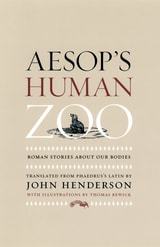
Aesop's Human Zoo
Roman Stories about Our BodiesPhaedrus
University of Chicago Press, 2004
Providing unusual insights into the heart of Roman culture, these clever poems open up odd avenues of ancient lore and life as they explore social types and physical aspects of the body, regularly mocking the limitations of human nature and offering vulgar or promiscuous interpretations of the stuff of social life.
Featuring folksy proverbs and satirical anecdotes, filled with saucy naughtiness and awful puns, Aesop's Human Zoo will amuse you with its eccentricities and hit home with its shrewdly candid and red raw messages. The entertainment offered in this volume of impeccably accurate translations is truly a novelty—a good-hearted and knowing laugh courtesy of classical poetry. Beginning to advanced classicists and Latin scholars will appreciate the original Latin text provided in this bilingual edition. The splash of classic Thomas Bewick wood engravings to accompany the fables renders the collection complete.
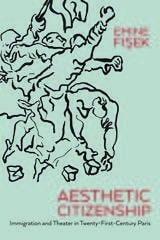
Aesthetic Citizenship
Immigration and Theater in Twenty-First-Century ParisEmine Fisek
Northwestern University Press, 2017
From neighborhood associations and humanitarian alliances to arts organizations both large and small, Fisek traces how theater has emerged as a practice with the perceived capacity to address questions regarding immigrant rights, integration, and experience. In Aesthetic Citizenship, she explores how the stage, one of France’s most evocative cultural spaces, has come to play a role in contemporary questions about immigration, citizenship and national identity. Yet Fişek’s insightful research also illuminates Paris’s broader historical, political, and cultural through-lines that continue to shape the relationship between theater and migration in France.
By focusing on how French public discourses on immigration are not only rendered meaningful but also inhabited and modified in the context of activist and arts practice, Aesthetic Citizenship seeks to answer the fundamental question: is theater a representational act or can it also be a transformative one?
Aesthetic Revolutions and Twentieth-Century Avant-Garde Movements
Aleš Erjavec, editor
Duke University Press, 2015
Contributors. John E. Bowlt, Sascha Bru, David Craven, Aleš Erjavec, Tyrus Miller, Raymond Spiteri, Miško Šuvakovic
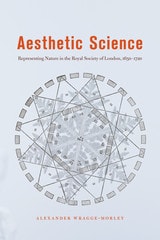
Aesthetic Science
Representing Nature in the Royal Society of London, 1650-1720Alexander Wragge-Morley
University of Chicago Press, 2020
To show how early modern naturalists conceived of the interplay between sensory experience and the production of knowledge, Aesthetic Science explores natural-historical and anatomical works of the Royal Society through the lens of the aesthetic. By underscoring the importance of subjective experience to the communication of knowledge about nature, Wragge-Morley offers a groundbreaking reconsideration of scientific representation in the early modern period and brings to light the hitherto overlooked role of aesthetic experience in the history of the empirical sciences.
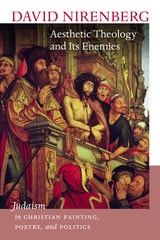
Aesthetic Theology and Its Enemies
Judaism in Christian Painting, Poetry, and PoliticsDavid Nirenberg
Brandeis University Press, 2015
Aesthetics and Revolution
Nicaraguan Poetry 1979-1990Greg Dawes
University of Minnesota Press, 1993
In Aesthetics and Revolution, Dawes demonstrates that there is an objective grounding for cultural studies found in the aesthetic means of production. By analyzing the relations and forces of production in this realm we inevitably cross over into the economic means of production as well as the struggle for political representation. Ultimately, aesthetics is at the intersection of class and gender interests and their struggle for hegemony.
In Aesthetics and Revolution, Dawes has chosen a group of writers of different theoretical sympathies, class, gender, and social positions to reveal the conflictual interests of the social classes and genders as a whole. Through close readings of their work, Dawes examines the thematic nodes that are expressed in positions as diverse as Ernesto Cardenal’s liberation theology, Pablo Antonio Cuadra’s populism, the campesino’s oral tradition, and Gioconda Belli’s erotic verses in relation to the changes taking place in revolutionary Nicaragua.
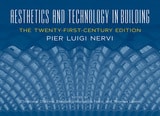
Aesthetics and Technology in Building
The Twenty-First-Century EditionPier Luigi Nervi; Edited by Cristiana Chiorino, Elisabetta Margiotta Nervi, and Thomas Leslie
University of Illinois Press, 2018
Aesthetics and Technology in Building: The Twenty-First-Century Edition introduces Nervi's ideas about architecture and engineering to a new generation of students and admirers. More than 200 photographs, details, drawings, and plans show how Nervi put his ideas into practice. Expanding on the seminal 1961 Norton Lectures at Harvard, Nervi analyzes various functional and construction problems. He also explains how precast and cast-in-place concrete can answer demands for economy, technical and functional soundness, and aesthetic perfection. Throughout, he uses his major projects to show how these now-iconic buildings emerged from structural truths and far-sighted construction processes.
This new edition features dozens of added images, a new introduction, and essays by Joseph Abram, Roberto Einaudi, Alberto Bologna, Gabriele Neri, and Hans-Christian Schink on Nervi's life, work, and legacy.

Aesthetics of Disturbance
Anti-Art in Avant-Garde DramaDavid Graver
University of Michigan Press, 1995
Aesthetics of Renewal
Martin Buber's Early Representation of Hasidism as KulturkritikMartina Urban
University of Chicago Press, 2008

Aesthetics, Industry, and Science
Hermann von Helmholtz and the Berlin Physical SocietyM. Norton Wise
University of Chicago Press, 2018
In Aesthetics, Industry, and Science M. Norton Wise answers these questions not simply from a technical perspective of theories and practices but with a broader cultural view of what was happening in Berlin at the time. He emphasizes in particular how rapid industrial development, military modernization, and the neoclassical aesthetics of contemporary art informed the ways in which these young men thought. Wise argues that aesthetic sensibility and material aspiration in this period were intimately linked, and he uses these two themes for a final reappraisal of Helmholtz’s early work. Anyone interested in modern German cultural history, or the history of nineteenth-century German science, will be drawn to this landmark book.

Aetna and the Moon
Explaining Nature in Ancient Greece and RomeLiba Taub
Oregon State University Press, 2008

Affectionately Yours
The Civil War Home-Front Letters of the Ovid Butler FamilyBarbara Butler Davis
Indiana Historical Society Press, 2004
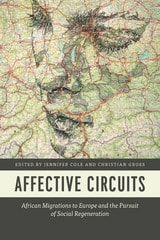
Affective Circuits
African Migrations to Europe and the Pursuit of Social RegenerationEdited by Jennifer Cole and Christian Groes
University of Chicago Press, 2016
The contributors point to the intersecting streams of goods, people, ideas, and money as they circulate between African migrants and their kin who remain back home. They also show the complex ways that emotions become entangled in these exchanges. Examining how these circuits operate in domains of social life ranging from child fosterage to binational marriages, from coming-of-age to healing and religious rituals, the book also registers the tremendous impact of state officials, laws, and policies on migrant experience. Together these essays paint an especially vivid portrait of new forms of kinship at a time of both intense mobility and ever-tightening borders.
Affective Communities
Anticolonial Thought, Fin-de-Siecle Radicalism, and the Politics of FriendshipLeela Gandhi
Duke University Press, 2006
Gandhi weaves together the stories of a number of South Asian and European friendships that flourished between 1878 and 1914, tracing the complex historical networks connecting figures like the English socialist and homosexual reformer Edward Carpenter and the young Indian barrister M. K. Gandhi, or the Jewish French mystic Mirra Alfassa and the Cambridge-educated Indian yogi and extremist Sri Aurobindo. In a global milieu where the battle lines of empire are reemerging in newer and more pernicious configurations, Affective Communities challenges homogeneous portrayals of “the West” and its role in relation to anticolonial struggles. Drawing on Derrida’s theory of friendship, Gandhi puts forth a powerful new model of the political: one that finds in friendship a crucial resource for anti-imperialism and transnational collaboration.
Affective Intellectuals and the Space of Catastrophe in the Americas
Judith Sierra-Rivera
The Ohio State University Press, 2018
Pursuing this argument, Sierra-Rivera examines print, radio, and web materials by authors whose emotional discourses have also had a measurable impact on the formation of communities that demand their full political inclusion in society. This book therefore fills a significant gap in the study of the relationship between materiality (space and bodies), emotions, and the political imagination. Affective Intellectuals demonstrates that writers and intellectuals themselves are vital in reshaping their communities and fighting for social justice in the Hemispheric Americas.
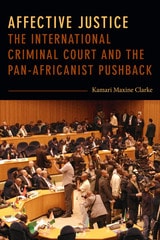
Affective Justice
The International Criminal Court and the Pan-Africanist PushbackKamari Maxine Clarke
Duke University Press, 2019
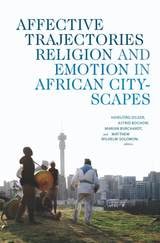
Affective Trajectories
Religion and Emotion in African CityscapesHansjörg Dilger, Astrid Bochow, Marian Burchardt, and Matthew Wilhelm-Solomon, editors
Duke University Press, 2019
Contributors. Astrid Bochow, Marian Burchardt, Rafael Cazarin, Hansjörg Dilger, Alessandro Gusman, Murtala Ibrahim, Peter Lambertz, Isabelle L. Lange, Isabel Mukonyora, Benedikt Pontzen, Hanspeter Reihling, Matthew Wilhelm-Solomon
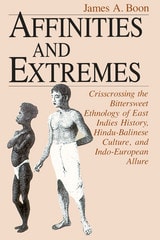
Affinities and Extremes
Crisscrossing the Bittersweet Ethnology of East Indies History, Hindu-Balinese Culture, and Indo-European AllureJames A. Boon
University of Chicago Press, 1990
Affirmative Action and the Stalled Quest for Black Progress
W. Avon Drake and Robert D. Holsworth
University of Illinois Press, 1996
Insightful and path-breaking, Affirmative Action and the Stalled Quest for Black Progress examines the accomplishments and limitations of the set-aside programs once at the center of political debates about affirmative action in the United States.
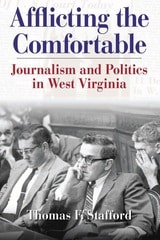
Afflicting the Comfortable
Journalism and Politics in West VirginiaThomas F. Stafford
West Virginia University Press, 2011
"Government corruption was not invented in West Virginia. But there are people who contend that West Virginia officials have done more than their share over the years to develop state-of-the-art techniques in vote theft, contract kickbacks, influence peddling and good old-fashioned bribery, extortion, fraud, tax evasion and outright stealing." New York Times
While investigating the Invest Right scandal, Thomas Stafford, a former journalist for the Charleston Gazette, found himself in a very precarious position. As a reporter he felt obligated to tell the whole truth, and he believed in the need to serve the public and those West Virginians who were being abused by a political machine. In Afflicting the Comfortable, Stafford relates such tales of the responsibility of journalism and politics in coordination with scandals that have unsettled the Mountain State over the past few decades. His probing would take him from the halls of Charleston to the center of our nation's ruling elite. Guided by his senses of duty, right, and fairness, he plunged head first into the misdeeds of West Virginia's politicians. His investigations would preface the downfall of a governor and an adminstration that robbed the state and the citizens of West Virginia for many years.
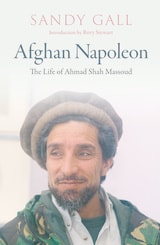
Afghan Napoleon
The Life of Ahmad Shah MassoudSandy Gall
Haus Publishing, 2022
When the Soviets invaded Afghanistan in 1979, the forces of resistance were disparate. Many groups were caught up in fighting each other and competing for Western arms. The exception were those commanded by Ahmad Shah Massoud, the military strategist and political operator who solidified the resistance and undermined the Russian occupation, leading resistance members to a series of defensive victories.
Sandy Gall followed Massoud during Soviet incursions and reported on the war in Afghanistan, and he draws on this first-hand experience in his biography of this charismatic guerrilla commander. Afghan Napoleon includes excerpts from the surviving volumes of Massoud’s prolific diaries—many translated into English for the first time—which detail crucial moments in his personal life and during his time in the resistance. Born into a liberalizing Afghanistan in the 1960s, Massoud ardently opposed communism, and he rose to prominence by coordinating the defense of the Panjsher Valley against Soviet offensives. Despite being under-equipped and outnumbered, he orchestrated a series of victories over the Russians. Massoud’s assassination in 2001, just two days before the attack on the Twin Towers, is believed to have been ordered by Osama bin Laden. Despite the ultimate frustration of Massoud’s attempts to build political consensus, he is recognized today as a national hero.
Afghanistan in the Cinema
Mark Graham
University of Illinois Press, 2010
The book considers a range of films, beginning with the 1970s epics The Man Who Would Become King and The Horsemen and following the shifts in representation of the Muslim world during the Russian War in films such as The Beast and Rambo III. Graham then moves on to Taliban-era films such as Kandahar, Osama, and Ellipsis, the first Afghan film directed by a woman. Lastly, the book discusses imperialist nostalgia in films such as Charlie Wilson's War and destabilizing visions represented in contemporary works such as The Kite Runner.
Afloat on the Ohio
An Historical Pilgrimage of a Thousand Miles in a Skiff, from Redstone to CairoReuben Gold Thwaites
Southern Illinois University Press, 1999
This edition is a reprinting of the original 1897 edition.
Afonso Costa
PortugalFilipe Ribeiro de Meneses
Haus Publishing, 2010
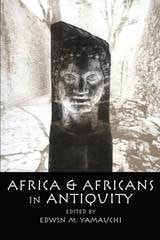
Africa & Africans in Antiquity
Edwin M. Yamauchi
Michigan State University Press, 2001
Africa and Africans in Antiquity assesses recent historical research and archaeology under way in Egypt, North Africa, the Sudan, and the Horn of Africa. Whereas many European and American scholars of earlier generations believed that Egyptian contacts with Africa to the south were not culturally significant, research contained in this important collection rejects such notions. At the same time, the volume takes issue with Afrocentric scholars who argue that most Egyptians were 'black' and that blacks are the rightful heirs to Egypt's past grandeur. These ten thought-provoking essays demonstrate that this large region was an ethnic and cultural mosaic in antiquity, a place where Phoenicians, Berbers, Greeks, as well as Egyptians and Nubians interacted.
Africa South
Harm J. de Blij
Northwestern University Press, 1962
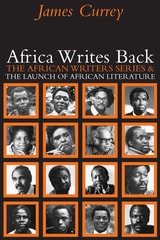
Africa Writes Back
The African Writers Series and the Launch of African LiteratureJames Currey
Ohio University Press, 2008
June 17, 2008, is the fiftieth anniversary of the publication of Chinua Achebe’s Things Fall Apart by Heinemann. This publication provided the impetus for the foundation of the African Writers Series in 1962 with Chinua Achebe as the editorial adviser.
Africa Writes Back: The African Writers Series and the Launch of African Literature captures the energy of literary publishing in a new and undefined field. Portraits of the leading characters and the many consultants and readers providing reports and advice to new and established writers make Africa Writes Back a stand-out book. James Currey’s voice and insights are an added bonus.
CONTENTS
Publishing and selling the African Writers Series
The African Writers Series Portfolio & George Hallett’s covers
Main dates for the African Writers Series
INTRODUCTION: The establishment of African Literature
Publishing Chinua Achebe
1. WRITERS FROM WEST AFRICA
Nigeria: The country where so much started
Negritude from Senegal to Cameroun
Magic & realism from Ghana, The Gambia & Sierra Leone
2. WRITERS FROM EASTERN AFRICA
Towards the oral & the popular in Kenya, Uganda & Tanzania
Publishing Ngugi
3. WRITERS FROM THE HORN & NORTH-EASTERN AFRICA
Emperors in Ethiopia
Publishing Nuruddin Farah
Arab authors in Egypt & Sudan
4. WRITERS FROM SOUTH AFRICA
Resistance in South Africa
Publishing Alex la Guma
Publishing Dennis Brutus
Publishing Bessie Head
Publishing Masizi Kunene
5. WRITERS FROM SOUTHERN AFRICAN
Guns & Guerrillas in Mozambique &Angola
Zambia Shall be Free
Death & detention in Malawi
The struggle to become Zimbabwe
Publishing Dambudzo Marechera
CONCLUSION: Is there still a role for the African Writers Series?
Africa and the Disciplines
The Contributions of Research in Africa to the Social Sciences and HumanitiesEdited by Robert H. Bates, V. Y. Mudimbe, and Jean F. O'Barr
University of Chicago Press, 1993
African Studies, contrary to some accounts, is not a separate continent in the world of American higher education. Its intellectual borders touch those of economics, literature, history, philosophy, and art; its history is the story of the world, both ancient and modern. This is the clear conclusion of Africa and the Disciplines, a book that addresses the question: Why should Africa be studied in the American university?
This question was put to distinguished scholars in the social sciences and humanities, prominent Africanists who are also leaders in their various disciplines. Their responses make a strong and enlightening case for the importance of research on Africa to the academy.
Paul Collier's essay, for example, shows how studies of African economies have clarified our understanding of the small open economies, and contributed to the theory of repressed inflation and to a number of areas in microeconomics as well. Art historian Suzanne Blier uses the terms and concepts that her discipline has applied to Africa to analyze the habits of mind and social practice of her own field. Christopher L. Miller describes the confounding and enriching impact of Africa on European and American literary theory. Political scientist Richard Sklar outlines Africa's contributions to the study of political modernization, pluralism, and rational choice. These essays, together with others from scholars in history, anthropology, philosophy, and comparative literature, attest to the influence of African research throughout the curriculum.
For many, knowledge from Africa seems distant and exotic. These powerful essays suggest the contrary: that such knowledge has shaped the way in which scholars in various disciplines understand their worlds. Eloquent testimony to Africa's necessary place in the mainstream of American education, this book should alter the academy's understanding of the significance of African research, its definition of core and periphery in human knowledge.
"These essays are at once exceptionally thoughtful and remarkably comprehensive. Not only do they offer an unusually interesting overview of African studies; they are also striking for the depth and freshness of their insights. This is the sort of volume from which both seasoned regional experts and students stand to learn an enormous amount."—John Comaroff, University of Chicago
"These essays provide an important perspective on the evolution of African studies and offer insights into what Africa can mean for the different humanistic and social science disciplines. Many show in ingenious and subtle ways the enormous potential that the study of Africa has for confounding the main tenets of established fields. One could only hope that the strictures expressed here would be taken to heart in the scholarly world."—Robert L. Tignor, Princeton University

Africa and the Olympics
Winning Away from the PodiumTodd Cleveland
Ohio University Press, 2024
At the 2020 Tokyo Olympic Games (held in 2021 due to COVID-19), the fifty-four African countries that participated finished the tournament with the lowest medal haul for any continent, continuing a historic trend since the inception of the modern Games in 1896. Reflecting this relative lack of sporting success, African Olympians—aside from elite Kenyan distance runners—rarely register in the minds of even the most dedicated followers of the Games. Yet for all their seeming invisibility on the Olympic landscape, African states, athletes, and officials have long been “winning” at the Olympics, albeit often far removed from the medal podium. Africa and the Olympics shows how African actors have achieved these nonsporting victories and examines how they have used the Olympics to engage in transformative political activity, realize social mobility, and enhance the quality of life for individuals, communities, and entire nations. In tracing these historical and contemporary processes and the motivations that underlie them, the book complicates reductive notions of the Olympics as solely a sporting competition and instead considers Africa’s engagement with the Games as a series of opportunities to improve personal, communal, ethnic, national, and even continental plights. If few sports fans have thought extensively about Africa and the Olympics, scholars have been only slightly more engaged with the subject. Most of this scholarship focuses on the International Olympic Committee’s ban of apartheid South Africa from 1964 to 1988. Other works that consider the Olympics more broadly tend to deal with Africa only summarily, further reducing its already low profile. As a result, the academic literature resembles a patchwork of circumscribed studies dispersed in a range of fields and disciplines. Not since the publication of Africa at the Olympics almost fifty years ago has a single volume featured a comprehensive history of the continent and the Games. This book both updates and expands previous work and, most importantly, reframes the analytical engagement with this topic.
Africa and the West
Philip D. Curtin
University of Wisconsin Press, 1974
“This book offers some exciting examples of the insights to be gained from studies of the intellectual responses of Africans to the West. In six case studies, anthropologists, historians, and a literary critic study the impact of the West on African patterns of thought.”—Library Journal
Africa as a Living Laboratory
Empire, Development, and the Problem of Scientific Knowledge, 1870-1950Helen Tilley
University of Chicago Press, 2011
Tropical Africa was one of the last regions of the world to experience formal European colonialism, a process that coincided with the advent of a range of new scientific specialties and research methods. Africa as a Living Laboratory is a far-reaching study of the thorny relationship between imperialism and the role of scientific expertise—environmental, medical, racial, and anthropological—in the colonization of British Africa.
A key source for Helen Tilley’s analysis is the African Research Survey, a project undertaken in the 1930s to explore how modern science was being applied to African problems. This project both embraced and recommended an interdisciplinary approach to research on Africa that, Tilley argues, underscored the heterogeneity of African environments and the interrelations among the problems being studied. While the aim of British colonialists was unquestionably to transform and modernize Africa, their efforts, Tilley contends, were often unexpectedly subverted by scientific concerns with the local and vernacular. Meticulously researched and gracefully argued, Africa as a Living Laboratory transforms our understanding of imperial history, colonial development, and the role science played in both.
Africa in America
Slave Acculturation and Resistance in the American South and the British Caribbean, 1736-1831Michael Mullin
University of Illinois Press, 1992
Africa in Translation
A History of Colonial Linguistics in Germany and Beyond, 1814-1945Sara Pugach
University of Michigan Press, 2022
The study of African languages in Germany, or Afrikanistik, originated among Protestant missionaries in the early nineteenth century and was incorporated into German universities after Germany entered the “Scramble for Africa” and became a colonial power in the 1880s. Despite its long history, few know about the German literature on African languages or the prominence of Germans in the discipline of African philology. In Africa in Translation: A History of Colonial Linguistics in Germany and Beyond, 1814–1945, Sara Pugach works to fill this gap, arguing that Afrikanistik was essential to the construction of racialist knowledge in Germany. While in other countries biological explanations of African difference were central to African studies, the German approach was essentially linguistic, linking language to culture and national identity. Pugach traces this linguistic focus back to the missionaries’ belief that conversion could not occur unless the “Word” was allowed to touch a person’s heart in his or her native language, as well as to the connection between German missionaries living in Africa and armchair linguists in places like Berlin and Hamburg. Over the years, this resulted in Afrikanistik scholars using language and culture rather than biology to categorize African ethnic and racial groups. Africa in Translation follows the history of Afrikanistik from its roots in the missionaries’ practical linguistic concerns to its development as an academic subject in both Germany and South Africa throughout the nineteenth and twentieth centuries.
Jacket image: Perthes, Justus. Mittel und Süd-Afrika. Map. Courtesy of the University of Michigan's Stephen S. Clark Library map collection.
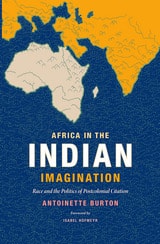
Africa in the Indian Imagination
Race and the Politics of Postcolonial CitationAntoinette Burton
Duke University Press, 2016
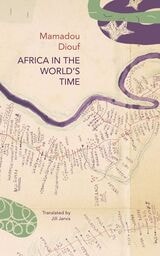
Africa in the World’s Time
Rewriting the Past Beyond Colonial NarrativesMamadou Diouf
Seagull Books, 2025
Mamadou Diouf unearths the intellectual and cultural traditions that have long defined Africa, proving that history was never just written about Africa, but also by it.
For too long, Africa has been framed as an afterthought in world history—a continent written into the margins of time. In Africa in the World’s Time, renowned historian Mamadou Diouf dismantles these colonial narratives and reclaims Africa’s rightful place at the center of global historical thought. Moving beyond Western frameworks, Diouf examines the continent’s intellectual traditions and demonstrates how African artists and historians have shaped and reshaped how we understand the past.
Tracing central debates from the independence era to today, Diouf examines figures like Cheikh Anta Diop and Samir Amin, as well as the vital role of literature and film in contesting predominant histories. He challenges the linear, Eurocentric timelines that have long governed historical discourse, and puts forward a vision of Africa as a force that has always been influencing and reimagining the world.
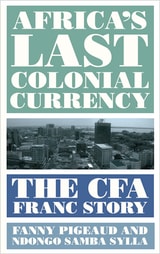
Africa's Last Colonial Currency
The CFA Franc StoryFanny Pigeaud
Pluto Press, 2021

Africa's Last Colonial Currency
The CFA Franc StoryFanny Pigeaud
Pluto Press, 2021