Results by title
22279 books match the query 'Social Science' and 1819 start with a
American Women in Transition
Suzanne M. Bianchi
Russell Sage Foundation, 1986
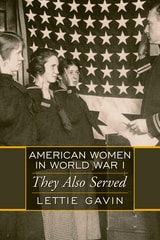
American Women in World War I
They Also ServedLettie Gavin
University Press of Colorado, 1997

American by Paper
How Documents Matter in Immigrant LiteracyKate Vieira
University of Minnesota Press, 2016
American by Paper reveals how two groups of immigrants who share a primary language nevertheless have very different experiences of literacy in the United States. It describes the social realities facing documented and undocumented immigrants who use everyday acts of writing to negotiate papers—the visas, green cards, and passports that promise access to the American Dream. It is both an ethnography, filled with illuminating details about contemporary immigrant lives, and a critical intervention into two leading—and conflicting—scholarly ideas of literacy and its social role.
Although popular thinking and scholarship have viewed literacy as a method of culturally assimilating immigrants into the nation, Kate Vieira finds that upward mobility and social inclusion in the United States are tied to literacy in complex ways. She draws from extensive interviews with Portuguese-speaking migrants who live and work together in a former mill town in Massachusetts that she calls South Mills: one group from the Azores, who are usually documented, and another from Brazil, who are usually undocumented. She explains how these migrants experience literacy not as a vehicle for assimilation (as educational policy makers often assert) nor as a means of resisting oppression (as literacy scholars often hope) but instead as tied up in papers, particularly in the papers that confer legal status. Papers and literacy are inextricably bound together, both promoting and constraining opportunities, and they shape why and how migrants read and write.
Vieira builds on insights from literacy theories that have long been in opposition to each other in order to develop a new sociomaterial theory of literacy, one that takes into account its inseparable link to paper, forms, and documentation. This point of view leads to a deeper understanding of how literacy actually accrues meaning by circulating, and recirculating, through institutions and the lives of individuals.
American, African, and Old European Mythologies
Edited by Yves Bonnefoy
University of Chicago Press, 1993
Almost all of Mythologies, originally published as a two-volume cloth set, is now available in four paperback volumes. These volumes reproduce the articles, introductory essays, and illustrations as they appeared in the full Mythologies set, and each includes a new Preface by Wendy Doniger.
This volume gathers eighty articles on mythologies from around the world. A section on the Americas and the South Pacific covers myths of native Americans, from the Inuit to the Mesoamericans, about such topics as the cosmos, fire, and the creation of the world. Essays on African mythology range from the 266 basic signs of West Africa to themes such as twins, the placenta, and masks. The final section, covering Celtic, Norse, and Slavic traditions opens with an overview of the Indo-Europeans and concludes with an essay on the religion and myths of Armenia.
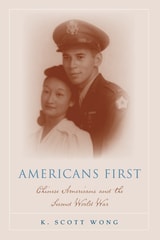
Americans First
Chinese Americans and the Second World WarK. Scott Wong
Temple University Press, 2008
In Americans First, K. Scott Wong uses archival research and oral histories to provide the first detailed account of Chinese Americans in the American military. Wong traces the history of the 14th Air Service Group, a segregated outfit of Chinese Americans sent to China in support of the American Army Air Corps and the Chinese Air Force. His ethnic history of inclusion shows how this new generation of Chinese Americans was more socially accepted, moving from the margins of society into the American mainstream during a time of pervasive racism.
Americas Jews
Chaim Waxman
Temple University Press, 1983
The book is a social history and sociology of American Jewry. It provides an up-to-date analysis of the contemporary American Jewish community, an analysis that includes educational, occupational, income, and political patterns of American Jews; the American Jewish family; anti-semitism; the relationship between American Jews and Israel; and the recent immigration of Soviet, Israeli, and Iranian Jews to the USA.
In synthesizing a vast array of empirical studies, the author argues that while American Jews have been successful in their quest to integrate into the American social system, recent developments both in the American social and cultural system, at large, and within the Jewish community, in particular, indicate that this ethno-religious group is confronting the challenge to its continuity and its manifesting survivalist strengths which were not readily apparent in earlier generations.
America's Jews in Transition should interest students in a wide range of fields, among them sociology, ethnic studies, Jewish studies, American studies, and religious studies. Because of its breadth and the freshness of its material, the book should also appeal to the general reader.
America’s New Racial Battle Lines
Protect versus RepairRogers M. Smith and Desmond King
University of Chicago Press, 2024
A sobering portrait of the United States’ divided racial politics.
For nearly two decades, Rogers M. Smith and Desmond King have charted the shifting racial policy alliances that have shaped American politics across different eras. In America’s New Racial Battle Lines, they show that US racial policy debates are undergoing fundamental change. Disputes over colorblind versus race-conscious policies have given way to new lines of conflict. Today’s conservatives promise to protect traditionalist, predominantly white, Christian Americans against what they call the “radical” Left. Meanwhile, today’s progressives seek not just to integrate American institutions but to more fully transform and “repair” pervasive systemic racism.
Drawing on interviews with activists, surveys, social network analyses, and comprehensive reviews of federal, state, and local policies and advocacy groups, Smith and King map the memberships and goals of two rival racial policy alliances and delineate the contrasting stories each side tells. They also show that these increasingly polarized racial policy alliances are substantially funded on both the Left and Right.
Placing today’s conflicts in theoretical and historical perspectives, Smith and King analyze where these intensifying clashes may take the nation in the years ahead. They highlight the great potential for mounting violence, as well as the remaining possibilities for finding common ground.
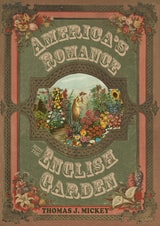
America’s Romance with the English Garden
Thomas J. Mickey
Ohio University Press, 2013
Named one of “the year’s best gardening books” by The Spectator (UK, Nov. 2014)
The 1890s saw a revolution in advertising. Cheap paper, faster printing, rural mail delivery, railroad shipping, and chromolithography combined to pave the way for the first modern, mass-produced catalogs. The most prominent of these, reaching American households by the thousands, were seed and nursery catalogs with beautiful pictures of middle-class homes surrounded by sprawling lawns, exotic plants, and the latest garden accessories—in other words, the quintessential English-style garden.
America’s Romance with the English Garden is the story of tastemakers and homemakers, of savvy businessmen and a growing American middle class eager to buy their products. It’s also the story of the beginnings of the modern garden industry, which seduced the masses with its images and fixed the English garden in the mind of the American consumer. Seed and nursery catalogs delivered aspirational images to front doorsteps from California to Maine, and the English garden became the look of America.
Amerikanuak
Basques In The New WorldWilliam A. Douglass
University of Nevada Press, 2005
Amid the Fall, Dreaming of Eden
Du Bois, King, Malcolm X, and Emancipatory CompositionBradford T. Stull
Southern Illinois University Press, 1999
Whom, or what, does composition—defined here as an intentional process of study, either oral or written—serve? Bradford T. Stull contends that composition would do well to articulate, in theory and practice, what could be called "emancipatory composition." He argues that emancipatory composition is radically theopolitical: it roots itself in the foundational theological and political language of the American experience while it subverts this language in order to emancipate the oppressed and, thereby, the oppressors.
To articulate this vision, Stull looks to those who compose from an oppressed place, finding in the works of W. E. B. Du Bois, Martin Luther King Jr., and Malcolm X radical theopolitical practices that can serve as a model for emancipatory composition. While Stull acknowledges that there are many sites of oppression, he focuses on what Du Bois has called the problem of the twentieth century: the color line, positing that the unique and foundational nature of the color line provides a fecund place in which, from which, a theory and practice of emancipatory composition might be elucidated.
By focusing on four key theopolitical tropes—The Fall, The Orient, Africa, and Eden—that inform the work of Du Bois, King, and Malcolm X, Stull discovers the ways in which these civil rights leaders root themselves in the vocabulary of the American experience in order to subvert it so that they might promote emancipation for African Americans, and thus all Americans.
In drawing on the work of Paulo Freire, Kenneth Burke, Edward Said, Christopher Miller, Ernst Bloch, and others, Stull also locates this study within the larger cultural context. By reading Du Bois, King, and Malcolm X together in a way that they have never before been read, Stull presents a new vision of composition practice to the African American studies community and a reading of African American emancipatory composition to the rhetoric and composition community, thus extending the question of emancipatory composition into new territory.
Amigas y Amantes
Sexually Nonconforming Latinas Negotiate FamilyAcosta, Katie L
Rutgers University Press, 2013
2014 Choice Outstanding Academic Title
Amigas y Amantes (Friends and Lovers) explores the experiences of sexually nonconforming Latinas in the creation and maintenance of families. It is based on forty-two in-depth ethnographic interviews with women who identify as lesbian, bisexual, or queer (LBQ). Additionally, it draws from fourteen months of participant observation at LBQ Latina events that Katie L. Acosta conducted in 2007 and 2008 in a major northeast city. With this data, Acosta examines how LBQ Latinas manage loving relationships with the families who raised them, and with their partners, their children, and their friends.
Acosta investigates how sexually nonconforming Latinas negotiate cultural expectations, combat compulsory heterosexuality, and reconcile tensions with their families. She offers a new way of thinking about the emotion work involved in everyday lives, which highlights the informal, sometimes invisible, labor required in preserving family ties. Acosta contends that the work LBQ Latinas take on to preserve connections with biological families, lovers, and children results in a unique way of doing family.
Paying particular attention to the negotiations that LBQ Latinas undertake in an effort to maintain familial order, Amigas y Amantes explores how they understand femininity, how they negotiate their religious faiths, how they face the unique challenges of being in interracial/interethnic relationships, and how they raise their children while integrating their families of origin.
Amigas
Letters of Friendship and ExileBy Marjorie Agosín and Emma Sepúlveda
University of Texas Press, 2001
This collection of letters chronicles a remarkable, long-term friendship between two women who, despite differences of religion and ethnicity, have followed remarkably parallel paths from their first adolescent meeting in their native Chile to their current lives in exile as writers, academics, and political activists in the United States. Spanning more than thirty years (1966-2000), Agosín's and Sepúlveda's letters speak eloquently on themes that are at once personal and political—family life and patriarchy, women's roles, the loneliness of being a religious or cultural outsider, political turmoil in Chile, and the experience of exile.
Among the Garifuna
Family Tales and Ethnography from the Caribbean CoastMarilyn McKillop Wells
University of Alabama Press, 2015
An intimate ethnographic narrative of one indigenous family in the twentieth-century Caribbean
Among the Garifuna is the first ethnographic narrative of a Garifuna family. The Garifuna are descendants of the “Black Carib,” whom the British deposited on Roatan Island in 1797 and who settled along the Caribbean coast from Belize City to Nicaragua.
In 1980, medical anthropologist Marilyn McKillop Wells found herself embarking on an “improbable journey” when she was invited to the area to do fieldwork with the added challenge of revealing the “real” Garifuna. Upon her arrival on the island, Wells was warmly embraced by a local family, the Diegos, and set to work recording life events and indigenous perspectives on polygyny, Afro-indigenous identity, ancestor-worshiping religion, and more. The result, as represented in Among the Garifuna, is a lovingly intimate, earthy human drama.
The family narrative is organized chronologically. Part I, “The Old Ways,” consists of vignettes that introduce the family backstory with dialogue as imagined by Wells based on the family history she was told. We meet the family progenitors, Margaret and Cervantes Diego, during their courtship, experience Margaret’s pain as Cervantes takes a second wife, witness the death of Cervantes and ensuing mourning rituals, follow the return of Margaret and the children to their previous home in British Honduras, and observe the emergence of the children’s personalities.
In Part II, “Living There,” Wells continues the story when she arrives in Belize and meets the Diego children, including the major protagonist, Tas. In Tas’s household Wells learns about foods and manners and watches family squabbles and reconciliations. In these mini-stories, Wells interweaves cultural information on the Garifuna people with first-person narrative and transcription of their words, assembling these into an enthralling slice of life. Part III, “The Ancestor Party,” takes the reader through a fascinating postmortem ritual that is enacted to facilitate the journey of the spirits of the honored ancestors to the supreme supernatural.
Among the Garifuna contributes to the literary genres of narrative anthropology and feminist ethnography in the tradition of Zora Neal Hurston and other women writing culture in a personal way. Wells’s portrait of this Garifuna family will be of interest to anthropologists, Caribbeanists, Latin Americanists, students, and general readers alike.

Amplifying Power
The Shaping of the Jamaican Sound SystemJulian Henriques
Duke University Press, 2027
Amulets, Effigies, Fetishes, and Charms
Native American Artifacts and Spirit Stones from the NortheastEdward J. Lenik
University of Alabama Press, 2016
Interpreting Sacred Objects: Indigenous Material Culture and Spiritual Meaning in the Northeast.
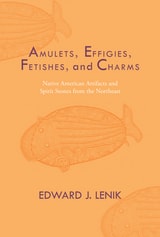
Decorated stone artifacts are a significant part of archaeological studies of Native Americans in the Northeast. The artifacts illuminated in Amulets, Effigies, Fetishes, and Charms: Native American Artifacts and Spirit Stones from the Northeast include pecked, sculpted, or incised figures, images, or symbols. These are rendered on pebbles, plaques, pendants, axes, pestles, and atlatl weights, and are of varying sizes, shapes, and designs. Lenik draws from Indian myths and legends and incorporates data from ethnohistoric and archaeological sources together with local environmental settings in an attempt to interpret the iconography of these fascinating relics. For the Algonquian and Iroquois peoples, they reflect identity, status, and social relationships with other Indians as well as beings in the spirit world.
Lenik begins with background on the Indian cultures of the Northeast and includes a discussion of the dating system developed by anthropologists to describe prehistory. The heart of the content comprises more than eighty examples of portable rock art, grouped by recurring design motifs. This organization allows for in-depth analysis of each motif. The motifs examined range from people, animals, fish, and insects to geometric and abstract designs. Information for each object is presented in succinct prose, with a description, illustration, possible interpretation, the story of its discovery, and the location where it is now housed. Lenik also offers insight into the culture and lifestyle of the Native American groups represented. An appendix listing places to see and learn more about the artifacts and a glossary are included.
The material in this book, used in conjunction with Lenik’s previous research, offers a reference for virtually every known example of northeastern rock art. Archaeologists, students, and connoisseurs of Indian artistic expression will find this an invaluable work.
Amusement, Inc.
Disneyland’s Corporate Apparatus and the Making of the Theme ParkRoland Betancourt
Duke University Press, 2027

Amy Levy
Critical EssaysNaomi Hetherington
Ohio University Press, 2010
Amy Levy has risen to prominence in recent years as one of the most innovative and perplexing writers of her generation. Embraced by feminist scholars for her radical experimentation with queer poetic voice and her witty journalistic pieces on female independence, she remains controversial for her representations of London Jewry that draw unmistakably on contemporary antisemitic discourse.
Amy Levy: Critical Essays brings together scholars working in the fields of Victorian cultural history, women’s poetry and fiction, and the history of Anglo-Jewry. The essays trace the social, intellectual, and political contexts of Levy’s writing and its contemporary reception. Working from close analyses of Levy’s texts, the collection aims to rethink her engagement with Jewish identity, to consider her literary and political identifications, to assess her representations of modern consumer society and popular culture, and to place her life and work within late-Victorian cultural debate.
This book is essential reading for undergraduate and postgraduate students offering both a comprehensive literature review of scholarship-to-date and a range of new critical perspectives.
Contributors:
Susan David Bernstein,University of Wisconsin-Madison
Gail Cunningham,Kingston University
Elizabeth F. Evans,Pennslyvania State University–DuBois
Emma Francis,Warwick University
Alex Goody,Oxford Brookes University
T. D. Olverson,University of Newcastle upon Tyne
Lyssa Randolph,University of Wales, Newport
Meri-Jane Rochelson,Florida International University
Amy Signs
A Mother, Her Deaf Daughter, and Their StoriesRebecca Willman Gernon
Gallaudet University Press, 2012
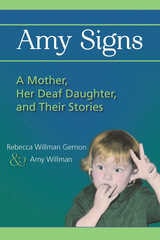
“Thirty-seven years ago, I vowed to write a truthful book about raising a deaf child.” Rebecca Willman Gernon followed through on her promise with her deaf daughter Amy Willman in this extraordinary new narrative. Many stories have been told about a parent’s struggle to help her deaf child succeed in a mostly hearing world. Amy Signs marks a signature departure in that both Rebecca and Amy relate their perspectives on their journey together.
When she learns of 11-month-old Amy’s deafness in 1969, Rebecca fully expresses her anguish, and traces all of the difficulties she endured in trying to find the right educational environment for Amy. The sacrifices of the rest of her family weighed heavily on her, also. Though she resolved to place four-year-old Amy in Nebraska’s residential school for deaf students, the emotional toll seemed too much to bear.
Amy’s view acts as the perfect counterpoint. Interwoven with her mother’s story, Amy’s account confirms that signing served her best. She summarizes life in boarding school as “laughter and homesickness.” She laughed with all of her deaf friends, though felt homesick at times. Amy thanks her mother for the gift of sign, asserting that a mainstream education would never have led her to earn a master’s degree and later teach American Sign Language at the University of Nebraska. Amy Signs is a positive albeit cautionary tale for parents of deaf children today whose only choice is a mainstreamed education.
Amá, Your Story Is Mine
Walking Out of the Shadows of AbuseBy Ercenia "Alice" Cedeño
University of Texas Press, 2007
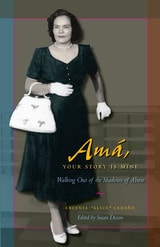
In the preface to her memoir, Ercenia "Alice" Cedeño recalls the secrecy and turmoil that marked her youth: "I spent most of my growing years mad at my mother and wanting her to change to fit in with the rest of the world," she writes. "When my sisters and I wanted her to visit our friends' mothers, she would say, 'Why do people need to know other peoples' lives?' Looking back, I wonder if she was really saying, 'I don't want them to know our business.' There was so much to hide."
Now bringing those hidden memories to light, Amá, Your Story Is Mine traces the hardship, violence, deceit, and defiance that shaped the identity of two generations of women in Alice's family. Born in the mountains of northern Mexico, Alice's mother married at age 14 into a family rife with passion that often turned to anger. After losing several infant children to disease, the young couple crossed into the United States seeking a better life.
Unfolding in a series of powerful vignettes, Amá, Your Story Is Mine describes in captivating detail a daring matriarch who found herself having to protect her children from their own father while facing the challenges of cultural discrimination. By turns wry and tender, Alice's recollections offer a rare memoir that fully encompasses the Latina experience in the United States.
Améfrica in Letters
Literary Interventions from Mexico to the Southern ConeJennifer Carolina Gómez Menjívar
Vanderbilt University Press, 2022
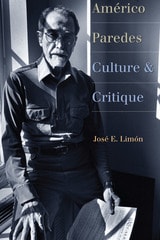
Américo Paredes
Culture and CritiqueBy José E. Limón
University of Texas Press, 2012
Several biographies of Américo Paredes have been published over the last decade, yet they generally overlook the paradoxical nature of his life’s work. Embarking on an in-depth, critical exploration of the significant body of work produced by Paredes, José E. Limón (one of Paredes’s students and now himself one of the world’s leading scholars in Mexican American studies) puts the spotlight on Paredes as a scholar/citizen who bridged multiple arenas of Mexican American cultural life during a time of intense social change and cultural renaissance.
Serving as a counterpoint to hagiographic commentaries, Américo Paredes challenges and corrects prevailing readings by contemporary critics of Paredes’s Asian period and of such works as the novel George Washington Gómez, illuminating new facets in Paredes’s role as a folklorist and public intellectual. Limón also explores how the field of cultural studies has drifted away from folklore, or “the poetics of everyday life,” while he examines the traits of Mexican American expressive culture. He also investigates the scholarly paradigm of ethnography itself, a stimulating inquiry that enhances readings of Paredes’s best-known study, “With His Pistol in His Hand,” and other works. Underscoring Paredes’s place in folklore and Mexican American literary production, the book questions the shifting reception of Paredes throughout his academic career, ultimately providing a deep hermeneutics of widely varied work. Offering new conceptions, interpretations, and perspectives, Américo Paredes gives this pivotal literary figure and his legacy the critical analysis they deserve.
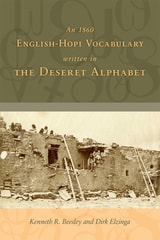
An 1860 English-Hopi Vocabulary Written in the Deseret Alphabet
Kenneth R. Beesley
University of Utah Press, 2014
The volume reproduces all 486 vocabulary entries of the original manuscript, presenting the Deseret and the modern English and Hopi translations. It explains the history of the Deseret Alphabet as well as that of the Mormon missions to the Hopi, while fleshing out the background of the two missionaries, Marion Jackson Shelton, who wrote the manuscript, and his companion, Thales Hastings Haskell. The book will be of interest to linguists, historians, ethnographers, and others who are curious about the unique combination of topics this work connects.

An Abolitionist Abroad
Sarah Parker Remond in Cosmopolitan EuropeSirpa Salenius
University of Massachusetts Press, 2016
Remond's extensive travels and diverse acquaintances demonstrate that the nineteenth-century grand tour of Europe was not exclusively the privilege of white intellectuals but included African American travelers, among them women. This biography, based on international archival research, tells the fascinating story of how Remond forged a radical path, establishing relationships with fellow activists, artists, and intellectuals across Europe.
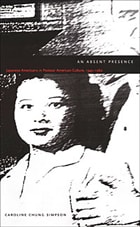
An Absent Presence
Japanese Americans in Postwar American Culture, 1945-1960Caroline Chung Simpson
Duke University Press, 2001
Simpson argues that when popular journals or social theorists engaged the topic of Japanese American history or identity in the Cold War era they did so in a manner that tended to efface or diminish the complexity of their political and historical experience. As a result, the shadowy figuration of Japanese American identity often took on the semblance of an “absent presence.” Individual chapters feature such topics as the case of the alleged Tokyo Rose, the Hiroshima Maidens Project, and Japanese war brides. Drawing on issues of race, gender, and nation, Simpson connects the internment episode to broader themes of postwar American culture, including the atomic bomb, McCarthyism, the crises of racial integration, and the anxiety over middle-class gender roles.
By recapturing and reexamining these vital flashpoints in the projection of Japanese American identity, Simpson fills a critical and historical void in a number of fields including Asian American studies, American studies, and Cold War history.
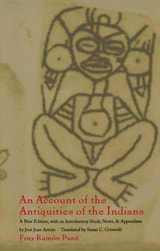
An Account of the Antiquities of the Indians
A New Edition, with an Introductory Study, Notes, and Appendices by José Juan ArromFray Ramon Pané
Duke University Press, 1999
Edited by the noted Hispanist José Juan Arrom, Pané’s report is the only surviving direct source of information about the myths, ceremonies, and lives of the New World inhabitants whom Columbus first encountered. The friar’s text contains many linguistic and cultural observations, including descriptions of the Taíno people’s healing rituals and their beliefs about their souls after death. Pané provides the first known description of the use of the hallucinogen cohoba, and he recounts the use of idols in ritual ceremonies. The names, functions, and attributes of native gods; the mythological origin of the aboriginal people’s attitudes toward sex and gender; and their rich stories of creation are described as well.
An African Voice
The Role of the Humanities in African IndependenceRobert W. July
Duke University Press, 1987
An Alliance Of Women
Immigration And The Politics Of RaceHeather Merrill
University of Minnesota Press, 2006
Taking as a starting point the Italian crisis over immigration in the early 1990s, Merrill examines grassroots interethnic spatial politics among female migrants and Turin feminists in Northern Italy. Using rich ethnographic material, she traces the emergence of Alma Mater—an anti-racist organization formed to address problems encountered by migrant women. Through this analysis, Merrill reveals the dynamics of an alliance consisting of women from many countries of origin and religious and class backgrounds.
Highlighting an interdisciplinary approach to migration and the instability of group identities in contemporary Italy, An Alliance of Women presents migrants grappling with spatialized boundaries amid growing nativist and anti-immigrant sentiment in Western Europe.
Heather Merrill is assistant professor of geography and anthropology at Dickinson College.
An American Body | Politic
A Deleuzian ApproachBernd Herzogenrath
Dartmouth College Press, 2010
An American Dilemma Revisited
Race Relations in a Changing WorldObie, Jr. Clayton
Russell Sage Foundation, 1996

An American Obsession
Science, Medicine, and Homosexuality in Modern SocietyJennifer Terry
University of Chicago Press, 1999
Terry's overarching argument is compelling: that homosexuality served as a marker of the "abnormal" against which malleable, tenuous, and often contradictory concepts of the "normal" were defined. One of the few histories to take into consideration homosexuality in both women and men, Terry's work also stands out in its refusal to erase the agency of people classified as abnormal. She documents the myriad ways that gays, lesbians, and other sexual minorities have coauthored, resisted, and transformed the most powerful and authoritative modern truths about sex. Proposing this history as a "useable past," An American Obsession is an indispensable contribution to the study of American cultural history.

An American Social Worker in Italy
Jean Charnley
University of Minnesota Press, 1961
An American Social Worker in Italy was first published in 1961. Minnesota Archive Editions uses digital technology to make long-unavailable books once again accessible, and are published unaltered from the original University of Minnesota Press editions.
Mrs. Charnley, an American social worker, spent six months in Italy on a Fulbright grant as a consultant to Italian child welfare agencies and schools of social work. Here, in diary form, she tells of her experiences during those months when she struggled to teach American social work principles to her Italian colleagues. The task was complicated not only by the need to communicate in a newly learned tongue but also by the necessity to tailor American casework philosophies to a vastly different culture. The story abounds in humor and pathos and, at the same time, offers rich information about Italy, its people, and its child-care methods and institutions.
Mrs. Charnley points out that one Italian child in ten spends his first seventeen years in an institution. The nation's laws for the protection of children date back to the Caesars; even the most progressive of the social workers she met hoped for reforms only in terms of decades or centuries. Against this background, the situations in which she found herself were sometimes frustrating, often comic, always challenging. Her determination to help Italy's half-million institutionalized children took her behind the doors of many orphanages and convents, into close contact with the children and the nuns and priests who cared for them. She studied the records of social agencies, analyzed problems with their staffs, and lectured at social work schools.

An American Travesty
Legal Responses to Adolescent Sexual OffendingFranklin E. Zimring
University of Chicago Press, 2004
An American Travesty is the first scholarly book in half a century to analyze the justice system’s response to sexual misconduct by children and adolescents in the United States. Writing with a refreshing dose of common sense, Franklin E. Zimring discusses our society's failure to consider the developmental status of adolescent sex offenders. Too often, he argues, the American legal system ignores age and developmental status when adjudicating young sexual offenders, in many cases responding as they would to an adult.
“An opinionated, articulate, and forceful critique of current politics and practices. . . . I would recommend this book for anyone interested in rethinking the fundamental questions of how our courts and systems should respond to these cases.”—Law and Politics Book Review
“One of the most important new books in the field of juvenile justice. . . . Zimring offers a thoughtful, research-based analysis of what went wrong with legal policy development.”—Barry Krisberg, President, National Council on Crime and Delinquency
An American Vein
Critical Readings in Appalachian LiteratureDanny L. Miller
Ohio University Press, 2005
The blossoming of Appalachian studies began some thirty years ago. Thousands of young people from the hills have since been made aware of their region’s rich literary tradition through high school and college courses. An entire generation has discovered that their own landscapes, families, and communities had been truthfully portrayed by writers whose background was similar to their own.
An American Vein: Critical Readings in Appalachian Literature is an anthology of literary criticism of Appalachian novelists, poets, and playwrights. The book reprises critical writing of influential authors such as Joyce Carol Oates, Cratis Williams, and Jim Wayne Miller. It introduces new writing by Rodger Cunningham, Elizabeth Engelhardt, and others.
Many writers from the mountains have found success and acclaim outside the region, but the region itself as a thriving center of literary creativity has not been widely appreciated. The editors of An American Vein have remedied this, producing the first general collection of Appalachian literary criticism. This book is a resource for those who teach and read Appalachian literature. What’s more, it holds the promise of introducing new readers, nationally and internationally, to Appalachian literature and its relevance to our times.
An American in the Making
The Life Story of an ImmigrantKellman, Steven G
Rutgers University Press, 2009
Steven G. Kellman brings Ravage's story to life again in this new edition, providing a brief biography and introduction that place the memoir within historical and literary contexts. An American in the Making contributes to a broader understanding of the global notion of "America" and remains timely, especially in an era when massive immigration, now from Latin America and Asia, challenges ideas of national identity.

An Amulet of Greek Earth
Generations of Immigrant Folk CultureHelen Papanikolas
Ohio University Press, 2002
The boys and men who left their Greek valley and mountain villages in the early 1900s for America came with amulets their mothers had made for them. Some were miniature sacks attached to a necklace; more often they were merely a square of fabric enclosing the values of their lives: a piece of a holy book or a sliver of the True Cross representing their belief in Greek Orthodoxy; a thyme leaf denoting their wild terrain; a blue bead to ward off the Evil Eye; and a pinch of Greek earth.
In her evocative and meticulously researched book An Amulet of Greek Earth, author Helen Papanikolas explains and examines the vibrant culture these immigrants brought with them to the new world. The Romiosini culture, as it was called, provided the foundation for their new lives and was oftentimes the cause of strife as they passed on their beliefs and traditions to successive generations of Greek Americans.
In the tradition of her fictional accounts of Greek immigrant life, Helen Papanikolas unearths the cultural beliefs and passions that compelled the Greek-American community to make its own way into the broader culture of America. Based on extensive study, personal interviews, and a lifetime of experience, An Amulet of Greek Earth is a revealing and informative chronicle of the immigrant’s experience in becoming an American.
An Analysis of Effigy Mound Complexes in Wisconsin
William M. Hurley
University of Michigan Press, 1975
An Analysis of the Wood-Cutting Process
Norman C. Franz
University of Michigan Press, 1958
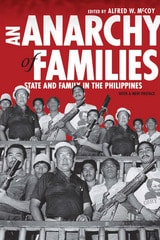
An Anarchy of Families
State and Family in the PhilippinesAlfred W. McCoy
University of Wisconsin Press, 2009
Edited by Alfred W. McCoy, An Anarchy of Families explores the pervasive influence of the modern dynasties that have led the Philippines during the past century. Exemplified by the Osmeñas and Lopezes, elite Filipino families have formed a powerful oligarchy—controlling capital, dominating national politics, and often owning the media. Beyond Manila, strong men such as Ramon Durano, Ali Dimaporo, and Justiniano Montano have used “guns, goons, and gold” to accumulate wealth and power in far-flung islands and provinces. In a new preface for this revised edition, the editor shows how this pattern of oligarchic control has continued into the twenty-first century, despite dramatic socio-economic change that has supplanted the classic “three g’s” of Philippine politics with the contemporary “four c’s”—continuity, Chinese, criminality, and celebrity.

An Annotated Bibliography of Chinese Painting Catalogues and Related Texts
Hin-cheung Lovell
University of Michigan Press, 1973
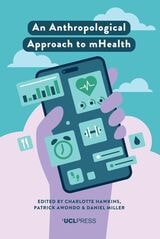
An Anthropological Approach to mHealth
Edited by Charlotte Hawkins, Patrick Awondo, and Daniel Miller
University College London, 2024
An Anthropological Approach to mHealth underlines ten sixteen-month ethnographies, set across Asia, Africa, Europe, and Latin America, that revealed people’s use of communicative apps, including as LINE, WeChat, and WhatsApp’s alternative primary health apps, highlighting the irrelevance of dedicated health apps. Using a “smart-from-below” approach, this book studies these surprising practices and proposes a radically different anthropological method to the development and dissemination of mobile health (mHealth), a rapidly growing sector in healthcare.
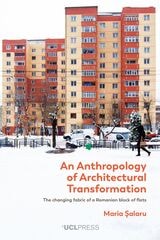
An Anthropology of Architectural Transformation
The Changing Fabric of a Romanian Block of FlatsMaria Salaru
University College London, 2025
Maria Salaru takes readers inside a Romanian apartment block, tracing its evolution from 1974 to the present as residents navigate shifting political and economic landscapes. Through rich ethnographic detail, this work exposes how everyday acts of repair and maintenance reshape both individual apartments and the broader urban fabric of Piatra-Neamț. As state support for housing recedes, new forms of solidarity emerge—whether through self-organized communities, housing associations, or activist interventions—presenting a new perspective on the lived experience of architectural transformation.
This book opposes the view of architecture as static and instead presents buildings as dynamic spaces co-created over time by their inhabitants. It will appeal to social scientists exploring the intersection of materiality and urban change, as well as architects interested in the evolving relationship between people and the built environment. By capturing the micro-scale transformations that collectively redefine city life, An Anthropology of Architectural Transformation provides a persuasive case for rethinking how we study and inhabit our shared spaces.
An Anthropology of the Machine
Tokyo's Commuter Train NetworkMichael Fisch
University of Chicago Press, 2018
An Anthropology of the Machine is a creative ethnographic study of the culture, history, and experience of commuting in Tokyo. At the same time, it is a theoretically ambitious attempt to think through our very relationship with technology and our possible ecological futures. Fisch provides an unblinking glimpse into what it might be like to inhabit a future in which more and more of our infrastructure—and the planet itself—will have to operate beyond capacity to accommodate our ever-growing population.
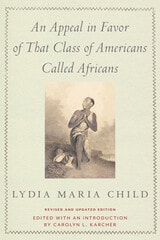
An Appeal in Favor of That Class of Americans Called Africans
Revised and Updated EditionLydia Maria Child, Edited with an introduction by Carolyn L. Karcher
University of Massachusetts Press, 2023
Published in Boston in 1833, Lydia Maria Child’s An Appeal in Favor of That Class of Americans Called Africans provided the abolitionist movement with its first full-scale analysis of race and enslavement. Controversial in its own time, the Appeal surveyed the institution of slavery from historical, political, economic, legal, racial, and moral perspectives and advocated for the immediate emancipation of the enslaved without compensation to their enslavers. By placing American slavery in historical context and demonstrating how slavery impacted—and implicated—Americans of all regions and races, the Appeal became a central text for the abolitionist movement that continues to resonate in the present day.
This revised and updated edition is enhanced by Carolyn L. Karcher’s illuminating introduction, a chronology of Child’s life, and a list of books for further reading.

An Appeal to Justice
Litigated Reform of Texas PrisonsBy Ben M. Crouch and James W. Marquart
University of Texas Press, 1989
How does a prison achieve institutional order while safeguarding prisoners' rights? Since the early 1960s, prison reform advocates have aggressively used the courts to extend rights and improve life for inmates, while prison administrators have been slow to alter the status quo. Litigated reform has been the most significant force in obtaining change.
An Appeal to Justice is a critical tudy of how the Texas Department of Corrections was transformed by Ruiz v. Estelle, the most sweeping class-action suit in correctional law history. Orders from federal judge William W. Justice rapidly moved the Texas system from one of the most autonomous, isolated, and paternalistic system to a more constitutional bureaucracy. In many respects the Texas experience is a microcosm of the transformation of American corrections over the second half of the twentieth century.
This is a careful account of TDC's fearful past as a plantation system, its tumultuous litigated reform, and its subsequent efforts to balance prisoner rights and prison order. Of major importance is the detailed examination of the broad stages of the reform process (and its costs and benefits) and an intimate look at prison brutality and humanity. The authors examine the terror tactics of the inmate guards, the development of prisoner gangs and widespread violence during the reforms, and the stability that eventually emerged. They also detail the change of the guard force from a relatively small, cohesive cadre dependent on discretion, personal loyalty, and physical dominance to a larger and more fragmented security staff controlled by formal procedures.
Drawing on years of research in archival sources and on hundreds of interviews with prisoners, administrators, and staff, An Appeal to Justice is a unique basis for assessing the course and consequences of prison litigation and will be valuable reading for legislators, lawyers, judges, prison administrators, and concerned citizens, as well as prison and public policy scholars.
An Appraisal of Tree-Ring Dated Pottery in the Southwest
David A. Breternitz
University of Arizona Press, 1966
An Archaeological Investigation on the Loboi Plain, Baringo District, Kenya
William R. Farrand
University of Michigan Press, 1976
An Archaeological Survey of the Keban Reservoir Area of East-Central Turkey
Robert Whallon
University of Michigan Press, 1979
An Archaeologist's Guide to Organic Residues in Pottery
Eleanora A. Reber
University of Alabama Press, 2022
Unlock the chemical secrets of ancient pottery in this guide for mastering organic residue pottery analysis.
Pottery analysis is a crucial component of excavating an archaeological site. Organic residues in pottery are made up of chemicals that absorb into pots over their lifetime. These residues can reveal what people ate, whether different types of vessels were used for different cooking or foodstuffs preparation, and whether “elite” vessels were in use.
Organic residue analysis is a technical specialty that blends an unusual type of instrumental organic chemistry and archaeology. Because it is considered an obscure technique, archaeologists of all degrees of experience tend to struggle with how to apply the technology to archaeological questions and how to sample effectively in the field to answer these questions.
Eleanora A. Reber’s An Archaeologist’s Guide to Organic Residues in Pottery is a user-friendly resource for all archaeologists. Composed of case studies gleaned from Reber’s more than twenty years of archaeological research, this guide covers the range of residues encountered in the field and explains the methods and application of organic residue analysis.
Reber illustrates the useful aspects of residue analysis, such as compound-specific isotope analysis for the identification of traces of maize and marine resources, conifer resins, and the psychoactive alkaloid biomarkers caffeine and nicotine. Special attention is paid to sampling and construction of meaning as well as research questions to help field archaeologists integrate residue analysis seamlessly into their projects

An Archaeology of the Soul
NORTH AMERICAN INDIAN BELIEF AND RITUALRobert L. Hall
University of Illinois Press, 1997
noted, but it has never been examined so thoroughly, nor with such an
eye for the amazing interconnectedness of Indian tribal ceremonies and
practices, as in An Archaeology of the Soul. In this monumental
work, destined to become a classic in its field, Robert Hall traces the
genetic and historical relationships of the tribes of the Midwest and
Plains--including roots that extend back as far as 3,000 years.
Looking beyond regional barriers, An Archaeology of the Soul offers new depths of insight into American Indian ethnography. Hall uncovers the lineage and kinship shared by Native North Americans through the perspectives of history, archaeology, archaeoastronomy, biological anthropology, linguistics, and mythology. The wholeness and panoramic complexity of American Indian belief has never been so fully explored--or more deeply understood.
An Archeological Survey of the Fremont Area
UUAP 28James Gunnerson
University of Utah Press, 1957