Results by title
3785 books match the query 'Poetry' and 303 start with a

Abandoned Women
Rewriting the Classics in Dante, Boccaccio, and ChaucerSuzanne Hagedorn
University of Michigan Press, 2003
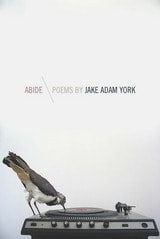
Abide
Jake Adam York
Southern Illinois University Press, 2014
Winner, 2015 Colorado Book Award
Finalist, 2015 National Book Critics Circle Award
In the years leading up to his recent passing, Alabama poet Jake Adam York set out on a journey to elegize the 126 martyrs of the civil rights movement, murdered in the years between 1954 and 1968. Abide is the stunning follow-up to York’s earlier volumes, a memorial in verse for those fallen. From Birmingham to Okemah, Memphis to Houston, York’s poems both mourn and inspire in their quest for justice, ownership, and understanding.
Within are anthems to John Earl Reese, a sixteen-year-old shot by Klansmen through the window of a café in Mayflower, Texas, where he was dancing in 1955; to victims lynched on the Oklahoma prairies; to the four children who perished in the Birmingham church bombing of 1963; and to families who saw the white hoods of the Klan illuminated by burning crosses. Juxtaposed with these horrors are more loving images of the South: the aroma of greens simmering on the stove, “tornado-strong” houses built by loved ones long gone, and the power of rivers “dark as roux.”
Throughout these lush narratives, York resurrects the ghosts of Orpheus, Sun Ra, Howlin’ Wolf, Thelonious Monk, Woody Guthrie, and more, summoning blues, jazz, hip-hop, and folk musicians for performances of their “liberation music” that give special meaning to the tales of the dead.
In the same moment that Abide memorializes the fallen, it also raises the ethical questions faced by York during this, his life’s work: What does it mean to elegize? What does it mean to elegize martyrs? What does it mean to disturb the symmetries of the South’s racial politics or its racial poetics?
A bittersweet elegy for the poet himself, Abide is as subtle and inviting as the whisper of a record sleeve, the gasp of the record needle, beckoning us to heed our history.
About Crows
Craig Blais
University of Wisconsin Press, 2013
About the Dead
Travis Mossotti
Utah State University Press, 2011
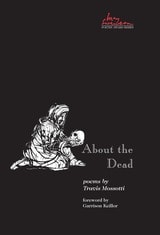
Travis Mossotti writes with humor, gravity, and humility about subjects grounded in a world of grit, where the quiet mortality of working folk is weighed. To Mossotti, the love of a bricklayer for his wife is as complex and simple as life itself: “ask him to put into words what that sinking is, / that shudder in his chest, as he notices / the wrinkles gathering at the corners of her mouth.” But not a whiff of sentiment enters these poems, for Mossotti has little patience for ideas of the noble or for sympathetic portraits of hard-used saints. His vision is clear, as clear as the memory of how scarecrows in the rearview, “each of them, stuffed / into a body they didn’t choose, resembled / your own plight.” His poetry embraces unsanctimonious life with all its wonder, its levity, and clumsiness. About the Dead is an accomplished collection by a writer in control of a wide range of experience, and it speaks to the heart of any reader willing to catch his “drift, and ride it like the billowed / end of some cockamamie parachute all the way / back to the soft, dysfunctional, waiting earth.”
Above the Birch Line
PoemsPia Taavila-Borsheim
Gallaudet University Press, 2021
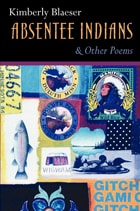
Absentee Indians and Other Poems
Kimberly Blaeser
Michigan State University Press, 2002
Absentee Indians and Other Poems evokes personal yet universal experiences of the places that Native Americans call home, their family and national histories, and the emotional forces that help forge Native American identities. These are poems of exile, loss, and the celebration of that which remains. Anchored in the physical landscape, Blaeser’s poetry finds the sacred in those ordinary actions that bind a community together. As Blaeser turns to the mysterious passage from sleeping to wakefulness, or from nature to spirit, she reveals not merely the movement from one age or place to another, but the movement from experience to vision.

Absinthe
World Literature in Translation: The Islamicate in TranslationJaideep Pandey
Michigan Publishing Services, 2025
Guest-edited by Razieh Araghi and Jaideep Pandey, this special issue explores the rich, multilingual, and transregional literary worlds shaped by and within the Islamicate sphere.
From the Mughal court to Metro Detroit, from Malayalam ghazals to Kurdish-inflected Persian prison poetry, this issue brings together literary translations and critical reflections that unsettle assumptions about language, identity, and belonging. Rather than framing the Islamicate as a fixed geography or religious category, Absinthe 31 approaches it as a set of fluid crossings—linguistic, cultural, historical, and affective.
The issue features work in and from an expansive range of languages, including Persian, Arabic, Malayalam, Kurdish, Assamese, Amazigh, Armeno-Turkish, Dari, and Urdu—foregrounding both canonical and marginalized voices. It includes new English translations of ghazals, sīrahs, biographies, and poems originally written by poets and thinkers working across sectarian, linguistic, and national boundaries, and often negotiating minority or diasporic positionalities.
In addition to the translated works, many contributions are accompanied by translator commentaries that reflect on the ethics, politics, and poetics of translating from within the Islamicate literary landscape. Together, they suggest that translation is not just a means of access, but a mode of thinking—a method native to the Islamicate tradition itself. Spanning from the premodern courts of empire to contemporary diasporic communities, Absinthe 31 offers readers a vibrant and pluralistic vision of the Islamicate as a dynamic literary terrain shaped by continual movement, negotiation, and transformation.
Absinthe
World Literature in Translation: Vol. 24: World HellenismsAli Bolcakan, Will Stroebel and Peter Vorissis
Michigan Publishing Services, 2018
Absinthe 24 pushes and prods Hellenism beyond its geographic and cultural comfort zones, and sets it tumbling off beyond both internal and external borders of its nation-state, in a wide-ranging but always site-specific and localized itinerary. At each stop along the way, this Greekness finds its plurals—hence the “Hellenisms” of the title. While they present no unified topography, tongue or even topic, these Hellenisms map out the contours of a shared conversation. Today’s Hellenism isn’t limited to Hellas, nor to the Hellenic language. The selected texts in this volume explore Greece from the perspective of visitors, displaced persons, and marginalized people looking in, or, conversely, from the perspective of locals striving to break out.
Absinthe: A Journal of World Literature in Translation publishes foreign literature in English translation, with a particular focus on previously untranslated contemporary fiction, poetry, and creative non-fiction by living authors. The magazine has its home in the Department of Comparative Literature at the University of Michigan and is edited by graduate students in the Department, as well as by occasional guest editors.
Absinthe
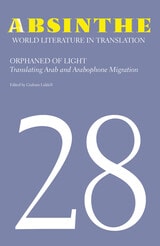
World Literature in Translation: Volume 28: Orphaned of Light: Translating Arab and Arabophone MigrationGraham Liddell
Michigan Publishing Services, 2022
Absinthe 28: Orphaned of Light features contemporary literature of migration translated from and to Arabic. In short stories, creative nonfiction essays, poetry, and selections from novels, a multiplicity of migration experiences is brought to the fore: life in diaspora, undocumented labor, refugeehood, human trafficking, internal displacement, exile.
This issue brings together names familiar to readers of Arabic literature in translation, such as Ghassan Kanafani and Saadi Youssef, with writers making their English-language debuts, such as Dearborn, MI-based Kurdish Iraqi poet Gulala Nouri and Libyan novelist Mohamad Alasfar. Likewise, the issue includes veteran translators Marilyn Booth, Nancy Roberts, and Khaled Mattawa alongside newcomers, several of them graduate students at the University of Michigan.
Each piece is accompanied by a translator’s reflection that meditates on the work’s themes as well as the creative process of translation, and the issue’s poetry is presented in a side-by-side Arabic-English format.
Absinthe 28 comes to us at a time when, according to the UN, one in every 78 people on earth is displaced. This collection serves as a reminder that translation and migration are inextricably linked.
Absinthe
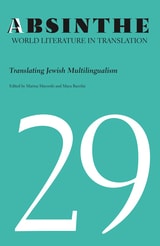
World Literature in Translation: Volume 29: Translating Jewish MultilingualismMarina Mayorski
Michigan Publishing Services, 2023
Absinthe 29: Translating Jewish Multilingualism showcases the variety of languages and genres in which modern Jewish writers have expressed themselves. Spanning short stories, essays, poetry, and selections from novels, the selection of literary works featured in this issue of Absinthe cuts across distinctions between European and non-European literary traditions and addresses diverse themes, including social class, gender, immigration, religious traditions, love and marriage, and the act of writing itself.
Rather than consider disparate Jewish languages and histories in isolation, we bring them into conversation within an open-ended framework that explores Jewish multilingualism in the modern world. The multilingual narrative of Jewish modernity told through them, in seven languages, spans from the 1880s to the 2020s.
Its wide geographical distribution ranges from Tel Aviv to São Paulo through Buenos Aires, Istanbul, Thessaloniki, Livorno, Warsaw, Prague, and Chicago. Each text and context exhibits different aspects of the Jewish encounter with the conditions of modern society, exemplifying the ways in which Jewish writing engages and negotiates different cultures and traditions.
The new volume of Absinthe foregrounds the multilingual legacy of Jewish migration and diasporic life that has become ubiquitous in modern Jewish writing, and it is evident in the enriching and disruptive presence of multiple languages and literary traditions in each of these texts. The title of this volume, Translating Jewish Multilingualism, refers both to the English translations of these texts and to the processes of translation, mediation, and hybridization encapsulated in the works themselves.
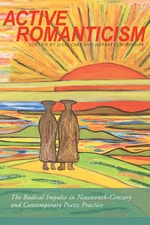
Active Romanticism
The Radical Impulse in Nineteenth-Century and Contemporary Poetic PracticeEdited by Julie Carr and Jeffrey C. Robinson
University of Alabama Press, 2015
A collection of essays highlighting the pervasive, yet often unacknowledged, role of Romantic poetry and poetics on modern and contemporary innovative poetry.
Literary history generally locates the primary movement toward poetic innovation in twentieth-century modernism, an impulse carried out against a supposedly enervated “late-Romantic” poetry of the nineteenth century. The original essays in Active Romanticism challenge this interpretation by tracing the fundamental continuities between Romanticism’s poetic and political radicalism and the experimental movements in poetry from the late nineteenth century to the present day.
According to editors July Carr and Jeffrey C. Robinson, “active romanticism” is a poetic response, direct or indirect, to pressing social issues and an attempt to redress forms of ideological repression; at its core, “active romanticism” champions democratic pluralism and confronts ideologies that suppress the evidence of pluralism. “Poetry fetter’d, fetters the human race,” declared poet William Blake at the beginning of the nineteenth century. No other statement from the era of the French Revolution marks with such terseness the challenge for poetry to participate in the liberation of human society from forms of inequality and invisibility. No other statement insists so vividly that a poetic event pushing for social progress demands the unfettering of traditional, customary poetic form and language.
Bringing together work by well-known writers and critics, ranging from scholarly studies to poets’ testimonials, Active Romanticism shows Romantic poetry not to be the sclerotic corpse against which the avant-garde reacted but rather the wellspring from which it flowed.
Offering a fundamental rethinking of the history of modern poetry, Carr and Robinson have grouped together in this collection a variety of essays that confirm the existence of Romanticism as an ongoing mode of poetic production that is innovative and dynamic, a continuation of the nineteenth-century Romantic tradition, and a form that reacts and renews itself at any given moment of perceived social crisis.
Acts of Attention, Second Edition
The Poems of D. H. LawrenceSandra M. Gilbert
Southern Illinois University Press, 1990
In the Preface to this second edition of her first book, Sandra M. Gilbert addresses the inevitable question: "How can you be a feminist and a Lawrentian?" The answer is intellectually satisfying and historically revealing as she traces an array of early twentieth-century women of letters, some of them proto-feminists, who revered Lawrence despite his countless statements that would today be condemned as "sexist."
H.D. regarded him as one of her "initiators" whose words "flamed alive, blue serpents on the page." Anais Nin insisted that he "had a complete realization of the feelings of women."
By focusing on Lawrence’s own definition of a poem as an "act of attention," Gilbert demonstrates how he developed the mature style of Birds, Beasts and Flowers, his finest collection of poetry. She discusses this volume at length, examines many of his later poems in detail, including the hymns from The Plumed Serpent, Pansies, Nettles, and More Pansies, and ends with a close look at Last Poems. Her detailed examination provides a clearer image of Lawrence as an artist—an artist whose poetry complements his novels and whose fiction enriches but does not outshine his poetry.
Acts of Mind
Conversations with Contemporary PoetsRichard Jackson
University of Alabama Press, 1984
Acts of Mind grew out of interviews conducted by the author for Poetry Miscellany. The aim of which was to help develop a method for talking about the work of contemporary poets.
The poets whose views appear in this volume represent a fair cross-section of the more important tendencies and impulses to be found in contemporary poetry and poetics.
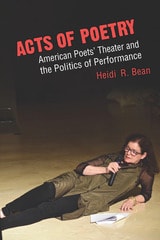
Acts of Poetry
American Poets' Theater and the Politics of PerformanceHeidi R. Bean
University of Michigan Press, 2019
American poets’ theater emerged in the postwar period alongside the rich, performance-oriented poetry and theater scenes that proliferated on the makeshift stages of urban coffee houses, shared apartments, and underground theaters, yet its significance has been largely overlooked by critics. Acts of Poetry shines a spotlight on poets’ theater’s key groups, practitioners, influencers, and inheritors, such as the Poets’ Theatre, the Living Theatre, Gertrude Stein, Bunny Lang, Frank O’Hara, Amiri Baraka, Carla Harryman, and Suzan-Lori Parks. Heidi R. Bean demonstrates the importance of poets’ theater in the development of twentieth-century theater and performance poetry, and especially evolving notions of the audience’s role in performance, and in narratives of the relationship between performance and everyday life. Drawing on an extensive archive of scripts, production materials, personal correspondence, theater records, interviews, manifestoes, editorials, and reviews, the book captures critical assessments and behind-the-scenes discussions that enrich our understanding of the intertwined histories of American theater and American poetry in the twentieth century.
Adobe Odes
Pat Mora
University of Arizona Press, 2006
From family gossip and beauty secrets, to women darning hand-me-downs, to reluctant hands carrying bodies across borders, Mora traverses the tangled threads of culture, community, family, gender, and injustice. Her vivid observations together with her deft handling of symmetry and meter make her poetry uniquely insightful, subtle, and elegant. Sprinkled with Spanish and plenty of spice, each ode is a sensory flurry of mind and body. Together they make a cauldron of flavorful, simmering language. They are meant to be savored as they slowly stir the soul.
Aesop's Human Zoo
Roman Stories about Our BodiesPhaedrus
University of Chicago Press, 2004
Providing unusual insights into the heart of Roman culture, these clever poems open up odd avenues of ancient lore and life as they explore social types and physical aspects of the body, regularly mocking the limitations of human nature and offering vulgar or promiscuous interpretations of the stuff of social life.
Featuring folksy proverbs and satirical anecdotes, filled with saucy naughtiness and awful puns, Aesop's Human Zoo will amuse you with its eccentricities and hit home with its shrewdly candid and red raw messages. The entertainment offered in this volume of impeccably accurate translations is truly a novelty—a good-hearted and knowing laugh courtesy of classical poetry. Beginning to advanced classicists and Latin scholars will appreciate the original Latin text provided in this bilingual edition. The splash of classic Thomas Bewick wood engravings to accompany the fables renders the collection complete.
Aesthetics and Revolution
Nicaraguan Poetry 1979-1990Greg Dawes
University of Minnesota Press, 1993
In Aesthetics and Revolution, Dawes demonstrates that there is an objective grounding for cultural studies found in the aesthetic means of production. By analyzing the relations and forces of production in this realm we inevitably cross over into the economic means of production as well as the struggle for political representation. Ultimately, aesthetics is at the intersection of class and gender interests and their struggle for hegemony.
In Aesthetics and Revolution, Dawes has chosen a group of writers of different theoretical sympathies, class, gender, and social positions to reveal the conflictual interests of the social classes and genders as a whole. Through close readings of their work, Dawes examines the thematic nodes that are expressed in positions as diverse as Ernesto Cardenal’s liberation theology, Pablo Antonio Cuadra’s populism, the campesino’s oral tradition, and Gioconda Belli’s erotic verses in relation to the changes taking place in revolutionary Nicaragua.
Affirmation of Poetry
Judith Balso
University of Minnesota Press, 2014
Since the times of Plato and Aristotle, the relation of poetry to philosophy has been controversial. For certain scholars, poetry should in no way be confused with philosophy. For others, poetry is at the heart of the possibility of thinking itself. In Affirmation of Poetry, Judith Balso defends the significance of poetry as a necessary practice for thinking. For Balso, if reading poetry properly has become an obscure task, poetry itself still carries with it a power of thinking: the efforts of the poets must continue. In analyzing the affirmation of thought found within the work of such poets as Osip Mandelstam, Wallace Stevens, Alberto Caeiro, and Giacomo Leopardi, Balso reestablishes poetry’s place as a site of thought.
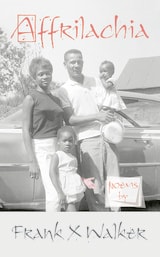
Affrilachia
PoemsFrank X Walker
Ohio University Press, 2000

African-American Poetry of the Nineteenth Century
AN ANTHOLOGYEdited by Joan R. Sherman
University of Illinois Press, 1992
from first editions and are annotated in detail.
After Frost
An Anthology of Poetry from New EnglandHenry Lyman
University of Massachusetts Press, 1996
After Frost is published in association with the New England Foundation for the Humanities, which has sponsored a program of reading and discussion groups with poets across the region using this anthology.
After Tomorrow the Days Disappear
Ghazals and Other PoemsHasan Sijzi of Delhi, Translated from the Persian by Rebecca Gould
Northwestern University Press, 2016
Hasan Sijzi, also known as Amir Hasan Sijzi Dehlavi, is considered the originator of the Indo-Persian ghazal, a poetic form that endures to this day—from the legacy of Hasan’s poetic descendent, Hafez, to contemporary Anglophone poets such as John Hollander, Maxine Kumin, Agha Shahid Ali, and W. S. Merwin.
As with other Persian poets, Hasan worked within a highly regulated set of poetic conventions that brought into relief the interpenetration of apparent opposites—metaphysical and material, mysterious and quotidian, death and desire, sacred and profane, fleeting time and eternity. Within these strictures, he crafted a poetics that blended Sufi Islam with non-Muslim Indic traditions. Of the Persian poets practiced the ghazal, Hafez and Rumi are best known to Western readers, but their verse represents only a small fraction of a rich tradition. This collection reveals the geographical range of the literature while introducing an Indian voice that will find a place on reader’s bookshelves alongside better known Iranian names.

After Urgency
Rusty Morrison
Tupelo Press, 2012
After and Before the Lightning
Simon J. Ortiz
University of Arizona Press, 1994
Acoma Pueblo poet Ortiz spent a winter in South Dakota, teaching at Sinte Gleska College on the Rosebud Lakota Sioux Reservation. The bitter cold and driving snow of a prairie winter were a reality commanding his attention through its absolute challenge to survival and the meaning of survival.
Ortiz's way of dealing with the hard elements of winter was to write After and Before the Lightning, prose and verse poems that were his response to that long season between the thunderstorms of autumn and spring. "I needed a map of where I was and what I was doing in the cosmos," he writes. In these poems, which he regards as a book-length poetic work, he charts the vast spaces of prairie and time that often seem indistinguishable. As he faces the reality of winter on the South Dakota reservation, he also confronts the harsh political reality for its Native community and culture and for Indian people everywhere.
"Writing this poetry reconnected me to the wonder and awe of life," Ortiz states emphatically. Readers will feel the reality of that wonder and awe—and the cold of that South Dakota winter—through the gentle ferocity of his words.
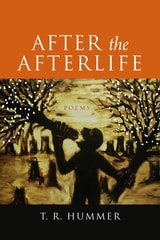
After the Afterlife
PoemsT. R. Hummer
Acre Books, 2017
which is like trying to teach
The cat to waltz, so much awkwardness, so many tender
advances, and I’m shocked when it actually learns,
When it minces toward me in a tiny cocktail gown, offering a martini,
asking for this dance, insisting on hearing me refuse
To reply, debating all along, in the chorus of its interior mewing, who
are you really, peculiar animal, who taught you to call you you.
After the Death of Poetry
Poet and Audience in Contemporary AmericaVernon Shetley
Duke University Press, 1993
In exemplary case studies, Shetley identifies the very different ways in which three postwar poets—Elizabeth Bishop, James Merrill, and John Ashbery—try to restore some of the challenge and risk that characterized modernist poetry's relation to its first readers. Sure to be controversial, this cogent analysis offers poets and readers a clear sense of direction and purpose, and so, the hope of reaching each other again.
After the Digging
Alan Shapiro
University of Chicago Press, 1998
"Powerful. . . . That a young poet can handle this subject so well in a first book is . . . a pleasure in itself."—Robert von Hallberg, Contemporary Literature, 1981
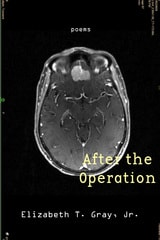
After the Operation
Elizabeth T. Gray
Four Way Books, 2025
After the Others
PoemsBruce Weigl
Northwestern University Press, 1999
In his twelfth volume of poetry, Bruce Weigl continues his quest for emotional and spiritual enlightenment. Quiet and moving, these poems combine an intimate voice with a searingly direct look at suffering and senseless violence, at human desire and love, and at man's relationship with nature.
After the Reunion
PoemsDavid Baker
University of Arkansas Press, 1994
After the Whale
Melville in the Wake of Moby-DickClark Davis
University of Alabama Press, 1995
Beyond Moby-Dick: Reinterpreting Melville's later works through language, embodiment, and literary transformation.
The study focuses on Melville’s vision of the purpose and function of language from Moby-Dick through Billy Budd with a special emphasis on how language—in function and form—follows and depends on the function and form of the body, how Melville’s attitude toward words echoes his attitude toward fish. Davis begins by locating and describing the fundamental dialectic formulated in Moby-Dick in the characters of Ahab and Ishmael. This dialectic produces two visions of bodily reality and two corresponding visions of language: Ahab’s, in which language is both weapon and substitute body, and Ishmael’s, in which language is an extension of the body—a medium of explanation, conversation, and play. These two forms of language provide a key to understanding the difficult relationships and formal changes in Melville’s writings after Moby-Dick.
By following each work’s attitude toward the dialectic, we can see the contours of the later career more clearly and so begin a movement away from weakly contextualized readings of individual novels and short stories to a more complete consideration of Melville’s career. Since the rediscovery of Herman Melville in the early decades of this century, criticism has been limited to the prose in general and to a few major works in particular.
Those who have given significant attention to the short fiction and poetry have done so frequently out of context, that is, in multi-author works devoted exclusively to these genres. The result has been a criticism with large gaps, most especially for works from Melville’s later career. The relative lack of interest in the poetry has left us with little understanding of how Melville’s later voices developed, of how the novels evolved into tales, the tales into poetry, and the poetry back into prose. In short, the development of Melville’s art during the final three decades of his life remains a subject of which we have been afforded only glimpses, rarely a continuous attention. After the Whale provides a new, more comprehensive understanding of Melville’s growth as a writer.
Afterfeast
Lisa Hiton
Tupelo Press, 2021
Afterlife
Michael Dhyne
University of Wisconsin Press, 2023
“If I tell the story in reverse, / it still ends with nothing,” he writes. Yet it is in the telling that Dhyne’s story—and the world he creates—is filled. The echoes of his childhood loss reverberate through adolescence and adulthood, his body, the bodies of those he loves, and the world around them—from Bourbon Street to dark and lonely bedrooms, from grief support groups to heartachingly beautiful sunsets.
How we are shaped by our experiences, and how we refuse to be shaped, is at the heart of the poet’s search for memory, meaning, and love—in all its forms and wonders. This bold and tender debut is a rousing reminder that poetry and art can heal.
Can I start with my birth? and I ask her if anything happened
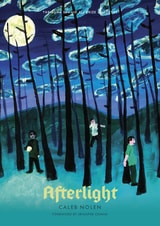
Afterlight
Caleb Nolen
University of Utah Press, 2026
Winner of the Agha Shahid Ali Prize in Poetry
“When I wake I’m in ninth grade again,” begins “Reunion,” the first poem in Caleb Nolen’s debut collection Afterlight. These haunting, tender poems revisit the fraught adolescence of a group of boys growing up in the late 1990s and early 2000s.
Told through the voice of one of the boys who left and is later looking back, Afterlight navigates the silences left by absent fathers, early deaths, and a God who doesn't speak. Interwoven throughout are letters to saints and biblical figures: pleas for intercession and understanding that echo the speaker’s search for grace amid violence and loss. By the book’s end, the lost boys and the saints share the same hallowed space, their stories entwined. Written in plain, unsparing language, these poems reveal the tenderness within troubled masculinity and the ache of trying to love what has already vanished.
Afternoon Masala
PoemsVandana Khanna
University of Arkansas Press, 2014
Afterworld
Christine Garren
University of Chicago Press, 1993
"I like Christine Garren's poetry for its fervor and idiosyncrasy. It lives in the common places of daily life but opens into mysterious invisible orders. Afterworld is a strange and compelling book by a gifted visionary artist."—W. S. Di Piero
"In Afterworld, Christine Garren calls up again and again how it feels to be touched by some relatively familiar thing that happens. A cluster of balloons rises from a birthday party, night falls, and it is left for her to sing about the separate moments with remarkable and unforced grace. Her poems confirm that there's as much at stake in evanescences as we've always suspected but not found ways to say."—James McMichael
"The language seems but a shade, a muted rendering of Garren's images, so concrete and ethereal, knowing and innocent. If this reviewer is being abstract it's because these poems do that to you—they create an arrangement of words, so that, for a while, I believed there was none other."—Harvard Review

Against Expression
An Anthology of Conceptual WritingCraig Dworkin and Kenneth Goldsmith
Northwestern University Press, 2011
Charles Bernstein has described conceptual poetry as "poetry pregnant with thought." Against Expression, the premier anthology of conceptual writing, presents work that is by turns thoughtful, funny, provocative, and disturbing. Dworkin and Goldsmith, two of the leading spokespersons and practitioners of conceptual writing, chart the trajectory of the conceptual aesthetic from early precursors including Samuel Beckett and Marcel Duchamp to the most prominent of today’s writers. Nearly all of the major avant-garde groups of the past century are represented here, including Dada, OuLiPo, L=A=N=G=U=A=G=E, and Flarf to name just a few, but all the writers are united in their imaginative appropriation of found and generated texts and their exploration of nonexpressive language. Against Expression is a timely collection and an invaluable resource for readers and writers alike.
Against Heidegger
LM Rivera
Omnidawn, 2019
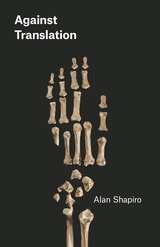
Against Translation
Alan Shapiro
University of Chicago Press, 2019
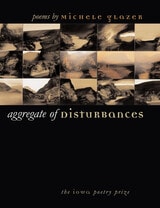
Aggregate of Disturbances
Michele Glazer
University of Iowa Press, 2004
These taut lyrical poems negotiate between desire for something irrefutable and an uneasy bedrock of paradox. In the interstices, Aggregate of Disturbances breaks open language and experience to offer a glimpse of “the eye on the other side.”
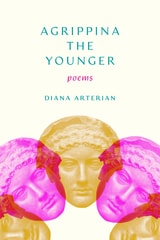
Agrippina the Younger
PoemsDiana Arterian
Northwestern University Press, 2025
A poetic journey through the past of the Roman Empress Agrippina looks toward the future
Agrippina the Younger follows one woman’s study of another, separated by thousands of miles and two millennia but bound by a shared sense of powerlessness. Agrippina was a daughter in a golden political family, destined for greatness—but she hungered for more power than women were allowed. Exhausted by the misogyny of the present, Diana Arterian reaches into the past to try to understand the patriarchal systems of today. In lyric verse and prose poems, she traces Agrippina’s rise, interrogating a life studded with intrigue, sex, murder, and manipulation. Arterian eagerly pursues Agrippina through texts, ruins, and films, exhuming the hidden details of the ancient noblewoman’s life. These poems consider the valences of patriarchy, power, and the archive to try to answer the question: How do we recover a woman erased by history?
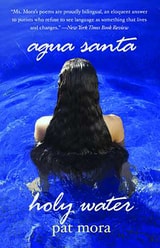
Agua Santa / Holy Water
Pat Mora
University of Arizona Press, 2007
Ain't No Grave
TJ Jarrett
New Issues Poetry and Prose, 2013

Aina Hanau / Birth Land
Brandy Nalani McDougall
University of Arizona Press, 2023
‘Āina Hānau / Birth Land is a powerful collection of new poems by Kanaka ʻŌiwi (Native Hawaiian) poet Brandy Nālani McDougall. ‘Āina hānau—or the land of one’s birth—signifies identity through intimate and familial connections to place and creates a profound bond between the people in a community. McDougall’s poems flow seamlessly between ‘Ōlelo Hawai‘i and English, forming rhythms and patterns that impress on the reader a deep understanding of the land. Tracing flows from the mountains to the ocean, from the sky to the earth, and from ancestor to mother to child, these poems are rooted in the rich ancestral and contemporary literature of Hawaiʻi —moʻolelo, moʻokūʻauhau, and mele —honoring Hawaiian ʻāina, culture, language, histories, aesthetics, and futures.
The poems in Āina Hānau / Birth Land cycle through sacred and personal narratives while exposing and fighting ongoing American imperialism, settler colonialism, militarism, and social and environmental injustice to protect the ʻāina and its people. The ongoing environmental crisis in Hawaiʻi, inextricably linked to colonialism and tourism, is captured with stark intensity as McDougall writes, Violence is what we settle for / because we’ve been led to believe / green paper can feed us / more than green land. The experiences of birth, motherhood, miscarriage, and the power of Native Hawaiian traditions and self-advocacy in an often dismissive medical system is powerfully narrated by the speaker of the titular poem, written for McDougall’s daughters.
‘Āina Hānau reflects on what it means to be from and belong to an ʻāina hānau, as well as what it means to be an ‘āina hānau, as all mothers serve as the first birth lands for their children.
Airs, Waters, Places
Bin Ramke
University of Iowa Press, 2001
Alchemist or Arsonist
PoemsBeth Gordon
Acre Books, 2027
A feminist poetry collection re-examining the figure of the crone and upending the patriarchal expectations she embodies.
In Alchemist or Arsonist, her second full-length collection, Beth Gordon supercharges the term crone, demonstrating in image-rich poems the magical strength of older women. The Crone is frank about the realities of aging—including plucking chin hairs—yet she also surprises, warning the reader: “The tiger has always been there. . . . She is right in front of you.” Taking afternoon shots of mescal and waiting in line for Mexican street corn, she contemplates Captcha pictures, AI, and tattoos.
The book expands its concerns in several long poems and sequences, encompassing the full range of human experience. “The Secret Fate of All Life,” a series of golden shovels based on quotes from the HBO show True Detective, moves into the surreal to represent language’s failure to describe the death of an infant, and how time can be displaced by grief. Other works explore the transformation that can come from tragedy, the perils of marriage and other relationships, and the complicated conversation older and younger versions of the self would have with each other.
Gordon’s candid, wry, uncompromising voice is both refreshing and bracing, and the poems perform alchemy as they set fire to traditional expectations. With an undercurrent of violence and murder, the book reveals the ultimate consequences of patriarchy. “Alchemist or arsonist: the end is the same,” The Crone tells us. “Something becomes something else.”
Aleksandr Tvardovskii
Memory and Truth in the Soviet UnionGeoffrey Hosking
Central European University Press, 2025
By giving a balanced account of his strengths and weaknesses, his achievements and failures, the author succeeds in giving the fullest picture available anywhere of a controversial man who turns out to be more complex than he has been portrayed so far. To understand him better is to understand why the Soviet intelligentsia changed so fundamentally in the USSR’s final decades, a change that helps to explain the rise of Gorbachev twenty years later. The study—which includes an in-depth analysis of Tvardovskii’s major works—also helps to better understand the fate of culture under an authoritarian regime and the intricacies of the struggle against censorship.
Alibi Lullaby
Norma Cole
Omnidawn, 2025
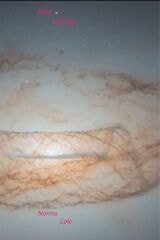
Alibi, in Latin, meant “elsewhere,” and “lullaby”—from lull, to soothe, and bye, near, close by—has elements linguistic elements that appear across cultures. Music, from ancient songs recorded on tables to contemporary compositions, share related framing elements that have persisted across time: formal patterns and rhythms, peaceful and hypnotic movements, and elements of terror arising from the moving frontier of “thrill, dread, certainty.”
In this collection, Norma Cole considers the ancient and transcendent patterns of music, finding them through nature, heart sounds, the spectral elegance of blood flow, the murmur of melody, and many diverse patterns and beats. Sounds of summer, massacres, “empathy through distress,” unknowing, energy, suspense, and fragility echo throughout the poems and other writings. Drawing on a poetics that embraces formal freefall and looks forward while holding up the shifting mirror of memory, Alibi Lullaby is a lyrical montage at the edges of musicality.
All Black Everything
Shane Book
University of Iowa Press, 2023
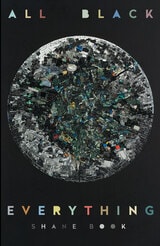
The political sublime of Caribbean poetics ebb and flood in this contagious new voice of borrowings, hijacking the trap house. This is an original collection, daring to assume the voice of the system and its death drives, having fun, mixing it up, throwing hands too. If old pirates rob I, then Shane Book has stolen back something from them. All Black Everything is a redemption song.
All Blue So Late
PoemsLaura Swearingen-Steadwell
Northwestern University Press, 2018
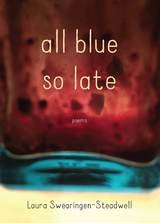
The skeleton of this fine collection is a series of direct addresses to the author’s fourteen-year-old self, caught at the moment between girlhood and womanhood, when her perspective on everything suddenly changes. Swearingen-Steadwell’s poetic adventures through worlds within and without reveal the restlessness of the seeker. They offer unabashed tenderness to anyone who reckons with solitude, and chases joy.