Results by title
28167 books match the query 'History' and 2536 start with a
An Indonesian History
Personalized Politics in Makassar and South Sulawesi, c.1600-2018Heather Sutherland
National University of Singapore Press, 2024
Indonesia, the world’s fourth most populous country, is a vast archipelago with a relatively short history of unified rule. The devolution of power to the provinces after 1998 has meant that regional social traditions and historical legacies are powerful forces in contemporary politics. South Sulawesi (Southwest Celebes), a crucial and understudied region of Indonesia, is no exception.
Starting in 1669, tensions between the Dutch East India Company’s cosmopolitan port town of Makassar and the aggressive, competitive dynasties of the interior began to shape peninsula politics. A strong ethnic Chinese community embodied the town’s wide horizons, while in the countryside, the nobility’s engagement with Islam ranged from symbiotic co-optation to hostility. Religion, rather than politics, framed the main challenges to authority. Finally integrated in 1965, the city and province remain among the most clientelist in the country, their politics personalized and transactional. Nevertheless, the large city of Makassar is booming. Dutch indirect rule and neocolonial strategies entrenched the power of local elites, who resisted changes imposed by Batavia or, after 1950, by Jakarta.
In this history, Heather Sutherland’s long-term perspective avoids dichotomies like continuity and change or autonomy and dependence, recognizing that trade-offs have always been fundamental to interaction within and between town and country and between the province and distant capitals.
An Inquiry into the Nature and Causes of the Wealth of Nations
Adam Smith
University of Chicago Press, 1977
Adam Smith's The Wealth of Nations was recognized as a landmark of immediately upon publication in 1776. As the first serious, data-driven argument for the principles of political economy, it is the point of departure for all subsequent economic thought. Smith's argument that human self-interest is the primary driver of economic activity, and that in aggregate that self-interest--acting through a market freed from government intervention-guides markets and economies toward the best outcomes for business and society, remains foundational for contemporary free-market economics.
This edition presents the definitive 1904 version of The Wealth of Nations, painstakingly edited by Edwin Cannan and featuring Cannan's illuminating introduction, and notes, as well as a a full index. An additional preface by distinguished economist George J. Stigler places Smith's book and thought in a contemporary context. The result is the best edition of this classic for students and general readers alike.

An Inquiry into the Nature and Causes of the Wealth of Nations
The Definitive EditionAdam Smith
University of Chicago Press, 0
The book that made the modern world, reissued in its definitive scholarly form and featuring a new foreword from Nobel Prize winner Amartya Sen.
First published in 1776, Adam Smith’s masterwork The Wealth of Nations formalized the first unified theory of modern economies—how human nature, public institutions, and private interests can coalesce in a society greater than the sum of its parts. More than 250 years later, it remains one of humanity’s most defining and lasting literary works.
This definitive edition includes Edwin Cannan’s famous annotations of the original text, accounting for both Smith’s early drafts and his lectures at the University of Glasgow, where he originated the book’s concepts. The result is the most complete edition of the work to date, maintaining unprecedented fidelity to Smith’s ideas and packaging them in fluent and elevating terms.
In a new foreword, Nobel laureate Amartya Sen offers context and contemporary incision for twenty-first-century readers, discussing the uses—and occasional misuses—of Smith’s ideas for the advancement of political agendas. The Wealth of Nations, Sen makes clear, is a book about societies, not just economies. “Smith’s economics accommodated his values,” he writes. As readers of The Wealth of Nations will discover and rediscover, those values prioritized the lives of everyday working people above all else.
An Insider's View of Mormon Origins
Grant Palmer
Signature Books, 2002
He finds that much of what we take for granted as literal history has been tailored over the years—slightly modified, added to, one aspect emphasized over another—to the point that the original narratives have been nearly lost. What was experienced as a spiritual or metaphysical event, something from a different dimension, often has been refashioned as if it were a physical, objective occurrence. This is not how the first Saints interpreted these events. Historians who have looked closer at the foundational stories and source documents have restored elements, including a nineteenth-century world view, that have been misunderstood, if not forgotten.
An Insight into an Insane Asylum
Joseph Camp
University of Alabama Press, 2011
A rare 19th‑century voice revealing what asylum life felt like from the inside.
In 1881, Joseph Camp, an elderly and self-trained Methodist minister from Talladega County in eastern Alabama, was brought by his family to Bryce Hospital, an insane asylum in Tuscaloosa, where he remained for over five months. Camp, misled by relatives concerning the purpose of the trip, was shocked and angered at his loss of freedom and his treatment in the hospital. After his release, he composed an account of his stay and published it at his own expense, providing a rare glimpse of 19th century mental health care from a patient’s viewpoint. Camp’s account reveals his naive trust in others, but also a sharp and retentive memory. Camp is remarkably accurate in his account of the details of his treatment and the operation and staff of the hospital, although his emotional assessments reflect his unhappiness with his situation. Adding to the importance of Camp’s account is the fact that in the 19th century Bryce was considered a remarkably humane institution focused on recovery. Camp provides a glimpse into how treatment for the insane felt to the recipient.

An Insignificant Family
Da Ngan
Northwestern University Press, 2009
An Intellectual History of Psychology
Daniel N. Robinson
University of Wisconsin Press, 1995
An Intellectual History of Psychology, already a classic in its field, is now available in a concise new third edition. It presents psychological ideas as part of a greater web of thinking throughout history about the essentials of human nature, interwoven with ideas from philosophy, science, religion, art, literature, and politics.
Daniel N. Robinson demonstrates that from the dawn of rigorous and self-critical inquiry in ancient Greece, reflections about human nature have been inextricably linked to the cultures from which they arose, and each definable historical age has added its own character and tone to this long tradition. An Intellectual History of Psychology not only explores the most significant ideas about human nature from ancient to modern times, but also examines the broader social and scientific contexts in which these concepts were articulated and defended. Robinson treats each epoch, whether ancient Greece or Renaissance Florence or Enlightenment France, in its own terms, revealing the problems that dominated the age and engaged the energies of leading thinkers.
Robinson also explores the abiding tension between humanistic and scientific perspectives, assessing the most convincing positions on each side of the debate. Invaluable as a text for students and as a stimulating and insightful overview for scholars and practicing psychologists, this volume can be read either as a history of psychology in both its philosophical and aspiring scientific periods or as a concise history of Western philosophy’s concepts of human nature.
An Intellectual History of Turkish Nationalism
Between Turkish Ethnicity and Islamic IdentityUmut Uzer
University of Utah Press, 2016
While predominantly a textual analysis of the primary sources written by the nationalists, this volume takes into account how political developments influenced Turkish nationalism and also tackles the question of how an ideology that began as a revolutionary, progressive, forward-looking ideal eventually transformed into one that is conservative, patriarchal, and nostalgic to the Ottoman and Islamic past. Between Islamic and Turkish Identity is the first book in any language to comprehensively analyze Turkish nationalism with such scope and engagement with primary sources; it aims to dissect the phenomenon in all its manifestations.
An Intellectual in Public
Alan Wolfe
University of Michigan Press, 2004
". . . proof that the spirit of the free-ranging public intellectual is still very much alive."
-Newsday
"Alan Wolfe is one of liberalism's last and most loyal sons. His mind is naturally decent and diversified; large enough and fair enough to contain both conviction and doubt. His profound respect for real people does not interfere with his profound respect for real thought. The criticism that he practices is, I fear, a dying art, but it is also one of the glories of American democracy."
-Leon Wieseltier, New Republic
"Alan Wolfe is one of America's indispensable essayists. On a broad range of topics-race, religion, politics, the marketplace, the university, and more-he combines a scholar's erudition with a historian's feel for the past and a journalist's keen attunement to the shifting patterns of the current scene. Above all he is a true writer, graceful but fearless, who ponders the deep questions so often ignored in the clamor of our ongoing civic conversation. Anyone who wonders what the term 'public intellectual' really means will find the answer-in fact many answers-in this scintillating collection."
-Sam Tanenhaus, Vanity Fair
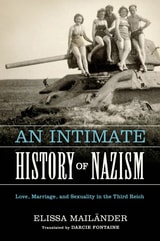
An Intimate History of Nazism
Love, Marriage, and Sexuality in the Third ReichElissa Mailänder
University of Wisconsin Press, 2027
Published to great acclaim in French and now available for the first time in English, this groundbreaking book explores how the Nazi regime used sexuality to promote political loyalty, conformity, and cohesion among “ordinary” Germans. Beginning before the collapse of the Weimar Republic and continuing through the postwar American occupation of Germany, Elissa Mailänder’s study highlights the complex and conflicted ways that sexual “liberation,” repression, and violence were used and experienced in the everyday lives of citizens of the Reich. Her analysis draws on a vast array of sources, from legal dossiers to private photographs and letters, as well as public archives, magazines, and movies. Mailänder’s findings are often uncomfortable; she demonstrates, for example, that a significant number of women who were not persecuted by the regime saw shifts in gender and sexual norms as positive developments—ones that some felt were lost under the American occupation, with its own routines of military sexual exploitation. What emerges is a portrait of a regime that was less interested in repressing sexuality than in reinventing it according to a racist, elitist, and homophobic agenda.
An Intimate Rebuke
Female Genital Power in Ritual and Politics in West AfricaLaura S. Grillo
Duke University Press, 2018
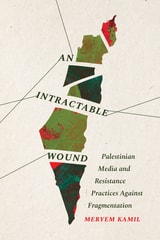
An Intractable Wound
Palestinian Media and Resistance Practices Against FragmentationMeryem Kamil
Rutgers University Press, 2027
An Intractable Wound explores Palestinian resistance to colonial fragmentation that originated as territorial fracture, as proposed through the United Nations partition plan that split the land between the state of Israel and Arab territories. The resulting fragmentation of geography, sovereignty, and populations spurred multiple other schisms that manifest culturally, politically, and developmentally across the West Bank, Gaza, refugee camps, exiled and diasporic Palestinians, and Arab citizens of Israel.
An Intractable Wound considers the various tactics Palestinians deploy to combat these multiple, intersecting iterations of fracture. In particular, this text considers Palestinian media technologies and practices that manage, subvert, and overcome fragmentation. Each chapter centers projects that elaborate on these fractures and combat them, including virtual reality representations, online archives, digital mapping platforms, and video games that imagine and construct an intact Palestinian community. Together, these case studies provide a capacious reading of the Palestinian condition as structured by fragmentation, and Palestinian resistance as struggling in opposition to that geographic, sociopolitical, and cultural disillusion.

An Introduction to Ancient Iranian Religion
Readings from the Avesta and the Achaemenid InscriptionsWilliam W. Malandra, EditorTranslated by William W. Malandra
University of Minnesota Press, 1983
An Introduction to Ancient Iranian Religion was first published in 1983. Minnesota Archive Editions uses digital technology to make long-unavailable books once again accessible, and are published unaltered from the original University of Minnesota Press editions.
When Persia fell to Islam in the mid-seventh century, the ancient Iranian religion of Zoroastrianism all but disappeared (although it is still practiced by small groups in India and Iran). As one of the dominant religions of antiquity, it influenced the Judeo- Christian tradition as well as some forms of gnosticism. Despite its age and venerable place in the history of world religions, Zoroastrianism remains little known outside of a few philologists and historians of religion. Because of the difficulty of translation, there is little primary textual material available for nonspecialists; the few translations that do exist are quite old.
In An Introduction to Ancient Iranian Religion, William Malandra provides not only modern English translations of the sacred texts but also a comprehensive introduction to the subject of Zoroastrianism itself. In an introductory essay Malandra outlines the main features of Zoroastrianism in its historical, cultural, and spiritual setting. His new translations of readings from the Avesta, the sacred book of Zoroastrianism, and selections from the Achaemenid inscriptions of the great kings Darius and Xerxes are accompanied by interpretive notes that allow students to make their way through this difficult material. This book is, therefore, not just a collection of texts but a selfcontained introduction to Zoroastrianism that can be used by the nonspecialist without recourse to additional interpretive works.
An Introduction to Greek Epigraphy of the Hellenistic and Roman Periods from Alexander the Great down to the Reign of Constantine
B. H. McLean
University of Michigan Press, 2011
“In short, this is a reference work of the best kind. For the beginner, it is indispensable. And for those who already know something about its subject matter, the book is in many ways useful, informative, and interesting. We all owe a debt to [the author] for undertaking this significant project, and for completing it so well.”
—Michael Peachin, Classical World
“. . . provides invaluable road maps for non-epigraphers faced with passages of inscribed Greek.”
—Graham Shipley, Bryn Mawr Classical Review
Greek inscriptions form a valuable resource for the study of all aspects of the Greco-Roman world. They are primary witnesses to society's laws and institutions, religious habits, and language. This volume provides students with the tools to take advantage of the historical value of these treasures. It examines letter forms, ancient names, and ancient calendars, knowledge of which is essential in reading inscriptions of all kinds.
B. H. McLean discusses the classification of inscriptions into their various categories and analyzes particular types of inscriptions, including decrees, honorary inscriptions, dedications, funerary inscriptions, and manumissions. Finally, McLean includes special topics that bear upon the interpretation of specific features of inscriptions, such as Greek and Roman administrative titles and functions.
An Investigation of Ethnographic and Archaeological Specimens of Mescalbeans (Sophora secundiflora) in American Museums
William L. Merrill
University of Michigan Press, 1977

An Iowa Schoolma’am
Letters of Elizabeth “Bess” Corey, 1904–1908Philip L. Gerber
University of Iowa Press, 2011
An Irish-American Odyssey
The Remarkable Rise of the O'Shaughnessy BrothersColum Kenny
University of Missouri Press, 2014
An Irish-Speaking Island
State, Religion, Community, and the Linguistic Landscape in Ireland, 1770–1870Nicholas M. Wolf
University of Wisconsin Press, 2014
As late as 1840, Ireland had as many as four million Irish speakers—a significant proportion of the total population—who could be found in every county of the island and in all social classes and religious persuasions. Their impact on the modern history of Ireland and the United Kingdom cannot be captured by a simple conclusion that they became anglicized. Rather, Nicholas M. Wolf explores the complex ways in which the transition from Irish to English placed a premium on adaptive bilingualism and shaped beliefs and behavior in the domestic sphere, religious life, and oral culture within the community. An Irish-Speaking Island will interest not only historians but also scholars of linguistics, folklore, politics, literature, and religion.
Winner, Michael J. Durkan Prize for Books on Language and Culture, American Conference for Irish Studies
Winner, Donald Murphy Prize for Distinguished First Books, American Conference for Irish Studies

An Islamic Alliance
Ali Dinar and the Sanusiyya, 1906-1916Jay Spaulding and Lidwien Kapteijns
Northwestern University Press, 2011
An Italian Journey
Jean Giono
Northwestern University Press, 1998
An Odyssey Reader
Selections from Homer's Odyssey, Books 1-12P. A. Draper
University of Michigan Press, 2012
Homer's Odyssey has captivated readers and influenced writers and artists for more than 2,000 years. Reading the poem in its original language provides an experience as challenging as it is rewarding. Most students encountering Homeric Greek for the first time need considerable help, especially with vocabulary and constructions that differ from the more familiar Attic forms. For anyone who has completed studies in elementary Greek, this edition provides the assistance necessary to read, understand, and appreciate the first book of the Odyssey in its original language.
Structured to maximize reading ease, P. A. Draper's volume stands out among introductions to the Greek Odyssey. Readers of this edition will appreciate the positioning of all notes facing the Greek text; the frequent vocabulary entries; the complete glossary; the appendix on basic Homeric forms and grammar; and the copious annotations on vocabulary, grammar, meter, historical and mythological allusions, and literary interpretation.
Primarily designed as a textbook, this volume will be an effective classroom tool and a useful acquisition for any library supporting a classics program. The book will find readers among high school and college Greek students, advanced students in Homer or epic poetry classes, graduate students working on reading-list requirements, and anyone interested in maintaining Greek reading skills.

An Ojibwe Home in the City
White Earth Women and Community Organizing in MinneapolisSasha Maria Suarez
University of Minnesota Press, 2026
The story of generations of Ojibwe women who built a thriving Indigenous home in the urban heart of Minneapolis
Minneapolis became home to White Earth Ojibwe people not through a centralized movement but through generations of determined, behind-the-scenes work by Ojibwe women. These women were organizing not in the streets, but in sewing clubs, churches, classrooms, and kitchens to bring people together and form interconnected communities. Rooted in care, tradition, and persistence, their labor laid the foundation for a thriving urban Indigenous population that continues to shape the city today.
An Ojibwe Home in the City tells the histories of Louise and Emily Peake, Winnie Jourdain, Ignatia Broker, and other Ojibwe women who endeavored to make space for Native families in South Minneapolis. From the 1930s through the 1970s, these women built institutions, secured services, and fought for culturally grounded education—all while working inside systems never intended for them. Their efforts led to the creation of vital community hubs such as the Division of Indian Work and the Minneapolis American Indian Center and helped ensure that future generations would stay connected to their culture, even in an urban setting.
Far broader than a local history, this book challenges what we think we know about Native activism in the twentieth century, shifting the focus from protest to perseverance and steady commitment. Intimate, compelling, and deeply grounded in community, An Ojibwe Home in the City is both a tribute and a revelation—an essential and personal account of how Indigenous women made a place for their people in a changing world.
Retail e-book files for this title are screen-reader friendly with images accompanied by short alt text and/or extended descriptions.
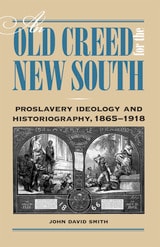
An Old Creed for the New South
Proslavery Ideology and Historiography, 1865-1918John David Smith, With a New Preface by the Author
Southern Illinois University Press, 1985
An Old Creed for the New South:Proslavery Ideology and Historiography, 1865–1918 details the slavery debate from the Civil War through World War I. Award-winning historian John David Smith argues that African American slavery remained a salient metaphor for how Americans interpreted contemporary race relations decades after the Civil War.
Smith draws extensively on postwar articles, books, diaries, manuscripts, newspapers, and speeches to counter the belief that debates over slavery ended with emancipation. After the Civil War, Americans in both the North and the South continued to debate slavery’s merits as a labor, legal, and educational system and as a mode of racial control. The study details how white Southerners continued to tout slavery as beneficial for both races long after Confederate defeat. During Reconstruction and after Redemption, Southerners continued to refine proslavery ideas while subjecting blacks to new legal, extralegal, and social controls.
An Old Creed for the New South links pre– and post–Civil War racial thought, showing historical continuity, and treats the Black Codes and the Jim Crow laws in new ways, connecting these important racial and legal themes to intellectual and social history. Although many blacks and some whites denounced slavery as the source of the contemporary “Negro problem,” most whites, including late nineteenth-century historians, championed a “new” proslavery argument. The study also traces how historian Ulrich B. Phillips and Progressive Era scholars looked at slavery as a golden age of American race relations and shows how a broad range of African Americans, including Booker T. Washington and W. E. B. Du Bois, responded to the proslavery argument. Such ideas, Smith posits, provided a powerful racial creed for the New South.
This examination of black slavery in the American public mind—which includes the arguments of former slaves, slaveholders, Freedmen's Bureau agents, novelists, and essayists—demonstrates that proslavery ideology dominated racial thought among white southerners, and most white northerners, in the five decades following the Civil War.
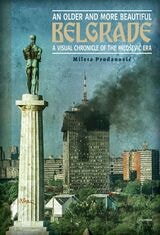
An Older and More Beautiful Belgrade
A Visual Chronicle of the Milo.evic EraMileta Prodanovic
Central European University Press, 2023
This substantial essay depicts urban collapse in an exceptionally difficult period of the Serbian capital. The author has marshalled facts, reflections, photographs and other imagesto demonstrate the transformation of Belgrade during the Milošević years. With the theoretical grounding of cultural anthropology, history studies, culture of memory, history of art, and urbanism, Mileta Prodanović considers changes to the built environment and urban landscape in the city in the 1990s. He covers many visual aspects of life with great ingenuity: shopping centers, unregulated construction and “wild” modifications of buildings, new buildings (broadcasting studios, shops, homes) that do not fit the surroundings, bad taste in home furnishings (camp, kitsch), boondoggles such as the international art center, problematic historical markers like the obelisk of the eternal flame, billboards, store displays, electoral propaganda, graffiti, grave-markers and cemetery memorials, coins and paper money, calendars, beer labels, and even religious icons (and more). All this information is provided with some critique and much implied comparison to past standards.
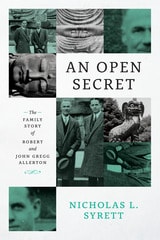
An Open Secret
The Family Story of Robert and John Gregg AllertonNicholas L. Syrett
University of Chicago Press, 2021
An Open Secret tells the striking story of these two iconoclasts, locating them among their queer contemporaries and exploring why becoming father and son made a surprising kind of sense for a twentieth-century couple who had every monetary advantage but one glaring problem: they wanted to be together publicly in a society that did not tolerate their love. Deftly exploring the nature of their design, domestic, and philanthropic projects, Nicholas L. Syrett illuminates how viewing the Allertons as both a same-sex couple and an adopted family is crucial to understanding their relationship’s profound queerness. By digging deep into the lives of two men who operated largely as ciphers in their own time, he opens up provocative new lanes to consider the diversity of kinship ties in modern US history.
An Open Secret
The Family Story of Robert and John Gregg AllertonNicholas L. Syrett
University of Chicago Press, 2021
This is an auto-narrated audiobook edition of this book.
In 1922 Robert Allerton—described by the Chicago Tribune as the “richest bachelor in Chicago”—met a twenty-two-year-old University of Illinois architecture student named John Gregg, who was twenty-six years his junior. Virtually inseparable from then on, they began publicly referring to one another as father and son within a couple years of meeting. In 1960, after nearly four decades together, and with Robert Allerton nearing ninety, they embarked on a daringly nonconformist move: Allerton legally adopted the sixty-year-old Gregg as his son, the first such adoption of an adult in Illinois history.
An Open Secret tells the striking story of these two iconoclasts, locating them among their queer contemporaries and exploring why becoming father and son made a surprising kind of sense for a twentieth-century couple who had every monetary advantage but one glaring problem: they wanted to be together publicly in a society that did not tolerate their love. Deftly exploring the nature of their design, domestic, and philanthropic projects, Nicholas L. Syrett illuminates how viewing the Allertons as both a same-sex couple and an adopted family is crucial to understanding their relationship’s profound queerness. By digging deep into the lives of two men who operated largely as ciphers in their own time, he opens up provocative new lanes to consider the diversity of kinship ties in modern US history.
An Open Secret
The History of Unwanted Pregnancy and Abortion in Modern BoliviaNatalie L. Kimball
Rutgers University Press, 2020

An Opportunity Lost
The Truman Administration and the Farm Policy DebateVirgil W. Dean
University of Missouri Press, 2006
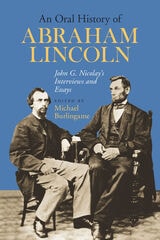
An Oral History of Abraham Lincoln
John G. Nicolay's Interviews and EssaysEdited by Michael Burlingame
Southern Illinois University Press, 2006
John C. Nicolay, who had known Lincoln in Springfield, Illinois, served as chief White House secretary from 1861 to 1865. Trained as a journalist, Nicolay had hoped to write a campaign biography of Lincoln in 1860, a desire that was thwarted when an obscure young writer named William Dean Howells got the job. Years later, however, Nicolay fulfilled his ambition; with John Hay, he spent the years from 1872 to 1890 writing a monumental ten-volume biography of Lincoln.
In preparation for this task, Nicolay interviewed men who had known Lincoln both during his years in Springfield and later when he became the president of the United States. "When it came time to write their massive biography, however," Burlingame notes, "he and Hay made sparing use of the interviews" because they had become "skeptical about human memory." Nicolay and Hay also feared that Robert Todd Lincoln might censor material that reflected "poorly on Lincoln or his wife."
Nicolay had interviewed such Springfield friends as Lincoln’s first two law partners, John Todd Stuart and Stephen T. Logan. At the Illinois capital in June and July 1875, he talked to a number of others including Orville H. Browning, U.S. senator and Lincoln’s close friend and adviser for over thirty-five years, and Ozias M. Hatch, Lincoln’s political ally and Springfield neighbor. Four years later he returned briefly and spoke with John W. Bunn, a young political "insider" from Springfield at the time Lincoln was elected president, and once again with Hatch.
Browning shed new light on Lincoln’s courtship and marriage, telling Nicolay that Lincoln often told him "that he was constantly under great apprehension lest his wife should do something which would bring him into disgrace" while in the White House. During their research, Nicolay and Hay also learned of Lincoln’s despondency and erratic behavior following his rejection by Matilda Edwards, and they were subsequently criticized by friends for suppressing the information. Burlingame argues that this open discussion of Lincoln’s depression of January 1841 is "perhaps the most startling new information in the Springfield interviews."
Briefer and more narrowly focused than the Springfield interviews, the Washington interviews deal with the formation of Lincoln’s cabinet, his relations with Congress, his behavior during the war, his humor, and his grief. In a reminiscence by Robert Todd Lincoln, for example, we learn of Lincoln’s despair at General Lee's escape after the Battle of Gettysburg: "I went into my father’s office ... and found him in [much] distress, his head leaning upon the desk in front of him, and when he raised his head there were evidences of tears upon his face. Upon my asking the cause of his distress he told me that he had just received the information that Gen. Lee had succeeded in escaping across the Potomac river. . ."
To supplement these interviews, Burlingame has included Nicolay’s unpublished essays on Lincoln during the 1860 campaign and on Lincoln’s journey from Springfield to Washington in 1861, essay’s based on firsthand testimony.
An Ordinary Life?
The Journeys of Tonia Lechtman, 1918–1996Anna Müller
Ohio University Press, 2024
One woman’s national, political, ethnic, social, and personal identities impart an extraordinary perspective on the histories of Europe, Polish Jews, Communism, activism, and survival during the twentieth century.
Tonia Lechtman was a Jew, a loving mother and wife, a Polish patriot, a committed Communist, and a Holocaust survivor. Throughout her life these identities brought her to multiple countries—Poland, Palestine, Spain, France, Germany, Switzerland, and Israel—during some of the most pivotal and cataclysmic decades of the twentieth century. In most of those places, she lived on the margins of society while working to promote Communism and trying to create a safe space for her small children.
Born in Łódź in 1918, Lechtman became fascinated with Communism in her early youth. In 1935, to avoid the consequences of her political activism during an increasingly antisemitic and hostile political environment, the family moved to Palestine, where Tonia met her future husband, Sioma. In 1937, the couple traveled to Spain to participate in the Spanish Civil War. After discovering she was pregnant, Lechtman relocated to France while Sioma joined the International Brigades. She spent the Second World War in Europe, traveling with two small children between France, Germany, and Switzerland, at times only miraculously avoiding arrest and being transported east to Nazi camps. After the war, she returned to Poland, where she planned to (re)build Communist Poland. However, soon after her arrival she was imprisoned for six years. In 1971, under pressure from her children, Lechtman emigrated from Poland to Israel, where she died in 1996.
In writing Lechtman’s biography, Anna Müller has consulted a rich collection of primary source material, including archival documentation, private documents and photographs, interviews from different periods of Lechtman’s life, and personal correspondence. Despite this intimacy, Müller also acknowledges key historiographical questions arising from the lacunae of lost materials, the selective preservation of others, and her own interpretive work translating a life into a life story.
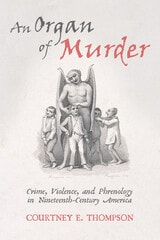
An Organ of Murder
Crime, Violence, and Phrenology in Nineteenth-Century AmericaCourtney E. Thompson
Rutgers University Press, 2021
An Organ of Murder explores the origins of both popular and elite theories of criminality in the nineteenth-century United States, focusing in particular on the influence of phrenology. In the United States, phrenology shaped the production of medico-legal knowledge around crime, the treatment of the criminal within prisons and in public discourse, and sociocultural expectations about the causes of crime. The criminal was phrenology’s ideal research and demonstration subject, and the courtroom and the prison were essential spaces for the staging of scientific expertise. In particular, phrenology constructed ways of looking as well as a language for identifying, understanding, and analyzing criminals and their actions. This work traces the long-lasting influence of phrenological visual culture and language in American culture, law, and medicine, as well as the practical uses of phrenology in courts, prisons, and daily life.
An Outline of the Origins of Money
Heinrich Schurtz
HAU, 2024
“On this subject, I only knew the excellent little book by the late Schurtz”—Marcel Mauss, 1914, Les origines de la notion de monnaie.
Heinrich Schurtz’s 1898 book has been a touchstone for economic historians, anthropologists, and philosophers interested in the nature and origins of money in various societies, including Georg Simmel, Max Weber, Marcel Mauss, and Karl Polanyi. In his brief book, Schurtz experimented with concepts about money, going beyond traditional economic paradigms. Drawing on an extensive range of archaeological and ethnographic sources, he reframed a theory of money to include its materiality, symbolic nature, relationship to forms of property, and its dual origin in “outside money” and “inside money.” While it is not well known today, it was important to the theorization of money in the first half of the 20th century and its innovative synthesis offers galvanizing questions and insights into how value relations are formed and how currency systems are interrelated.

An Unassuming Heroism
The Life of Robert Russa MotonBrian McGovern and Kevin McGovern
University of Alabama Press, 2026
The story of a Tuskegee Institute visionary who advised US presidents and led unprecedented advances in American Civil Rights
An Unassuming Heroism: The Life of Robert Russa Moton is a landmark biography that reveals the previously overlooked story of one of the most influential African American leaders of the twentieth century. Brian and Kevin McGovern trace Robert Moton’s life: from his birth as the son of freed people through his tenure as the leader of Tuskegee Institute directly after Booker T. Washington. Moton guided Tuskegee to new levels of excellence and international prominence, became an advisor to seven US presidents, and won their cooperation in the establishment of greater minority rights.
Rejecting conventional portrayals of Moton as a mere follower of Washington, the authors reveal an astute and increasingly independent leader who worked to bridge competing visions of Black advancement while championing broader African American rights, educational opportunities, and social justice. Through his investigations of issues such as racial discrimination in World War I, inequitable minority treatment during the Mississippi River flood of 1927, and Black people’s struggles to access healthcare and public accommodation, Moton helped shape national conversations on race and equality and advanced many arguments utilized by later Civil Rights leaders.
This biography offers a compelling reassessment of a courageous and visionary civic pioneer whose historical impact calls for renewed recognition. It is essential reading for scholars, students, and any reader interested in African American history, education, or progressive political leadership.
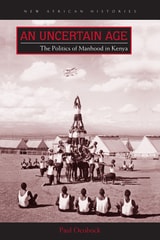
An Uncertain Age
The Politics of Manhood in KenyaPaul Ocobock
Ohio University Press, 2017
In twentieth-century Kenya, age and gender were powerful cultural and political forces that animated household and generational relationships. They also shaped East Africans’ contact with and influence on emergent colonial and global ideas about age and masculinity. Kenyan men and boys came of age achieving their manhood through changing rites of passage and access to new outlets such as town life, crime, anticolonial violence, and nationalism. And as they did, the colonial government appropriated masculinity and maturity as means of statecraft and control.
In An Uncertain Age, Paul Ocobock positions age and gender at the heart of everyday life and state building in Kenya. He excavates in unprecedented ways how the evolving concept of “youth” motivated and energized colonial power and the movements against it, exploring the masculinities boys and young men debated and performed as they crisscrossed the colony in search of wages or took the Mau Mau oath. Yet he also considers how British officials’ own ideas about masculinity shaped not only young African men’s ideas about manhood but the very nature of colonial rule.
An Uncertain Age joins a growing number of histories that have begun to break down monolithic male identities to push the historiographies of Kenya and empire into new territory.
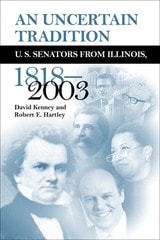
An Uncertain Tradition
David Kenney and Robert E. Hartley
Southern Illinois University Press, 2003
This sweeping survey constitutes the first comprehensive treatment of the forty-seven individuals—forty-six white males and one African American female—who have been chosen to represent Illinois in the United States Senate from 1818 to 2003. David Kenney and Robert E. Hartley underscore nearly two centuries of Illinois history with these biographical and political portraits, compiling an incomparably rich resource for students, scholars, teachers, journalists, historians, politicians, and any Illinoisan interested in the state’s heritage.
An Uncertain Tradition:U. S. Senators from Illinois, 1818–2003 is a fresh and careful study of the shifting set of political issues occurring over time and illuminated by the lives of participants in the politics of choice and service in the Senate. Kenney and Hartley plot the course of the state’s varied senatorial leadership, from the state’s founding and the appearance of political parties, through the Civil War and its aftermath, and into the diverse political climate of the twenty-first century. From the notorious to the heroic, the popular to the pioneering, the senatorial roster includes such luminaries as “The Little Giant” Stephen A. Douglas; Lyman Trumbull, who served three terms in the Civil War era; “Uncle Dick” and “Black Jack,” also known as Richard Oglesby and John A. Logan; the “Wizard of Ooze” Everett Dirksen; and modern leaders such as Adlai Stevenson III, Paul Simon, and Carol Moseley-Braun.
Kenney and Hartley offer incisive commentary on the quality of senate service in each case, as well as timeline graphs relating to the succession of individuals in each of the two sequences of service, the geographical distribution of senators within the state, and the variations in party voting for senate candidates. Rigorously documented and supremely readable, this convenient reference volume is enhanced by portraits of many of the senators.
An Uncompromising Generation
The Nazi Leadership of the Reich Security Main OfficeMichael Wildt
University of Wisconsin Press, 2009
Wildt’s study traces the intellectual evolution of key members of the Reich Security Main Office (RSHA) from their days as students until the end of World War II. Established in 1939, this office fused together the Gestapo, the Criminal Police, and the Sicherheitsdienst (Security Service) of the SS. Far from being small cogs in a big bureaucratic machine, Wildt finds that the people who made up the RSHA constructed the concepts and operated the apparatus that carried out the Holocaust.
At the center of both theory and practice of persecution and genocide in Nazi-occupied Europe, these young men of the RSHA—none of whom envisioned the systematic annihilation of the European Jews—became radicalized. How this occurred is the central question of Wildt’s book. Wildt also discusses the postwar careers of the members of the RSHA. Strikingly, he shows how the leaders of the RSHA evaded the consequences of their actions under the Nazi regime and went on to have important careers in the rebuilt West Germany.
An alternate selection of the History Book Club and Military Book Club
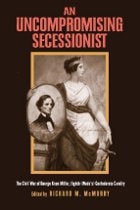
An Uncompromising Secessionist
The Civil War of George Knox Miller, Eighth (Wade's) Confederate CavalryGeorge Knox Miller, edited by Richard M. McMurry
University of Alabama Press, 2006
Offers significant insight into the life, heart, mind, and attitudes of an intelligent, educated, young mid-19th-century white Southerner
This book contains the letters of George Knox Miller who served as a line officer in the Confederate cavalry and participated in almost all of the major campaigns of the Army of Tennessee. He was, clearly, a very well-educated young man. Born in 1836 in Talladega, Alabama, he developed a great love for reading and the theater and set his sights upon getting an education that would lead to a career in law or medicine; meanwhile he worked as an apprentice in a painting firm to earn tuition. Miller then enrolled in the University of Virginia, where he excelled in his studies.
Eloquent, bordering on the lyrical, the letters provide riveting first-hand accounts of cavalry raids, the monotony of camp life, and the horror of battlefield carnage. Miller gives detailed descriptions of military uniforms, cavalry tactics, and prison conditions. He conveys a deep commitment to the Confederacy, but he was also critical of Confederate policies that he felt hindered the army's efforts. Dispersed among these war-related topics is the story of Miller's budding relationship with Celestine “Cellie” McCann, the love of his life, whom he would eventually marry.
An Underground Life
Memoirs of a Gay Jew in Nazi BerlinGad Beck; written with Frank Heibert, translated by Allison Brown
University of Wisconsin Press, 2000
An Unformed Map
Geographies of Belonging between Africa and the CaribbeanPhilip Janzen
Duke University Press, 2025
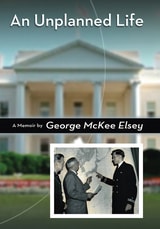
An Unplanned Life
A MemoirGeorge McKee Elsey
University of Missouri Press, 2005
Elsey’s duties continued with Harry Truman’s succession to the presidency. He decoded the famous message from Secretary of War Henry Stimson reporting the dropping of the atomic bomb on Hiroshima and carried it to President Truman. In 1947, he shed his Naval Reserve uniform and joined the White House’s civilian staff as assistant to the special counsel to the president. In 1949, he became administrative assistant to the president, and, in 1952, he became a member of the Mutual Security Agency staff. During those years, he grew very close to Harry Truman, and thus, a major portion of An Unplanned Life relates to his experiences then.
In the first postwar winter, Elsey was frequently the only staff member who accompanied President Truman on the USS Williamsburg. In September 1946, Elsey submitted a report to Truman on U.S.-Soviet relations, which came to be well known as the “Clifford-Elsey Report.” Providing Truman with notes for some two hundred of his “back-of-the-train” informal talks, Elsey played a part in the best remembered feature of the “Whistle-Stop Campaign” that resulted in “the political upset of the century.” In addition to his years at the White House, Elsey also touches on his post–White House years—his time in private industry, his months with Clark Clifford when Clifford was trying unsuccessfully to extricate America from Vietnam, and his long association with the American Red Cross.
An Unplanned Life is a fascinating look at the life of an extraordinary individual who played an important and unprecedented part in two different presidents’ decisions and affected the course of our nation. Anyone with an interest in history will find this memoir fascinating and invaluable.
An Unseen Unheard Minority
Asian American Students at the University of IllinoisSharon S. Lee
Rutgers University Press, 2022
Anaconda
Labor, Community, and Culture in Montana's Smelter CityLaurie Mercier
University of Illinois Press, 2001
Laurie Mercier's look at "community unionism" examines the distinctive culture of cooperation and activism fostered by residents in Anaconda, Montana, home to the world's largest copper smelter and the namesake of the Anaconda Copper Mining Company.
Mercier depicts the vibrant life of the smelter city at full steam, incorporating the candid commentary of the locals ("the company furnished three pair of leather gloves . . . and all the arsenic [dust] you could eat"). During five decades of devoted unionism, locals embraced an "alternative Americanism" that championed improved living standards for working people as the best defense against communism. Mercier also explores how gender limits on women's political, economic, and social roles shaped the nature and outcome of labor struggles, and traces how union rivalries, environmental concerns, and the 1980 closing of the Anaconda smelter transformed the town.
A fascinating portrait of how community molds working class consciousness, Anaconda offers important insights about the changing nature of working class culture and collective action.
Anahulu
The Anthropology of History in the Kingdom of Hawaii, Volume 1: Historical EthnographyPatrick Vinton Kirch and Marshall Sahlins
University of Chicago Press, 1992
Volume I shows the surprising effects of the encounter with the imperial forces of commerce and Christianity—the distinctive ways the Hawaiian people culturally organized the experience, from the structure of the kingdom to the daily life of ordinary people. Volume II examines the material record of changes in local social organization, economy and production, population, and domestic settlement arrangements.
Anahulu
The Anthropology of History in the Kingdom of Hawaii, Volume 2: The Archaeology of HistoryPatrick Vinton Kirch and Marshall Sahlins
University of Chicago Press, 1992
Volume 2, by Patrick V. Kirch, examines the material record of changes in local social organization, economy and production, population, and domestic settlement arrangements.
Analog Superpowers
How Twentieth-Century Technology Theft Built the National Security StateKatherine C. Epstein
University of Chicago Press, 2024
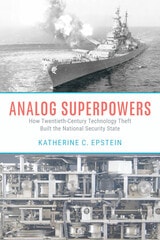
At the beginning of the twentieth century, two British inventors, Arthur Pollen and Harold Isherwood, became fascinated by a major military question: how to aim the big guns of battleships. These warships—of enormous geopolitical import before the advent of intercontinental missiles or drones—had to shoot in poor light and choppy seas at distant moving targets, conditions that impeded accurate gunfire. Seeing the need to account for a plethora of variables, Pollen and Isherwood built an integrated system for gathering data, calculating predictions, and transmitting the results to the gunners. At the heart of their invention was the most advanced analog computer of the day, a technological breakthrough that anticipated the famous Norden bombsight of World War II, the inertial guidance systems of nuclear missiles, and the networked “smart” systems that dominate combat today. Recognizing the value of Pollen and Isherwood’s invention, the British Royal Navy and the United States Navy pirated it, one after the other. When the inventors sued, both the British and US governments invoked secrecy, citing national security concerns.
Drawing on a wealth of archival evidence, Analog Superpowers analyzes these and related legal battles over naval technology, exploring how national defense tested the two countries’ commitment to individual rights and the free market. Katherine C. Epstein deftly sets out Pollen’s and Isherwood’s pioneering achievements, the patent questions raised, the geopolitical rivalry between Britain and the United States, and the legal precedents each country developed to control military tools built by private contractors.
Epstein’s account reveals that long before the US national security state sought to restrict information about atomic energy, it was already embroiled in another contest between innovation and secrecy. The America portrayed in this sweeping and accessible history isn’t yet a global hegemon but a rising superpower ready to acquire foreign technology by fair means or foul—much as it accuses China of doing today.

Analog Superpowers
How Twentieth-Century Technology Theft Built the National Security StateKatherine C. Epstein
University of Chicago Press, 2024
A gripping history that spans law, international affairs, and top-secret technology to unmask the tension between intellectual property rights and national security.
At the beginning of the twentieth century, two British inventors, Arthur Pollen and Harold Isherwood, became fascinated by a major military question: how to aim the big guns of battleships. These warships—of enormous geopolitical import before the advent of intercontinental missiles or drones—had to shoot in poor light and choppy seas at distant moving targets, conditions that impeded accurate gunfire. Seeing the need to account for a plethora of variables, Pollen and Isherwood built an integrated system for gathering data, calculating predictions, and transmitting the results to the gunners. At the heart of their invention was the most advanced analog computer of the day, a technological breakthrough that anticipated the famous Norden bombsight of World War II, the inertial guidance systems of nuclear missiles, and the networked “smart” systems that dominate combat today. Recognizing the value of Pollen and Isherwood’s invention, the British Royal Navy and the United States Navy pirated it, one after the other. When the inventors sued, both the British and US governments invoked secrecy, citing national security concerns.
Drawing on a wealth of archival evidence, Analog Superpowers analyzes these and related legal battles over naval technology, exploring how national defense tested the two countries’ commitment to individual rights and the free market. Katherine C. Epstein deftly sets out Pollen’s and Isherwood’s pioneering achievements, the patent questions raised, the geopolitical rivalry between Britain and the United States, and the legal precedents each country developed to control military tools built by private contractors.
Epstein’s account reveals that long before the US national security state sought to restrict information about atomic energy, it was already embroiled in another contest between innovation and secrecy. The America portrayed in this sweeping and accessible history isn’t yet a global hegemon but a rising superpower ready to acquire foreign technology by fair means or foul—much as it accuses China of doing today.
Analogical Thinking
Post-Enlightenment Understanding in Language, Collaboration, and InterpretationRonald Schleifer
University of Michigan Press, 2001
The book traces this mode of thinking in linguistics, collaborative intellectual work in the arts and sciences, and interpretations of literary and sacred texts, concluding with a reading of the concept of Enlightenment in a comparison of Descartes and Foucault. The book examines the poststructuralism of Derrida; the collaborations of information theory and modern science as opposed to the individualism of Adam Smith and others, and analogical interpretations of Yeats, Dinesen, the Bible, Dreiser, and Mailer. Its overall aim is to present an interdisciplinary examination of a particular kind of understanding that responds to the experiences of our time.
Ronald Schleifer is Professor of English, University of Oklahoma. His books include Rhetoric and Death: The Language of Modernism and Postmodern Discourse Theory, Criticism and Culture; and Culture and Cognition: The Boundaries of Literary and Scientific Inquiry.
Anamnesis
On the Theory of History and PoliticsEric Voegelin, Edited & Translated by Gerhart Niemeyer
University of Missouri Press, 1990
Anamnesis pulls together those materials that focus most sharply upon the development of Eric Voegelin's philosophy of consciousness. Voegelin is considered one of the most influential and profound philosophers of our time and has had an enormous impact on contemporary intellectual life.
Anarchism & The Mexican Working Class, 1860-1931
By John M. Hart
University of Texas Press, 1978
The anarchist movement had a crucial impact upon the Mexican working class between 1860 and 1931. John M. Hart destroys some old myths and brings new information to light as he explores anarchism's effect on the development of the Mexican urban working-class and agrarian movements.
Hart shows how the ideas of European anarchist thinkers took root in Mexico, how they influenced revolutionary tendencies there, and why anarchism was ultimately unsuccessful in producing real social change in Mexico. He explains the role of the working classes during the Mexican Revolution, the conflict between urban revolutionary groups and peasants, and the ensuing confrontation between the new revolutionary elite and the urban working class.
The anarchist tradition traced in this study is extremely complex. It involves various social classes, including intellectuals, artisans, and ordinary workers; changing social conditions; and political and revolutionary events which reshaped ideologies. During the nineteenth century the anarchists could be distinguished from their various working- class socialist and trade unionist counterparts by their singular opposition to government. In the twentieth century the lines became even clearer because of hardening anarchosyndicalist, anarchistcommunist, trade unionist, and Marxist doctrines. In charting the rise and fall of anarchism, Hart gives full credit to the roles of other forms of socialism and Marxism in Mexican working-class history.
Mexican anarchists whose contributions are examined here include nineteenth-century leaders Plotino Rhodakanaty, Santiago Villanueva, Francisco Zalacosta, and José María Gonzales; the twentieth-century revolutionary precursor Ricardo Flores Magón; the Casa del Obrero founders Amadeo Ferrés, Juan Francisco Moncaleano, and Rafael Quintero; and the majority of the Centro Sindicalista Ubertario, leaders of the General Confederation of Workers.
This work is based largely on primary sources, and the bibliography contains a definitive listing of anarchist and radical working-class newspapers for the period.
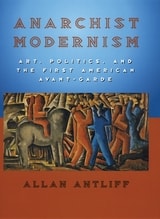
Anarchist Modernism
Art, Politics, and the First American Avant-GardeAllan Antliff
University of Chicago Press, 2001
By situating American art's evolution in the progressive politics of the time, Antliff offers a richly illustrated chronicle of the anarchist movement and also revives the creative agency of those who shaped and implemented modernism for radical ends.