Results by title
3071 books match the query 'Business & Economics' and 183 start with a
Analytical and Negotiating Issues in the Global Trading System
Alan Deardorff and Robert M. Stern, Editors
University of Michigan Press, 1994

Ancient Maritime Loan Contracts
Peter Candy
University of Michigan Press, 2025
Combining a wide variety of papyrological, epigraphic, and legal evidence, Peter Candy’s framework illustrates the significance of these contracts in both their economic and legal context. By using an interdisciplinary approach, Ancient Maritime Loan Contracts addresses important questions about how maritime trade was financed in the context of the ancient economy; the response of individual legal cultures to maritime loan contracts; and the relationship between international commercial practice and legal development in the ancient world.

Animals as Food
(Re)connecting Production, Processing, Consumption, and ImpactsAmy J. Fitzgerald
Michigan State University Press, 2015

Anthropologists Wanted
Why Organizations Need AnthropologyLaurens Bakker
Amsterdam University Press, 2021
Anthropologists Wanted includes portraits of anthropologists and their diverse occupations, interviews with employers and academic counsellors' answers to frequently asked questions about degree programmes, anthropological skills, and tips to help you land that job.

Anthropology, Economics, and Choice
By Michael Chibnik
University of Texas Press, 2011
In the midst of global recession, angry citizens and media pundits often offer simplistic theories about how bad decisions lead to crises. Many economists, however, base their analyses on rational choice theory, which assumes that decisions are made by well-informed, intelligent people who weigh risks, costs, and benefits. Taking a more realistic approach, the field of anthropology carefully looks at the underlying causes of choices at different times and places.
Using case studies of choices by farmers, artisans, and bureaucrats drawn from Michael Chibnik's research in Mexico, Peru, Belize, and the United States, Anthropology, Economics, and Choice presents a clear-eyed perspective on human actions and their economic consequences. Five key issues are explored in-depth: choices between paid and unpaid work; ways people deal with risk and uncertainty; how individuals decide whether to cooperate; the extent to which households can be regarded as decision-making units; and the "tragedy of the commons," the theory that social chaos may result from unrestricted access to commonly owned property.
Both an accessible primer and an innovative exploration of economic anthropology, this interdisciplinary work brings fresh insight to a timely topic.

Anti-Politics Machine
Development, Depoliticization, and Bureaucratic Power in LesothoJames Ferguson
University of Minnesota Press, 1994

Anticipations of the General Theory?
And Other Essays on KeynesDon Patinkin
University of Chicago Press, 1982
Antidumping Law and Practice
A Comparative StudyJohn H. Jackson and Edwin A. Vermulst, Editors
University of Michigan Press, 1990
Antidumping Law
Policy and ImplementationJohn H. Jackson, Editor
University of Michigan Press, 1979

Antidumping
How It Works and Who Gets HurtJ. Michael Finger
University of Michigan Press, 1993

Apartheid’s Leviathan
Electricity and the Power of Technological AmbivalenceFaeeza Ballim
Ohio University Press, 2023

Applied General Equilibrium and Economic Development
Present Achievements and Future TrendsJean Mercenier and T. N. Srinivasan, Editors
University of Michigan Press, 1994

Arab American Public History
Edited by Edward E. Curtis IV
Temple University Press, 2026
Arab American Public History is an invitation to engage more deeply with Arab American communities. Chapters examine Arab Americans’ origins, ethnic identities, and efforts to belong in America through case studies of the community’s food cultures, genealogy research, cultural production, and neighborhood enclaves.
The first formal study of Arab American public history, this exciting volume charts various ways Arab Americans have interpreted their past as a source of defiant humanity, cultural enfranchisement, social solidarity, and political power.
Contributors: Reem Awad-Rashmawi, Chloe Bordewich, Richard M. Breaux, Maria F. Curtis, Lydia Harrington, Randa A. Kayyali, Matthew Jaber Stiffler, Rebecca K. Shrum, and the editor
In the series History and the Public

Are Predatory Commitments Credible?
Who Should the Courts Believe?John R. Lott, Jr.
University of Chicago Press, 1999
John R. Lott, Jr. provides long-awaited empirical analysis in this book. By examining firms accused of or convicted of predation over a thirty-year period of time, he shows that these firms are not organized as the game-theoretic or other models of predation would predict. In contrast, what evidence exists for predation suggests that government enterprises are more of a threat.
Lott presents crucial new data and analysis, attacking an issue of major legal and economic importance. This impressive work will be of great interest to economists, legal scholars, and antitrust policy makers.
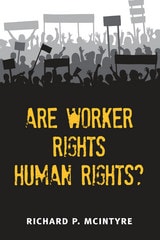
Are Worker Rights Human Rights?
Richard P. McIntyre
University of Michigan Press, 2008
"In a much-needed intervention, Ric McIntyre recasts the debate about globalization and labor rights and speeds us to the heart of the matter: the battle between transnational corporations who distance themselves from responsibility for the fate of workers, and labor activists who seek to reestablish bonds of accountability and moral obligation. The stakes in this struggle are enormous, and Dr. McIntyre provides crucial insight into the economic and political dynamics that define it."
---Scott Nova, Executive Director, Worker Rights Consortium, Washington, DC
"This book presents an insightful, powerful corrective to the contemporary debate over worker rights. McIntyre identifies the limitations of thinking of worker rights as individualized human rights and challenges us instead to examine how rights are defined through conventional thinking and class interest. The product is rich and compelling: McIntyre's investigation demands of us that we be far more attentive to the contradictory effects of ‘rights talk.' I recommend this book enthusiastically to all those who advocate for a just economic order the world over."
---George DeMartino, Associate Professor of Political Economy, the Josef Korbel School of International Studies, University of Denver
"An important contribution to the interdisciplinary study of labor. McIntyre's book will challenge the debate over labor rights on all fronts."
---Michael Hillard, Professor of Economics, University of Southern Maine
"A timely examination of our modern 'sweating system' . . . essential reading for all workers who hope for greater dignity in the workplace and greater fairness in society."
---Janet Knoedler, Associate Professor of Economics, Bucknell University
"Ric McIntyre convincingly shows how local actions, regulations changes, and international norms can combine to establish collective rights for workers."
---Gilles Raveaud, Assistant Professor in Economics, University of Saint-Denis, France, and cofounder of the "post-autistic economics movement"
"An important, timely, and needed contribution to our understanding of worker rights."
---Patrick McHugh, Associate Professor of Management, George Washington University
"Workers of the world, unite!" Karl Marx's famous call to action still promises an effective means of winning human rights in the modern global economy, according to economist Richard P. McIntyre. Currently, the human rights movement insists upon a person's right to life, freedom, and material necessities. In democratic, industrial nations such as the United States, the movement focuses more specifically on a person's civil rights and equal opportunity.
The movement's victories since WWII have come at a cost, however. The emphasis on individual rights erodes collective rights---the rights that disadvantaged peoples need to assert their most basic human rights. This is particularly true for workers, McIntyre argues. By reintroducing Marxian and Institutional analysis, he reveals the class relations and power structures that determine the position of workers in the global economy. The best hope for achieving workers' rights, he concludes, lies in grassroots labor organizations that claim the right of association and collective bargaining.
At last, an economist offers a vision for human rights that takes both moral questions and class relations seriously.
Richard P. McIntyre is Director of the University Honors Program and Professor of Economics at the University of Rhode Island.
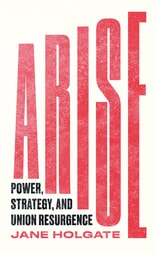
Arise
Power, Strategy and Union ResurgenceJane Holgate
Pluto Press, 2021
'Jane Holgate is a brilliant thinker' - Jane McAlevey
In Arise, Jane Holgate argues that unions must revisit their understanding of power in order to regain influence and confront capital. Drawing on two decades of research and organizing experience, Holgate examines the structural inertia of today’s unions from a range of perspectives: from strategic choice, leadership and union democracy to politics, tactics and the agency afforded to rank-and-file members.
In the midst of a neoliberal era of economic crisis and political upheaval, the labor movement stands at a crossroads. Union membership is on the rise, but the ‘turn to organizing’ has largely failed to translate into meaningful gains for workers. There is considerable discussion about the lack of collectivism among workers due to casualization, gig work and precarity, yet these conditions were standard in the UK when workers built the foundations of the 19th-century trade union movement.
Drawing on history and case studies of unions developing and using power effectively, this book offers strategies for moving beyond the pessimism that prevails in much of today’s union movement. By placing power analysis back at the heart of workers’ struggle, Holgate shows us that transformational change is not only possible, but within reach.

Arms and Innovation
Entrepreneurship and Alliances in the Twenty-First Century Defense IndustryJames Hasik
University of Chicago Press, 2008
For all their advantages, small firms also face significant challenges in access to capital and customers. To overcome such problems, they can form alliances either with each other or with larger companies. Hasik traces the trade-offs of such alliances and provides crucial insight into their promises and pitfalls.
This ground-breaking study is a significant contribution to understanding both entrepreneurship and alliances, two crucial factors in business generally. It will be of interest to readers in the defense sector as well as the wider business community.
Art Management
Entrepreneurial StyleGiep Hagoort
Eburon Academic Publishers, 2003
Art and the Market
Roger Fry on Commerce in Art, Selected Writings, Edited with an InterpretationCraufurd D. Goodwin
University of Michigan Press, 1998

Artivate 11.3
Adrienne Callander
University of Arkansas Press, 2024
In this special edition of Artivate built around the expanded field of arts entrepreneurship, guest editors Adrienne Callander and Johanna K. Taylor collect scholars’ research on ideas they see as both central and pivotal in driving the field forward. In a futurecasting glossary, past, present, and future Artivate editors gather their thinking around such ideas, exploring where and how arts entrepreneurship currently happens beyond expected models. The three articles contained in this issue explore arts entrepreneurship’s overlaps from policy to activism to philanthropy through new adaptable organizational modeling. Starting with an in-depth analysis of hybrid practice as a mode of institutional entrepreneurship, the conversation turns to a view on artist activism as a form of arts entrepreneurship, followed by a case study of the Maniobra program of cultural employment supporting artists. To culminate in this issue’s galleries, an artist showcase profiles participating artists in the Maniobra program.

As if the Future Mattered
Translating Social and Economic Theory into Human BehaviorNeva R. Goodwin, Editor
University of Michigan Press, 1996
Asking About Prices
A New Approach to Understanding Price StickinessAlan Blinder
Russell Sage Foundation, 1998
Assessing the Value of Law in Transition Economies
Peter Murrell, Editor
University of Michigan Press, 2001
Asset Accumulation and Economic Activity
Reflections on Contemporary Macroeconomic TheoryJames Tobin
University of Chicago Press, 1982
Asset Prices and Monetary Policy
Edited by John Y. Campbell
University of Chicago Press, 2008
The contributors examine how central bankers determine their policy prescriptions with reference to the fluctuating housing market, the balance of debt and credit, changing beliefs of investors, the level of commodity prices, and other factors. At a time when the public has never been more involved in stocks, retirement funds, and real estate investment, this insightful book will be useful to all those concerned with the current state of the economy.
Assets for the Poor
The Benefits of Spreading Asset OwnershipThomas M. Shapiro
Russell Sage Foundation, 2001
Asymmetric Information, Corporate Finance, and Investment
Edited by R. Glenn Hubbard
University of Chicago Press, 1990
In this volume, specialists from traditionally separate areas in economics and finance investigate issues at the conjunction of their fields. They argue that financial decisions of the firm can affect real economic activity—and this is true for enough firms and consumers to have significant aggregate economic effects. They demonstrate that important differences—asymmetries—in access to information between "borrowers" and "lenders" ("insiders" and "outsiders") in financial transactions affect investment decisions of firms and the organization of financial markets. The original research emphasizes the role of information problems in explaining empirically important links between internal finance and investment, as well as their role in accounting for observed variations in mechanisms for corporate control.
At Home and Abroad
U.S. Labor Market Performance in International PerspectiveFrancine D. Blau
Russell Sage Foundation, 2002
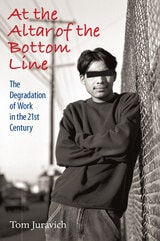
At the Altar of the Bottom Line
The Degradation of Work in the 21st CenturyThomas Juravich
University of Massachusetts Press, 2009
Tom Juravich combines oral history with social and economic analysis to provide a vivid account of the multiple challenges presented in today's workplaces.
Based on extensive interviews with workers in four different industries, this book takes us behind the statistics of the economic collapse and into the lives of Americans who are struggling to make ends meet and support their families.
At a Verizon call center in Andover, Massachusetts, customer service reps find themselves overwhelmed by the pace of work and the constant monitoring. They describe a daily routine marked by regimentation, intense pressure to sell, and unrelenting stress. In New Bedford, undocumented Guatemalans in the fish-processing industry are fired if they don't work fast enough, cheated out of wages, and mistreated by supervisors. Juravich describes a brutal immigration raid by U.S. Immigration and Customs Enforcement that divided families and forced workers further underground.
Juravich then takes us inside the operating rooms at the Boston Medical Center, where hospital consolidation has brought a new “bottom line” philosophy that has fundamentally altered the way patient care is delivered. Surgery takes place almost non-stop, driving some nurses from their chosen profession and leaving those who remain exhausted.
The final case study looks at the shuttering of the Jones Beloit plant, an internationally known manufacturer of machinery for the paper industry. Despite the best efforts of highly skilled and productive workers to save their plant, it was abruptly closed and they were abandoned after their CEO recklessly became involved in a shaky foreign investment.
Juravich argues that workers face a series of paradoxes in the contemporary American workplace. They can no longer assume that large established firms create good jobs. The new working conditions often resemble what was traditionally associated with marginal and low-wage employers. He concludes that we must bring a discussion about the quality of jobs back into the public discourse and that a “good jobs” strategy is a fundamental building block to economic recovery.
Workers' voices are front and center in this highly readable book. It includes striking photographs by Paul Shoul and a CD that presents a series of audio documentaries with excerpts from the interviews, as well as four original songs written and performed by Juravich.
Atlanta Life Insurance
Guardian of Black Economic DignityAlexa Benson Henderson
University of Alabama Press, 1990
Efforts to develop an economic base within the Black community began even before the Civil War. These efforts gained new meaning in the post-Reconstruction period as Blacks strove to adapt to radically changing economic circumstances and the emergence of the Jim Crow South. In Atlanta, shortly after the turn of the century, Alonzo Franklin Herndon, a former slave, joined a long line of Black entrepreneurs by creating Atlanta Life Insurance Company. More than three-quarters of a century later, it remains an important enterprise that is the nation’s largest Black-controlled shareholder insurance company. The firm is today a significant example of the efforts of Black Americans to achieve economic independence and dignity in America.
Augmented Exploitation
Artificial Intelligence, Automation and WorkPhoebe Moore
Pluto Press, 2021
Automobiles and the Future
Competition, Cooperation, and ChangeRobert E. Cole, Editor
University of Michigan Press, 1983