Results by title
2285 books match the query 'Women' and 165 start with a
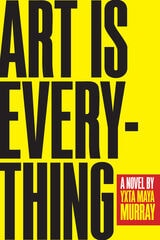
Art Is Everything
A NovelYxta Maya Murray
Northwestern University Press, 2021
In her funny, idiosyncratic, and propulsive new novel, Art Is Everything, Yxta Maya Murray offers us a portrait of a Chicana artist as a woman on the margins. L.A. native Amanda Ruiz is a successful performance artist who is madly in love with her girlfriend, a wealthy and pragmatic actuary named Xōchitl. Everything seems under control: Amanda’s grumpy father is living peacefully in Koreatown; Amanda is about to enjoy a residency at the Guggenheim Museum in New York and, once she gets her NEA, she’s going to film a groundbreaking autocritical documentary in Mexico.
But then everything starts to fall apart when Xōchitl’s biological clock begins beeping, Amanda’s father dies, and she endures a sexual assault. What happens to an artist when her emotional support vanishes along with her feelings of safety and her finances? Written as a series of web posts, Instagram essays, Snapchat freakouts, rejected Yelp reviews, Facebook screeds, and SmugMug streams-of-consciousness that merge volcanic confession with eagle-eyed art criticism, Art Is Everything shows us the painful but joyous development of a mid-career artist whose world implodes just as she has a breakthrough.
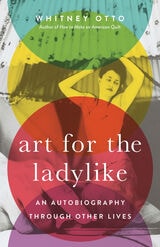
Art for the Ladylike
An Autobiography through Other LivesWhitney Otto
The Ohio State University Press, 2021
In Art for the Ladylike, Whitney Otto limns the lives of eight pioneering women photographers—Sally Mann, Imogen Cunningham, Judy Dater, Ruth Orkin, Tina Modotti, Lee Miller, Madame Yvonne, and Grete Stern—to in turn excavate her own writer’s life. The result is an affecting exploration of what it means to be a woman, what it means to be an artist, and the perils and rewards of being both at once. In considering how feminism, career, and motherhood were entangled throughout her subjects’ lives as they tirelessly sought to render their visions and paved the way for others creating within the bounds of domesticity, Otto assesses her own struggles with balancing writing and the pulls of home life. Ultimately, she ponders the persistent question that artistic women face in a world that devalues women’s ambition: If what we love is what we are, how do those of us with multiple loves forge lives with room for everything?
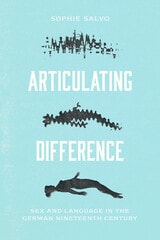
Articulating Difference
Sex and Language in the German Nineteenth CenturySophie Salvo
University of Chicago Press, 2024
Drawing on a wide range of texts, from understudied ethnographic and scientific works to canonical literature and philosophy, Sophie Salvo uncovers the prehistory of the inextricability of gender and language. Taking German discourses on language as her focus, she argues that we are not the inventors but, rather, the inheritors and adapters of the notion that gender and language are interrelated. Particularly during the long nineteenth century, ideas about sexual differences shaped how language was understood, classified, and analyzed. As Salvo explains, philosophers asserted the patriarchal origins of language, linguists investigated “women’s languages” and grammatical gender, and literary Modernists imagined “feminine” sign systems, and in doing so they not only deemed sex-based divisions to be necessary categories of language but also produced a plethora of gendered tropes and fictions, which they used both to support their claims and delimit their disciplines.
Articulating Difference charts new territory, revealing how gendered conceptions of language make possible the misogynistic logic of exclusion that underlies arguments claiming, for example, that women cannot be great orators or writers. While Salvo focuses on how male scholars aligned language study with masculinity, she also uncovers how women responded, highlighting the contributions of understudied nineteenth-century works on language that women wrote even as they were excluded from academic opportunities.
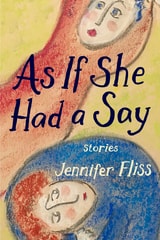
As If She Had a Say
StoriesJennifer Fliss
Northwestern University Press, 2023
Who has a right to tell us how to experience our grief? How to perform—or not perform—the roles society prescribes to us based on our various points of identity?
As If She Had a Say, the second story collection from Jennifer Fliss, uses an absurdist lens to showcase characters—predominantly women—plumbing their resources as they navigate misogyny, abuse, and grief. In these stories, a woman melts in the face of her husband’s cruelty; a seven-tablespoons-long woman lives inside a refrigerator and engages in an affair with the man of the house; a balloon-animal artist attends a funeral to discover he was invited as more than entertainment; and a man loses all his nouns.
Fans of Karen Russell and Carmen Maria Machado will appreciate how As If She Had a Say’s inventive narratives expose inequities by taking us on imaginative romps through domesticity and patriarchal expectations. Each story functions as a magnifying glass through which we might examine our own lives and see ourselves more clearly.
As If a Bird Flew By Me
A NovelSara Greenslit
University of Alabama Press, 2011
“The world is full of continuous conversations: Now is surrounded by Past, and both are encircled by Forever.” So states an unnamed narrator in As if a Bird Flew by Me.
Celia lives in the contemporary Midwest. Ann is an accused witch, executed during the Salem witch trials. Two women separated by time and place yet yoked by heritage and history. Set in three time periods, stories within stories unfold, and Greenslit’s language seamlessly weaves Celia’s modern life with the historical record of Ann’s demise alongside dazzling renderings of animal life. Greenslit’s hybrid of fiction and nonfiction occupies that rarest of airs: it is a book that illuminates, line by line and page by page, how it should be read.
As Told By Herself
Women’s Childhood Autobiography, 1845-1969Lorna Martens
University of Wisconsin Press, 2022
Stopping just before second-wave feminism brought an explosion in women's childhood autobiographical writing, As Told by Herself explores the genre's roots and development from the mid-nineteenth century, and recovers many works that have been neglected or forgotten. The result illustrates how previous generations of women—in a variety of places and circumstances—understood themselves and their upbringing, and how they thought to present themselves to contemporary and future readers.
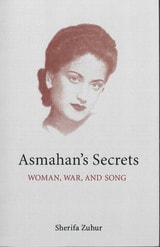
Asmahan's Secrets
Woman, War, and SongBy Sherifa Zuhur
University of Texas Press, 2001
The great Arab singer Asmahan was the toast of Cairo song and cinema in the late 1930s and early 1940s, as World War II approached. She remained a figure of glamour and intrigue throughout her life and lives on today in legend as one of the shaping forces in the development of Egyptian popular culture. In this biography, author Sherifa Zuhur does a thorough study of the music and film of Asmahan and her historical setting.
A Druze princess actually named Amal al-Atrash, Asmahan came from an important clan in the mountains of Syria but broke free from her traditional family background, left her husband, and became a public performer, a role frowned upon for women of the time.
This unique biography of the controversial Asmahan focuses on her public as well as her private life. She was a much sought-after guest in the homes of Egypt's rich and famous, but she was also rumored to be an agent for the Allied forces during World War II.
Through the story of Asmahan, the reader glimpses not only aspects of the cultural and political history of Egypt and Syria between the two world wars, but also the change in attitude in the Arab world toward women as public performers on stage. Life in wartime Cairo comes alive in this illustrated account of one of the great singers of the Arab world, a woman who played an important role in history.
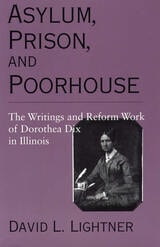
Asylum, Prison, and Poorhouse
The Writings and Reform Work of Dorothea Dix in IllinoisDavid L. Lightner
Southern Illinois University Press, 1999
This illustrated collection of annotated newspaper articles and memorials by Dorothea Dix provides a forum for the great mid-nineteenth-century humanitarian and reformer to speak for herself.
Dorothea Lynde Dix (1802–87) was perhaps the most famous and admired woman in America for much of the nineteenth century. Beginning in the early 1840s, she launched a personal crusade to persuade the various states to provide humane care and effective treatment for the mentally ill by funding specialized hospitals for that purpose. The appalling conditions endured by most mentally ill inmates in prisons, jails, and poorhouses led her to take an active interest also in prison reform and in efforts to ameliorate poverty.
In 1846–47 Dix brought her crusade to Illinois. She presented two lengthy memorials to the legislature, the first describing conditions at the state penitentiary at Alton and the second discussing the sufferings of the insane and urging the establishment of a state hospital for their care. She also wrote a series of newspaper articles detailing conditions in the jails and poorhouses of many Illinois communities.
These long-forgotten documents, which appear in unabridged form in this book, contain a wealth of information on the living conditions of some of the most unfortunate inhabitants of Illinois. In his preface, David L. Lightner describes some of the vivid images that emerge from Dorothea Dix's descriptions of social conditions in Illinois a century and a half ago: "A helpless maniac confined throughout the bitter cold of winter to a dark and filthy pit. Prison inmates chained in hallways and cellars because no more men can be squeezed into the dank and airless cells. Aged paupers auctioned off by county officers to whoever will maintain them at the lowest cost."
Lightner provides an introduction to every document, placing each memorial and newspaper article in its proper social and historical context. He also furnishes detailed notes, making these documents readily accessible to readers a century and a half later. In his final chapter, Lightner assesses both the immediate and the continuing impact of Dix's work.
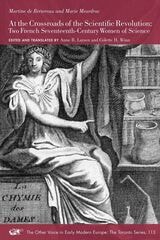
At the Crossroads of the Scientific Revolution
Two French Seventeenth-Century Women of ScienceMartine de Bertereau and Marie Meurdrac
Iter Press, 2026
The writings of mineralogist and hydrogeologist Martine de Bertereau (ca. 1584–ca. 1643) and alchemist and chemist Marie Meurdrac (ca. 1610–80) stand at the crossroads of the Scientific Revolution, a significant period between Copernicus and Newton that oversaw a new ferment in both the theoretical and empirical investigation of the natural world. Bertereau’s writings appear at the interface of a negotiation between an older form of knowledge, dating back to Aristotle, and a new scientific empiricism. She brilliantly addresses the relationship between knowledge and mining applications, as well as the roles of the king, the state, the market, and the public. Meurdrac published the first so-called chemistry book by a woman, which contributed to the various areas of scientific knowledge generally associated with alchemy in its development into chemistry, particularly medical cookery, botany, pharmacology, and cosmetology.
Bertereau’s and Meurdrac’s works illustrate this age of transition, a spectacular time of growth in ideas and discoveries for both men and women. This first-time translation of their works is an important step in restoring the voices of these early modern French women scientists.
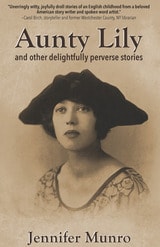
Aunty Lily
and other delightfully perverse storiesJennifer Munro
Parkhurst Brothers, Inc., 2016
Munro’s stories were born five decades ago in a small English village where children were seen and not heard, fathers were wacky, neighbors were snoopy, and maiden aunts were beautifully crafted artifices. Her original stories, dolloped with characters reminiscent of those from her childhood, telling of domestic shenanigans and outings gone revealingly awry are written with meticulous timing. Rich in details about the frailty and strength of the human spirit, her stories resonate with the truth of what is means to be human.
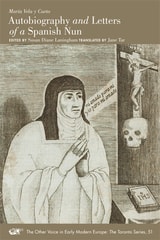
Autobiography and Letters of a Spanish Nun
María Vela y Cueto
Iter Press, 2016
When María Vela y Cueto (1561–1617) declared that God had personally ordered her to take only the Eucharist as food and to restore primitive dress and public penance in her aristocratic convent, the entire religious community, according to her confessor, “rose up in wrath.” Yet, when Vela died, her peers joined with the populace to declare her a saint. In her autobiography and personal letters, Vela speaks candidly of the obstacles, perils, and rewards of re-negotiating piety in a convent where devotion to God was no longer expressed through rigorous asceticism. Vela’s experience, told in her own words, reveals her shrewd understanding of the persuasive power of a woman’s body.
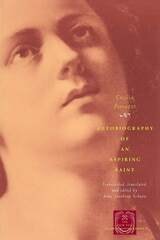
Autobiography of an Aspiring Saint
Cecilia Ferrazzi
University of Chicago Press, 1996
Born in 1609 into an artisan family, Cecilia Ferrazzi wanted to become a nun. When her parents' death in the plague of 1630 made it financially impossible for her to enter the convent, she refused to marry and as a single laywoman set out in pursuit of holiness. Eventually she improvised a vocation: running houses of refuge for "girls in danger," young women at risk of being lured into prostitution.
Ferrazzi's frequent visions persuaded her, as well as some clerics and acquaintances among the Venetian elite, that she was on the right track. The socially valuable service she was providing enhanced this impresssion. Not everyone, however, was convinced that she was a genuine favorite of God. In 1664 she was denounced to the Inquisition.
The Inquisition convicted Ferrazzi of the pretense of sanctity. Yet her autobiographical act permits us to see in vivid detail both the opportunities and the obstacles presented to seventeenth-century women.
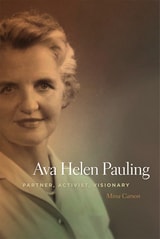
Ava Helen Pauling
Partner, Activist, VisionaryMina Carson
Oregon State University Press, 2013
Though she began her public career in the shadow of her spouse, Ava Helen soon found herself tugged between her ardor to support Linus in his career and her desire that he embrace the social and political causes she felt passionate about. She believed it was her destiny to accept duties as a mother and homemaker, but neither of those roles was fully satisfying. Her more complete identity emerged over decades, as she evolved as an influential activist.
Ava Helen Pauling’s story is significant because so many aspects of it were shared with countless American women of her generation and the generations surrounding her. They had new educational opportunities but were expected to conform to the same limited social roles dictated by the gender ideology of the nineteenth century. When second wave feminism erupted in the 1960s, its force did not come solely from the young women rebelling against their elders’ rules and limitations, but also from the frustrated dreams of those elders themselves.
Ava Helen did not experience overt oppression by her husband or community; she even asserted some very non-feminist positions as a young woman. This, combined with a structural lack of opportunity, contributed to the strength and persistence of role expectations in her life. At the same time, she was feisty and willful. Her personality both created her marital loyalty and eventually took her down an openly feminist path.
Ava Helen Pauling: Partner, Activist, Visionary is an important complement to writings about Linus Pauling and a welcome addition to the literature on women’s and family history. It will also appeal to students and scholars of peace and reform movements and the social history of science.
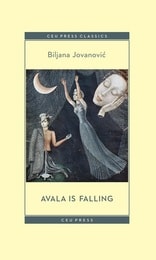
Avala Is Falling
Biljana Jovanovic
Central European University Press, 2020
In Avala Is Falling, Jovanović’s breakout success in 1978, a young woman challenges the expectations that teachers, parents, bus drivers, and doctors have for her. The “Avala” of the title refers to a mountain south of Belgrade which is home to some of Serbia’s most important nationalist monuments and shrines; it is also the site of the main mental hospital for the region, and its “falling” is the unexpected fulfillment of a prophecy from a traditional Serbian folk song. Jovanović’s use of stream of consciousness in her characters’ thinking and speaking, as well as of intertextuality in description and plot advancement heralded the arrival of an innovative new writer who was determined to break with the of traditional concerns of earlier women writers.
This book is now recognized as much more than “jeans prose,” although the fame the book achieved under that characterization eventually pushed it to cult status. Jovanović is now considered a major avant-garde writer, whose stylistic innovations were as challenging as her women-centered themes.
a women
Vanessa Roveto
University of Iowa Press, 2020