Results by title
8 books match the query 'Narration'

A Glance Beyond Doubt
Narration, Representation, SubjectivityShlomith Rimmon-Kenan
The Ohio State University Press, 1900
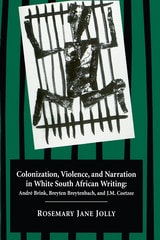
Colonization, Violence, and Narration in White South African Writing
André Brink, Breyten Breytenbach, and J. M. CoetzeeRosemary Jane Jolly
Ohio University Press, 1995
The representation of pain and suffering in narrative form is an ongoing ethical issue in contemporary South African literature. Can violence be represented without sensationalistic effects, or, alternatively, without effects that tend to be conservative because they place the reader in a position of superiority over the victim or the perpetrator?
Jolly looks at three primary South African authors—André Brink, Breyten Breytenbach, and J. M. Coetzee—to consider violence in the context of apartheid and colonialism and their inherent patriarchies.
Jolly also discusses the violence attendant upon the act of narration in the broader context of critiques of Kafka, Freud, Hegel, the postcolonial critics Jan Mohamed and Bhabha, and feminists such as Susan Suleiman.
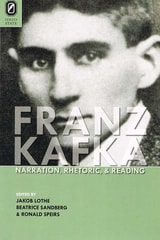
Franz Kafka
Narration, Rhetoric, and ReadingEdited by Jakob Lothe, Beatrice Sandberg, and Ronald Speirs
The Ohio State University Press, 2011
Franz Kafka: Narration, Rhetoric, and Reading presents essays by noted Kafka critics and by leading narratologists who explore Kafka’s original and innovative uses of narrative throughout his career. Collectively, these essays by Stanley Corngold, Anniken Greve, Gerhard Kurz, Jakob Lothe, J. Hillis Miller, Gerhard Neumann, James Phelan, Beatrice Sandberg, Ronald Speirs, and Benno Wagner examine a number of provocative questions that arise in narration and narratives in Kafka’s fiction. The arguments of the essays relate both to the peculiarities of Kafka’s story-telling and to general issues in narrative theory. They reflect, for example, the complexity of the issues surrounding the “somebody” doing the telling, the attitude of the narrator to what is told, the perceived purpose(s) of the telling, the implied or actual reader, the progression of events, and the progression of the telling. As the essays also demonstrate, Kafka’s narratives still present a considerable challenge to, as well as a great resource for, narrative theory and analysis.
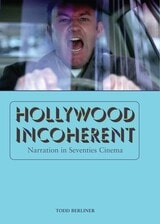
Hollywood Incoherent
Narration in Seventies CinemaBy Todd Berliner
University of Texas Press, 2010
In the 1970s, Hollywood experienced a creative surge, opening a new era in American cinema with films that challenged traditional modes of storytelling. Inspired by European and Asian art cinema as well as Hollywood's own history of narrative ingenuity, directors such as Martin Scorsese, Robert Altman, William Friedkin, Stanley Kubrick, Woody Allen, and Francis Ford Coppola undermined the harmony of traditional Hollywood cinema and created some of the best movies ever to come out of the American film industry. Critics have previously viewed these films as a response to the cultural and political upheavals of the 1970s, but until now no one has explored how the period's inventive narrative design represents one of the great artistic accomplishments of American cinema.
In Hollywood Incoherent, Todd Berliner offers the first thorough analysis of the narrative and stylistic innovations of seventies cinema and its influence on contemporary American filmmaking. He examines not just formally eccentric films—Nashville; Taxi Driver; A Clockwork Orange; The Godfather, Part II; and the films of John Cassavetes—but also mainstream commercial films, including The Exorcist, The Godfather, The French Connection, Willy Wonka and the Chocolate Factory, Dog Day Afternoon, Chinatown, The Bad News Bears, Patton, All the President's Men, Annie Hall, and many others. With persuasive revisionist analyses, Berliner demonstrates the centrality of this period to the history of Hollywood's formal development, showing how seventies films represent the key turning point between the storytelling modes of the studio era and those of modern American cinema.

Music and Levels of Narration in Film
Steps across the BorderGuido Heldt
Intellect Books, 2013
A PDF version of this book is available for free in open access via the OAPEN Library platform, www.oapen.org It has been made available under a Creative Commons Attribution 4.0 International Public License and is part of Knowledge Unlatched.
Narration in the Fiction Film
David Bordwell
University of Wisconsin Press, 1985
Most films tell tales, but what does that involve? How do motion pictures tease us into building what we all agree to call stories? In this study, David Bordwell offers the first comprehensive account of how movies use fundamental principles of narrative representation, unique features of the film medium, and diverse story-telling patterns to construct their fictional narratives. The result is a pioneering, far-reaching work which will change the way we perceive narrative film—and which every serious film scholar, student or fan will welcome.
“This book is of crucial importance to film specialists. I cannot think that any film teacher/scholar would miss reading this work.”—Don Fredricksen, Cornell University
“David Bordwell’s Narration in the Fiction Film is a major contribution to film studies and to narrative theory. The work, I predict, will be widely read, praised, debated, and damned. Brodwell’s originality lies not so much in demonstrating the deficiencies of other theories, which he does very convincingly, but in the scope and design of his project, against which there is no competition of comparable intellectual weight.”—Jerry Carlson, DePaul University
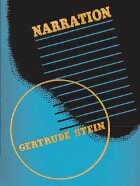
Narration
Four LecturesGertrude Stein
University of Chicago Press, 2010
Newly famous in the wake of the publication of her groundbreaking Autobiography of Alice B. Toklas, Gertrude Stein delivered her Narration lectures to packed audiences at the University of Chicago in 1935. Stein had not been back to her home country since departing for France in 1903, and her remarks reflect on the changes in American culture after thirty years abroad.
In Stein’s trademark experimental prose, Narration reveals the legendary writer’s thoughts about the energy and mobility of the American people, the effect of modernism on literary form, the nature of history and its recording, and the inventiveness of the English language—in particular, its American variant. Stein also discusses her ambivalence toward her own literary fame as well as the destabilizing effect that notoriety had on her daily life. Restored to print for a new generation of readers to discover, these vital lectures will delight students and scholars of modernism and twentieth-century literature.
“Narration is a treasure waiting to be rediscovered and to be pirated by jolly marauders of sparkling texts.”—Catharine Stimpson, NYU
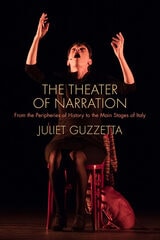
The Theater of Narration
From the Peripheries of History to the Main Stages of ItalyJuliet Guzzetta
Northwestern University Press, 2021
This book examines the theater of narration, an Italian performance genre and aesthetic that revisits historical events of national importance from local perspectives, drawing on the rich relationship between personal experiences and historical accounts. Incorporating original research from the private archives of leading narrators—artists who write and perform their work—Juliet Guzzetta argues that the practice teaches audiences how ordinary people aren’t simply witnesses to history but participants in its creation.
The theater of narration emerged in Italy during the labor and student protests, domestic terrorism, and social progress of the 1970s. Developing Dario Fo and Franca Rame’s style of political theater, influenced by Jerzy Grotowski and Bertolt Brecht, and following in the freewheeling actor‑author traditions of the commedia dell’arte, narrators created a new form of popular theater that grew in prominence in the 1990s and continues to gain recognition. Guzzetta traces the history of the theater of narration, contextualizing its origins—both political and intellectual—and centers the contributions of Teatro Settimo, a performance group overlooked in previous studies. She also examines the genre’s experiments in television and media.
The first full-length book in English on the subject, The Theater of Narration leverages close readings and a wealth of primary sources to examine the techniques used by narrators to remake history—a process that reveals the ways in which history itself is a theater of narration.