Results by title
3745 books match the query 'Europe' and 292 start with a

An Environmental History of Knowledge and Politics
Forestry in Nineteenth- and Twentieth-Century HungaryRobert Balogh
Central European University Press, 2026

An Errant Eye
Poetry and Topography in Early Modern FranceTom Conley
University of Minnesota Press, 2010
This tension, Conley demonstrates, cuts through literature and graphic matter of various shapes and forms-hybrid genres that include the comic novel, the emblem-book, the eclogue, sonnets, and the personal essay. An Errant Eye differs from historical treatments of spatial invention through Conley's argument that the topographic sensibility is one in which the ocular faculty, vital to the description of locale, is endowed with tact and touch.
Detailed close readings of Apian, Rabelais, Montaigne, and others empower the reader with a lively sense of the topographical impulse, deriving from Conley's own "errant eye," which is singularly discerning in attentiveness to the ambiguities of charted territory, the contours of woodcut images, and the complex combinations of word and figure in French Renaissance poetry, emblem, and politics.
An Imperfect Occupation
Enduring the South African WarJohn Boje
University of Illinois Press, 2015

An Intimate History of Nazism
Love, Marriage, and Sexuality in the Third ReichElissa Mailänder
University of Wisconsin Press, 2027
Published to great acclaim in French and now available for the first time in English, this groundbreaking book explores how the Nazi regime used sexuality to promote political loyalty, conformity, and cohesion among “ordinary” Germans. Beginning before the collapse of the Weimar Republic and continuing through the postwar American occupation of Germany, Elissa Mailänder’s study highlights the complex and conflicted ways that sexual “liberation,” repression, and violence were used and experienced in the everyday lives of citizens of the Reich. Her analysis draws on a vast array of sources, from legal dossiers to private photographs and letters, as well as public archives, magazines, and movies. Mailänder’s findings are often uncomfortable; she demonstrates, for example, that a significant number of women who were not persecuted by the regime saw shifts in gender and sexual norms as positive developments—ones that some felt were lost under the American occupation, with its own routines of military sexual exploitation. What emerges is a portrait of a regime that was less interested in repressing sexuality than in reinventing it according to a racist, elitist, and homophobic agenda.

An Irish-Speaking Island
State, Religion, Community, and the Linguistic Landscape in Ireland, 1770–1870Nicholas M. Wolf
University of Wisconsin Press, 2014
As late as 1840, Ireland had as many as four million Irish speakers—a significant proportion of the total population—who could be found in every county of the island and in all social classes and religious persuasions. Their impact on the modern history of Ireland and the United Kingdom cannot be captured by a simple conclusion that they became anglicized. Rather, Nicholas M. Wolf explores the complex ways in which the transition from Irish to English placed a premium on adaptive bilingualism and shaped beliefs and behavior in the domestic sphere, religious life, and oral culture within the community. An Irish-Speaking Island will interest not only historians but also scholars of linguistics, folklore, politics, literature, and religion.
Winner, Michael J. Durkan Prize for Books on Language and Culture, American Conference for Irish Studies
Winner, Donald Murphy Prize for Distinguished First Books, American Conference for Irish Studies
An Ordinary Life?
The Journeys of Tonia Lechtman, 1918–1996Anna Müller
Ohio University Press, 2024
One woman’s national, political, ethnic, social, and personal identities impart an extraordinary perspective on the histories of Europe, Polish Jews, Communism, activism, and survival during the twentieth century.
Tonia Lechtman was a Jew, a loving mother and wife, a Polish patriot, a committed Communist, and a Holocaust survivor. Throughout her life these identities brought her to multiple countries—Poland, Palestine, Spain, France, Germany, Switzerland, and Israel—during some of the most pivotal and cataclysmic decades of the twentieth century. In most of those places, she lived on the margins of society while working to promote Communism and trying to create a safe space for her small children.
Born in Łódź in 1918, Lechtman became fascinated with Communism in her early youth. In 1935, to avoid the consequences of her political activism during an increasingly antisemitic and hostile political environment, the family moved to Palestine, where Tonia met her future husband, Sioma. In 1937, the couple traveled to Spain to participate in the Spanish Civil War. After discovering she was pregnant, Lechtman relocated to France while Sioma joined the International Brigades. She spent the Second World War in Europe, traveling with two small children between France, Germany, and Switzerland, at times only miraculously avoiding arrest and being transported east to Nazi camps. After the war, she returned to Poland, where she planned to (re)build Communist Poland. However, soon after her arrival she was imprisoned for six years. In 1971, under pressure from her children, Lechtman emigrated from Poland to Israel, where she died in 1996.
In writing Lechtman’s biography, Anna Müller has consulted a rich collection of primary source material, including archival documentation, private documents and photographs, interviews from different periods of Lechtman’s life, and personal correspondence. Despite this intimacy, Müller also acknowledges key historiographical questions arising from the lacunae of lost materials, the selective preservation of others, and her own interpretive work translating a life into a life story.
An Uncompromising Generation
The Nazi Leadership of the Reich Security Main OfficeMichael Wildt
University of Wisconsin Press, 2009
Wildt’s study traces the intellectual evolution of key members of the Reich Security Main Office (RSHA) from their days as students until the end of World War II. Established in 1939, this office fused together the Gestapo, the Criminal Police, and the Sicherheitsdienst (Security Service) of the SS. Far from being small cogs in a big bureaucratic machine, Wildt finds that the people who made up the RSHA constructed the concepts and operated the apparatus that carried out the Holocaust.
At the center of both theory and practice of persecution and genocide in Nazi-occupied Europe, these young men of the RSHA—none of whom envisioned the systematic annihilation of the European Jews—became radicalized. How this occurred is the central question of Wildt’s book. Wildt also discusses the postwar careers of the members of the RSHA. Strikingly, he shows how the leaders of the RSHA evaded the consequences of their actions under the Nazi regime and went on to have important careers in the rebuilt West Germany.
An alternate selection of the History Book Club and Military Book Club

An Underground Life
Memoirs of a Gay Jew in Nazi BerlinGad Beck; written with Frank Heibert, translated by Allison Brown
University of Wisconsin Press, 2000
Analog Superpowers
How Twentieth-Century Technology Theft Built the National Security StateKatherine C. Epstein
University of Chicago Press, 2024
At the beginning of the twentieth century, two British inventors, Arthur Pollen and Harold Isherwood, became fascinated by a major military question: how to aim the big guns of battleships. These warships—of enormous geopolitical import before the advent of intercontinental missiles or drones—had to shoot in poor light and choppy seas at distant moving targets, conditions that impeded accurate gunfire. Seeing the need to account for a plethora of variables, Pollen and Isherwood built an integrated system for gathering data, calculating predictions, and transmitting the results to the gunners. At the heart of their invention was the most advanced analog computer of the day, a technological breakthrough that anticipated the famous Norden bombsight of World War II, the inertial guidance systems of nuclear missiles, and the networked “smart” systems that dominate combat today. Recognizing the value of Pollen and Isherwood’s invention, the British Royal Navy and the United States Navy pirated it, one after the other. When the inventors sued, both the British and US governments invoked secrecy, citing national security concerns.
Drawing on a wealth of archival evidence, Analog Superpowers analyzes these and related legal battles over naval technology, exploring how national defense tested the two countries’ commitment to individual rights and the free market. Katherine C. Epstein deftly sets out Pollen’s and Isherwood’s pioneering achievements, the patent questions raised, the geopolitical rivalry between Britain and the United States, and the legal precedents each country developed to control military tools built by private contractors.
Epstein’s account reveals that long before the US national security state sought to restrict information about atomic energy, it was already embroiled in another contest between innovation and secrecy. The America portrayed in this sweeping and accessible history isn’t yet a global hegemon but a rising superpower ready to acquire foreign technology by fair means or foul—much as it accuses China of doing today.

Analog Superpowers
How Twentieth-Century Technology Theft Built the National Security StateKatherine C. Epstein
University of Chicago Press, 2024
A gripping history that spans law, international affairs, and top-secret technology to unmask the tension between intellectual property rights and national security.
At the beginning of the twentieth century, two British inventors, Arthur Pollen and Harold Isherwood, became fascinated by a major military question: how to aim the big guns of battleships. These warships—of enormous geopolitical import before the advent of intercontinental missiles or drones—had to shoot in poor light and choppy seas at distant moving targets, conditions that impeded accurate gunfire. Seeing the need to account for a plethora of variables, Pollen and Isherwood built an integrated system for gathering data, calculating predictions, and transmitting the results to the gunners. At the heart of their invention was the most advanced analog computer of the day, a technological breakthrough that anticipated the famous Norden bombsight of World War II, the inertial guidance systems of nuclear missiles, and the networked “smart” systems that dominate combat today. Recognizing the value of Pollen and Isherwood’s invention, the British Royal Navy and the United States Navy pirated it, one after the other. When the inventors sued, both the British and US governments invoked secrecy, citing national security concerns.
Drawing on a wealth of archival evidence, Analog Superpowers analyzes these and related legal battles over naval technology, exploring how national defense tested the two countries’ commitment to individual rights and the free market. Katherine C. Epstein deftly sets out Pollen’s and Isherwood’s pioneering achievements, the patent questions raised, the geopolitical rivalry between Britain and the United States, and the legal precedents each country developed to control military tools built by private contractors.
Epstein’s account reveals that long before the US national security state sought to restrict information about atomic energy, it was already embroiled in another contest between innovation and secrecy. The America portrayed in this sweeping and accessible history isn’t yet a global hegemon but a rising superpower ready to acquire foreign technology by fair means or foul—much as it accuses China of doing today.

Ancestral Voices
Religion and Nationalism in IrelandConor Cruise O'Brien
University of Chicago Press, 1995
"O'Brien's bravura performance [is] seductive in its intellectual sweep and literary assurance."—Toby Barnard, Times Literary Supplement
"Has the magical insistence which Conor Cruise O'Brien can produce at his best. . . . Where he looks back to his own childhood the book shines. He writes of his mother and father with effortless grace and candor, with a marvelous, elegant mix of affection and detachment."—Observer
Andreas Capellanus, Scholasticism, and the Courtly Tradition
Don A. Monson
Catholic University of America Press, 2005
Androids in the Enlightenment
Mechanics, Artisans, and Cultures of the SelfAdelheid Voskuhl
University of Chicago Press, 2013
Angelic Airs, Subversive Songs
Music as Social Discourse in the Victorian NovelAlisa Clapp-Itnyre
Ohio University Press, 2027
Music was at once one of the most idealized and one of the most contested art forms of the Victorian period. Yet this vitally important nineteenth-century cultural form has been studied by literary critics mainly as a system of thematic motifs. Angelic Airs, Subversive Songs positions music as a charged site of cultural struggle, promoted concurrently as a transcendent corrective to social ills and as a subversive cause of those ills. Alisa Clapp-Itnyre examines Victorian constructions of music to advance patriotism, Christianity, culture, and domestic harmony, and suggests that often these goals were undermined by political tensions in song texts or “immoral sensuality” in the “spectacle” of live music-making. Clapp-Itnyre turns her focus to the novels of Elizabeth Gaskell, George Eliot, and Thomas Hardy, who present complex engagements with those musical genres most privileged by Victorian society: folk songs, religious hymns, and concert music. Angelic Airs, Subversive Songs recovers the pervasive ambiguities of the Victorian musical period, ambiguities typically overlooked by both literary scholars and musicologists. To the literary critic and cultural historian, Clapp-Itnyre demonstrates the necessity of further exploring the complete aesthetic climate behind some of the Victorian period’s most powerful literary works. And to the feminist scholar and the musicologist, Clapp-Itnyre reveals the complexities of music as both an oppressive cultural force and an expressive, creative outlet for women.
Angels, Devils
The Supernatural and Its Visual RepresentationGerhard Jaritz
Central European University Press, 2011

Anglicanus ortus
A Verse Herbal of the Twelfth CenturyHenry of Huntingdon
Bodleian Library Publishing, 2012
Animal Labor and Colonial Warfare
James L. Hevia
University of Chicago Press, 2018
In Animal Labor and Colonial Warfare, James Hevia examines the use of camels, mules, and donkeys in colonial campaigns of conquest and pacification, starting with the Second Afghan War—during which an astonishing 50,000 to 60,000 camels perished—and ending in the early twentieth century. Hevia explains how during the nineteenth and twentieth centuries a new set of human-animal relations were created as European powers and the United States expanded their colonial possessions and attempted to put both local economies and ecologies in the service of resource extraction. The results were devastating to animals and human communities alike, disrupting centuries-old ecological and economic relationships. And those effects were lasting: Hevia shows how a number of the key issues faced by the postcolonial nation-state of Pakistan—such as shortages of clean water for agriculture, humans, and animals, and limited resources for dealing with infectious diseases—can be directly traced to decisions made in the colonial past. An innovative study of an underexplored historical moment, Animal Labor and Colonial Warfare opens up the animal studies to non-Western contexts and provides an empirically rich contribution to the emerging field of multispecies historical ecology.
Animal Skins and the Reading Self in Medieval Latin and French Bestiaries
Sarah Kay
University of Chicago Press, 2017
Bestiaries present accounts of animals whose fantastic behaviors should be imitated or avoided, depending on the given trait. In a highly original argument, Kay suggests that the association of beasts with books is here both literal and material, as nearly all surviving bestiaries are copied on parchment made of animal skin, which also resembles human skin. Using a rich array of examples, she shows how the content and materiality of bestiaries are linked due to the continual references in the texts to the skins of other animals, as well as the ways in which the pages themselves repeatedly—and at times, it would seem, deliberately—intervene in the reading process. A vital contribution to animal studies and medieval manuscript studies, this book sheds new light on the European bestiary and its profound power to shape readers’ own identities.

Animals under the Swastika
J. W. Mohnhaupt, translated by John R. J. Eyck
University of Wisconsin Press, 2022
Drawing from diaries, journals, school textbooks, and printed propaganda, J.W. Mohnhaupt tells these animals’ stories vividly and with an eye for everyday detail, focusing each chapter on a different facet of Nazism by way of a specific animal species: red deer, horses, cats, and more. Animals under the Swastika illustrates the complicated, thought-provoking relationship between Nazis and animals.
Anonymous Connections
The Body and Narratives of the Social in Victorian BritainTina Young Choi
University of Michigan Press, 2016
Anonymus and Master Roger
Martyn Rady
Central European University Press, 2010
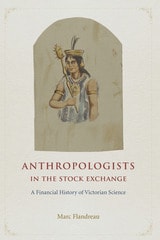
Anthropologists in the Stock Exchange
A Financial History of Victorian ScienceMarc Flandreau
University of Chicago Press, 2016
Flandreau argues that finance and science were at the heart of a new brand of imperialism born during Benjamin Disraeli’s first term as Britain’s prime minister in the 1860s. As anthropologists advocated the study of Miskito Indians or stated their views on a Jamaican rebellion, they were in fact catering to the impulses of the stock exchange—for their own benefit. In this way the very development of the field of anthropology was deeply tied to issues relevant to the financial market—from trust to corruption. Moreover, this book shows how the interplay between anthropology and finance formed the foundational structures of late nineteenth-century British imperialism and helped produce essential technologies of globalization as we know it today.
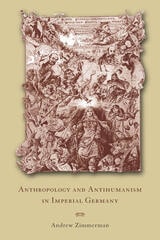
Anthropology and Antihumanism in Imperial Germany
Angela Elisabeth Zimmerman
University of Chicago Press, 2001
Drawing on sources ranging from scientific papers and government correspondence to photographs, pamphlets, and police reports of "freak shows," Zimmerman demonstrates how German imperialism opened the door to antihumanism. As Germans interacted more frequently with peoples and objects from far-flung cultures, they were forced to reevaluate not just those peoples, but also the construction of German identity itself. Anthropologists successfully argued that their discipline addressed these issues more productively—and more accessibly—than humanistic studies.
Scholars of anthropology, European and intellectual history, museum studies, the history of science, popular culture, and colonial studies will welcome this book.
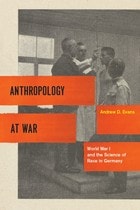
Anthropology at War
World War I and the Science of Race in GermanyAndrew D. Evans
University of Chicago Press, 2010
Between 1914 and 1918, German anthropologists conducted their work in the midst of full-scale war. The discipline was relatively new in German academia when World War I broke out, and, as Andrew D. Evans reveals in this illuminating book, its development was profoundly altered by the conflict. As the war shaped the institutional, ideological, and physical environment for anthropological work, the discipline turned its back on its liberal roots and became a nationalist endeavor primarily concerned with scientific studies of race.
Combining intellectual and cultural history with the history of science, Anthropology at War examines both the origins and consequences of this shift. Evans locates its roots in the decision to allow scientists access to prisoner-of-war camps, which prompted them to focus their research on racial studies of the captives. Caught up in wartime nationalism, a new generation of anthropologists began to portray the country’s political enemies as racially different. After the war ended, the importance placed on racial conceptions and categories persisted, paving the way for the politicization of scientific inquiry in the years of the ascendancy of National Socialism.

Anti-Communism in Britain During the Early Cold War
A Very British Witch-HuntMatthew Gerth
University of London Press, 2022
The Cold War produced in many countries a form of political repression and societal paranoia which often infected governmental and civic institutions. In the West, the driving catalyst for the phenomenon was anti-communism. While much has been written on the post-war American red scare commonly known as McCarthyism, the domestic British response to the “red menace” during the early Cold War has until now received little attention. Anti-communism in Britain During the Early Cold War is the first book to examine how British Cold War anti-communism transpired and manifested as McCarthyism raged across the Atlantic.
Drawing from a wealth of archival material, this book demonstrates that while policymakers and politicians in Britain sought to differentiate their anti-communist initiatives from the “witch hunt hysteria” occurring in the United States, they were often keen to conduct—albeit less publicly—their own hunts as well. Through analyzing how domestic anti-communism exhibited itself in state policies, political rhetoric, party politics, and the trade union movement, Matthew Gerth argues that an overreaction to the communist threat occurred. In striking detail, this book describes a nation at war with a specific political ideology and its willingness to use a variety of measures to either disrupt or eradicate its influence.

Anti-fascism in European History
From the 1920s to TodayJože Pirjevec
Central European University Press, 2023
The increasing radicalization of political life in most countries in Europe lends special relevance to studies of the antifascist legacies on the continent. This insightful collection of essays is an in-depth review of antifascism in Slovenia, setting it in the context of related movements elsewhere in Europe. The period treated by the 19 essays comprises the interwar period, World War Two, and the post-war decades. The comparative and transnational perspectives advanced by the volume change our understanding of antifascism.
The essays deal with the right-wing but also left-wing instrumentalization of antifascism, with a particular focus on the communist and post-communist periods. The authors point out that antifascism comes in various strains, whether inspired by liberalism, social democracy, communism, monarchism, anarchism, or even Christian conservatism. The contributors bring to light several overlooked antifascist actors, campaigns, and organisations, mostly in Slovenia and the Adriatic area.
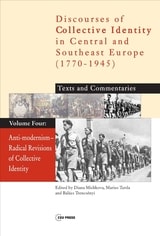
Anti-modernism
Radical Revisions of Collective IdentityAhmet Ersoy
Central European University Press, 2014
Antidiets of the Avant-Garde
From Futurist Cooking to Eat ArtCecilia Novero
University of Minnesota Press, 2009
Discussing an aspect of the European avant-garde that has often been neglected-its relationship to the embodied experience of food, its sensation, and its consumption-Cecilia Novero exposes the surprisingly key roles that food plays in the theoretical foundations and material aesthetics of a broad stratum of works ranging from the Italian Futurist Cookbook to the magazine Dada, Walter Benjamin's writings on eating and cooking, Daniel Spoerri's Eat Art, and the French New Realists.
Starting from the premise that avant-garde art involves the questioning of bourgeois aesthetics, Novero demonstrates that avant-garde artists, writers, and performers have produced an oppositional aesthetics of indigestible art. Through the rhetoric of incorporation and consumption and the use of material ingredients in their work, she shows, avant-garde artists active in the 1920s and 1930s as well as the neo-avant-garde movements engaged critically with consumer culture, memory, and history.
Attention to food in avant-garde aesthetics, Novero asserts, reveals how these works are rooted in a complex temporality that associates memory and consumption with dynamics of change.

Antiquarianism and Intellectual Life in Europe and China, 1500-1800
Peter N. Miller and François Louis, editors
University of Michigan Press, 2012
This book is a project in comparative history, but along two distinct axes, one historical and the other historiographical. Its purpose is to constructively juxtapose the early modern European and Chinese approaches to historical study that have been called "antiquarian." As an exercise in historical recovery, the essays in this volume amass new information about the range of antiquarian-type scholarship on the past, on nature, and on peoples undertaken at either end of the Eurasian landmass between 1500 and 1800. As a historiographical project, the book challenges the received---and often very much under conceptualized---use of the term "antiquarian" in both European and Chinese contexts. Readers will not only learn more about the range of European and Chinese scholarship on the past---and especially the material past---but they will also be able to integrate some of the historiographical observations and corrections into new ways of conceiving of the history of historical scholarship in Europe since the Renaissance, and to reflect on the impact of these European terms on Chinese approaches to the Chinese past. This comparison is a two-way street, with the European tradition clarified by knowledge of Chinese practices, and Chinese approaches better understood when placed alongside the European ones.

Apocalypse 1692
Empire, Slavery, and the Great Port Royal EarthquakeBen Hughes
Westholme Publishing, 2017
A haven for pirates and the center of the New World’s frenzied trade in slaves and sugar, Port Royal, Jamaica, was a notorious cutthroat settlement where enormous fortunes were gained for the fledgling English empire. But on June 7, 1692, it all came to a catastrophic end. Drawing on research carried out in Europe, the Caribbean, and the United States, Apocalypse 1692: Empire, Slavery, and the Great Port Royal Earthquake by Ben Hughes opens in a post–Glorious Revolution London where two Jamaica-bound voyages are due to depart. A seventy-strong fleet will escort the Earl of Inchiquin, the newly appointed governor, to his residence at Port Royal, while the Hannah, a slaver belonging to the Royal African Company, will sail south to pick up human cargo in West Africa before setting out across the Atlantic on the infamous Middle Passage. Utilizing little-known first-hand accounts and other primary sources, Apocalypse 1692 intertwines several related themes: the slave rebellion that led to the establishment of the first permanent free black communities in the New World; the raids launched between English Jamaica and Spanish Santo Domingo; and the bloody repulse of a full-blown French invasion of the island in an attempt to drive the English from the Caribbean. The book also features the most comprehensive account yet written of the massive earthquake and tsunami which struck Jamaica in 1692, resulting in the deaths of thousands, and sank a third of the city beneath the sea. From the misery of everyday life in the sugar plantations, to the ostentation and double-dealings of the plantocracy; from the adventures of former-pirates-turned-treasure-hunters to the debauchery of Port Royal, Apocalypse 1692 exposes the lives of the individuals who made late seventeenth-century Jamaica the most financially successful, brutal, and scandalously corrupt of all of England’s nascent American colonies.
Apology for the Woman Writing and Other Works
Marie le Jars de Gournay
University of Chicago Press, 2002
This volume presents translations of four of Gournay's works that address feminist issues. Two of these appear here in English for the first time—The Promenade of Monsieur de Montaigne and The Apology for the Woman Writing. One of the first modern psychological novels, the best-selling Promenade was also the first to explore female sexual feeling. With the autobiographical Apology, Gournay defended every aspect of her life, from her moral conduct to her household management. The book also includes Gournay's last revisions (1641) of her two best-known feminist treatises, The Equality of Men and Women and The Ladies' Complaint. The editors provide a general overview of Gournay's career, as well as individual introductions and extensive annotations for each work.

Aqueduct Hunting in the Seventeenth Century
Raffaele Fabretti's De aquis et aquaeductibus veteris RomaeHarry B. Evans
University of Michigan Press, 2002
Fabretti's treatise, De aquis et aquaeductibus veteris Romae dissertationes tres, is cited as a matter of course by all later scholars working in the area of Roman topography. Its findings--while updated and supplemented by more recent archaeological efforts--have never been fully superseded. Yet despite its enormous importance and impact on scholarly efforts, the De aquis has never yet been translated from the original Latin. Aqueduct Hunting in the Seventeenth Century provides a full translation of and commentary on Fabretti's writings, making them accessible to a broad audience and carefully assessing their scholarly contributions.
Harry B. Evans offers his reader an introduction to Fabretti and his scholarly world. A complete translation and a commentary that focuses primarily on the topographical problems and Fabretti's contribution to our understanding of them are also provided. Evans also assesses the contributions and corrections of later archaeologists and topographers and places the De aquis in the history of aqueduct studies.
Evans demonstrates that Fabretti's conclusions, while far from definitive, are indeed significant and merit wider attention than they have received to date. This book will appeal to classicists and classical archaeologists, ancient historians, and readers interested in the history of technology, archaeology, and Rome and Italy in the seventeenth century.
Harry B. Evans is Professor of Classics, Fordham University.

Arabic Dialogues
Phrasebooks and the Learning of Colloquial Arabic, 1798–1945Rachel Mairs
University College London, 2024
During the nineteenth century and into the early twentieth century, more Europeans visited the Middle East than ever before, as tourists, archaeologists, pilgrims, settler-colonists, and soldiers. These visitors engaged with the Arabic language to differing degrees. While some were serious scholars of Classical Arabic, in the Orientalist mold, many did not learn the language at all. Between these two extremes lies a neglected group of language learners who wanted to learn enough everyday colloquial Arabic to get by. The needs of these learners were met by popular language books, which boasted that they could provide an easy route to fluency in a difficult language.
Arabic Dialogues explores the motivations of Arabic learners and the effectiveness of instructional materials, principally in Egypt and Palestine, by analyzing a corpus of Arabic phrasebooks published in nine languages (English, French, German, Spanish, Portuguese, Italian, Yiddish, Hebrew, Russian) and in the territories of twenty-five modern countries. Beginning with Napoleon’s Expédition d’Égypte, the book moves through the periods of mass tourism and European colonialism in the Middle East, concluding with the Second World War. The book also considers how Arab intellectuals understood the project of teaching Arabic to foreigners, the remarkable history of Arabic learning among Yiddish- and Hebrew-speaking immigrants in Palestine, and the networks of language learners, teachers, and plagiarists who produced these phrasebooks.
Archaeological Investigations in a Northern Albanian Province
Results of the Projekti Arkeologjik i Shkodrës (PASH): Volume One: Survey and Excavation ResultsMichael L. Galaty and Lorenc Bejko, Editors
University of Michigan Press, 2023
Some of the earliest and largest hill forts and tumuli (burial mounds) in Albania, dating to the Bronze and Iron Age, are located in Shkodër. Shkodër (Rozafa) Castle became the capital of the so-called Illyrian Kingdom, which was conquered by Rome in the early 3rd century BC. This research report, focused on the province of Shkodër, is based on five years of field and laboratory work and is the first synthetic archaeological treatment of this region.
The results of the Projekti Arkeologjik i Shkodrës (or PASH) are presented here in two volumes. Volume 1 includes geological context, a literature review, historical background, and reports on the regional survey and test excavations at three settlements and three tumuli. In Volume 2, the authors describe the artifacts recovered through survey and excavation, including chipped stone, small finds, and pottery from the prehistoric, Classical, Roman, medieval, and post-medieval periods. They also present results of faunal, petrographic, chemical, carpological, and strontium isotope analyses of the artifacts. Extensive supporting data is available on the University of Michigan's Deep Blue data repository: https://doi.org/10.7302/xnpy-0e60
These two volumes place northern Albania—and the Shkodër Province in particular—at the forefront of archaeological research in the Balkans.
Archaeological Investigations in a Northern Albanian Province
Results of the Projekti Arkeologjik i Shkodrës (PASH): Volume Two: Artifacts and Artifact AnalysisMichael L. Galaty and Lorenc Bejko, Editors
University of Michigan Press, 2023
Some of the earliest and largest hill forts and tumuli (burial mounds) in Albania, dating to the Bronze and Iron Age, are located in Shkodër. Shkodër (Rozafa) Castle became the capital of the so-called Illyrian Kingdom, which was conquered by Rome in the early 3rd century BC. This research report, focused on the province of Shkodër, is based on five years of field and laboratory work and is the first synthetic archaeological treatment of this region.
The results of the Projekti Arkeologjik i Shkodrës (or PASH) are presented here in two volumes. Volume 1 includes geological context, a literature review, historical background, and reports on the regional survey and test excavations at three settlements and three tumuli. In Volume 2, the authors describe the artifacts recovered through survey and excavation, including chipped stone, small finds, and pottery from the prehistoric, Classical, Roman, medieval, and post-medieval periods. They also present results of faunal, petrographic, chemical, carpological, and strontium isotope analyses of the artifacts. Extensive supporting data is available on the University of Michigan's Deep Blue data repository: https://doi.org/10.7302/xnpy-0e60
These two volumes place northern Albania—and the Shkodër Province in particular—at the forefront of archaeological research in the Balkans.
Architects of Long Change
The Expert Roots of Post-Socialism in Czechoslovakia (1980–1995)Edited by Michal Kopecek
Karolinum Press, 2026
Architects of Long Change examines expert forms of governance and their legitimization before 1989, as well as the transfer of expert knowledge and practices of political and social management during the democratic transition. The contributors argue that so-called neoliberal governance was not solely the result of imported Western political and cultural models, but was also shaped by intellectual, mental, and sociocultural continuities from the period of late socialism. These continuities—and the broader hypothesis of a “long systemic change” spanning from 1980 to 1995—are explored through case studies in legal science, sociology, urban planning, environmental studies, psychotherapy, and business management.
Architects of Long Change offers a novel perspective on the late communist dictatorship, the democratic revolution of 1989, and the early development of liberal democracy and capitalism in Czechoslovakia and later the Czech Republic.
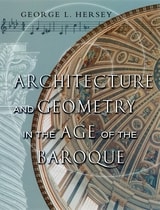
Architecture and Geometry in the Age of the Baroque
George L. Hersey
University of Chicago Press, 2001
Hersey first concentrates on specific problems in geometry and architectural design. He then explores the affinities between musical chords and several types of architectural form. He turns to advances in optics, such as artificial lenses and magic lanterns, to show how architects incorporated light, a heavenly emanation, into their impressive domes. With ample illustrations and lucid, witty language, Hersey shows how abstract ideas were transformed into visual, tactile form—the epicycles of the cosmos, the sexual mystique surrounding the cube, and the imperfections of heavenly bodies. Some two centuries later, he finds that the geometric principles of the Baroque resonate, often unexpectedly, in the work of architects such as Frank Lloyd Wright and Le Corbusier. A discussion of these surprising links to the past rounds out this brilliant reexamination of some of the long-forgotten beliefs and practices that helped produce some of Europe's greatest masterpieces.
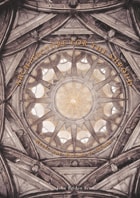
Architecture for the Shroud
Relic and Ritual in TurinJohn Beldon Scott
University of Chicago Press, 2003
In this amply illustrated volume, John Beldon Scott traces the history of the unique relic, focusing especially on the black-marble and gilt-bronze structure Guarino Guarini designed to house and exhibit it. A key Baroque monument, the chapel comprises many unusual architectural features, which Scott identifies and explains, particulary how the chapel's unprecedented geometry and bizarre imagery convey to the viewer the supernatural powers of the object enshrined there. Drawing on early plans and documents, he demonstrates how the architect's design mirrors the Shroud's strange history as well as political aspirations of its owners, the Dukes of Savoy. Exhibiting it ritually, the Savoy prized their relic with its godly vestige as a means to link their dynasty with divine purposes. Guarini, too, promoted this end by fashioning an illusionary world and sacred space that positioned the duke visually so that he appeared close to the Shroud during its ceremonial display. Finally, Scott describes how the additional need for an outdoor stage for the public showing of the relic to the thousands who came to Turin to see it also helped shape the urban plan of the city and its transformation into the Savoyard capital.
Exploring the mystique of this enigmatic relic and investigating its architectural and urban history for the first time, Architecture for the Shroud will appeal to anyone curious about the textile, its display, and the architectural settings designed to enhance its veneration and boost the political agenda of the ruling family.
Architecture in Translation
Germany, Turkey, and the Modern HouseEsra Akcan
Duke University Press, 2012
Archives and the Public Interest
Selected Essays by Ernest PosnerKen Munden
Society of American Archivists, 2006
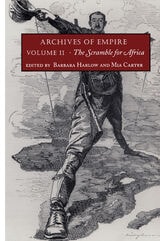
Archives of Empire
Volume 2. The Scramble for AfricaBarbara Harlow and Mia Carter, eds.
Duke University Press, 2004
While focusing on the expansion of the British Empire, The Scramble for Africa illuminates the intense nineteenth-century contest among European nations over Africa’s land, people, and resources. Highlighting the 1885 Berlin Conference in which Britain, France, Germany, Portugal, and Italy partitioned Africa among themselves, this collection follows British conflicts with other nations over different regions as well as its eventual challenge to Leopold of Belgium’s rule of the Congo. The reports, speeches, treatises, proclamations, letters, and cartoons assembled here include works by Henry M. Stanley, David Livingstone, Joseph Conrad, G. W. F. Hegel, Winston Churchill, Charles Darwin, and Arthur Conan Doyle. A number of pieces highlight the proliferation of companies chartered to pursue Africa’s gold, diamonds, and oil—particularly Cecil J. Rhodes’s British South Africa Company and Frederick Lugard’s Royal Niger Company. Other documents describe debacles on the continent—such as the defeat of General Gordon in Khartoum and the Anglo-Boer War—and the criticism of imperial maneuvers by proto-human rights activists including George Washington Williams, Mark Twain, Olive Schreiner, and E.D. Morel.
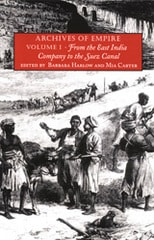
Archives of Empire
Volume I. From The East India Company to the Suez CanalBarbara Harlow and Mia Carter, eds.
Duke University Press, 2003
Tracing the beginnings of the British colonial enterprise in South Asia and the Middle East, From the Company to the Canal brings together key texts from the era of the privately owned British East India Company through the crises that led to the company’s takeover by the Crown in 1858. It ends with the momentous opening of the Suez Canal in 1869. Government proclamations, military reports, and newspaper articles are included here alongside pieces by Rudyard Kipling, Charles Dickens, John Stuart Mill, Karl Marx, Benjamin Disraeli, and many others. A number of documents chronicle arguments between mercantilists and free trade advocates over the competing interests of the nation and the East India Company. Others provide accounts of imperial crises—including the trial of Warren Hastings, the Indian Rebellion (Sepoy Mutiny), and the Arabi Uprising—that highlight the human, political, and economic costs of imperial domination and control.
Archives of Infamy
Foucault on State Power in the Lives of Ordinary CitizensNancy Luxon
University of Minnesota Press, 2019
Expanding the insights of Arlette Farge and Michel Foucault’s Disorderly Families into policing, public order, (in)justice, and daily life
What might it mean for ordinary people to intervene in the circulation of power between police and the streets, sovereigns and their subjects? How did the police come to understand themselves as responsible for the circulation of people as much as things—and to separate law and justice from the maintenance of a newly emergent civil order? These are among the many questions addressed in the interpretive essays in Archives of Infamy.
Crisscrossing the Atlantic to bring together unpublished radio broadcasts, book reviews, and essays by historians, geographers, and political theorists, Archives of Infamy provides historical and archival contexts to the recent translation of Disorderly Families by Arlette Farge and Michel Foucault. This volume includes new translations of key texts, including a radio address Foucault gave in 1983 that explains the writing process for Disorderly Families; two essays by Foucault not readily available in English; and a previously untranslated essay by Farge that describes how historians have appropriated Foucault.
Archives of Infamy pushes past old debates between philosophers and historians to offer a new perspective on the crystallization of ideas—of the family, gender relations, and political power—into social relationships and the regimes of power they engender.
Contributors: Roger Chartier, Collège de France; Stuart Elden, U of Warwick; Arlette Farge, Centre national de recherche scientifique; Michel Foucault (1926–1984); Jean-Philippe Guinle, Catholic Institute of Paris; Michel Heurteaux; Pierre Nora, École des Hautes Études en Sciences Sociales; Michael Rey (1953–1993); Thomas Scott-Railton; Elizabeth Wingrove, U of Michigan.
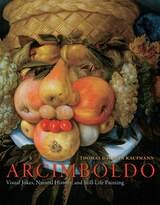
Arcimboldo
Visual Jokes, Natural History, and Still-Life PaintingThomas DaCosta Kaufmann
University of Chicago Press, 2010
In Giuseppe Arcimboldo’s most famous paintings, grapes, fish, and even the beaks of birds form human hair. A pear stands in for a man’s chin. Citrus fruits sprout from a tree trunk that doubles as a neck. All sorts of natural phenomena come together on canvas and panel to assemble the strange heads and faces that constitute one of Renaissance art’s most striking oeuvres. The first major study in a generation of the artist behind these remarkable paintings, Arcimboldo tells the singular story of their creation.
Drawing on his thirty-five-year engagement with the artist, Thomas DaCosta Kaufmann begins with an overview of Arcimboldo’s life and work, exploring the artist’s early years in sixteenth-century Lombardy, his grounding in Leonardesque traditions, and his tenure as a Habsburg court portraitist in Vienna and Prague. Arcimboldo then trains its focus on the celebrated composite heads, approaching them as visual jokes with serious underpinnings—images that poetically display pictorial wit while conveying an allegorical message. In addition to probing the humanistic, literary, and philosophical dimensions of these pieces, Kaufmann explains that they embody their creator’s continuous engagement with nature painting and natural history. He reveals, in fact, that Arcimboldo painted many more nature studies than scholars have realized—a finding that significantly deepens current interpretations of the composite heads.
Demonstrating the previously overlooked importance of these works to natural history and still-life painting, Arcimboldo finally restores the artist’s fantastic visual jokes to their rightful place in the history of both science and art.

Arguing it Out
Discussion in Twelfth-Century ByzantiumAveril Cameron
Central European University Press, 2016
Armenia
A Historical AtlasRobert H. Hewsen
University of Chicago Press, 2001
Hewsen has divided the maps into five sections, each of which begins with a chronology of important dates and a historical introduction to the period. Specialized maps include Ptolemy's second-century map of Armenia, as well as maps of Roman, Cilician, Ottoman, tsarist, and Soviet Armenia. Other maps show the Persian khanate of Erevan, the Caucasian campaigns of World War I, the Armenian Genocide, the Armenian monuments in Turkey and Transcaucasia, the worldwide diaspora, ground plans of selected cities, and plans of the great monastery of Echmiadzin in 1660, 1890, and 1990. The atlas concludes with maps portraying the Karabagh war and the new Armenian Republic, and an extensive bibliography compiles references to the vast historical, ethnological, and travel literature on the region.
The first comprehensive and authoritative atlas of any of the former Soviet republics, this book does not treat Armenia in isolation, but instead sets it within the context of Caucasia as a whole, providing detailed information on neighboring regions such as Georgia and Azerbaijan. Armenia: A Historical Atlas will be an essential reference and an important teaching tool for generations to come.
Army of Hope, Army of Alienation
Culture and Contradiction in the American Army Communities of Cold War GermanyJohn P. Hawkins
University of Alabama Press, 2004
An inside look at the promises, pressures, and paradoxes of American military life in Cold War Germany.
Army life has always been known as a life of sacrifice, challenge, and frustration, yet one filled also with deep satisfactions. This is so for the soldiers’ families as much as for the soldiers themselves. Over the years, military and civilian leaders of the US Army have tried to reduce the hardships of military life by creating an array of community services designed to provide social support for soldiers and families and help them live satisfying lives in military communities.
Unfortunately, this effort has not been particularly successful, and frustration, dissatisfaction, and alienation persist among soldiers and family member in the US Army communities in Germany. Discontent continues because the underlying sources of alienation in the Army and among its families are highly complex, poorly understood, and therefore hardly addressed by the Army’s quality-of-life programs that are intended to make soldier and family life more bearable.
In Army of Hope, Army of Alienation: Culture and Contradiction in the American Army Communities of Cold War Germany, the author seeks to penetrate the logic, social structure, and daily practice of life in the American military communities that lay scattered along the frontier between East and West Germany during the final years of the Cold War. In coming to understand the life and thought of these American soldiers and families, ordinary American citizens can learn much about their military forces and about their own society and culture. In addition, a greater understanding about how people work and live around an institution that is at once so important and yet tasked with a mission so different from that of ordinary pursuits can stimulate social scientists and concerned citizens to think differently about culture, society, and behavior in general.
Arrows in the Dark (Volumes 1 and 2)
David Ben-Gurion, the Yishuv Leadership, and Rescue Attempts during the HolocaustTuvia Friling; Translated by Ora Cummings
University of Wisconsin Press, 2005
Art and Curiosity Cabinets of the Late Renaissance
A Contribution to the History of CollectingJulius von Schlosser
J. Paul Getty Trust, The, 2021
For the first time, the pioneering book that launched the study of art and curiosity cabinets is available in English.
Julius von Schlosser’s Die Kunst- und Wunderkammern der Spätrenaissance (Art and Curiosity Cabinets of the Late Renaissance) is a seminal work in the history of art and collecting. Originally published in German in 1908, it was the first study to interpret sixteenth- and seventeenth-century cabinets of wonder as precursors to the modern museum, situating them within a history of collecting going back to Greco-Roman antiquity. In its comparative approach and broad geographical scope, Schlosser’s book introduced an interdisciplinary and global perspective to the study of art and material culture, laying the foundation for museum studies and the history of collections. Schlosser was an Austrian professor, curator, museum director, and leading figure of the Vienna School of art history whose work has not achieved the prominence of his contemporaries until now.
This eloquent and informed translation is preceded by Thomas DaCosta Kaufmann’s substantial introduction. Tracing Schlosser’s biography and intellectual formation in Vienna at the turn of the twentieth century, it contextualizes his work among that of his contemporaries, offering a wealth of insights along the way.
Art beyond Borders
Artistic Exchange in Communist Europe (1945-1989)Jérôme Bazin
Central European University Press, 2016