Results by title
4917 books match the query 'Philosophy' and 406 start with a
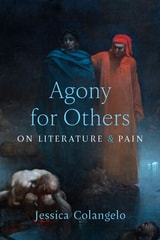
Agony for Others
On Literature and PainJessica Colangelo
University of Michigan Press, 2026
Agony for Others investigates the phenomenological, rhetorical, and political challenges of representing pain in literature. Pain cries vary between cultural and linguistic groups, and pain expression (such as grimacing or crying) can likewise vary in quality and intensity from person to person, affected by disability, temperament, and past experiences with pain, as well as the experiencer’s own understanding of what that pain is and what it means. Jessica Colangelo explores pain's role as a subjective indication of objective damage; that, contrary to claims of its subjective privacy, the feeling of pain is always felt in terms of an objectively existing entity (one’s physical body) which is perceivable by others. Thus, pain enters into intersubjectivity through the physical body—one's expressions, words, actions, presence—which then mediates between the self and the other.
Drawing on disability studies, phenomenology, philosophy, and literary studies, Colangelo examines works by Virginia Woolf, James Baldwin, Sarah Kane, Elie Wiesel, and Margaret Edson to argue that the belief that pain is incommunicable and thought-destroying obscures its central role in relationships and community formation. Agony for Others demonstrates that pain is not excluded from, but rather constitutive of, intersubjectivity, and argues that the aesthetic dimension of interpretation is essential to understanding the ethical and political role of pain.
Al-Ghazali's "Moderation in Belief"
Al-Ghazali
University of Chicago Press, 2013
The first complete English-language edition of Moderation in Belief, this new annotated translation by Aladdin M. Yaqub draws on the most esteemed critical editions of the Arabic texts and offers detailed commentary that analyzes and reconstructs the arguments found in the work’s four treatises. Explanations of the historical and intellectual background of the texts also enable readers with a limited knowledge of classical Arabic to fully explore al-Ghazali and this foundational text for the first time.
With the recent resurgence of interest in Islamic philosophy and the conflict between philosophy and religion, this new translation will be a welcome addition to the scholarship.
Albert Camus' Critique of Modernity
Ronald D. Srigley
University of Missouri Press, 2011
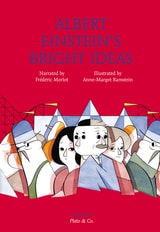
Albert Einstein's Bright Ideas
Frédéric Morlot and Anne-Margot Ramstein
Diaphanes, 2017
In Albert Einstein’s Flashes of Inspiration, the young Albert Einstein has a very important job: he must deliver electricity to the big Oktoberfest celebration in Munich. As he hurries from one merry-go-round to another, nothing seems to be going as planned. With his sister, Maja, Heinrich the dog, and Niels Bohr, a qualified dwarf-thrower, can he win a battle against the laws of the universe? The key just may lie in the question of whether a dumpling can fly faster than light?
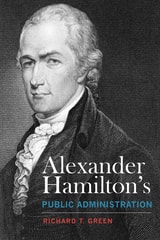
Alexander Hamilton's Public Administration
Richard T. Green
University of Alabama Press, 2019
Examines how Hamilton’s thoughts and experiences about public administration theory and practice have shaped the nation
American public administration inherited from Alexander Hamilton a distinct republican framework through which we derive many of our modern governing standards and practices. His administrative theory flowed from his republican vision, prescribing not only the how of administration but also what should be done and why. Administration and policy merged seamlessly in his mind, each conditioning the other. His Anti-Federalist detractors clearly saw this and fought his vision tooth and nail.
That conflict endures to this day because Americans still have not settled on just one vision of the American republic. That is why, Richard Green argues, Hamilton is a pivotal figure in our current reckoning. If we want to more fully understand ourselves and our ways of governing today, we must start by understanding Hamilton, and we cannot do that without exploring his administrative theory and practice in depth.
Alexander Hamilton’s Public Administration considers Hamilton both as a founder of the American republic, steeped in the currents of political philosophy and science of his day, and as its chief administrative theorist and craftsman, deeply involved in establishing the early institutions and policies that would bring his interpretation of the written Constitution to life. Accordingly, this book addresses the complex mix of classical and modern ideas that informed his vision of a modern commercial and administrative republic; the administrative ideas, institutions, and practices that flowed from that vision; and the substantive policies he deemed essential to its realization. Green’s analysis grows out of an immersion in Hamilton’s extant papers, including reports, letters, pamphlets, and essays. Readers will find a comprehensive explanation of his theoretical contributions and a richly detailed account of his ideas and practices in historical context.
Alexandre Kojève and the Specters of Russian Philosophy
Trevor Wilson
Northwestern University Press, 2025
Recounts Kojève’s key role in the pivotal exchange of ideas between Eastern and Western European intellectuals in the early twentieth century
This book shines critical new light on the story of Alexandre Kojève’s intellectual origins and his role in the emigration of Russian philosophy into the West in the early twentieth century. Trevor Wilson illustrates how Kojève, at once adversarial to the insular communities of émigré philosophy and yet dependent on their networks and ideas for professional success, navigated the specters of the Russian tradition in pursuit of an autonomous self-definition as a philosopher and intellectual.
Alexandre Kojève and the Specters of Russian Philosophy analyzes the philosopher’s complicated relationship to the interwar diaspora and the complex role played by the Russian tradition in his intellectual formation. Wilson examines Kojève’s early writings in the émigré press on Russian religious philosophy, Soviet politics, and Eurasianism and argues for their enduring relevance for understanding Kojève in his mature period. Crucially, he contextualizes Kojève’s famed seminars on Hegel and examines how Kojève’s thought became embedded in the politics of the Cold War. Based on newly transcribed and translated archival material, he highlights a previously unacknowledged, transnational exchange of ideas between Eastern and Western European intellectuals and shows how it played a pivotal role in twentieth-century intellectual history—and its legacy in the twenty-first.
Alfarabi and the Foundation of Islamic Political Philosophy
Muhsin S. Mahdi
University of Chicago Press, 2001
Beginning with a survey of Islamic philosophy and a discussion of its historical background, Mahdi considers the interrelated spheres of philosophy, political thought, theology, and jurisprudence of the time. He then turns to Alfarabi's concept of "the virtuous city," and concludes with an in-depth analysis of the trilogy, Philosophy of Plato and Aristotle.
This philosophical engagement with the writings of and about Alfarabi will be essential reading for anyone interested in medieval political philosophy.
Algebraic Semantics in Language and Philosophy
Godehard Link
CSLI, 1997
Algorithmic Desire
Toward a New Structuralist Theory of Social MediaMatthew Flisfeder
Northwestern University Press, 2021
In Algorithmic Desire, Matthew Flisfeder shows that social media is a metaphor that reveals the dominant form of contemporary ideology: neoliberal capitalism. The preeminent medium of our time, social media’s digital platform and algorithmic logic shape our experience of democracy, enjoyment, and desire. Weaving between critical theory and analyses of popular culture, Flisfeder uses examples from The King’s Speech, Black Mirror, Gone Girl, The Circle, and Arrival to argue that social media highlights the antisocial dimensions of twenty‑first-century capitalism. He counters leading critical theories of social media—such as new materialism and accelerationism—and thinkers such as Gilles Deleuze and Michel Foucault, proposing instead a new structuralist account of the ideology and metaphor of social media. Emphasizing the structural role of crises, gaps, and negativity as central to our experiences of reality, Flisfeder interprets the social media metaphor through a combination of dialectical, Marxist, and Lacanian frameworks to show that algorithms may indeed read our desire, but capitalism, not social media, truly makes us antisocial. Wholly original in its interdisciplinary approach to social media and ideology, Flisfeder’s conception of “algorithmic desire” is timely, intriguing, and sure to inspire debate.
Alien Phenomenology, or What It’s Like to Be a Thing
Ian Bogost
University of Minnesota Press, 2012
Humanity has sat at the center of philosophical thinking for too long. The recent advent of environmental philosophy and posthuman studies has widened our scope of inquiry to include ecosystems, animals, and artificial intelligence. Yet the vast majority of the stuff in our universe, and even in our lives, remains beyond serious philosophical concern.
In Alien Phenomenology, or What It’s Like to Be a Thing, Ian Bogost develops an object-oriented ontology that puts things at the center of being—a philosophy in which nothing exists any more or less than anything else, in which humans are elements but not the sole or even primary elements of philosophical interest. And unlike experimental phenomenology or the philosophy of technology, Bogost’s alien phenomenology takes for granted that all beings interact with and perceive one another. This experience, however, withdraws from human comprehension and becomes accessible only through a speculative philosophy based on metaphor.
Providing a new approach for understanding the experience of things as things, Bogost also calls on philosophers to rethink their craft. Drawing on his own background as a videogame designer, Bogost encourages professional thinkers to become makers as well, engineers who construct things as much as they think and write about them.
All Shook Up
The Archival Legacy of Terry CookTom Nesmith
Society of American Archivists, 2020

All That Was Not Her
Todd Meyers
Duke University Press, 2022
All Thoughts Are Equal
Laruelle and Nonhuman PhilosophyJohn Ó Maoilearca
University of Minnesota Press, 2015
All Thoughts Are Equal is both an introduction to the work of French philosopher François Laruelle and an exercise in nonhuman thinking. For Laruelle, standard forms of philosophy continue to dominate our models of what counts as exemplary thought and knowledge. By contrast, what Laruelle calls his “non-standard” approach attempts to bring democracy into thought, because all forms of thinking—including the nonhuman—are equal.
John Ó Maoilearca examines how philosophy might appear when viewed with non-philosophical and nonhuman eyes. He does so by refusing to explain Laruelle through orthodox philosophy, opting instead to follow the structure of a film (Lars von Trier’s documentary The Five Obstructions) as an example of the non-standard method. Von Trier’s film is a meditation on the creative limits set by film, both technologically and aesthetically, and how these limits can push our experience of film—and of ourselves—beyond what is normally deemed “the perfect human.”
All Thoughts Are Equal adopts film’s constraints in its own experiment by showing how Laruelle’s radically new style of philosophy is best presented through our most nonhuman form of thought—that found in cinema.
Altarity
Mark C. Taylor
University of Chicago Press, 1987
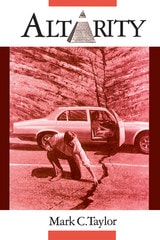
In Altarity, Taylor develops a genealogy of otherness and difference that is based on the principle of creative juxtaposition. Rather than relying on a historical or chronological survey of crucial moments in modern philosophical thinking, he explores the complex question of difference through the strategies of contrast, resonance, and design. Taylor brings together the work of thinkers as diverse as Hegel, Heidegger, Merleau-Ponty, Lacan, Bataille, Kristeva, Levinas, Blanchot, Derrida, and Kierkegaard to fashion a broad intellectual scheme.
Situated in an interdisciplinary discourse, Altarity signifies a harnessing of continental and American habits of intellectual thought and illustrates the singularity that emerges from such a configuration. As such, the book functions as a mirror of our intellectual moment and offers the academy a rigorous way of acknowledging the limitations of its own interpretive practices.
Altered Pasts
Counterfactuals in HistoryRichard J. Evans
Brandeis University Press, 2014
Altered Reading
Levinas and LiteratureJill Robbins
University of Chicago Press, 1999
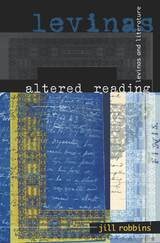
With an attitude at once respectful and interrogative, closely attentive to Levinas's texts while in dialogue with readings by Derrida, Blanchot, and Bataille, Altered Reading shows how the thread of the literary leads directly to the internal tensions of Levinas's ethical discourse. Jill Robbins provides a comprehensive critical account of Levinas's early and mature philosophy as well as later key transitional essays. In an invaluable appendix, she includes her own translation of an important, previously untranslated essay by Bataille on Levinas.
Altered Reading will interest philosophers, literary critics, scholars of religion, and others drawn to Levinas's work.
Alterity
Jean-Michel Oughourlian
Michigan State University Press, 2023
Alterity Politics
Ethics and Performative SubjectivityJeffrey T. Nealon
Duke University Press, 1998
While discussing the work of others who have refused to thematize difference in terms of the possibility or impossibility of sameness—Levinas, Butler, Derrida, Foucault, Deleuze, Guattari, Zizek, Jameson, Heidegger, Bakhtin—Nealon argues that ethics is constituted as inexorable affirmative response to different identities, not through an inability to understand or totalize the other. Alterity Politics combines this theoretical itinerary with crucial discussions of specific and diverse sites of literary and cultural production—the work of William S. Burroughs, Amiri Baraka, Andy Warhol, Ishmael Reed, Rush Limbaugh, and Vincent Van Gogh—along with analyses of the social formation of subjects as found in identity politics, and in multicultural and whiteness studies. In the process, Nealon takes on a wide variety of issues including white male anger, the ethical questions raised by drug addiction, the nature of literary meaning, and the concept of “becoming-black.”
In seeking to build an ethical structure around poststructuralist discourse and to revitalize the applied use of theoretical concepts to notions of performative identity, Alterity Politics marks a decisive intervention in literary theory, cultural studies, twentieth-century philosophy, and performance studies.
Althusser and His Contemporaries
Philosophy's Perpetual WarWarren Montag
Duke University Press, 2013
Althusser, The Infinite Farewell
Emilio de Ipola
Duke University Press, 2018

Always More Than One
Individuation's DanceErin Manning
Duke University Press, 2012

Ambient Media
Japanese Atmospheres of SelfPaul Roquet
University of Minnesota Press, 2016
Ambient Media examines music, video art, film, and literature as tools of atmospheric design in contemporary Japan, and what it means to use media as a resource for personal mood regulation. Paul Roquet traces the emergence of ambient styles from the environmental music and Erik Satie boom of the 1960s and 1970s to the more recent therapeutic emphasis on healing and relaxation.
Focusing on how an atmosphere works to reshape those dwelling within it, Roquet shows how ambient aesthetics can provide affordances for reflective drift, rhythmic attunement, embodied security, and urban coexistence. Musicians, video artists, filmmakers, and novelists in Japan have expanded on Brian Eno’s notion of the ambient as a style generating “calm, and a space to think,” exploring what it means to cultivate an ambivalent tranquility set against the uncertain horizons of an ever-shifting social landscape. Offering a new way of understanding the emphasis on “reading the air” in Japanese culture, Ambient Media documents both the adaptive and the alarming sides of the increasing deployment of mediated moods.
Arguing against critiques of mood regulation that see it primarily as a form of social pacification, Roquet makes a case for understanding ambient media as a neoliberal response to older modes of collective attunement—one that enables the indirect shaping of social behavior while also allowing individuals to feel like they are the ones ultimately in control.
America and the Political Philosophy of Common Sense
Scott Philip Segrest
University of Missouri Press, 2009
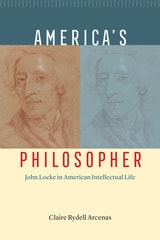
America's Philosopher
John Locke in American Intellectual LifeClaire Rydell Arcenas
University of Chicago Press, 2022
The influence of polymath philosopher John Locke (1632–1704) can still be found in a dizzying range of fields, as his writings touch on issues of identity, republicanism, and the nature of knowledge itself. Claire Rydell Arcenas’s new book tells the story of Americans’ longstanding yet ever-mutable obsession with this English thinker’s ideas, a saga whose most recent manifestations have found the so-called Father of Liberalism held up as a right-wing icon.
The first book to detail Locke’s trans-Atlantic influence from the eighteenth century until today, America’s Philosopher shows how and why interpretations of his ideas have captivated Americans in ways few other philosophers—from any nation—ever have. As Arcenas makes clear, each generation has essentially remade Locke in its own image, taking inspiration and transmuting his ideas to suit the needs of the particular historical moment. Drawing from a host of vernacular sources to illuminate Locke’s often contradictory impact on American daily and intellectual life from before the Revolutionary War to the present, Arcenas delivers a pathbreaking work in the history of ideas.
America's Philosopher
John Locke in American Intellectual LifeClaire Rydell Arcenas
University of Chicago Press, 2022
This is an auto-narrated audiobook edition of this book.
America’s Philosopher examines how John Locke has been interpreted, reinterpreted, and misinterpreted over three centuries of American history.
The influence of polymath philosopher John Locke (1632–1704) can still be found in a dizzying range of fields, as his writings touch on issues of identity, republicanism, and the nature of knowledge itself. Claire Rydell Arcenas’s new book tells the story of Americans’ longstanding yet ever-mutable obsession with this English thinker’s ideas, a saga whose most recent manifestations have found the so-called Father of Liberalism held up as a right-wing icon.
The first book to detail Locke’s trans-Atlantic influence from the eighteenth century until today, America’s Philosopher shows how and why interpretations of his ideas have captivated Americans in ways few other philosophers—from any nation—ever have. As Arcenas makes clear, each generation has essentially remade Locke in its own image, taking inspiration and transmuting his ideas to suit the needs of the particular historical moment. Drawing from a host of vernacular sources to illuminate Locke’s often contradictory impact on American daily and intellectual life from before the Revolutionary War to the present, Arcenas delivers a pathbreaking work in the history of ideas.
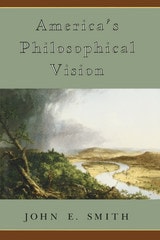
America's Philosophical Vision
John E. Smith
University of Chicago Press, 1992
American philosophers like Peirce, James, Royce, and
Dewey have forged a unique philosophical tradition—one
that is rich and complex enough to represent a genuine
alternative to the analytic, phenomenological, and
hermeneutical traditions which have originated in Britain
or Europe.
"In my judgment, John Smith has no equal today in
combining two scholarly qualities: the analysis of
philosophical texts with penetration and rigor, and the
discernment of what it is in these texts that matters.
These qualities are in evidence throughout the essays in
America's Philosophical Vision. Whether he is
evaluating Rorty's view of Dewey; the pragmatic theory of
experience and truth; theories of freedom, creativity,
and the self; Royce's conception of community; or
synoptic philosophic visions, Smith always succeeds in
uniting a comprehensive understanding of philosophic
writings with a sure grasp of their import for human
culture and aspiration. It is a great benefit to
students of American thought that these papers have now
been collected into one volume."—James Gouinlock, Emory
University
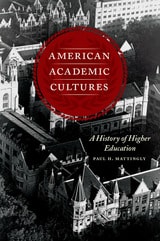
American Academic Cultures
A History of Higher EducationPaul H. Mattingly
University of Chicago Press, 2017
Mattingly sketches out seven broad generational cultures: evangelical, Jeffersonian, republican/nondenominational, industrially driven, progressively pragmatic, internationally minded, and the current corporate model. What we see through his close analysis of each of these cultures in their historical moments is that the politics of higher education, both inside and outside institutions, are ultimately driven by the dominant culture of the time. By looking at the history of higher education in this new way, Mattingly opens our eyes to our own moment, and the part its culture plays in generating its politics and promise.
American Corruption Talk
A Political EtymologyRobert G. Boatright and Molly Brigid McGrath
Temple University Press, 2025
Robert Boatright and Molly Brigid McGrath focus on the role corruption talk plays in American political discourse. They distinguish between two ways people speak about corruption—corruption talk in the style of a purifier, who wishes to expunge the evil forces or drain the swamp, and corruption talk in the style of the mender, who thinks of managing, replacing, or repairing.
American Corruption Talk begins by tracing how the concept of political corruption was developed by philosophers and political thinkers, leading up to its use in the American context, especially in the Progressive Era. It also compares modes of contemporary corruption talk in different areas of public life. In doing so, the authors hope to resolve confusion and partisan disagreements about what corruption is and to discourage the tendency to label actions, events, and ideas that we merely disagree with as corrupt.
American Examples, Vol 2
New Conversations about ReligionEdited by Samah Choudhury, Prea Persaud, and Michael J. Altman
University of Alabama Press, 2022
Fresh new perspectives on the study of religion, ranging from SoulCycle to Mark Twain
American Examples: New Conversations about Religion, Volume Two, is the second in a series of annual anthologies produced by the American Examples workshop hosted by the Department of Religious Studies at The University of Alabama. In the latest volume from this dynamic academic project, nine scholars with diverse topics and methodologies vividly reimagine the meaning of all three words in the phrase “American religious history.” The essays use case studies from America, broadly conceived, to ask trenchant theoretical questions that are of interest to scholars and students beyond the subfield of American religious history.
Cody Musselman uses a Weberian analysis to explore questions of identity, authority, and authenticity in the world of SoulCycle while Zachary T. Smith finds commonality between the rhetoric and practices of scholarship and mixed martial arts. Erik Kline provides a new perspective on the psychedelic mysticism of the 1960s, and Brook Wilensky-Lanford takes stock of the cultural power of parody in Mark Twain’s last work of fiction. Christopher Cannon Jones examines the reciprocal relationship between religious texts and cultural contexts by comparing early Mormon missions to Hawai‘i and Jamaica and Lindsey Jackson explores what debates over circumcision can tell us about gender stereotypes and motherhood. Dana Lloyd uses the 1988 Supreme Court decision in Lyng v. Northwest Indian Cemetery Protective Association as a case study in order to consider how Indigenous religion and sovereignty have been understood and adjudicated in the American legal system. Matt Sheedy studies the identity categories of “atheist” and “ex-Muslim” and Brad Stoddard uses ethnographic fieldwork to evaluate the role of religious pluralism in regulating and policing correctional institutions. Editors Samah Choudhury and Prea Persaud provide an introduction that reconsiders the trajectory of the American Examples project in light of the siege on the US Capitol in January 2021 and the continuing COVID pandemic.
Visit americanexamples.ua.edu for more information on upcoming workshop dates and future projects.
CONTRIBUTORS
Michael J. Altman / Samah Choudhury / Lindsey Jackson / Christopher Cannon Jones / / Erik Kline / Dana Lloyd / Cody Musselman / Prea Persaud / Matt Sheedy / Zachary T. Smith / Brad Stoddard / Brook Wilensky-Lanford
American Examples, Vol 4
New Conversations about ReligionEdited by Candace Lukasik, Joshua Urich, and Michael J. Altman
University of Alabama Press, 2025
Case studies that vividly reimagine the meaning and applications of American religious history
American Examples: New Conversations about Religion, Volume Four, continues the annual anthology series produced by the American Examples workshop at the University of Alabama’s Department of Religious Studies. The goal of American Examples is to examine examples of “something someone called religious, somewhere someone called America” by asking theoretical questions that exceed the boundaries of American religion or American religious history. This volume features seven essays exploring examples ranging from American Muslim headwear to online pickup artists to the connections between Dutch immigrants and Japanese students. This collection offers valuable insights for scholars and students within and beyond the field of American religious history.
Visit americanexamples.ua.edu for more information on upcoming workshop dates and future projects
American Exceptionalism
A New History of an Old IdeaIan Tyrrell
University of Chicago Press, 2022
The idea that the United States is unlike every other country in world history is a surprisingly resilient one. Throughout his distinguished career, Ian Tyrrell has been one of the most influential historians of the idea of American exceptionalism, but he has never written a book focused solely on it until now. The notion that American identity might be exceptional emerged, Tyrrell shows, from the belief that the nascent early republic was not simply a postcolonial state but a genuinely new experiment in an imperialist world dominated by Britain. Prior to the Civil War, American exceptionalism fostered declarations of cultural, economic, and spatial independence. As the country grew in population and size, becoming a major player in the global order, its exceptionalist beliefs came more and more into focus—and into question. Over time, a political divide emerged: those who believed that America’s exceptionalism was the basis of its virtue and those who saw America as either a long way from perfect or actually fully unexceptional, and thus subject to universal demands for justice. Tyrrell masterfully articulates the many forces that made American exceptionalism such a divisive and definitional concept. Today, he notes, the demands that people acknowledge America’s exceptionalism have grown ever more strident, even as the material and moral evidence for that exceptionalism—to the extent that there ever was any—has withered away.
American Literature and the Destruction of Knowledge
Innovative Writing in the Age of EpistemologyRonald E. Martin
Duke University Press, 1991
The works of Melville, Emerson, Whitman, and Dickinson, followed by Crane, Frost, Pound, Stein, Hemingway, Dos Passos, Aiken, Stevens, and Williams, are examined as part of a cultural current that casts doubt on the possibility of knowledge itself. The destruction of concepts, of literary and linguistic forms, was for these writers a precondition for liberating the imagination to gain more access to the self and the real world. As part of the exploration of this cultural context, literary and philosophical realisms are examined together, allowing a comparison of their somewhat different objectives, as well as their common epistemological predicament.
American Nietzsche
A History of an Icon and His IdeasJennifer Ratner-Rosenhagen
University of Chicago Press, 2011
If you were looking for a philosopher likely to appeal to Americans, Friedrich Nietzsche would be far from your first choice. After all, in his blazing career, Nietzsche took aim at nearly all the foundations of modern American life: Christian morality, the Enlightenment faith in reason, and the idea of human equality. Despite that, for more than a century Nietzsche has been a hugely popular—and surprisingly influential—figure in American thought and culture.
In American Nietzsche, Jennifer Ratner-Rosenhagen delves deeply into Nietzsche's philosophy, and America’s reception of it, to tell the story of his curious appeal. Beginning her account with Ralph Waldo Emerson, whom the seventeen-year-old Nietzsche read fervently, she shows how Nietzsche’s ideas first burst on American shores at the turn of the twentieth century, and how they continued alternately to invigorate and to shock Americans for the century to come. She also delineates the broader intellectual and cultural contexts within which a wide array of commentators—academic and armchair philosophers, theologians and atheists, romantic poets and hard-nosed empiricists, and political ideologues and apostates from the Left and the Right—drew insight and inspiration from Nietzsche’s claims for the death of God, his challenge to universal truth, and his insistence on the interpretive nature of all human thought and beliefs. At the same time, she explores how his image as an iconoclastic immoralist was put to work in American popular culture, making Nietzsche an unlikely posthumous celebrity capable of inspiring both teenagers and scholars alike.
A penetrating examination of a powerful but little-explored undercurrent of twentieth-century American thought and culture, American Nietzsche dramatically recasts our understanding of American intellectual life—and puts Nietzsche squarely at its heart.

American Orient
Imagining the East from the Colonial Era through the Twentieth CenturyDavid Weir
University of Massachusetts Press, 2011
Surveying the American fascination with the Far East since the mid-eighteenth century, this book explains why the Orient had a fundamentally different meaning in the United States than in Europe or Great Britain. David Weir argues that unlike their European counterparts, Americans did not treat the East simply as a site of imperialist adventure; on the contrary, colonial subjugation was an experience that early Americans shared with the peoples of China and India.
In eighteenth-century America, the East was, paradoxically, a means of reinforcing the enlightenment values of the West: Franklin, Jefferson, and other American writers found in Confucius a complement to their own political and philosophical beliefs. In the nineteenth century, with the shift from an agrarian to an industrial economy, the Hindu Orient emerged as a mystical alternative to American reality. During this period, Emerson, Thoreau, and other Transcendentalists viewed the “Oriental” not as an exotic other but as an image of what Americans could be, if stripped of all the commercialism and materialism that set them apart from their ideal. A similar sense of Oriental otherness informed the aesthetic discoveries of the early twentieth century, as Pound, Eliot, and other poets found in Chinese and Japanese literature an artistic purity and intensity absent from Western tradition. For all of these figures the Orient became a complex fantasy that allowed them to overcome something objectionable, either in themselves or in the culture of which they were a part, in order to attain some freer, more genuine form of philosophical, religious, or artistic expression.
American Power and International Theory at the Council on Foreign Relations, 1953-54
David M. McCourt, Editor
University of Michigan Press, 2020
Between December 1953 and June 1954, the elite think-tank the Council on Foreign Relations (CFR) joined prominent figures in International Relations, including Pennsylvania’s Robert Strausz-Hupé, Yale’s Arnold Wolfers, the Rockefeller Foundation’s William Thompson, government adviser Dorothy Fosdick, and nuclear strategist William Kaufmann. They spent seven meetings assessing approaches to world politics—from the “realist” theory of Hans Morgenthau to theories of imperialism of Karl Marx and V.I. Lenin—to discern basic elements of a theory of international relations.
The study group’s materials are an indispensable window to the development of IR theory, illuminating the seeds of the theory-practice nexus in Cold War U.S. foreign policy. Historians of International Relations recently revised the standard narrative of the field’s origins, showing that IR witnessed a sharp turn to theoretical consideration of international politics beginning around 1950, and remained preoccupied with theory. Taking place in 1953–54, the CFR study group represents a vital snapshot of this shift.
This book situates the CFR study group in its historical and historiographical contexts, and offers a biographical analysis of the participants. It includes seven preparatory papers on diverse theoretical approaches, penned by former Berkeley political scientist George A. Lipsky, followed by the digest of discussions from the study group meetings. American Power and International Theory at the Council on Foreign Relations, 1953–54 offers new insights into the early development of IR as well as the thinking of prominent elites in the early years of the Cold War.
American Public Philosophy and the Mystery of Lincolnism
Eric C. Sands
University of Missouri Press, 2009
Amythia
Crisis in the Natural History of Western CultureLoyal D. Rue
University of Alabama Press, 1989
Amythia results when cosmology and morality are not effectively integrated by a root metaphor, and the only possibility for the future is to transpose the old Christian God as Person to a root metaphor that is even older in origin, the concept of the Covenant tradition inherited from Israel but now understood in a nonsupernaturalist manner.
Rue asserts that amythia is a critical condition within the natural history of Western culture. The argument of the book begins with a theoretical perspective on the place of human culture within the scope of natural history and proceeds to establish the conceptual foundations for a natural history of culture.
Following an overview of the natural history of Western culture to expose the origins and depth of the contemporary intellectual and moral crisis, Rue moves on to specify and justify the limits of distinctiveness and plausibility appropriate for the task of transposing Covenant tradition. Finally, an appeal is made to the mythmakers of contemporary culture to take up the challenge of amythia.
An American Body | Politic
A Deleuzian ApproachBernd Herzogenrath
Dartmouth College Press, 2010
An Artificial History of Natural Intelligence
Thinking with Machines from Descartes to the Digital AgeDavid W. Bates
University of Chicago Press, 2024
We imagine that we are both in control of and controlled by our bodies—autonomous and yet automatic. This entanglement, according to David W. Bates, emerged in the seventeenth century when humans first built and compared themselves with machines. Reading varied thinkers from Descartes to Kant to Turing, Bates reveals how time and time again technological developments offered new ways to imagine how the body’s automaticity worked alongside the mind’s autonomy. Tracing these evolving lines of thought, An Artificial History of Natural Intelligence offers a new theorization of the human as a being that is dependent on technology and produces itself as an artificial automaton without a natural, outside origin.
An Ecology of Happiness
Eric Lambin
University of Chicago Press, 2012
In this clever and wide-ranging work, Lambin draws on new scientific evidence in the fields of geography, political ecology, environmental psychology, urban studies, and disease ecology, among others, to answer such questions as: To what extent do we need nature for our well-being? How does environmental degradation affect our happiness? What can be done to protect the environment and increase our well-being at the same time? Drawing on case studies from Asia, Africa, Europe, and North America, Lambin makes a persuasive case for the strong link between healthy ecosystems and happy humans.
Unique in its scope and evenhanded synthesis of research from many fields, An Ecology of Happiness offers a compelling human-centered argument that is impossible to overlook when we marvel at murmurations of starlings or seek out the most brilliant fall foliage: nature makes our steps a little lighter and our eyes a little brighter. What better reason to protect an ecosystem or save a species than for our own pleasure?
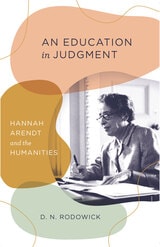
An Education in Judgment
Hannah Arendt and the HumanitiesD. N. Rodowick
University of Chicago Press, 2021
Rodowick takes after the theories of Hannah Arendt and argues that thinking is an art we practice with and for each other in our communities.
In An Education in Judgment, philosopher D. N. Rodowick makes the definitive case for a philosophical humanistic education aimed at the cultivation of a life guided by both self-reflection and interpersonal exchange. Such a life is an education in judgment, the moral capacity to draw conclusions alone and with others, and letting one’s own judgments be answerable to the potentially contrasting judgments of others. Thinking, for Rodowick, is an art we practice with and learn from each other on a daily basis.
In taking this approach, Rodowick follows the lead of Hannah Arendt, who made judgment the cornerstone of her conception of community. What is important for Rodowick, as for Arendt, is the cultivation of “free relations,” in which we allow our judgments to be affected and transformed by those of others, creating “an ever-widening fabric of intersubjective moral consideration.” That is a fragile fabric, certainly, but one that Rodowick argues is worth pursuing, caring for, and preserving. This original work thinks with and beyond Arendt about the importance of the humanities and what “the humanities” amounts to beyond the walls of the university.
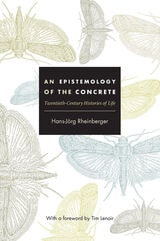
An Epistemology of the Concrete
Twentieth-Century Histories of LifeHans-Jörg Rheinberger
Duke University Press, 2010
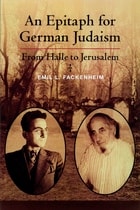
An Epitaph for German Judaism
From Halle to JerusalemEmil Fackenheim
University of Wisconsin Press, 2007
“An ‘epoch-making’ autobiography.”—Arnold Ages, Jewish Tribune

An Essay for Ezra
Racial Terror in AmericaGrant Farred
University of Minnesota Press, 2021
An intensely personal, and philosophical, account of why white America’s racial unconscious is not so unconscious
An Essay for Ezra is a critique of terror that begins but by no means ends with the presidency of Donald J. Trump. A father addresses his son and a boy shares his observations in a dynamic dialogistic exchange that is a commentary of and for its time, taking the measure of racial terror and of white supremacy both in our moment and as a historical phenomenon.
Framed through the experiences of the author’s biracial son, An Essay for Ezra is intensely personal while also powerfully universal. Drawing on the social and political thought of James Baldwin and Martin Luther King, Grant Farred examines the temptation and the perils of essentialism and the need to discriminate—to engage the black mind as much as the black body. With that dialectic as his starting point, Farred engages the ideas of Jameson, Barthes, Derrida, Adorno, Kant, and other thinkers to derive an ethics of being in our time of social peril. His antiessentialist racial analysis is salient, especially when he deploys Dave Chappelle as a counterpoint to Baldwin—and Chappelle’s brilliant comic philosophic voice jabs at both racial and gender identity.
Standing apart for its willingness to explore terror in all its ambivalence, this theoretical reflection on racism, knowledge, ethics, and being in our neofascist present brings to bear the full weight of philosophical inquiry and popular cultural critique on black life in the United States.

An Essay on African Philosophical Thought
Kwame Gyekye
Temple University Press, 1995
An Essay on Contraction
André Fuhrmann
CSLI, 1996
An Essay on Facts
Kenneth Russel Olson
CSLI, 1987
An Essay on Negation
For a Linguistic AnthropologyPaolo Virno
Seagull Books, 2018
As speaking animals, we continuously make use of an unassuming grammatical particle, without suspecting that what is at work in its inconspicuousness is a powerful apparatus, which orchestrates language, signification, and the world at large. What particle might this be? The word not.
In Essay on Negation, Paolo Virno argues that the importance of the not is perhaps comparable only to that of money—that is, the universality of exchange. Negation is what separates verbal thought from silent cognitive operations, such as feelings and mental images. Speaking about what is not happening here and now, or about properties that are not referable to a given object, the human animal deactivates its original neuronal empathy, which is prelinguistic; it distances itself from the prescriptions of its own instinctual endowment and accesses a higher sociality, negotiated and unstable, which establishes the public sphere. In fact, the speaking animal soon learns that the negative statement does not amount to the linguistic double of unpleasant realities or destructive emotions: while it rejects them, negation also names them and thus includes them in social life. Virno sees negation as a crucial effect of civilization, one that is, however, also always exposed to further regressions. Taking his cue from a humble word, the author is capable of unfolding the unexpected phenomenology of the negating consciousness.
An Essay on Philosophical Method
R.G. Collingwood
St. Augustine's Press, 2011
“My best book in matter, in style. I may call it my only book.”
An Essay on Philosophical Method contains the most sustained discussion in the twentieth century of the subject matter and method of philosophy and an unparalleled explanation of why philosophy has a distinctive domain of enquiry that differs from that of the sciences of nature.
Collingwood’s mature work of metaphysics seeks to overhaul the notion of philosophical method, assigning philosophy the task of “thinking out the idea of an object that shall completely satisfy the demands of reason.” The Essay is particularly interesting as an embodiment of the idealistic metaphysics Collingwood abandoned in later life.
This edition (a reprint of the 1933 edition) of the Essay focuses on Collingwood’s contribution to metaphilosophy and locates his argument for the autonomy of philosophy against the twentieth-century trend to naturalize its subject matter. Collingwood argues that the distinctions which philosophers make, for example, between the concepts of duty and utility in moral philosophy, or between the concepts of mind and body in the philosophy of mind, are not empirical taxonomies that cut nature at the joints but semantic distinctions to which there may correspond no empirical classes. This identification of philosophical distinctions with semantic distinctions provides the basis for an argument against the naturalization of the subject matter of philosophy for it entails that not all concepts are empirical concepts and not all classifications are empirical classifications. Collingwood’s explanation of why philosophy has a distinctive subject matter thus constitutes a clear challenge to the project of radical empiricism.
“One of the finest restatements in contemporary British philosophy of a Platonic and Hegelian metaphysic viewed from a modern standpoint.” – Times Literary Supplement
An Ethics of Interrogation
Michael Skerker
University of Chicago Press, 2010