Results by title
8113 books match the query 'Literary Criticism' and 619 start with a

African Hustler Narratives
E-Fraud Economy and Postmillennial CapitalismDaniel Chukwuemeka
University of Michigan Press, 2027
Across contemporary African literature, hustlers appear as online scammers, sex workers, undocumented migrants, and others who pursue self-advancement through unconventional or compromising means. African Hustler Narratives asks what these figures reveal when we look beyond the familiar discourse of morality or criminality. Daniel Chukwuemeka argues that the hustler’s pursuit of self-advancement through improvised means constitutes a response to structural exclusion from global capitalism, which a purely moral or criminal framing misses entirely.
Moving from earlier forms of hustling to the digital world of e-fraud, Chukwuemeka shows how African writers use these morally complicated figures to explore economic inequality and the difficult choices that arise when the neoliberal promise of opportunity collides with the realities of systemic exclusion. Chukwuemeka also extends the hustler motif to those who tell and study these stories. Though their work differs from the e-scammer’s, African writers and critics negotiate Global North publishing and academic valuation systems that reproduce the disparities they interrogate, making the e-scammer their doppelgänger.

African Literature in the Twentieth Century
O.R. Dathorne
University of Minnesota Press, 1976
African Literature in the Twentieth Century was first published in 1976. Minnesota Archive Editions uses digital technology to make long-unavailable books once again accessible, and are published unaltered from the original University of Minnesota Press editions.
This paperback makes available the major part of Professor Dathorne's The Black Mind.It concentrates on the writings of Africans in various African and European languages and provides insight, both broad and deep, into the Black intellect. Professor Dathorne examines the literature of Africans as spoken or written in their local languages and in French, Portuguese, and English. This extensive survey and interpretation gives the reader a remarkable pathway to an understanding of the Black imagination and its relevance to thought and creativity throughout the world.
The author himself lived in Africa for ten years, and his view is not that of an outsider, since it is as a Black man that he speaks about Black people. Throughout the book, a major theme is the demonstration that, despite slavery and colonialism, Africans remained very close to their own cultures. Professor Dathorne shows that African writers may be, like some Afro-American writers, "marginal men," but that they are Black men and it is as Black men that they feel the nostalgia of their past and the corrosive influences of their present.
O. R. Dathorne is a member of the Department of Black Studies and of the Department of English at Ohio State University. He has taught at universities in Nigeria and Sierra Leone and served as a UNESCO adviser in Sierra Leone. He also has taught at Ohio State University, Howard University, and the University of Wisconsin and lectured at Yale, Federal City College, Michigan State, and other universities in and out of the United States. He is the author of two novels and editor of a number of anthologies of Black literature, and has written widely in journals on his subject.
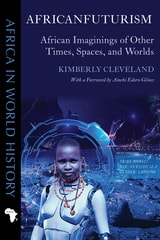
Africanfuturism
African Imaginings of Other Times, Spaces, and WorldsKimberly Cleveland
Ohio University Press, 2024
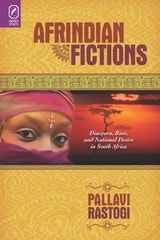
Afrindian Fictions
Diaspora, Race, and National Desire in South AfricaPallavi Rastogi
The Ohio State University Press, 2008
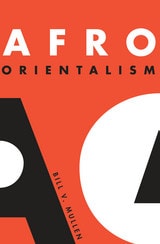
Afro Orientalism
Bill V. Mullen
University of Minnesota Press, 2004
Reveals a century of political solidarity uniting Asians and African Americans
As early as 1914, in his pivotal essay “The World Problem of the Color Line,” W. E. B. Du Bois was charting a search for Afro-Asian solidarity and for an international anticolonialism. In Afro-Orientalism, Bill Mullen traces the tradition of revolutionary thought and writing developed by African American and Asian American artists and intellectuals in response to Du Bois’s challenge.
Afro-Orientalism unfolds here as a distinctive strand of cultural and political work that contests the longstanding, dominant discourse about race and nation first fully named in Edward Said’s Orientalism. Mullen tracks Afro-Asian engagement with U.S. imperialism—including writings by Richard Wright, Grace and James Boggs, Robert F. Williams, and Fred Ho—and companion struggles against racism and capitalism around the globe. To this end, he offers Afro-Orientalism as an antidote to essentialist, race-based, or narrow conceptions of ethnic studies and postcolonial studies, calling on scholars in these fields to re-imagine their critical enterprises as mutually constituting and politically interdependent.
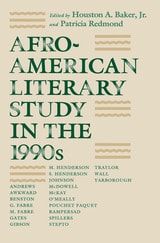
Afro-American Literary Study in the 1990s
Edited by Houston A. Baker Jr. and Patricia Redmond
University of Chicago Press, 1989
"This diverse and inspired collection . . . testifies to the Afro-Am academy's extraordinary vitality."—Voice Literary Supplement
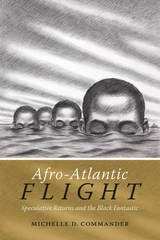
Afro-Atlantic Flight
Speculative Returns and the Black FantasticMichelle D. Commander
Duke University Press, 2017
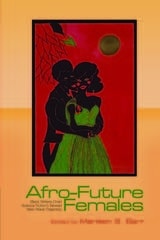
Afro-Future Females
Black Writers Chart Science Fiction's Newest New-Wave TrajectoryMarleen S. Barr
The Ohio State University Press, 2008
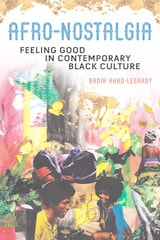
Afro-Nostalgia
Feeling Good in Contemporary Black CultureBadia Ahad-Legardy
University of Illinois Press, 2021
Badia Ahad-Legardy mines literature, visual culture, performance, and culinary arts to form an archive of black historical joy for use by the African-descended. Her analysis reveals how contemporary black artists find more than trauma and subjugation within the historical past. Drawing on contemporary African American culture and recent psychological studies, she reveals nostalgia’s capacity to produce positive emotions. Afro-nostalgia emerges as an expression of black romantic recollection that creates and inspires good feelings even within our darkest moments.
Original and provocative, Afro-Nostalgia offers black historical pleasure as a remedy to contend with the disillusionment of the present and the traumas of the past.
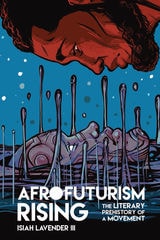
Afrofuturism Rising
The Literary Prehistory of a MovementIsiah Lavender III
The Ohio State University Press, 2019
By engaging with authors as diverse as Phillis Wheatley, David Walker, Frederick Douglass, Harriet Ann Jacobs, Samuel R. Delany Jr., Pauline Hopkins, Zora Neale Hurston, and Richard Wright, Afrofuturism Rising extends existing scholarly conversations about who creates and what is created via science fiction. Through a trans-historical rereading of texts by these authors as science fiction, Lavender highlights the ways black experience in America has always been an experience of spatial and temporal dislocation akin to science fiction. Compelling and ambitious in scope, Afrofuturism Rising redefines both science fiction and literature as a whole.
Afrofuturism and World Order
Reynaldo Anderson
The Ohio State University Press, 2025
Afrofuturism, Volume 20
Alondra Nelson
Duke University Press, 0
The collection includes a reflection on the ideologies of race created by cultural critics in their analyses of change wrought by the information age; an interview with Nalo Hopkinson, the award-winning novelist and author of speculative fiction novels Midnight Robber and Brown Girl in the Ring, who fuses futuristic thinking with Caribbean traditions; an essay on how contemporary R&B music presents African American reflections on the technologies of everyday life; and an article examining early interventions by the black community to carve out a distinct niche in cyberspace.
Contributors. Ron Eglash, Anna Everett, Tana Hargest, Nalo Hopkinson, Tracie Morris, Alondra Nelson, Kalí Tal, Fatimah Tuggar, Alexander G. Weheliye
Alondra Nelson is a Ph.D. candidate in the American Studies Program at New York University and is the Ann Plato Fellow at Trinity College. She will begin teaching in the African American Studies and Sociology Departments at Yale University in the fall of 2002.
Contributors. Ron Eglash, Anna Everett, Tana Hargest, Nalo Hopkinson, Alondra Nelson, Tracie Morris, Kali Tal, Fatimah Tuggar, Alexander G. Weheliye
Afrofuturisms
Ecology, Humanity, and Francophone Cultural ExpressionsIsaac Vincent Joslin
Ohio University Press, 2023
Afroindigenization
A Theory of Grassroots Cultural PracticeCatherine A. John
Duke University Press, 2026

After Brecht
British Epic TheaterJanelle G. Reinelt
University of Michigan Press, 1996
The book has been enriched by the author's in-depth conversations with the playwrights. The topics covered include contemporary politics and the theater, the National Theatre, the Royal Shakespeare Company, and such well-known fringe companies as Foco Novo, Joint Stock, Portable Theatre, and 7:84. Reinelt examines each playwright within an interpretive frame drawn from an application of Brecht's theories and practice to the historically specific situation of post-war British theater.
The book will appeal to those interested in the relationship between politics and art and contemporary European theater and its antecedents.
"After Brecht represents the best and most detailed engagement with the contemporary British theater scene to date." --Stanton B. Garner, Jr.
"This fine study . . . confronts issues that are important to all students and practitioners of the theater. Sensitive to the uniqueness of each of the playwrights in her study, Reinelt demonstrates that Brechtian theory can be modified in many ways by those who share the belief that 'politics and aesthetics are inseparably linked.'" --Choice
Janelle Reinelt is Chair of the Department of Dramatic Art and Dance, University of California-Davis.

After Capitalism
Science Fiction and the End of the End of the WorldJo Lindsay Walton
Lever Press, 2027
In After Capitalism, Jo Lindsay Walton uses speculative fiction to tackle some of the largest, most urgent, and strangest political questions of our time. Is climate science itself a speculative practice, even as it conveys some of the hardest facts we know? Does the end of capitalism require the end of money, or might money mutate into something new—a currency based on time, labor or reputation? As AI threatens to take over more aspects of social life, might we think of money itself as a kind of AI, one that could be reprogrammed? Why do ecological forms of calculation—from real world carbon credits to speculative energy currencies—fail to protect the planet that sustains us?
Drawing on the works of Edward Bellamy, Octavia Butler, Samuel R. Delany, Cory Doctorow, Ursula K. Le Guin, Yoon Ha Lee, Karen Lord, Malka Older, Nnedi Okorafor, Marge Piercy, Adam Roberts, Joanna Russ, Wole Talabi, and more, Walton explores whether science fiction can create space for fugitive dreams to thrive, or whether it serves merely as a laboratory for capitalism’s own reinvention.Weaving together literary criticism, critical political economy, and perspectives from the environmental humanities, After Capitalism argues that the worlds beyond capitalism are neither unimaginable nor entirely elsewhere.
After Empire
Scott, Naipaul, RushdieMichael Gorra
University of Chicago Press, 1997
Arguing against a model of cultural identity based on race, Gorra begins with Scott's portrait, in The Raj Quartet, of the character Hari Kumar—a seeming oxymoron, an "English boy with a dark brown skin," whose very existence undercuts the belief in an absolute distinction between England and India. He then turns to the opposed figures of Naipaul and Rushdie, the two great novelists of the Indian diaspora. Whereas Naipaul's long and controversial career maps the "deep disorder" spread by both imperialism and its passing, Rushdie demonstrates that certain consequences of that disorder, such as migrancy and mimicry, have themselves become creative forces.
After Empire provides engaging and enlightening readings of postcolonial fiction, showing how imperialism helped shape British national identity—and how, after the end of empire, that identity must now be reconfigured.
After Frost
An Anthology of Poetry from New EnglandHenry Lyman
University of Massachusetts Press, 1996
After Frost is published in association with the New England Foundation for the Humanities, which has sponsored a program of reading and discussion groups with poets across the region using this anthology.
After Representation?
The Holocaust, Literature, and CultureSpargo, R. Clifton
Rutgers University Press, 2010
As experts in the study of literature and culture, the scholars in this collection examine the shifting cultural contexts for Holocaust representation and reveal how writersùwhether they write as witnesses to the Holocaust or at an imaginative distance from the Nazi genocideùarticulate the shadowy borderline between fact and fiction, between event and expression, and between the condition of life endured in atrocity and the hope of a meaningful existence. What imaginative literature brings to the study of the Holocaust is an ability to test the limits of language and its conventions. After Representation? moves beyond the suspicion of representation and explores the changing meaning of the Holocaust for different generations, audiences, and contexts.

After Sex?
On Writing since Queer TheoryJanet Halley and Andrew Parker, eds.
Duke University Press, 2011
Contributors. Lauren Berlant, Leo Bersani, Michael Cobb, Ann Cvetkovich, Lee Edelman, Richard Thompson Ford, Carla Freccero, Elizabeth Freeman, Jonathan Goldberg, Janet Halley, Neville Hoad, Joseph Litvak, Heather Love, Michael Lucey, Michael Moon, José Esteban Muñoz, Jeff Nunokawa, Andrew Parker, Elizabeth A. Povinelli, Richard Rambuss, Erica Rand, Bethany Schneider, Eve Kosofsky Sedgwick, Kate Thomas
After Strange Texts
The Role of Theory in the Study of LiteratureGregory S. Jay and David L. Miller
University of Alabama Press, 1985
In this collection of essays by seven outstanding American scholars, interests as diverse as feminism, Marxism, deconstruction, and cultural poetics are brought together around a central question: how does the choice of a particular theory alter the practice of reading and do altered practices of reading in turn call forth more theory?
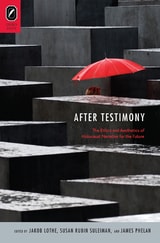
After Testimony
The Ethics and Aesthetics of Holocaust Narrative for the FutureEdited by Jakob Lothe, Susan Rubin Suleiman, and James Phelan
The Ohio State University Press, 2012
After Testimony: The Ethics and Aesthetics of Holocaust Narrative for the Future collects sixteen essays written with the awareness that we are on the verge of a historical shift in our relation to the Third Reich’s programmatic genocide. Soon there will be no living survivors of the Holocaust, and therefore people not directly connected to the event must assume the full responsibility for representing it. The contributors believe that this shift has broad consequences for narratives of the Holocaust. By virtue of being “after” the accounts of survivors, storytellers must find their own ways of coming to terms with the historical reality that those testimonies have tried to communicate. The ethical and aesthetic dimensions of these stories will be especially crucial to their effectiveness. Guided by these principles and employing the tools of contemporary narrative theory, the contributors analyze a wide range of Holocaust narratives—fictional and nonfictional, literary and filmic—for the dual purpose of offering fresh insights and identifying issues and strategies likely to be significant in the future. In addition to the editors, the contributors are Daphna Erdinast-Vulcan, Sidra DeKoven Ezrahi, Anniken Greve, Jeremy Hawthorn, Marianne Hirsch, Irene Kacandes, Phillipe Mesnard, J. Hillis Miller, Michael Rothberg, Beatrice Sandberg, Anette H. Storeide, Anne Thelle, and Janet Walker.

After The Grapes Of Wrath
Essays On John Steinbeck In Honor of Tetsumaro HayashiDonald V. Coers
Ohio University Press, 1994
Traditionally, the critical reputation of Nobel Prize-winning American novelist John Steinbeck (1902-1968) has rested on his achievements of the 1930s, especially In Dubious Battle (1936), Of Mice and Men (19370, The Long Valley (1938), and, of course, The Grapes of Wrath (1939), one of the most powerful – and arguable on of the greatest – American novels of this century.
Book reviewers and academic critics often turned antagonistic toward Steinbeck when he no longer produced work with the sweeping reach and social consciousness of The Grapes of Wrath. He was accused of selling out, or co-opting his talent, when in fact the inordinate public success of Grapes and especially its attendant notoriety had caused a backlash for Steinbeck. As a result he became self-conscious about his own ability, and suspicious of that “clumsy vehicle,” the novel. The very act of researching and writing Grapes, which occupied him fully for several years and which he had already conceived as his final book on proletarian themes, changed him drastically.
No longer willing to be the chronicler of Depression-era subjects, Steinbeck went afield to find new roots, new sources, new forms. For example, in the six years following the publication of Grapes, Steinbeck completed a suit of love poems; a full-length novel (bastardized by Alfred Hitchcock in his 1943 film, Lifeboat); a nonfiction scientific book, Sea of Cortez: A Leisurely Journal of Travel and Research (with Edward F. Ricketts); a documentary film, The Forgotten Village; a documentary book to help the war effort, Bombs Away: The Story of a Bomber Team; a series of articles he wrote as a war correspondent for the New York Herald Tribune (later collected as Once There Was a War); and two novels, The Moon Is Down and Cannery Row.
Steinbeck came to define himself less as a novelist and more as a man of letters, a restless experimenter with form and subject matter, and a prophetic postmodernist whose key subject for the rest of his career was the dilemma of individual choice and ethical consciousness. Thus, Steinbeck’s later fiction, from The Moon Is Down (1942) through The Winter of Our Discontent (1962), and his later nonfiction, from Sea of Cortez (1941) through Travels with Charley (1962) and America and Americans (1966), often shows a different set of stylistic, thematic, and philosophical bearings from his earlier work and underscores his dramatic shift toward “individual thinking.” A full appreciation of Steinbeck’s mid-career metamorphosis and, consequently, of his later achievement requires a corresponding shift in critical approach – a departure from the traditional New Critical norms. Instead of marginalizing these works, all the contributors to this volume agree that Steinbeck’s later publications merit – indeed, demand – closer scrutiny.
Written especially for this collection in honor of Professor Tetsumaro Hayashi, the distinguished founder and editor-in-chief of the Steinbeck Quarterly, on his retirement from Ball State University and his move to Kwassui Women’s College in Nagasaki, Japan, these essays explore new ways of addressing Steinbeck’s later work and career, and include forays into subjects as diverse as ethnicity and music. They range from treatment of his post-structuralist use of language in Sea of Cortez and his involvement as a speech writer for Franklin Delano Roosevelt’s reelection bid in 1944 to the influence of Charles Darwin’s theories of sexual selection in The Wayward Bus, his revision of the myth of Cain in The Winter of Our Discontent, and his employment of Arthurian quest values in his last book, America and Americans.
For this group of critics – which includes respected veteran Steinbeck scholars Robert DeMott, John Ditsky, Mimi Gladstein, Cliff Lewis, Robert Morsberger, Susan Shillinglaw, and Roy Simmonds, as well as talented new voices Debra Barker, Kevin Hearle, Michael Meyer, Brian Railsback, Eiko Shiraga, and Geralyn Strecker – The Moon is Down and The Wayward Bus loom as significant works in the post 1930s re-evaluation (two essays each appear on these works). The book also includes Donald Coers’s interview with the writer’s widow, Elaine Steinbeck, the first of its kind ever published. After The Grapes of Wrath opens with eminent Americanist Warren French’s appreciation of Professor Hayashi’s distinguished career and his influence in Steinbeck studies; a bibliography of Hayashi’s major publication concludes this honorary gathering.
After Transformation
A Lyrical History of Christian Late AntiquityMaia Kotrosits
Duke University Press, 2025
After the Death of Literature
Richard B. Schwartz
Southern Illinois University Press, 1997
Calling Samuel Johnson the greatest literary critic since Aristotle, Richard B. Schwartz assumes the perspective of that quintessential eighteenth-century man of letters to examine the critical and theoretical literary developments that gained momentum in the 1970s and stimulated the culture wars of the 1980s and 1990s.
Schwartz speculates that Johnson—who revered hard facts, a wide cultural base, and common sense—would have exhibited scant patience with the heavily academic approaches currently favored in the study of literature. He considers it probable that the combatants in the early struggles of the culture wars are losing energy and that, in the wake of Alvin Kernan’s declaration of the death of literature, new battlegrounds are developing. Ironically admiring the orchestration and staging of battles old and new—"superb" he calls them—he characterizes the entire cultural war as a "battle between straw men, carefully constructed by the combatants to sustain a pattern of polarization that could be exploited to provide continuing professional advancement."
In seven diverse essays, Schwartz calls for both the broad cultural vision and the sanity of a Samuel Johnson from those who make pronouncements about literature. Running through and unifying these essays is the conviction that the cultural elite is clearly detached from life: "Academics, fleeing in horror from anything smacking of the bourgeois, offer us something far worse: bland sameness presented in elitist terms in the name of the poor." Another theme is that the either/or absolutism of many of the combatants is "absurd on its face [and] belies the complexities of art, culture, and humanity."
Like Johnson, Schwartz would terminate the divorce between literature and life, make allies of literature and criticism, and remove poetry from the province of the university and return it to the domain of readers. Texts would carry meaning, embody values, and have a serious impact on life.
After the End of History
American Fiction in the 1990sCohe, Samuel
University of Iowa Press, 2009
In this bold book, Samuel Cohen asserts the literary and historical importance of the period between the fall of the Berlin wall and that of the Twin Towers in New York. With refreshing clarity, he examines six 1990s novels and two post-9/11 novels that explore the impact of the end of the Cold War: Pynchon's Mason & Dixon, Roth's American Pastoral, Morrison's Paradise, O'Brien's In the Lake of the Woods, Didion's The Last Thing He Wanted, Eugenides's Middlesex, Lethem's Fortress of Solitude, and DeLillo's Underworld. Cohen emphasizes how these works reconnect the past to a present that is ironically keen on denying that connection. Exploring the ways ideas about paradise and pastoral, difference and exclusion, innocence and righteousness, triumph and trauma deform the stories Americans tell themselves about their nation’s past, After the End of History challenges us to reconsider these works in a new light, offering fresh, insightful readings of what are destined to be classic works of literature.
At the same time, Cohen enters into the theoretical discussion about postmodern historical understanding. Throwing his hat in the ring with force and style, he confronts not only Francis Fukuyama’s triumphalist response to the fall of the Soviet Union but also the other literary and political “end of history” claims put forth by such theorists as Fredric Jameson and Walter Benn Michaels. In a straightforward, affecting style, After the End of History offers us a new vision for the capabilities and confines of contemporary fiction.
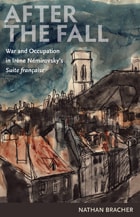
After the Fall
War and Occupation in Irène Némirovsky's Suite françaiseNathan Bracher
Catholic University of America Press, 2010
After the Future
The Paradoxes of Postmodernism & Contemporary Russian CultureMikhail N. Epstein
University of Massachusetts Press, 1995
This book brings together for the first time in English the major writings of Mikhail Epstein, one of post-Soviet Russia's most prominent theoreticians of cultural studies and postmodernism. Written from a non-Western point of view yet informed by a familiarity with Western literary theory, it offers a fresh, lucid perspective on the post-communist literary scene as well as a practical and theoretical introduction to the new discipline of Russian “culturology.”
After the Irish Renaissance
A Critical History of the Irish Drama since The Plough and The StarsRobert Hogan
University of Minnesota Press, 1967
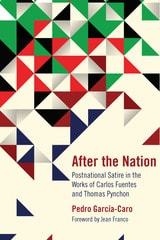
After the Nation
Postnational Satire in the Works of Carlos Fuentes and Thomas PynchonPedro García-Caro Foreword by Jean Franco
Northwestern University Press, 2014
After the Nation proposes a series of groundbreaking new approaches to novels, essays, and short stories by Carlos Fuentes and Thomas Pynchon within the framework of a hemispheric American studies. García-Caro offers a pioneering comparativist approach to the contemporary American and Mexican literary canons and their underlying nationalist encodement through the study of a wide range of texts by Pynchon and Fuentes which question and historicize in different ways the processes of national definition and myth-making deployed in the drawing of literary borders. After the Nation looks at these literary narratives as postnational satires that aim to unravel and denounce the combined hegemonic processes of modernity and nationalism while they start to contemplate the ensuing postnational constellations. These are texts that playfully challenge the temporal and spatial designs of national themes while they point to and debase “holy” borders, international borders as well as the internal lines where narratives of nation are embodied and consecrated.
After the New Criticism
Frank Lentricchia
University of Chicago Press, 1981
Lentricchia's critical intention is in evidence in his sustained attack on the more or less hidden formalist premises inherited from the New Critical fathers. Even in the name of historical consciousness, he contends, contemporary theorists have often cut literature off from social and temporal processes. By so doing he believes that they have deprived literature of its relevant values and turned the teaching of both literature and theory into a rarefied activity. All along the way, with the help of such diverse thinkers as Saussure, Barthes, Foucault, Derrida, and Bloom, Lentricchia indicates a strategy by which future critical theorists may resist the mandarin attitudes of their fathers.
After the Whale
Melville in the Wake of Moby-DickClark Davis
University of Alabama Press, 1995
Beyond Moby-Dick: Reinterpreting Melville's later works through language, embodiment, and literary transformation.
The study focuses on Melville’s vision of the purpose and function of language from Moby-Dick through Billy Budd with a special emphasis on how language—in function and form—follows and depends on the function and form of the body, how Melville’s attitude toward words echoes his attitude toward fish. Davis begins by locating and describing the fundamental dialectic formulated in Moby-Dick in the characters of Ahab and Ishmael. This dialectic produces two visions of bodily reality and two corresponding visions of language: Ahab’s, in which language is both weapon and substitute body, and Ishmael’s, in which language is an extension of the body—a medium of explanation, conversation, and play. These two forms of language provide a key to understanding the difficult relationships and formal changes in Melville’s writings after Moby-Dick.
By following each work’s attitude toward the dialectic, we can see the contours of the later career more clearly and so begin a movement away from weakly contextualized readings of individual novels and short stories to a more complete consideration of Melville’s career. Since the rediscovery of Herman Melville in the early decades of this century, criticism has been limited to the prose in general and to a few major works in particular.
Those who have given significant attention to the short fiction and poetry have done so frequently out of context, that is, in multi-author works devoted exclusively to these genres. The result has been a criticism with large gaps, most especially for works from Melville’s later career. The relative lack of interest in the poetry has left us with little understanding of how Melville’s later voices developed, of how the novels evolved into tales, the tales into poetry, and the poetry back into prose. In short, the development of Melville’s art during the final three decades of his life remains a subject of which we have been afforded only glimpses, rarely a continuous attention. After the Whale provides a new, more comprehensive understanding of Melville’s growth as a writer.
Afterlives of Modernism
Liberalism, Transnationalism, and Political CritiqueJohn Carlos Rowe
Dartmouth College Press, 2015
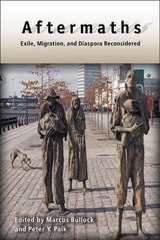
Aftermaths
Exile, Migration, and Diaspora ReconsideredBullock, Marcus
Rutgers University Press, 2008
Marcus Bullock and Peter Y. Paik, in bringing this collection together, show we have reached a moment in history when it is imperative to question prevailing intellectual models. The interconnectedness of the world's economies, the contributors argue, can exacerbate existing antagonisms or create new ones. With essays by Ihab Hassan, Paul Brodwin, and Helen Fehervary, among others, Aftermaths engages not only with important academic topics but also with the leading political issues of the day.

Afterwords
Letters on the Death of Virginia WoolfOldfield, Sybil
Rutgers University Press, 2005
On 28 March, 1941, at the height of Hitler's victories during the Second World War, Virginia Woolf filled her pockets with stones and drowned herself in the River Ouse near her home in Sussex. At the time of her death some voices in the press attacked her for showing cowardice in the face of the enemy and for setting a bad example to the general population. Woolf's suicide has been the subject of controversy for the media, for literary scholars, and for her biographers ever since.
Just when it may seem that nothing else could be said about Virginia Woolf and the ambiguous details of her suicide, Afterwords provides an entirely fresh perspective. It makes available to a wide readership for the first time letters sent to Leonard Woolf and Vanessa Bell (Virginia Woolf's sister) in the aftermath of the event. This unique volume brings together over two hundred letters from T. S. Eliot, H. G. Wells, May Sarton, Vita Sackville-West, Edith Sitwell, E. M. Forster, Radclyffe Hall, and many others, including political figures and religious leaders. In addition, informative annotations reveal the identities of many unexpected condolence-letter writers from among the general public.
In her introduction, editor Sybil Oldfield confronts the contemporary controversy over Woolf's suicide note, arguing that no one who knew Woolf or her work believed that she had deserted Britain. The ensuing collection of letters supports Oldfield's assertion. In elegant prose that rises to the stature of the occasion, these writers share remembrances of Virginia Woolf in life, comment on the quality of her work and her antifascist values, and reveal previously unknown facets of her capacity for friendship.
A richly deserved tribute to the life of an extraordinary woman as well as a testimony to the human capacity for sympathy, Afterwords is essential reading for anyone interested in the life, death, and enduring impact of Virginia Woolf.
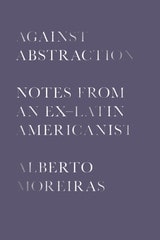
Against Abstraction
Notes from an Ex-Latin AmericanistBy Alberto Moreiras
University of Texas Press, 2020
In 2015, members of the philosophy department at the University of Madrid conducted an interview with Alberto Moreiras for the university’s digital archive. The resulting dialogues and the Spanish edition of this work, Marranismo e inscripción, o el abandono de la conciencia desdichada, are the basis for Against Abstraction, supplemented with an interview conducted for the Chilean journal Papel máquina. In these landmark conversations, Moreiras describes how, though he was initially committed to Latin American literary studies, he eventually transitioned to become an eminent scholar of critical theory, existential philosophy, and ultimately infrapolitics and posthegemony.
Blending intellectual autobiography with a survey of Hispanism as practiced in universities in the United States (including the schisms in Latin American subaltern studies that eventually led to Moreiras’s departure from Duke University), these narratives read like a picaresque and a polemic on the symbolic power of scholars. Drawing on the concept of marranism (originally a term for Iberian Jews and Muslims forced to convert to Christianity during the Middle Ages) to consider the situations and allegiances he has navigated over the years, Moreiras has produced a multifaceted self-portrait that will surely spark further discourse.

Against Exclusion
Disrupting Anti-Chinese Violence in the Nineteenth CenturyAudrey Wu Clark
The Ohio State University Press, 2024
In Against Exclusion, Audrey Wu Clark dramatically reframes Asian American resistance via the lives of five early Chinese American public figures. In contrast to later activists who sought to defy stereotypes, Ah Toy, Mary Tape, Wong Chin Foo, Yan Phou Lee, and Yung Wing deployed the model minority and yellow peril tropes to make themselves visible during a period of rampant anti-Chinese violence and legal exclusion. In making themselves visible, they sought to expose and dismantle the contradictory exceptionalism of nineteenth-century US liberalism that both required and “disavowed” the deaths of Chinese Americans. In examining these figures and the ways in which they fought their exclusion as Chinese Americans—via court cases, autobiographical writings, journalism, and other forms of activism—Clark contributes to prevailing scholarly conversations about stereotypes of Asian Americans but contextualizes them in the nineteenth century. She traces the twinned emergences of the model minority and the yellow peril, excavating the exceptionalism with which Chinese Americans were racialized and subject to death—whether by lynching, other forms of driving out, or loss of citizenship or rights—and mapping its reverberations into the present day.

Against Expression
An Anthology of Conceptual WritingCraig Dworkin and Kenneth Goldsmith
Northwestern University Press, 2011
Charles Bernstein has described conceptual poetry as "poetry pregnant with thought." Against Expression, the premier anthology of conceptual writing, presents work that is by turns thoughtful, funny, provocative, and disturbing. Dworkin and Goldsmith, two of the leading spokespersons and practitioners of conceptual writing, chart the trajectory of the conceptual aesthetic from early precursors including Samuel Beckett and Marcel Duchamp to the most prominent of today’s writers. Nearly all of the major avant-garde groups of the past century are represented here, including Dada, OuLiPo, L=A=N=G=U=A=G=E, and Flarf to name just a few, but all the writers are united in their imaginative appropriation of found and generated texts and their exploration of nonexpressive language. Against Expression is a timely collection and an invaluable resource for readers and writers alike.
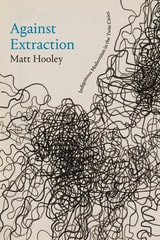
Against Extraction
Indigenous Modernism in the Twin CitiesMatt Hooley
Duke University Press, 2024
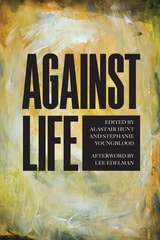
Against Life
Edited by Alastair Hunt and Stephanie Youngblood, with an afterword by Lee Edelman
Northwestern University Press, 2015
The contributors to Against Life think critically about the turn to life in theory and culture and especially about its redemptive tendencies. Editors Alastair Hunt and Stephanie Youngblood shape their collection to provocatively challenge an assumption rife in the humanities, mainly that the idea of redeeming life might hinder important ethical conversations.
They and their contributors question whether it is intelligent—or even necessary— to orient our collective ethico-political projects from figures of life, and to posit forms of equality and freedom that might emerge if we did not organize being-together under the sign of life. Taken together the essays in Against Life mark an important turn in the ethico-political work of the humanities.
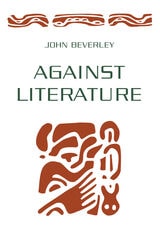
Against Literature
John Beverley
University of Minnesota Press, 1993
Is there a way of thinking about literature that is “outside” or “against” literature? In Against Literature, John Beverly brilliantly responds to this question, arguing for a negation of the literary that would allow nonliterary forms of cultural practice to displace literature’s hegemony.
Reminding us that most contemporary theorist speak today of literature with historically and socially specific conditions of production and reading formations, Beverley begins with a provocative exploration of Latin American literature, which he says the legacy of Columbus (discovery, conquest, and colonization) has endowed with an ambiguous cultural function, making it both a colonial institution and a historical agent of nation formation. He moves from this consideration to an extensive discussion of the postcolonial testimonio, poised between literature and the dynamics of subaltern culture. Beverley’s demonstration of how the internal logic that has always driven the dominant conception f literature must of necessity explode int cultural politics is a significant intervention into current debates about cultural studies, the canon, and multiculturalism.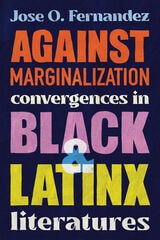
Against Marginalization
Convergences in Black and Latinx LiteraturesJose O. Fernandez
The Ohio State University Press, 2022
Against Normalization
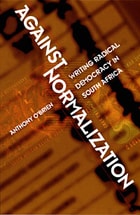
Writing Radical Democracy in South AfricaAnthony O'Brien
Duke University Press, 2001
O’Brien brings together an unusual array of contemporary South African writing: cultural theory and debate, worker poetry, black and white feminist writing, Black Consciousness drama, the letters of exiled writers, and postapartheid fiction and film. Paying subtle attention to well-known figures like Nadine Gordimer, Bessie Head, and Njabulo Ndebele, but also foregrounding less-studied writers like Ingrid de Kok, Nise Malange, Maishe Maponya, and the Zimbabwean Dambudzo Marechera, he reveals in their work the construction of a political aesthetic more radically democratic than the current normalization of nationalism, ballot-box democracy, and liberal humanism in culture could imagine. Juxtaposing his readings of these writers with the theoretical traditions of postcolonial thinkers about race, gender, and nation like Paul Gilroy, bell hooks, and Gayatri Spivak, and with others such as Samuel Beckett and Vaclav Havel, O’Brien adopts a uniquely comparatist and internationalist approach to understanding South African writing and its relationship to the cultural settlement after apartheid.
With its appeal to specialists in South African fiction, poetry, history, and politics, to other Africanists, and to those in the fields of colonial, postcolonial, race, and gender studies, Against Normalization will make a significant intervention in the debates about cultural production in the postcolonial areas of global capitalism.
Against Racism
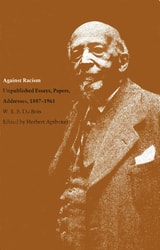
Unpublished Essays, Papers, Addresses, 1887–1961W.E.B. Du Bois
University of Massachusetts Press, 1985
A collection of essays, papers, and addresses which explains the author's views on racism.
Against Theory
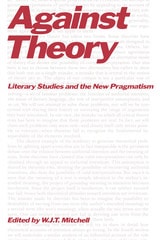
Literary Studies and the New PragmatismW. J. T. Mitchell
University of Chicago Press, 1985
The argument is directed against both sides of the current debates in literary theory, criticizing theoretical "objectivists" like E. D. Hirsch, Jr., on the one hand, and proponents of indeterminacy like Paul de Man on the other. The attack is not just on a particular way of doing theory but on the entire project of literary theory. The challenge is not only to a way of thinking and writing but to a way of making a living.
The resulting controversy has drawn so much attention among literary critics that it has been collected in a single volume so that the debate can be followed from start to finish. This collection includes the essay "Against Theory," seven responses to it, and a rejoinder by Knapp and Michaels (originally published in Critical Inquiry 9:4); in addition, there are two new statements plus a final reply by Knapp and Michaels.
The debate chronicled in this volume raises the most fundamental issues in the theory of meaning and the practice of interpretation. Are Knapp and Michaels confronting literary theory with a new "pragmatic" form of theory? Or are they (as some of their respondents suggest) arguing for a new form of nihilism? "If it is a nihilism," writes editor W. J. T. Mitchell, "it is one that demands an answer, not easy polemical dismissal, one that calls for theory to clarify its claims, not to mystify them and the easy assurance of intellectual fashion and institutional authority." It is the intention of Against Theory to aid in that clarification.
Against a Sharp White Background
Infrastructures of African American PrintEdited by Brigitte Fielder and Jonathan Senchyne
University of Wisconsin Press, 2019
Against the Avant-Garde
Pier Paolo Pasolini, Contemporary Art, and NeocapitalismAra H. Merjian
University of Chicago Press, 2020
Against the Closet
Black Political Longing and the Erotics of RaceAliyyah I. Abdur-Rahman
Duke University Press, 2012
Abdur-Rahman brings black feminist, psychoanalytic, critical race, and poststructuralist theories to bear on literary genres from slave narratives to science fiction. Analyzing works by African American writers, including Frederick Douglass, Pauline Hopkins, Harriet Jacobs, James Baldwin, and Octavia Butler, she shows how literary representations of transgressive sexuality expressed the longings of African Americans for individual and collective freedom. Abdur-Rahman contends that those representations were fundamental to the development of African American forms of literary expression and modes of political intervention and cultural self-fashioning.
Against the Gallows
Antebellum American Writers and the Movement to Abolish Capital PunishmentPaul C. Jones
University of Iowa Press, 2011
In Against the Gallows, Paul Christian Jones explores the intriguing cooperation of America’s writers—including major figures such as Walt Whitman, John Greenleaf Whittier, E. D. E. N. Southworth, and Herman Melville—with reformers, politicians, clergymen, and periodical editors who attempted to end the practice of capital punishment in the United States during the 1840s and 1850s. In an age of passionate reform efforts, the antigallows movement enjoyed broad popularity, waging its campaign in legislatures, pulpits, newspapers, and literary journals.
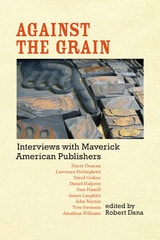
Against the Grain
Interviews with Maverick American PublishersRobert Dana
University of Iowa Press, 1986
Against the Grain is a collection of interviews with nine small press publishers, each one characterized by strength of resolve and a dedication to good books. Each press reflects, perhaps more directly than any large trade publisher could, the character of its founder; and each has earned its own place in the select group of important small presses in America.
This collection is the first of its kind to explore with the publishers themselves the historical, aesthetic, practical, and personal impulses behind literary publishing. The publishers included are Harry Duncan (the Cummington Press), Lawrence Ferlinghetti (City Lights), David Godine (David R. Godine), Daniel Halpern (the Ecco Press), Sam Hamill and Tree Swenson (Copper Canyon Press), James Laughlin (New Directions), John Martin (Black Sparrow), and Jonathan Williams (the Jargon Society). Their passion for books, their belief in their individual visions of what publishing is or could be, their inspired mulishness crackle on the page.