Results by title
3258 books match the query 'Art' and 405 start with a

Art and the Academy in the Nineteenth Century
Rafael Cardoso Denis
Rutgers University Press, 2000
"Intellectually broad and carefully grounded in fundamental issues affecting the time, role, and place of the academy in society, this collection explores the ways in which art and tradition are either maintained or rearticulated late in the Victorian Era. Art and the Academy forges a distinctive new way to look at the broad range of academic creativity against a complex network of changing social patterns." -Gabriel P. Weisberg, department of art history, University of Minnesota
Throughout the nineteenth century, academies functioned as the main venues for the teaching, promotion, and display of art. Contemporary scholars have, for the most part, denigrated academic art, calling it formulaic, unoriginal, and repetitious. The contributors to Art and the Academy in the Nineteenth Century challenge this entrenched notion and consider how academies worldwide have represented an important system of artistic preservation and transmission. Their essays eschew easy binaries that have reigned in academia for over half a century and that simply oppose the avant-garde to academism.
The essayists uncover the institutional structures and artistic practices of academies in England, France, Germany, and Brazil. Investigating artistic protocols across national and cultural boundaries, the scholars examine the relationship between artistic training and cultural identity. Their essays provide new insights into the ways in which institutions of art helped shape the nineteenth century's view of itself as an age of civilization amidst the turmoil of rapid social and cultural change. With an engaging mix of works by leading scholars, Art and the Academy will be essential reading for anyone interested in the artistic, cultural, and social history of the nineteenth century.
Rafael Cardoso Denis is adjunct professor (visiting) at the Escola Superior de Desenho Industrial (Universidade do Estado do Rio de Janeiro). Colin Trodd is senior lecturer in art history at the University of Sunderland.
.
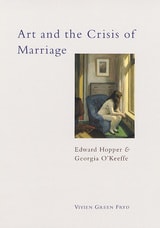
Art and the Crisis of Marriage
Edward Hopper and Georgia O'KeeffeVivien Green Fryd
University of Chicago Press, 2002
Vivien Green Fryd argues that this crisis played a crucial role in the lives and works of two of America's most familiar and beloved artists, Georgia O'Keeffe (1887-1986) and Edward Hopper (1882-1967). Combining biographical study of their marriages with formal and iconographical analysis of their works, Fryd shows how both artists expressed the pleasures and perils of their relationships in their paintings. Hopper's many representations of Victorian homes in sunny, tranquil landscapes, for instance, take on new meanings when viewed in the context of the artist's own tumultuous marriage with Jo and the widespread middle-class fears that the new urban, multidwelling homes would contribute to the breakdown of the family. Fryd also persuasively interprets the many paintings of skulls and crosses that O'Keeffe produced in New Mexico as embodying themes of death and rebirth in response to her husband Alfred Stieglitz's long-term affair with Dorothy Norman.
Art and the Crisis of Marriage provides both a penetrating reappraisal of the interconnections between Georgia O'Keeffe's and Edward Hopper's lives and works, as well as a vivid portrait of how new understandings of family, gender, and sexuality transformed American society between the wars in ways that continue to shape it today.
Art and the Higher Life
Painting and Evolutionary Thought in Late Nineteenth-Century AmericaBy Kathleen Pyne
University of Texas Press, 1996
Art and the Market
Roger Fry on Commerce in Art, Selected Writings, Edited with an InterpretationCraufurd D. Goodwin
University of Michigan Press, 1998
Art and the Public Sphere
Edited by W. J. T. Mitchell
University of Chicago Press, 1992
With contributions from the arts, philosophy, criticism, and the law, the thirteen essays in this volume explore the aesthetic, social, and political dynamics that make contemporary public art so controversial, and that that have placed recent art work at the center of public debates.
Contributors include Vito Acconci, "Public Space in a Private Time"; Agnes Denes, "The Dream"; W. J. T. Mitchell, "The Violence of Public Art: Do the Right Thing"; Ben Nicholson, "Urban Poises"; Michael North, "The Public as Sculpture: From Heavenly City to Mass Ornament"; Barbara Kruger, in an interview with W. J. T. Mitchell; Barbara Hoffman, "Law for Art's Sake in the Public Realm"; Richard Serra, "Art and Censorship"; James E. Young, "The Counter-Monument: Memory Against Itself in Germany Today": Charles Griswold, "The Vietnam Veterans Memorial and the Washington Mall: Philosophical Thoughts on Political Iconography"; John Hallmark Neff, "Daring to Dream"; and David Antin and Virginia Maksymowicz.
Presenting a balance of theoretical and performative essays by both critics and artists, this book will provide deep and discordant analyses of contemporary public art for general readers, as well as students and scholars of art, architecture, and public policy related to the arts.
Most of these articles originally appeared in the journal Critical Inquiry.
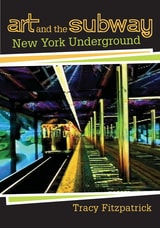
Art and the Subway
New York UndergroundFitzpatrick, Tracy
Rutgers University Press, 2009
Fitzpatrick captures the emotions of artists and riders alike, as she explores paintings, photographs, performance art, graffiti, and public art by artists such as Walker Evans, Bruce Davidson, DONDI, Keith Haring, Yayoi Kusama, Jacob Lawrence, Reginald Marsh, Elizabeth Murray, and many others. She also considers representations of the subway in film, on song sheet covers, and in illustration. By examining the cultural, technological, and social contexts for these creative interpretations, Fitzpatrick illuminates in fresh ways the contradictions and harmonies between public and private space.
Featuring 17 color plates and 80 black-and-white images, Art and the Subway takes readers on a fascinating ride through the visual history of one of the twentieth century's greatest urban planning endeavors as it grew, changed form, and reinvented itself with passion and vitality.
Art as Information Ecology
Artworks, Artworlds, and Complex Systems AestheticsJason Hoelscher
Duke University Press, 2021

Art as Research
Opportunities and ChallengesEdited by Shaun McNiff
Intellect Books, 2013
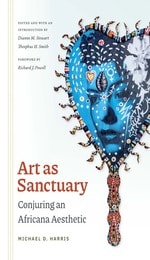
Art as Sanctuary
Conjuring an Africana AestheticMichael D. Harris. Edited and with an introduction by Dianne M. Stewart and Theophus H. Smith. Foreword by Richard J. Powell.
Duke University Press, 2026
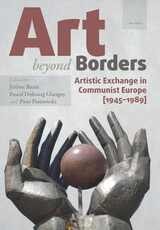
Art beyond Borders
Artistic Exchange in Communist Europe (1945-1989)Jérôme Bazin
Central European University Press, 2016
Art beyond Itself
Anthropology for a Society without a Story LineNéstor García Canclini
Duke University Press, 2014
Art during Wartime
Painting Everyday Life in the Civil War NorthVanessa Meikle Schulman
University of Massachusetts Press, 2024
While the Civil War raged on, many northern artists depicted everyday life rather than grand battles or landscapes of noble sacrifice. Amidst a conflict that was upending antebellum social norms, these artists created realistic scenes of mundane events, known as genre paintings. While many of the paintings seem merely to show everyday incidents, Vanessa Meikle Schulman argues that artists connected the visuals to larger concerns.
With attention to how the war shaped new definitions of gender, race, and disability, Art during Wartime uncovers the complexity of these genre paintings. Schulman uses seven case studies of prominent and lesser-known artists who explored how the war instigated social change and shaped northern opinions about current events, including George Cochran Lambdin, Vincent Colyer, and Eastman Johnson. Utilizing detailed visual analysis and extensive historical research, Art during Wartime reframes our narrative of Civil War visual culture, placing genre painting in a central ideological role.

Art for Daily Living
The Story of the Owatonna Art Education ProjectEdwin Ziegfeld
University of Minnesota Press, 1944
Art for People's Sake
Artists and Community in Black Chicago, 1965-1975Rebecca Zorach
Duke University Press, 2019
Art for a Modern India, 1947-1980
Rebecca M. Brown
Duke University Press, 2009
Through close analyses of specific objects of art and design, Brown describes how Indian artists engaged with questions of authenticity, iconicity, narrative, urbanization, and science and technology. She explains how the filmmaker Satyajit Ray presented the rural Indian village as a socially complex space rather than as the idealized site of “authentic India” in his acclaimed Apu Trilogy, how the painter Bhupen Khakhar reworked Indian folk idioms and borrowed iconic images from calendar prints in his paintings of urban dwellers, and how Indian architects developed a revivalist style of bold architectural gestures anchored in India’s past as they planned the Ashok Hotel and the Vigyan Bhavan Conference Center, both in New Delhi. Discussing these and other works of art and design, Brown chronicles the mid-twentieth-century trajectory of India’s modern visual culture.
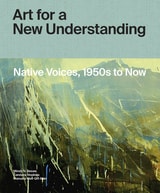
Art for a New Understanding
Native Voices, 1950s to NowMindy N. Besaw
University of Arkansas Press, 2018
This fully illustrated volume includes essays by art historians and historians and reflections by the artists included in the collection. Also included are key contemporary writings—from the 1950s onward—by artists, scholars, and critics, investigating the themes of transculturalism and pan-Indian identity, traditional practices conducted in radically new ways, displacement, forced migration, shadow histories, the role of personal mythologies as a means to reimagine the future, and much more.
As both a survey of the development of Indigenous art from the 1950s to the present and a consideration of Native artists within contemporary art more broadly, Art for a New Understanding expands the definition of American art and sets the tone for future considerations of the subject. It is an essential publication for any institution or individual with an interest in contemporary Native American art, and an invaluable resource in ongoing scholarly considerations of the American contemporary art landscape at large.
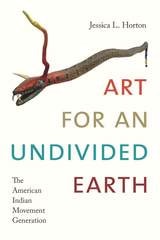
Art for an Undivided Earth
The American Indian Movement GenerationJessica L. Horton
Duke University Press, 2017
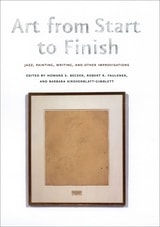
Art from Start to Finish
Jazz, Painting, Writing, and Other ImprovisationsEdited by Howard S. Becker, Robert R. Faulkner, and Barbara Kirshenblatt-Gimblett
University of Chicago Press, 2006
Art from Start to Finish gathers a unique group of contributors from the worlds of sociology, musicology, literature, and communications—many of them practicing artists in their own right—to discuss how artists from jazz musicians to painters work: how they coordinate their efforts, how they think, how they start, and, of course, how they finish their productions.
Specialists in the arts have much to say about the works themselves, which are often neglected by scholarsi n other fields. Art from Start to Finish takes a different tack by exploring the creative process itself and its social component. Any reader who makes art or has an interest in it will value this book.
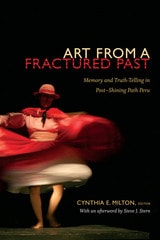
Art from a Fractured Past
Memory and Truth-Telling in Post-Shining Path PeruCynthia E. Milton, ed.
Duke University Press, 2014
Contributors. Ricardo Caro Cárdenas, Jesús Cossio, Ponciano del Pino, Cynthia M. Garza, Edilberto Jímenez Quispe, Cynthia E. Milton, Jonathan Ritter, Luis Rossell, Steve J. Stern, María Eugenia Ulfe, Víctor Vich, Alfredo Villar
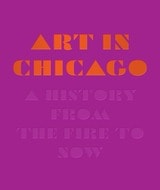
Art in Chicago
A History from the Fire to NowEdited by Maggie Taft and Robert Cozzolino
University of Chicago Press, 2018
Now that art is getting its due. Art in Chicago is a magisterial account of the long history of Chicago art, from the rupture of the Great Fire in 1871 to the present, Manierre Dawson, László Moholy-Nagy, and Ivan Albright to Chris Ware, Anne Wilson, and Theaster Gates. The first single-volume history of art and artists in Chicago, the book—in recognition of the complexity of the story it tells—doesn’t follow a single continuous trajectory. Rather, it presents an overlapping sequence of interrelated narratives that together tell a full and nuanced, yet wholly accessible history of visual art in the city. From the temptingly blank canvas left by the Fire, we loop back to the 1830s and on up through the 1860s, tracing the beginnings of the city’s institutional and professional art world and community. From there, we travel in chronological order through the decades to the present. Familiar developments—such as the founding of the Art Institute, the Armory Show, and the arrival of the Bauhaus—are given a fresh look, while less well-known aspects of the story, like the contributions of African American artists dating back to the 1860s or the long history of activist art, finally get suitable recognition. The six chapters, each written by an expert in the period, brilliantly mix narrative and image, weaving in oral histories from artists and critics reflecting on their work in the city, and setting new movements and key works in historical context. The final chapter, comprised of interviews and conversations with contemporary artists, brings the story up to the present, offering a look at the vibrant art being created in the city now and addressing ongoing debates about what it means to identify as—or resist identifying as—a Chicago artist today. The result is an unprecedentedly inclusive and rich tapestry, one that reveals Chicago art in all its variety and vigor—and one that will surprise and enlighten even the most dedicated fan of the city’s artistic heritage.
Part of the Terra Foundation for American Art’s year-long Art Design Chicago initiative, which will bring major arts events to venues throughout Chicago in 2018, Art in Chicago is a landmark publication, a book that will be the standard account of Chicago art for decades to come. No art fan—regardless of their city—will want to miss it.
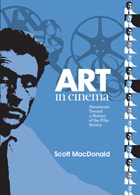
Art in Cinema
Documents Toward a History of the Film SocietyScott MacDonald
Temple University Press, 2006
Scott MacDonald's Art in Cinema presents complete programs presented by the legendary society; dozens of previously unavailable letters between Stauffacher, his collaborators, and filmmakers including Maya Deren, Hans Richter, Vincent Minelli, and Man Ray; a reprint of the society's original catalog, which features essays by Henry Miller and others; and a wide range of other remarkable historical documents.
A companion to Cinema 16 (Temple), a documentary history of the first west coast film society, Art in Cinema provides cineastes, students, teachers, and scholars with extensive and fascinating documentation of one of the most important film societies in American history. Together or separately, the books provide an indispensable reference source for the beginning of this country's love affair with independent film.
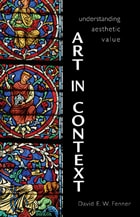
Art in Context
Understanding Aesthetic ValueDavid E. W. Fenner
Ohio University Press, 2008
Art in Context is a systematic, historically situated, and historically evidenced attempt to demonstrate the importance of considering contexts that will, in the vast majority of cases, increase the aesthetic experience. While focusing on distance, detachment, aestheticism, art for art’s sake, and formalism can at times be instructive and interesting, such approaches risk missing the larger and often central issue of the piece.
Based on the findings of philosophers and critics, and on artwork throughout
history, Art in Context provides a solid foundation for understanding and valuing a work of art in perspective as well as within the particular world in which it exists.
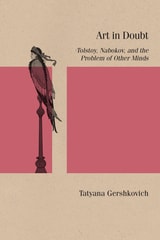
Art in Doubt
Tolstoy, Nabokov, and the Problem of Other MindsTatyana Gershkovich
Northwestern University Press, 2021
Leo Tolstoy’s and Vladimir Nabokov’s radically opposed aesthetic worldviews emanate from a shared intuition—that approaching a text skeptically is easy, but trusting it is hard
Two figures central to the Russian literary tradition—Tolstoy, the moralist, and Nabokov, the aesthete—seem to have sharply conflicting ideas about the purpose of literature. Tatyana Gershkovich undermines this familiar opposition by identifying a shared fear at the root of their seemingly antithetical aesthetics: that one’s experience of the world might be entirely one’s own, private and impossible to share through art.
Art in Doubt: Tolstoy, Nabokov, and the Problem of Other Minds reconceives the pair’s celebrated fiction and contentious theorizing as coherent, lifelong efforts to reckon with the problem of other people’s minds. Gershkovich demonstrates how the authors’ shared yearning for an impossibly intimate knowledge of others formed and deformed their fiction and brought them through parallel logic to their rival late styles: Tolstoy’s rustic simplicity and Nabokov’s baroque complexity. Unlike those authors for whom the skeptical predicament ends in absurdity or despair, Tolstoy and Nabokov both hold out hope that skepticism can be overcome, not by force of will but with the right kind of text, one designed to withstand our impulse to doubt it. Through close readings of key canonical works—Anna Karenina, The Kreutzer Sonata, Hadji Murat, The Gift, Pale Fire—this book brings the twin titans of Russian fiction to bear on contemporary debates about how we read now, and how we ought to.
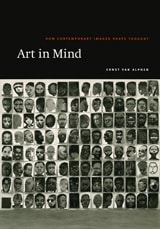
Art in Mind
How Contemporary Images Shape ThoughtErnst van Alphen
University of Chicago Press, 2005
Examining a broad range of works, van Alphen—a renowned art historian and cultural theorist—demonstrates how art serves a socially constructive function by actually experimenting with the parameters of thought. Employing work from artists as diverse as Picasso, Watteau, Francis Bacon, Marlene Dumas, and Matthew Barney, he shows how art confronts its viewers with the "pain points" of cultural experience-genocide, sexuality, diaspora, and transcultural identity-and thereby transforms the ways in which human existence is conceived. Van Alphen analyzes how art visually "thinks" about these difficult cultural issues, tapping into an understudied interpretation of art as the realm where ideas and values are actively created, given form, and mobilized. In this way, van Alphen's book is a work of art in itself as it educates us in a new mode of thought that will forge equally new approaches and responses to the world.
Art in Red Wing
Lawrence Schmeckebier
University of Minnesota Press, 1946
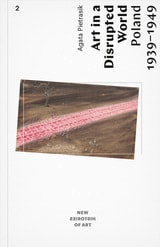
Art in a Disrupted World
Poland 1939–1949Agata Pietrasik
Museum of Modern Art in Warsaw, 2020
Employing an accessible, essayistic style, Pietrasik offers a new look at life in the ten years following the outbreak of World War II and features artists—including Marian Bogusz, Jadwiga Simon-Pietkiewicz, and Józef Szajna—whose work has not yet found substantial audiences in the English-speaking world. Her reading of the art and artists of this period strives to capture their autonomous artistic language and poses critical questions about the ability of traditional art history writing to properly accommodate artworks created in direct response to traumatic experiences.
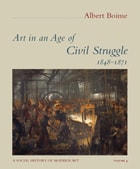
Art in an Age of Civil Struggle, 1848-1871
Albert Boime
University of Chicago Press, 2008
Tracing the various movements of realism through the major metropolitan centers of Europe and America, Boime strikingly evokes the milieus that shaped the lives and works of Gustave Courbet, Edouard Manet, Émile Zola, Honoré Daumier, Walt Whitman, Abraham Lincoln, and the earliest photographers, among countless others. In doing so, he spearheads a powerful new way of reassessing how art emerges from the welter of cultural and political events and the artist’s struggle to interpret his surroundings. Boime supports this multifaceted approach with a wealth of illustrations and written sources that demonstrate the intimate links between visual culture and social change. Culminating at the transition to impressionism, Art in an Age of Civil Struggle makes historical sense of a movement that paved the way for avant-garde aesthetics and, more broadly, of how a particular style emerges at a particular moment.
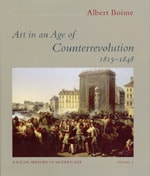
Art in an Age of Counterrevolution, 1815-1848
Albert Boime
University of Chicago Press, 2004
This volume focuses on the astonishing range of art forms currently understood to fall within the broad category of Romanticism. Drawing on visual media and popular imagery of the time, this generously illustrated work examines the art of Romanticism as a reaction to the social and political events surrounding it. Boime reinterprets canonical works by such politicized artists as Goya, Delacroix, Géricault, Friedrich, and Turner, framing their work not by personality but by its sociohistorical context. Boime's capacious approach and scope allows him to incorporate a wide range of perspectives into his analysis of Romantic art, including Marxism, social history, gender identity, ecology, structuralism, and psychoanalytic theory, a reach that parallels the work of contemporary cultural historians and theorists such as Edward Said, Pierre Bourdieu, Eric Hobsbawm, Frederic Jameson, and T. J. Clark.
Boime ultimately establishes that art serves the interests and aspirations of the cultural bourgeoisie. In grounding his arguments on their work and its scope and influence, he elucidates how all artists are inextricably linked to history. This book will be used widely in art history courses and exert enormous influence on cultural studies as well.
Art in the Cinematic Imagination
By Susan Felleman
University of Texas Press, 2006
Bringing an art historical perspective to the realm of American and European film, Art in the Cinematic Imagination examines the ways in which films have used works of art and artists themselves as cinematic and narrative motifs. From the use of portraits in Vertigo to the cinematic depiction of women artists in Artemisia and Camille Claudel, Susan Felleman incorporates feminist and psychoanalytic criticism to reveal individual and collective perspectives on sex, gender, identity, commerce, and class.
Probing more than twenty films from the postwar era through contemporary times, Art in the Cinematic Imagination considers a range of structurally significant art objects, artist characters, and art-world settings to explore how the medium of film can amplify, reinvent, or recontextualize the other visual arts. Fluently speaking across disciplines, Felleman's study brings a broad array of methodologies to bear on questions such as the evolution of the "Hollywood Love Goddess" and the pairing of the feminine with death on screen.
A persuasive approach to an engaging body of films, Art in the Cinematic Imagination illuminates a compelling and significant facet of the cinematic experience.
Art in the Lives of Immigrant Communities in the United States
DiMaggio, Paul
Rutgers University Press, 2010
Art of Darkness
A Poetics of GothicAnne Williams
University of Chicago Press, 1995
Building on the psychoanalytic and feminist theory of Julia Kristeva, Williams argues that Gothic conventions such as the haunted castle and the family curse signify the fall of the patriarchal family; Gothic is therefore "poetic" in Kristeva's sense because it reveals those "others" most often identified with the female. Williams identifies distinct Male and Female Gothic traditions: In the Male plot, the protagonist faces a cruel, violent, and supernatural world, without hope of salvation. The Female plot, by contrast, asserts the power of the mind to comprehend a world which, though mysterious, is ultimately sensible. By showing how Coleridge and Keats used both Male and Female Gothic, Williams challenges accepted notions about gender and authorship among the Romantics. Lucidly and gracefully written, Art of Darkness alters our understanding of the Gothic tradition, of Romanticism, and of the relations between gender and genre in literary history.
Art of War
Niccolò Machiavelli
University of Chicago Press, 2003
Machiavelli scholar Christopher Lynch offers a sensitive and entirely new translation of the Art of War, faithful to the original but rendered in modern, idiomatic English. Lynch's fluid translation helps readers appreciate anew Machiavelli's brilliant treatments of the relationships between war and politics, civilians and the military, and technology and tactics. Clearly laying out the fundamentals of military organization and strategy, Machiavelli marshals a veritable armory of precepts, prescriptions, and examples about such topics as how to motivate your soldiers and demoralize the enemy's, avoid ambushes, and gain the tactical and strategic advantage in countless circumstances.
To help readers better appreciate the Art of War, Lynch provides an insightful introduction that covers its historical and political context, sources, influence, and contemporary relevance. He also includes a substantial interpretive essay discussing the military, political, and philosophical aspects of the work, as well as maps, an index of names, and a glossary.
Art of the Baltics
The Struggle for Freedom of Artistic Expression under the Soviets, 1945-1991Edited by Alla Rosenfeld
Rutgers University Press, 2001
Art of the Baltics is the first major survey of the development of modernist art in Estonia, Lithuania, and Latvia during the post-World War II Soviet period. The contributors discuss and reappraise the art of Baltic artists working in modernist styles. They argue that Estonian, Lithuanian, and Latvian art did not develop in similar ways. Estonia, for example, had closer contact with Scandinavian countries, while Lithuania clearly was part of Central Europe, and was more influenced by Poland.
This book contains nearly three hundred illustrations—many in color—that serve to visually compare the art of the three Baltic countries. It also has three useful historical timelines that contextualize the art presented. In addition to historical overviews of each country, Art of theBaltics contains essays on the art of the region, written by both Baltic and American scholars. The articles extensively cover the Baltic art of the 1960s through the 1980s, which reflect the Zimmerli Art Museum’s holdings of the Norton and Nancy Dodge Collection of Nonconformist Art from the Soviet Union. To round out the scope of this work, contributors also discuss the pre-Soviet art of the region, as well as the recent creative developments that resulted from these small countries gaining independence in 1991.
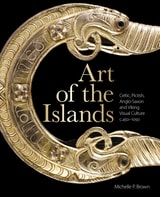
Art of the Islands
Celtic, Pictish, Anglo-Saxon and Viking Visual Culture, c. 450-1050Michelle P. Brown
Bodleian Library Publishing, 2015
Michelle P. Brown remedies this oversight, presenting an extensively illustrated art historical overview of this formative period in the region’s history. Describing the interactions between the region’s inhabitants, she also explores the formation of national and regional identities. Brown ranges across works as diverse as the Book of Kells, the Tara Brooch, the Aberlemno Stone, the Lindisfarne Gospels, the Alfred Jewel, and the Benedictional of St. Ethelwold, showing how their complex imagery can be best interpreted. She also considers the impact of the art of this period upon the history of art in general, exploring how it has influenced many movements since, from the Carolingian Renaissance and the Romanesque style to the nineteenth-century Arts and Crafts movement.
Art of the United States, 1750–2000
John Davis and Michael Leja
Terra Foundation for American Art, 2020
A sourcebook of unprecedented breadth and depth, Art of the United States brings together multiple voices throughout the ages to provide a framework for learning and critical thinking on US art.
Art on the Edge
Creators and SituationsHarold Rosenberg
University of Chicago Press, 1983
Art to Come
Histories of Contemporary ArtTerry Smith
Duke University Press, 2019
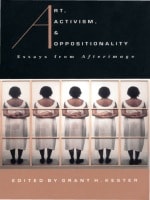
Art, Activism, and Oppositionality
Essays from AfterimageGrant Kester, ed.
Duke University Press, 1998
Forging a style of criticism where aesthetic, critical, theoretical, and activist concerns converge, Afterimage has shaped American debates around the politics of visual production and arts education while offering a voice to politically involved artists and scholars. Art, Activism, and Oppositionality insists not only on the continuing relevance of an activist stance to contemporary art practice and criticism, but also on the significance of an engaged art practice that is aligned with social or political activism. With essays that span fifteen years—roughly from Ronald Reagan’s 1980 presidential win to the 1994 Republican victories in Congress, a period marked by waning public support for the arts and growing antagonism toward activist art—Art, Activism, and Oppositionality confronts issues ranging from arts patronage, pedagogy, and the very definitions of art and activism to struggles involving AIDS, reproductive rights, sexuality, and racial identity.
Contributors. Maurice Berger, Richard Bolton, Ann Cvetkovich, Coco Fusco, Brian Goldfarb, Mable Haddock, Grant H. Kester, Ioannis Mookas, Chiquita Mullins Lee, Darrell Moore, Lorraine O’Grady, Michael Renov, Martha Rosler, Patricia Thomson, David Trend, Charles A. Wright Jr., Patricia R. Zimmerman
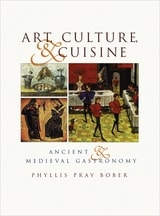
Art, Culture, and Cuisine
Ancient and Medieval GastronomyPhyllis Pray Bober
University of Chicago Press, 1999
Bober draws on archaeology and art history to examine prehistoric eating customs in ancient Turkey; traditions of the great civilizations of Egypt, Mesopotamia, Greece, and Rome; and rituals of the Middle Ages. Both elegant and entertaining, Art, Culture, and Cuisine reveals cuisine and dining's place at the heart of cultural, religious, and social activities that have shaped Western sensibilities.
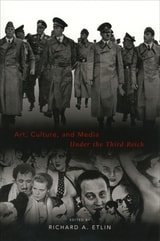
Art, Culture, and Media Under the Third Reich
Edited by Richard A. Etlin
University of Chicago Press, 2002
Contributors address nearly every facet of the arts and mass media under the Third Reich—efforts to define degenerate music and art; the promotion of race hatred through film and public assemblies; views of the racially ideal garden and landscape; race as portrayed in popular literature; the reception of art and culture abroad; the treatment of exiled artists; and issues of territory, conquest, and appeasement. Familiar subjects such as the Munich Accord, Nuremberg Party Rally Grounds, and Lebensraum (Living Space) are considered from a new perspective. Anyone studying the history of Nazi Germany or the role of the arts in nationalist projects will benefit from this book.
Contributors:
Ruth Ben-Ghiat
David Culbert
Albrecht Dümling
Richard A. Etlin
Karen A. Fiss
Keith Holz
Kathleen James-Chakraborty
Paul B. Jaskot
Karen Koehler
Mary-Elizabeth O'Brien
Jonathan Petropoulos
Robert Jan van Pelt
Joachim Wolschke-Bulmahn and Gert Gröning
Art, Imagination and Public Service
Hughie O'Donoghue, Brenda Hale, James O'Donnell, Clare Moriarty, Micheal O'Siadhail, and David Blunkett
Haus Publishing, 2021
Intended to inspire public servants of all kinds to reconnect fearlessly with their fundamental humanity, the three conversations in Art, Imagination and Public Service present a way of thinking about imaginative, compassionate, and intelligent public service. The book consists of three dialogues: between former UK Home Secretary David Blunkett and poet Micheal O’Siadhail, former UK Supreme Court president Brenda Hale and painter Hughie O’Donoghue, and UK Permanent Secretary Clare Moriarty and musician James O’Donnell. Together they explore how art and imagination can sustain public servants and enable them to find new ways of addressing the problems facing government, parliament, and the law—problems that resist utilitarian responses in which people end up being treated only as statistics in a target-driven world. Through these conversations, the speakers discover surprising connections in approaches to their work.

Art, Intellect and the State
Cultural Histories of Late Pahlavi IranEdited by Bianca Devos and Robert Steele
Gingko, 2026
A cross-disciplinary volume on the intersections of—and tensions between—culture and government in Iran's late Pahlavi period.
In recent years, scholarly interest in Iran's late Pahlavi period (1941–1979) has grown significantly and historians are increasingly approaching the era not merely as a prelude to the Iranian Revolution, but as a period worthy of study in its own right. New generations of scholars have uncovered fresh sources and offered original perspectives on the cultural and social life of this era. Yet opportunities for cross-disciplinary engagement among scholars from different fields who are exploring similar questions remain limited. This volume, the product of two international workshops at the Austrian Academy of Sciences in Vienna and the University of Marburg, respectively, is a collection of the work of scholars at various stages of their careers from various disciplines investigating the cultural history of late Pahlavi Iran from a multiplicity of perspectives, including: archaeology, architecture, scholarship, media, art, film, literature, politics, religion, museums, music, philosophy, education, and theater.
Chapters explore the interactions between state ideology and the sociocultural sphere, exploring ideas such as: the influence of the press and literature on social discourses; the culturally strategic and identity-forming role of the performing arts; the relationship between state education policy and culture; the employment of foreign artists, architects, scholars, and musicians in the context of Iran’s cultural diplomacy; and the dynamics of (state) religion, spirituality, nationalism, and psychology in modern media or through their dissemination in the media. The volume explores not only the Pahlavi state’s direct participation in facilitating cultural activity or scholarly endeavors, but also how artists, writers, historians, and other cultural actors flourished independent of (sometimes in spite of) the state apparatus.
The volume does not seek to provide an encyclopaedic collection detailing every aspect of culture in the Pahlavi period, but the case studies explored demonstrate the breadth and complexities of this field in the historiography. Moreover, by shedding light on the various features of culture in the late Pahlavi era and encouraging multidisciplinary discussions, the volume aims to contribute to a greater understanding of the vibrant cultural life in Iran during this period.
Art, Music, and Literature, 1897-1902
Theodore Dreiser. Edited by Yoshinobu Hakutani
University of Illinois Press, 2007
In this volume, liberally seasoned with period illustrations, Yoshinobu Hakutani has collected and annotated a rich selection of Theodore Dreiser's pre-fame writings on the cultural milieu of his day.
In these brief essays, Dreiser sallies into the vibrant world of creative work in turn-of-the-century America. He inspects the eccentric and revealing paraphernalia of artists' studios, probes the work habits of writers, and goes behind the scenes in the popular song-writing business, where this week's celebrity is next week's has-been. He profiles famous figures and introduces numerous women artists, novelists, and musicians, including the prolific and tireless Amelia Barr (mother of fourteen children and author of thirty-two novels), the illustrator Alice B. Stephens, and the opera singer Lillian Nordica. Hakutani's notes provide biographical detail on dozens of now-obscure individuals mentioned by Dreiser.
Art, Nature, and Religion in the Central Andes
Themes and Variations from Prehistory to the PresentBy Mary Strong
University of Texas Press, 2012
From prehistory to the present, the Indigenous peoples of the Andes have used a visual symbol system—that is, art—to express their sense of the sacred and its immanence in the natural world. Many visual motifs that originated prior to the Incas still appear in Andean art today, despite the onslaught of cultural disruption that native Andeans have endured over several centuries. Indeed, art has always been a unifying power through which Andeans maintain their spirituality, pride, and culture while resisting the oppression of the dominant society.
In this book, Mary Strong takes a significantly new approach to Andean art that links prehistoric to contemporary forms through an ethnographic understanding of Indigenous Andean culture. In the first part of the book, she provides a broad historical survey of Andean art that explores how Andean religious concepts have been expressed in art and how artists have responded to cultural encounters and impositions, ranging from invasion and conquest to international labor migration and the internet. In the second part, Strong looks at eight contemporary art types—the scissors dance (danza de tijeras), home altars (retablos), carved gourds (mates), ceramics (ceramica), painted boards (tablas), weavings (textiles), tinware (hojalateria), and Huamanga stone carvings (piedra de Huamanga). She includes prehistoric and historic information about each art form, its religious meaning, the natural environment and sociopolitical processes that help to shape its expression, and how it is constructed or performed by today’s artists, many of whom are quoted in the book.
Art, Politics, and Commerce in Chinese Cinema
Edited by Ying Zhu and Stanley Rosen
Hong Kong University Press, 2010
Art, Politics, and Development
Philipp H Lepenies
Temple University Press, 2013
In the series Politics, History and Social Change, edited by John C. Torpey
Art, Sustainability and Learning Communities
Call to ActionEdited by Raphael Vella and Victoria Pavlou
Intellect Books, 2024
The main aim of Art, Sustainability and Learning Communities is to show how shared spaces for exchange in the fields of art education and continuous professional development can reflect, inspire, and integrate sustainability principles that are becoming crucial in today’s world. The authors propose the idea that coordinated action can lead to a more sustainable future by promoting a sense of community, lifelong learning, and confidence in the possibility of changing current conditions.
Its three parts combine expertise in visual arts education, education for sustainable development, contemporary art practice, and sustainability activism. While Part I focuses on literature in the field and the interrelation of different disciplines, Part II provides concrete examples of professional learning communities and pedagogies that can be used to enrich the field of art education. Finally, Part III presents brief case studies illustrating international projects by contemporary artists, curators, environmentalists, and others, providing educators with several inspirational models of concrete and creative action.
Art, Technology, Consciousness
mind@largeEdited by Roy Ascott
Intellect Books, 2000
This volume develops from the studies published in Roy Ascott's highly successful Reframing Consciousness, documenting the very latest research from those connected with the CAiiA-STAR centre and its associated conferences. Their work embodies artistic and theoretical research in new media and telematics including aspects of artificial life, robotics, technoetics, performance, computer music and intelligent architecture, to growing international acclaim.
Art, Theory, Revolution
The Turn to Generality in Contemporary LiteratureMitchum Huehls
The Ohio State University Press, 2022
Art, Trade, and Culture in the Islamic World and Beyond
From the Fatimids to the MughalsEdited by Alison Ohta, Michael Rogers, and Rosalind Wade Haddon
Gingko, 2016
The essays range across a variety of topics. These include a look at tile production during the reign of the Qaytbay, the book bindings associated with Qansuh al-Ghuri, and the relationship between Mamluk metalwork and that found in Rasulid Yemen and Italy. Several essays examine inscriptions found on buildings of the Fatimid, Mamluk, and Ottoman periods, and others look at the debt of European lacquer works to Persian craftsmen, the Armenian patrons of eighteenth-century Chinese exports, and the influences of Islam on art and architecture found all across India. The result is a sweeping but deeply researched look at one of the richest networks of artistic traditions the world has ever known.