Results by title
28164 books match the query 'History' and 2536 start with a

A History of Interest Rates
Richard Sylla
Rutgers University Press, 1996
This one-of-a-kind guide presents a readable account of interest rate trends and lending practices spanning over four millennia of economic history. Filled with in-depth insights and illustrative charts and tables, this updated Fourth Edition provides a historical perspective of interest rate movements as well as a new chapter of contemporary material and added discussions of interest rate developments over the past ten years.
A sampling of eras and areas covered include:
- Ancient Times: Mesopotamia, Greece, and Rome
- Medieval Times and Renaissance Europe: Italy, Spain, Germany, France, and more
- Modern Europe and North America to 1900: England, France, and other European countries, as well as the United States
- Europe and North America since 1900: England, France, Germany, and Italy, as well as Canada and the United States
- Other countries and regions in the 1900s: Japan, Russia, China, and Latin America

A History of Italian Fascist Culture, 1922–1943
Alessandra Tarquini, Translated by Marissa Gemma
University of Wisconsin Press, 2022
Tarquini sketches the universe of Italian fascism in three broad directions: the regime’s cultural policies, the condition of various art forms and scholarly disciplines, and the ideology underpinning the totalitarian state. She details the choices the ruling class made between 1922 and 1943, revealing how cultural policies shaped the country and how intellectuals and artists contributed to those decisions. The result is a view of fascist ideology as a system of visions, ideals, and, above all, myths capable of orienting political action and promoting a precise worldview.
Building on George L. Mosse’s foundational research, Tarquini provides the best single-volume work available to fully understand a complex and challenging subject. It reveals how the fascists used culture—art, cinema, music, theater, and literature—to build a conservative revolution that purported to protect the traditional social fabric while presenting itself as maximally oriented toward the future.

A History of Japan’s Government-Business Relationship
The Passenger Car IndustryPhyllis A. Genther
University of Michigan Press, 1990

A History of Language
Steven Roger Fischer
Reaktion Books, 2018

A History of Light
Jan Nemec
Seagull Books, 2024
Have you ever wondered what a story written by a beam of light would be like? The story would be ordinary, but the course of events extraordinary. Its hero would be a photographer, a guardian of light. And, naturally, the tale would be full of shadow.
A History of Light delves into the fascinating life of František Drtikol (1883–1961), an important figure in early-twentieth-century photography who is all but forgotten in contemporary times. A dandy from a small mining town, a world-famous photographer whose business went bankrupt, a master of the nude who never had much luck with women, a mystic and a Buddhist who believed in communism—a man whose numerous contradictions were evident externally and synthesized internally.
A unique blend of fiction and biography, this novel vividly portrays Drtikol’s life, tracing the diverse stages of his career and offering detailed, almost encyclopedic insights into the times and places pivotal to his journey. Acclaimed Czech author Jan Němec narrates the story in the uncommon second-person singular, speaking directly to his subject. Fresco-like, this novel is an artistic and spiritual Bildungsroman that covers over half a century, bringing to life the silver mines of Príbram, Jugendstil Munich, and the Bohemianism of the First Czechoslovak Republic. Drtikol’s role as a photographer is set against the turbulent history of Central Europe through the two World Wars, and the events of those five decades form a riveting backdrop for an exploration of the artist’s work.
A History of Missouri (V1)
Volume I, 1673 to 1820William E. Foley
University of Missouri Press, 1971
Including a completely revised and updated bibliography, A History of Missouri: Volume I, 1673 to 1820 covers the pre-statehood history of Missouri, beginning with the arrival in 1673 of the first Europeans in the area, Louis Jolliet and Jesuit Father Jacques Marquette, and continuing through the development and growth of the region, to the final campaign for statehood in 1820. In tracing the broad outlines of Missouri's development through the formative years, the author examines the origins of Missouri's diverse heritage as the region passed under the control of French, Spanish, and American authorities.

A History of Missouri (V2)
Volume II, 1820 to 1860Perry McCandless
University of Missouri Press, 2000
With a newly revised bibliography, A History of Missouri: Volume II, 1820 to 1860 covers the turbulent years of Missouri's adolescence—from statehood to the outset of the Civil War.

A History of Missouri (V3)
Volume III, 1860 to 1875William E. Parrish
University of Missouri Press, 2001
A History of Missouri: Volume III, 1860 to 1875, now available in paperback with a new, up-to-date bibliography, follows the course of the state's history through the turbulent years of the Civil War and Reconstruction. Increasingly bitter confrontations over the questions of secession and neutrality divided Missourians irreparably in 1861, with the result that the state was represented in the armies both of the North and of the South. During the next four years, Missouri would be the scene of several important battles, including Wilson's Creek and Westport, and much bloody combat as secessionist guerrillas and Union militias engaged in constant encounters throughout the state. Indeed, Missouri probably saw more military encounters during the war than any other state.
Out of the chaos, the Radical party emerged as a powerful political force seeking to eradicate pro-Confederate influences, and its efforts made the Reconstruction era as volatile as the war years had been. Jesse and Frank James, who had been part of Quantrill's guerrillas, continued to provoke disorder through their numerous bank and train robberies. In their efforts to establish a "new order," the Radicals effected a new, highly proscriptive constitution. In the long run, however, they were unable to eradicate the strong conservative influences in the state, and by the mid-1870s reaction set in.
In addition to the important political events of the period, the social and economic conditions of the state immediately before, during, and after the war are treated in A History of Missouri: Volume III. Despite the ravages of war and political dispute, Missouri managed during Reconstruction to make impressive strides in economic development, education, and racial equality. The changes introduced by such industries as railroads, farming, and mining served to revitalize the state and to guarantee its future growth and development.
This volume will be an essential resource for anyone—scholars, students, and general readers—interested in this crucial and important part of Missouri's history.
A History of Missouri (V4)
Volume IV, 1875 to 1919Lawrence O. Christensen & Gary R. Kremer
University of Missouri Press, 2004
Drawing on original research in primary sources, this comprehensive study covers such topics as the Constitution of 1875, the impact of railroad expansion, the 1904 World's Fair, the Populist and Progressive movements, and World War I. It also deals with less familiar topics, such as the state's use of convict labor to save taxpayers money, the emergence of women's clubs, the arrival of moving pictures, and the terrible conditions under which coal miners worked and lived.
Research on the weekly newspapers of such towns as Edina, Bethany, Boonville, Mount Vernon, and Kennett provides a comparative regional and rural perspective on events that took place around the turn of the century, giving the reader a unique glimpse of what small-town life was like. The rapid growth of Missouri's cities is also discussed in detail. St. Louis's development as one of the nation's leading cities is fully recorded, as is the rise of smaller towns such as St. Joseph, Joplin, Springfield, and Sedalia. Kansas City's City Beautiful Movement and the rise of the Pendergast Machine are also treated.
Significant attention is given to World War I. The authors document Missourians' reliance on voluntarism to support the war effort, and they also explain how government officials mobilized the citizens of the state to support the war, especially Missourians of German ancestry. The book fully details the experiences of African Americans and women who lived in Missouri during the period.
This extensive and balanced coverage of Missouri as it moved into the twentieth century will be the authoritative volume on the subject for decades to come. Anyone with an interest in Missouri history will treasure this informative new resource.
A History of Missouri (V5)
Volume V, 1919 to 1953Richard S. Kirkendall
University of Missouri Press, 2004
This interpretation of Missouri's history from the end of World War I until the return of Harry Truman to the state after his presidency describes the turbulent political, economic, and social changes experienced by Missouri's people during those years.
A History of Missouri (V6)
Volume VI, 1953 to 2003Lawrence H. Larsen
University of Missouri Press, 2004

A History of Modern Ethiopia, 1855–1991
Second EditionBahru Zewde
Ohio University Press, 2002
Bounded by Sudan to the west and north, Kenya to the south, Somalia to the southeast, and Eritrea and Djibouti to the northeast, Ethiopia is a pivotal country in the geopolitics of the region. Yet it is important to understand this ancient and often splintered country in its own right.
In A History of Modern Ethiopia, Bahru Zewde, one of Ethiopia’s leading historians, provides a compact and comprehensive history of his country, particularly the last two centuries. Of importance to historians, political scientists, journalists, and Africanists alike, Bahru’s A History of Modern Ethiopia, now with additional material taking it up to the last decade, will be the preeminent overview of present-day Ethiopia.

A History of Modern Lebanon
Fawwaz Traboulsi
Pluto Press, 2012

A History of Modern Singapore, 1819-2005
Constance Turnbull
National University of Singapore Press, 2020

A History of Navajo Nation Education
Disentangling Our Sovereign BodyWendy Shelly Greyeyes; Foreword by Kevin K. Washburn
University of Arizona Press, 2022
On the heels of the fiftieth anniversary of the founding of the Department of Diné Education, this important education history explains how the current Navajo educational system is a complex terrain of power relationships, competing agendas, and jurisdictional battles influenced by colonial pressures and tribal resistance. An iron grip of colonial domination over Navajo education remains, thus inhibiting a unified path toward educational sovereignty. In providing the historical roots to today’s challenges, Wendy Shelly Greyeyes clears the path and provides a go-to reference to move discussions forward.

A History of Occupational Health and Safety
From 1905 to the PresentMichelle Follette Turk
University of Nevada Press, 2018
A History of Occupational Health and Safety examines the work, hazards, and health and safety programs from the early building of the railroad through the construction of the Hoover Dam, chemical manufacturing during World War II, nuclear testing, and dense megaresort construction on the Las Vegas Strip. In doing so, this comprehensive chronicle reveals the long and unfortunate history of exposing workers, residents, tourists, and the environment to dangerous work—all while exposing the present and future to crises in the region. Complex interactions and beliefs among the actors involved are emphasized, as well as how the medical community interpreted and responded to the risks posed.
Few places in the United States contain this mixture of industrial and postindustrial sites, the Las Vegas area offers unique opportunities to evaluate American occupational health during the twentieth century, and reminds us all about the relevancy of protecting our workers.

A History of Oregon Ornithology
From Territorial Days to the Rise of BirdingAlan L. Contreras
Oregon State University Press, 2022
Editors Alan Contreras, Vjera Thompson, and Nolan Clements have assembled chapters exploring the differences and interplay between the amateur and professional study of birds, along with discussions of early birding societies, notable observers, and ornithological studies. It includes significant chapters on Charles Bendire, William L. Finley, Ira Gabrielson, Stanley Jewett, and David B. Marshall. It also notes the sometimes-overlooked contributions of women to our expanding knowledge of western birds. Special attention is paid to the development of seabird observation, the impact of the Internet, and the rise of digital resources for bird observers.
Intended for readers interested in the history of Oregon, the history of scientific explorations in the west, and the origins of modern birding and field ornithology, A History of Oregon Ornithology offers a detailed and entertaining tour of how birds were first observed and studied by explorers in what is now Oregon.

A History of Pentateuchal Traditions
Martin Noth
SBL Press, 1981
Now Available from Duke University Press
Originally published in German in 1948, Noth’s application of a traditio-historical approach has made this book required reading for students and scholars

A History of Photography in Fifty Cameras
Michael Pritchard
University of Chicago Press, 2014
Through brief, illustrated chapters on fifty landmark cameras and the photographers who used them, Michael Pritchard offers an entertaining look at photography as practiced by professionals, artists, and amateurs. A History of Photography in Fifty Cameras is organized chronologically, beginning with William Henry Fox Talbot’s wooden “Mousetrap” camera of 1835. Other entries include the Brownie (1900), the Coronet Midget (1935), the Kodak Instamatic 100 (1963), and, of course, the Polaroid SX-70 (1972). Photographs within each chapter show not only the cameras themselves but also samples of the images made with them. Pritchard uses each camera as a point of entry for talking about the people who used them and the kind of photos they produced, from Weegee and his Speed Graphic to Cartier-Bresson and the Leica’s role in the invention of photojournalism. In the hands of individual photographers, he reveals, cameras came to represent unique styles of depiction.
Together, the stories of the fifty cameras gathered here present an approachable and informative take on a medium that continues to fire the imagination, whether we’re perfecting the selfie or longing for the days of Fotomat.

A History of Physical Education and Athletics at Oberlin College
Lee C. Drickamer with Fredrick D. Shults
The Ohio State University Press, 2022

A History of Reading in the West
Guglielmo Cavallo
University of Massachusetts Press, 1999

A History of Religious Ideas, Volume 1
From the Stone Age to the Eleusinian MysteriesMircea Eliade
University of Chicago Press, 1978

A History of Roads in 100 Maps
Jeremy Black
University of Chicago Press, 2026
A beautifully illustrated, first-of-its-kind chronicle of road maps through the ages.
Road maps are the most common form of map that most of us regularly interact with while we all seek to find our way from here to there. Today, the digital maps on our devices are just the latest in a series of cartographic innovations designed to make transportation of people and goods easier and more predictable. Whether traveling on foot, in a vehicle, or by animal, people have long created and relied on roads, and efforts to map these overland routes predate the invention of the printing press. Yet the vast majority of road maps have been produced only within the last five hundred years—and even more specifically within the last century.
Historian Jeremy Black is the first to chart the tale of road maps, beginning with the "Peutinger Map," which illustrated the roads famously connecting the Roman Empire. From the time of antiquity, Black guides the reader through the centuries all the way to the modern age, when the invention of the automobile spurred the creation of roads and road maps like nothing before. Over the course of this journey, Black illuminates the integral role maps played in the development of government infrastructures through time and across all the inhabited continents. And, arriving in the present day, Black shows how technology may soon make the paper road map obsolete even as it builds on the conventions of the preceding centuries.
Featuring a series of full-color maps from the British Library's collection and beyond, A History of Roads in 100 Maps is an eye-opening visual story of how modern civilizations traversed, constructed, and connected their worlds.

A History of Russia
Medieval, Modern, Contemporary, c.882-1996Paul Dukes
Duke University Press, 1998
With its breadth of scope and conciseness of presentation, this third edition of A History of Russia will be invaluable to students of European and Russian history, and also to students of Russian language, literature, and social science.

A History of Russian Literature
From Its Beginnings to 1900D.S. Mirsky
Northwestern University Press, 1999

A History of Scandinavian Literature, 1870-1980
Sven Rossel
University of Minnesota Press, 1982

A History of Scientific Journals
Publishing at the Royal Society, 1665–2015Aileen Fyfe, Noah Moxham, Julie Mcdougall-Waters, and Camilla Mørk Røstvik
University College London, 2022
Modern scientific research has changed significantly since the days of Isaac Newton, with professionalized, collaborative, and international networks that engage a more diverse community of researchers. Yet, the long history of scientific publishing reveals a deep mutual relationship between how academic discourse develops and what (and how) research is published. With unique insights from the Royal Society of London’s comprehensive archives spanning 350 years of scientific journal publishing, A History of Scientific Journals illustrates the entangled histories of scientific publishing and professional discourses. This volume provides insights into the editorial management, business practices, and financial difficulties of journals such as Philosophical Transactions, which was first published in 1665 and has published papers by Newton, Darwin, Dorothy Hodgkin, and Stephen Hawking. Highly illustrated with photographs of historic archived documents, including early publications and editorial annotations, this history extends to the present day and includes a look at digital journal publication and the open-access movement, making the book's publication through UCL Press both appropriate and symbiotic.
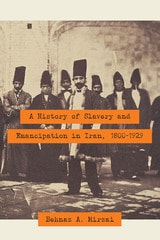
A History of Slavery and Emancipation in Iran, 1800-1929
By Behnaz A. Mirzai
University of Texas Press, 2017
Shortlisted for the 2018 Wallace K. Ferguson Prize, Canadian Historical Association
The leading authority on slavery and the African diaspora in modern Iran presents the first history of slavery in this key Middle Eastern country and shows how slavery helped to shape the nation’s unique character.
Slavery in the Middle East is a growing field of study, but the history of slavery in a key country, Iran, has never before been written. This history extends to Africa in the west and India in the east, to Russia and Turkmenistan in the north, and to the Arab states in the south. As the slave trade between Iran and these regions shifted over time, it transformed the nation and helped forge its unique culture and identity. Thus, a history of Iranian slavery is crucial to understanding the character of the modern nation.
Drawing on extensive archival research in Iran, Tanzania, England, and France, as well as fieldwork and interviews in Iran, Behnaz A. Mirzai offers the first history of slavery in modern Iran from the early nineteenth century to emancipation in the mid-twentieth century. She investigates how foreign military incursion, frontier insecurity, political instability, and economic crisis altered the patterns of enslavement, as well as the ethnicity of the slaves themselves. Mirzai’s interdisciplinary analysis illuminates the complex issues surrounding the history of the slave trade and the process of emancipation in Iran, while also giving voice to social groups that have never been studied—enslaved Africans and Iranians. Her research builds a clear case that the trade in slaves was inexorably linked to the authority of the state. During periods of greater decentralization, slave trading increased, while periods of greater governmental autonomy saw more freedom and peace.
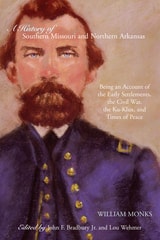
A History of Southern Missouri and Northern Arkansas
Being an Account of the Early Settlements, the Civil War, the Ku-Klux, and Times of PeaceWilliam Monks
University of Arkansas Press, 2006
Originally published in 1907 and now reprinted for the first time, this is the only account published by a Union guerrilla in the border region of the central Ozarks, where political and civil violence lasted from the Civil War well into the 1880s.
There were probably many people who wanted to shoot Billy Monks. He was a Union patriot and skilled guerrilla fighter to some, but others called him a bushwhacker, a murderer, and a thief. His was a very personal combat: he commanded, rallied, arrested, killed, quarreled with, and sued people he knew. His life provides a striking example of the cliché that the war did not end in 1865, but continued fiercely on several fronts for another decade as partisan factions settled old scores and battled for local political control.
This memoir was Monks’s last salvo at his old foes, by turns self-defense and an uncompromising affirmation of the Radical Union cause in the Ozarks. The editors include a new biographical sketch of the author, fill in gaps in his narrative, identify all the people and places to which he refers, and offer a detailed index. Monks himself illustrated the volume with staged photographs of key events re-created by aged comrades who appear to have been just barely able to hoist the muskets they hold as props.

A History of Southland College
The Society of Friends and Black Education in ArkansasThomas Kennedy
University of Arkansas Press, 2009

A History of Tourism in Africa
Exoticization, Exploitation, and EnrichmentTodd Cleveland
Ohio University Press, 2021
An engaging social history of foreign tourists’ dreams, the African tourism industry’s efforts to fulfill them, and how both sides affect each other.
Since the nineteenth century, foreign tourists and resident tourism workers in Africa have mutually relied upon notions of exoticism, but from vastly different perspectives. Many of the countless tourists who have traveled to the African continent fail to acknowledge or even realize that skilled African artists in the tourist industry repeatedly manufacture “authentic” experiences in order to fulfill foreigners’ often delusional, or at least uninformed, expectations. These carefully nurtured and controlled performances typically reinforce tourists’ reductive impressions—formed over centuries—of the continent, its peoples, and even its wildlife. In turn, once back in their respective homelands, tourists’ accounts of their travels often substantiate, and thereby reinforce, prevailing stereotypes of “exotic” Africa. Meanwhile, Africans’ staged performances not only impact their own lives, primarily by generating remunerative opportunities, but also subject the continent’s residents to objectification, exoticization, and myriad forms of exploitation.
A History of Trust in Ancient Greece
Steven Johnstone
University of Chicago Press, 2011

A History of Utah International
From Construction to MiningSterling D Sessions
University of Utah Press, 2005
The story of how the Utah Construction Company, founded in Ogden, Utah in 1900, became Utah International, a multinational corporation, is known to historians of the American West but perhaps not by the general public. The publication of this book remedies that omission.
During its first decades, the company built railroads and dams and was one of the Six Companies Consortium that built Hoover Dam. Utah Construction was also engaged in numerous war-contract activities during World War II. In the postwar period, the company expanded its activities into mining and land development and moved its headquarters to San Francisco. Changing its name to Utah Construction and Mining, and eventually to Utah International, the corporation became one of the most successful multinational mining companies in the world. In 1976, Utah International and General Electric negotiated the largest yet corporate merger in the United States.
Based on the Utah International archives housed in the Stewart Library at Weber State University, the story of Utah International describes more than projects: it is also the story of how two remarkable entrepreneurs, Marriner Stoddard Eccles and Edmund Wattis Littlefield, transformed the company incorporated in 1900 by the Wattis brothers into the largest and most profitable mining company in the United States.

A History of Violence
Kai Ziegner
Diaphanes, 2025

A History of the "Atlantic Monthly," 1857-1909
Yankee Humanism at High Tide and EbbEllery Sedgwick
University of Massachusetts Press, 1994
From its founding in 1857 until its sale by Houghton Mifflin in 1908, the Atlantic Monthly was the most respected literary periodical in the United States. This study focuses on the magazine's first seven editors: James Russell Lowell, James T. Fields, William Dean Howells, Thomas Bailey Aldrich, Horace Scudder, Walter Hines Page, and Bliss Perry. Ellery Sedgwick examines their personalities, editorial policies, and literary tastes, and shows how each balanced his role as advocate of “high” culture with the demands of the literary marketplace and American democracy.
Although the Atlantic was rooted in the Yankee humanism of Boston, Cambridge, and Concord, its scope was national. Sedgwick points out that while the magazine spoke for high culture, its tradition was one of intellectual tolerance and of moderate liberalism on social and political issues. It supported abolition, women's rights, and religious tolerance, and published incisive criticism of unregulated industrial capitalism. The Atlantic also played an important role in the rise of American literary realism, and published early work not only by such authors as James, Jewett, and Howells, but also by Chesnutt, Du Bois, Cahan, and Zitkala-Sa.
A History of the Alans in the West
From Their First Appearance in the Sources of Classical Antiquity through the Early Middle AgesBernard S. Bachrach
University of Minnesota Press, 1973
A History of the Alans in the West was first published in 1973. Minnesota Archive Editions uses digital technology to make long-unavailable books once again accessible, and are published unaltered from the original University of Minnesota Press editions.
The Alans, a nomadic people from the steppe lands of south Russia, were among the many invaders of the Roman empire who helped to bring about its fall. Unlike the majority of the invaders, they were not Germans — they were Indo-Iranians—and they were not, like most barbarians, organized in agricultural communities. This history traces their westward movement from the time of their first mention in sources of classical antiquity through the early Middle Ages.
Professor Bachrach discusses the social and religious institutions of the Alans and especially their military customs. As he shows, they contributed much to the military repertoire of the West, especially the feigned retreat tactic and the role of the cavalry as the primary part of the army. In their westward movement the Alans were assimilated by people in Gaul and Italy and served the empire in a military capacity during the fourth and fifth centuries. IN addition to their military and political impact in several areas, the Alans also influenced early medieval artistic styles, literary developments, place names, and personal names.
A number of illustrations provide examples of the artistic influence of the Alans, and there are maps pertinent to the history.

A History of the American Theatre from Its Origins to 1832
William Dunalp, Introduction by Tice L. Miller
University of Illinois Press, 2005
As America passed from a mere venue for English plays into a country with its own nationally regarded playwrights, William Dunlap lived the life of a pioneer on the frontier of the fledgling American theatre, full of adventures, mishaps, and close calls. He adapted and translated plays for the American audience and wrote plays of his own as well, learning how theatres and theatre companies operated from the inside out.
Dunlap's masterpiece, A History of American Theatre was the first of its kind, drawing on the author's own experiences. In it, he describes the development of theatre in New York, Philadelphia, and South Carolina as well as Congress's first attempts at theatrical censorship. Never before previously indexed, this edition also includes a new introduction by Tice L. Miller.
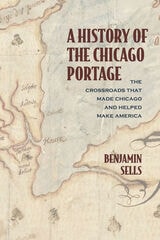
A History of the Chicago Portage
The Crossroads That Made Chicago and Helped Make AmericaBenjamin Sells
Northwestern University Press, 2021
This fascinating account explores the significance of the Chicago Portage, one of the most important—and neglected—sites in early US history. A seven-mile-long strip of marsh connecting the Chicago and Des Plaines Rivers, the portage was inhabited by the earliest indigenous people in the Midwest and served as a major trade route for Native American tribes. A link between the Mississippi River and the Atlantic Ocean, the Chicago Portage was a geopolitically significant resource that the French, British, and US governments jockeyed to control. Later, it became a template for some of the most significant waterways created in the nineteenth and twentieth centuries. The portage gave Chicago its name and spurred the city’s success—and is the reason why the metropolis is located in Illinois, not Wisconsin.
A History of the Chicago Portage: The Crossroads That Made Chicago and Helped Make America is the definitive story of a national landmark.

A History of the Circle
Mathematical Reasoning and the Physical UniverseZebrowski, Ernest
Rutgers University Press, 2000
The concept of the circle is ubiquitous. It can be described mathematically, represented physically, and employed technologically. The circle is an elegant, abstract form that has been transformed by humans into tangible, practical forms to make our lives easier.
And yet no one has ever discovered a true mathematical circle. Rainbows are fuzzy; car tires are flat on the bottom, and even the most precise roller bearings have measurable irregularities. Ernest Zebrowski, Jr., discusses why investigations of the circle have contributed enormously to our current knowledge of the physical universe. Beginning with the ancient mathematicians and culminating in twentieth-century theories of space and time, the mathematics of the circle has pointed many investigators in fruitful directions in their quests to unravel nature’s secrets. Johannes Kepler, for example, triggered a scientific revolution in 1609 when he challenged the conception of the earth’s circular motion around the sun. Arab and European builders instigated the golden age of mosque and cathedral building when they questioned the Roman structural arches that were limited to geometrical semicircles.
Throughout his book, Zebrowski emphasizes the concepts underlying these mathematicians’ calculations, and how these concepts are linked to real-life examples. Substantiated by easy-to-follow mathematical reasoning and clear illustrations, this accessible book presents a novel and interesting discussion of the circle in technology, culture, history, and science.

A History of the City of Cairo, Illinois
John M. Lansden. Foreword by Clyde C. Walton
Southern Illinois University Press, 1976
Long out of print and much sought after bycollectors, Lansden’s classic 1910 history of Cairo remains valuable for the early history of the city. Its reprinting here, with a new Foreword by Clyde C. Walton, former Illinois State Historian, thus makes available again one of the finest examples of local history ever written, stressing as itdoes Cairo’s important relations with its area and with the country—in Lansden’s words, “this part of the Valley of the Mississippi—this Illinois Country.”
A History of the Crusades, Volume I
The First Hundred YearsSeries Edited by Kenneth M. Setton; Volume Edited by Marshall W. Baldwin
University of Wisconsin Press, 1969

A History of the Crusades, Volume II
The Later Crusades, 1189-1311Series Edited by Kenneth M. Setton; Volume Edited by Wolff and Hazard
University of Wisconsin Press, 1969

A History of the Crusades, Volume III
The Fourteenth and Fifteenth CenturiesSeries Edited by Kenneth M. Setton; Volume Edited by Harry W. Hazard
University of Wisconsin Press, 1975

A History of the Crusades, Volume IV
The Art and Architecture of the Crusader StatesSeries Edited by Kenneth M. Setton, Volume Edited by Harry W. Hazard
University of Wisconsin Press, 1977

A History of the Crusades, Volume V
The Impact of the Crusades on the Near EastSeries Edited by Kenneth M. Setton, Volume Edited by Zacour and Hazard
University of Wisconsin Press, 1985

A History of the Crusades, Volume VI
The Impact of the Crusades on EuropeSeries Edited by Kenneth M. Setton, Volume Edited by Hazard and Zacour
University of Wisconsin Press, 1990
A History of the Czech Lands
Second EditionEdited by Jaroslav Pánek, Oldrich Tuma, et al
Karolinum Press, 2016
The second edition includes sixty new photographs and a new chapter detailing the transformation of this post-communist country into a member of the European Union. The only study in English of this scope and ambition, A History of the Czech Lands is essential for scholars of Slavic, Central, and East European studies and a must-read for those who trace their ancestry to these lands.
A History of the Federal Reserve, Volume 1
1913-1951Allan H. Meltzer
University of Chicago Press, 2002
To understand why the Federal Reserve acted as it did at key points in its history, Meltzer draws on meeting minutes, correspondence, and other internal documents (many made public only during the 1970s) to trace the reasoning behind its policy decisions. He explains, for instance, why the Federal Reserve remained passive throughout most of the economic decline that led to the Great Depression, and how the Board's actions helped to produce the deep recession of 1937 and 1938. He also highlights the impact on the institution of individuals such as Benjamin Strong, governor of the Federal Reserve Bank of New York in the 1920s, who played a key role in the adoption of a more active monetary policy by the Federal Reserve. Meltzer also examines the influence the Federal Reserve has had on international affairs, from attempts to build a new international financial system in the 1920s to the Bretton Woods Agreement of 1944 that established the International Monetary Fund and the World Bank, and the failure of the London Economic Conference of 1933.
Written by one of the world's leading economists, this magisterial biography of the Federal Reserve and the people who helped shape it will interest economists, central bankers, historians, political scientists, policymakers, and anyone seeking a deep understanding of the institution that controls America's purse strings.
"It was 'an unprecedented orgy of extravagance, a mania for speculation, overextended business in nearly all lines and in every section of the country.' An Alan Greenspan rumination about the irrational exuberance of the late 1990s? Try the 1920 annual report of the board of governors of the Federal Reserve. . . . To understand why the Fed acted as it did—at these critical moments and many others—would require years of study, poring over letters, the minutes of meetings and internal Fed documents. Such a task would naturally deter most scholars of economic history but not, thank goodness, Allan Meltzer."—Wall Street Journal
"A seminal work that anyone interested in the inner workings of the U. S. central bank should read. A work that scholars will mine for years to come."—John M. Berry, Washington Post
"An exceptionally clear story about why, as the ideas that actually informed policy evolved, things sometimes went well and sometimes went badly. . . . One can only hope that we do not have to wait too long for the second installment."—David Laidler, Journal of Economic Literature
"A thorough narrative history of a high order. Meltzer's analysis is persuasive and acute. His work will stand for a generation as the benchmark history of the world's most powerful economic institution. It is an impressive, even awe-inspiring achievement."—Sir Howard Davies, Times Higher Education Supplement
A History of the Federal Reserve, Volume 2, Book 1, 1951-1969
Allan H. Meltzer
University of Chicago Press, 2009
Allan H. Meltzer’s critically acclaimed history of the Federal Reserve is the most ambitious, most intensive, and most revealing investigation of the subject ever conducted. Its first volume, published to widespread critical acclaim in 2003, spanned the period from the institution’s founding in 1913 to the restoration of its independence in 1951. This two-part second volume of the history chronicles the evolution and development of this institution from the Treasury–Federal Reserve accord in 1951 to the mid-1980s, when the great inflation ended. It reveals the inner workings of the Fed during a period of rapid and extensive change. An epilogue discusses the role of the Fed in resolving our current economic crisis and the needed reforms of the financial system.
In rich detail, drawing on the Federal Reserve’s own documents, Meltzer traces the relation between its decisions and economic and monetary theory, its experience as an institution independent of politics, and its role in tempering inflation. He explains, for example, how the Federal Reserve’s independence was often compromised by the active policy-making roles of Congress, the Treasury Department, different presidents, and even White House staff, who often pressured the bank to take a short-term view of its responsibilities. With an eye on the present, Meltzer also offers solutions for improving the Federal Reserve, arguing that as a regulator of financial firms and lender of last resort, it should focus more attention on incentives for reform, medium-term consequences, and rule-like behavior for mitigating financial crises. Less attention should be paid, he contends, to command and control of the markets and the noise of quarterly data.
At a time when the United States finds itself in an unprecedented financial crisis, Meltzer’s fascinating history will be the source of record for scholars and policy makers navigating an uncertain economic future.
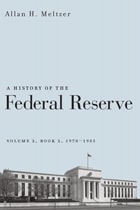
A History of the Federal Reserve, Volume 2, Book 2, 1970-1986
Allan H. Meltzer
University of Chicago Press, 2009
Allan H. Meltzer’s critically acclaimed history of the Federal Reserve is the most ambitious, most intensive, and most revealing investigation of the subject ever conducted. Its first volume, published to widespread critical acclaim in 2003, spanned the period from the institution’s founding in 1913 to the restoration of its independence in 1951. This two-part second volume of the history chronicles the evolution and development of this institution from the Treasury–Federal Reserve accord in 1951 to the mid-1980s, when the great inflation ended. It reveals the inner workings of the Fed during a period of rapid and extensive change. An epilogue discusses the role of the Fed in resolving our current economic crisis and the needed reforms of the financial system.
In rich detail, drawing on the Federal Reserve’s own documents, Meltzer traces the relation between its decisions and economic and monetary theory, its experience as an institution independent of politics, and its role in tempering inflation. He explains, for example, how the Federal Reserve’s independence was often compromised by the active policy-making roles of Congress, the Treasury Department, different presidents, and even White House staff, who often pressured the bank to take a short-term view of its responsibilities. With an eye on the present, Meltzer also offers solutions for improving the Federal Reserve, arguing that as a regulator of financial firms and lender of last resort, it should focus more attention on incentives for reform, medium-term consequences, and rule-like behavior for mitigating financial crises. Less attention should be paid, he contends, to command and control of the markets and the noise of quarterly data.
At a time when the United States finds itself in an unprecedented financial crisis, Meltzer’s fascinating history will be the source of record for scholars and policy makers navigating an uncertain economic future.