Results by title
4917 books match the query 'Philosophy' and 406 start with a
Apocalypse of Truth
Heideggerian MeditationsJean Vioulac
University of Chicago Press, 2021
In his first book to be translated into English, Vioulac radicalizes Heidegger’s understanding of truth as disclosure through the notion of truth as apocalypse. This “apocalypse of truth” works as an unveiling that reveals both the finitude and mystery of truth, allowing a full confrontation with truth-as-absence. Engaging with Heidegger, Marx, and St. Paul, as well as contemporary figures including Giorgio Agamben, Alain Badiou, and Slavoj Žižek, Vioulac’s book presents a subtle, masterful exposition of his analysis before culminating in a powerful vision of “the abyss of the deity.” Here, Vioulac articulates a portrait of Christianity as a religion of mourning, waiting for a god who has already passed by, a form of ever-present eschatology whose end has always already taken place. With a preface by Jean-Luc Marion, Apocalypse of Truth presents a major contemporary French thinker to English-speaking audiences for the first time.
Apples and Oranges
Explorations In, On, and With ComparisonBruce Lincoln
University of Chicago Press, 2018
Lincoln presents critiques of recent attempts at grand comparison, and enlists numerous theoretical examples of how a more modest, cautious, and discriminating form of comparison might work and what it can accomplish. He does this through studies of shamans, werewolves, human sacrifices, apocalyptic prophecies, sacred kings, and surveys of materials as diverse and wide-ranging as Beowulf, Herodotus’s account of the Scythians, the Native American Ghost Dance, and the Spanish Civil War.
Ultimately, Lincoln argues that concentrating one's focus on a relatively small number of items that the researcher can compare closely, offering equal attention to relations of similarity and difference, not only grants dignity to all parties considered, it yields more reliable and more interesting—if less grandiose—results. Giving equal attention to the social, historical, and political contexts and subtexts of religious and literary texts also allows scholars not just to assess their content, but also to understand the forces, problems, and circumstances that motivated and shaped them.
Apprehending the Inaccessible
Freudian Psychoanalysis and Existential PhenomenologyRichard Askay and Jensen Farquhar
Northwestern University Press, 2006
With its unique perspective on Freud's work, Apprehending the Inaccessible puts readers in a better position to appreciate his contributions and evaluate the relationship between his and other philosophical world views. The authors, both of whom have extensive backgrounds in philosophy and psychology, present balanced critical analyses of crucial developments in, for example, the evolution of the Freudian notion of the unconscious, and the engagement of existential phenomenology with Freudian psychoanalysis. Askay and Farquhar then consider—often for the first time—individual thinkers' reflections on and interpretations of Freud, ranging from the primary figures in existential phenomenology to the most prominent figures in the existential psychoanalytic movement. Even as their work offers a new approach to Freudian thought, it reasserts the importance of alternative views found in existential phenomenology as those views pertain to psychoanalysis and the question of apprehending the inaccessible.
Aquinas and Analogy
Ralph McInerny
Catholic University of America Press, 1996
Aquinas and Sartre
On Freedom, Personal Identity, and the Possibility of HappinessStephen Wang
Catholic University of America Press, 2009
Aquinas and the Cry of Rachel
John F.X. Knasas
Catholic University of America Press, 2013
Generally speaking, possible philosophical accounts for evil are two kinds: cosmological or personal. The cosmological account has evils rebounding to the perfection of creation. The personal account would have evils suffered rebounding to the good of the sufferer. Knasas argues that for Aquinas no philosophical resolution of these two kinds of accounts
is possible. This argument is based upon Aquinas's understanding of the human as an intellector of analogical being. Such an understanding establishes two truths. First, the human is by nature only a principal part of the created whole. Second, there is the philosophically discernible possibility of supernatural elevation by the creator.
Hence, as far as philosophy can discern, evil may have a natural explanation or it may have a supernatural one. The Thomistic philosopher has no answer as to why evil exists because that philosopher discerns too many possible ones. In that respect, Aquinas's thinking on evil is similar to his thinking about the philosophical knowledge of the biblical
truth of the world's creation in time. Such a creation is one metaphysical possibility among others. Some authors that Aquinas and the Cry of Rachel considers are: Anthony Flew and Albert Camus, Jacques Maritain and Charles Journet, William Rowe, Marily McCord Adams, William Hasker, John Hick, David Ray Griffin, David Hume, Diogenes Allen, J. L. Mackie, Alvin Plantinga, Richard Swinburne, Bruce Reichenbach,
Brian Davies, and Eleonore Stump.
Aquinas and the Platonist Tradition
Fran O'Rourke
Catholic University of America Press, 2026
Aquinas on Crime
Charles P. Nemeth
St. Augustine's Press, 2008
Not much escapes the intellect and imagination of the Angelic Doctor, St. Thomas Aquinas. Whether it be love, children, education, moral reasoning, happiness or the proper dispositions for human existence, St. Thomas seems an expert in all of it. Crime and criminal conduct are no exceptions to this general tendency with him. Not only does he have much to say about it, what he relates is perpetually fresh and surely the bedrock of what is now taken for granted. In this short treatise, the focus targets St. Thomas’s criminal codification – his law of crimes.
Indeed the magnanimity of his crimes code is a subject matter not yet treated in any detail in the scholarly literature. While parts and pieces are covered in many quarters, the literature has yet to develop a systematic, codified examination of Thomistic criminal law. The essence of the endeavor is threefold: first, how does St. Thomas factor the nature of the human person into the concept of criminal culpability and personal responsibility; second, what types of criminal conduct does St. Thomas specifically delineate and define; and lastly, what is Thomas’s view of mitigation and defense, as well as the corresponding punishment meted out for criminal conduct? This short commentary zeroes in on Thomistic Criminal Law – a project which will illuminate the root, the heritage and the foundation of modern criminal codification.
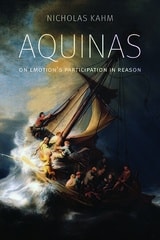
Aquinas on Emotion's Participation in Reason
Nicholas Kahm
Catholic University of America Press, 2019
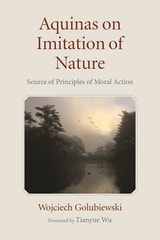
Aquinas on Imitation of Nature
Source of Principles of Moral ActionWojciech Golubiewski
Catholic University of America Press, 2022
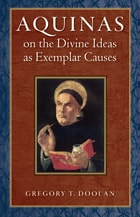
Aquinas on the Divine Ideas as Exemplar Causes
Gregory T. Doolan
Catholic University of America Press, 2008

Aquinas, Wittgenstein, and the Riddle of Spiritual Pedagogy
Matthew Dunch
Catholic University of America Press, 2027
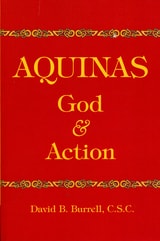
Aquinas
God and ActionDavid B. Burrell C.S.C.
University of Scranton Press, 2008
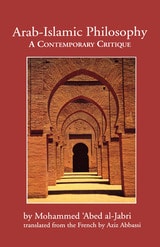
Arab-Islamic Philosophy
A Contemporary CritiqueBy Mohammed al-Jabri
University of Texas Press, 1999
The distinguished Moroccan philosopher Mohammed Abed al-Jabri, in this summary of his own work, examines the status of Arab thought in the late twentieth century. Al-Jabri rejects what he calls the current polarization of Arab thought between an imported modernism that disregards Arab tradition and a fundamentalism that would reconstruct the present in the image of an idealized past.
Both past and present intellectual currents are examined. Al-Jabri first questions the current philosophical positions of the liberals, the Marxists, and the fundamentalists. Then he turns to history, exploring Arab philosophy in the tenth and twelfth centuries, a time of political and ideological struggle. In the writings of Ibn Hazm and Averroës, he identifies the beginnings of Arab rationalism, a rationalism he traces through the innovative fourteenth–century work of Ibn Khaldun.
Al-Jabri offers both Western readers and his own compatriots a radical new approach to Arab thought, one that finds in the past the roots of an open, critical rationalism which he sees as emerging in the Arab world today.
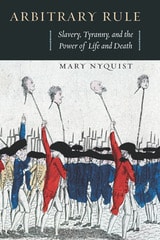
Arbitrary Rule
Slavery, Tyranny, and the Power of Life and DeathMary Nyquist
University of Chicago Press, 2013
Throughout, Nyquist demonstrates how principles relating to political slavery and tyranny are bound up with a Roman jurisprudential doctrine that sanctions the power of life and death held by the slaveholder over slaves and, by extension, the state, its representatives, or its laws over its citizenry.
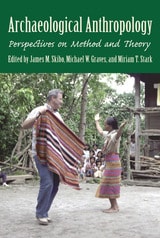
Archaeological Anthropology
Perspectives on Method and TheoryEdited by James M. Skibo, Michael W. Graves, and Miriam T. Stark
University of Arizona Press, 2014
In this collection of twelve new chapters, four generations of Longacre protégés show how they are building upon and developing but also modifying the theoretical paradigm that remains at the core of Americanist archaeology. The contributions focus on six themes prominent in Longacre’s career: the intellectual history of the field in the late twentieth century, archaeological methodology, analogical inference, ethnoarchaeology, cultural evolution, and reconstructing ancient society.
More than a comprehensive overview of the ideas developed by one of the most influential scholars in the field, however, Archaeological Anthropology makes stimulating contributions to contemporary research. The contributors do not unequivocally endorse Longacre’s ideas; they challenge them and expand beyond them, making this volume a fitting tribute to a man whose robust research and teaching career continues to resonate.
Archaeological Concepts for the Study of the Cultural Past
Alan P Sullivan III
University of Utah Press, 2008
By using the theoretical tension that has arisen between archaeology and cultural anthropology, the contributors illustrate the effectiveness of concepts and methods that have little, if any, overlap with those of the mother discipline.
Archaeological Concepts for the Study of the Cultural Past examines the degree to which the historically close relationship between archaeology and cultural anthropology may actually have inhibited archaeological investigations—particularly of those aspects of the cultural past that may be ethnographically undocumented or incompletely described.
Archaeological Structuration
A Critical Engagement for the Twenty-First CenturyMichael T. Searcy
University of Arizona Press, 2025
To illustrate the usefulness of structuration theory, archaeologist Michael T. Searcy deploys it to uncover new understandings of ancient societies, particularly focusing on the Casas Grandes civilization in precolonial northern Mexico. Spanning more than seven hundred years, this society exemplifies the rise of social complexity in the Western Hemisphere. Searcy reexamines previous hypotheses about major structural shifts during the twelfth and thirteenth centuries CE, providing fresh insights and updated perspectives.
This book not only revisits the foundational influence of structuration theory but also introduces new methodologies to study the longue durée, the long-term historical trajectories of ancient societies. Searcy deftly bridges the gap between theoretical frameworks and practical archaeological applications, providing a thorough analysis of how structuration can address real-world problems through the lens of ancient societal transformations.
Archaeologies of Vision
Foucault and Nietzsche on Seeing and SayingGary Shapiro
University of Chicago Press, 2003
Shapiro explores the whole range of Foucault's writings on visual art, including the theory of visual resistance, the concept of the phantasm or simulacrum, and his interrogation of the relation of painting, language, and power in artists from Bosch to Warhol. Shapiro also shows through an excavation of little-known writings that the visual is a major theme in Nietzsche's thought. In addition to explaining the significance of Nietzsche's analysis of Raphael, Dürer, and Claude Lorrain, he examines the philosopher's understanding of the visual dimension of Greek theater and Wagnerian opera and offers a powerful new reading of Thus Spoke Zarathustra.
Archaeologies of Vision will be a landmark work for all scholars of visual culture as well as for those engaged with continental philosophy.
Archaeologists as Activists
Can Archaeologists Change the World?Edited by M. Jay Stottman
University of Alabama Press, 2011
Could archaeologists benefit contemporary cultures and be a factor in solving world problems? Can archaeologists help individuals? Can archaeologists change the world? These questions form the root of “archaeology activism” or “activist archaeology”: using archaeology to advocate for and affect change in contemporary communities.
Archaeologists currently change the world through the products of their archaeological research that contribute to our collective historical and cultural knowledge. Their work helps to shape and reshape our perceptions of the past and our understanding of written history. Archaeologists affect contemporary communities through the consequences of their work as they become embroiled in controversies over negotiating the past and the present with native peoples. Beyond the obvious economic contributions to local communities caused by heritage tourism established on the research of archaeologists at cultural sites, archaeologists have begun to use the process of their work as a means to benefit the public and even advocate for communities.
In this volume, Stottman and his colleagues examine the various ways in which archaeologists can and do use their research to forge a partnership with the past and guide the ongoing dialogue between the archaeological record and the various contemporary stakeholders. They draw inspiration and guidance from applied anthropology, social history, public history, heritage studies, museum studies, historic preservation, philosophy, and education to develop an activist approach to archaeology—theoretically, methodologically, and ethically.
Archaeology of Algorithmic Artefacts
David Link
University of Minnesota Press, 2016
As historical processes increasingly become steeped in technology, it becomes more necessary for a discipline to emerge that is capable of comprehending these materialities to better understand the fields they inundate such as science, art, and warfare. This effort is further compromised by the inherent complexity and complete arbitrariness of technical languages—especially when they are algorithmic—along with the rapid pace in which they become obsolete, unintelligible, or simply forgotten. The Turing Machine plays a central role in the Archaeology of Algorithmic Artefacts, wherein the gradual developments of the individual components encompassed by this complex technology are placed within the context of engineering sciences and the history of inventions. This genealogy also traces the origin of the computer in mathematics, meta-mathematics, combinatorics, cryptology, philosophy, and physics. The investigations reveal that the history of apparatuses that process signs is in no way limited to the second half of the twentieth century; rather, it is possible they existed at all times and in all cultures.
Archaism and Actuality
Japan and the Global Fascist ImaginaryHarry Harootunian
Duke University Press, 2023
Architectural Body
Madeline Gins and Shusaku Arakawa
University of Alabama Press, 2002
This revolutionary work by artist-architects Arakawa and Madeline Gins demonstrates the inter-connectedness of innovative architectural design, the poetic process, and philosophical inquiry. Together, they have created an experimental and widely admired body of work--museum installations, landscape and park commissions, home and office designs, avant-garde films, poetry collections--that challenges traditional notions about the built environment. This book promotes a deliberate use of architecture and design in dealing with the blight of the human condition; it recommends that people seek architectural and aesthetic solutions to the dilemma of mortality.
In 1997 the Guggenheim Museum presented an Arakawa/Gins retrospective and published a comprehensive volume of their work titled Reversible Destiny: We Have Decided Not to Die. Architectural Body continues the philosophical definition of that project and demands a fundamental rethinking of the terms “human” and “being.” When organisms assume full responsibility for inventing themselves, where they live and how they live will merge. The artists believe that a thorough re-visioning of architecture will redefine life and its limitations and render death passe. The authors explain that “Another way to read reversible destiny . . . Is as an open challenge to our species to reinvent itself and to desist from foreclosing on any possibility.”
Audacious and liberating, this volume will be of interest to students and scholars of 20th-century poetry, postmodern critical theory, conceptual art and architecture, contemporary avant-garde poetics, and to serious readers interested in architecture's influence on imaginative expression.
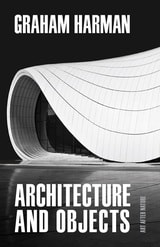
Architecture and Objects
Graham Harman
University of Minnesota Press, 2022
Thinking through object-oriented ontology—and the work of architects such as Rem Koolhaas and Zaha Hadid—to explore new concepts of the relationship between form and function
Object-oriented ontology has become increasingly popular among architectural theorists and practitioners in recent years. Architecture and Objects, the first book on architecture by the founder of object-oriented ontology (OOO), deepens the exchange between architecture and philosophy, providing a new roadmap to OOO’s influence on the language and practice of contemporary architecture and offering new conceptions of the relationship between form and function.
Graham Harman opens with a critique of Heidegger, Derrida, and Deleuze, the three philosophers whose ideas have left the deepest imprint on the field, highlighting the limits of their thinking for architecture. Instead, Harman contends, architecture can employ OOO to reconsider traditional notions of form and function that emphasize their relational characteristics—form with a building’s visual style, function with its stated purpose—and constrain architecture’s possibilities through literalism. Harman challenges these understandings by proposing de-relationalized versions of both (zero-form and zero-function) that together provide a convincing rejoinder to Immanuel Kant’s dismissal of architecture as “impure.”
Through critical engagement with the writings of Peter Eisenman and fresh assessments of buildings by Rem Koolhaas, Frank Gehry, and Zaha Hadid, Architecture and Objects forwards a bold vision of architecture. Overcoming the difficult task of “zeroing” function, Harman concludes, would place architecture at the forefront of a necessary revitalization of exhausted aesthetic paradigms.
Architecture, Means and Ends
Vittorio Gregotti
University of Chicago Press, 2010
Vittorio Gregotti—the architect of Barcelona’s Olympic Stadium, Milan’s Arcimboldi Opera Theater, and Lisbon’s Centro Cultural de Belém, among many other noted constructions—is not only a designer of international repute but an acclaimed theorist and critic. Architecture, Means and Ends is his practical and imaginative reflection on the role of the technical aspects of architectural design, both as part of the larger process of innovation and in relation to the mythic opposition between vision and construction.
Interweaving the seemingly irreconcilable concerns of aesthetics, meaning, and construction, Architecture, Means and Ends reflects Gregotti’s overarching claim that buildings always have a symbolic, cultural content. In this book, he argues that by making symbolic expression a primary objective in the design of a project, the designer will produce a practical aesthetic as well as an ethical solution. Architecture, Means and Ends embraces that philosophy and will appeal to those, like Gregotti, working at the intersections of the history of design, art criticism, and architectural theory.
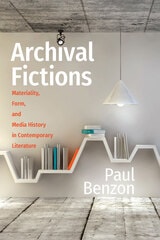
Archival Fictions
Materiality, Form, and Media History in Contemporary LiteraturePaul Benzon
University of Massachusetts Press, 2021
Taking up works from Andy Warhol, Kevin Young, Don DeLillo, and Hari Kunzru, Archival Fictions considers how these writers have constructed a speculative history of media technology through formal experimentation. Although media technologies have determined the extent of what can be written, recorded, and remembered in the immediate aftermath of print's hegemony, Paul Benzon argues that literary form provides a vital means for critical engagement with the larger contours of media history. Drawing on approaches from media poetics, film studies, and the digital humanities, this interdisciplinary study demonstrates how authors who engage technology through form continue to imagine new roles for print literature across the late twentieth and early twenty-first centuries.

Archive Fever
A Freudian ImpressionJacques Derrida
University of Chicago Press, 1996
"Judaic mythos, Freudian psychoanalysis, and e-mail all get fused into another staggeringly dense, brilliant slab of scholarship and suggestion."—The Guardian
"[Derrida] convincingly argues that, although the archive is a public entity, it nevertheless is the repository of the private and personal, including even intimate details."—Choice
"Beautifully written and clear."—Jeremy Barris, Philosophy in Review
"Translator Prenowitz has managed valiantly to bring into English a difficult but inspiring text that relies on Greek, German, and their translations into French."—Library Journal

Archive Fever
A Freudian ImpressionJacques Derrida
University of Chicago Press, 1996
"Judaic mythos, Freudian psychoanalysis, and e-mail all get fused into another staggeringly dense, brilliant slab of scholarship and suggestion."—The Guardian
"[Derrida] convincingly argues that, although the archive is a public entity, it nevertheless is the repository of the private and personal, including even intimate details."—Choice
"Beautifully written and clear."—Jeremy Barris, Philosophy in Review
"Translator Prenowitz has managed valiantly to bring into English a difficult but inspiring text that relies on Greek, German, and their translations into French."—Library Journal
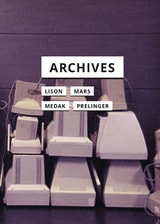
Archives
Andrew Lison
University of Minnesota Press, 2019
How digital networks and services bring the issues of archives out of the realm of institutions and into the lives of everyday users
Archives have become a nexus in the wake of the digital turn. Electronic files, search engines, video sites, and media player libraries make the concepts of “archival” and “retrieval” practically synonymous with the experience of interconnected computing. Archives today are the center of much attention but few agendas. Can archives inform the redistribution of power and resources when the concept of the public library as an institution makes knowledge and culture accessible to all members of society regardless of social or economic status? This book sets out to show that archives need our active support and continuing engagement.
This volume offers three distinct perspectives on the present status of archives that are at once in disagreement and solidarity with each other, from contributors whose backgrounds cut across the theory–practice divide. Is the increasing digital storage of knowledge pushing us toward a turning point in its democratization? Can archives fulfill their paradoxical potential as utopian sites in which the analog and the digital, the past and future, and remembrance and forgetting commingle? Is there a downside to the present-day impulse toward total preservation?
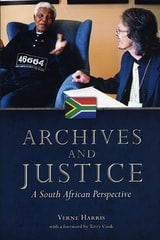
Archives and Justice
Verne Harris
Society of American Archivists, 2007
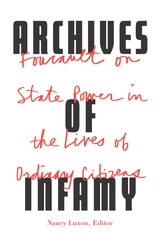
Archives of Infamy
Foucault on State Power in the Lives of Ordinary CitizensNancy Luxon
University of Minnesota Press, 2019
Expanding the insights of Arlette Farge and Michel Foucault’s Disorderly Families into policing, public order, (in)justice, and daily life
What might it mean for ordinary people to intervene in the circulation of power between police and the streets, sovereigns and their subjects? How did the police come to understand themselves as responsible for the circulation of people as much as things—and to separate law and justice from the maintenance of a newly emergent civil order? These are among the many questions addressed in the interpretive essays in Archives of Infamy.
Crisscrossing the Atlantic to bring together unpublished radio broadcasts, book reviews, and essays by historians, geographers, and political theorists, Archives of Infamy provides historical and archival contexts to the recent translation of Disorderly Families by Arlette Farge and Michel Foucault. This volume includes new translations of key texts, including a radio address Foucault gave in 1983 that explains the writing process for Disorderly Families; two essays by Foucault not readily available in English; and a previously untranslated essay by Farge that describes how historians have appropriated Foucault.
Archives of Infamy pushes past old debates between philosophers and historians to offer a new perspective on the crystallization of ideas—of the family, gender relations, and political power—into social relationships and the regimes of power they engender.
Contributors: Roger Chartier, Collège de France; Stuart Elden, U of Warwick; Arlette Farge, Centre national de recherche scientifique; Michel Foucault (1926–1984); Jean-Philippe Guinle, Catholic Institute of Paris; Michel Heurteaux; Pierre Nora, École des Hautes Études en Sciences Sociales; Michael Rey (1953–1993); Thomas Scott-Railton; Elizabeth Wingrove, U of Michigan.
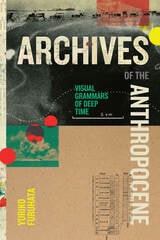
Archives of the Anthropocene
Visual Grammars of Deep TimeYuriko Furuhata
Duke University Press, 2026
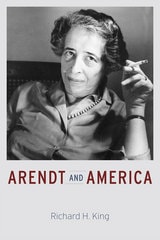
Arendt and America
Richard H. King
University of Chicago Press, 2015
Situating Arendt within the context of U.S. intellectual, political, and social history, King reveals how Arendt developed a fascination with the political thought of the Founding Fathers. King also re-creates her intellectual exchanges with American friends and colleagues, such as Dwight Macdonald and Mary McCarthy, and shows how her lively correspondence with sociologist David Riesman helped her understand modern American culture and society. In the last section of Arendt and America, King sets out the context in which the Eichmann controversy took place and follows the debate about “the banality of evil” that has continued ever since. As King shows, Arendt’s work, regardless of focus, was shaped by postwar American thought, culture, and politics, including the Civil Rights Movement and the Cold War.
For Arendt, the United States was much more than a refuge from Nazi Germany; it was a stimulus to rethink the political, ethical, and historical traditions of human culture. This authoritative combination of intellectual history and biography offers a unique approach for thinking about the influence of America on Arendt’s ideas and also the effect of her ideas on American thought.
Arendt, Kant, and the Enigma of Judgment
Martin Blumenthal-Barby
Northwestern University Press, 2023
A nuanced extrapolation of Hannah Arendt’s theory of judgment through her highly provocative reading of Immanuel Kant
More than a half century after it was first published, Hannah Arendt’s Origins of Totalitarianism rose to the top of best-seller lists as readers grappled with the triumph of Trumpism. Arendt, Kant, and the Enigma of Judgment directs our attention to her later thought, the posthumously published and highly provocative Lectures on Kant’s Political Philosophy. Martin Blumenthal-Barby puts this work in dialogue with Arendt’s other writings, including her notes on Kant’s Critique of Judgment, to outline her own theory of judgment for the twentieth century. In an era of post-truths and artificial intelligence, the idea that authentic judgment—for example, the ability to distinguish right from wrong—is incommensurable with abstract, automated processes lies at the center of Arendt’s late work and at the fore of our collective reckoning.
Rather than presenting us with a fixed account, Blumenthal-Barby suggests, Arendt’s drawing and redrawing of conceptual distinctions is itself an enactment of judgment, a process that challenges and complicates what she says at every turn. In so doing, Arendt, in thoroughly Kantian fashion, establishes judgment as a performative category that can never be taught but only demonstrated. As sharp as it is timely, this incisive book reminds us why a shared reality matters in a time of intense political polarization and why the democratic project, vulnerable as it may appear today, crucially depends on it.
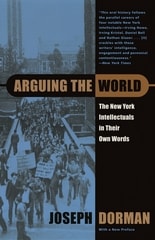
Arguing the World
The New York Intellectuals in their Own WordsJoseph Dorman
University of Chicago Press, 2001
Joseph Dorman's acclaimed documentary, Arguing the World, included stunning interviews with Irving Howe, Daniel Bell, Irving Kristol, and Nathan Glazer. Now with a new preface, Dorman converted the film into this book that includes an overview of the New York Intellectuals and a chapter on the future of the public intellectual. Expertly spliced together from the film and new material, this book gives the sense that these men are still engaged in their fiery debates that targeted everything from the Depression to McCarthyism to the rise of the New Left through the Age of Reagan.
Argumentation and the Social Grounds of Knowledge
Charles Arthur Willard
University of Alabama Press, 2009
Aristotle On Poetics
Seth Benardete
St. Augustine's Press, 2002
Aristotle’s much-translated On Poetics is the earliest and arguably the best treatment that we possess of tragedy as a literary form. The late Seth Benardete and Michael Davis have translated it anew with a view to rendering Aristotle’s text into English as precisely as possible. A literal translation has long been needed, for in order to excavate the argument of On Poetics one has to attend not simply to what is said on the surface but also to the various puzzles, questions, and peculiarities that emerge only on the level of how Aristotle says what he says and thereby leads one to revise and deepen one’s initial understanding of the intent of the argument. As On Poetics is about how tragedy ought to be composed, it should not be surprising that it turns out to be a rather artful piece of literature in its own right.
Benardete and Davis supplement their edition of On Poetics with extensive notes and appendices. They explain nuances of the original that elude translation, and they provide translations of passages found elsewhere in Aristotle’s works as well as in those of other ancient authors that prove useful in thinking through the argument of On Poetics both in terms of its treatment of tragedy and in terms of its broader concerns. By following the connections Aristotle plots between On Poetics and his other works, readers will be in a position to appreciate the centrality of this little book for his thought on the whole.
In an introduction that sketches the overall interpretation of On Poetics, Davis argues that, while On Poetics is certainly about tragedy, it has a further concern extending beyond poetry to the very structure of the human soul in its relation to what is, and that Aristotle reveals in the form of his argument the true character of human action.
Aristotle and Hamilton on Commerce and Statesmanship
Michael D. Chan
University of Missouri Press, 2006
Although America’s founders may have been inspired by the political thought of ancient Greece and Rome, the United States is more often characterized by its devotion to the pursuit of commerce. Some have even said that a modern commercial republic such as the United States unavoidably lowers its moral horizon to little more than a concern with securing peace and prosperity so that commerce can flourish.
Aristotle in Late Antiquity
Lawrence P. Schrenk
Catholic University of America Press, 2018
Aristotle on Memory
Second EditionRichard Sorabji
University of Chicago Press, 2006
“Sorabji has produced a first-class book on an important topic. All Aristotelians, and anyone with an interest in any aspect of memory, will be in his debt.”—Jonathan Barnes, Isis
“Anyone concerned with Aristotle’s psychology, theory of mind, or rhetoric, anyone interested in mnemonic systems, and anyone trying to work out for himself a theory of memory, should read Aristotle’s treatise On Memory, with the comments by Richard Sorabji.”—International Studies in Philosophy
“Sorabji’s book is a sample of care, intelligence, and subtlety that the Anglo-Saxon philosophers do not hesitate to invest in such enterprises. . . . The notes seem to leave no detail, no textual difficulty unilluminated.”—Revue de Métaphysique et de Morale
Aristotle's "Art of Rhetoric"
Aristotle
University of Chicago Press, 2019
Here Robert C. Bartlett offers a literal, yet easily readable, new translation of Aristotle’s “Art of Rhetoric,” one that takes into account important alternatives in the manuscript and is fully annotated to explain historical, literary, and other allusions. Bartlett’s translation is also accompanied by an outline of the argument of each book; copious indexes, including subjects, proper names, and literary citations; a glossary of key terms; and a substantial interpretive essay.
Aristotle's "Politics"
Second EditionAristotle
University of Chicago Press, 2013
Aristotle's Dialogue with Socrates
On the "Nicomachean Ethics"Ronna Burger
University of Chicago Press, 2008
What is the good life for a human being? Aristotle’s exploration of this question in the Nicomachean Ethics has established it as a founding work of Western philosophy, though its teachings have long puzzled readers and provoked spirited discussion. Adopting a radically new point of view, Ronna Burger deciphers some of the most perplexing conundrums of this influential treatise by approaching it as Aristotle’s dialogue with the Platonic Socrates.
Tracing the argument of the Ethics as it emerges through that approach, Burger’s careful reading shows how Aristotle represents ethical virtue from the perspective of those devoted to it while standing back to examine its assumptions and implications.
“This is the best book I have read on Aristotle’s Nicomachean Ethics. It is so well crafted that reading it is like reading the Ethics itself, in that it provides an education in ethical matters that does justice to all sides of the issues.”—Mary P. Nichols, Baylor University
Aristotle's Nicomachean Ethics
Aristotle
University of Chicago Press, 2011
The most precise and authoritative translation of one of the founding works of Western culture, in an edition supported by helpful, effective notes
The Nicomachean Ethics is one of Aristotle’s most widely read and influential works. Ideas central to ethics—that happiness is the end of human endeavor, that moral virtue is formed through action and habituation, and that good action requires prudence—found their most powerful proponent in the person medieval scholars simply called “the Philosopher.” Drawing on their intimate knowledge of Aristotle’s thought, Robert C. Bartlett and Susan D. Collins have produced here an English-language translation of the Ethics that is as remarkably faithful to the original as it is graceful in its rendering.
Aristotle is well known for the precision with which he chooses his words, and in this elegant translation his work has found its ideal match. Bartlett and Collins provide copious notes and a glossary providing context and further explanation for students, as well as an introduction and a substantial interpretive essay that sketch central arguments of the work and the seminal place of Aristotle’s Ethics in his political philosophy as a whole.
The Nicomachean Ethics has engaged the serious interest of readers across centuries and civilizations—of peoples ancient, medieval, and modern; pagan, Christian, Muslim, and Jewish—and this new edition will take its place as the standard English-language translation.
Aristotle's Ontology of Change
Mark Sentesy
Northwestern University Press, 2020
Aristotle may be the only thinker to propose a noncircular definition of change. With his landmark argument that change did, in fact, exist, Aristotle challenged established assumptions about what it is and developed a set of conceptual frameworks that continue to provide insight into the nature of reality. This groundbreaking work on change, however, has long been interpreted through a Platonist view of change as unreal. By offering a comprehensive reexamination of Aristotle’s pivotal arguments, and establishing his positive ontological conception of change, Sentesy makes a significant contribution to scholarship on Aristotle, ancient philosophy, the history and philosophy of science, and metaphysics.
Aristotle's Physics
A Guided StudyAritotle
Rutgers University Press, 1995
This is a new translation, with introduction, commentary, and an explanatory glossary.
"Sachs's translation and commentary rescue Aristotle's text from the rigid, pedantic, and misleading versions that have until now obscured his thought. Thanks to Sachs's superb guidance, the Physics comes alive as a profound dialectical inquiry whose insights into the enduring questions about nature, cause, change, time, and the 'infinite' are still pertinent today. Using such guided studies in class has been exhilarating both for myself and my students." ––Leon R. Kass, The Committee on Social Thought, University of Chicago
Aristotle’s Physics is the only complete and coherent book we have from the ancient world in which a thinker of the first rank seeks to say something about nature as a whole. For centuries, Aristotle’s inquiry into the causes and conditions of motion and rest dominated science and philosophy. To understand the intellectual assumptions of a powerful world view—and the roots of the Scientific Revolution—reading Aristotle is critical. Yet existing translations of Aristotle’s Physics have made it difficult to understand either Aristotle’s originality or the lasting value of his work.
In this volume in the Masterworks of Discovery series, Joe Sachs provides a new plain-spoken English translation of all of Aristotle’s classic treatise and accompanies it with a long interpretive introduction, a running explication of the text, and a helpful glossary. He succeeds brilliantly in fulfilling the aim of this innovative series: to give the general reader the tools to read and understand a masterwork of scientific discovery.
Aristotle's Poetics
Stephen Halliwell
University of Chicago Press, 1998
The core of the book is a fresh appraisal of Aristotle's view of tragic drama, in which Halliwell contends that at the heart of the Poetics lies a philosophical urge to instill a secularized understanding of Greek tragedy.
"Essential reading not only for all serious students of the Poetics . . . but also for those—the great majority—who have prudently fought shy of it altogether."—B. R. Rees, Classical Review
"A splendid work of scholarship and analysis . . . a brilliant interpretation."—Alexander Nehamas, Times Literary Supplement
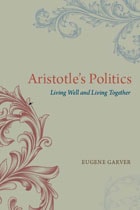
Aristotle's Politics
Living Well and Living TogetherEugene Garver
University of Chicago Press, 2011
Close examination of Aristotle’s treatise, Garver finds, reveals a significant, practical role for philosophy to play in politics. Philosophers present arguments about issues—such as the right and the good, justice and modes of governance, the relation between the good person and the good citizen, and the character of a good life—that politicians must then make appealing to their fellow citizens. Completing Garver’s trilogy on Aristotle’s unique vision, Aristotle’s Politics yields new ways of thinking about ethics and politics, ancient and modern.
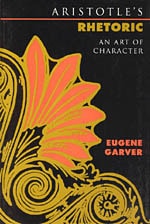
Aristotle's Rhetoric
An Art of CharacterEugene Garver
University of Chicago Press, 1995
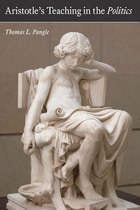
Aristotle's Teaching in the "Politics"
Thomas L. Pangle
University of Chicago Press, 2013