Results by title
4413 books match the query 'Anthropology' and 363 start with a
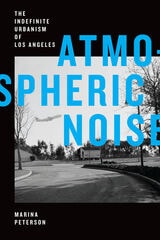
Atmospheric Noise
The Indefinite Urbanism of Los AngelesMarina Peterson
Duke University Press, 2021
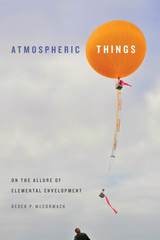
Atmospheric Things
On the Allure of Elemental EnvelopmentDerek P. McCormack
Duke University Press, 2018
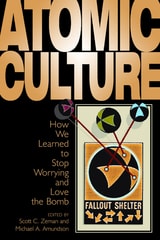
Atomic Culture
How We Learned to Stop Worrying and Love the BombMichael A. Amundson
University Press of Colorado, 2004
Despite the growing interest in atomic culture and history, the body of relevant scholarship is relatively sparse. Atomic Culture opens new doors into the field by providing a substantive, engaging, and historically based consideration of the topic that will appeal to students and scholars of the Atomic Age as well as general readers.
Contributors include Michael A. Amundson, Mick Broderick, Peter Goin, John Hunner, Ferenc M. Szasz, A. Costandina Titus, Peter C. van Wyck, and Scott C. Zeman.
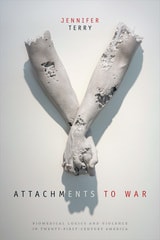
Attachments to War
Biomedical Logics and Violence in Twenty-First-Century AmericaJennifer Terry
Duke University Press, 2017
Attraction of Opposites
Thought and Society in the Dualistic ModeDavid Maybury-Lewis and Uri Almagor, Editors
University of Michigan Press, 1989
Au Te Waate / We Remember It
Hiaki Survival Through a Bitter WarMaria Fernanda Leyva; Edited by Heidi Harley
University of Arizona Press, 2025
This compelling work delves into the personal narratives of Hiaki (Yaqui) individuals who endured the tumultuous period from 1900 to 1930, when they faced systematic attacks, conscription, deportation, and enslavement under Mexican government policies. Presented in both the original Hiaki language and English translation, these accounts offer an unparalleled glimpse into the lives of those who resisted and survived the era’s harsh realities. The narratives describe military engagements, the struggles of refugee life, forced labor, and the resilience of families under extreme duress. This work provides a unique and unvarnished account of the impacts of Mexican colonialism and aggression on individuals and families, completely from the Hiaki perspective.
Au Te Waate / We Remember It is not just a historical account but a linguistic treasure, preserving the naturally produced speech of five Hiaki speakers from a previous era. Transcriptions of interviews recorded by author Maria Fernanda Leyva with family members and friends provide invaluable insights into the Hiaki language. The interviews document and preserve the narrative styles, vocabulary, and grammatical constructions of the time.
This work also serves as a crucial resource for scholars of linguistics and history alike, capturing dialect variation and illustrating the linguistic evolution of the Hiaki community. Additionally, for Hiaki people studying their own language, this book stands as a rich repository of cultural and linguistic heritage, meticulously maintained through side-by-side translations and contextual historical introductions.
The narratives in this book are anchored by the experiences of five Hiaki speakers, whose stories of displacement, survival, and resistance provide a deeply personal perspective on the broader historical events of the Porfirio Díaz dictatorship and the early years of the Mexican Revolution. Au Te Waate / We Remember It stands as an important record, preserving these critical voices for future generations and offering profound insights into the resilience of the Hiaki people.
Automatic Religion
Nearhuman Agents of Brazil and FrancePaul Christopher Johnson
University of Chicago Press, 2021
Automatic Religion explores an unlikely series of episodes from the end of the nineteenth century, when crucial ideas related to automatism and, in a different realm, the study of religion were both being born. Paul Christopher Johnson draws on years of archival and ethnographic research in Brazil and France to explore the crucial boundaries being drawn at the time between humans, “nearhumans,” and automata. As agency came to take on a more central place in the philosophical, moral, and legal traditions of the West, certain classes of people were excluded as less-than-human. Tracking the circulation of ideas across the Atlantic, Johnson tests those boundaries, revealing how they were constructed on largely gendered and racial foundations. In the process, he reanimates one of the most mysterious and yet foundational questions in trans-Atlantic thought: what is agency?
Avian Reservoirs
Virus Hunters and Birdwatchers in Chinese Sentinel PostsFrédéric Keck
Duke University Press, 2020
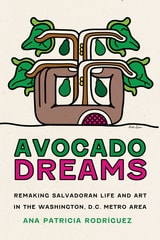
Avocado Dreams
Remaking Salvadoran Life and Art in the Washington, D.C. Metro AreaAna Patricia Rodríguez
University of Arizona Press, 2025
In Avocado Dreams, Ana Patricia Rodríguez draws from her own positionality as a Salvadoran transplant to examine the construction of the unique Salvadoran cultural imaginary made in the greater D.C. area. Through a careful reading of the creative works of local writers, performers, artists, and artivists, Rodríguez demonstrates how the people have remade themselves in relation to the cultural, ethnoracial, and sociolinguistic diversity of the area. She discusses how Salvadoran people have developed unique, intergenerational Salvadoreñidades, manifested in particular speech and symbolic acts, ethnoracial embodiments, and local identity formations in relation to the diverse communities, most notably Black Washingtonians, who co-inhabit the region.
This timely and relevant work not only enriches our understanding of Salvadoran diasporic experiences but also contributes significantly to broader discussions on migration, identity, and cultural production in the United States.
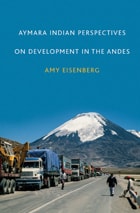
Aymara Indian Perspectives on Development in the Andes
Amy Eisenberg
University of Alabama Press, 2013
Aymara Indians are a geographically isolated, indigenous people living in the Andes Mountains near Chile’s Atacama Desert, one of the most arid regions of the world. As rapid economic growth in the area has begun to divert scarce water to hydroelectric and agricultural projects, the Aymara struggle to maintain their sustainable and traditional systems of water use, agriculture, and pastoralism.
In Aymara Indian Perspectives on Development in the Andes, Amy Eisenberg provides a detailed exploration of the ethnoecological dimensions of the tension between the Aymara, whose economic, spiritual, and social life are inextricably tied to land and water, and three major challenges: the paving of Chile Highway 11, the diversion of the Altiplano waters of the Río Lauca for irrigation and power-generation, and Chilean national park policies regarding Aymara communities, their natural resources, and cultural properties within Parque Nacional Lauca, the International Biosphere Reserve.
Pursuing collaborative research, Eisenberg performed ethnographic interviews with Aymara people in more than sixteen Andean villages, some at altitudes of 4,600 meters. Drawing upon botany, agriculture, natural history, physical and cultural geography, history, archaeology, and social and environmental impact assessment, she presents deep, multifaceted insights from the Aymara’s point of view.
Illustrated with maps and dramatic photographs by John Amato, Aymara Indian Perspectives on Development in the Andes provides an account of indigenous perspectives and concerns related to economic development that will be invaluable to scholars and policy-makers in the fields of natural and cultural resource preservation in and beyond Chile.
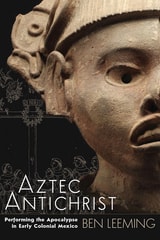
Aztec Antichrist
Performing the Apocalypse in Early Colonial MexicoBen Leeming
University Press of Colorado, 2022
Discovered in the archives of the Hispanic Society of America in New York inside a notebook of miscellaneous Nahuatl-Christian texts written almost entirely by an Indigenous writer named Fabían de Aquino, the plays are filled with references to human sacrifice, bloodletting, ritual divination, and other religious practices declared “idolatrous” at a time when ecclesiastical authorities actively sought to suppress writing about Indigenous religion. These are Indigenous plays for an Indigenous audience that reveal how Nahuas made sense of Christianity and helped form its colonial image—the title figure is a powerful Indigenous being, an “Aztec Antichrist,” who violently opposes the evangelizing efforts of the church and seeks to draw converted Nahuas back to the religious practices of their ancestors. These practices include devotion to Nahua deities such as Tlaloc, Quetzalcoatl, and Tezcatlipoca who, in one of the most striking moves made by Aquino, are cast as characters in the plays.
Along with the translations, Leeming provides context and analysis highlighting these rare and fascinating examples of early Indigenous American literature that offer a window into the complexity of Nahua interactions with Christianity in the early colonial period. The work is extremely valuable to all students and scholars of Latin American religion, colonialism, Indigenous history, and early modern history and theater.
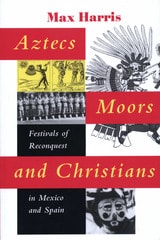
Aztecs, Moors, and Christians
Festivals of Reconquest in Mexico and SpainBy Max Harris
University of Texas Press, 2000
In villages and towns across Spain and its former New World colonies, local performers stage mock battles between Spanish Christians and Moors or Aztecs that range from brief sword dances to massive street theatre lasting several days. The festival tradition officially celebrates the triumph of Spanish Catholicism over its enemies, yet this does not explain its persistence for more than five hundred years nor its widespread diffusion.
In this insightful book, Max Harris seeks to understand Mexicans' "puzzling and enduring passion" for festivals of moros y cristianos. He begins by tracing the performances' roots in medieval Spain and showing how they came to be superimposed on the mock battles that had been a part of pre-contact Aztec calendar rituals. Then using James Scott's distinction between "public" and "hidden transcripts," he reveals how, in the hands of folk and indigenous performers, these spectacles of conquest became prophecies of the eventual reconquest of Mexico by the defeated Aztec peoples. Even today, as lively descriptions of current festivals make plain, they remain a remarkably sophisticated vehicle for the communal expression of dissent.
addicted.pregnant.poor
Kelly Ray Knight
Duke University Press, 2015