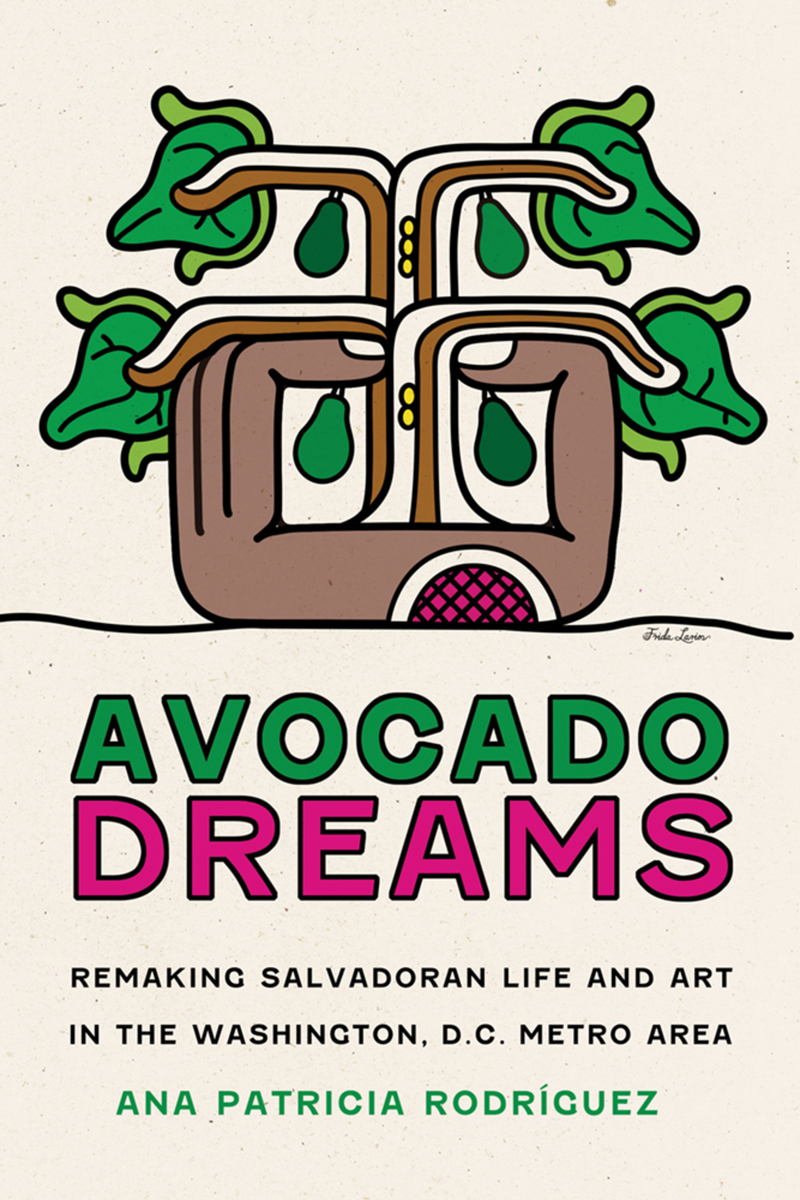
Avocado Dreams: Remaking Salvadoran Life and Art in the Washington, D.C. Metro Area
University of Arizona Press, 2025
Cloth: 978-0-8165-4643-5 | Paper: 978-0-8165-4642-8 | eISBN: 978-0-8165-4644-2 (standard)
Library of Congress Classification F205.S26.R64 2025
Dewey Decimal Classification 975.30049687284
Cloth: 978-0-8165-4643-5 | Paper: 978-0-8165-4642-8 | eISBN: 978-0-8165-4644-2 (standard)
Library of Congress Classification F205.S26.R64 2025
Dewey Decimal Classification 975.30049687284
ABOUT THIS BOOK | AUTHOR BIOGRAPHY | REVIEWS | TOC
ABOUT THIS BOOK
For more than four generations, Salvadorans have made themselves at home in the greater Washington, D.C. metropolitan area and have transformed the region, contributing their labor, ingenuity, and culture to the making of a thriving but highly neglected and overlooked community.
In Avocado Dreams, Ana Patricia Rodríguez draws from her own positionality as a Salvadoran transplant to examine the construction of the unique Salvadoran cultural imaginary made in the greater D.C. area. Through a careful reading of the creative works of local writers, performers, artists, and artivists, Rodríguez demonstrates how the people have remade themselves in relation to the cultural, ethnoracial, and sociolinguistic diversity of the area. She discusses how Salvadoran people have developed unique, intergenerational Salvadoreñidades, manifested in particular speech and symbolic acts, ethnoracial embodiments, and local identity formations in relation to the diverse communities, most notably Black Washingtonians, who co-inhabit the region.
This timely and relevant work not only enriches our understanding of Salvadoran diasporic experiences but also contributes significantly to broader discussions on migration, identity, and cultural production in the United States.
See other books on: Ethnic identity | Rodríguez, Ana Patricia | Salvadorans | Washington | Washington (D.C.)
See other titles from University of Arizona Press